Problems
Filters
38 problems found
1996 Paper 1 Q10
A spaceship of mass \(M\) is at rest. It separates into two parts in an explosion in which the total kinetic energy released is \(E\). Immediately after the explosion the two parts have masses \(m_{1}\) and \(m_{2}\) and speeds \(v_{1}\) and \(v_{2}\) respectively. Show that the minimum possible relative speed \(v_{1}+v_{2}\) of the two parts of the spaceship after the explosion is \((8E/M)^{1/2}.\)
1995 Paper 2 Q10
Three small spheres of masses \(m_{1},m_{2}\) and \(m_{3},\) move in a straight line on a smooth horizontal table. (Their order on the straight line is the order given.) The coefficient of restitution between any two spheres is \(e\). The first moves with velocity \(u\) towards the second whilst the second and third are at rest. After the first collision the second sphere hits the third after which the velocity of the second sphere is \(u.\) Find \(m_{1}\) in terms of \(m_{2},m_{3}\) and \(e\). deduce that \[ m_{2}e>m_{3}(1+e+e^{2}). \] Suppose that the relation between \(m_{1},m_{2}\) and \(m_{3}\) is that in the formula you found above, but that now the first sphere initially moves with velocity \(u\) and the other two spheres with velocity \(v\), all in the same direction along the line. If \(u>v>0\) use the first part to find the velocity of the second sphere after two collisions have taken place. (You should not need to make any substantial computations but you should state your argument clearly.)
1992 Paper 2 Q13
Two particles \(P_{1}\) and \(P_{2}\), each of mass \(m\), are joined by a light smooth inextensible string of length \(\ell.\) \(P_{1}\) lies on a table top a distance \(d\) from the edge, and \(P_{2}\) hangs over the edge of the table and is suspended a distance \(b\) above the ground. The coefficient of friction between \(P_{1}\) and the table top is \(\mu,\) and \(\mu<1\). The system is released from rest. Show that \(P_{1}\) will fall off the edge of the table if and only if \[ \mu<\frac{b}{2d-b}. \] Suppose that \(\mu>b/(2d-b)\) , so that \(P_{1}\) comes to rest on the table, and that the coefficient of restitution between \(P_{2}\) and the floor is \(e\). Show that, if \(e>1/(2\mu),\) then \(P_{1}\) comes to rest before \(P_{2}\) bounces a second time.
1991 Paper 1 Q11
A piledriver consists of a weight of mass \(M\) connected to a lighter counterweight of mass \(m\) by a light inextensible string passing over a smooth light fixed pulley. By considerations of energy or otherwise, show that if the weights are released from rest, and move vertically, then as long as the string remains taut and no collisions occur, the weights experience a constant acceleration of magnitude \[ g\left(\frac{M-m}{M+m}\right). \] Initially the weight is held vertically above the pile, and is released from rest. During the subsequent motion both weights move vertically and the only collisions are between the weight and the pile. Treating the pile as fixed and the collisions as completely inelastic, show that, if just before a collision the counterweight is moving with speed \(v\), then just before the next collision it will be moving with speed \(mv/\left(M+m\right)\). {[}You may assume that when the string becomes taut, the momentum lost by one weight equals that gained by the other.{]} Further show that the times between successive collisions with the pile form a geometric progression. Show that the total time before the weight finally comes to rest is three times the time from the start to the first impact.
1990 Paper 2 Q14
The identical uniform smooth spherical marbles \(A_{1},A_{2},\ldots,A_{n},\) where \(n\geqslant3,\) each of mass \(m,\) lie in that order in a smooth straight trough, with each marble touching the next. The marble \(A_{n+1},\) which is similar to \(A_{n}\) but has mass \(\lambda m,\) is placed in the trough so that it touches \(A_{n}.\) Another marble \(A_{0},\) identical to \(A_{n},\) slides along the trough with speed \(u\) and hits \(A_{1}.\) It is given that kinetic energy is conserved throughout.
- Show that if \(\lambda<1,\) there is a possible subsequent motion in which only \(A_{n}\) and \(A_{n+1}\) move (and \(A_{0}\) is reduced to rest), but that if \(\lambda>1,\) such a motion is not possible.
- If \(\lambda>1,\) show that a subsequent motion in which only \(A_{n-1},A_{n}\) and \(A_{n+1}\) move is not possible.
- If \(\lambda>1,\) find a possible subsequent motion in which only two marbles move.
Solution: Without loss of generality, let \(m = u = 1\).
- \begin{align*} \text{COM}: && 1&= v_n + \lambda v_{n+1} \\ && &= v_n + \lambda v_{n+1}\\ \text{COE}: && \frac12 &= \frac12 v_n^2 + \frac12 \lambda v_{n+1}^2 \\ && 1 &= v_n^2 +\lambda v_{n+1}^2 \\ \\ \Rightarrow && v_n^2 + 2\lambda v_n v_{n+1} + \lambda^2 v_{n+1}^2 &= v_n^2 + \lambda v_{n+1}^2 \\ && \lambda v_{n+1}^2 &= v_{n+1}^2 - 2 v_n v_{n+1} \\ && \lambda v_{n+1} &= (v_{n+1} - 2v_n) \\ && (1-\lambda)v_{n+1} &= 2v_n \end{align*} Since \(v_{n+1} > v_n > 0\) this is only possible if \(\lambda < 1\)
- \begin{align*} \text{COM}: && 1&= v_{n-1}+v_n+\lambda v_{n+1} \\ && 1&= v_{n-1} + v_n + \lambda v_{n+1} \\ \text{COE}: && \frac12 &= \frac12 v_{n-1}^2+\frac12v_n^2+\frac12\lambda v_{n+1}^2 \\ && 1&= v_{n-1}^2 + v_n^2 + \lambda v_{n+1}^2 \\ \\ \Rightarrow && 1 &= v_{n-1}^2 + v_n^2 + \lambda \frac{(1-v_{n-1}-v_n)^2}{\lambda^2} \\ &&&= v_{n-1}^2 + v_n^2 + \frac{(1-v_{n-1}-v_n)^2}{\lambda} \\ \Rightarrow && 1 &< v_{n-1}^2 + v_n^2 + (1-v_{n-1}-v_n)^2 \\ &&&= 2v_{n-1}^2+2v_n^2 + 1-2v_{n-1}-2v_{n-2} +2v_{n-1}v_n\\ \Rightarrow && v_{n-1}+v_n & <(v_{n-1}+v_n)^2 - v_{n-1}v_n \end{align*} but this cannot be true since \(0 < v_{n-1}+v_n < 1\) and \(v_n v_{n-1} > 0\)
- The only way this is possible is if the first and last marble are moving. \begin{align*} \text{COM}: && 1 &= v_0 +\lambda v_{n+1} \\ \text{COE}: && \frac12 &= \frac12 v_0^2 + \frac12 \lambda^2 v_{n+1} \\ && 1 &= v_0^2 + \lambda v_{n+1}^2 \\ \Rightarrow && 2v_0 + \lambda v_{n+1} &= v_{n+1} \\ \Rightarrow && v_{n+1} &=\frac{2}{1-\lambda} v_0 \\ \Rightarrow && v_0 &= \frac{1-\lambda}{1+\lambda} \\ && v_{n+1} &= \frac{2}{1+\lambda} \end{align*} which will work since \(v_0\) can travel backwards.
1990 Paper 3 Q12
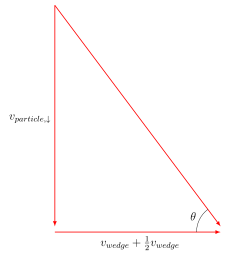
A uniform smooth wedge of mass \(m\) has congruent triangular end faces \(A_{1}B_{1}C_{1}\) and \(A_{2}B_{2}C_{2},\) and \(A_{1}A_{2},B_{1}B_{2}\) and \(C_{1}C_{2}\) are perpendicular to these faces. The points \(A,B\) and \(C\) are the midpoints of \(A_{1}A_{2},B_{1}B_{2}\) and \(C_{1}C_{2}\) respectively. The sides of the triangle \(ABC\) have lengths \(AB=AC=5a\) and \(BC=6a.\) The wedge is placed with \(BC\) on a smooth horizontal table, a particle of mass \(2m\) is placed at \(A\) on \(AC,\) and the system is released from rest. The particle slides down \(AC,\) strikes the table, bounces perfectly elastically and lands again on the table at \(D\). At this time the point \(C\) of the wedge has reached the point \(E\). Show that \(DE=\frac{192}{19}a.\)
Solution: Conservation of energy, tells us that \(2m \cdot g \cdot 4a = 8amg\) is equal to \(\frac12 m v_{wedge}^2 + \frac12(2m)v_{particle}^2\). Conservation of momentum (horizontally) tells us that \(m v_{wedge}+2mv_{particle, \rightarrow} = 0 \Rightarrow v_{particle, \rightarrow} = -\frac12 v_{wedge}\).
1988 Paper 3 Q12
A smooth billiard ball moving on a smooth horizontal table strikes another identical ball which is at rest. The coefficient of restitution between the balls is \(e(<1)\). Show that after the collision the angle between the velocities of the balls is less than \(\frac{1}{2}\pi.\) Show also that the maximum angle of deflection of the first ball is \[ \sin^{-1}\left(\frac{1+e}{3-e}\right). \]
Solution:

1987 Paper 1 Q11
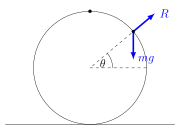
A smooth sphere of radius \(r\) stands fixed on a horizontal floor. A particle of mass \(m\) is displaced gently from equilibrium on top of the sphere. Find the angle its velocity makes with the horizontal when it loses contact with the sphere during the subsequent motion. By energy considerations, or otherwise, find the vertical component of the momentum of the particle as it strikes the floor.
Solution: