Problems
Filters
36 problems found
1990 Paper 3 Q9
The real variables \(\theta\) and \(u\) are related by the equation \(\tan\theta=\sinh u\) and \(0\leqslant\theta<\frac{1}{2}\pi.\) Let \(v=\mathrm{sech}u.\) Prove that
- \(v=\cos\theta;\)
- \(\dfrac{\mathrm{d}\theta}{\mathrm{d}u}=v;\)
- \(\sin2\theta=-2\dfrac{\mathrm{d}v}{\mathrm{d}u}\quad\) and \(\quad\cos2\theta=-\cosh u\dfrac{\mathrm{d}^{2}v}{\mathrm{d}u^{2}};\)
- \({\displaystyle \frac{\mathrm{d}u}{\mathrm{d}\theta}\frac{\mathrm{d}^{2}v}{\mathrm{d}\theta^{2}}+\frac{\mathrm{d}v}{\mathrm{d}\theta}\frac{\mathrm{d}^{2}u}{\mathrm{d}\theta^{2}}+\left(\frac{\mathrm{d}u}{\mathrm{d}\theta}\right)^{2}=0.}\)
Solution:
- \begin{align*} v &= \mathrm{sech} u \\ &= \frac{1}{\mathrm{cosh } u} \\ &= \frac{1}{\sqrt{1+\mathrm{sinh}^2 u}} \tag{\(u > 0\)} \\ &= \frac{1}{\sqrt{1+\tan^2 \theta}} \\ &= \frac{1}{\sqrt{\mathrm{sec}^2 \theta}} \\ &= \cos \theta \tag{\(0 < \theta < \tfrac{\pi}{2}\)} \end{align*}
- \begin{align*} && \tan \theta &= \textrm{sinh} u \\ \underbrace{\Rightarrow}_{\frac{\d}{\d u}} && \sec^2 \theta \cdot \frac{\d \theta}{\d u} &= \cosh u \\ \Rightarrow && \frac{\d \theta}{\d u} &=\cosh u \cdot \cos^2 \theta \\ &&&= \frac{1}{v} \cdot v^2 \\ &&&=v \end{align*}
- \begin{align*} \sin 2 \theta &= 2 \sin \theta \cos \theta \\ &= 2 \sin \theta \cdot \frac{\d \theta}{\d u} \\ &= -2 \frac{\d v}{\d \theta} \cdot \frac{\d \theta}{\d u} \tag{\(\cos \theta = v\)} \\ &= -2 \frac{\d v}{\d u} \end{align*} \begin{align*} && \sin 2 \theta &= -2 \frac{\d v}{\d u} \\ \underbrace{\Rightarrow}_{\frac{\d}{\d u}} && 2 \cos 2 \theta \cdot \frac{\d \theta}{\d u} &= -2 \frac{\d^2 v}{\d u^2} \\ \Rightarrow && \cos 2 \theta &= - \frac{\d^2 v}{\d u^2} \frac{1}{v} \\ &&&= -\frac{\d ^2v}{\d u^2} \cosh u \end{align*}
- \begin{align*} && \frac{\d u}{\d \theta} &= \frac{1}{v} \\ \Rightarrow && \frac{\d^2 u}{\d \theta^2} &= -\frac{1}{v^2} \frac{\d v}{\d \theta} \\ &&&= \frac{1}{v^2} \sin \theta \\ && \frac{\d v}{\d \theta} &= -\sin \theta \\ \Rightarrow && \frac{\d^2 v}{\d \theta^2} &= -\cos \theta \\ &&&= - v \\ \end{align*} Therefore \begin{align*} \frac{\mathrm{d}u}{\mathrm{d}\theta}\frac{\mathrm{d}^{2}v}{\mathrm{d}\theta^{2}}+\frac{\mathrm{d}v}{\mathrm{d}\theta}\frac{\mathrm{d}^{2}u}{\mathrm{d}\theta^{2}}+\left(\frac{\mathrm{d}u}{\mathrm{d}\theta}\right)^{2} &= \frac{1}{v} \cdot \left (-v\right) + \left ( - \sin \theta \right ) \cdot \left (\frac{1}{v^2} \sin \theta \right) + \frac{1}{v^2} \\ &= -1 + \frac{1-\sin^2 \theta}{v^2} \\ &= -1 + \frac{\cos^2 \theta}{v^2} \\ &= -1 + 1 \\ &= 0 \end{align*}
1989 Paper 2 Q3
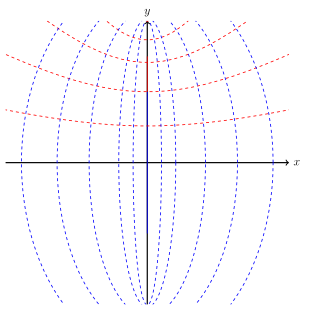
The real numbers \(x\) and \(y\) are related to the real numbers \(u\) and \(v\) by \[ 2(u+\mathrm{i}v)=\mathrm{e}^{x+\mathrm{i}y}-\mathrm{e}^{-x-\mathrm{i}y}. \] Show that the line in the \(x\)-\(y\) plane given by \(x=a\), where \(a\) is a positive constant, corresponds to the ellipse \[ \left(\frac{u}{\sinh a}\right)^{2}+\left(\frac{v}{\cosh a}\right)^{2}=1 \] in the \(u\)-\(v\) plane. Show also that the line given by \(y=b\), where \(b\) is a constant and \(0<\sin b<1,\) corresponds to one branch of a hyperbola in the \(u\)-\(v\) plane. Write down the \(u\) and \(v\) coordinates of one point of intersection of the ellipse and hyperbola branch, and show that the curves intersect at right-angles at this point. Make a sketch of the \(u\)-\(v\) plane showing the ellipse, the hyperbola branch and the line segments corresponding to:
- \(x=0\);
- \(y=\frac{1}{2}\pi,\) \(\quad 0\leqslant x\leqslant a.\)
Solution: \begin{align*} && 2(u+iv) &= e^{a+iy} - e^{-a-iy} \\ && &=(e^a \cos y - e^{-a} \cos y) + (e^a \sin y + e^{-a} \sin y)i \\ &&&= 2 \sinh a \cos y + 2\cosh a \sin y i\\ \Rightarrow && \frac{u}{\sinh a} &= \cos y \\ && \frac{v}{\cosh a} &= \sin y \\ \Rightarrow && 1 &= \left(\frac{u}{\sinh a}\right)^{2}+\left(\frac{v}{\cosh a}\right)^{2} \end{align*} \begin{align*} && 2(u+iv) &= e^{x+ib} - e^{-x-ib} \\ &&&= 2\sinh x \cos b + 2\cosh x \sin b i \\ \Rightarrow && \frac{u}{\cos b} &= \sinh x \\ && \frac{v}{\sin b} &= \cosh x \\ \Rightarrow && 1 &= \left (\frac{v}{\sin b} \right)^2 - \left (\frac{u}{\cos b} \right)^2 \end{align*} Therefore all the points lie of a hyperbola, and since \(\frac{v}{\sin b} > 0 \Rightarrow v > 0\) it's one branch of the hyperbola. (And all points on it are reachable as \(x\) varies from \(-\infty < x < \infty\). \begin{align*} 2(u+iv) &= e^{a+ib} - e^{-a-ib} \\ &= 2 \sinh a \cos b + 2 \cosh a \sin b i \end{align*} so we can take \(u = \sinh a \cos b, v = \cosh a \sin b\). \begin{align*} \frac{\d }{\d u} && 0 &= \frac{2 u}{\sinh^2 a} + \frac{2v}{\cosh^2 a} \frac{\d v}{\d u} \\ \Rightarrow && \frac{\d v}{\d u} &= -\frac{u}{v} \coth^2 a \\ \\ && \frac{\d v}{\d u} \rvert_{(u,v)} &= -\frac{\sinh a \cos b}{\cosh a \sin b} \coth^2 a \\ &&&= -\cot b \coth a \\ \frac{\d }{\d u} && 0 &= \frac{2 v}{\sin^2 b} \frac{\d v}{\d u} - \frac{2u}{\cos^2 b} \\ \Rightarrow && \frac{\d v}{\d u} &= \frac{u}{v} \tan^2 b \\ && \frac{\d v}{\d u} \rvert_{(u,v)} &= \frac{\sinh a \cos b}{\cosh a \sin b} \tan^2 b \\ &&&= \tanh a \tan b \end{align*} Therefore they are negative reciprocals and hence perpendicular.
1989 Paper 2 Q9
The matrix \(\mathbf{F}\) is defined by \[ \mathbf{F}=\mathbf{I}+\sum_{n=1}^{\infty}\frac{1}{n!}t^{n}\mathbf{A}^{n}, \] where $\mathbf{A}=\begin{pmatrix}-3 & -1\\ 8 & 3 \end{pmatrix} \( and \) t \( is a variable scalar. Evaluate \)\mathbf{A}^{2}$, and show that \[ \mathbf{F}=\mathbf{I}\cosh t+\mathbf{A}\sinh t. \] Show also that \(\mathbf{F}^{-1}=\mathbf{I}\cosh t-\mathbf{A}\sinh t\), and that \(\dfrac{\mathrm{d}\mathbf{F}}{\mathrm{d}t}=\mathbf{FA}\). The vector $\mathbf{r}=\begin{pmatrix}x(t)\\ y(t) \end{pmatrix}$ satisfies the differential equation \[ \frac{\mathrm{d}\mathbf{r}}{\mathrm{d}t}+\mathbf{A}\mathbf{r}=\mathbf{0}, \] with \(x=\alpha\) and \(y=\beta\) at \(t=0.\) Solve this equation by means of a suitable matrix integrating factor, and hence show that \begin{alignat*}{1} x(t) & =\alpha\cosh t+(3\alpha+\beta)\sinh t\\ y(t) & =\beta\cosh t-(8\alpha+3\beta)\sinh t. \end{alignat*}
Solution: \begin{align*} \begin{pmatrix} -3 & -1 \\ 8 & 3 \end{pmatrix}^2 &= \begin{pmatrix} 9-8 & 3-3 \\ -24+24 & -8+9 \end{pmatrix} \\ &= \begin{pmatrix} 1 & 0 \\ 0 & 1 \end{pmatrix} \\ &= \mathbf{I} \end{align*} Therefore: \begin{align*} \mathbf{F} &= \mathbf{I}+\sum_{n=1}^{\infty}\frac{1}{n!}t^{n}\mathbf{A}^{n} \\ &= \mathbf{I} + \sum_{n=1}^{\infty} \frac{1}{(2n)!}t^{2n} \mathbf{I} + \sum_{n=0}^{\infty} \frac{1}{(2n+1)!}t^{2n+1} \mathbf{A} \\ &= \cosh t \mathbf{I} + \sinh t \mathbf{A} \end{align*} Notice that \begin{align*} \mathbf{F} (\mathbf{I}\cosh t-\mathbf{A}\sinh t) &= (\mathbf{I}\cosh t+\mathbf{A}\sinh t)(\mathbf{I}\cosh t-\mathbf{A}\sinh t) \\ &= \mathbf{I}^2 \cosh^2 t+\mathbf{A}(\sinh t \cosh t - \cosh t \sinh t) - \mathbf{A}^2\sinh^2 t \\ &= \mathbf{I} \cosh^2 t - \mathbf{I} \sinh^2 t \\ &= \mathbf{I} \end{align*} Therefore \(\mathbf{F}^{-1} = \mathbf{I}\cosh t-\mathbf{A}\sinh t\) \begin{align*} \frac{\d \mathbf{F}}{\d t} &= \frac{\d }{\d t} \left [ \mathbf{I}+\sum_{n=1}^{\infty}\frac{1}{n!}t^{n}\mathbf{A}^{n}\right] \\ &= \sum_{n=1}^{\infty} \frac{1}{(n-1)!}t^{n-1} \mathbf{A}^n \\ &= \left ( \sum_{n=1}^{\infty} \frac{1}{(n-1)!}t^{n-1} \mathbf{A}^{n-1} \right) \mathbf{A} \\ &= \mathbf{F}\mathbf{A} \end{align*} \begin{align*} && \frac{\mathrm{d}\mathbf{r}}{\mathrm{d}t}+\mathbf{A}\mathbf{r}&=\mathbf{0} \\ \Rightarrow && \mathbf{F} \frac{\d \mathbf{r}}{\d t} + \mathbf{FAr} &= \mathbf{0} \\ && \frac{\d }{\d t} \left ( \mathbf{F} \mathbf{r}\right) &= 0 \\ \Rightarrow && \mathbf{Fr} &= \mathbf{c} \\ \Rightarrow && \mathbf{r} &= \mathbf{F}^{-1}\mathbf{c} \\ &&&= ( \mathbf{I}\cosh t-\mathbf{A}\sinh t)\mathbf{c} \\ t = 0: && \binom{\alpha}{\beta} &= \mathbf{c} \\ \Rightarrow && \mathbf{r} &= ( \mathbf{I}\cosh t-\mathbf{A}\sinh t)\binom{\alpha}{\beta} \\ &&&= \binom{\alpha \cosh t}{\beta \cosh t} - \binom{-3\alpha-\beta}{8\alpha + 3\beta}\sinh t \\ &&&= \binom{\alpha \cosh t + (3\alpha + \beta) \sinh t}{\beta \cosh t -(8\alpha + 3\beta)\sinh t} \end{align*} as required
1989 Paper 3 Q5
Given that \(y=\cosh(n\cosh^{-1}x),\) for \(x\geqslant1,\) prove that \[ y=\frac{(x+\sqrt{x^{2}-1})^{n}+(x-\sqrt{x^{2}-1})^{n}}{2}. \] Explain why, when \(n=2k+1\) and \(k\in\mathbb{Z}^{+},\) \(y\) can also be expressed as the polynomial \[ a_{0}x+a_{1}x^{3}+a_{2}x^{5}+\cdots+a_{k}x^{2k+1}. \] Find \(a_{0},\) and show that
- \(a_{1}=(-1)^{k-1}2k(k+1)(2k+1)/3\);
- \(a_{2}=(-1)^{k}2(k-1)k(k+2)(2k+1)/15.\)
Solution: Recall, \(\cosh^{-1} x = \ln (x + \sqrt{x^2-1})\) \begin{align*} \cosh(n \cosh^{-1} x) &= \frac12 \left ( \exp(n \cosh^{-1} x) + \exp(-n\cosh^{-1}x) \right) \\ &= \frac12 \left ((x + \sqrt{x^2-1})^n + (x + \sqrt{x^2-1})^{-n} \right) \\ &= \frac12 \left ((x + \sqrt{x^2-1})^n + (x - \sqrt{x^2-1})^{n} \right) \\ \end{align*} When \(n = 2k+1\) \begin{align*} \cosh(n \cosh^{-1} x)&= \frac12 \left ((x + \sqrt{x^2-1})^n + (x - \sqrt{x^2-1})^{n} \right) \\ &= \frac12 \left (\sum_{i=0}^{2k+1}\binom{2k+1}{i}x^{2k+1-i}\left ( (\sqrt{x^2-1}^{i} + (-\sqrt{x^2-1})^{i} \right) \right) \\ &=\sum_{i=0}^{k} \binom{2k+1}{2i}x^{2k+1-2i}(x^2-1)^i \\ &=\sum_{i=0}^{k} \binom{2k+1}{2i}x^{2(k-i)+1}(x^2-1)^i \\ \end{align*} Which is clearly a polynomial with only odd degree terms. \begin{align*} a_0 &= \frac{\d y}{\d x} \vert_{x=0} \\ &= \sum_{i=0}^k\binom{2k+1}{2i} \left ( (2(k-i)+1)x^{2(k-i)}(x^2-1)^i + 2i\cdot x^{2(k-i)+2}(x^2-1) \right) \\ &= \binom{2k+1}{2k} (-1)^{k} \\ &= (-1)^k(2k+1) \end{align*}
- \begin{align*} a_1 &= \binom{2k+1}{2k}\binom{k}{1}(-1)^{k-1}+\binom{2k+1}{2(k-1)}(-1)^{k-1} \\ &=(-1)^{k-1}\cdot ( (2k+1)k + \frac{(2k+1)\cdot 2k \cdot (2k-1)}{3!}) \\ &= (-1)^{k-1}(2k+1)k\frac{3 + 2k-1}{3} \\ &= (-1)^{k-1}2(2k+1)k (k+1) \end{align*}
- \begin{align*} a_2 &= \binom{2k+1}{2k} \binom{k}{2}(-1)^{k-2} + \binom{2k+1}{2(k-1)} \binom{k-1}{1} (-1)^{k-2}+\binom{2k+1}{2(k-2)} (-1)^{k-2} \\ &= \binom{2k+1}{1} \binom{k}{2}(-1)^{k-2} + \binom{2k+1}{3} \binom{k-1}{1} (-1)^{k-2}+\binom{2k+1}{5} (-1)^{k-2} \\ &= (-1)^{k} \left (\binom{2k+1}{1} \frac{k(k-1)}{2} + \binom{2k+1}{3}(k-1)+\binom{2k+1}{5} \right) \\ &= (-1)^{k} \left ( \frac{(2k+1)k(k-1)}{2} + \frac{(2k+1)k(2k-1)}{3} + \frac{(2k+1)k(2k-1)(k-1)(2k-3)}{5\cdot2\cdot3} \right) \\ &= (-1)^k (2k+1)k\frac{1}{30} \left ( 15(k-1) + 10(2k-1)+(2k-1)(k-1)(2k-3) \right) \end{align*}
1988 Paper 2 Q6
Show that the following functions are positive when \(x\) is positive:
- [ \(x-\tanh x\)
- \(x\sinh x-2\cosh x+2\)
- \(2x\cosh2x-3\sinh2x+4x\).
Solution:
- Notice that \(f(x) = x - \tanh x\) has \(f'(x) = 1-\textrm{sech}^2 x = \tanh^2 x > 0\) so \(f(x)\) is strictly increasing on \((0, \infty)\) and \(f(0) = 0\) therefore \(f(x)\) is positive for all \(x\) positive
- Let \(f(x) = x\sinh x-2\cosh x+2\) then \(f'(x) = \sinh x +x \cosh x - 2 \sinh x = x \cosh x -\sinh x = \cosh x ( x - \tanh x) > 0\) by the first part. \(f(0) = 0\) so \(f(x)\) is positive for all \(x\) positive.
- Let \(f(x) = 2x\cosh2x-3\sinh2x+4x\) then \begin{align*} f'(x) &= 2\cosh 2x +4x\sinh 2x - 6 \cosh 2x + 4 \\ &= 4( x\sinh 2x-\cosh 2x +1) \\ &= 4(x2\cosh x \sinh x -2\cosh^2x ) \\ &= 8 \cosh^2 x (x - \tanh x) \end{align*} Which is always positive when \(x\) > 0, \(f(0) = 0\) so \(f(x) > 0\) for all positive \(x\).
1987 Paper 3 Q4

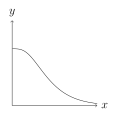
Solution: The initial volume of water in \(A\) is: \begin{align*} \pi \int_0^4 x^2 \, \d y &= \pi \int_0^4 y \d y \\ &= \pi [ \frac{y^2}{2}]_0^4 \\ &= 8\pi \end{align*} We assume that no water is in the tube as it is `thin'. Therefore we must have: \begin{align*} && 8\pi &= \pi \int_0^{h-1} x^2 \d y +\pi \int_0^{h} x^2 \d y \\ &&&= \pi \int_0^{h-1} y \d y +\pi \int_0^{h} \l \sinh \frac{x}{2}\r^2 \d y \\ &&&= \pi \left [\frac{y^2}{2} \right]_0^{h-1} + \pi \int_0^h \frac{-1+\cosh y}{2}\d y \\ &&&= \pi \frac{(h-1)^2}{2} + \pi \left [ -\frac{y}{2} +\frac{\sinh y}{2}\right]_0^h \\ &&&= \pi \frac{(h-1)^2}{2} -\pi \frac{h}{2} + \pi \frac{\sinh h}{2} \\ \Rightarrow && 0 &= h^2-2h+1-h+\sinh h -16 \\ &&&= h^2 -3h+\sinh h - 15 \\ \Rightarrow && 15 &= h^2 -3h+\sinh h \end{align*}