Problems
Filters
91 problems found
2012 Paper 2 Q5
- Sketch the curve \(y=\f(x)\), where \[ \f(x) = \frac 1 {(x-a)^2 -1} \hspace{2cm}(x\ne a\pm1), \] and \(a\) is a constant.
- The function \(\g(x)\) is defined by \[ \g(x) = \frac 1 {\big( (x-a)^2-1 \big) \big( (x-b)^2 -1\big)} \hspace{1cm}(x\ne a\pm1, \ x\ne b\pm1), \] where \(a\) and \(b\) are constants, and \(b>a\). Sketch the curves \(y=\g(x)\) in the two cases \(b>a+2\) and \(b=a+2\), finding the values of \(x\) at the stationary points.
Solution:
- \(\,\)

- \(\,\) \begin{align*}
&& \frac{\d}{\d x} \left ( \frac{1}{g(x)} \right) &= \frac{\d }{\d x} \left ( \big( (x-a)^2-1 \big) \big( (x-b)^2 -1\big)\right) \\
&&&= ((x-a)^2-1)(2(x-b))+((x-b)^2-1)(2(x-a)) \\
&&&= 2(2x-a-b)(x^2-(a+b)x+ab-1) \\
\Rightarrow && x &= \frac{a+b}{2}, \frac{a+b \pm \sqrt{(a+b)^2-4ab+4}}{2} \\
&&&= \frac{a+b}{2}, \frac{a+b \pm \sqrt{(a-b)^2+4}}{2}
\end{align*}
If \(b > a+2\):
If \(b = a+2\):


2012 Paper 3 Q11
One end of a thin heavy uniform inextensible perfectly flexible rope of length \(2L\) and mass \(2M\) is attached to a fixed point \(P\). A particle of mass \(m\) is attached to the other end. Initially, the particle is held at \(P\) and the rope hangs vertically in a loop below \(P\). The particle is then released so that it and a section of the rope (of decreasing length) fall vertically as shown in the diagram.
2011 Paper 1 Q3
Prove the identity \[ 4\sin\theta \sin(\tfrac13\pi-\theta) \sin (\tfrac13\pi+\theta)= \sin 3\theta\, . \tag{\(*\)}\]
- By differentiating \((*)\), or otherwise, show that \[ \cot \tfrac19\pi - \cot \tfrac29\pi + \cot \tfrac49\pi = \sqrt3\,. \]
- By setting \(\theta = \frac16\pi-\phi\) in \((*)\), or otherwise, obtain a similar identity for \(\cos3\theta\) and deduce that \[ \cot \theta \cot (\tfrac13\pi-\theta) \cot (\tfrac13\pi+\theta) =\cot3\theta\,. \] Show that \[ \cosec \tfrac19\pi -\cosec \tfrac59\pi +\cosec \tfrac79\pi = 2\sqrt3\,. \]
Solution: \begin{align*} && LHS &= 4\sin\theta \sin(\tfrac13\pi-\theta) \sin (\tfrac13\pi+\theta) \\ &&&= 4 \sin \theta \left (\tfrac{\sqrt{3}}{2}\cos \theta - \tfrac12 \sin \theta \right)\left (\tfrac{\sqrt{3}}{2}\cos \theta + \tfrac12 \sin \theta \right) \\ &&&= 4 \sin \theta \left (\tfrac{3}{4}\cos^2 \theta - \tfrac14 \sin^2 \theta \right) \\ &&&= 3\sin \theta - 4\sin^3 \theta \\ &&&= \cos 3 \theta = RHS \end{align*}
- \(\,\) \begin{align*} && 3 \cos 3 \theta &= \sin 3 \theta \left (\cot \theta - \cot (\tfrac13\pi - \theta) + \cot (\tfrac13\pi + \theta) \right) \\ \Rightarrow && 3 \cot 3\theta &= \cot \theta - \cot (\tfrac13\pi - \theta) + \cot (\tfrac13\pi + \theta) \\ \theta = \tfrac{\pi}{9}: && 3\cot \frac{\pi}{3} &= \cot \tfrac{\pi}{9} - \cot \tfrac{2}{9}\pi + \cot \tfrac49 \pi \\ \Rightarrow && \sqrt{3} &= \cot \tfrac{\pi}{9} - \cot \tfrac{2}{9}\pi + \cot \tfrac49 \pi \end{align*}
- \(\,\) \begin{align*} \theta = \tfrac16\pi - \phi && \sin(\tfrac12\pi - 3\phi) &= 4\sin(\tfrac16\pi - \phi)\sin(\phi+\tfrac16\pi)\sin(\tfrac12\pi - \phi) \\ \Rightarrow && \cos 3\phi &= 4\cos(\phi - \tfrac13\pi)\cos(\tfrac13\pi - \phi)\cos\phi \\ \Rightarrow && \cot 3\theta &= \cot \theta\cot(\phi - \tfrac13\pi)\cot(\tfrac13\pi - \phi) \tag{dividing by (\(*\))} \\ \\ \frac{\d}{\d \theta}:&& -\csc^2 3\phi &= \cot3\phi \left (-\csc^2 \phi\tan \phi+\csc^2 (\tfrac13\pi - \phi) \tan (\tfrac13\pi - \phi) -\csc^2(\phi - \tfrac13\pi)\tan (\phi - \tfrac13\pi) \right) \\ \Rightarrow && \csc^23\phi\tan3\phi & = 2( \csc2\phi- \csc(\tfrac{2}{3}\pi - 2\phi)+\csc(\phi - \tfrac23\pi)) \\ \phi = \frac{1}{18}\pi: && 4\sqrt{3} &= 2(\csc \tfrac{1}{9}\pi - \csc \tfrac59\pi + \csc \tfrac79 \pi) \\ \end{align*} and the result follows.
2011 Paper 2 Q3
In this question, you may assume without proof that any function \(\f\) for which \(\f'(x)\ge 0\) is increasing; that is, \(\f(x_2)\ge \f(x_1)\) if \(x_2\ge x_1\,\).
- Let \(\f(x) =\sin x -x\cos x\). Show that \(\f(x)\) is increasing for \(0\le x \le \frac12\pi\,\) and deduce that \(\f(x)\ge 0\,\) for \(0\le x \le \frac12\pi\,\).
- Given that \(\dfrac{\d}{\d x} (\arcsin x) \ge1\) for \(0\le x< 1\), show that \[ \arcsin x\ge x \quad (0\le x < 1). \]
- Let \(\g(x)= x\cosec x\, \text{ for }0< x < \frac12\pi\). Show that \(\g\) is increasing and deduce that \[ ({\arcsin x})\, x^{-1} \ge x\,{\cosec x} \quad (0 < x < 1). \]
- Given that $\dfrac{\d}{\d x} (\arctan x)\le 1\text{ for }x\ge 0$, show by considering the function \(x^{-1} \tan x\) that \[ (\tan x)( \arctan x) \ge x^2 \quad (0< x < \tfrac12\pi). \]
Solution:
- Given \(\frac{\d}{\d x} (\arctan x) \leq 1\) we must have \(\frac{\d}{ \d x} (x-\arctan x) \geq 0\) for \(x \geq 0\), but since \( 0 - \arctan 0 = 0\) this means that \(x - \arctan x \geq 0\), ie \( \arctan x \geq x\) for \(x \geq 0\) \(g(x) = x^{-1} \tan x \Rightarrow g'(x) = -x^{-2}\tan x +x^{-1} \sec^2 x\). If we can show \(f(x) = x \sec ^2 x - \tan x\) is positive that would be great. However \(f'(x) = x 2 \tan x \sec^2 x \geq 0\) and \(f(0) = 0\) so \(f(x)\) is positive and \(g'(x)\) is positive and hence increasing, therefore \(g(x) \geq g(\arctan x) \Rightarrow \frac{\tan x}{x} \geq \frac{x}{\arctan x}\) from which the result follows.
2010 Paper 1 Q2
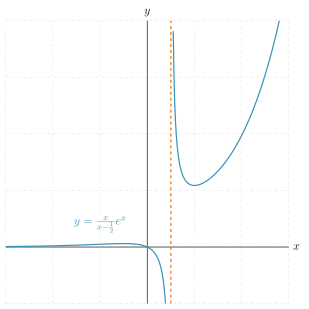
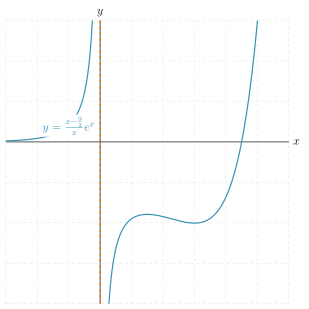
The curve \(\displaystyle y=\Bigl(\frac{x-a}{x-b}\Bigr)\e^{x}\), where \(a\) and \(b\) are constants, has two stationary points. Show that \[ a-b<0 \ \ \ \text{or} \ \ \ a-b>4 \,. \]
- Show that, in the case \(a=0\) and \(b= \frac12\), there is one stationary point on either side of the curve's vertical asymptote, and sketch the curve.
- Sketch the curve in the case \( a=\tfrac{9}{2}\) and \(b=0\,\).
Solution: \begin{align*} && y &= \left ( \frac{x-a}{x-b} \right )e^x \\ &&y'& = \left ( \frac{x-a}{x-b} \right )e^x + \left ( \frac{(x-b)-(x-a)}{(x-b)^2}\right )e^x \\ &&&= \left ( \frac{(x-b)(x-a) +a-b}{(x-b)^2} \right)e^x \\ &&&= \left ( \frac{x^2-(a+b)x+a-b+ab}{(x-b)^2} \right)e^x \\ && 0 &< \Delta = (a+b)^2 - 4 \cdot 1 \cdot (a-b+ab) \\ &&&= a^2+2ab+b^2-4a+4b-4ab \\ &&&= a^2-2ab+b^2-4a+4b\\ &&&= (a-b)^2-4(a-b) \\ &&&= (a-b)(a-b-4) \\ \end{align*} Considered as a quadratic in \(a-b\) we can see \(a-b < 0\) or \(a-b > 4\)
- If \(a = 0, b = \frac12\), we have \(x^2-\frac12x -\frac12 = 0 \Rightarrow (2x+1)(x-1) = 0 \Rightarrow x = -\frac12, x=1\). The asymptote is at \(x = \frac12\) so they are on either side.
- \(\,\)
2010 Paper 1 Q5
By considering the expansion of \(\left(1+x\right)^{n}\) where \(n\) is a positive integer, or otherwise, show that:
- \[\binom{n}{0}+\binom{n}1+\binom{n}2 +\cdots +\binom{n}n=2^{n} \]
- \[\binom{n}{1}+2\binom{n}2+3\binom{n}3 +\cdots +n\binom{n}n=n2^{n-1} \]
- \[\binom{n}{0}+\frac12\binom{n}1+\frac13\binom{n}2 +\cdots +\frac1{n+1}\binom{n}n=\frac1{n+1}(2^{n+1}-1) \]
- \[\binom{n}{1}+2^2\binom{n}2+3^2\binom{n}3 +\cdots +n^2\binom{n}n=n(n+1)2^{n-2} \]
Solution:
- Notice that \begin{align*} && (1+x)^n &= \sum_{i=0}^n \binom{n}{i} x^i \\ \text{Evaluate at }x = 1: && 2^n &= \sum_{i=0}^n \binom{n}{i} \end{align*}
- \(\,\) \begin{align*} && (1+x)^n &= \sum_{i=0}^n \binom{n}{i} x^i \\ \frac{\d}{\d x}: && n(1+x)^{n-1} &= \sum_{i=1}^n i\binom{n}{i} x^{i-1} \\ \text{Evaluate at }x = 1: && n2^{n-1} &= \sum_{i=1}^n i\binom{n}{i} \end{align*}
- \(\,\) \begin{align*} && (1+x)^n &= \sum_{i=0}^n \binom{n}{i} x^i \\ \Rightarrow && \int_0^1(1+x)^n \d x &= \int_0^1 \sum_{i=0}^n \binom{n}{i} x^i \d x \\ \Rightarrow && \frac{1}{n+1}(2^{n+1}-1) &= \sum_{i=0}^n \binom{n}{i}\int_0^1 x^i \d x\\ &&& = \sum_{i=0}^n \frac{1}{i+1}\binom{n}{i} \\ \end{align*}
- \(\,\) \begin{align*} && (1+x)^n &= \sum_{i=0}^n \binom{n}{i} x^i \\ \frac{\d}{\d x}: && n(1+x)^{n-1} &= \sum_{i=1}^n i\binom{n}{i} x^{i-1} \\ \times x: && nx(1+x)^{n-1} &= \sum_{i=1}^n i\binom{n}{i} x^{i} \\ \frac{\d}{\d x}: && n(1+x)^{n-1}+n(n-1)x(1+x)^{n-2} &= \sum_{i=1}^n i^2\binom{n}{i} x^{i-1} \\ \text{Evaluate at }x = 1: && \sum_{i=1}^n i^2\binom{n}{i} &= n(1+1)^{n-1}+n(n-1)x(1+1)^{n-2} \\ &&&= 2^{n-2} \left (n(n-1) + 2n \right) \\ &&&= n(n+1)2^{n-2} \end{align*}
2010 Paper 2 Q1
Let \(P\) be a given point on a given curve \(C\). The \textit{osculating circle} to \(C\) at \(P\) is defined to be the circle that satisfies the following two conditions at \(P\): it touches \(C\); and the rate of change of its gradient is equal to the rate of change of the gradient of \(C\). Find the centre and radius of the osculating circle to the curve \(y=1-x+\tan x\) at the point on the curve with \(x\)-coordinate \(\frac14 \pi\).
Solution: The condition is that we match the first and second derivative (as well as passing through the point in question, which is \((\frac{\pi}{4}, 2 - \frac{\pi}{4})\) The gradient is \(y' = -1 + \sec^2 x\), so the value is \(1\). The second derivative is \(y'' = 2 \sec^2 x \tan x\), which is \(4\) If we have a circle, radius \(r\), so \((x-a)^2 + (y-b)^2 = r^2\) then \(2(x-a) + 2(y-b) \frac{\d y}{\d x} = 0\) and \(2 + 2 \left ( \frac{\d y}{\d x} \right)^2 + 2(y-b) \frac{\d^2y}{\d x^2} = 0\). Therefore we must have \(1+1+(2-\frac{\pi}{4}-b)4 = 0 \Rightarrow b =\frac52-\frac{\pi}{4}\) We know that the centre lies on the line \(y = 2-x\), so we must have \(a = \frac{\pi}{4}-\frac12\) and so the centre is \(( \frac{\pi}{4} - \frac12,\frac52 - \frac{\pi}{4})\) and the radius is \(\sqrt{\frac14 + \frac14} = \frac{\sqrt{2}}{2}\)
2009 Paper 2 Q7
Let \(y= (x-a)^n \e^{bx} \sqrt{1+x^2}\,\), where \(n\) and \(a\) are constants and \(b\) is a non-zero constant. Show that \[ \frac{\d y}{\d x} = \frac{(x-a)^{n-1} \e^{bx} \q(x)}{\sqrt{1+x^2}}\,, \] where \(\q(x)\) is a cubic polynomial. Using this result, determine:
- $\displaystyle \int \frac {(x-4)^{14} \e^{4x}(4x^3-1)} {\sqrt{1+x^2\;}} \, \d x\,;\(
- \)\displaystyle \int \frac{(x-1)^{21}\e^{12x}(12x^4-x^2-11)} {\sqrt{1+x^2\;}}\,\d x\,;\(
- \)\displaystyle \int \frac{(x-2)^{6}\e^{4x}(4x^4+x^3-2)} {\sqrt{1+x^2\;}}\,\d x\,.$
2009 Paper 3 Q3
The function \(\f(t)\) is defined, for \(t\ne0\), by \[ \f(t) = \frac t {\e^t-1}\,. \] \begin{questionparts} \item By expanding \(\e^t\), show that \(\displaystyle \lim _{t\to0} \f(t) = 1\,\). Find \(\f'(t)\) and evaluate \(\displaystyle \lim _{t\to0} \f'(t)\,\). \item Show that \(\f(t) +\frac12 t\) is an even function. [{\bf Note:} A function \(\g(t)\) is said to be {\em even} if \(\g(t) \equiv \g(-t)\).] \item Show with the aid of a sketch that \( \e^t( 1-t)\le 1\,\) and deduce that \(\f'(t)\ne 0\) for \(t\ne0\). \end{questionpart} Sketch the graph of \(\f(t)\).
Solution:
- Claim \(f(t) + \frac12 t\) is an even function. Proof: Consider \(f(-t) - \frac12t\), then \begin{align*} f(-t) - \frac12t &= \frac{-t}{e^{-t}-1} - \frac12t \\ &= \frac{-te^t}{1-e^t} - \frac12 t \\ &= \frac{t(1-e^t) -t}{1-e^t} - \frac12 t \\ &= t - \frac{t}{1-e^t} - \frac12 t \\ &= \frac{t}{e^t-1} + \frac12 t \end{align*} So it is even.
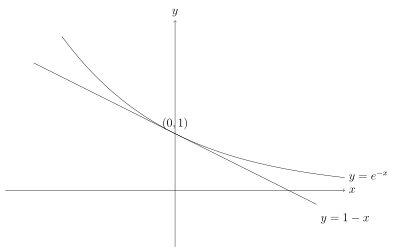
- Drawing the tangent to \(y = e^{-x}\) at \((0,1)\) we find that \(e^{-t} \geq (1-t)\) for all \(t\), in particular, \(e^t(1-t) \leq 1\) \(f'(t) = \frac{(e^t(1-t) -1}{(e^t-1)^2} \leq 0\) and \(f'(t) = -\frac12\) when \(t = 0\)

2009 Paper 3 Q7
- The functions \(\f_n(x)\) are defined for \(n=0\), \(1\), \(2\), \(\ldots\)\, , by \[ \f_0(x) = \frac 1 {1+x^2}\, \qquad \text{and}\qquad \f_{n+1}(x) =\frac{\d \f_n(x)}{\d x}\,. \] Prove, for \(n\ge1\), that \[ (1+x^2)\f_{n+1}(x) + 2(n+1)x\f_n(x) + n(n+1)\f_{n-1}(x)=0\,. \]
- The functions \(\P_n(x)\) are defined for \(n=0\), \(1\), \(2\), \(\ldots\)\, , by \[ \P_n(x) = (1+x^2)^{n+1}\f_n(x)\,. \] Find expressions for \(\P_0(x)\), \(\P_1(x)\) and \(\P_2(x)\). Prove, for \(n\ge0\), that \[ \P_{n+1}(x) -(1+x^2)\frac {\d \P_n(x)}{\d x}+ 2(n+1)x \P_n(x)=0\,, \] and that \(\P_n(x)\) is a polynomial of degree \(n\).
2008 Paper 1 Q4
A function \(\f(x)\) is said to be convex in the interval \(a < x < b\) if \(\f''(x)\ge0\) for all \(x\) in this interval.
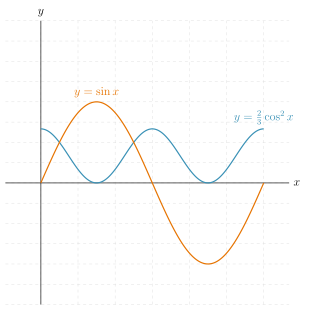
- Sketch on the same axes the graphs of \(y= \frac23 \cos^2 x\) and \(y=\sin x\) in the interval \(0\le x \le 2\pi\). The function \(\f(x)\) is defined for \(0 < x < 2\pi\) by \[\f(x) = \e^{\frac23 \sin x}. \] Determine the intervals in which \(\f(x)\) is convex.
- The function \(\g(x)\) is defined for \(0 < x < \frac12\pi\) by \[\g(x) = \e^{-k \tan x}. \] If \(k=\sin 2 \alpha\) and \(0 < \alpha < \frac{1}{4}\pi\), show that \(\g(x)\) is convex in the interval \(0 < x < \alpha\), and give one other interval in which \(\g(x)\) is convex.
Solution:
- \begin{align*} && f(x) &= \exp\left (\tfrac23\sin x \right) \\ && f'(x) &= \exp\left (\tfrac23\sin x \right) \cdot \tfrac23 \cos x \\ && f''(x) &= \left ( \exp\left (\tfrac23\sin x \right) \cdot \tfrac23\right) \left ( \tfrac23 \cos^2 x - \sin x \right) \end{align*} Therefore \(f(x)\) is convex when \(\frac23 \cos^2 x \geq \sin x\). Note that we can find the equality points when \begin{align*} && \sin x &= \frac23 \cos^2 x \\ &&&= \frac23 (1- \sin^2 x) \\ \Rightarrow && 0 &= 2\sin^2 x + 3 \sin x - 2 \\ &&&= (2 \sin x -1) (\sin x+2) \end{align*} ie \(\sin x = \frac12 \Rightarrow x = \frac{\pi}{6}, \frac{5\pi}{6}\). Therefore \(f\) is convex on \([0, \frac{\pi}{6}] \cup [\frac{5\pi}{6}, 2\pi]\)
- Suppose \(g(x) = \exp \left ( -k \tan x \right)\) then \begin{align*} && g'(x) &= \exp \left ( -k \tan x \right) \cdot (-k \sec^2 x ) \\ && g''(x) &= \left ( -k \exp \left ( -k \tan x \right) \right) \left ( -k\sec^4 x + 2 \sec x \cdot \sec x \tan x\right) \\ &&&= -k \exp \left ( -k \tan x \right) \sec^4 x \left ( -k + 2\sin x \cos x \right) \\ &&&= -k \exp \left ( -k \tan x \right) \sec^4 x \left ( -k + \sin 2x \right) \\ \end{align*} If \(0 < \alpha < \frac{\pi}{4}\) then \(k > 0\) so \(g\) is convex if \(-k + \sin 2x < 0\), ie \(\sin 2x < \sin 2\alpha\), ie on \((0, \alpha)\) and \((\frac{\pi}{2} - \alpha, \frac{\pi}{2})\)
2008 Paper 1 Q8
- The gradient \(y'\) of a curve at a point \((x,y)\) satisfies \[ (y')^2 -xy'+y=0\,. \tag{\(*\)} \] By differentiating \((*)\) with respect to \(x\), show that either \(y''=0\) or \(2y'=x\,\). Hence show that the curve is either a straight line of the form \(y=mx+c\), where \(c=-m^2\), or the parabola \(4y=x^2\).
- The gradient \(y'\) of a curve at a point \((x,y)\) satisfies \[ (x^2-1)(y')^2 -2xyy'+y^2-1=0\,. \] Show that the curve is either a straight line, the form of which you should specify, or a circle, the equation of which you should determine.
Solution:
- \(\,\) \begin{align*} && 0 &= (y')^2 -xy'+y\\ \Rightarrow && 0 &= 2y' y'' -y' - xy'' + y' \\ &&&= 2y'y'' - xy'' \\ &&&= y'' (2y'-x) \end{align*} Therefore \(y'' = 0 \Rightarrow y = mx + c\) or \(y' = \frac12 x \Rightarrow x = \frac14x^2 + C\). Plugging these into the original equation we have \(m^2 - xm+mx+c = 0 \Rightarrow c = -m^2\) \(\frac14 x^2 - \frac12 x^2 + \frac14x^2 + C = 0 \Rightarrow C = 0\). Therefore \(4y = x^2\)
- \begin{align*} && 0 &= (x^2-1)(y')^2 -2xyy'+y^2-1 \\ \Rightarrow && 0 &= 2x(y')^2 +(x^2-1)2y'y'' - 2yy' - 2x(y')^2-2xyy''+2yy' \\ &&&= (x^2-1)2y'y'' -2xyy'' \\ &&&= 2y'' ((x^2-1)y'-xy) \end{align*} Therefore \(y'' = 0\) so \(y = mx + c\) or \begin{align*} && \frac{\d y}{\d x} &= \frac{xy}{x^2-1} \\ \Rightarrow && \int \frac1y \d y &= \int \frac{x}{x^2-1} \d x \\ \Rightarrow && \ln |y| &= \frac12 \ln |x^2-1| + C \\ \Rightarrow && y^2 &= A(x^2-1) \end{align*} Suppose \(y = mx+c\) then we must have \((x^2-1)m^2-2xm(mx+c)+(mx+c)^2 = -m^2+c^2 \Rightarrow c^2 = m^2\) If \(y^2 = A(x^2-1)\) then \(2yy' = 2xA\) and \begin{align*} && 0 &= \frac{y^2}{A}\left ( \frac{xA}{y} \right)^2 - 2x^2A+A(x^2-1)-1 \\ &&&= x^2A-2x^2A+x^2A-A-1 \\ \Rightarrow && A &= -1 \end{align*} Therefore \(x^2 + y^2 = 1\)
2007 Paper 2 Q6
- Differentiate \(\ln\big (x+\sqrt{3+x^2}\,\big)\) and \(x\sqrt{3+x^2}\) and simplify your answers. Hence find \(\int \! \sqrt{3+x^2}\, \d x\).
- Find the two solutions of the differential equation \[ 3\left(\frac{\d y}{\d x}\right)^{\!2} + 2 x \frac {\d y}{\d x} =1 \] that satisfy \(y=0\) when \(x=1\).
Solution:
- \(\,\) \begin{align*} && y &= \ln (x + \sqrt{3+x^2}) \\ \Rightarrow && y' &= \frac{1}{x + \sqrt{3+x^2}} \cdot \left (1 + \frac{x}{\sqrt{3+x^2}} \right) \\ &&&= \frac{1}{\sqrt{3+x^2}} \\ \\ && y &= x\sqrt{3+x^2} \\ && y' &= \sqrt{3+x^2} + \frac{x^2}{\sqrt{3+x^2}} \\ &&&= 2\sqrt{3+x^2} - \frac{3}{\sqrt{3+x^2}} \\ \\ \Rightarrow && \sqrt{3+x^2} &= \frac12(x \sqrt{3+x^2})' + \frac32(\ln(x+\sqrt{3+x^2})' \\ \Rightarrow && \int \sqrt{3+x^2}\, \d x &= \frac12x\sqrt{3+x^2} + \frac32 \ln (x+\sqrt{3+x^2}) + C \end{align*}
- \(\,\) \begin{align*} && 3 \left ( \frac{\d y}{\d x} \right)^2 + 2x \frac{\d y}{\d x} &= 1 \\ && \frac{\d y}{\d x} &= \frac{-x \pm \sqrt{x^2+3} }3 \\ \Rightarrow && y &= -\frac{x^2}{6} \pm \frac16x\sqrt{3+x^2} \pm \frac12 \ln (x+\sqrt{3+x^2}) + C \\ y = 0, x = 1: && 0 &= -\frac16 \pm \frac13 \pm \frac12 \ln 3 \\ \Rightarrow && y &= -\frac{x^2}{6} \pm \frac12x\sqrt{3+x^2} \pm \frac32 \ln (x+\sqrt{3+x^2}) + \frac16 \mp \frac13 \mp \frac12 \ln 3 \end{align*}
2007 Paper 3 Q2
- Show that \(1.3.5.7. \;\ldots \;.(2n-1)=\dfrac {(2n)!}{2^n n!}\;\) and that, for $\vert x \vert < \frac14$, \[ \frac{1}{\sqrt{1-4x\;}\;} =1+\sum_{n=1}^\infty \frac {(2n)!}{(n!)^2} \, x^n \,. \]
- By differentiating the above result, deduce that \[ \sum _{n=1}^\infty \frac{(2n)!}{n!\,(n-1)!} \left(\frac6{25}\right)^{\!\!n} = 60 \,. \]
- Show that \[ \sum _{n=1}^\infty \frac{2^{n+1}(2n)!}{3^{2n}(n+1)!\,n!} = 1 \,. \]
Solution:
- Notice that \(1 \cdot 3 \cdot 5 \cdot 7 \cdot (2n-1) = \frac{1 \cdot 2 \cdot 3 \cdot 4 \cdots \cdots 2n}{2 \cdot 4 \cdot 6 \cdots 2n} = \frac{(2n)!}{2^n \cdot n!}\) as required. When \(|4x| < 1\) or \(|x|<\frac14\) we can apply the generalised binomial theorem to see that: \begin{align*} \frac{1}{\sqrt{1-4x}} &= (1-4x)^{-\frac12} \\ &= 1+\sum_{n=1}^\infty \frac{-\frac12 \cdot \left ( -\frac32\right)\cdots \left ( -\frac{2n-1}2\right)}{n!} (-4x)^n \\ &= 1+\sum_{n=1}^{\infty} (-1)^n\frac{(2n)!}{(n!)^2 2^{2n}} (-4)^n x^n \\ &= 1+\sum_{n=1}^{\infty} \frac{(2n)!}{(n!)^2 } x^n \\ \end{align*}
- Differentiating we obtain \begin{align*} && 2(1-4x)^{-\frac32} &= \sum_{n=1}^\infty \frac{(2n)!}{n!(n-1)!} x^{n-1} \\ \Rightarrow &&\sum_{n=1}^\infty \frac{(2n)!}{n!(n-1)!} \left (\frac{6}{25} \right)^{n} &= \frac{6}{25} \cdot 2\left(1- 4 \frac{6}{25}\right)^{-\frac32} \\ &&&= \frac{12}{25} \left (\frac{1}{25} \right)^{-\frac32} \\ &&&= \frac{12}{25} \cdot 125 = 60 \end{align*}
- By integrating, we obtain \begin{align*} && \int_{t=0}^{t=x} \frac{1}{\sqrt{1-4t}} \d t &= \int_{t=0}^{t=x} \left (1+\sum_{n=1}^{\infty} \frac{(2n)!}{(n!)^2 } t^n \right) \d t \\ \Rightarrow && \left [ -\frac12 \sqrt{1-4t}\right]_0^x &= x + \sum_{n=1}^{\infty} \frac{(2n)!}{n!(n+1)! } x^{n+1} \\ \Rightarrow && \frac12 - \frac12\sqrt{1-4x} - x &= \sum_{n=1}^{\infty} \frac{(2n)!}{n!(n+1)! } x^{n+1} \\ \\ \Rightarrow && 9\sum_{n=1}^{\infty} \frac{(2n)!}{n!(n+1)! } \left ( \frac{2}{9}\right)^{n+1} &=9 \cdot\left( \frac12 - \frac12 \sqrt{1-4\cdot \frac{2}{9}} - \frac29\right )\\ &&&= 9 \cdot \left (\frac12 - \frac{1}{6} - \frac{2}{9} \right) \\ &&&= 1 \end{align*}
2007 Paper 3 Q4
A curve is given parametrically by \begin{align*} x&= a\big( \cos t +\ln \tan \tfrac12 t\big)\,,\\ y&= a\sin t\,, \end{align*} where \(0 < t < \frac12 \pi\) and \(a\) is a positive constant. Show that \(\ds \frac{\d y}{\d x} = \tan t\) and sketch the curve. Let \(P\) be the point with parameter \(t\) and let \(Q\) be the point where the tangent to the curve at \(P\) meets the \(x\)-axis. Show that \(PQ=a\). The {\sl radius of curvature}, \(\rho\), at \(P\) is defined by \[ \rho= \frac {\big(\dot x ^2+\dot y^2\big)^{\frac32}} {\vert \dot x \ddot y - \dot y \ddot x\vert \ \ } \,, \] where the dots denote differentiation with respect to \(t\). Show that \(\rho =a\cot t\). The point \(C\) lies on the normal to the curve at \(P\), a distance \(\rho\) from \(P\) and above the curve. Show that \(CQ\) is parallel to the \(y\)-axis.