Problems
Filters
74 problems found
2007 Paper 1 Q3
Prove the identities \(\cos^4\theta -\sin^4\theta \equiv \cos 2\theta\) and $\cos^4 \theta + \sin^4 \theta \equiv 1 - {\frac12} \sin^2 2 \theta$. Hence or otherwise evaluate \[ \int_0^{\frac{1}{2}\pi} \cos^4 \theta \; \d \theta \;\;\;\; \mbox{and}\;\;\;\; \int_0^{\frac{1}{2}\pi} \sin^4 \theta \; \d \theta \,. \] Evaluate also \[ \int_0^{\frac{1}{2}\pi} \cos^6 \theta \; \d \theta \;\;\;\; \mbox{and}\;\;\;\; \int_0^{\frac{1}{2}\pi} \sin^6 \theta \; \d \theta \,. \]
Solution: \begin{align*} && \cos^4 \theta - \sin^4 \theta &= (\cos^2 \theta - \sin^2 \theta)(\cos^2 \theta + \sin^2 \theta) \\ &&&= \cos^2 \theta - \sin^2 \theta \\ &&&= \cos 2 \theta \\ \\ && 1&= (\cos^2 \theta + \sin^2 \theta)^2 \\ &&&= \cos^4 \theta + \sin^4 \theta + 2 \sin^2 \theta \cos^2 \theta \\ &&&= \cos^4 \theta + \sin^4 \theta + \frac12 ( \sin^2 2 \theta) \\ \Rightarrow && \cos^4 \theta + \sin^4 \theta &= 1 - \tfrac12 \sin^2 2 \theta \end{align*} \begin{align*} && I &= \int_{0}^{\pi/2} \cos^4 \theta \d \theta \\ && J &= \int_0^{\pi/2} \sin^4 \theta \d \theta \\ && I-J &= \int_0^{\pi/2} \cos 2 \theta \d \theta = 0 \\ && I+J &= \int_0^{\pi/2} (1- \frac12 \sin^2 2 \theta) \d \theta \\ &&&= \frac{\pi}{2} - \frac14 \int_0^{\pi} \sin^2 \theta \d \theta \\ &&&= \frac{\pi}{2} - \frac{\pi}{8} \\ &&&= \frac{3\pi}{8} \\ \Rightarrow && I=J &= \frac{3\pi}{16} \end{align*} \begin{align*} && \cos^6 \theta + \sin^6 \theta &= (\cos^2 \theta + \sin^2 \theta)(\cos^4 \theta - \cos^2 \theta \sin^2 \theta + \sin^4 \theta) \\ &&&= 1-\tfrac12 \sin^2 2\theta - \tfrac14 \sin^2 2 \theta \\ &&&= 1 - \tfrac34 \sin^2 2 \theta \\ %&& \cos^6 \theta - \sin^6 \theta &= (\cos^2 \theta - \sin^2 \theta)(\cos^4 \theta + \cos^2 \theta \sin^2 \theta + \sin^4 \theta) \\ %&&&= \cos 2 \theta (1 - \tfrac12 \sin^2 2 \theta + \tfrac14 \sin^2 2 \theta) \\ %&&&= \cos 2 \theta (1 - \tfrac14 \sin^2 2 \theta) \\ \end{align*} \begin{align*} && I &= \int_{0}^{\pi/2} \cos^6 \theta \d \theta \\ && J &= \int_0^{\pi/2} \sin^6 \theta \d \theta \\ && I-J &= 0 \\ && I+J &= \int_0^{\pi/2} (1 - \tfrac34 \sin^2 2 \theta) \d \theta \\ &&&= \frac{\pi}{2} - \frac{3\pi}{16} = \frac{5\pi}{16} \\ \Rightarrow && I = J &= \frac{5\pi}{32} \end{align*}
2007 Paper 2 Q3
By writing \(x=a\tan\theta\), show that, for \(a\ne0\), $\displaystyle \int \frac 1 {a^2+x^2}\, \d x =\frac 1 a \arctan \frac x a + \text{constant}\,$.
- Let $\displaystyle I=\int_0^{\frac{1}{2}\pi}
\frac {\cos x}{1+\sin^2 x} \, \d x\,$.
- Evaluate \(I\).
- Use the substitution \(t=\tan \frac12 x\) to show that \(\displaystyle \int_0^1 \frac {1-t^2}{1+6t^2+t^4} \, \d t = \tfrac12 I\,\).
- Evaluate \(\displaystyle \int_0^1 \frac {1-t^2}{1+14t^2+t^4} \, \d t \,\).
Solution: \begin{align*} && I &= \int \frac{1}{a^2+x^2} \d x\\ x = a \tan \theta, \d x =a \sec^2 \theta \d \theta &&&= \int \frac{1}{a^2+a^2\tan^2 x} a \sec^2 \theta \d \theta \\ &&&=\int \frac{\sec^2 \theta}{a \sec^2 \theta} \d \theta \\ &&&= \frac1a \theta + C \\ &&&= \frac1a \arctan \frac{x}{a} + C \end{align*}
- \(\,\) \begin{align*} && I &= \int_0^{\frac{1}{2}\pi} \frac {\cos x}{1+\sin^2 x} \d x \\ &&&= \left [ \arctan (\sin x) \right]_0^{\pi/2} \\ &&&= \arctan(1) - \arctan(0) = \frac{\pi}{4} \end{align*}
- \(\,\) \begin{align*} && t &= \tan \frac{x}{2} \\ \Rightarrow && \sin x &= \frac{2t}{1+t^2} \\ && \cos x &= \frac{1-t^2}{1+t^2} \\ && \d x &= \frac{2}{1+t^2} \d t \\ \Rightarrow && I &= \int_0^{\pi/2} \frac{\cos x}{1 + \sin^2 x } \d x \\ &&&= \int_{t=0}^{t = 1} \frac{\frac{1-t^2}{1+t^2}}{1 + \left (\frac{2t}{1+t^2} \right)^2} \frac{2}{1+t^2} \d t \\ &&&= 2 \int_0^1 \frac{1-t^2}{(1+t^2)^2+(2t)^2} \d t\\ &&&= 2 \int_0^1 \frac{1-t^2}{1+6t^2+t^4} \d t\\ \end{align*} From which the conclusion follows
- \(\,\) \begin{align*} && J &= \int_0^1 \frac {1-t^2}{1+14t^2+t^4} \, \d t \\ &&&= \int_0^1 \frac {\frac{1-t^2}{1+t^2}}{\frac{1+14t^2+t^4}{(1+t^2)^2}} \frac{1}{1+t^2} \, \d t \\ &&&= \int_0^1 \frac {\frac{1-t^2}{1+t^2}}{\frac{(t^2+1)^2+3(2t)^2}{(1+t^2)^2}} \frac{1}{1+t^2} \, \d t \\ &&&= \frac12\int_{x=0}^{x=\pi/2} \frac {\cos x}{1+3 \sin^2 x} \d x \\ &&&= \frac{1}{6}\left[ \sqrt{3} \arctan(\sin \sqrt{3}x)\right]_0^{\pi/2} \\ &&&= \frac16 \sqrt{3} \frac{\pi}{3} \\ &&&= \frac{\sqrt{3}\pi}{18} \end{align*}
2006 Paper 1 Q5
- Use the substitution \(u^2=2x+1\) to show that, for \(x>4\), \[ \int \frac{3} { ( x-4 ) \sqrt {2x+1}} \; \d x = \ln \l \frac{\sqrt{2x+1}-3} {\sqrt{2x+1}+3} \r + K\,, \] where \(K\) is a constant.
- Show that $ \displaystyle \int_{\ln 3}^{\ln 8} \frac{2} { \e^x \sqrt{ \e^x + 1}}\; \mathrm{d}x\, = \frac 7{12} + \ln \frac23 $ .
Solution:
- \begin{align*} && I &= \int \frac{3}{(x-4)\sqrt{2x+1}}\, \d x \\ u^2 =2x+1, 2u \frac{\d u}{\d x}=2: && &= \int \frac{3}{\left(\frac{u^2-1}{2}-4\right)u} u \d u \\ &&&= \int \frac{6}{u^2-9} \d u \\ &&&= \int \frac{6}{(u-3)(u+3)} \d u\\ &&&= \int \left ( \frac{1}{u-3} - \frac{1}{u+3} \right )\d u \\ &&&= \ln (u-3) - \ln (u+3) + C \\ &&&= \ln \frac{u-3}{u+3} + C \\ &&&= \ln \left (\frac{\sqrt{2x+1}-3}{\sqrt{2x+1}+3} \right) + C \end{align*}
- \begin{align*} && I &= \int_{\ln 3}^{\ln 8} \frac{2}{e^x\sqrt{e^x+1}} \d x \\ u = e^x, \frac{\d u}{\d x} = e^x: &&&= \int_{u=3}^{u=8} \frac{2}{u\sqrt{u+1}} \frac{1}{u} \d u \\ v^2=u+1, 2v \frac{\d v}{\d u} = 1: &&&= \int_{v=2}^{v=3} \frac{2}{v(v^2-1)^2} \d v \\ &&&= \int_2^3 \left ( \frac{2}{v} - \frac{}{v-1} - \frac{1}{2(v-1)^2} - \frac{1}{v+1} - \frac{1}{2(v+1)^2}\right) \d v \\ &&&= \left [2\ln v - \ln(v^2-1)+\frac12(v-1)^{-1}+\frac12(v+1)^{-1} \right]_2^3 \\ &&&= \left ( 2\ln3-\ln 8+\frac14+\frac18\right)-\left ( 2\ln2-\ln 3+\frac12+\frac16\right) \\ &&&= \end{align*}
2006 Paper 2 Q4
By making the substitution \(x=\pi-t\,\), show that \[ \! \int_0^\pi x\f(\sin x) \d x = \tfrac12 \pi \! \int_0^\pi \f(\sin x) \d x\,, \] where \(\f(\sin x)\) is a given function of \(\sin x\). Evaluate the following integrals:
- \(\displaystyle \int_0^\pi \frac {x \sin x}{3+\sin^2 x}\,\d x\,\);
- $\displaystyle \int_0^{2\pi} \frac {x \sin x}{3+\sin^2 x}\,\d x\,\(;
- \)\displaystyle \int_{0}^{\pi} \frac {x \big\vert\sin 2x\big\vert}{3+\sin^2 x}\,\d x\,$.
2006 Paper 3 Q2
Let \[ I = \int_{-\frac12 \pi}^{\frac12\pi} \frac {\cos^2\theta}{1-\sin\theta\sin2\alpha} \, \d\theta \text{ and } J = \int_{-\frac12 \pi}^{\frac12\pi} \frac {\sec^2\theta}{1+\tan^2\theta\cos^22\alpha} \, \d\theta \] where \(0 < \alpha < \frac14\pi\,\).
- Show that \[ I = \int_{-\frac12 \pi}^{\frac12\pi} \frac {\cos^2\theta}{1+\sin\theta\sin2\alpha} \d\theta \] and hence that \[ \displaystyle 2I = \int_{-\frac12 \pi}^{\frac12\pi} \frac {2}{1+\tan^2\theta\cos^22\alpha} \, \d\theta \]
- Find \(J\).
- By considering \(I\sin^2 2\alpha +J\cos^2 2\alpha \), or otherwise, show that \(I =\frac12 \pi \sec^2\alpha\).
- Evaluate \(I\) in the case \(\frac14\pi < \alpha < \frac12\pi\).
Solution:
- \(\,\) \begin{align*} && I &= \int_{-\frac12 \pi}^{\frac12\pi} \frac {\cos^2\theta}{1-\sin\theta\sin2\alpha} \, \d\theta \\ \phi = -\theta, \d \phi = - \d \theta: &&&= \int_{\phi=\frac12\pi}^{\phi=-\frac12\pi} \frac{\cos^2(-\phi)}{1-\sin(-\phi)\sin 2 \alpha} (-1) \d \phi \\ &&&= \int_{-\frac12 \pi}^{\frac12\pi} \frac {\cos^2\phi}{1+\sin\phi\sin2\alpha} \d\phi \\ \\ && 2I &= \int_{-\frac12 \pi}^{\frac12\pi} \frac {\cos^2\theta}{1-\sin\theta\sin2\alpha} \, \d\theta +\int_{-\frac12 \pi}^{\frac12\pi} \frac {\cos^2\theta}{1+\sin\theta\sin2\alpha} \, \d\theta \\ &&&= \int_{-\frac12 \pi}^{\frac12\pi} \left ( \frac {\cos^2\theta}{1-\sin\theta\sin2\alpha} +\frac {\cos^2\theta}{1+\sin\theta\sin2\alpha} \right) \, \d\theta \\ &&&= \int_{-\frac12 \pi}^{\frac12\pi} \left ( \frac {2\cos^2\theta}{1-\sin^2\theta\sin^22\alpha} \right) \, \d\theta \\ &&&= \int_{-\frac12 \pi}^{\frac12\pi} \left ( \frac {2\cos^2\theta}{1-(1-\cos^2\theta)(1-\cos^22\alpha)} \right) \, \d\theta \\ &&&= \int_{-\frac12 \pi}^{\frac12\pi} \left ( \frac {2\cos^2\theta}{\cos^2\theta+\cos^22\alpha-\cos^2 \theta \cos^2 2 \alpha)} \right) \, \d\theta \\ &&&= \int_{-\frac12 \pi}^{\frac12\pi} \left ( \frac {2}{1+\cos^22\alpha(\sec^2 \theta - 1))} \right) \, \d\theta \\ &&&= \int_{-\frac12 \pi}^{\frac12\pi} \left ( \frac {2}{1+\tan^2 \theta \cos^22\alpha} \right) \, \d\theta \\ \end{align*}
- \(\,\) \begin{align*} && J &= \int_{-\frac12 \pi}^{\frac12\pi} \frac {\sec^2\theta}{1+\tan^2\theta\cos^22\alpha} \, \d\theta \\ &&&= \left [\sec 2 \alpha \tan^{-1} \left ( \cos 2 \alpha \tan \theta \right) \right]_{-\frac12 \pi}^{\frac12\pi} \\ &&&= \sec(2\alpha)\pi = \frac{\pi}{\cos 2 \alpha} \end{align*}
- \(\,\) \begin{align*} && I\sin^2 2\alpha +J\cos^2 2\alpha &= \int_{-\frac12\pi}^{\frac12 \pi} \frac{\sin^2 2 \alpha+\cos^2 2 \alpha \sec^2 \theta}{1+\tan^2 \theta \cos^2 2\alpha} \d \theta \\ &&&= \int_{-\frac12\pi}^{\frac12 \pi} \frac{\sin^2 2 \alpha+\cos^2 2 \alpha (1 + \tan^2 \theta)}{1+\tan^2 \theta \cos^2 2\alpha} \d \theta \\ &&&= \pi \\ \\ \Rightarrow && I &= \frac{\pi - \pi \cos 2 \alpha}{\sin^2 2 \alpha} \\ &&&= \pi \frac{2\sin^2 \alpha}{4 \sin^2 \alpha \cos^2 \alpha} \\ &&&= \frac12 \pi \sec^2 \alpha \end{align*}
- If \(\frac14 \pi < \alpha < \frac12 \pi\) then our calculation for \(J\) is not correct. \begin{align*} && J &= \int_{-\frac12 \pi}^{\frac12\pi} \frac {\sec^2\theta}{1+\tan^2\theta\cos^22\alpha} \, \d\theta \\ &&&= \left [\sec 2 \alpha \tan^{-1} \left ( \cos 2 \alpha \tan \theta \right) \right]_{-\frac12 \pi}^{\frac12\pi} \\ &&&= \sec(2\alpha) \left ( \lim_{\theta \to \frac{\pi}{2}} \tan^{-1} \left ( \cos 2 \alpha \tan \theta \right) - \lim_{\theta \to -\frac{\pi}{2}} \tan^{-1} \left ( \cos 2 \alpha \tan \theta \right) \right) \\ &&&= \sec(2\alpha) \left ( \tan^{-1} \left ( \lim_{x\to -\infty} x \right) - \tan^{-1} \left ( \lim_{x\to \infty} x \right) \right) \\ &&&= -\pi \sec 2 \alpha \end{align*} Still using the same logic, we can say \begin{align*} && I &= \frac{\pi+\pi\cos 2 \alpha}{\sin^2 2 \alpha} \\ &&&= \pi \frac{2 \cos^2 \alpha}{4 \sin^2 \alpha \cos^2 \alpha}\\ &&&= \frac12 \pi \cosec^2 \alpha \end{align*}
2005 Paper 1 Q5
- Evaluate the integral \[ \int_0^1 \l x + 1 \r ^{k-1} \; \mathrm{d}x \] in the cases \(k\ne0\) and \(k = 0\,\). Deduce that \(\displaystyle \frac{2^k - 1}{k} \approx \ln 2\) when \(k \approx 0\,\).
- Evaluate the integral \[ \int_0^1 x \l x + 1 \r ^m \; \mathrm{d}x \; \] in the different cases that arise according to the value of \(m\).
Solution:
- Case \(k \neq 0\): \begin{align*} && \int_0^1 (x+1)^{k-1} \d x &= \left [\frac{1}{k}(x+1)^k \right]_0^1 \\ &&&= \frac{2^k-1}{k} \\ \end{align*} Case \(k = 0\): \begin{align*} && \int_0^1 (x+1)^{k-1} \d x &= \int_0^1 (x+1)^{-1} \d x \\ &&&= \left [\ln(x+1) \right]_0^1 \\ &&&= \ln 2 \end{align*} Therefore for \(k \approx 0\), we must have both integrals being close to each other, since the function is nice on this interval, ie \(\frac{2^k-1}{k} \approx \ln 2\)
- Case \(m = 0\). \(I = \frac12\) Case \(m \neq 0, -1, -2\) \begin{align*} u = x+1, \d u = \d x && \int_0^1 x(x+1)^m \d x &= \int_{u=1}^{u=2} (u-1)u^m \d u \\ &&&=\left[ \frac{u^{m+2}}{m+2} - \frac{u^{m+1}}{m+1} \right]_1^2 \\ &&&= 2^{m+1}\left ( \frac{2}{m+2} - \frac1{m+1} \right) - \frac{1}{m+2} + \frac{1}{m+1} \\ &&&= 2^{m+1} \frac{m}{(m+1)(m+2)} + \frac{1}{(m+1)(m+2)} \\ &&&= \frac{m2^{m+1}+1}{(m+1)(m+2)} \\ \end{align*} Case \(m = -1\). \begin{align*} && \int_0^1 \frac{x}{x+1} \d x &= \int_0^1 1 - \frac{1}{x+1} \d x \\ &&&= 1 - \ln2 \\ \end{align*} Case \(m = -2\): \begin{align*} && \int_0^1 \frac{x}{(x+1)^2} \d x &= \int_0^1\frac{x+1-1}{(x+1)^2} \d x \\ &&&= \left [ \ln (x+1) +(1+x)^{-1} \right]_0^1 \\ &&&= \ln 2 + \frac12 - 1 \\ &&&= \ln 2 - \frac12 \end{align*}
2005 Paper 2 Q3
Give a sketch, for \(0 \le x \le \frac{1}{2}\pi\), of the curve $$ y = (\sin x - x\cos x)\;, $$ and show that \(0\le y \le 1\,\). Show that:
- \(\displaystyle \int_0^{\frac{1}{2}\pi}\,y\;\d x = 2 -\frac \pi 2 \)
- \(\displaystyle \int_0^{\frac{1}{2}\pi}\,y^2\,\d x = \frac{\pi^3}{48}-\frac \pi 8 \)
Solution:
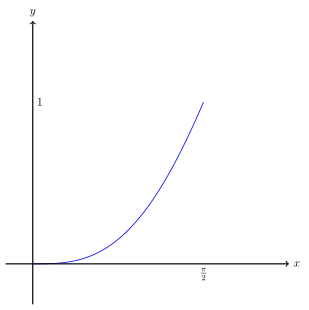
- \(\,\) \begin{align*} \int_0^{\frac{1}{2}\pi}\,y\;\d x &= \int_0^{\frac{1}{2}\pi} (\sin x - x \cos x) \d x \\ &= \left [-\cos x \right]_0^{\frac{1}{2}\pi} +\left [ -x \sin x \right]_0^{\frac{1}{2}\pi} + \int_0^{\frac{1}{2}\pi} \sin x \d x \\ &= 1-\frac{\pi}{2} + 1 = 2 - \frac{\pi}{2} \end{align*}
- \(\,\) \begin{align*} \int_0^{\frac{1}{2}\pi}y^2\d x &= \int_0^{\frac{1}{2}\pi} (\sin x - x \cos x)^2 \d x \\ &= \int_0^{\frac{1}{2}\pi} (\sin^2x - 2x\sin x \cos x+x^2\cos^2 x) \d x\\ &= \int_0^{\frac{1}{2}\pi} (\sin^2x -x \sin 2x+\tfrac12x^2(\cos 2 x + 1)) \d x\\ &= \frac{\pi}{4} + \frac{\pi^3}{48} + \int_0^{\frac{1}{2}\pi} (-x \sin 2x+\tfrac12x^2\cos 2 x) \d x \\ &= \frac{\pi}{4} + \frac{\pi^3}{48} + \left [\frac12 x \cos 2x +\frac14 x^2 \sin2x\right]_0^{\frac{1}{2}\pi}-\int_0^{\frac{1}{2}\pi}(\tfrac12 \cos 2x +\tfrac12 x \sin 2x) \d x\\ &= \frac{\pi}{4} + \frac{\pi^3}{48} - \frac{\pi}{4} - \left [ \frac14 \sin 2x \right]_0^{\frac{1}{2}\pi} - \int_0^{\frac{1}{2}\pi} \tfrac12 x \sin 2x \d x\\ &= \frac{\pi^3}{48} - \left( \left[ -\frac14 x \cos 2x \right]_0^{\frac{1}{2}\pi} - \int_0^{\frac{1}{2}\pi} -\frac14 \cos 2x \d x \right)\\ &= \frac{\pi^3}{48} - \left( \frac{\pi}{8} + \left[ \frac18 \sin 2x \right]_0^{\frac{1}{2}\pi} \right)\\ &= \frac{\pi^3}{48} - \frac{\pi}{8} \end{align*}
2004 Paper 1 Q4
Differentiate \(\sec {t}\) with respect to \(t\).
- Use the substitution \(x=\sec t\) to show that $\displaystyle \int^2_{\sqrt 2} \frac{1}{ x^3\sqrt {x^2-1} } \; \mathrm{d}x =\frac{\sqrt 3 - 2}{8} + \frac {\pi}{24} \;.$
- Determine $\displaystyle \int \frac{1} {( x+2) \sqrt {(x+1)(x+3)} } \; \mathrm{d}x \;$.
- Determine $\displaystyle \int \frac {1} {(x+2) \sqrt {x^2+4x-5} } \; \mathrm{d}x \;$.
Solution: \[\frac{\d}{\d t} \left ( \sec t \right) = \frac{\sin t }{\cos^2 t} = \sec t \tan t \]
- \(\,\) \begin{align*} && I_1 &= \int_{\sqrt{2}}^2 \frac{1}{x^3 \sqrt{x^2-1}} \\ x = \sec t, \d x = \sec t \tan t:&&&= \int_{t=\pi/4}^{t=\pi/3} \frac{1}{\sec^3 t \tan t} \sec t \tan t \d t \\ &&&= \int_{t=\pi/4}^{t=\pi/3} \cos^2 t \d t \\ &&&= \int_{t=\pi/4}^{t=\pi/3} \frac{1+\cos 2t}{2} \d t \\ &&&= \frac12 \frac{\pi}{12} + \frac12 \left (\sin \frac{\pi}{3} - \sin \frac{\pi}{4} \right) \\ &&&= \frac{\pi}{24} + \frac{\sqrt{3}-2}{8} \\ \end{align*}
- \(\,\) \begin{align*} && I_2 &= \int \frac{1}{(x+2)\sqrt{(x+1)(x+3)}} \d x \\ &&&= \int \frac{1}{(x+2)\sqrt{(x+2)^2-1}} \d x \\ &&&= \int \frac{1}{u\sqrt{u^2-1}} \d u \\ &&&= \sec^{-1} u + C \\ &&&= \sec^{1} (x+2) + C \end{align*}
- \(\,\) \begin{align*} && I_3 &= \int \frac{1}{(x+2)\sqrt{(x+2)^2 - 9}} \d x \\ &&&= \int\frac{1}{9(\frac{x+2}{3})\sqrt{(\frac{x+2}3)^2 - 1}} \d x \\ u = \frac{x+2}{3}, 3\d u =\d x &&&= \frac19 \int \frac{1}{u\sqrt{u^2-1}} 3 \d u \\ &&&= \frac13 \sec^{-1} u + C \\ &&&= \frac13 \sec^{-1} \frac{x+2}{3} + C \end{align*}
2004 Paper 3 Q1
Show that \[ \int_0^a \frac{\sinh x}{2\cosh^2 x -1} \, \mathrm{d} x = \frac{1}{2 \sqrt{2}} \ln \l \frac{\sqrt{2}\cosh a -1}{\sqrt{2}\cosh a +1}\r + \frac{1}{2 \sqrt{2}} \ln \l \frac{\sqrt{2}+1}{\sqrt{2}-1}\r \] and find \[ \int_0^a \frac{\cosh x}{1+2\sinh^2 x} \, \mathrm{d} x \, . \] Hence show that \[ \int_0^\infty \frac{\cosh x - \sinh x}{1+2\sinh^2 x} \, \mathrm{d} x = \frac{\pi}{2\sqrt{2}} - \frac{1}{2 \sqrt{2}} \ln \l \frac{\sqrt{2}+1}{\sqrt{2}-1}\r \, . \] By substituting \(u = \e^x\) in this result, or otherwise, find \[ \int_1^\infty \frac{1}{1+u^4} \, \mathrm{d} u \, . \]
2003 Paper 1 Q6
Evaluate the following integrals, in the different cases that arise according to the value of the positive constant \(a\,\):
- \[ \displaystyle \int_0^1 \frac 1 {x^2 + (a+2)x +2a} \; \d x \]
- \[\displaystyle \int _{1}^2\frac 1 {u^2 +au +a-1} \; \d u\]
Solution:
- \(\,\) \begin{align*} && I &= \int_0^1 \frac 1 {x^2 + (a+2)x +2a} \; \d x \\ &&&= \int_0^1 \frac{1}{(x+a)(x+2)} \d x\\ \end{align*} Case 1: \(a = 2\) \begin{align*} && I &= \int_0^1 \frac{1}{(x+2)^2} \d x \\ &&&= \left [ -(x+2)^{-1}\right]_0^1 = \frac12 - \frac13 = \frac16 \end{align*} Case 2: \(a \neq 2, a \not \in [0,1]\) \begin{align*} && I &=\frac{1}{a-2} \int_0^1 \left ( \frac{1}{x+2} - \frac{1}{x+a} \right) \d x \\ &&&= \frac{1}{a-2} \left [ \ln |x+2| - \ln |x + a|\right]_0^1 \\ &&&= \frac{1}{a-2} \left ( \ln \frac{3}{|1+a|} - \ln \frac{2}{|a|} \right) \\ &&&= \frac{1}{a-2} \ln \frac{3|a|}{2|a+1|} \end{align*} Case 3: \(a \in [0, 1]\), \(I\) does not converge
- \(\,\) \begin{align*} && J &= \int _{1}^2\frac 1 {u^2 +au +a-1} \; \d u \\ &&&= \int_1^2 \frac{1}{(u+a-1)(u+1)} \d u \\ x = u-1:&&&= \int_0^1 \frac{1}{(x+a)(x+2)} \d x \end{align*} So it's the same as the previous integral
2002 Paper 1 Q7
Let \[ I= \int_0^a \frac {\cos x}{\sin x + \cos x} \; \d x \, \quad \mbox{ and } \quad J= \int_0^a \frac {\sin x}{\sin x + \cos x} \; \d x \;, \] where \(0\le a < \frac{3}{4}\pi\,\). By considering \(I+J\) and \(I-J\), show that $ 2I= a + \ln (\sin a +\cos a)\;. $ Find also:
- \(\displaystyle \int_0^{\frac{1}{2}\pi} \frac {\cos x}{p\sin x + q\cos x} \; \d x \,\), where \(p\) and \(q\) are positive numbers; %
- [(ii)] %\(\displaystyle \int_0^{\frac{1}{2}\pi/2} \frac {\cos x}{\sin (x+k)} \; \d x \,\), where \(0 < k < \pi/2\,\);
- \(\displaystyle \int_0^{\frac{1}{2}\pi} \frac {\cos x+4}{3\sin x + 4\cos x+ 25} \; \d x \,\).
Solution: \begin{align*} && I + J &= \int_0^a \frac{\sin x + \cos x}{\sin x + \cos x } \d x = a \\ && I - J &= \int_0^a \frac{\cos x - \sin x}{\sin x + \cos x} \d x \\ &&&= \left [\ln ( \sin x + \cos x) \right]_0^a = \ln (\sin a + \cos a) - \ln 1 = \ln(\sin a + \cos a) \\ \\ \Rightarrow && 2I &= a + \ln(\sin a + \cos a) \end{align*}
- Let \(\displaystyle I = \int_0^{\frac12 \pi} \frac{\cos x}{p \sin x + q \cos x} \d x, J = \int_0^{\frac12 \pi} \frac{\sin x}{p \sin x + q \cos x} \d x\) so \begin{align*} && qI + pJ &= \frac{\pi}{2} \\ && pI - qJ &= \int_0^{\frac12 \pi} \frac{p \cos x - q \sin x}{p \sin x + q \cos x } \d x \\ &&&= \left [\ln (p \sin x + q \cos x) \right]_0^{\pi/2} \\ &&&= \ln(p) - \ln(q) = \ln \frac{p}{q} \end{align*}
- \(\,\) \begin{align*} && \int_0^{\frac{\pi}{2}} \frac{\cos x}{\sin(x + k)} \d x &= \int_0^{\frac{\pi}{2}} \frac{\cos x}{\sin(x) \cos(k) + \cos(x) \sin (k)} \d x \\ &&&= \ln \tan k \end{align*}
- Let \(\displaystyle I = \int_0^{\pi/2} \frac{\cos x + 4}{3 \sin x + 4 \cos x + 25} \d x, J = \int_0^{\pi/2} \frac{\sin x + 3}{3 \sin x + 4 \cos x + 25} \d x\), so \begin{align*} && 4I + 3J &= \int_0^{\pi/2} \frac{3 \sin x + 4 \cos x + 25}{3 \sin x + 4 \cos x + 25} \d x \\ &&&= \frac{\pi}{2} \\ && 3I - 4J &= \int_0^{\pi/2} \frac{3\cos x - 4 \sin x}{3 \sin x + 4 \cos x + 25} \d x \\ &&&= \left [\ln(3 \sin x + 4 \cos x + 25) \right]_0^{\pi/2} \\ &&&= \ln (28) - \ln (29) = \ln \frac{28}{29} \\ \Rightarrow && 25I &= 2\pi + 3 \ln \frac{28}{29} \\ \Rightarrow && I &= \frac{2}{25} \pi + \frac{3}{25} \ln \frac{28}{29} \end{align*}
2002 Paper 2 Q1
Show that \[ \int_{\frac{1}{6}\pi}^{\frac{1}{4}\pi} \frac 1{1-\cos2\theta} \;\d\theta = \frac{\sqrt3}2 - \frac12\;. \] By using the substitution \(x=\sin2\theta\), or otherwise, show that \[ \int_{\sqrt3/2}^1 \frac 1 {1-\sqrt{1-x^2}} \, \d x = \sqrt 3 -1 -\frac\pi 6 \;. \] Hence evaluate the integral \[ \int_1^{2/\sqrt3} \frac 1{y ( y - \sqrt{y^2-1^2})} \, \d y \;. \]
Solution: \begin{align*} && I &= \int_{\frac{1}{6}\pi}^{\frac{1}{4}\pi} \frac 1{1-\cos2\theta} \;\d\theta \\ &&&= \int_{\frac{1}{6}\pi}^{\frac{1}{4}\pi} \frac 1{2\sin^2 \theta} \;\d\theta \\ &&&= \frac12\int_{\frac{1}{6}\pi}^{\frac{1}{4}\pi} \cosec^2 \theta \;\d\theta \\ &&&= \frac12\left [-\cot \theta \right]_{\frac{1}{6}\pi}^{\frac{1}{4}\pi} \\ &&&= \frac12 \left (\cot \frac{\pi}{6} - \cot \frac{\pi}{4} \right)\\ &&&= \frac{\sqrt{3} - 1}{2} \end{align*} \begin{align*} && J &= \int_{\sqrt3/2}^1 \frac 1 {1-\sqrt{1-x^2}} \, \d x \\ x = \sin 2 \theta, \d x = 2\cos 2\theta \d \theta &&&=\int_{\pi/6}^{\pi/4} \frac{2 \cos 2 \theta }{1-\cos 2 \theta} \d \theta \\ &&&=\int_{\pi/6}^{\pi/4} \frac{2 \cos 2 \theta -2+2}{1-\cos 2 \theta} \d \theta \\ &&&= -2\left (\frac{\pi}{4} - \frac{\pi}6 \right) + 2I \\ &&&= \sqrt{3}-1-\frac{\pi}{6} \end{align*} \begin{align*} && K &= \int_1^{2/\sqrt{3}} \frac{1}{y(y-\sqrt{y^2-1})} \d y \\ y = 1/x, \d x = -1/y^2 \d y &&&= \int_{x=1}^{x=\sqrt{3}/2} \frac{1}{1-\sqrt{1-x^2}} \d x\\ &&&= \sqrt{3}-1 -\frac{\pi}6 \end{align*}
2002 Paper 2 Q4
Give a sketch to show that, if \(\f(x) > 0\) for \(p < x < q\,\), then \(\displaystyle \int_p^{q} \f(x) \d x > 0\,\).
- By considering \(\f(x) = ax^2-bx+c\,\) show that, if \(a > 0\) and \(b^2 < 4ac\), then \(3b < 2a+6c\,\).
- By considering \(\f(x)= a\sin^2x - b\sin x + c\,\) show that, if \(a > 0\) and \(b^2< 4ac\), then \(4b < (a+2c)\pi\)
- Show that, if \(a > 0\), \(b^2 < 4ac\) and \(q > p > 0\,\), then $$ b\ln(q/p) < a\left(\frac1p -\frac1q\right) +c(q-p)\;. $$
Solution:
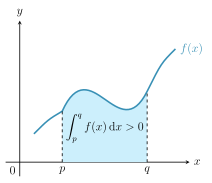
- If \(a > 0\) and \(b^2 < 4ac \Rightarrow \Delta < 0\) then \(f(x) = ax^2-bx+c > 0\) for all \(x\). Therefore \begin{align*} && 0 & < \int_0^1 (ax^2-bx+c) \d x\\ &&&= \frac13 a-\frac12b+c \\ \Rightarrow && 3b &< 2a+6c \end{align*}
- Similar logic tells us this must also be always positive, therefore \begin{align*} && 0 &< \int_0^{\pi} (a \sin^2 x - b \sin x +c ) \d x\\ &&&= \frac{\pi}{2}a - 2b+\pi c \\ \Rightarrow && 4b &< (a+2c)\pi \end{align*}
- Similar logic shows that \(f(x) = \frac{a}{x^2}-\frac{b}{x} +c>0\), therefore \begin{align*} && 0 &< \int_p^q \left (\frac{a}{x^2} - \frac{b}{x} + c\right) \d x \\ &&&=a\left (\frac{1}{p} - \frac{1}{q} \right) - b(\ln q - \ln p)+c(q-p) \\ \Rightarrow && b \ln (q/p) &,< a\left (\frac{1}{p} - \frac{1}{q} \right) +c(q-p) \end{align*}
2001 Paper 1 Q5
Show that (for \(t>0\))
- \[ \int_0^1 \frac1{(1+tx)^2} \d x = \frac1{(1+t)} \]
- \[ \int_0^1 \frac{-2x}{(1+tx)^3} \d x = -\frac1{(1+t)^2} \]
Solution:
- For the first one, consider \begin{align*} && \int_0^1 \frac{1}{(1+tx)^2} \d x &= \left [ -\frac{1}{t}(1+tx)^{-1} \right]_0^1 \\ &&&= \frac{1}{t} - \frac{1}{t(1+t)} \\ &&&= \frac{t+1-1}{t(t+1)} = \frac{1}{t+1} \end{align*}
- Consider \begin{align*} && \int_0^1 \frac{-2x}{(1+tx)^3} \d x &= \int_0^1 \frac{\frac{2}{t}(1+tx) -\frac{2}{t}}{(1+tx)^3} \d x \\ &&&= -\frac{2}{t} \int_0^1 \left (\frac{1}{(1+tx)^2}- \frac{1}{(1+tx)^3} \right) \d x \\ &&&= -\frac{2}{t} \frac{1}{t+1} + \frac{2}{t} \left [ \frac{1}{-2t}(1+tx)^{-2}\right]_0^1 \\ &&&= -\frac{2}{t(t+1)} + \frac2t\left (\frac{1}{2t} - \frac{1}{2t(1+t)^2} \right) \\ &&&= -\frac{2}{t} \left ( \frac{1}{t+1} + \frac{1}{2t(1+t)^2} - \frac{1}{2t}\right) \\ &&&= -\frac{2}{t} \frac{2t(1+t)+1-(1+t)^2}{2t(1+t)^2} \\ &&&= -\frac{2}{t} \frac{2t^2+2t+1-1-2t-t^2}{2t(1+t)^2} \\ &&&= -\frac{1}{(1+t)^2} \end{align*}
2001 Paper 2 Q6
Show that \[ \int_0^1 \frac{x^4}{1+x^2} \, \d x = \frac \pi {4} - \frac 23 \;. \] Determine the values of
- \(\displaystyle \int_0^1 x^3 \; \tan ^{-1} \left(\frac {1-x} {1+x} \right) \,\d x \)
- \(\displaystyle \int_0^1 \frac {(1-y)^3} {(1+y)^5} \; {{\tan}^{-1} y}\, \d y\)
Solution: \begin{align*} && \int_0^1 \frac{x^4}{1+x^2} \d x &= \int_0^1 \frac{(x^2-1)(1+x^2)+1}{x^2+1} \d x\\ &&&= \int_0^1 \frac{1}{1+x^2} \d x -\int_0^1 (1-x^2) \d x \\ &&&= \left [\tan^{-1}x \right]_0^1 - \left [x - \tfrac13x^3 \right]_0^1 \\ &&&= \frac{\pi}{4} - \frac23 \end{align*}
- \(\,\) \begin{align*} && I &= \int_0^1 x^3 \; \tan ^{-1} \left(\frac {1-x} {1+x} \right) \,\d x \\ &&&= \left [ \frac{x^4}{4}\tan ^{-1} \left(\frac {1-x} {1+x} \right) \right]_0^1 -\int_0^1 \frac{x^4}{4} \frac{1}{1 +\left(\frac {1-x} {1+x} \right) ^2 } \cdot \frac{-2}{(1+x)^2} \d x \\ &&&= \frac{1}{2} \int_0^1 \frac{x^4}{(1+x)^2+(1-x)^2} \d x \\ &&&= \frac{1}{4} \int_0^1 \frac{x^4}{1+x^2} \d x \\ &&&= \frac{\pi}{16} - \frac{1}{6} \end{align*}
- \(\,\) \begin{align*} && J &= \int_0^1 \frac {(1-y)^3} {(1+y)^5} \; {{\tan}^{-1} y}\, \d y \\ &&&= \left [ \frac {(y(1+y^2)} {(1+y)^4} \tan^{-1}y \right]_0^1 - \int_0^1 \frac {(y(1+y^2)} {(1+y)^4} \frac{1}{1+y^2} \d y \\ &&&= \frac{\pi}{32} - \int_0^1 \frac{y}{(1+y)^4} \d y \\ &&&= \frac{\pi}{32} - \left[ - \frac{3y+1}{6(1+y)^3} \right]_0^1 \\ &&&= \frac{\pi}{32} +\frac{4}{6 \cdot 8} - \frac{1}{6} \\ &&&= \frac{\pi}{32} - \frac{1}{12} \end{align*}