Problems
Filters
54 problems found
1999 Paper 3 Q11
Calculate the moment of inertia of a uniform thin circular hoop of mass \(m\) and radius \(a\) about an axis perpendicular to the plane of the hoop through a point on its circumference. The hoop, which is rough, rolls with speed \(v\) on a rough horizontal table straight towards the edge and rolls over the edge without initially losing contact with the edge. Show that the hoop will lose contact with the edge when it has rotated about the edge of the table through an angle \(\theta\), where \[ \cos\theta = \frac 12 +\frac {v^2}{2ag}. \] %Give the corresponding result for a smooth hoop and table.
1997 Paper 1 Q10
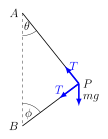
The point \(A\) is vertically above the point \(B\). A light inextensible string, with a smooth ring \(P\) of mass \(m\) threaded onto it, has its ends attached at \(A\) and \(B\). The plane \(APB\) rotates about \(AB\) with constant angular velocity \(\omega\) so that \(P\) describes a horizontal circle of radius \(r\) and the string is taut. The angle \(BAP\) has value \(\theta\) and the angle \(ABP\) has value \(\phi\). Show that \[\tan\frac{\phi-\theta}{2}=\frac{g}{r\omega^{2}}.\] Find the tension in the string in terms of \(m\), \(g\), \(r\), \(\omega\) and \(\sin\frac{1}{2}(\theta+\phi)\). Deduce from your results that if \(r\omega^2\) is small compared with \(g\), then the tension is approximately \(\frac{mg}{2}\)
Solution: None \begin{multicols}{2}
1996 Paper 2 Q10
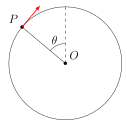
The plot of `Rhode Island Red and the Henhouse of Doom' calls for the heroine to cling on to the circumference of a fairground wheel of radius \(a\) rotating with constant angular velocity \(\omega\) about its horizontal axis and then let go. Let \(\omega_{0}\) be the largest value of \(\omega\) for which it is not possible for her subsequent path to carry her higher than the top of the wheel. Find \(\omega_{0}\) in terms of \(a\) and \(g\). If \(\omega>\omega_{0}\) show that the greatest height above the top of the wheel to which she can rise is \[\frac{a}{2}\left(\frac{\omega}{\omega_{0}} -\frac{\omega_{0}}{\omega}\right)^{\!\!2}.\]
Solution:
1996 Paper 3 Q9
A particle of mass \(m\) is at rest on top of a smooth fixed sphere of radius \(a\). Show that, if the particle is given a small displacement, it reaches the horizontal plane through the centre of the sphere at a distance % at least $$a(5\sqrt5+4\sqrt23)/27$$ from the centre of the sphere. [Air resistance should be neglected.]
1996 Paper 3 Q11
A smooth circular wire of radius \(a\) is held fixed in a vertical plane with light elastic strings of natural length \(a\) and modulus \(\lambda\) attached to the upper and lower extremities, \(A\) and \(C\) respectively, of the vertical diameter. The other ends of the two strings are attached to a small ring \(B\) which is free to slide on the wire. Show that, while both strings remain taut, the equation for the motion of the ring is $$2ma \ddot\theta=\lambda(\cos\theta-\sin\theta)-mg\sin\theta,$$ where \(\theta\) is the angle \( \angle{CAB}\). Initially the system is at rest in equilibrium with \(\sin\theta=\frac{3}{5}\). Deduce that \(5\lambda=24mg\). The ring is now displaced slightly. Show that, in the ensuing motion, it will oscillate with period approximately $$10\pi\sqrt{a\over91g}\,.$$
1994 Paper 1 Q10
One end \(A\) of a light elastic string of natural length \(l\) and modulus of elasticity \(\lambda\) is fixed and a particle of mass \(m\) is attached to the other end \(B\). The particle moves in a horizontal circle with centre on the vertical through \(A\) with angular velocity \(\omega.\) If \(\theta\) is the angle \(AB\) makes with the downward vertical, find an expression for \(\cos\theta\) in terms of \(m,g,l,\lambda\) and \(\omega.\) Show that the motion described is possible only if \[ \frac{g\lambda}{l(\lambda+mg)}<\omega^{2}<\frac{\lambda}{ml}. \]
1993 Paper 3 Q14
A particle rests at a point \(A\) on a horizontal table and is joined to a point \(O\) on the table by a taut inextensible string of length \(c\). The particle is projected vertically upwards at a speed \(64\surd(6gc)\). It next strikes the table at a point \(B\) and rebounds. The coefficient of restitution for any impact between the particle and the table is \({1\over 2}\). After rebounding at \(B\), the particle will rebound alternately at \(A\) and \(B\) until the string becomes slack. Show that when the string becomes slack the particle is at height \(c/2\) above the table. Determine whether the first rebound between \(A\) and \(B\) is nearer to \(A\) or to \(B\).
Solution: \begin{align*} \text{N2}(radially): && T + mg \cos \theta &= m\frac{v^2}{r} \\ \Rightarrow && v^2-gc \cos \theta &\geq 0 \\ \text{COE}: && \frac12 m u^2 &= \frac12mv^2 + mgc\cos \theta \\ \Rightarrow && u^2 &= v^2 + 2gc\cos \theta \\ && u^2 &\geq gc \cos \theta+2gc\cos \theta \\ \Rightarrow && u^2 &\geq 3gc\cos \theta \end{align*} Therefore it will complete bounces with the string taught if it leaves the table with \(u^2 \geq 3gc\). After \(6\) bounces it will leave the table with speed \(\sqrt{6gc} > \sqrt{3gc}\) and after \(7\) bounces it will leave the table with speed \(\sqrt{\frac{3}{2} gc} < \sqrt{3 gc}\). When it leaves the table with speed \(\sqrt{\tfrac32 gc}\), the string will go slack when \begin{align*} && \tfrac32 gc &= 3gc \cos \theta \\ \Rightarrow && \cos \theta &= \frac{1}{2} \end{align*} ie at a height \(c\cos \theta = \frac12c\) above the table. Once the string goes slack, the particle travels under circular motion, \begin{align*} && u^2 &= \frac12 gc \\ \Rightarrow && u_\rightarrow &= \sqrt{\tfrac12 gc} \cos \theta \\ && u_{\uparrow} &= \sqrt{\tfrac12 gc} \sin \theta \\ \Rightarrow && s &= ut - \tfrac12 gt^2 \\ \Rightarrow && -\frac{c}{2} &= \sqrt{\tfrac12 gc} \frac{\sqrt{3}}{2} t - \tfrac12 g t^2 \\ \Rightarrow && t &= \sqrt{\frac{c}{g}} \left ( \frac{\sqrt{6}+\sqrt{22}}{4} \right) \\ \Rightarrow && s_{\rightarrow} &= \tfrac12 \sqrt{\tfrac12 gc} \sqrt{\frac{c}{g}} \left ( \frac{\sqrt{6}+\sqrt{22}}{4} \right) - \frac{\sqrt{3}}{2}c \\ &&&= \left ( \frac{\sqrt{11}-3\sqrt{3}}{8} \right)c \\ \end{align*} We need to establish whether this position is positive or negative (ie if we cross the centre line. Clearly \(\sqrt{11} < 3\sqrt{3}\) so we haven't crossed the centre line and we land closer to where we took off. Since it's the 7th take off, this is closer to \(B\).
1992 Paper 3 Q12
\(\,\)
1992 Paper 3 Q14
\(\,\)
1991 Paper 1 Q13
\(\ \)\vspace{-1.5cm} \noindent
1991 Paper 3 Q11
1991 Paper 3 Q12
A smooth tube whose axis is horizontal has an elliptic cross-section in the form of the curve with parametric equations \[ x=a\cos\theta\qquad y=b\sin\theta \] where the \(x\)-axis is horizontal and the \(y\)-axis is vertically upwards. A particle moves freely under gravity on the inside of the tube in the plane of this cross-section. By first finding \(\ddot{x}\) and \(\ddot{y},\) or otherwise, show that the acceleration along the inward normal at the point with parameter \(\theta\) is \[ \frac{ab\dot{\theta}^{2}}{\sqrt{a^{2}\sin^{2}\theta+b^{2}\cos^{2}\theta}}. \] The particle is projected along the surface in the vertical cross-section plane, with speed \(2\sqrt{bg},\) from the lowest point. Given that \(2a=3b,\) show that it will leave the surface at the point with parameter \(\theta\) where \[ 5\sin^{3}\theta+12\sin\theta-8=0. \]
1991 Paper 3 Q14
1990 Paper 3 Q11
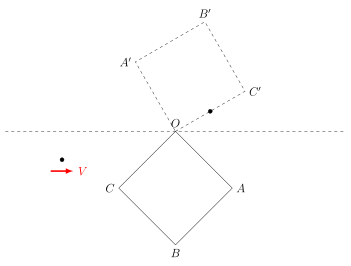
The points \(O,A,B\) and \(C\) are the vertices of a uniform square lamina of mass \(M.\) The lamina can turn freely under gravity about a horizontal axis perpendicular to the plane of the lamina through \(O\). The sides of the lamina are of length \(2a.\) When the lamina is haning at rest with the diagonal \(OB\) vertically downwards it is struck at the midpoint of \(OC\) by a particle of mass \(6M\) moving horizontally in the plane of the lamina with speed \(V\). The particle adheres to the lamina. Find, in terms of \(a,M\) and \(g\), the value which \(V^{2}\) must exceed for the lamina and particle to make complete revolutions about the axis.
Solution:
1990 Paper 3 Q13
A particle \(P\) is projected, from the lowest point, along the smooth inside surface of a fixed sphere with centre \(O\). It leaves the surface when \(OP\) makes an angle \(\theta\) with the upward vertical. Find the smallest angle that must be exceeded by \(\theta\) to ensure that \(P\) will strike the surface below the level of \(O\). You may find it helpful to find the time at which the particle strikes the sphere.
Solution:
