Problems
Filters
1531 problems found
2013 Paper 3 Q7
- Let \(y(x)\) be a solution of the differential equation \( \dfrac {\d^2 y}{\d x^2}+y^3=0\) with \(y = 1\) and \(\dfrac{\d y}{\d x} =0\) at \(x=0\), and let \[ {\rm E} (x)= \left ( \frac {\d y}{\d x}\right)^{\!\!2} + \tfrac 12 y^4\,. \] Show by differentiation that \({\rm E}\) is constant and deduce that \( \vert y(x) \vert \le 1\) for all \(x\).
- Let \(v(x)\) be a solution of the differential equation \( \dfrac{\d^2 v}{\d x^2} + x \dfrac {\d v}{\d x} +\sinh v =0\) with \(v = \ln 3\) and \(\dfrac{\d v}{\d x} =0\) at \(x=0\), and let \[ {\rm E} (x)= \left ( \frac {\d v}{\d x}\right)^{\!\!2} + 2 \cosh v\,. \] Show that \(\dfrac{\d{\rm E}}{\d x}\le 0\) for \(x\ge0\) and deduce that \(\cosh v(x) \le \frac53\) for \(x\ge0\).
- Let \(w(x)\) be a solution of the differential equation \[ \frac{\d^2 w}{\d x^2} + (5\cosh x - 4 \sinh x -3) \frac{\d w}{\d x} + (w\cosh w + 2 \sinh w) =0 \] with \(\dfrac{\d w }{\d x}=\dfrac 1 { \sqrt 2 }\) and \(w=0\) at \(x=0\). Show that \(\cosh w(x) \le \frac54\) for \(x\ge0\).
Solution:
- \(\,\) \begin{align*} && E(x) &= \left ( \frac{\d y}{\d x} \right)^2 + \frac12 y^4 \\ \Rightarrow && E'(x) &= 2 \frac{\d y}{\d x} \frac{\d^2 y}{\d x^2} + 2y^3 \frac{\d y}{\d x} \\ &&&= 2\frac{\d y}{\d x} \left ( \frac{\d^2 y}{\d x^2} + y^3 \right) \\ &&&= 0 \end{align*} Therefore \(E\) is constant. \(E(0) = \frac12\) and \begin{align*} &&\frac12 &= \left ( \frac{\d y}{\d x} \right)^2 + \frac12 y^4 \\ &&&\geq \frac12 y^4 \\ \Rightarrow && |y| &\leq 1 \end{align*}
- \(\,\) \begin{align*} && E(x) &= \left ( \frac{\d v}{\d x} \right)^2 + 2 \cosh v \\ \Rightarrow && E'(x) &= 2 \frac{\d v}{\d x}\frac{\d^2 v}{\d^2 x} + 2 \sinh v \frac{\d v}{\d x} \\ &&&= 2 \frac{\d v}{\d x} \left ( \frac{\d^2 v}{\d^2 x} + \sinh v\right) \\ &&&= 2 \frac{\d v}{\d x} \left ( -x \frac{\d v}{\d x}\right) \\ &&&= -2x \left ( \frac{\d v}{\d x} \right)^2 \leq 0 \tag{\(x \geq 0\)} \\ \\ && E(0) &= 0^2 + 2 \cosh \ln 3 \\ &&&= 3 + \frac13 = \frac{10}{3} \\ \Rightarrow && \frac{10}{3} &\geq E(x) \\ &&&= \left ( \frac{\d v}{\d x} \right)^2 + 2 \cosh v \\ &&&\geq 2 \cosh v \\ \Rightarrow && \cosh v &\leq \frac53 \end{align*}
- \(\,\) \begin{align*} && E(x) &= \left ( \frac{\d w}{\d x} \right)^2 + 2(w \sinh w + \cosh w) \\ && E'(x) &= 2 \frac{\d w}{\d x}\frac{\d^2 w}{\d^2 x} + 2(w \cosh w + 2 \sinh w) \frac{\d w}{\d x} \\ &&&= 2 \frac{\d w}{\d x} \left ( \frac{\d^2 w}{\d^2 x}+(w \cosh w + 2 \sinh w)\right) \\ &&&= -2 \left ( \frac{\d w}{\d x} \right)^2 \left (\underbrace{5\cosh x - 4 \sinh x -3}_{\geq0} \right) \\ &&&\leq 0 \\ && E(0) &= \frac12 + 2 = \frac52 \\ \Rightarrow && \frac52 &\geq E(x) \\ &&&=\underbrace{ \left ( \frac{\d w}{\d x} \right)^2}_{\geq0} + 2(\underbrace{w \sinh w}_{\geq 0} + \cosh w) \\ &&&\geq2\cosh w \\ \Rightarrow && \cosh w &\leq \frac54 \end{align*}
2013 Paper 3 Q8
Evaluate \(\displaystyle \sum_{r=0}^{n-1} \e^{2i(\alpha + r\pi/n)}\) where \(\alpha\) is a fixed angle and \(n\ge2\). The fixed point \(O\) is a distance \(d\) from a fixed line \(D\). For any point \(P\), let \(s\) be the distance from \(P\) to \(D\) and let \(r\) be the distance from \(P\) to \(O\). Write down an expression for \(s\) in terms of \(d\), \(r\) and the angle \(\theta\), where \(\theta\) is as shown in the diagram below.

Solution: \begin{align*} \sum_{r=0}^{n-1} \e^{2i(\alpha + r\pi/n)} &= e^{2i\alpha} \sum_{r=0}^{n-1} \left (\e^{2i\pi/n} \right)^r \\ &= e^{2i\alpha} \frac{1-\left (\e^{2i\pi/n} \right)^n}{1-\e^{2i\pi/n} } \\ &= 0 \end{align*} \(d = s + r \cos \theta\) ie \(s = d - r \cos \theta\) Therefore \(d = \frac{r}{k} + r \cos \theta \Rightarrow r = \frac{kd}{1+k \cos \theta}\). The \(l_j\) will come from \(r(\alpha + \frac{j \pi}{n} )+r(\alpha + \pi + \frac{j \pi}{n} )\) \begin{align*} && l_j &= r(\alpha + \frac{(j-1) \pi}{n} )+r(\alpha + \pi + \frac{(j-1) \pi}{n} ) \\ &&&= \frac{kd}{1+k \cos \left ( \alpha + \frac{(j-1) \pi}{n}\right)}+\frac{kd}{1+k \cos \left ( \alpha+\pi+ \frac{(j-1) \pi}{n}\right)}\\ &&&= \frac{kd}{1+k \cos \left ( \alpha + \frac{(j-1) \pi}{n}\right)}+\frac{kd}{1-k \cos \left ( \alpha+ \frac{(j-1) \pi}{n}\right)}\\ &&&= \frac{2kd}{1-k^2 \cos^2 \left ( \alpha + \frac{(j-1) \pi}{n}\right)}\\ \Rightarrow && \sum_{j=1}^n \frac 1 {l_j} &= \sum_{j=0}^{n-1} \frac{1-k^2 \cos^2 \left ( \alpha + \frac{j \pi}{n}\right)}{2kd} \\ &&&= \frac{n}{2kd}-\frac{k^2}{2kd} \sum_{j=0}^{n-1} \cos^2 \left ( \alpha + \frac{j \pi}{n}\right) \\ &&&= \frac{n}{2kd}-\frac{k^2}{2kd} \sum_{j=0}^{n-1} \frac{1+ \cos \left ( 2\alpha + \frac{2j \pi}{n}\right)}{2} \\ &&&= \frac{n}{2kd}-\frac{nk^2}{2kd}-\frac{k^2}{4kd} \sum_{j=0}^{n-1}\cos \left ( 2\alpha + \frac{2j \pi}{n}\right) \\ &&&= \frac{n}{2kd}-\frac{nk^2}{2kd}-\frac{k^2}{4kd} \underbrace{\textrm{Re} \left ( \sum_{j=0}^{n-1}e^{ 2i(\alpha + \frac{j \pi}{n})} \right)}_{=0} \\ &&&= \frac{n}{2kd} - \frac{nk^2}{4kd} \\ &&&= \frac{n(2-k^2)}{4kd} \end{align*}
2013 Paper 3 Q9
A sphere of radius \(R\) and uniform density \(\rho_{\text{s}}\) is floating in a large tank of liquid of uniform density \(\rho\). Given that the centre of the sphere is a distance \(x\) above the level of the liquid, where \(x < R\), show that the volume of liquid displaced is \[ \frac \pi 3 (2R^3-3R^2x +x^3)\,. \] The sphere is acted upon by two forces only: its weight and an upward force equal in magnitude to the weight of the liquid it has displaced. Show that \[ 4 R^3\rho_{\text{s}} (g+\ddot x) = (2R^3 -3R^2x +x^3)\rho g\,. \] Given that the sphere is in equilibrium when \(x=\frac12 R\), find \(\rho_{\text{s}}\) in terms of \(\rho\). Find, in terms of \(R\) and \(g\), the period of small oscillations about this equilibrium position.
2013 Paper 3 Q10
A uniform rod \(AB\) has mass \(M\) and length \(2a\). The point \(P\) lies on the rod a distance \(a-x\) from~\(A\). Show that the moment of inertia of the rod about an axis through \(P\) and perpendicular to the rod is \[ \tfrac13 M(a^2 +3x^2)\,. \] The rod is free to rotate, in a horizontal plane, about a fixed vertical axis through \(P\). Initially the rod is at rest. The end \(B\) is struck by a particle of mass \(m\) moving horizontally with speed \(u\) in a direction perpendicular to the rod. The coefficient of restitution between the rod and the particle is \(e\). Show that the angular velocity of the rod immediately after impact is \[ \frac{3mu(1+e)(a+x)}{M(a^2+3x^2) +3m(a+x)^2}\,. \] In the case \(m=2M\), find the value of \(x\) for which the angular velocity is greatest and show that this angular velocity is \(u(1+e)/a\,\).
2013 Paper 3 Q11
An equilateral triangle, comprising three light rods each of length \(\sqrt3a\), has a particle of mass \(m\) attached to each of its vertices. The triangle is suspended horizontally from a point vertically above its centre by three identical springs, so that the springs and rods form a tetrahedron. Each spring has natural length \(a\) and modulus of elasticity \(kmg\), and is light. Show that when the springs make an angle \(\theta\) with the horizontal the tension in each spring is \[ \frac{ kmg(1-\cos\theta)}{\cos\theta}\,. \] Given that the triangle is in equilibrium when \(\theta = \frac16 \pi\), show that \(k=4\sqrt3 +6\). The triangle is released from rest from the position at which \(\theta=\frac13\pi\). Show that when it passes through the equilibrium position its speed \(V\) satisfies \[ V^2 = \frac{4ag}3(6+\sqrt3)\,. \]
2013 Paper 3 Q12
A list consists only of letters \(A\) and \(B\) arranged in a row. In the list, there are \(a\) letter \(A\)s and \(b\) letter \(B\)s, where \(a\ge2\) and \(b\ge2\), and \(a+b=n\). Each possible ordering of the letters is equally probable. The random variable \(X_1\) is defined by \[ X_1 = \begin{cases} 1 & \text{if the first letter in the row is \(A\)};\\ 0 & \text{otherwise.} \end{cases} \] The random variables \(X_k\) (\(2 \le k \le n\)) are defined by \[ X_k = \begin{cases} 1 & \text{if the \((k-1)\)th letter is \(B\) and the \(k\)th is \(A\)};\\ 0 & \text{otherwise.} \end{cases} \] The random variable \(S\) is defined by \(S = \sum\limits_ {i=1}^n X_i\,\).
- Find expressions for \(\E(X_i)\), distinguishing between the cases \(i=1\) and \(i\ne1\), and show that \(\E(S)= \dfrac{a(b+1)}n\,\).
- Show that:
- for \(j\ge3\), \(\E(X_1X_j) = \dfrac{a(a-1)b}{n(n-1)(n-2)}\,\);
- \[ \sum\limits_{i=2}^{n-2} \bigg( \sum\limits_{j=i+2}^n \E(X_iX_j)\bigg) = \dfrac{a(a-1)b(b-1)}{2n(n-1)}\,\]
- \(\var(S) = \dfrac {a(a-1)b(b+1)}{n^2(n-1)}\,\).
Solution:
- Notice that \(\E[X_1] = \frac{a}{n}\) and consider \(\E[X_i]\) with \(i > 1\). the probability that this is \(1\) is \(\frac{b}{n} \cdot \frac{a}{n-1}\). So \begin{align*} && \E[S] &= \E[X_1] + \sum_{i=2}^n \E[X_i] \\ &&&= \frac{a}{n} + (n-1) \frac{ab}{n(n-1)} \\ &&&= \frac{a(b+1)}{n} \end{align*}
- The probability \(X_1X_j = 1\) is \(\frac{a}{n} \cdot \frac{b}{n-1} \cdot \frac{a-1}{n-2} = \frac{a(a-1)b}{n(n-1)(n-2)}\) since there is nothing special about the order, and the first is an \(A\) with probability \(\frac{a}{n}\) and given this occurs there are now \(a-1\) \(A\) and \(n-1\) letters left etc... Therefore \(\E[X_1X_j] = \frac{a(a-1)b}{n(n-1)(n-2)}\)
- \(\E[X_iX_j]\) when the pairs don't overlap is \(\frac{a}{n} \frac{b}{n-1} \frac{a-1}{n-2} \frac{b-1}{n-3}\), and so \begin{align*} && \sum\limits_{i=2}^{n-2} \bigg( \sum\limits_{j=i+2}^n \E(X_iX_j)\bigg) &= \sum\limits_{i=2}^{n-2} \bigg( \sum\limits_{j=i+2}^n \frac{a(a-1)b(b-1)}{n(n-1)(n-2)(n-3)}\bigg) \\ &&&= \frac{a(a-1)b(b-1)}{n(n-1)(n-2)(n-3)}\sum\limits_{i=2}^{n-2} \bigg( \sum\limits_{j=i+2}^n 1\bigg) \\ &&&= \frac{a(a-1)b(b-1)}{n(n-1)(n-2)(n-3)}\sum\limits_{i=2}^{n-2} (n-(i+1)) \\ &&&= \frac{a(a-1)b(b-1)}{n(n-1)(n-2)(n-3)} \left ((n-1)(n-3)-\frac{(n-2)(n-1)}{2}+1 \right) \\ &&&= \frac{a(a-1)b(b-1)}{n(n-1)(n-2)(n-3)} \left ( \frac{2n^2-8n-6-n^2+3n-2+2}{2}\right) \\ &&&= \frac{a(a-1)b(b-1)}{n(n-1)(n-2)(n-3)} \left ( \frac{n^2-5n-6}{2}\right) \\ &&&= \frac{a(a-1)b(b-1)}{2n(n-1)} \end{align*}
- We also need to consider the other cross terms. \(X_iX_{i+1}=0\). (Since \(X_i = 1\) means the \(i\)th letter is \(A\) and \(X_{i+1} = 1\) means the \(i\)th letter is \(B\)). It's the same story for \(X_1X_2\), and so all the cross terms are accounted for. Therefore \begin{align*} && \E[S^2] &= \E \left [\sum X_i^2 + 2\sum_{i \neq j} X_i X_j \right] \\ &&&= \frac{a(b+1)}{n} +2(n-2)\frac{a(a-1)b}{n(n-1)(n-2)}+ 2 \frac{a(a-1)b(b-1)}{2n(n-1)} \\ &&&= \frac{a(b+1)}{n} +\frac{2a(a-1)b}{n(n-1)} + \frac{a(a-1)b(b-1)}{n(n-1)} \\ &&&= \frac{a(b+1)}{n} +\frac{a(a-1)b(b+1)}{n(n-1)} \\ && \var[S] &= \E[S^2] - \left ( \E[S] \right)^2 \\ &&&= \frac{a(b+1)}{n} + \frac{a(a-1)b(b+1)}{n(n-1)} - \frac{a^2(b+1)^2}{n^2} \\ &&&= \frac{a(b+1) \left (n(n-1) + (a-1)b n -a(b+1)(n-1) \right)}{n^2(n-1)} \\ &&&= \frac{a(b+1) \left ( (n-a)(n-b-1) \right)}{n^2(n-1)} \\ &&&= \frac{a(b+1) \left ( b(a-1) \right)}{n^2(n-1)} \\ \end{align*}
2013 Paper 3 Q13
- The continuous random variable \(X\) satisfies
\(0\le X\le 1\), and has probability density function
\(\f(x)\) and cumulative distribution
function \(\F(x)\). The
greatest value of \(\f(x)\) is \(M\), so that \(0\le \f(x) \le M\).
- Show that \(0\le \F(x) \le Mx\) for \(0\le x\le1\).
- For any function \(\g(x)\), show that \[ \int_0^1 2 \g(x) \F(x) \f(x) \d x = \g(1) - \int_0^1 \g'(x) \big( \F(x)\big)^2 \d x \,. \]
- The
continuous random variable \(Y\)
satisfies
\(0\le Y\le 1\), and has probability density function
\(k \F(y) \f(y)\), where \(\f\) and \(\F\) are as above.
- Determine the value of the constant \(k\).
- Show that \[ 1+ \frac{nM}{n+1}\mu_{n+1} - \frac{nM}{n+1} \le \E(Y^n) \le 2M\mu_{n+1}\,, \] where \(\mu_{n+1} = \E(X^{n+1})\) and \(n\ge0\).
- Hence show that, for \(n\ge 1\), \[ \mu _n \ge \frac{n}{(n+1)M} -\frac{n-1}{n+1} \,.\]
Solution:
- \(\,\) \begin{align*} && 0 &\leq f(t) &\leq M \\ \Rightarrow && \int_0^x 0 \d t &\leq \int_0^x f(t) \d t & \leq \int_0^x M \d x \\ \Rightarrow && 0 &\leq F(x) &\leq Mx \end{align*}
- \(\,\) \begin{align*} && \int_0^1 2g(x)F(x)f(x) \d x &= \left [ g(x) F(x)^2 \right] - \int_0^1 g'(x) \left ( F(x)\right)^2 \d x \\ &&&= g(1) - \int_0^1 g'(x) \left ( F(x)\right)^2 \d x \end{align*}
- \(\,\) \begin{align*} && 1 &= \int_0^1 kF(y)f(y) \d y \\ &&&= k\left [ \frac12 F(y)^2\right]_0^1 \\ &&&= \frac{k}{2} \\ \Rightarrow && k &= 2 \end{align*}
- \(\,\) \begin{align*} \E[Y^n] &= \int_0^1 y^n 2F(y)f(y) \d y \\ &\geq \int_0^1 y^n 2My f(y) \d y \\ &= 2M\int_0^1 y^{n+1} f(y) \d y \\ &= 2M \E[X^{n+1}] = 2M\mu_{n+1} \\ \\ \E[Y^n] &= \int_0^1 y^n 2F(y)f(y) \d y \\ &= 1 - \int_0^1 ny^{n-1} F(y)^2 \d y \\ &\geq 1 - \int_0^1 ny^{n-1}My F(y) \d y \\ &= 1 - M\int_0^1 ny^n F(y) \d y \\ &= 1 - M[\frac{n}{n+1}y^{n+1} F(y)]_0^1 + M\int_0^1\frac{n}{n+1} y^{n+1} f(y) \d y \\ &= 1 - \frac{nM}{n+1} + \frac{nM}{n+1} \mu_{n+1} \end{align*}
- Since \(\E[Y^{n-1}] \geq 0\) we must have \begin{align*} && 2M\mu_n \geq 1 + \frac{(n-1)M}{n}\mu_n - \frac{(n-1)M}{n} \\ \Rightarrow && \mu_n \left (2M + \frac{(n-1)M}{n} \right) \geq 1 - \frac{(n-1)M}{n} \\ \Rightarrow && \mu_n \frac{3Mn-M}{n} & \geq \frac{n-(n-1)M}{n} \\ \Rightarrow && \mu_n & \geq \frac{n-(n-1)M}{3Mn-M} \end{align*}
2012 Paper 1 Q1
The line \(L\) has equation \(y=c-mx\), with \(m>0\) and \(c>0\). It passes through the point \(R(a,b)\) and cuts the axes at the points \(P(p,0)\) and \(Q(0,q)\), where \(a\), \(b\), \(p\) and \(q\) are all positive. Find \(p\) and \(q\) in terms of \(a\), \(b\) and \(m\). As \(L\) varies with \(R\) remaining fixed, show that the minimum value of the sum of the distances of \(P\) and \(Q\) from the origin is \((a^{\frac12} + b^{\frac12})^2\), and find in a similar form the minimum distance between \(P\) and \(Q\). (You may assume that any stationary values of these distances are minima.)
Solution: \begin{align*} && b &= c - ma \\ \Rightarrow && c &= b+ma \\ \Rightarrow && y &= m(a-x)+b \\ \Rightarrow && q &= ma+b \\ && p &= \frac{ma+b}{m} \\ \\ && d &= p+q \\ &&&= a + \frac{b}{m} + ma + b \\ \Rightarrow && d' &= -bm^{-2}+a \\ \Rightarrow && m &= \sqrt{b/a} \\ \\ \Rightarrow &&d &= a + \sqrt{ba}+\sqrt{ba} + b \\ &&&= (\sqrt{a}+\sqrt{b})^2 \\ \\ && |PQ|^2 &= p^2 + q^2 \\ &&&= a^2 + \frac{2ab}{m} + \frac{b^2}{m^2} + m^2a^2 + 2mab + b^2 \\ &&&= a^2+b^2 + \frac{b^2}{m^2} + \frac{2ab}{m}+ 2abm + a^2m^2 \\ && \frac{\d}{\d m}&= -2b^2m^{-3}-2abm^{-2}+2ab + 2a^2m \\ && 0 &=2a^2m^4+2abm^3-2abm-2b^2 \\ &&&= 2(am^3-b)(am+b) \\ \Rightarrow && m &= \sqrt[3]{\frac{b}{a}} \\ \\ &&|PQ|^2 &= \left[ a^{1/3}(a^{2/3} + b^{2/3}) \right]^2 + \left[ b^{1/3}(a^{2/3} + b^{2/3}) \right]^2 \\ &&&= a^{2/3}(a^{2/3} + b^{2/3})^2 + b^{2/3}(a^{2/3} + b^{2/3})^2 \\ &&&= (a^{2/3} + b^{2/3})^2 \cdot (a^{2/3} + b^{2/3}) \\ &&&= (a^{2/3} + b^{2/3})^3 \\ \Rightarrow && |PQ| &= (a^{2/3} + b^{2/3})^{3/2} \end{align*} We can also do this with AM-GM instead: \begin{align*} && d &= a + b + \frac{b}{m} + am \\ &&&\geq a+b + 2 \sqrt{\frac{b}{m} \cdot am} \\ &&&= a+2\sqrt{ab}+b \\ \\ && |PQ|^2 &= a^2+b^2 + \frac{b^2}{m^2} + \frac{2ab}{m}+ 2abm + a^2m^2 \\ &&&= a^2+b^2 + \frac{b^2}{m} + abm + abm + a^2m^2 + \frac{ab}{m} + \frac{ab}{m} \\ &&&= a^2+b^2 + 3\sqrt[3]{ \frac{b^2}{m} \cdot abm \cdot abm} + 3 \sqrt[3]{ a^2m^2 \cdot \frac{ab}{m} \cdot \frac{ab}{m} } \\ &&&= a^2 + 3b^{4/3}a^{2/3}+3b^{2/3}a^{4/3}+b^2 \\ &&&= (a^{2/3}+b^{2/3})^3 \end{align*}
2012 Paper 1 Q2
- Sketch the curve \(y= x^4-6x^2+9\) giving the coordinates of the stationary points. Let \(n\) be the number of distinct real values of \(x\) for which
\[
x^4-6x^2 +b=0.
\]
State the values of \(b\), if any, for which
- \(n=0\,\);
- \(n=1\,\);
- \(n=2\,\);
- \(n=3\,\);
- \(n=4\,\).
- For which values of \(a\) does the curve \(y= x^4-6x^2 +ax +b\) have a point at which both \(\dfrac{\d y}{\d x}=0\) and \(\dfrac{\d^2y}{\d x^2}=0\,\)? For these values of \(a\), find the number of distinct real values of \(x\) for which \(\vphantom{\dfrac{A}{B}}\) \[ x^4-6x^2 +ax +b=0\,, \] in the different cases that arise according to the value of \(b\).
- Sketch the curve \(y= x^4-6x^2 +ax\) in the case \(a>8\,\).
Solution:
- \(\,\)

- \(n = 0\) if \(b > 9\)
- \(n = 1\) is not possible, since by symmetry if \(x\) is a root, so is \(-x\), and \(0\) can never be the only root.
- \(n = 2\) if \(b < 0\) or \(b = 9\)
- \(n = 3\) if \(b = 0\)
- \(n = 4\) if \(0 < b < 9\)
- \(\,\) \begin{align*}
&& y' &= 4x^3-12x+a \\
&& y'' &= 12x^2-12 \\
\Rightarrow && x &= \pm 1 \\
\Rightarrow && 0 &= 4(\pm 1) - 12 (\pm 1) + a \\
&&&= a \mp 8 \\
\Rightarrow && a &= \pm 8
\end{align*}
When \(a = 8\), we have \(y = x^4-6x^2+8x\) and
\begin{align*}
&&y' &= 4x^3-12x+8 \\
&&&= 4(x^3-3x+2) \\
&&&= 4(x-1)^2(x+2) \\
\Rightarrow && y(1) &= 3\\
&& y(-2) &= -24
\end{align*}
Therefore there are no solutions if \(b > 24\), one solution if \(b = 24\) and two solutions otherwise. Similarly, if \(a = -8\), we have \(y = x^4 - 6x^2-8x\) \begin{align*} && y' &= 4x^3-12x-8 \\ &&&= 4(x^3-3x-2) \\ &&&= 4(x-2)(x+1)^2 \end{align*} So we have stationary points at \(x = 2\) and \(x = -1\) (which is also a inflection point) and at \(x = 2\) \(y = -24\), so we have the same story: there are no solutions if \(b > 24\), one solution if \(b = 24\) and two solutions otherwise.
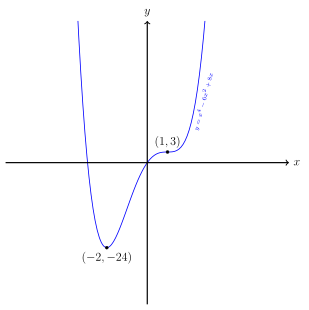
- \(\,\)

2012 Paper 1 Q3
- Sketch the curve \(y=\sin x\) for \(0\le x \le \tfrac12 \pi\) and add to your diagram the tangent to the curve at the origin and the chord joining the origin to the point \((b, \sin b)\), where \(0 < b < \frac12\pi\). By considering areas, show that \[ 1-\tfrac12 b^2 <\cos b < 1-\tfrac 12 b \sin b\,. \]
- By considering the curve \(y=a^x\), where \(a>1\), show that \[ \frac{2(a-1)}{a+1} < \ln a < -1 + \sqrt{2a-1\,}\,. \] [Hint: You may wish to write \(a^x\) as \(\e^{x\ln a}\).]
Solution:
- \(\,\)
The area under the blue curve is \(1-\cos b\). The area under the green line is \(\frac12 b \sin b\) The area under the red line is \(\frac12 b^2\) Therefore \(\frac12 b \sin b < 1- \cos b < \frac12 b^2 \Rightarrow 1- \frac12 b^2 < \cos b < 1 - \frac12 b \sin b\)

- \(\,\)
\begin{align*} &&\text{Area under blue curve}: &= \int_0^1 a^x \d x\\ &&&= \left [ \frac{1}{\ln a}e^{x \ln a} \right]_0^1 \\ &&&= \frac{a-1}{\ln a} \\ \\ &&\text{Area under green line}: &=\frac12 \cdot 1 \cdot (a + 1)\\ &&&= \frac{a+1}{2} \\ \\ &&\text{Area under tangent}: &=\frac12 \cdot 1 \cdot (1+\ln a + 1)\\ &&&= \frac{\ln a+2}{2} \\ \\ \Rightarrow && \frac{a+1}{2} & > \frac{a-1}{\ln a} \\ \Rightarrow && \ln a& > \frac{2(a-1)}{a+1} \\ \\ \Rightarrow && \frac{a-1}{\ln a} &> \frac{\ln a +2}{2} \\ \Rightarrow && 2(a-1) -2\ln a - (\ln a)^2 &> 0 \\ \Rightarrow && \ln a & < -1 + \sqrt{2a-1} \end{align*}

2012 Paper 1 Q4
The curve \(C\) has equation \(xy = \frac12\). The tangents to \(C\) at the distinct points \(P\big(p, \frac1{2p}\big)\) and \(Q\big(q, \frac1{2q}\big)\) where \(p\) and \(q\) are positive, intersect at \(T\) and the normals to \(C\) at these points intersect at \(N\). Show that \(T\) is the point \[ \left( \frac{2pq}{p+q}\,,\, \frac 1 {p+q}\right)\!. \] In the case \(pq=\frac12\), find the coordinates of \(N\). Show (in this case) that \(T\) and \(N\) lie on the line \(y=x\) and are such that the product of their distances from the origin is constant.
Solution: \begin{align*} && \frac{\d y}{\d x} &= -\frac1{2x^2} \\ \Rightarrow && \frac{y - \frac{1}{2p}}{x - p} &= - \frac{1}{2p^2} \\ \Rightarrow && y - \frac1{2p} &= -\frac{1}{2p^2}x +\frac1{2p} \\ \Rightarrow && y +\frac{1}{2p^2}x &= \frac1p \\ \Rightarrow && 2p^2 y + x &= 2p\\ \Rightarrow && 2q^2 y + x &= 2q \\ \Rightarrow && (p^2-q^2)y &= p-q \\ \Rightarrow && y &= \frac{1}{p+q} \\ && x &= \frac{2pq}{p+q} \end{align*} \begin{align*} \text{normal}: && \frac{y-\frac1{2p}}{x-p} &= 2p^2 \\ \Rightarrow && y - \frac1{2p} &= 2p^2x - 2p^3 \\ \Rightarrow && 2py -4p^3x &= 1-4p^4 \\ \Rightarrow && 2qy -4q^3x &= 1-4q^4 \\ pq = \tfrac12: && y - 2p^2 x &= q-2p^3 \\ && y - 2q^2 x &= p-2q^3 \\ \Rightarrow && (2q^2-2p^2)x &= q-p +2q^3-2p^3 \\ &&&= (q-p)(q+p+2q^2+1+2p^2) \\ \Rightarrow && x &= \frac{1+2(p^2+q^2)+1}{2(p+q)} \\ &&&= \frac{1+2(p^2+q^2+2pq-1)+1}{2(p+q)} \\ &&&= p+q\\ && y &= 2p^2 \left ( p+q \right) + q - 2p^3 \\ &&&= p+q \end{align*} So \(N(p+q, p+q)\) and \(T\left (\frac{1}{p+q}, \frac{1}{p+q} \right)\), so both points lie on \(y = x\). \[ OT \cdot ON = \frac{\sqrt{2}}{p+q} \cdot (p+q)\sqrt{2} = 2 \] which is clearly constant.
2012 Paper 1 Q5
Show that \[ \int_0^{\frac14\pi} \sin (2x) \ln(\cos x)\, \d x = \frac14(\ln 2 -1)\,, \] and that \[ \int_0^{\frac14\pi} \cos (2x) \ln(\cos x)\, \d x = \frac18(\pi -\ln 4-2)\,. \] Hence evaluate \[ \int_{\frac14\pi}^{\frac12\pi} \big ( \cos(2x) + \sin (2x)\big) \, \ln \big( \cos x + \sin x\big)\, \d x\,. \]
Solution: \begin{align*} &&\int_0^{\frac14\pi} \sin (2x) \ln(\cos x)\, \d x &= \int_0^{\frac14 \pi} 2 \sin x \cos x \ln (\cos x) \d x \\ u = \cos \theta :&&&= \int_{u=1}^{u=\frac1{\sqrt2}} -2u \ln u \d u \\ &&&= \int_{\frac1{\sqrt{2}}}^1 2u \ln u \d u \\ &&&= \left [u^2 \ln u \right]_{\frac1{\sqrt{2}}}^1-\int_{\frac1{\sqrt{2}}}^1 u \d u \\ &&&= -\frac12 \ln \frac{1}{\sqrt{2}} - \l\frac12 - \frac14 \r \\ &&&= \frac14 (\ln 2 - 1) \end{align*} \begin{align*} && \int_0^{\frac14\pi} \cos (2x) \ln(\cos x)\, \d x &= \left [ \frac12 \sin 2x \ln (\cos x) \right]_0^{\frac14\pi}- \int_0^{\frac14\pi} \frac12 \sin 2x \frac{-\sin x}{\cos x} \d x \\ &&&=\frac12 \ln \frac{1}{\sqrt{2}}+\int_0^{\frac14\pi} \sin^2 x \d x \\ &&&= -\frac14 \ln 2 + \int_0^{\frac14\pi} \frac{1-\cos 2x }{2} \d x \\ &&&= -\frac14 \ln 2 +\frac{\pi}{8} -\frac{1}{4} \\ &&&= \frac18 (\pi - 2\ln 2 - 2) \\ &&&= \frac18 (\pi - \ln 4 - 2) \\ \end{align*} Notice that \(\cos x + \sin x = \sqrt{2} \cos (x -\frac{\pi}{4})\), so: \begin{align*} &&\int_{\frac14\pi}^{\frac12\pi} \big ( \cos(2x) + \sin (2x)\big) \ln \big( \cos x + \sin x\big)\d x &= \int_{\frac14\pi}^{\frac12\pi} \big ( \cos(2x) + \sin (2x)\big) \ln (\sqrt{2} \cos ( x - \frac{\pi}{4}) ) \d x \\ &&&= \int_{u=0}^{u=\frac{\pi}{4}} \l \cos(2u+\frac{\pi}{2})+\sin(2u+\frac{\pi}{2}) \r \cdot \l \frac12 \ln 2 +\ln (\cos u) \r \d x \\ &&&= \int_{0}^{\frac{\pi}{4}} \l -\sin 2u+\cos 2u \r \cdot \l \frac12 \ln 2 +\ln (\cos u) \r \d x \\ &&&= \frac14 \ln 2\left [ \cos 2u + \sin 2u \ \right]_{0}^{\frac{\pi}{4}} - \frac14(\ln2 - 1) + \frac18\pi - \frac14(\ln 2 +1) \\ &&&= \frac{\pi}{8}-\frac12 \ln 2 \end{align*}
2012 Paper 1 Q6
A thin circular path with diameter \(AB\) is laid on horizontal ground. A vertical flagpole is erected with its base at a point \(D\) on the diameter \(AB\). The angles of elevation of the top of the flagpole from \(A\) and \(B\) are \(\alpha\) and \(\beta\) respectively (both are acute). The point \(C\) lies on the circular path with \(DC\) perpendicular to \(AB\) and the angle of elevation of the top of the flagpole from \(C\) is \(\phi\). Show that \(\cot\alpha\cot \beta = \cot^2\phi\). Show that, for any \(p\) and \(q\), \[ \cos p \cos q \sin^2\tfrac12(p+q) - \sin p\sin q \cos^2 \tfrac12 (p+q) = \tfrac12 \cos(p+q) -\tfrac12 \cos(p+q)\cos(p-q) .\] Deduce that, if \(p\) and \(q\) are positive and \( p+q \le \tfrac12 \pi\), then \[ \cot p\cot q\, \ge \cot^2 \tfrac12(p+q) \, \] and hence show that \(\phi \le \tfrac12(\alpha+\beta)\) when \( \alpha +\beta \le \tfrac12 \pi\,\).
Solution:

2012 Paper 1 Q7
A sequence of numbers \(t_0\), \(t_1\), \(t_2\), \(\ldots\,\) satisfies \[ \ \ \ \ \ \ \ \ \ \ \ \ \ \ \ \ \ \ \ \ \ \ \ \ t_{n+2} = p t_{n+1}+qt_{n} \ \ \ \ \ \ \ \ \ \ (n\ge0), \] where \(p\) and \(q\) are real. Throughout this question, \(x\), \(y\) and \(z\) are non-zero real numbers.
- Show that, if \(t_n=x\) for all values of \(n\), then \(p+q=1\) and \(x\) can be any (non-zero) real number.
- Show that, if \(t_{2n} = x\) and \(t_{2n+1}=y\) for all values of \(n\), then \(q\pm p=1\). Deduce that either \(x=y\) or \(x=-y\), unless \(p\) and \(q\) take certain values that you should identify.
- Show that, if \(t_{3n} = x\), \(t_{3n+1}=y\) and \(t_{3n+2}=z\) for all values of \(n\), then \[ p^3+q^3 +3pq-1=0\,. \] Deduce that either \(p+q=1\) or \((p-q)^2 +(p+1)^2+(q+1)^2=0\). Hence show that either \(x=y=z\) or \(x+y+z=0\).
Solution:
- Suppose \(t_n = x\) for all \(n\), then we must have \begin{align*} && x &= p x + q x \\ \Leftrightarrow && 1 &= p+q \end{align*} and this clearly works for any value of \(x\).
- Suppose \(t_{2n} = x, t_{2n+1} = y\) for all \(n\), then \begin{align*} && x &= py + q x \\ && y &= px + q y \\ \Rightarrow && 0 &= py + (q-1) x \\ && 0 &= px + (q-1) y \\ \Rightarrow && p &= (q-1) \frac{x}{y} = (q-1) \frac{y}{x} \\ \Rightarrow && \frac{y}{x} = \pm 1 & \text{ or } q = 1, p = 0 \\ \Rightarrow && y = \pm x & \text{ or } (p,q) = (0,1) \\ \end{align*}
- Suppose \(t_{3n} = x\), \(t_{3n+1}=y\) and \(t_{3n+2}=z\) , so \begin{align*} && x &= pz + qy \\ && y & = px + qz \\ && z &= py + qx \\ \\ && z &= p(px+qz) + q(pz + qy) \\ &&&= p^2x + 2pqz + q^2 y \\ &&&= p^2(pz+qy) + 2pqz + q^2(px+qz) \\ &&&= p^3 z + p^2qy + 2pqz + q^2p x + q^3 z \\ &&&= (p^3+q^3+2pq)z + pq(py+qx) \\ &&&= (p^3 + q^3 + 2pq)z + pq z \\ &&&= (p^3 + q^3 + 3pq)z \\ \Rightarrow && 0 &= p^3 + q^3 + 3pq- 1 \\ &&&= (p+q-1)(p^2+q^2+1+p+q-pq) \\ &&&= \tfrac12(p+q-1)((p-q)^2+(p+1)^2+(q+1)^2) \end{align*} Therefore \(p+q = 1\) or \((p-q)^2+(p+1)^2+(q+1)^2 = 0 \Rightarrow p = q = -1\). If \(p+q = 1\), then \(z = py + (1-p)x\) and \(x = p(py+(1-p)x) + (1-p)y \Rightarrow (1-p+p^2)x = (1-p+p^2)y \Rightarrow x = y \Rightarrow x= y = z\). If \(p = q = -1\) then adding all the equations we get \(x + y + z = -2(x+y+z) \Rightarrow x + y + z = 0\)
2012 Paper 1 Q8
- Show that substituting \(y=xv\), where \(v\) is a function of \(x\), in the differential equation \[ xy \frac{\d y}{\d x} +y^2- 2x^2 =0 \quad (x\ne0) \] leads to the differential equation \[ xv\frac{\d v}{\d x} +2v^2 -2=0\,. \] Hence show that the general solution can be written in the form \[ x^2(y^2 -x^2) = C \,,\] where \(C\) is a constant.
- Find the general solution of the differential equation \[ y \frac{\d y}{\d x} +6x +5y=0\, \quad (x\ne0). \]
Solution:
- \(\,\) \begin{align*} && y &= xv \\ && y' &= v + xv' \\ \Rightarrow && 0 &= x^2 v \left ( v + x\frac{\d v}{\d x} \right) +(x^2v^2) - 2x^2 \\ &&&= 2x^2v^2 + x^3 v \frac{\d v}{\d x} - 2x^2 \\ \Rightarrow && 0 &= xv \frac{\d v}{\d x} + 2v^2-2 \\ \\ \Rightarrow && \frac{v}{1-v^2} \frac{\d v}{\d x} &= \frac{2}{x} \\ \Rightarrow && \int \frac{v}{1-v^2} \d v &=2 \ln |x| \\ \Rightarrow && -\frac12\ln |1-v^2| &= 2\ln |x| + C \\ \Rightarrow && 4\ln |x| + \ln |1-v^2| &= K \\ \Rightarrow && x^4(1-v^2) &= K \\ \Rightarrow && x^2(x^2-y^2) &= K \end{align*}
- \(\,\) \begin{align*} && 0 &= xv \left (v +x \frac{\d v}{\d x} \right) + 6x + 5xv \\ &&&= x^2 v \frac{\d v}{\d x} +xv^2 + 6x+5xv \\ \Rightarrow && 0 &= xv\frac{\d v}{\d x} +v^2 +5v+6 \\ \Rightarrow && -\int \frac{1}{x} \d x &=\int \frac{v}{v^2+5v+6} \d v \\ \Rightarrow && -\ln |x| &= \int \frac{v}{(v+2)(v+3)} \d v \\ &&&= \int \left (\frac{3}{v+3} - \frac{2}{v+2} \right) \d v \\ \Rightarrow && -\ln |x| &= 3\ln |v+3| - 2 \ln |v+2| + C\\ \Rightarrow && -\ln |x| &= \ln \frac{|v+3|^3}{|v+2|^2} + C \\ \Rightarrow && \frac{1}{|x|}|v+2|^2 &= A|v+3|^3 \\ \Rightarrow && \frac{1}{|x|}|\frac{y}{x} + 2|^2&= A|\frac{y}{x} + 3|^3 \\ \Rightarrow && \frac{1}{|x|^3} |y +2x|^2 &= \frac{A}{|x|^3}|y + 3x|^3 \\ \Rightarrow && (y+2x)^2 &= A|y+3x|^3 \end{align*}