Problems
Filters
298 problems found
1988 Paper 1 Q10
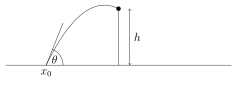
A sniper at the top of a tree of height \(h\) is hit by a bullet fired from the undergrowth covering the horizontal ground below. The position and elevation of the gun which fired the shot are unknown, but it is known that the bullet left the gun with speed \(v\). Show that it must have been fired from a point within a circle centred on the base of the tree and of radius \((v/g)\sqrt{v^{2}-2gh}\). {[}Neglect air resistance.{]}
Solution:
1988 Paper 1 Q12
A skater of mass \(M\) is skating inattentively on a smooth frozen canal. She suddenly realises that she is heading perpendicularly towards the straight canal bank at speed \(V\). She is at a distance \(d\) from the bank and can choose one of two methods of trying to avoid it; either she can apply a force of constant magnitude \(F\), acting at right-angles to her velocity, so that she travels in a circle; or she can apply a force of magnitude \(\frac{1}{2}F(V^{2}+v^{2})/V^{2}\) directly backwards, where \(v\) is her instantaneous speed. Treating the skater as a particle, find the set of values of \(d\) for which she can avoid hitting the bank. Comment briefly on the assumption that the skater is a particle.
Solution: Suppose she applies a force of magnitude \(\frac{1}{2}F(V^{2}+v^{2})/V^{2}\) backwards, then \begin{align*} && M v \frac{dv}{dx} &= -\frac{1}{2}F(V^{2}+v^{2})/V^{2} \\ \Rightarrow && M\int_{V}^0 \frac{2v}{V^2+ v^2} \d v &= - \frac{F}{V^2} x \\ \Rightarrow && M \left [ -\log(V^2+v^2) \right]_0^V &= -\frac{Fx}{V^2} \\ \Rightarrow && -M \ln 2&= -\frac{Fx}{V^2} \end{align*} Therefore she will stop quickly enough if \(d > \frac{V^2M \ln 2}{F}\) If she attempts to use the right-angled method, then she will travel a distance at most \(r\) where \(r\) is the radius of her circle: \begin{align*} && F &= M \frac{V^2}{r} \\ \Rightarrow && r &= \frac{MV^2}{F} \end{align*} Therefore she can always avoid the wall if \(d > \frac{MV^2}{F}\). There are two potential issues with being a particle. Firstly we would need to account for any variation in the distance to the wall (which could be accounted for by changing \(d\)). Secondly when she enters circular motion she will rotate and therefore we might need to consider her inertia as well as just her velocity when modelling.
1988 Paper 2 Q6
Show that the following functions are positive when \(x\) is positive:
- [ \(x-\tanh x\)
- \(x\sinh x-2\cosh x+2\)
- \(2x\cosh2x-3\sinh2x+4x\).
Solution:
- Notice that \(f(x) = x - \tanh x\) has \(f'(x) = 1-\textrm{sech}^2 x = \tanh^2 x > 0\) so \(f(x)\) is strictly increasing on \((0, \infty)\) and \(f(0) = 0\) therefore \(f(x)\) is positive for all \(x\) positive
- Let \(f(x) = x\sinh x-2\cosh x+2\) then \(f'(x) = \sinh x +x \cosh x - 2 \sinh x = x \cosh x -\sinh x = \cosh x ( x - \tanh x) > 0\) by the first part. \(f(0) = 0\) so \(f(x)\) is positive for all \(x\) positive.
- Let \(f(x) = 2x\cosh2x-3\sinh2x+4x\) then \begin{align*} f'(x) &= 2\cosh 2x +4x\sinh 2x - 6 \cosh 2x + 4 \\ &= 4( x\sinh 2x-\cosh 2x +1) \\ &= 4(x2\cosh x \sinh x -2\cosh^2x ) \\ &= 8 \cosh^2 x (x - \tanh x) \end{align*} Which is always positive when \(x\) > 0, \(f(0) = 0\) so \(f(x) > 0\) for all positive \(x\).
1988 Paper 2 Q13
A librarian wishes to pick up a row of identical books from a shelf, by pressing her hands on the outer covers of the two outermost books and lifting the whole row together. The covers of the books are all in parallel vertical planes, and the weight of each book is \(W\). With each arm, the librarian can exert a maximum force of \(P\) in the vertical direction, and, independently, a maximum force of \(Q\) in the horizontal direction. The coefficient of friction between each pair of books and also between each hand and a book is \(\mu.\) Derive an expression for the maximum number of books that can be picked up without slipping, using this method. {[}You may assume that the books are thin enough for the rotational effect of the couple on each book to be ignored.{]}
Solution:

1988 Paper 3 Q1
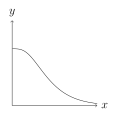
Sketch the graph of \[ y=\frac{x^{2}\mathrm{e}^{-x}}{1+x}, \] for \(-\infty< x< \infty.\) Show that the value of \[ \int_{0}^{\infty}\frac{x^{2}\mathrm{e}^{-x}}{1+x}\,\mathrm{d}x \] lies between \(0\) and \(1\).
Solution:

1988 Paper 3 Q5
A firm of engineers obtains the right to dig and exploit an undersea tunnel. Each day the firm borrows enough money to pay for the day's digging, which costs £\(c,\) and to pay the daily interest of \(100k\%\) on the sum already borrowed. The tunnel takes \(T\) days to build, and, once finished, earns £\(d\) a day, all of which goes to pay the daily interest and repay the debt until it is fully paid. The financial transactions take place at the end of each day's work. Show that \(S_{n},\) the total amount borrowed by the end of day \(n\), is given by \[ S_{n}=\frac{c[(1+k)^{n}-1]}{k} \] for \(n\leqslant T\). Given that \(S_{T+m}>0,\) where \(m>0,\) express \(S_{T+m}\) in terms of \(c,d,k,T\) and \(m.\) Show that, if \(d/c>(1+k)^{T}-1,\) the firm will eventually pay off the debt.
Solution: After \(n\) days they will have borrowed \(c\) for \(n-1\) days, \(c\) for \(n-2\) days, etc until \(c\) for no days. Therefore the outstanding balance will be: \begin{align*} c + (1+k)\cdot c+ (1+k)^2 \cdot c + \cdots + (1+k)^{n-1} \cdot c &= c\frac{(1+k)^n-1}{(1+k)-1} \\ &= \frac{c[(1+k)^n-1]}{k} \end{align*} At the end of \(T\) days the outstanding balance will be \(S_T = \frac{c[(1+k)^T-1]}{k}\). We can think of each payment of \(d\) during the subsequent period as being equivalent of a payment of \(d (1+k)^{m-1}\) \(m\) days later (as otherwise they would have accrued the equivalent amount in interest. Therefore after \(m\) days the amount paid back (equivalent) is: \begin{align*} (1+k)^{m-1} \cdot d + (1+k)^{m-2} \cdot d + \cdots + d &= \frac{d[(1+k)^m-1]}{k} \end{align*} Therefore the net position, \(S_{T+m}\) will be: \begin{align*} S_{T+m} &= \frac{c[(1+k)^T-1](1+k)^m-d[(1+k)^m-1]}{k} \\ &= \frac{(1+k)^m [c ((1+k)^T-1)-d]+d}{k} \end{align*} Therefore they will eventually pay back their debts if \( [c ((1+k)^T-1)-d]\) is negative. ie \(d > c((1+k)^T-1) \Rightarrow d/c > (1+k)^T-1\)
1988 Paper 3 Q12
A smooth billiard ball moving on a smooth horizontal table strikes another identical ball which is at rest. The coefficient of restitution between the balls is \(e(<1)\). Show that after the collision the angle between the velocities of the balls is less than \(\frac{1}{2}\pi.\) Show also that the maximum angle of deflection of the first ball is \[ \sin^{-1}\left(\frac{1+e}{3-e}\right). \]
Solution:

1987 Paper 1 Q6
Let \(y=\mathrm{f}(x)\), \((0\leqslant x\leqslant a)\), be a continuous curve lying in the first quadrant and passing through the origin. Suppose that, for each non-negative value of \(y\) with \(0\leqslant y\leqslant\mathrm{f}(a)\), there is exactly one value of \(x\) such that \(\mathrm{f}(x)=y\); thus we may write \(x=\mathrm{g}(y)\), for a suitable function \(\mathrm{g}.\) For \(0\leqslant s\leqslant a,\) \(0\leqslant t\leqslant \mathrm{f}(a)\), define \[ \mathrm{F}(s)=\int_{0}^{s}\mathrm{f}(x)\,\mathrm{d}x,\qquad\mathrm{G}(t)=\int_{0}^{t}\mathrm{g}(y)\,\mathrm{d}y. \] By a geometrical argument, show that \[ \mathrm{F}(s)+\mathrm{G}(t)\geqslant st.\tag{*} \] When does equality occur in \((*)\)? Suppose that \(y=\sin x\) and that the ranges of \(x,y,s,t\) are restricted to \(0\leqslant x\leqslant s\leqslant\frac{1}{2}\pi,\) \(0\leqslant y\leqslant t\leqslant1\). By considering \(s\) such that the equality holds in \((*)\), show that \[ \int_{0}^{t}\sin^{-1}y\,\mathrm{d}y=t\sin^{-1}t-\left(1-\cos(\sin^{-1}t)\right). \] Check this result by differentiating both sides with respect to \(t\).
Solution:

1987 Paper 2 Q1
Prove that:
- if \(a+2b+3c=7x\), then \[ a^{2}+b^{2}+c^{2}=\left(x-a\right)^{2}+\left(2x-b\right)^{2}+\left(3x-c\right)^{2}; \]
- if \(2a+3b+3c=11x\), then \[ a^{2}+b^{2}+c^{2}=\left(2x-a\right)^{2}+\left(3x-b\right)^{2}+\left(3x-c\right)^{2}. \]
Solution:
- \begin{align*} \left(x-a\right)^{2}+\left(2x-b\right)^{2}+\left(3x-c\right)^{2} &= x^2-2ax+a^2 + 4x^2 -4bx+b^2 + 9x^2-6cx + c^2 \\ &= (1^2 + 2^2 + 3^2)x^2 - 2x(a+2b+3c) +a^2+b^2 + c^2 \\ &= 14x^2 - 2x(7x) + a^2 + b^2 + c^2 \\ &= a^2 + b^2 + c^2 \end{align*}
- \begin{align*} \left(2x-a\right)^{2}+\left(3x-b\right)^{2}+\left(3x-c\right)^{2} &= (2^2+3^2+3^2)x^2 - 2x(2a+3b+3c) + (a^2 + b^2+c^2) \\ &= 22x^2 - 2x(11x) + a^2+b^2+c^2 \\ &= a^2+b^2+c^2 \end{align*}
1987 Paper 2 Q7
A definite integral can be evaluated approximately by means of the Trapezium rule: \[ \int_{x_{0}}^{x_{N}}\mathrm{f}(x)\,\mathrm{d}x\approx\tfrac{1}{2}h\left\{ \mathrm{f}\left(x_{0}\right)+2\mathrm{f}\left(x_{1}\right)+\ldots+2\mathrm{f}\left(x_{N-1}\right)+\mathrm{f}\left(x_{N}\right)\right\} , \] where the interval length \(h\) is given by \(Nh=x_{N}-x_{0}\), and \(x_{r}=x_{0}+rh\). Justify briefly this approximation. Use the Trapezium rule with intervals of unit length to evaluate approximately the integral \[ \int_{1}^{n}\ln x\,\mathrm{d}x, \] where \(n(>2)\) is an integer. Deduce that \(n!\approx\mathrm{g}(n)\), where \[ \mathrm{g}(n)=n^{n+\frac{1}{2}}\mathrm{e}^{1-n}, \] and show by means of a sketch, or otherwise, that \[ n!<\mathrm{g}(n). \] By using the Trapezium rule on the above integral with intervals of width \(k^{-1}\), where \(k\) is a positive integer, show that \[ \left(kn\right)!\approx k!n^{kn+\frac{1}{2}}\left(\frac{\mathrm{e}}{k}\right)^{k\left(1-n\right)}. \] Determine whether this approximation or \(\mathrm{g}(kn)\) is closer to \(\left(kn\right)!\).
Solution:


1987 Paper 2 Q15
A train of length \(l_{1}\) and a lorry of length \(l_{2}\) are heading for a level crossing at speeds \(u_{1}\) and \(u_{2}\) respectively. Initially the front of the train and the front of the lorry are at distances \(d_{1}\) and \(d_{2}\) from the crossing. Find conditions on \(u_{1}\) and \(u_{2}\) under which a collision will occur. On a diagram with \(u_{1}\) and \(u_{2}\) measured along the \(x\) and \(y\) axes respectively, shade in the region which represents collision. Hence show that if \(u_{1}\) and \(u_{2}\) are two independent random variables, both uniformly distributed on \((0,V)\), then the probability of a collision in the case when initially the back of the train is nearer to the crossing than the front of the lorry is \[ \frac{l_{1}l_{2}+l_{2}d_{1}+l_{1}d_{2}}{2d_{2}\left(l_{2}+d_{2}\right)}. \] Find the probability of a collision in each of the other two possible cases.
1987 Paper 3 Q7
Prove that \[ \tan^{-1}t=t-\frac{t^{3}}{3}+\frac{t^{5}}{5}-\cdots+\frac{(-1)^{n}t^{2n+1}}{2n+1}+(-1)^{n+1}\int_{0}^{t}\frac{x^{2n+2}}{1+x^{2}}\,\mathrm{d}x. \] Hence show that, if \(0\leqslant t\leqslant1,\) then \[ \frac{t^{2n+3}}{2(2n+3)}\leqslant\left|\tan^{-1}t-\sum_{r=0}^{n}\frac{(-1)^{r}t^{2r+1}}{2r+1}\right|\leqslant\frac{t^{2n+3}}{2n+3}. \] Show that, as \(n\rightarrow\infty,\) \[ 4\sum_{r=0}^{n}\frac{(-1)^{r}}{(2r+1)}\rightarrow\pi, \] but that the error in approximating \(\pi\) by \({\displaystyle 4\sum_{r=0}^{n}\frac{(-1)^{r}}{(2r+1)}}\) is at least \(10^{-2}\) if \(n\) is less than or equal to \(98\).
Solution: We start by noticing that \(\displaystyle \tan^{-1} t = \int_0^t \frac{1}{1+x^2} \d x\). Consider the geometric series \(1-x^2+(-x^2)^2+ \cdots + (-x^2)^n = \frac{1-(-x^2)^{n+1}}{1+x^2}\). Therefore, \((1+x^2)(1-x^2+(-x^2)^2+ \cdots + (-x^2)^n) = 1-(-x^2)^{n+1}\) or \(1 = (1+x^2)(1-x^2+x^4-\cdots+(-1)^nx^{2n}) +(-1)^{n+1}x^{2n+2}\) \begin{align*} \tan^{-1} t &= \int_0^t \frac{1}{1+x^2} \d x \\ &= \int_0^t \frac{(1+x^2)(1-x^2+x^4-\cdots+(-1)^nx^{2n}) +(-1)^{n+1}x^{2n+2}}{x^2+1} \d x \\ &= \int_0^t (1-x^2+x^4-\cdots+(-1)^nx^{2n})\d x + \int_0^t \frac{(-1)^{n+1}x^{2n+2}}{x^2+1} \d x \\ &= t - \frac{t^3}{3}+\frac{t^5}{5}-\cdots + (-1)^n \frac{t^{2n+1}}{2n+1}+\int_0^t \frac{(-1)^{n+1}x^{2n+2}}{x^2+1} \d x \\ &= \sum_{r=0}^n \frac{(-1)^r t^{2r+1}}{2r+1} + \int_0^t \frac{(-1)^{n+1}x^{2n+2}}{x^2+1} \d x \\ \end{align*} Therefore we can say (for \(0 \leq t \leq 1\)) \begin{align*} \left | \tan^{-1} t - \sum_{r=0}^n \frac{(-1)^r t^{2r+1}}{2r+1} \right | &= \left | \int_0^t \frac{(-1)^{n+1}x^{2n+2}}{x^2+1} \d x \right | \\ &\leq \left | \int_0^t x^{2n+2} \d x \right | \\ &= \frac{t^{2n+3}}{2n+3} \\ \\ \left | \tan^{-1} t - \sum_{r=0}^n \frac{(-1)^r t^{2r+1}}{2r+1} \right | &= \left | \int_0^t \frac{(-1)^{n+1}x^{2n+2}}{x^2+1} \d x \right | \\ &\geq \left | \int_0^t \frac{(-1)^{n+1}x^{2n+2}}{1+1} \d x \right | \\ &= \frac{t^{2n+3}}{2(2n+3)} \\ \end{align*} Since \(\tan^{-1} 1 = \frac{\pi}{4}\) we must have that: \begin{align*} \lim_{n \to \infty} \left | \frac{\pi}{4} - \sum_{r=0}^{n}\frac{(-1)^{r}}{(2r+1)} \right | \to 0 \Rightarrow \lim_{n \to \infty} 4\sum_{r=0}^{n}\frac{(-1)^{r}}{(2r+1)} \to \pi \end{align*} However, \begin{align*} && \left | 4\sum_{r=0}^{n}\frac{(-1)^{r}}{(2r+1)} - \pi \right | &\geq 4 \frac{1}{2(2n+3)} \\ && &= \frac{2}{2n+3} \\ \\ && \frac{2}{2n+3} \geq 10^{-2} \\ \Leftrightarrow && 200 \geq 2n+3 \\ \Leftrightarrow && 197 \geq 2n \\ \Leftrightarrow && 98.5 \geq n \\ \end{align*} Therefore we need more than \(98\) terms to get two decimal places of accuracy. Not great!
1987 Paper 3 Q8
Show that, if the lengths of the diagonals of a parallelogram are specified, then the parallogram has maximum area when the diagonals are perpendicular. Show also that the area of a parallelogram is less than or equal to half the square of the length of its longer diagonal. The set \(A\) of points \((x,y)\) is given by \begin{alignat*}{1} \left|a_{1}x+b_{1}y-c_{1}\right| & \leqslant\delta,\\ \left|a_{2}x+b_{2}y-c_{2}\right| & \leqslant\delta, \end{alignat*} with \(a_{1}b_{2}\neq a_{2}b_{1}.\) Sketch this set and show that it is possible to find \((x_{1},y_{1}),(x_{2},y_{2})\in A\) with \[ (x_{1}-x_{2})^{2}+(y_{1}-y_{2})^{2}\geqslant\frac{8\delta^{2}}{\left|a_{1}b_{2}-a_{2}b_{1}\right|}. \]
Solution: In a parallelogram the diagonals meet at their mid points. Fixing one diagonal, we can look at the two triangles formed by the other diagonal. Suppose the angle between them is \(\theta\). Then the area of the triangles will be \(\frac12 \frac{l_1}{2} \frac{l_2}2 \sin \theta+\frac12 \frac{l_1}{2} \frac{l_2}2 \sin (\pi -\theta) = \frac{l_1l_2}{4} \sin \theta\). This will be true on both sides. Therefore we can maximise this area by setting \(\theta = \frac{\pi}{2}\).
