Problems
Filters
48 problems found
1987 Paper 1 Q16
The parliament of Laputa consists of 60 Preservatives and 40 Progressives. Preservatives never change their mind, always voting the same way on any given issue. Progressives vote at random on any given issue.
- A randomly selected member is known to have voted the same way twice on a given issue. Find the probability that the member will vote the same way a third time on that issue.
- Following a policy change, a proportion \(\alpha\) of Preservatives now consistently votes against Preservative policy. The Preservative leader decides that an election must be called if the value of \(\alpha\) is such that, at any vote on an item of Preservative policy, the chance of a simple majority would be less than 80\%. By making a suitable normal approximation, estimate the least value of \(\alpha\) which will result in an election being called.
Solution:
- The vote is will now be \(60(1-\alpha)\) for, \(60\alpha\) against and \(X \sim B(40, \frac12)\) at random between those. For a majority, they need \(60(1-\alpha) + X > 50\), ie \(\P(X > 60\alpha - 10) \geq 0.8\). Using a normal approximation to the binomial, we need \(X \approx N(20, 10)\), so \begin{align*} \P(X > 60 \alpha - 10) &= 1- \P(X \leq 60 \alpha - 10) \\ &\approx 1 - \P(\sqrt{10}Z+20 \leq 60\alpha - 10.5) \\ &\approx 1 - \P(Z \leq \frac{60\alpha - 30.5}{\sqrt{10}}) \end{align*} If we want this to be less than \(0.2\) we need \( \frac{60\alpha - 30.5}{\sqrt{10}} < -0.8416 \Rightarrow \alpha < 0.4639\). This would correspond to 27 or fewer exiles or 33 or more remaining preservatives. [Actual computations using Binomial distribution shows we should expect at least 17 to randomly join 20% of the time, so 34 preservatives are required]
1987 Paper 2 Q1
Prove that:
- if \(a+2b+3c=7x\), then \[ a^{2}+b^{2}+c^{2}=\left(x-a\right)^{2}+\left(2x-b\right)^{2}+\left(3x-c\right)^{2}; \]
- if \(2a+3b+3c=11x\), then \[ a^{2}+b^{2}+c^{2}=\left(2x-a\right)^{2}+\left(3x-b\right)^{2}+\left(3x-c\right)^{2}. \]
Solution:
- \begin{align*} \left(x-a\right)^{2}+\left(2x-b\right)^{2}+\left(3x-c\right)^{2} &= x^2-2ax+a^2 + 4x^2 -4bx+b^2 + 9x^2-6cx + c^2 \\ &= (1^2 + 2^2 + 3^2)x^2 - 2x(a+2b+3c) +a^2+b^2 + c^2 \\ &= 14x^2 - 2x(7x) + a^2 + b^2 + c^2 \\ &= a^2 + b^2 + c^2 \end{align*}
- \begin{align*} \left(2x-a\right)^{2}+\left(3x-b\right)^{2}+\left(3x-c\right)^{2} &= (2^2+3^2+3^2)x^2 - 2x(2a+3b+3c) + (a^2 + b^2+c^2) \\ &= 22x^2 - 2x(11x) + a^2+b^2+c^2 \\ &= a^2+b^2+c^2 \end{align*}
1987 Paper 2 Q2
Show that if at least one of the four angles \(A\pm B\pm C\) is a multiple of \(\pi\), then \begin{alignat*}{1} \sin^{4}A+\sin^{4}B+\sin^{4}C & -2\sin^{2}B\sin^{2}C-2\sin^{2}C\sin^{2}A\\ & -2\sin^{2}A\sin^{2}B+4\sin^{2}A\sin^{2}B\sin^{2}C=0. \end{alignat*}
1987 Paper 2 Q3
Let \(a\) and \(b\) be positive integers such that \(b<2a-1\). For any given positive integer \(n\), the integers \(N\) and \(M\) are defined by \[ [a+\sqrt{a^{2}-b}]^{n}=N-r, \] \[ [a-\sqrt{a^{2}-b}]^{n}=M+s, \] where \(0\leqslant r<1\) and \(0\leqslant s<1\). Prove that \begin{questionparts} \item \(M=0\), \item \(r=s\), \item \(r^{2}-Nr+b^{n}=0.\) \end{questionpart} Show that for large \(n\), \(\left(8+3\sqrt{7}\right)^{n}\) differs from an integer by about \(2^{-4n}\).
Solution:
- If we can show that \(0 < a - \sqrt{a^2-b} < 1\) then we will be done, since raising a number in \([0,1)\) to a positive integer power will always remain in the same interval. Clearly \(\sqrt{a^2-b} < \sqrt{a^2} = a\) so we have \(a-\sqrt{a^2-b} > 0\) We also have that \(\sqrt{a^2-b} > \sqrt{a^2-(2a-1)} = (a-1)\). Therefore \(a - \sqrt{a^2-b} < a - (a-1) = 1\) as required.
- If we can show that \(\l a + \sqrt{a^2-b} \r^n + \l a - \sqrt{a^2-b} \r^n = N -r + s\) is an integer we will be done, since the only integer value \(-r+s\) can be is \(0\). This is easy to see, since \begin{align*} \l a + \sqrt{a^2-b} \r^n + \l a - \sqrt{a^2-b} \r^n &= \sum_{k=0}^n \binom{n}{k}a^{n-k}(\sqrt{a^2-b})^k +\sum_{k=0}^n \binom{n}{k}a^{n-k}(-\sqrt{a^2-b})^k \\ &= \sum_{k=0}^n \binom{n}{k}a^{n-k}\l (\sqrt{a^2-b})^k +(-\sqrt{a^2-b})^k \r \\ \end{align*} But every term where \(k\) is odd in this sum is \(0\) (since they cancel) and ever term where \(k\) is even in this sum is an integer. Therefore the sum is an integer and we're done.
- \begin{align*} -r^2+rN &= -r(r-N) \\ &= s(r-N) \\ &=- \l a - \sqrt{a^2-b} \r^n \l a + \sqrt{a^2-b} \r^n \\ &= -\l \l a - \sqrt{a^2-b} \r \l a + \sqrt{a^2-b} \r\r^n \\ &= - \l a^2 - a^2+b\r^n \\ &= b^n \end{align*} Therefore \(r^2-rN + b^n = 0\)
1987 Paper 2 Q4
Explain the geometrical relationship between the points in the Argand diagram represented by the complex numbers \(z\) and \(z\mathrm{e}^{\mathrm{i}\theta}.\) Write down necessary and sufficient conditions that the distinct complex numbers \(\alpha,\beta\) and \(\gamma\) represent the vertices of an equilateral triangle taken in anticlockwise order. Show that \(\alpha,\beta\) and \(\gamma\) represent the vertices of an equilateral triangle (taken in any order) if and only if \[ \alpha^{2}+\beta^{2}+\gamma^{2}-\beta\gamma-\gamma\alpha-\alpha\beta=0. \] Find necessary and sufficient conditions on the complex coefficients \(a,b\) and \(c\) for the roots of the equation \[ z^{3}+az^{2}+bz+c=0 \] to lie at the vertices of an equilateral triangle in the Argand digram.
Solution: The point \(ze^{i\theta}\) is obtained by rotating the point \(z\) about \(0\) by an angle \(\theta\) anticlockwise. The complex numbers \(\alpha, \beta\) and \(\gamma\) will form an equilateral triangle iff the angles between each side are \(\frac{\pi}{3}\), ie \begin{align*} \begin{cases}{\gamma - \beta} &= e^{i \frac{\pi}{3}}({\beta - \alpha}) \\ {\alpha- \gamma} &= e^{i \frac{\pi}{3}}({\gamma- \beta}) \\ {\beta- \alpha} &= e^{i \frac{\pi}{3}}({\alpha- \gamma})\end{cases} \end{align*} We don't need all these equations, since the first two are equivalent to the third. Combining the first two equations, we have \begin{align*} && \frac{\gamma - \beta}{\beta-\alpha} &= \frac{\alpha-\gamma}{\gamma - \beta} \\ \Leftrightarrow && (\gamma - \beta)^2 &= (\alpha-\gamma)(\beta-\alpha) \\ \Leftrightarrow && \gamma^2 +\beta^2 - 2\gamma \beta &= \alpha\beta-\alpha^2-\gamma\beta+\gamma\alpha \\ \Leftrightarrow && \alpha^{2}+\beta^{2}+\gamma^{2}-\beta\gamma-\gamma\alpha-\alpha\beta&=0 \end{align*} as required. If the roots of \(z^{3}+az^{2}+bz+c=0\) are \(\alpha, \beta, \gamma\) then \(\alpha+\beta+\gamma = -a\) and \(\beta\gamma+\gamma\alpha+\alpha\beta = b\). We also have that \(a^2 - 2b = \alpha^2+\beta^2+\gamma^2\). Therefore there roots will lie at the vertices of an equilateral triangle iff \(a^2-3b = 0\)
1987 Paper 2 Q5
If \(y=\mathrm{f}(x)\), then the inverse of \(\mathrm{f}\) (when it exists) can be obtained from Lagrange's identity. This identity, which you may use without proof, is \[ \mathrm{f}^{-1}(y)=y+\sum_{n=1}^{\infty}\frac{1}{n!}\frac{\mathrm{d}^{n-1}}{\mathrm{d}y^{n-1}}\left[y-\mathrm{f}\left(y\right)\right]^{n}, \] provided the series converges.
- Verify Lagrange's identity when \(\mathrm{f}(x)=\alpha x\), \((0<\alpha<2)\).
- Show that one root of the equation \[ \tfrac{1}{2}=x-\tfrac{1}{4}x^{3} \] is \[ x=\sum_{n=0}^{\infty}\frac{\left(3n\right)!}{n!\left(2n+1\right)!2^{4n+1}} \]
- Find a solution for \(x\), as a series in \(\lambda,\) of the equation \[ x=\mathrm{e}^{\lambda x}. \]
Solution:
- If \(f(x) = \alpha x\) then \(f^{-1}(x) = \frac{1}{\alpha}x\). \begin{align*} && \frac{\d^{n-1}}{\d y^{n-1}} [y - \alpha y]^n &= \frac{\d^{n-1}}{\d y^{n-1}} [(1 - \alpha)^n y^n] \\ && &= (1-\alpha)^n n! y \\ \Rightarrow && y + \sum_{n=1}^{\infty} \frac{1}{n!}\frac{\d^{n-1}}{\d y^{n-1}} [y - \alpha y]^n &= y +\sum_{n=1}^{\infty} (1-\alpha)^ny \\ &&&= y + y\l \frac{1}{1-(1-\alpha)}-1 \r \\ &&&= \frac{1}{\alpha}y \end{align*} Where we can sum the geometric progression if \(|1-\alpha| < 1 \Leftrightarrow 0 < \alpha < 2\)
- Suppose that \(f(x) = x-\frac14x^3\). We would like to find \(f^{-1}(\frac12)\). \begin{align*} && \frac{\d^{n-1}}{\d y^{n-1}} [y - (y+\frac14 y^3)]^n &= \frac{\d^{n-1}}{\d y^{n-1}} [\frac1{4^n} y^{3n}] \\ && &= \frac{1}{4^n} \frac{(3n)!}{(2n+1)!} y^{2n+1} \\ \Rightarrow && f^{-1}(\frac12) &= \frac12 + \sum_{n=1}^{\infty} \frac{1}{4^n} \frac{(3n)!}{n!(2n+1)!} \frac{1}{2^{2n+1}} \\ &&&= \frac12 + \sum_{n=1}^{\infty} \frac{(3n)!}{n!(2n+1)!} \frac{1}{2^{4n+1}} \\ \end{align*} Since when \(n = 0\) \(\frac{0!}{0!1!} \frac{1}{2^{0+1}} = \frac12\) we can include the wayward \(\frac12\) in our infinite sum and so we have the required result.
- Consider \(f(x) = x - e^{\lambda x}\) we are interested in \(f^{-1}(0)\). \begin{align*} && \frac{\d^{n-1}}{\d y^{n-1}} [y - (y-e^{\lambda y})]^n &= \frac{\d^{n-1}}{\d y^{n-1}} [e^{n\lambda y}] \\ &&&= n^{n-1} \lambda^{n-1}e^{n \lambda y} \\ \Rightarrow && f^{-1}(0) &= \sum_{n=1}^\infty \frac{1}{n!} n^{n-1} \lambda^{n-1} \end{align*} We don't care about convergence, but it's worth noting this has a radius of convergence of \(\frac{1}{e}\) (ie this series is valid if \(|\lambda| < \frac1e\)).
1987 Paper 2 Q6
Let \[ I=\int_{-\frac{1}{2}\pi}^{\frac{1}{2}\pi}\frac{\cos^{2}\theta}{1-\sin\theta\sin2\alpha}\,\mathrm{d}\theta\, , \] where \(0<\alpha<\frac{1}{4}\pi\). Show that \[ I=\int_{-\frac{1}{2}\pi}^{\frac{1}{2}\pi}\frac{\cos^{2}\theta}{1+\sin\theta\sin2\alpha}\,\mathrm{d}\theta\, , \] and hence that \[ I=\frac{\pi}{\sin^{2}2\alpha}-\cot^{2}2\alpha\int_{-\frac{1}{2}\pi}^{\frac{1}{2}\pi}\frac{\sec^{2}\theta}{1+\cos^{2}2\alpha\tan^{2}\theta}\,\mathrm{d}\theta. \] Show that \(I=\frac{1}{2}\pi\sec^{2}\alpha\), and state the value of \(I\) if \(\frac{1}{4}\pi<\alpha<\frac{1}{2}\pi\).
Solution: \begin{align*} \int_{-\frac{1}{2}\pi}^{\frac{1}{2}\pi}\frac{\cos^{2}\theta}{1-\sin\theta\sin2\alpha}\,\mathrm{d}\theta &= \int_{u = \frac12 \pi}^{u = -\frac12 \pi} \frac{\cos^2 (-u)}{1-\sin(-u) \sin 2 \alpha} -\d u \tag{\(u = -\theta\)} \\ &= \int_{\frac12 \pi}^{-\frac12 \pi} \frac{\cos^2 u}{1+\sin u \sin 2 \alpha} -\d u \\ &= \int_{-\frac12 \pi}^{\frac12 \pi} \frac{\cos^2 u}{1+\sin u \sin 2 \alpha} \d u \\ &= \int_{-\frac12 \pi}^{\frac12 \pi} \frac{\cos^2 \theta}{1+\sin \theta \sin 2 \alpha} \d \theta \\ \end{align*} Since \(\displaystyle \frac{1}{(1-a^2u^2)} = \frac12 \l \frac{1}{1+au} + \frac1{1-au} \r\) \begin{align*} \int_{-\frac12 \pi}^{\frac12 \pi} \frac{\cos^2 \theta}{1+\sin \theta \sin 2 \alpha} \d \theta &= \int_{-\frac12 \pi}^{\frac12 \pi} \frac{\cos^2 \theta}{1-\sin ^2\theta \sin^2 2 \alpha} \d \theta \\ &= \int_{-\frac12 \pi}^{\frac12 \pi} \frac{1-\sin^2 \theta}{1-\sin ^2\theta \sin^2 2 \alpha} \d \theta \\ &= \int_{-\frac12 \pi}^{\frac12 \pi} \frac{(1-\sin ^2\theta \sin^2 2 \alpha) \frac{1}{\sin^2 2\alpha} + 1 - \cosec^2 2\alpha}{1-\sin ^2\theta \sin^2 2 \alpha} \d \theta \\ &= \frac{\pi}{\sin^2 2\alpha} -\cot^2 2\alpha \int_{-\frac{\pi}2}^{\frac{\pi}2} \frac{1}{1 - \sin^2 \theta \sin^2 2 \alpha} \d \theta \\ &= \frac{\pi}{\sin^2 2\alpha} -\cot^2 2\alpha \int_{-\frac{\pi}2}^{\frac{\pi}2} \frac{1}{1 - \sin^2 \theta (1-\cos^2 2 \alpha)} \d \theta \\ &= \frac{\pi}{\sin^2 2\alpha} -\cot^2 2\alpha \int_{-\frac{\pi}2}^{\frac{\pi}2} \frac{1}{\cos^2 \theta +\sin^2 \theta \cos^2 2 \alpha} \d \theta \\ &= \frac{\pi}{\sin^2 2\alpha} -\cot^2 2\alpha \int_{-\frac{\pi}2}^{\frac{\pi}2} \frac{\sec^2 \theta}{1 +\tan^2 \theta \cos^2 2 \alpha} \d \theta \\ \end{align*} Finally, using the substitution \(u =|\cos 2 \alpha | \tan \theta, \d u = |\cos 2 \alpha |\sec^2 \theta \d \theta\) \begin{align*} \int_{-\frac{\pi}2}^{\frac{\pi}2} \frac{\sec^2 \theta}{1 +\tan^2 \theta \cos^2 2 \alpha} \d \theta &= |\sec 2\alpha|\int_{u = -\infty}^{u = \infty} \frac{1}{1 + u^2} \d u \\ &= |\sec 2 \alpha|\pi \end{align*} and so \begin{align*} I &= \frac{\pi}{\sin^2 2\alpha} -\cot^2 2\alpha |\sec 2 \alpha|\pi \\ &= \frac{\pi}{\sin^2 2\alpha} \l 1-\cos 2\alpha \r \\ &= \frac{\pi}{4\sin^2 \alpha\cos^2 \alpha} \l 2 \sin^2 \alpha \r \\ &= \frac{\pi}{2 \cos^2 \alpha} = \frac{\pi}{2} \sec^2 \alpha \end{align*} When \(\alpha\) small enough that the modulus doesn't flip the sign. When if \(\frac{1}{4}\pi<\alpha<\frac{1}{2}\pi\) we have: \begin{align*} I &= \frac{\pi}{\sin^2 2\alpha} -\cot^2 2\alpha |\sec 2 \alpha|\pi \\ &= \frac{\pi}{\sin^2 2\alpha} \l 1+\cos 2\alpha \r \\ &= \frac{\pi}{4\sin^2 \alpha\cos^2 \alpha} \l 2 \cos^2 \alpha \r \\ &= \frac{\pi}{2 \sin^2 \alpha} = \frac{\pi}{2} \cosec^2 \alpha \end{align*}
1987 Paper 2 Q7
A definite integral can be evaluated approximately by means of the Trapezium rule: \[ \int_{x_{0}}^{x_{N}}\mathrm{f}(x)\,\mathrm{d}x\approx\tfrac{1}{2}h\left\{ \mathrm{f}\left(x_{0}\right)+2\mathrm{f}\left(x_{1}\right)+\ldots+2\mathrm{f}\left(x_{N-1}\right)+\mathrm{f}\left(x_{N}\right)\right\} , \] where the interval length \(h\) is given by \(Nh=x_{N}-x_{0}\), and \(x_{r}=x_{0}+rh\). Justify briefly this approximation. Use the Trapezium rule with intervals of unit length to evaluate approximately the integral \[ \int_{1}^{n}\ln x\,\mathrm{d}x, \] where \(n(>2)\) is an integer. Deduce that \(n!\approx\mathrm{g}(n)\), where \[ \mathrm{g}(n)=n^{n+\frac{1}{2}}\mathrm{e}^{1-n}, \] and show by means of a sketch, or otherwise, that \[ n!<\mathrm{g}(n). \] By using the Trapezium rule on the above integral with intervals of width \(k^{-1}\), where \(k\) is a positive integer, show that \[ \left(kn\right)!\approx k!n^{kn+\frac{1}{2}}\left(\frac{\mathrm{e}}{k}\right)^{k\left(1-n\right)}. \] Determine whether this approximation or \(\mathrm{g}(kn)\) is closer to \(\left(kn\right)!\).
Solution:


1987 Paper 2 Q8
Let \(\mathbf{r}\) be the position vector of a point in three-dimensional space. Describe fully the locus of the point whose position vector is \(\mathbf{r}\) in each of the following four cases:
- \(\left(\mathbf{a-b}\right) \cdot \mathbf{r}=\frac{1}{2}(\left|\mathbf{a}\right|^{2}-\left|\mathbf{b}\right|^{2});\)
- \(\left(\mathbf{a-r}\right)\cdot\left(\mathbf{b-r}\right)=0;\)
- \(\left|\mathbf{r-a}\right|^{2}=\frac{1}{2}\left|\mathbf{a-b}\right|^{2};\)
- \(\left|\mathbf{r-b}\right|^{2}=\frac{1}{2}\left|\mathbf{a-b}\right|^{2}.\)
Solution:
- \(\mathbf{n} \cdot \mathbf{r} = 0\) is the equation of a plane with normal \(\mathbf{n}\). \(\mathbf{n} \cdot (\mathbf{r}-\mathbf{a}) = 0\) is the equation of a plane through \(\mathbf{a}\) with normal \(\mathbf{n}\). Our expression is: \begin{align*} && \left(\mathbf{a-b}\right) \cdot \mathbf{r}&=\frac{1}{2}(\left|\mathbf{a}\right|^{2}-\left|\mathbf{b}\right|^{2}) \\ &&&=\frac{1}{2}(\mathbf{a}-\mathbf{b})\cdot(\mathbf{a}+\mathbf{b}) \\ \Leftrightarrow && \left(\mathbf{a-b}\right) \cdot \left ( \mathbf{r} - \frac12 (\mathbf{a}+\mathbf{b}) \right) &= 0 \end{align*} So this is a plane through \(\frac12 (\mathbf{a}+\mathbf{b})\) perpendicular to \(\mathbf{a}-\mathbf{b}\). ie the plane halfway between \(\mathbf{a}\) and \(\mathbf{b}\) perpendicular to the line between them.
- \begin{align*} && 0 &= \left(\mathbf{a-r}\right)\cdot\left(\mathbf{b-r}\right) \\ &&&= \mathbf{a} \cdot \mathbf{b} - \mathbf{r} \cdot (\mathbf{a}+\mathbf{b}) + \mathbf{r}\cdot\mathbf{r} \\ &&&= \left ( \mathbf{r}- \frac12(\mathbf{a}+\mathbf{b}) \right) \cdot \left ( \mathbf{r}- \frac12(\mathbf{a}+\mathbf{b}) \right) - \frac14 \left (\mathbf{a}\cdot\mathbf{a}+2\mathbf{a}\cdot\mathbf{b} + \mathbf{b}\cdot\mathbf{b} \right) +\mathbf{a}\cdot\mathbf{b} \\ &&&= \left | \mathbf{r} - \frac12 \left (\mathbf{a}+\mathbf{b} \right) \right|^2 - \left |\frac12 \left ( \mathbf{a} - \mathbf{b}\right) \right|^2 \end{align*} Therefore this is a sphere, centre \(\frac12 \left (\mathbf{a}+\mathbf{b} \right)\) radius \(\left |\frac12 \left ( \mathbf{a} - \mathbf{b}\right) \right|\)
- This is a sphere centre \(\mathbf{a}\) radius \(\frac1{\sqrt{2}} \left|\mathbf{a-b}\right|\)
- This is a sphere centre \(\mathbf{b}\) radius \(\frac1{\sqrt{2}} \left|\mathbf{a-b}\right|\)
1987 Paper 2 Q9
For any square matrix \(\mathbf{A}\) such that \(\mathbf{I-A}\) is non-singular (where \(\mathbf{I}\) is the unit matrix), the matrix \(\mathbf{B}\) is defined by \[ \mathbf{B}=(\mathbf{I+A})(\mathbf{I-A})^{-1}. \] Prove that \(\mathbf{B}^{\mathrm{T}}\mathbf{B}=\mathbf{I}\) if and only if \(\mathbf{A+A}^{\mathrm{T}}=\mathbf{O}\) (where \(\mathbf{O}\) is the zero matrix), explaining clearly each step of your proof. {[}You may quote standard results about matrices without proof.{]}
Solution: We use the following properties: \((\mathbf{AB})^T = \mathbf{B}^T\mathbf{A}^T\), \((\mathbf{AB})^{-1} = \mathbf{B}^{-1}\mathbf{A}^{-1}\), and \((\mathbf{A}^T)^{-1} = (\mathbf{A}^{-1})^T\) \begin{align*} &&\mathbf{I} &= \mathbf{B}^{\mathrm{T}}\mathbf{B} \\ \Leftrightarrow && {\mathbf{B}^{T}}^{-1} &= \mathbf{B} \\ \Leftrightarrow && (\mathbf{I+A})(\mathbf{I-A})^{-1} &= {((\mathbf{I+A})(\mathbf{I-A})^{-1})^{T}}^{-1} \\ &&&= {((\mathbf{I+A})(\mathbf{I-A})^{-1})^{-1}}^{T} \\ &&&= ((\mathbf{I-A})(\mathbf{I+A})^{-1})^{T} \\ &&&= {(\mathbf{I+A})^{-1}}^T(\mathbf{I-A})^T \\ &&&= {(\mathbf{I+A}^T)}^{-1}(\mathbf{I-A}^T) \\ \Leftrightarrow && (\mathbf{I+A}^T)(\mathbf{I+A}) &= (\mathbf{I-A}^T)(\mathbf{I-A}) \\ \Leftrightarrow && \mathbf{I}+\mathbf{A}+\mathbf{A}^T+\mathbf{A}^T\mathbf{A} &= \mathbf{I}-\mathbf{A}-\mathbf{A}^T+\mathbf{A}^T\mathbf{A} \\ \Leftrightarrow && 2( \mathbf{A}^T+\mathbf{A}) &= \mathbf{O} \\ \Leftrightarrow && \mathbf{A}+\mathbf{A}^T &= \mathbf{O} \end{align*}
1987 Paper 2 Q10
The set \(S\) consists of \(N(>2)\) elements \(a_{1},a_{2},\ldots,a_{N}.\) \(S\) is acted upon by a binary operation \(\circ,\) defined by \[ a_{j}\circ a_{k}=a_{m}, \] where \(m\) is equal to the greater of \(j\) and \(k\). Determine, giving reasons, which of the four group axioms hold for \(S\) under \(\circ,\) and which do not. Determine also, giving reasons, which of the group axioms hold for \(S\) under \(*\), where \(*\) is defined by \[ a_{j}*a_{k}=a_{n}, \] where \(n=\left|j-k\right|+1\).
Solution:
- (Closure) This operation is clearly closed by construction
- (Associative) \(a_j \circ (a_k \circ a_l) = a_j \circ a_{\max(k,l)} = a_{\max(j,k,l)} = a_{\max(j,k)} \circ a_l = (a_j \circ a_k) \circ a_l\), so it is associative
- (Identity) \(a_1 \circ a_k = a_{\max(1,k)} = a_k = a_{\max(k,1)} = a_k \circ a_1\) so \(a_1\) is an identity.
- (Inverses) There is no inverse, since \(a_N \circ a_k = a_N\) for all \(k\), and hence \(a_N\) can have no inverse.
- (Closure) \(n = |j-k|+1 \geq 1\) so we need to show that \(n \leq N\) to ensure closure. This is true since the largest \(j-k\) can be is if \(j = N\) and \(k = 1\), and this also satisfies \(|j-k| + 1 \leq N\). Hence the operation is closed.
- (Associative) \(a_j * (a_k * a_l) = a_j * (a_{|k-l|+1}) = a_{|j-|k-l|-1|+1}\). \((a_j * a_k) * a_l = a_{|j-k|+1}*a_l = a_{|l-|j-k|-1|+1}\). \(a_2 * (a_2 * a_3) = a_2 * a_2 = a_1\). \((a_2 *a_2)*a_3 = a_1 * a_3 = a_3 \neq a_2\) therefore this isn't associative for any \(N > 2\)
- (Identity) \(a_1\) is an identity, since \(a_1 * a_k = a_{|k-1|+1} = a_{k-1+1} = a_k\).
- (Inverse) Every element is self-inverse since \(a_k * a_k = a_{|k-k|+1} = a_1\)
1987 Paper 2 Q11
A rough ring of radius \(a\) is fixed so that it lies in a plane inclined at an angle \(\alpha\) to the horizontal. A uniform heavy rod of length \(b(>a)\) has one end smoothly pivoted at the centre of the ring, so that the rod is free to move in any direction. It rests on the circumference of the ring, making an angle \(\theta\) with the radius to the highest point on the circumference. Find the relation between \(\alpha,\theta\) and the coefficient of friction, \(\mu,\) which must hold when the rod is in limiting equilibrium.
Solution:

- The mass of the rod
- The reaction where it meets the ring
- The friction at the ring
1987 Paper 2 Q12
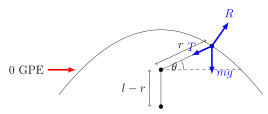
A long, inextensible string passes through a small fixed ring. One end of the string is attached to a particle of mass \(m,\) which hangs freely. The other end is attached to a bead also of mass \(m\) which is threaded on a smooth rigid wire fixed in the same vertical plane as the ring. The curve of the wire is such that the system can be in static equilibrium for all positions of the bead. The shortest distance between the wire and the ring is \(d(>0).\) Using plane polar coordinates centred on the ring, find the equation of the curve. The bead is set in motion. Assuming that the string remains taut, show that the speed of the bead when it is a distance \(r\) from the ring is \[ \left(\frac{r}{2r-d}\right)^{\frac{1}{2}}v, \] where \(v\) is the speed of the bead when \(r=d.\)
Solution:
1987 Paper 2 Q13
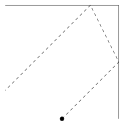
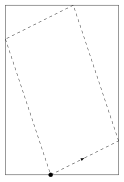
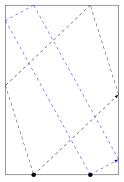
Ice snooker is played on a rectangular horizontal table, of length \(L\) and width \(B\), on which a small disc (the puck) slides without friction. The table is bounded by smooth vertical walls (the cushions) and the coefficient of restitution between the puck and any cushion is \(e\). If the puck is hit so that it bounces off two adjacent cushions, show that its final path (after two bounces) is parallel to its original path. The puck rests against the cushion at a point which divides the side of length \(L\) in the ratio \(z:1\). Show that it is possible, whatever \(z\), to hit the puck so that it bounces off the three other cushions in succession clockwise and returns to the spot at which it started. By considering these paths as \(z\) varies, explain briefly why there are two different ways in which, starting at any point away from the cushions, it is possible to perform a shot in which the puck bounces off all four cushions in succession clockwise and returns to its starting point.
Solution:
1987 Paper 2 Q14
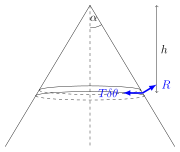
A thin uniform elastic band of mass \(m,\) length \(l\) and modulus of elasticity \(\lambda\) is pushed on to a smooth circular cone of vertex angle \(2\alpha,\) in such a way that all elements of the band are the same distance from the vertex. It is then released from rest. Let \(x(t)\) be the length of the band at time \(t\) after release, and let \(t_{0}\) be the time at which the band becomes slack. Assuming that a small element of the band which subtends an angle \(\delta\theta\) at the axis of the cone experiences a force, due to the tension \(T\) in the band, of magnitude \(T\delta\theta\) directed towards the axis, and ignoring the effects of gravity, show that \[ \frac{\mathrm{d}^{2}x}{\mathrm{d}t^{2}}+\frac{4\pi^{2}\lambda}{ml}(x-l)\sin^{2}\alpha=0,\qquad(0< t< t_{0}). \] Find the value of \(t_{0}.\)
Solution: