Problems
Filters
74 problems found
2013 Paper 3 Q3
The four vertices \(P_i\) (\(i= 1, 2, 3, 4\)) of a regular tetrahedron lie on the surface of a sphere with centre at \(O\) and of radius 1. The position vector of \(P_i\) with respect to \(O\) is \({\bf p}_i\) (\(i= 1, 2, 3, 4\)). Use the fact that \({\bf p}_1+ {\bf p}_2+{\bf p}_3+{\bf p}_4={\bf 0}\,\) to show that \({\bf p}_i \,.\, {\bf p}_j =-\frac13\,\) for \(i\ne j\). Let \(X\) be any point on the surface of the sphere, and let \(XP_i\) denote the length of the line joining \(X\) and \(P_i\) (\(i= 1, 2, 3, 4\)).
- By writing \((XP_i) ^2\) as \(({\bf p}_i- {\bf x)}\,.\,({\bf p}_i- {\bf x})\), where \({\bf x}\) is the position vector of \(X\) with respect to \(O\), show that \[ \sum_{i=1}^4(XP_i) ^2 =8\,. \]
- Given that \(P_1\) has coordinates \((0,0,1)\) and that the coordinates of \(P_2\) are of the form \((a,0,b)\), where \(a > 0\), show that \(a=2\sqrt2/3\) and \(b=-1/3\), and find the coordinates of \(P_3\) and \(P_4\).
- Show that \[ \sum_{i=1}^4 (XP_i)^4 = 4 \sum_{i=1}^4 (1- {\bf x}\,.\,{\bf p}_i)^2\,. \] By letting the coordinates of \(X\) be \( (x,y,z)\), show further that \(\sum\limits_{i=1}^4 (XP_i)^4\) is independent of the position of \(X\).
Solution: Note that \({\bf p}_i \cdot {\bf p}_i = 1\) and \({\bf p}_i \cdot {\bf p}_j\) are all equal when \(i \neq j\) by symmetry and commutativity. \begin{align*} && 0 &= {\bf p}_i \cdot \left ( {\bf p}_1+ {\bf p}_2+{\bf p}_3+{\bf p}_4 \right) \\ &&&= 1 + \sum_{j \neq i} {\bf p}_i \cdot {\bf p}_j \\ &&&= 1 + 3 {\bf p}_i \cdot {\bf p}_j \\ \Rightarrow && {\bf p}_i \cdot {\bf p}_j &= -\frac13 \end{align*}
- \(\,\) \begin{align*} && (XP_i)^2 &= ({\bf p}_i- {\bf x)}\,.\,({\bf p}_i- {\bf x}) \\ &&&= {\bf p}_i \cdot {\bf p}_i - 2 {\bf p}_i \cdot {\bf x} + {\bf x} \cdot {\bf x} \\ &&&= 2 - 2 {\bf p}_i \cdot {\bf x} \\ \Rightarrow && \sum_i (XP_i)^2 &= \sum_i \left (2 - 2 {\bf p}_i \cdot {\bf x} \right) \\ &&&= 8 - 2 \sum_i {\bf p}_i \cdot {\bf x} \\ &&&= 8 - 2 \left ( {\bf p}_1+ {\bf p}_2+{\bf p}_3+{\bf p}_4 \right) \cdot {\bf x} \\ &&&= 8 \end{align*}
- Notice we have \(1 = \left \|\begin{pmatrix} a \\0 \\b \end{pmatrix} \right \|= a^2 + b^2\) and \(-\frac13 = \begin{pmatrix} a \\0 \\b \end{pmatrix} \cdot \begin{pmatrix} 0 \\0 \\ 1 \end{pmatrix} = b\). So \(b = -1/3\) and \(a = \sqrt{1-b^2} = 2\sqrt{2}/3\). Suppose another of the vertices has coordinates \((u,v,w)\) we must have \begin{align*} && 1 &= u^2+v^2+w^2 \\ && -\frac13&=w \\ && -\frac13 &= \frac{2\sqrt{2}}3 u +\frac19 \\ \Rightarrow && u &= -\frac{\sqrt2}3 \\ \Rightarrow && 1 &= \frac19 + \frac29 + v^2 \\ \Rightarrow && v &= \pm \sqrt{\frac{2}{3}} \end{align*} So \(P_3, P_4 = (-\frac{\sqrt2}3, \pm \frac{\sqrt{6}}3, -\frac13)\)
- \(\,\) \begin{align*} && \sum_{i=1}^4 (XP_i)^4 &= \sum_i \left (2 - 2 {\bf p}_i \cdot {\bf x} \right)^2 \\ &&&= 4 \sum_i \left (1 - {\bf p}_i \cdot {\bf x} \right)^2 \\ &&&= 4 \sum_i (1 - 2{\bf p}_i \cdot {\bf x} + ({\bf p}_i \cdot {\bf x})^2) \\ &&&= 16 + 4\sum_i ({\bf p}_i \cdot {\bf x})^2 \\ &&&=16+ 4\left ( z^2+\left (\frac{2\sqrt{2}}3x-\frac13z \right)^2 +\left (-\frac{\sqrt{2}}3x-\frac{\sqrt{6}}3y-\frac13z \right)^2 +\left (-\frac{\sqrt{2}}3x+\frac{\sqrt{6}}3y-\frac13z \right)^2 \right) \\ &&&= 16+4 \left ( \frac43z^2 + \left (\frac89 + \frac29+\frac29 \right)x^2+\left (\frac69 + \frac69 \right)y^2 + 0xz + 0yz + 0zx \right) \\ &&&= 16+ 4\cdot\frac43(x^2+y^2+z^2) \\ &&&=16+\frac{16}{3}=\frac{64}{3} \end{align*}
2012 Paper 2 Q7
Three distinct points, \(X_1\), \(X_2\) and \(X_3\), with position vectors \({\bf x}_1\), \({\bf x}_2\) and \({\bf x}_3\) respectively, lie on a circle of radius 1 with its centre at the origin \(O\). The point \(G\) has position vector \(\frac13({\bf x}_1+{\bf x}_2+{\bf x}_3)\). The line through \(X_1\) and \(G\) meets the circle again at the point \(Y_1\) and the points \(Y_2\) and \(Y_3\) are defined correspondingly. Given that \(\overrightarrow{GY_1} =-\lambda_1\overrightarrow{GX_1}\), where \(\lambda_1\) is a positive scalar, show that \[ \overrightarrow{OY_1}= \tfrac13 \big( (1-2\lambda_1){\bf x}_1 +(1+\lambda_1)({\bf x}_2+{\bf x}_3)\big) \] and hence that \[ \lambda_1 = \frac {3-\alpha-\beta-\gamma} {3+\alpha -2\beta-2\gamma} \,,\] where \(\alpha = {\bf x}_2 \,.\, {\bf x}_3\), \(\beta = {\bf x}_3\,.\, {\bf x}_1\) and \(\gamma = {\bf x}_1\,.\, {\bf x}_2\). Deduce that $\dfrac {GX_1}{GY_1} + \dfrac {GX_2}{GY_2} + \dfrac {GX_3}{GY_3} =3 \,$.
Solution:

2011 Paper 2 Q5
The points \(A\) and \(B\) have position vectors \(\bf a \) and \(\bf b\) with respect to an origin \(O\), and \(O\), \(A\)~and~\(B\) are non-collinear. The point \(C\), with position vector \(\bf c\), is the reflection of \(B\) in the line through \(O\) and \(A\). Show that \(\bf c\) can be written in the form \[ \bf c = \lambda \bf a -\bf b \] where \(\displaystyle \lambda = \frac{2\,{\bf a .b}}{{\bf a.a}}\). The point \(D\), with position vector \(\bf d\), is the reflection of \(C\) in the line through \(O\) and \(B\). Show that \(\bf d\) can be written in the form \[ \bf d = \mu\bf b - \lambda \bf a \] for some scalar \(\mu\) to be determined. Given that \(A\), \(B\) and \(D\) are collinear, find the relationship between \(\lambda\) and \(\mu\). In the case \(\lambda = -\frac12\), determine the cosine of \(\angle AOB\) and describe the relative positions of \(A\), \(B\) and \(D\).
2011 Paper 2 Q11
Three non-collinear points \(A\), \(B\) and \(C\) lie in a horizontal ceiling. A particle \(P\) of weight \(W\) is suspended from this ceiling by means of three light inextensible strings \(AP\), \(BP\) and \(CP\), as shown in the diagram. The point \(O\) lies vertically above \(P\) in the ceiling.
- Show that the unit vector in the direction \(PB\) can be written in the form \[ -\frac13\, {\bf i} - \frac{\sqrt2\,}3\, {\bf j} + \frac{\sqrt2\, }{\sqrt3 \,} \,{\bf k} \,,\] where \(\bf i\,\), \(\, \bf j\) and \(\bf k\) are the usual mutually perpendicular unit vectors with \(\bf j\) parallel to \(OA\) and \(\bf k\) vertically upwards.
- Find expressions in vector form for the forces acting on \(P\).
- Show that \(U=\sqrt6 V\) and find \(T\), \(U\) and \(V\) in terms of \(W\).
2010 Paper 1 Q7
Relative to a fixed origin \(O\), the points \(A\) and \(B\) have position vectors \(\bf{a}\) and \(\bf{b}\), respectively. (The points \(O\), \(A\) and \(B\) are not collinear.) The point \(C\) has position vector \(\bf c\) given by \[ {\bf c} =\alpha {\bf a}+ \beta {\bf b}\,, \] where \(\alpha\) and \(\beta\) are positive constants with \(\alpha+\beta<1\,\). The lines \(OA\) and \(BC\) meet at the point \(P\) with position vector \(\bf p\) and the lines \(OB\) and \(AC\) meet at the point \(Q\) with position vector \(\bf q\). Show that \[ {\bf p} =\frac{\alpha {\bf a} }{1-\beta}\,, \] and write down \(\bf q\) in terms of \(\alpha,\ \beta\) and \(\bf {b}\). Show further that the point \(R\) with position vector \(\bf r\) given by \[ {\bf r} =\frac{\alpha {\bf a} + \beta {\bf b}}{\alpha + \beta}\,, \] lies on the lines \(OC\) and \(AB\). The lines \(OB\) and \(PR\) intersect at the point \(S\). Prove that $ \dfrac{OQ}{BQ} = \dfrac{OS}{BS}\,$.
2010 Paper 1 Q10
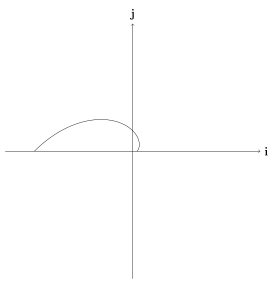
A particle \(P\) moves so that, at time \(t\), its displacement \( \bf r \) from a fixed origin is given by \[ {\bf r} =\left( \e^{t}\cos t \right) {\bf i}+ \left(\e^t \sin t\right) {\bf j}\,.\] Show that the velocity of the particle always makes an angle of \(\frac{\pi}{4}\) with the particle's displacement, and that the acceleration of the particle is always perpendicular to its displacement. Sketch the path of the particle for \(0\le t \le \pi\). A second particle \(Q\) moves on the same path, passing through each point on the path a fixed time \(T\) after \(P\) does. Show that the distance between \(P\) and \(Q\) is proportional to \(\e^{t}\).
Solution: \begin{align*} && {\bf r} &=\left( \e^{t}\cos t \right) {\bf i}+ \left(\e^t \sin t\right) {\bf j} \\ \Rightarrow && \dot{\bf r} &= \left( \e^{t}\cos t -\e^t \sin t\right) {\bf i}+ \left(\e^t \sin t+\e^t \cos t\right) {\bf j} \\ \Rightarrow && \mathbf{r}\cdot\dot{ \mathbf{r}} &= e^{2t}(\cos^2 t - \sin t \cos t) + e^{2t}(\sin^2 t+ \sin t \cos t) \\ &&&= e^{2t} (\cos^2 t + \sin ^2 t)\\ &&&= e^{2t} \\ \\ && | {\bf r}| &= e^{t} \\ && |{\bf \dot{r}}| &= e^t \sqrt{(\cos t - \sin t)^2 + (\sin t + \cos t)^2} \\ &&&= e^t \sqrt{2 \cos^2 t + 2 \sin^2 t} \\ &&&= \sqrt{2} e^t \\ \\ \Rightarrow && \frac{\mathbf{r}\cdot\dot{ \mathbf{r}}}{ |{\bf {r}}| |{\bf \dot{r}}|} &= \frac{e^{2t}}{\sqrt{2}e^te^t} \\ &&&= \frac{1}{\sqrt{2}} \end{align*} Therefore the angle between the velocity and displacement is \(\frac{\pi}{4}\). \begin{align*} && \ddot{\bf{r}} &= \left( \e^{t}(\cos t - \sin t) - \e^t (\sin t + \cos t)\right) {\bf i}+ \left(\e^t (\sin t + \cos t) + \e^t(\cos t - \sin t)\right) {\bf j} \\ &&&= \left ( -2\e^{t} \sin t \right) {\bf i}+ \left ( 2\e^{t} \cos t \right) {\bf j} \\ \Rightarrow && {\bf r} \cdot \ddot{\bf{r}} &= 2e^{2t} \left ( -\sin t \cos t + \sin t \cos t \right) \\ &&&= 0 \end{align*} Therefore the acceleration is perpendicular.
2010 Paper 2 Q5
The points \(A\) and \(B\) have position vectors \(\bf i +j+k\) and \(5{\bf i} - {\bf j} -{\bf k}\), respectively, relative to the origin \(O\). Find \(\cos2\alpha\), where \(2\alpha\) is the angle \(\angle AOB\).
- The line \(L _1\) has equation \({\bf r} =\lambda(m{\bf i}+n {\bf j} + p{\bf k})\). Given that \(L _1\) is inclined equally to \(OA\) and to \(OB\), determine a relationship between \(m\), \(n\) and~\(p\). Find also values of \(m\), \(n\) and~\(p\) for which \(L _1\) is the angle bisector of \(\angle AOB\).
- The line \(L _2\) has equation \({\bf r} =\mu(u{\bf i}+v {\bf j} + w{\bf k})\). Given that \( L _2\) is inclined at an angle \(\alpha\) to \(OA\), where \(2\alpha = \angle AOB\), determine a relationship between \(u\), \(v\) and \(w\). Hence describe the surface with Cartesian equation \(x^2+y^2+z^2 =2(yz+zx+xy)\).
2010 Paper 3 Q6
The points \(P\), \(Q\) and \(R\) lie on a sphere of unit radius centred at the origin, \(O\), which is fixed. Initially, \(P\) is at \(P_0(1, 0, 0)\), \(Q\) is at \(Q_0(0, 1, 0)\) and \(R\) is at \(R_0(0, 0, 1)\).
- The sphere is then rotated about the \(z\)-axis, so that the line \(OP\) turns directly towards the positive \(y\)-axis through an angle \(\phi\). The position of \(P\) after this rotation is denoted by \(P_1\). Write down the coordinates of \(P_1\).
- The sphere is now rotated about the line in the \(x\)-\(y\) plane perpendicular to \(OP_1\), so that the line \(OP\) turns directly towards the positive \(z\)-axis through an angle \(\lambda\). The position of \(P\) after this rotation is denoted by \(P_2\). Find the coordinates of \(P_2\). Find also the coordinates of the points \(Q_2\) and \(R_2\), which are the positions of \(Q\) and \(R\) after the two rotations.
- The sphere is now rotated for a third time, so that \(P\) returns from \(P_2\) to its original position~\(P_0\). During the rotation, \(P\) remains in the plane containing \(P_0\), \(P_2\) and \(O\). Show that the angle of this rotation, \(\theta\), satisfies \[ \cos\theta = \cos\phi \cos\lambda\,, \] and find a vector in the direction of the axis about which this rotation takes place.
2009 Paper 2 Q8
The non-collinear points \(A\), \(B\) and \(C\) have position vectors \(\bf a\), \(\bf b\) and \(\bf c\), respectively. The points \(P\) and \(Q\) have position vectors \(\bf p\) and \(\bf q\), respectively, given by \[ {\bf p}= \lambda {\bf a} +(1-\lambda){\bf b} \text{ \ \ \ and \ \ \ } {\bf q}= \mu {\bf a} +(1-\mu){\bf c} \] where \(0<\lambda<1\) and \(\mu>1\). Draw a diagram showing \(A\), \(B\), \(C\), \(P\) and \(Q\). Given that \(CQ\times BP = AB\times AC\), find \(\mu\) in terms of \(\lambda\), and show that, for all values of \(\lambda\), the the line \(PQ\) passes through the fixed point \(D\), with position vector \({\bf d}\) given by \({\bf d= -a +b +c}\,\). What can be said about the quadrilateral \(ABDC\)?
2008 Paper 2 Q8
The points \(A\) and \(B\) have position vectors \(\bf a\) and \(\bf b\), respectively, relative to the origin \(O\). The points \(A\), \(B\) and \(O\) are not collinear. The point \(P\) lies on \(AB\) between \(A\) and \(B\) such that \[ AP : PB = (1-\lambda):\lambda\,. \] Write down the position vector of \(P\) in terms of \(\bf a\), \(\bf b\) and \(\lambda\). Given that \(OP\) bisects \(\angle AOB\), determine \(\lambda\) in terms of \(a\) and \(b\), where \(a=\vert \bf a\vert\) and $b=\vert \mathbf{b}\vert\(. The point \)Q\( also lies on \)AB\( between \)A\( and \)B\(, and is such that \)AP=BQ$. Prove that $$OQ^2-OP^2=(b-a)^2\,.$$
Solution:

2007 Paper 1 Q5
Note: a regular octahedron is a polyhedron with eight faces each of which is an equilateral triangle.
- Show that the angle between any two faces of a regular octahedron is \(\arccos \left( -{\frac1 3} \right)\).
- Find the ratio of the volume of a regular octahedron to the volume of the cube whose vertices are the centres of the faces of the octahedron.
Solution:
- Suppose the vertices are \((\pm1, 0,0), (0,\pm1,0), (0,0,\pm1)\), then clearly this is an octahedron. We can measure the angle between the faces, by looking at vectors in the same plane and also in two of the faces: \(\langle \frac12, \frac12, - 1\rangle\) and \(\langle \frac12, \frac12, 1\rangle\), then by considering the dot product: \begin{align*} && \cos \theta &= \frac{\frac14+\frac14-1}{\frac14+\frac14+1} \\ &&&= \frac{-2}{6} = -\frac13 \end{align*}
- The volume of our octahedron is \(2 \cdot \frac13 \cdot \underbrace{\sqrt{2}^2}_{\text{base}} \cdot \underbrace{1}_{\text{height}} = \frac43\). The centre of two touching faces are \(\langle \frac13, \frac13, \frac13 \rangle\) and \(\langle \frac13, \frac13, -\frac13 \rangle\) and so the length of the side of the cube is \(\frac23\) and so the volume of the cube is \(\frac8{27}\). Therefore the ratio is \(\frac{2}{9}\)
2007 Paper 1 Q7
- The line \(L_1\) has vector equation $\displaystyle {\bf r} = \begin{pmatrix} 1 \\ 0 \\ 2 \end{pmatrix} + \lambda \begin{pmatrix} \hphantom{-} 2 \\ \hphantom{-} 2 \\ -3 \end{pmatrix} $. The line \(L_2\) has vector equation $\displaystyle {\bf r} = \begin{pmatrix} \hphantom{-} 4 \\ -2 \\ \hphantom{-} 9 \end{pmatrix} + \mu \begin{pmatrix} \hphantom{-} 1 \\ \hphantom{-} 2 \\ -2 \end{pmatrix} . $ Show that the distance \(D\) between a point on \(L_1\) and a point on \(L_2\) can be expressed in the form \[ D^2 = \left(3\mu -4 \lambda-5 \right)^2 + \left( \lambda -1 \right)^2 + 36\,. \] Hence determine the minimum distance between these two lines and find the coordinates of the points on the two lines that are the minimum distance apart.
- The line \(L_3\) has vector equation ${\bf r} = \begin{pmatrix} 2 \\ 3 \\ 5 \end{pmatrix} + \alpha \begin{pmatrix} 0 \\ 1 \\ 0 \end{pmatrix} . $ The line \(L_4\) has vector equation $ {\bf r} = \begin{pmatrix} \hphantom{-} 3 \\ \hphantom{-} 3 \\ -2 \end{pmatrix} + \beta \begin{pmatrix} \, 4k\\ 1-k \\ \!\!\! -3k \end{pmatrix} . $ Determine the minimum distance between these two lines, explaining geometrically the two different cases that arise according to the value of \(k\).
2007 Paper 2 Q8
The points \(B\) and \(C\) have position vectors \(\mathbf{b}\) and \(\mathbf{c}\), respectively, relative to the origin \(A\), and \(A\), \(B\) and \(C\) are not collinear.
- The point \(X\) has position vector \(s \mathbf{b}+t\mathbf{c}\). Describe the locus of \(X\) when \(s+t=1\).
- The point \(P\) has position vector \(\beta \mathbf{b}+\gamma\mathbf{c}\), where \(\beta\) and \(\gamma\) are non-zero, and \(\beta+\gamma\ne1\). The line \(AP\) cuts the line \(BC\) at \(D\). Show that \(BD:DC=\gamma:\beta\).
- The line \(BP\) cuts the line \(CA\) at \(E\), and the line \(CP\) cuts the line \(AB\) at \(F\). Show that \[ \frac{AF}{FB} \times \frac{BD}{DC} \times \frac{CE}{EA}=1\,. \]
Solution:
- \(X\) lies on the line including \(B\) and \(C\).
- points on the line \(AP\) have the form \(\lambda(\beta \mathbf{b}+\gamma\mathbf{c})\), and the point \(D\) will be the point where \(\lambda\beta + \lambda \gamma = 1\). \begin{align*} && \frac{|BD|}{|DC|} &= \frac{|\mathbf{b} -\lambda(\beta \mathbf{b}+\gamma\mathbf{c})| }{|\lambda(\beta \mathbf{b}+\gamma\mathbf{c})- \mathbf{c}|} \\ &&&= \frac{|(1-\lambda \beta)\mathbf{b} - \lambda \gamma \mathbf{c}|}{|\lambda \beta \mathbf{b}+(\lambda \gamma -1)\mathbf{c}|}\\ &&&= \frac{|\lambda \gamma\mathbf{b} - \lambda \gamma \mathbf{c}|}{|\lambda \beta \mathbf{b}-(\lambda \beta)\mathbf{c}|} \\ &&&= \frac{\gamma}{\beta} \end{align*}
- The line \(BP\) is \(\mathbf{b} + \mu(\beta \mathbf{b}+\gamma\mathbf{c})\) and will meet \(CA\) when \(1+\mu\beta = 0\), ie \(\mu = -\frac{1}{\beta}\), therefore \(E\) is \(-\frac{\gamma}{\beta}\mathbf{c}\), and so \(\frac{|CE|}{|EA|} = \frac{1+\gamma/\beta}{\gamma/\beta} = \frac{\beta+\gamma}{\gamma}\). Similarly, \(F\) is \(-\frac{\beta}{\gamma}\mathbf{b}\) and \(\frac{|AF|}{|FB|} = \frac{\beta/\gamma}{1+\frac{\beta}{\gamma}} = \frac{\beta}{\gamma+\beta}\), and so \[\frac{AF}{FB} \times \frac{BD}{DC} \times \frac{CE}{EA} = \frac{\beta}{\gamma+\beta} \frac{\gamma}{\beta} \frac{\beta+\gamma}{\gamma} = 1 \]
2007 Paper 2 Q11
{\sl In this question take the acceleration due to gravity to be \(10\,{\rm m \,s}^{-2}\) and neglect air resistance.} The point \(O\) lies in a horizontal field. The point \(B\) lies \(50\,\)m east of \(O\). A particle is projected from \(B\) at speed \(25\,{\rm m\,s}^{-1}\) at an angle \(\arctan \frac12\) above the horizontal and in a direction that makes an angle \(60^\circ\) with \(OB\); it passes to the north of \(O\).
- Taking unit vectors \(\mathbf i\), \(\mathbf j\) and \(\mathbf k\) in the directions east, north and vertically upwards, respectively, find the position vector of the particle relative to \(O\) at time \(t\)~seconds after the particle was projected, and show that its distance from \(O\) is \[ 5(t^2- \sqrt5 t +10)\, {\rm m}. \] When this distance is shortest, the particle is at point \(P\). Find the position vector of \(P\) and its horizontal bearing from \(O\).
- Show that the particle reaches its maximum height at \(P\).
- When the particle is at \(P\), a marksman fires a bullet from \(O\) directly at \(P\). The initial speed of the bullet is \(350\,{\rm m\,s}^{-1}\). Ignoring the effect of gravity on the bullet show that, when it passes through \(P\), the distance between \(P\) and the particle is approximately~\(3\,\)m.
2006 Paper 1 Q8
{\it Note that the volume of a tetrahedron is equal to \(\frac1 3\) \(\times\) the area of the base \(\times\) the height.} The points \(O\), \(A\), \(B\) and \(C\) have coordinates \((0,0,0)\), \((a,0,0)\), \((0,b,0)\) and \((0,0,c)\), respectively, where \(a\), \(b\) and \(c\) are positive.
- Find, in terms of \(a\), \(b\) and \(c\), the volume of the tetrahedron \(OABC\).
- Let angle \(ACB = \theta\). Show that \[ \cos\theta = \frac {c^2} { { \sqrt{\vphantom{ \dot b} (a^2+c^2)(b^2+c^2)} } ^{\vphantom A} \ } \] and find, in terms of \(a\), \(b\) and \(c\), the area of triangle \(ABC\). % is %\(\displaystyle \tfrac12 \sqrt{ \vphantom{\dot A } a^2b^2 +b^2c^2 + c^2 a^2 \;} \;\).