Problems
Filters
31 problems found
1997 Paper 1 Q12
An experiment produces a random number \(T\) uniformly distributed on \([0,1]\). Let \(X\) be the larger root of the equation \[x^{2}+2x+T=0.\] What is the probability that \(X>-1/3\)? Find \(\mathbb{E}(X)\) and show that \(\mathrm{Var}(X)=1/18\). The experiment is repeated independently 800 times generating the larger roots \(X_{1}, X_{2}, \dots, X_{800}\). If \[Y=X_{1}+X_{2}+\dots+X_{800}.\] find an approximate value for \(K\) such that \[\mathrm{P}(Y\leqslant K)=0.08.\]
Solution: \((x+1)^2+T-1 = 0\) so the larger root is \(-1 + \sqrt{1-T}\) \begin{align*} && \mathbb{P}(X > -1/3) &= \mathbb{P}(-1 + \sqrt{1-T} > -1/3) \\ &&&= \mathbb{P}(\sqrt{1-T} > 2/3)\\ &&&= \mathbb{P}(1-T > 4/9)\\ &&&= \mathbb{P}\left (T < \frac59 \right) = \frac59 \end{align*} Similarly, for \(t \in [-1,0]\) \begin{align*} && \mathbb{P}(X \leq t) &= \mathbb{P}(-1 + \sqrt{1-T} \leq t) \\ &&&= \mathbb{P}(\sqrt{1-T} \leq t+1)\\ &&&= \mathbb{P}(1-T \leq (t+1)^2)\\ &&&= \mathbb{P}\left (T \geq 1-(t+1)^2\right) = (t+1)^2 \\ \Rightarrow && f_X(t) &= 2(t+1) \\ \Rightarrow && \E[X] &= \int_{-1}^0 x \cdot f_X(x) \d x \\ &&&= \int_{-1}^0 x2(x+1) \d x \\ &&&= \left [\frac23x^3+x^2 \right]_{-1}^0 \\ &&&= -\frac13 \\ && \E[X^2] &= \int_{-1}^0 x^2 \cdot f_X(x) \d x \\ &&&= \int_{-1}^0 2x^2(x+1) \d x \\ &&&= \left [ \frac12 x^4 + \frac23x^3\right]_{-1}^0 \\ &&&= \frac16 \\ \Rightarrow && \var[X] &= \E[X^2] - \left (\E[X] \right)^2 \\ &&&= \frac16 - \frac19 = \frac1{18} \end{align*} Notice that by the central limit theorem \(\frac{Y}{800} \approx N( -\tfrac13, \frac{1}{18 \cdot 800})\). Also notice that \(\Phi^{-1}(0.08) \approx -1.4 \approx -\sqrt{2}\) Therefore we are looking for roughly \(800 \cdot (-\frac13 -\frac{1}{\sqrt{18 \cdot 800}} \sqrt{2})) = -267-9 = -276\)
1996 Paper 2 Q12
- Let \(X_{1}, X_{2}, \dots, X_{n}\) be independent random variables each of which is uniformly distributed on \([0,1]\). Let \(Y\) be the largest of \(X_{1}, X_{2}, \dots, X_{n}\). By using the fact that \(Y<\lambda\) if and only if \(X_{j}<\lambda\) for \(1\leqslant j\leqslant n\), find the probability density function of \(Y\). Show that the variance of \(Y\) is \[\frac{n}{(n+2)(n+1)^{2}}.\]
- The probability that a neon light switched on at time \(0\) will have failed by a time \(t>0\) is \(1-\mathrm{e}^{-t/\lambda}\) where \(\lambda>0\). I switch on \(n\) independent neon lights at time zero. Show that the expected time until the first failure is \(\lambda/n\).
Solution:
- \(\,\) \begin{align*} && F_Y(\lambda) &= \mathbb{P}(Y < \lambda) \\ &&&= \prod_i \mathbb{P}(X_i < \lambda) \\ &&&= \lambda^n \\ \Rightarrow && f_Y(\lambda) &= \begin{cases} n \lambda^{n-1} & \text{if } 0 \leq \lambda \leq 1 \\ 0 & \text{otherwise} \end{cases} \\ \\ && \E[Y] &= \int_0^1 \lambda f_Y(\lambda) \d \lambda \\ &&&= \int_0^1 n \lambda^n \d \lambda \\ &&&= \frac{n}{n+1} \\ && \E[Y^2] &= \int_0^1 \lambda^2 f_Y(\lambda) \d \lambda \\ &&&= \int_0^1 n \lambda^{n+1} \d \lambda \\ &&&= \frac{n}{n+2} \\ \Rightarrow && \var[Y] &= \E[Y^2]-(\E[Y])^2 \\ &&&= \frac{n}{n+2} - \frac{n^2}{(n+1)^2} \\ &&&= \frac{(n+1)^2n-n^2(n+2)}{(n+2)(n+1)^2} \\ &&&= \frac{n[(n^2+2n+1)-(n^2+2n)]}{(n+2)(n+1)^2} \\ &&&= \frac{n}{(n+2)(n+1)^2} \end{align*}
- Using the same reasoning, we can see that \begin{align*} && 1-F_Z(t) &= \mathbb{P}(\text{all lights still on after t}) \\ &&&= \prod_i e^{-t/\lambda} \\ &&&= e^{-nt/\lambda} \\ \\ \Rightarrow && F_Z(t) &= 1-e^{-nt/\lambda} \end{align*} Therefore \(Z \sim Exp(\frac{n}{\lambda})\) and the time to first failure is \(\lambda/n\)
1996 Paper 2 Q14
The random variable \(X\) is uniformly distributed on \([0,1]\). A new random variable \(Y\) is defined by the rule \[ Y=\begin{cases} 1/4 & \mbox{ if }X\leqslant1/4,\\ X & \mbox{ if }1/4\leqslant X\leqslant3/4\\ 3/4 & \mbox{ if }X\geqslant3/4. \end{cases} \] Find \({\mathrm E}(Y^{n})\) for all integers \(n\geqslant 1\). Show that \({\mathrm E}(Y)={\mathrm E}(X)\) and that \[{\mathrm E}(X^{2})-{\mathrm E}(Y^{2})=\frac{1}{24}.\] By using the fact that \(4^{n}=(3+1)^{n}\), or otherwise, show that \({\mathrm E}(X^{n}) > {\mathrm E}(Y^{n})\) for \(n\geqslant 2\). Suppose that \(Y_{1}\), \(Y_{2}\), \dots are independent random variables each having the same distribution as \(Y\). Find, to a good approximation, \(K\) such that \[{\rm P}(Y_{1}+Y_{2}+\cdots+Y_{240000} < K)=3/4.\]
Solution: \begin{align*} && \E[Y^n] &= \frac14 \cdot \frac1{4^n} + \frac14 \cdot \frac{3^n}{4^n} + \frac12 \int_{1/4}^{3/4}2 y^n \d y \\ &&&= \frac{3^n+1}{4^{n+1}} + \left [ \frac{y^{n+1}}{n+1} \right]_{1/4}^{3/4} \\ &&&= \frac{3^n+1}{4^{n+1}} + \frac{3^{n+1}-1}{(n+1)4^{n+1}} \end{align*} \begin{align*} && \E[Y] &= \frac{3+1}{16} + \frac{9-1}{2 \cdot 16} \\ &&&= \frac{1}{4} + \frac{1}{4} = \frac12 = \E[X] \end{align*} \begin{align*} && \E[X^2] &= \int_0^1 x^2 \d x = \frac13 \\ && \E[Y^2] &= \frac{9+1}{64} + \frac{27-1}{3 \cdot 64} = \frac{56}{3 \cdot 64} = \frac{7}{24} \\ \Rightarrow && \E[X^2] - \E[Y^2] &= \frac13 - \frac{7}{24} = \frac{1}{24} \end{align*} \begin{align*} && \E[X^n] &= \frac{1}{n+1} \\ && \E[Y^n] &= \frac{1}{n+1} \frac{1}{4^{n+1}}\left ( (n+1)(3^n+1)+3^{n+1}-1 \right) \\ &&&= \frac{1}{n+1} \frac{1}{4^{n+1}}\left ( 3^{n+1} + (n+1)3^n +n \right) \\ \\ && (3+1)^{n+1} &= 3^{n+1} + (n+1)3^n + \cdots + (n+1) \cdot 3 + 1 \\ &&&> 3^{n+1} + (n+1)3^n + n + 1 \end{align*} if \(n \geq 2\) Notice that by the central limit theorem: \begin{align*} &&\frac{1}{240\,000} \sum_{i=1}^{240\,000} Y_i &\sim N \left ( \frac12, \frac{1}{24 \cdot 240\,000}\right) \\ \Rightarrow && \mathbb{P}\left (\frac{\frac{1}{240\,000} \sum_{i=1}^{240\,000} Y_i - \frac12}{\frac1{24} \frac{1}{100}} \leq \frac23 \right) &\approx 0.75 \\ \Rightarrow && \mathbb{P} \left ( \sum_i Y_i \leq 240\,000 \cdot \left ( \frac2{3} \frac1{2400}+\frac12 \right) \right ) & \approx 0.75 \\ \Rightarrow && K &= 120\,000 + 66 \\ &&&\approx 120\,066 \end{align*}
1994 Paper 2 Q14
When Septimus Moneybags throws darts at a dart board they are certain to end on the board (a disc of radius \(a\)) but, it must be admitted, otherwise are uniformly randomly distributed over the board.
- Show that the distance \(R\) that his shot lands from the centre of the board is a random variable with variance \(a^{2}/18.\)
- At a charity fete he can buy \(m\) throws for \(\pounds(12+m)\), but he must choose \(m\) before he starts to throw. If at least one of his throws lands with \(a/\sqrt{10}\) of the centre he wins back \(\pounds 12\). In order to show that a good sport he is, he is determined to play but, being a careful man, he wishes to choose \(m\) so as to minimise his expected loss. What values of \(m\) should he choose?
Solution:
- \(\,\) \begin{align*} && \mathbb{P}(R < d) &= \frac{\pi d^2}{\pi a^2} \\ &&&= \frac{d^2}{a^2} \\ \Rightarrow && f_R(d) &= \frac{2d}{a^2}\\ \\ && \E[R] &= \int_0^a x \cdot f_R(x) \d x \\ &&&= \int_0^a \frac{2x^2}{a^2} \d x \\ &&&= \frac{2a}{3} \\ \\ && \E[R^2] &= \int_0^a x^2 \cdot f_R(x) \d x \\ &&&= \int_0^a \frac{2x^3}{a^2} \d x \\ &&&= \frac{a^2}{2} \\ \Rightarrow && \var[R] &= \frac{a^2}2 - \frac{4a^2}{9} \\ &&7= \frac{a^2}{18} \end{align*}
- Let \(p = \mathbb{P}(R < \frac{a}{\sqrt{10}}) = \frac{a^2}{10a^2} = \frac{1}{10}\) be the probability of hitting the target on each throw. His expected loss is \((12+m)p^m + m(1-p^m) = 12p^m + m\). \begin{array}{c|c} m & \text{expected loss} \\ \hline 0 & 12 \\ 1 & \frac{12}{10} + 1 \approx 2.2 \\ 2 & \frac{12}{100} + 2 \approx 2.12 \\ \end{array} If he takes more than \(2\) throws it will definitely cost more than \(3\), therefore he should take exactly \(2\) throws.
1994 Paper 3 Q14
Three points, \(P,Q\) and \(R\), are independently randomly chosen on the perimeter of a circle. Prove that the probability that at least one of the angles of the triangle \(PQR\) will exceed \(k\pi\) is \(3(1-k)^{2}\) if \(\frac{1}{2}\leqslant k\leqslant1.\) Find the probability if \(\frac{1}{3}\leqslant k\leqslant\frac{1}{2}.\)
1993 Paper 1 Q16
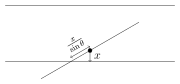
By making the substitution \(y=\cos^{-1}t,\) or otherwise, show that \[ \int_{0}^{1}\cos^{-1}t\,\mathrm{d}t=1. \] A pin of length \(2a\) is thrown onto a floor ruled with parallel lines equally spaced at a distance \(2b\) apart. The distance \(X\) of its centre from the nearest line is a uniformly distributed random variable taking values between \(0\) and \(b\) and the acute angle \(Y\) the pin makes with a direction perpendicular to the line is a uniformly distributed random variable taking values between \(0\) and \(\pi/2\). \(X\) and \(Y\) are independent. If \(X=x\) what is the probability that the pin crosses the line? If \(a < b\) show that the probability that the pin crosses a line for a general throw is \(\dfrac{2a}{\pi b}.\)
Solution: \begin{align*} && I &= \int_0^1 \cos^{-1} t \d t \\ \cos y = t: -\sin y \d y = \d t: &&&= \int_{\frac{\pi}{2}}^0 -y \sin y \d y \\ &&&= \int_0^{\pi/2} y \sin y \d y \\ &&&= \left [-y \cos y \right]_0^{\pi/2} + \int_0^{\pi/2} \cos y \d y \\ &&&= \left [ \sin y \right]_0^{\pi/2} = 1 \end{align*}
1992 Paper 3 Q15
A goat \(G\) lies in a square field \(OABC\) of side \(a\). It wanders randomly round its field, so that at any time the probability of its being in any given region is proportional to the area of this region. Write down the probability that its distance, \(R\), from \(O\) is less than \(r\) if \(0 < r\leqslant a,\) and show that if \(r\geqslant a\) the probability is \[ \left(\frac{r^{2}}{a^{2}}-1\right)^{\frac{1}{2}}+\frac{\pi r^{2}}{4a^{2}}-\frac{r^{2}}{a^{2}}\cos^{-1}\left(\frac{a}{r}\right). \] Find the median of \(R\) and probability density function of \(R\). The goat is then tethered to the corner \(O\) by a chain of length \(a\). Find the conditional probability that its distance from the fence \(OC\) is more than \(a/2\).
1991 Paper 2 Q15
Integers \(n_{1},n_{2},\ldots,n_{r}\) (possibly the same) are chosen independently at random from the integers \(1,2,3,\ldots,m\). Show that the probability that \(\left|n_{1}-n_{2}\right|=k\), where \(1\leqslant k\leqslant m-1\), is \(2(m-k)/m^{2}\) and show that the expectation of \(\left|n_{1}-n_{2}\right|\) is \((m^{2}-1)/(3m)\). Verify, for the case \(m=2\), the result that the expection of \(\left|n_{1}-n_{2}\right|+\left|n_{2}-n_{3}\right|\) is \(2(m^{2}-1)/(3m).\) Write down the expectation, for general \(m\), of \[ \left|n_{1}-n_{2}\right|+\left|n_{2}-n_{3}\right|+\cdots+\left|n_{r-1}-n_{r}\right|. \] Desks in an examination hall are placed a distance \(d\) apart in straight lines. Each invigilator looks after one line of \(m\) desks. When called by a candidate, the invigilator walks to that candidate's desk, and stays there until called again. He or she is equally likely to be called by any of the \(m\) candidates in the line but candidates never call simultaneously or while the invigilator is attending to another call. At the beginning of the examination the invigilator stands by the first desk. Show that the expected distance walked by the invigilator in dealing with \(N+1\) calls is \[ \frac{d(m-1)}{6m}[2N(m+1)+3m]. \]
1991 Paper 2 Q16
Each time it rains over the Cabbibo dam, a volume \(V\) of water is deposited, almost instanetaneously, in the reservoir. Each day (midnight to midnight) water flows from the reservoir at a constant rate \(u\) units of volume per day. An engineer, if present, may choose to alter the value of \(u\) at any midnight.
- Suppose that it rains at most once in any day, that there is a probability \(p\) that it will rain on any given day and that, if it does, the rain is equally likely to fall at any time in the 24 hours (i.e. the time at which the rain falls is a random variable uniform on the interval \([0,24]\)). The engineers decides to take two days' holiday starting at midnight. If at this time the volume of water in the reservoir is \(V\) below the top of the dam, find an expression for \(u\) such that the probability of overflow in the two days is \(Q\), where \(Q < p^{2}.\)
- For the engineer's summer holidays, which last 18 days, the reservoir is drained to a volume \(kV\) below the top of the dam and the rate of outflow \(u\) is set to zero. The engineer wants to drain off as little as possible, consistent with the requirement that the probability that the dam will overflow is less than \(\frac{1}{10}.\) In the case \(p=\frac{1}{3},\) find by means of a suitable approximation the required value of \(k\).
- Suppose instead that it may rain at most once before noon and at most once after noon each day, that the probability of rain in any given half-day is \(\frac{1}{6}\) and that it is equally likely to rain at any time in each half-day. Is the required value of \(k\) lower or higher?
Solution:
- It cannot overflow on the first day, since it is already \(V\) below the top. The only way it can overflow is if it rains both days. This will occur with probability \(p^2\). The probability it overflows therefore is the probability that bad timing hampers us, ie \(V - u(1+t_2) > 0\) where \(t_2\) is the timing of the rain on day 2 (as a fraction of a day). Ie \(t_2 < \frac{V}{u}-1\). Therefore \begin{align*} && Q &= p^2 \left (\frac{V}{u} - 1 \right) \\ \Rightarrow && u &= \frac{Vp^2}{p^2+Q} \end{align*}
- The probability the reservoir overflows during this \(18\) days is \(\mathbb{P}(\text{rains more than }k\text{ times})\). The number of times it rains (\(X\)) is \(B(18, \tfrac13)\), since \(18 \cdot \tfrac13 = 6 > 5\) a normal approximation is reasonable, ie \(X \approx N(6, 4)\). We wish to find \(k\) such that \(\mathbb{P}( X > k + 0.5) < \tfrac1{10}\) therefore \(k \approx 1.28 \cdot 2 + 6 - 0.5 \approx 8.1\) so they should set \(k\) to \(9\)
- In this case we have \(B(36, \tfrac16)\) approximated by \(B(6, 5)\) which has a larger standard deviation, therefore we need to choose a larger value for \(k\). [It turns out to actually be the same, but there's no reason to be able to expect students without a calculator to establish this]
1990 Paper 3 Q16
- A rod of unit length is cut into pieces of length \(X\) and \(1-X\); the latter is then cut in half. The random variable \(X\) is uniformly distributed over \([0,1].\) For some values of \(X\) a triangle can be formed from the three pieces of the rod. Show that the conditional probability that, if a triangle can be formed, it will be obtuse-angled is \(3-2\sqrt{2.}\)
- The bivariate distribution of the random variables \(X\) and \(Y\) is uniform over the triangle with vertices \((1,0),(1,1)\) and \((0,1).\) A pair of values \(x,y\) is chosen at random from this distribution and a (perhaps degenerate) triangle \(ABC\) is constructed with \(BC=x\) and \(CA=y\) and \(AB=2-x-y.\) Show that the construction is always possible and that \(\angle ABC\) is obtuse if and only if \[ y>\frac{x^{2}-2x+2}{2-x}. \] Deduce that the probability that \(\angle ABC\) is obtuse is \(3-4\ln2.\)
Solution:
- The construction is possible if \(x + y > 2-x-y \Rightarrow x+y > 1\) (which is as the triangle is above the diagonal line), and \(x + (2-x-y) > y \Rightarrow 1 > y\) (true as the triangle is below the horizontal line) and \(y + (2-x-y) > x \Rightarrow 1 > x\) (true as the triangle is left of the vertical arrow). By the cosine rule: \begin{align*} && y^2 &= x^2 + (2-x-y)^2 - 2 x (2-x-y) \cos \angle ABC \\ \Rightarrow && \cos \angle ABC &= \frac{x^2+(2-x-y)^2 - y^2}{2x(2-x-y)} \\ &&&= \frac{4+2x^2-4x-4y+2xy}{2x(2-x-y)} \\ \underbrace{\Rightarrow}_{\cos \angle ABC < 0} && 0 &> 4+2x^2-4x-4y+2xy \\ \Rightarrow && 0 &> 2x^2-4x+4 - 2(x-2)y \\ \Rightarrow && y &> \frac{x^2-2x+2}{2-x} \\ &&&= -x + \frac{2}{2-x} \end{align*}
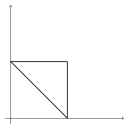 Therefore the area we want is: \begin{align*} A &= 1 - \int_0^1 \left ( -x + \frac{2}{2-x} \right)\d x \\ &= 1 - \left [-\frac12 x^2 - 2 \ln(2-x) \right]_0^1 \\ &= 1 + \frac12 -2 \ln 2 \\ &= \frac32 - 2 \ln 2 \end{align*} Therefore the relative area is: \(\frac{\frac32 - 2 \ln 2}{1/2} = 3 - 4 \ln 2\)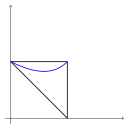
1989 Paper 1 Q15
I can choose one of three routes to cycle to school. Via Angle Avenue the distance is 5\(\,\)km, and I am held up at a level crossing for \(A\) minutes, where \(A\) is a continuous random variable uniformly distributed between \(0\) and 10. Via Bend Boulevard the distance is 4\(\,\)km, and I am delayed, by talking to each of \(B\) friends for 3\(\,\)minutes, for a total of \(3B\) minutes, where \(B\) is a random variable whose distribution is Poisson with mean 4. Via Detour Drive the distance should be only 2\(\,\)km, but in addition, due to never-ending road works, there are five places at each of which, with probability \(\frac{4}{5},\) I have to make a detour that increases the distance by 1\(\,\)km. Except when delayed by talking to friends or at the level crossing, I cycle at a steady 12\(\,\)km\(\,\)h\(^{-1}\). For each of the three routs, calculate the probability that a journey lasts at least 27 minutes. Each day I choose one of the three routes at random, and I am equally likely to choose any of the three alternatives. One day I arrive at school after a journey of at least 27 minutes. What is the probability that I came via Bend Boulevard? Which route should I use all the time: \begin{questionparts} \item if I wish my average journey time to be as small as possible; \item if I wish my journey time to be less than 32 minutes as often as possible? \end{questionpart} Justify your answers.
Solution: \(A \sim 5\cdot 5 + U[0,10]\) \(B \sim 4 \cdot 5 + 3 \textrm{Po}(4)\) \(C \sim 2 \cdot 5 + B(5, \frac{4}{5}) \cdot 5\) \begin{align*} && \mathbb{P}(A \leq 27) &= \mathbb{P}(U \leq 2) = 0.2 \\ && \mathbb{P}(B \leq 27) &= \mathbb{P}(3 \textrm{Po}(4) \leq 7) \\\ &&&= \mathbb{P}(Po(4) \leq 2) \\ &&&= e^{-4}(1 + 4 + \frac{4^2}{2}) \\ &&&= 0.23810\ldots \\ && \mathbb{P}(C \leq 27) &= \mathbb{P}(5 \cdot B(5,\tfrac45) \leq 17) \\ &&&= \mathbb{P}(B(5,\tfrac45) \leq 3) \\ &&&= \binom{5}{0} (\tfrac15)^5 + \binom{5}{1} (\tfrac45)(\tfrac 15)^4+ \binom{5}{2} (\tfrac45)^2(\tfrac 15)^3 + \binom{5}3 (\tfrac45)^3(\tfrac 15)^2+\\ &&&= 0.26272 \end{align*} \begin{align*} \mathbb{P}(\text{came via B} | \text{at least 27 minutes}) &= \frac{\mathbb{P}(\text{came via B and at least 27 minutes})}{\mathbb{P}(\text{at least 27 minutes})} \\ &= \frac{\frac13 \cdot 0.23810\ldots }{\frac13 \cdot 0.2 + \frac13 \cdot 0.23810\ldots + \frac13 \cdot 0.26272} \\ &= 0.3397\ldots \\ &= 0.340 \, \, (3\text{ s.f.}) \end{align*}
- \begin{align*} \mathbb{E}(A) &= 25 + 5 &= 30 \\ \mathbb{E}(B) &= 20 + 3\cdot 4 &= 32 \\ \mathbb{E}(C) &= 10 + 5 \cdot 4 &= 30 \end{align*} \(A\) and \(C\) are equally good.
- \begin{align*} \mathbb{P}(A \leq 32) &= \mathbb{P}(U \leq 7) &= 0.7 \\ \mathbb{P}(B \leq 32) &= \mathbb{P}(Po(4) \leq 4) \\ &= e^{-4}(1 + 4 + 8 + \frac{4^3}{6}) &= 0.4334\ldots \\ \mathbb{P}(C \leq 32) &= \mathbb{P}(B(5,\tfrac45) \leq 4) \\ &= 1 - \mathbb{P}(B(5,\tfrac45) = 5) \\ &= 1 - \frac{4^5}{5^5} &=0.67232 \end{align*} So you should choose route \(A\).
1989 Paper 3 Q15
The continuous random variable \(X\) is uniformly distributed over the interval \([-c,c].\) Write down expressions for the probabilities that:
- \(n\) independently selected values of \(X\) are all greater than \(k\),
- \(n\) independently selected values of \(X\) are all less than \(k\),
Solution:
- \begin{align*} \mathbb{P}(n\text{ independent values of }X > k) &= \prod_{i=1}^n \mathbb{P}(X > k) \\ &= \left ( \frac{c-k}{2c}\right)^n \end{align*}
- \begin{align*} \mathbb{P}(n\text{ independent values of }X < k) &= \prod_{i=1}^n \mathbb{P}(X < k) \\ &= \left ( \frac{k+c}{2c}\right)^n \end{align*}
1988 Paper 2 Q15
An examination consists of several papers, which are marked independently. The mark given for each paper can be an integer from \(0\) to \(m\) inclusive, and the total mark for the examination is the sum of the marks on the individual papers. In order to make the examination completely fair, the examiners decide to allocate the mark for each paper at random, so that the probability that any given candidate will be allocated \(k\) marks \((0\leqslant k\leqslant m)\) for a given paper is \((m+1)^{-1}\). If there are just two papers, show that the probability that a given candidate will receive a total of \(n\) marks is \[ \frac{2m-n+1}{\left(m+1\right)^{2}} \] for \(m< n\leqslant2m\), and find the corresponding result for \(0\leqslant n\leqslant m\). If the examination consists of three papers, show that the probability that a given candidate will receive a total of \(n\) marks is \[ \frac{6mn-4m^{2}-2n^{2}+3m+2}{2\left(m+1\right)^{2}} \] in the case \(m< n\leqslant2m\). Find the corresponding result for \(0\leqslant n\leqslant m\), and deduce the result for \(2m< n\leqslant3m\).
Solution: In order to receive \(n\) marks over the two papers, where \(m < n \leq 2m\) the student must receive \(k\) and \(n-k\) marks in each paper. Since \(n > m\), \(n-k\) is a valid mark when \(n-k \leq m\) ie when \(n-m\leq k\), therefore the probability is: \begin{align*} \sum_{k = n-m}^m \mathbb{P}(\text{scores }k\text{ and }n-k) &= \sum_{k=n-m}^m \frac{1}{(m+1)^2} \\ &= \frac{m-(n-m-1)}{(m+1)^2} \\ &= \frac{2m-n+1}{(m+1)^2} \end{align*} If \(0 \leq n \leq m\) then we need \(n-k\) marks in the second paper to be positive, ie \(n-k \geq 0 \Rightarrow n \geq k\), so \begin{align*} \sum_{k = 0}^n \mathbb{P}(\text{scores }k\text{ and }n-k) &= \sum_{k = 0}^n \frac{1}{(m+1)^2} \\ &= \frac{n+1}{(m+1)^2} \end{align*} On the first paper, they can score any number of marks, since \(n > m\), so we must have: \begin{align*} \sum_{k=0}^m \mathbb{P}(\text{scores }k\text{ and }n-k) &= \frac{1}{m+1} \sum_{k=0}^m \mathbb{P}(\text{scores }n-k\text{ on second papers}) \\ &= \frac{1}{m+1}\l \sum_{k=0}^{n-m} \frac{2m-(n-k)+1}{(m+1)^2} +\sum_{k=n-m+1}^m \frac{n-k+1}{(m+1)^2}\r \end{align*}
1987 Paper 1 Q15
A point \(P\) is chosen at random (with uniform distribution) on the circle \(x^{2}+y^{2}=1\). The random variable \(X\) denotes the distance of \(P\) from \((1,0)\). Find the mean and variance of \(X\). Find also the probability that \(X\) is greater than its mean.
Solution: Consider the angle from the origin, then \(P = (\cos \theta, \sin \theta)\) where \(\theta \sim U(0, 2\pi)\), and \(X = \sqrt{(\cos \theta - 1)^2 + \sin^2 \theta}\) \begin{align*} \mathbb{E}[X] &= \int_0^{2\pi} \sqrt{(\cos \theta - 1)^2 + \sin^2 \theta} \frac1{2\pi} \d \theta \\ &= \frac1{2\pi}\int_0^{2\pi} \sqrt{2 - 2\cos \theta} \d \theta \\ &= \frac{1}{2\pi}\int_0^{2\pi} \sqrt{4\sin^2 \frac{\theta}{2}} \d \theta \\ &= \frac{1}{\pi}\int_0^{2\pi} \left |\sin \frac{\theta}{2} \right| \d \theta \\ &= \frac{1}{\pi} \left [ -2\cos \frac{\theta}{2} \right]_0^{2\pi} \\ &= \frac1{\pi} \l 2 + 2\r \\ &= \frac{4}{\pi} \end{align*} \begin{align*} \mathbb{E}(X^2) &= \frac1{2\pi}\int_0^{2\pi} (\cos \theta - 1)^2 + \sin^2 \theta \d \theta \\ &= \frac1{2\pi}\int_0^{2\pi} 2 - 2 \cos \theta \d \theta \\ &= \frac{4\pi}{2\pi} \\ &= 2 \\ \end{align*} \(\Rightarrow\) \(\mathrm{Var}(X) = \mathbb{E}(X^2) - \mathbb{E}(X)^2 = 2 - \frac{16}{\pi^2} = \frac{2\pi^2 - 16}{\pi^2}\).

1987 Paper 2 Q15
A train of length \(l_{1}\) and a lorry of length \(l_{2}\) are heading for a level crossing at speeds \(u_{1}\) and \(u_{2}\) respectively. Initially the front of the train and the front of the lorry are at distances \(d_{1}\) and \(d_{2}\) from the crossing. Find conditions on \(u_{1}\) and \(u_{2}\) under which a collision will occur. On a diagram with \(u_{1}\) and \(u_{2}\) measured along the \(x\) and \(y\) axes respectively, shade in the region which represents collision. Hence show that if \(u_{1}\) and \(u_{2}\) are two independent random variables, both uniformly distributed on \((0,V)\), then the probability of a collision in the case when initially the back of the train is nearer to the crossing than the front of the lorry is \[ \frac{l_{1}l_{2}+l_{2}d_{1}+l_{1}d_{2}}{2d_{2}\left(l_{2}+d_{2}\right)}. \] Find the probability of a collision in each of the other two possible cases.