Problems
Filters
142 problems found
2016 Paper 1 Q3
In this question, \(\lfloor x \rfloor\) denotes the greatest integer that is less than or equal to \(x\), so that (for example) \(\lfloor 2.9 \rfloor = 2\), \(\lfloor 2\rfloor = 2\) and \(\lfloor -1.5 \rfloor = -2\). On separate diagrams draw the graphs, for \(-\pi \le x \le \pi\), of:
Solution:


2016 Paper 1 Q9
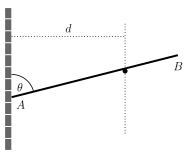
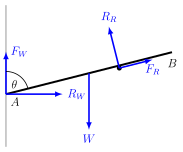
A horizontal rail is fixed parallel to a vertical wall and at a distance \(d\) from the wall. A uniform rod \(AB\) of length \(2a\) rests in equilibrium on the rail with the end \(A\) in contact with the wall. The rod lies in a vertical plane perpendicular to the wall. It is inclined at an angle \(\theta\) to the vertical (where \(0 < \theta < \frac12\pi\)) and \(a\sin\theta < d\), as shown in the diagram.
Solution:
2016 Paper 1 Q11
The point \(O\) is at the top of a vertical tower of height \(h\) which stands in the middle of a large horizontal plain. A projectile \(P\) is fired from \(O\) at a fixed speed \(u\) and at an angle \(\alpha\) above the horizontal. Show that the distance \(x\) from the base of the tower when \(P\) hits the plain satisfies \[ \frac{gx^2}{u^2} = h(1+\cos 2\alpha) + x \sin 2\alpha \,. \] Show that the greatest value of \(x\) as \(\alpha\) varies occurs when \(x=h\tan2\alpha\) and find the corresponding value of \(\cos 2\alpha\) in terms of \(g\), \(h\) and \(u\). Show further that the greatest achievable distance between \(O\) and the landing point is \(\dfrac {u^2}g +h\,\).
Solution: \begin{align*} \rightarrow: && x &= u \cos \alpha t\\ \Rightarrow && t &= \frac{x}{u \cos \alpha}\\ \uparrow: && -h &= u\sin \alpha t- \frac12gt^2 \\ && - h &= x\tan \alpha - \frac12 g \frac{x^2}{u^2}\sec^2 \alpha \\ \Rightarrow && \frac{gx^2}{u^2} &= h(2\cos^2 \alpha) + x2 \tan \alpha \cos^2 \alpha \\ &&&= h(1 + \cos 2 \alpha) + x \sin 2\alpha \\ \frac{\d}{\d \alpha}: && \frac{g}{u^2} 2 x \frac{\d x}{\d \alpha} &= -2h \sin 2 \alpha + 2x \cos 2 \alpha +\frac{\d x}{\d \alpha} \sin 2 \alpha \\ \Rightarrow && \frac{\d x}{\d \alpha} \left ( \frac{2xg}{u^2} - \sin 2 \alpha \right) &= 2\cos 2 \alpha (x -h \tan 2 \alpha) \end{align*} Since the turning point will be a maximum must be \(x = h \tan 2 \alpha\). Therefore, let \(c = \cos 2 \alpha\) \begin{align*} && \frac{gh^2}{u^2} \tan^2 2 \alpha &= h(1 + \cos 2 \alpha) + h \tan 2 \alpha \sin 2 \alpha \\ \Rightarrow && \frac{gh}{u^2}(c^{-2}-1) &= 1+c+\frac{1-c^2}{c} \\ \Rightarrow && \frac{gh(1-c^2)}{u^2c^2} &= \frac{c+c^2+1-c^2}{c}\\ &&&= \frac{1+c}{c} \\ \Rightarrow && \frac{gh(1-c)}{u^2c} &= 1 \\ \Rightarrow && u^2c &= gh(1-c) \\ \Rightarrow && c(u^2+gh) &= gh \\ \Rightarrow && \cos 2 \alpha &= \frac{gh}{u^2+gh} \\ \\ \Rightarrow && d_{max}^2 &= h^2 + h^2 \tan^2 2 \alpha \\ &&&= h^2\sec^2 2 \alpha \\ &&&= h^2 \frac{(u^2+gh)^2}{g^2h^2} \\ &&&= \frac{(u^2+gh)^2}{g^2} \\ &&&= \left (\frac{u^2}{g}+h \right)^2 \\ \Rightarrow && d_{max} &= \frac{u^2}{g}+h \end{align*}
2016 Paper 2 Q4
Let \[ y=\dfrac{x^2+x\sin\theta+1}{x^2+x\cos\theta+1} \,.\]
- Given that \(x\) is real, show that \[ (y\cos\theta -\sin\theta)^2 \ge 4 (y-1)^2 \,. \] Deduce that \[ y^2+1 \ge 4(y-1)^2 \,, \] and hence that \[ \dfrac {4-\sqrt7}3 \le y \le \dfrac {4+\sqrt7}3 \,. \]
- In the case $y= \dfrac {4+\sqrt7}3 \,$, show that \[\sqrt{y^2+1}=2(y-1)\] and find the corresponding values of \(x\) and \(\tan\theta\).
Solution:
- \(\,\) \begin{align*} && y&=\frac{x^2+x\sin\theta+1}{x^2+x\cos\theta+1} \\ \Leftrightarrow && 0 &= x^2(y-1) + x(y \cos \theta - \sin \theta) + y-1 \\ \Leftrightarrow && 0 &\leq \Delta = (y\cos \theta - \sin \theta)^2 - 4(y-1)^2 \\ \Leftrightarrow && (y\cos \theta - \sin \theta)^2 &\geq 4(y-1)^2 \end{align*} [Assuming that \(y \neq 1\), if \(y = 1\) then the RHS is \(0\) and it is automatically satisfied]. Notice that \((y\cos \theta - \sin \theta)^2 \leq (y^2+1)(\cos^2 \theta + \sin^2 \theta)\) by Cauchy-Schwarz, so \(y^2 + 1 \geq 4(y-1)^2\). \begin{align*} && y^2 + 1 &\geq 4(y-1)^2 \\ \Leftrightarrow && 0 &\geq 3y^2-8y+3 \\ \text{c.v.} && y&= \frac{8 \pm \sqrt{64-4\cdot3 \cdot 3}}{6} \\ &&&= \frac{4 \pm \sqrt{16-9}}{3} = \frac{4 \pm \sqrt{7}}3 \end{align*} so \(\frac{4-\sqrt{7}}3 \leq y \leq \frac{4+\sqrt7}3\).
- If \(y = \frac{4+\sqrt7}3\) then \(y - 1 = \frac{1+\sqrt7}3\) and since \(y^2+1 = 4(y-1)^2\) taking square roots we obtain \(\sqrt{y^2+1} = 2(y-1)\). Since equality must hold in our C-S identity, we must have \(\langle y, -1 \rangle\) parallel to \( \langle \cos \theta , \sin \theta \rangle\), ie \(\tan \theta = -\frac{3}{4+\sqrt{7}}\) and \begin{align*} && x & = \frac{-(y \cos \theta - \sin \theta) \pm \sqrt{\Delta}}{2(y-1)} \\ &&&= \frac{\pm2(y-1)}{2(y-1)} \\ &&&= \pm1 \end{align*}
2016 Paper 2 Q7
Show that \[ \int_0^a \f(x) \d x= \int _0^a \f(a-x) \d x\,, \tag{\(*\)} \] where f is any function for which the integrals exist.
- Use (\(*\)) to evaluate \[ \int_0^{\frac12\pi} \frac{\sin x}{\cos x + \sin x} \, \d x \,. \]
- Evaluate \[ \int_0^{\frac14\pi} \frac{\sin x}{\cos x + \sin x} \, \d x \,. \]
- Evaluate \[ \int_0^{\frac14\pi} \ln (1+\tan x) \, \d x \,. \]
- Evaluate \[ \int_0^{\frac14 \pi} \frac x {\cos x \, (\cos x + \sin x)}\, \d x \,. \]
Solution: \begin{align*} u = a-x, \d u = - \d x: && \int_0^a f(x) \d x &= \int_{u=a}^{u=0} f(a-u) (-1) \d u \\ &&&= \int_0^a f(a-u) \d u \\ &&&= \int_0^a f(a-x) \d x \end{align*}
- \begin{align*} && I &= \int_0^{\frac12 \pi} \frac{\sin x}{\cos x + \sin x } \d x\\ &&&= \int_0^{\frac12 \pi} \frac{\sin (\frac12 \pi - x)}{\cos (\frac12 \pi-x) + \sin (\frac12 \pi-x) } \d x\\ &&&= \int_0^{\frac12 \pi} \frac{\cos x}{\sin x + \cos x } \d x\\ \Rightarrow && 2I &= \int_0^{\frac12 \pi} 1 \d x \\ \Rightarrow && I &= \frac{\pi}{4} \end{align*}
- \begin{align*} && I &= \int_0^{\frac14 \pi} \frac{\sin x}{\cos x + \sin x } \d x\\ &&&= \int_0^{\frac14 \pi} \frac{\sin (\frac14 \pi - x)}{\cos (\frac14 \pi-x) + \sin (\frac14 \pi-x) } \d x\\ &&&= \int_0^{\frac14 \pi} \frac{\frac1{\sqrt{2}} \cos x - \frac{1}{\sqrt{2}} \sin x}{\frac1{\sqrt{2}} \cos x + \frac{1}{\sqrt{2}} \sin x + \frac1{\sqrt{2}} \cos x - \frac{1}{\sqrt{2}} \sin x} \d x \\ &&&= \int_0^{\frac14 \pi} \frac{\cos x - \sin x}{2 \cos x} \d x \\ &&&= \left [\frac12 x + \ln(\cos x) \right]_0^{\pi/4} \\ &&&= \frac{\pi}{8} -\frac12\ln2 - 1 \end{align*}
- \begin{align*} && I &= \int_0^{\frac14\pi} \ln (1+\tan x) \, \d x \\ &&&= \int_0^{\frac14 \pi} \ln \left (1 + \tan \left(\frac{\pi}{4} - x\right) \right) \, \d x\\ &&&= \int_0^{\frac14 \pi} \ln \left (1 +\frac{1 - \tan x}{1+ \tan x} \right) \, \d x\\ &&&= \int_0^{\frac14 \pi} \ln \left (\frac{2}{1+ \tan x} \right) \, \d x\\ &&&= \frac{\pi}{4} \ln 2 - I \\ \Rightarrow && I &= \frac{\pi}{8} \ln 2 \end{align*}
- \begin{align*} && I &= \int_0^{\frac14 \pi} \frac x {\cos x \, (\cos x + \sin x)}\, \d x \\ &&&= \int_0^{\frac14 \pi} \frac {\frac14 \pi - x} {(\frac1{\sqrt{2}} \cos x + \frac{1}{\sqrt{2}} \sin x) \, (\frac{2}{\sqrt{2}}\cos x)}\, \d x \\ &&&= \int_0^{\frac14 \pi} \frac {\frac14 \pi - x} {\cos x \, (\cos x + \sin x)}\, \d x \\ \\ \Rightarrow && I &= \frac{\pi}{8} \int_0^{\pi/4} \frac{\sec^2 x}{1 + \tan x} \d x\\ &&&= \frac{\pi}{8} \left [\ln (1 + \tan x) \right]_0^{\pi/4} \\ &&&= \frac{\pi}{8} \ln 2 \end{align*}
2015 Paper 1 Q9
A short-barrelled machine gun stands on horizontal ground. The gun fires bullets, from ground level, at speed \(u\) continuously from \(t=0\) to \(t= \dfrac{\pi}{ 6\lambda}\), where \(\lambda\) is a positive constant, but does not fire outside this time period. During this time period, the angle of elevation \(\alpha\) of the barrel decreases from \(\frac13\pi\) to \(\frac16\pi\) and is given at time \(t\) by \[ \alpha =\tfrac13 \pi - \lambda t\,. \] Let \(k = \dfrac{g}{2\lambda u}\). Show that, in the case \(\frac12 \le k \le \frac12 \sqrt3\), the last bullet to hit the ground does so\\[2pt] at a distance \[ \frac{ 2 k u^2 \sqrt{1-k^2}}{g} \] from the gun. What is the corresponding result if \(k<\frac12\)?
Solution: The bullet fired at time \(t\) will hit the ground at time \(t+\frac{2u \sin (\frac13\pi - \lambda t)}{g}\). To find the last time a bullet hits the ground, we can differentiate, noting that \begin{align*} && T(t) &= t + \frac{2u \sin \alpha}{g} \\ \Rightarrow && T'(t) &= 1 - \frac{2u\lambda}{g} \cos \alpha \\ && T''(t) &= \frac{2u \lambda^2}{g} \sin \alpha > 0 \end{align*} If \(k = \frac{g}{2\lambda u} \in [\frac12, \frac12\sqrt{3}]\) then notice that this turning point is always achieved, and will be a maximum. It will be when \(\cos \alpha = k, \sin \alpha = \sqrt{1-k^2}\). The distance will be \(u \cos \alpha \cdot \frac{2 u \sin \alpha}{g} = \frac{2ku^2\sqrt{1-k^2}}{g}\). If \(k < \frac12\) then the last bullet to hit the ground will be the last bullet fired, ie \(\frac{2u^2 \sin \frac16\pi \cos \frac16\pi}{g} = \frac{u^2 \sin \frac13 \pi}{g} = \frac{\sqrt{3}u^2}{2g}\)
2015 Paper 3 Q4
- If \(a\), \(b\) and \(c\) are all real, show that the equation \[ z^3+az^2+bz+c=0 \tag{\(*\)} \] has at least one real root.
- Let \[ S_1= z_1+z_2+z_3, \ \ \ \ S_2= z_1^2 + z_2^2 + z_3^2, \ \ \ \ S_3= z_1^3 + z_2^3 + z_3^3\,, \] where \(z_1\), \(z_2\) and \(z_3\) are the roots of the equation \((*)\). Express \(a\) and \(b\) in terms of \(S_1\) and \(S_2\), and show that \[ 6c =- S_1^3 + 3 S_1S_2 - 2S_3\,. \]
- The six real numbers \(r_k\) and \(\theta_k\) (\(k=1, \ 2, \ 3\)), where \(r_k>0\) and \(-\pi < \theta_k <\pi\), satisfy \[ \textstyle \sum\limits _{k=1}^3 r_k \sin (\theta_k) = 0\,, \ \ \ \ \textstyle \sum\limits _{k=1}^3 r_k^2 \sin (2\theta_k) = 0\,, \ \ \ \ \ \textstyle \sum\limits _{k=1}^3 r_k^3 \sin (3\theta_k) = 0\, . \] Show that \(\theta_k=0\) for at least one value of \(k\). Show further that if \(\theta_1=0\) then \(\theta_2 = - \theta_3\,\).
Solution:
- Let \(z \in \mathbb{R}\) and let \(z \to \pm \infty\) then \(z^3 + az^2 + bz + c\) changes sign, therefore somewhere it must have a real root.
- \begin{align*} &&z^3 + az^2 + bz + c &= (z-z_1)(z-z_2)(z-z_3) \\ && &= z^3 - (z_1+z_2+z_3)z^2 + (z_1z_2 + z_2z_3+z_3z_1)z - (z_1z_2z_3) \\ \\ \Rightarrow && S_1 &= z_1+z_2+z_3 \\ &&&= -a \\ \\ \Rightarrow && S_2 &= z_1^2+z_2^2+z_3^2 \\ &&&= (z_1+z_2+z_3)^2 - 2(z_1z_2 + z_2z_3+z_3z_1) \\ &&&= a^2 - 2b \\ \Rightarrow && a &= -S_1 \\ && b &= \frac12 \l S_1^2 - S_2\r \\ \\ && 0 &= z_i^3 + az_i^2+bz_i+c \\ \Rightarrow && 0 &= S_3 + aS_2+bS_1+3c \\ &&&= S_3 -S_1S_2 + \frac12 \l S_1^2 - S_2\r S_1 + 3c \\ \Rightarrow && 0 &= 2S_3 - 3S_1S_2 + S_1^3 + 6c \end{align*}
- Let \(z_k= r_ke^{i \theta_k}\), then we have \(\textrm{Im}(S_k) = 0\) and so the polynomial with roots \(z_k\) has real coefficients, and therefore at least one root is real. This root will have \(\theta_k = 0\). Moreover, since if \(w\) is a root of a real polynomial \(\overbar{w}\) is also a root, and therefore if \(\theta_1 = 0\), we must have that \(z_2\) and \(z_3\) are complex conjugate, ie \(\theta_2 = - \theta_3\)
2014 Paper 1 Q4
An accurate clock has an hour hand of length \(a\) and a minute hand of length \(b\) (where \(b>a\)), both measured from the pivot at the centre of the clock face. Let \(x\) be the distance between the ends of the hands when the angle between the hands is \(\theta\), where \(0\le\theta < \pi\). Show that the rate of increase of \(x\) is greatest when \(x=(b^2-a^2)^\frac12\). In the case when \(b=2a\) and the clock starts at mid-day (with both hands pointing vertically upwards), show that this occurs for the first time a little less than 11 minutes later.
Solution: The position of the hands are \(\begin{pmatrix} a\sin(-t) \\ a \cos(-t) \end{pmatrix}\) and \(\begin{pmatrix} b\sin(-60t) \\ b \cos(-60t) \end{pmatrix}\), the distance between the hands is \begin{align*} x &= \sqrt{\left ( a \sin t - b \sin 60t\right)^2+\left ( a \cos t - b \cos 60t\right)^2} \\ &= \sqrt{a^2+b^2-2ab\left (\sin t \sin 60t+\cos t \cos 60t \right)} \\ &= \sqrt{a^2+b^2-2ab \cos(59t)} = \sqrt{a^2+b^2-2ab \cos \theta} \\ \\ \frac{\d x}{\d \theta} &= \frac{ab \sin \theta}{ \sqrt{a^2+b^2-2ab \cos \theta}} \\ \frac{\d^2 x}{\d \theta^2} &= \frac{ab \cos \theta\sqrt{a^2+b^2-2ab \cos \theta} - \frac{a^2b^2 \sin^2 \theta}{\sqrt{a^2+b^2-2ab \cos \theta}} }{a^2+b^2-2ab \cos \theta} \\ &= \frac{ab \cos \theta(a^2+b^2-2ab \cos \theta) - a^2b^2 \sin^2 \theta }{(a^2+b^2-2ab \cos \theta)^{3/2}} \\ &= \frac{ab \cos \theta(a^2+b^2-2ab \cos \theta) - a^2b^2(1-\cos^2 \theta)}{(a^2+b^2-2ab \cos \theta)^{3/2}} \\ &= \frac{ab(a^2+b^2) \cos \theta-a^2b^2 \cos \theta- a^2b^2}{(a^2+b^2-2ab \cos \theta)^{3/2}} \\ &= \frac{-ab(a\cos \theta -b)(b \cos \theta - a)}{(a^2+b^2-2ab \cos \theta)^{3/2}} \\ \end{align*} So the rate of increase is largest when \(\cos \theta = \frac{a}{b}\) (since \(\frac{b}{a}\) is impossible. Therefore when \(x = \sqrt{a^2+b^2-2ab \frac{a}{b}} = \sqrt{a^2+b^2-2a^2} = \sqrt{b^2-a^2}\) If \(b = 2a\) then \(\cos \theta = \frac{a}{2a} = \frac12 = \frac{\pi}{3} = 60^\circ\) The relative speed of the hands is \(5.5^\circ\) per minute, so \(\frac{60}{5.5} = \frac{120}{11} \approx 11\) but clearly also less than since \(121 = 11^2\).
2014 Paper 2 Q2
This question concerns the inequality \begin{equation} \int_0^\pi \bigl( f(x) \bigr)^2 \d x \le \int_0^\pi \bigl( f'(x)\bigr)^2 \d x\,.\tag{\(*\)} \end{equation}
- Show that \((*)\) is satisfied in the case \(f(x)=\sin nx\), where \(n\) is a positive integer. Show by means of counterexamples that \((*)\) is not necessarily satisfied if either \(f(0) \ne 0\) or \(f(\pi)\ne0\).
- You may now assume that \((*)\) is satisfied for any (differentiable) function \(f\) for which \(f(0)=f(\pi)=0\). By setting \(f(x) = ax^2 + bx +c\), where \(a\), \(b\) and \(c\) are suitably chosen, show that \(\pi^2\le 10\). By setting \(f(x) = p \sin \frac12 x + q\cos \frac12 x +r\), where \(p\), \(q\) and \(r\) are suitably chosen, obtain another inequality for \(\pi\). Which of these inequalities leads to a better estimate for \(\pi^2\,\)?
Solution:
- If \(f(x) = \sin nx\) then \(f'(x) = n \cos n x\) and so \begin{align*} && LHS &= \int_0^\pi \sin^2 n x \d x \\ &&&= \left [ \frac{x+\frac1{2n}\sin 2n x}{2} \right ]_0^{\pi} \\ &&&= \frac{\pi}{2} \\ \\ && RHS &= \int_0^{\pi} n^2 \cos^2 n x \d x \\ &&&= n^2 \left [ \frac{\frac{1}{2n}\sin 2n x + x}{2} \right]_0^{\pi} \\ &&&= n^2\frac{\pi}{2} \geq LHS \end{align*} [\(f(0) = 0, f(\pi) \neq 0\)] Suppose \(f(x) = x\) then \(f'(x) = 1\) and \(LHS = \frac{\pi^3}{3} > \pi = RHS\). [\(f(0) \neq 0, f(\pi) = 0\)] Suppose \(f(x) = \pi - x\) then \(f'(x) = -1\) and \(LHS = \frac{\pi^3}{3} > \pi = RHS\)
- Suppose \(f(x) = x(\pi - x)\) then \(f'(x) = \pi - 2x\) and so \begin{align*} && \int_0^\pi x^2(\pi-x)^2 \d x &\leq \int_0^\pi (\pi-2x)^2 \d x \\ \Leftrightarrow && \left [\pi^2 \frac{x^3}{3} - 2\pi \frac{x^4}{4} + \frac{x^5}{5} \right]_0^{\pi} &\leq \left [ \pi^2x - 4\pi \frac{x^2}{2} + \frac{4x^3}{3} \right]_0^{\pi} \\ \Leftrightarrow && \pi^5 \left (\frac13 - \frac12+\frac15 \right) &\leq \pi^3 \left ( 1 - 2+\frac43 \right) \\ \Leftrightarrow && \pi^2 \frac{1}{30} &\leq \frac13 \\ \Leftrightarrow && \pi^2 &\leq 10 \end{align*} Suppose \(f(x) = p\sin \tfrac12 x + q \cos \tfrac12 x + r\), so \(f(0) = q + r\) and \(f(\pi) = p + r\), so say \(p = q = 1, r = -1\) \begin{align*} && LHS &= \int_0^{\pi} \left ( \sin \tfrac12 x + \cos \tfrac12 x-1\right)^2 \d x \\ &&&=\int_0^\pi \left ( \sin^2 \tfrac12 x + \cos^2 \tfrac12 x+1-2\sin \tfrac12 x - 2\cos \tfrac12 x+ \sin x \right)\\ &&&= \left [2x + 4\cos \tfrac12 x - 4\sin \tfrac12 x - \cos x \right]_0^{\pi} \\ &&&= \left ( 2\pi -4+1 \right) - \left ( 4-1 \right) \\ &&&= 2\pi -6\\ \\ && RHS&= \int_0^{\pi} \left ( \tfrac12 \cos \tfrac12 x -\tfrac12 \sin \tfrac12 x\right)^2 \d x \\ &&&= \int_0^{\pi} \left ( \tfrac14 \cos^2 \tfrac12 x +\tfrac14 \sin^2 \tfrac12 x-\tfrac14 \sin x\right) \d x \\ &&&= \frac{\pi}{4} - \frac12 \\ \Rightarrow && 2\pi -6 &\leq \frac{\pi}{4} - \frac12 \\ \Rightarrow && \frac{7\pi}{4} &\leq \frac{11}{2} \\ \Rightarrow && \pi &\leq \frac{22}{7} \end{align*} \(22^2/7^2 = 484/49 < 10\) therefore \(\pi \leq \frac{22}{7}\) is the better estimate.
2014 Paper 2 Q6
By simplifying \(\sin(r+\frac12)x - \sin(r-\frac12)x\) or otherwise show that, for \(\sin\frac12 x \ne0\), \[ \cos x + \cos 2x +\cdots + \cos nx = \frac{\sin(n+\frac12)x - \sin\frac12 x}{2\sin\frac12x}\,. \] The functions \(S_n\), for \(n=1, 2, \dots\), are defined by \[ S_n(x) = \sum_{r=1}^n \frac 1 r \sin rx \qquad (0\le x \le \pi). \]
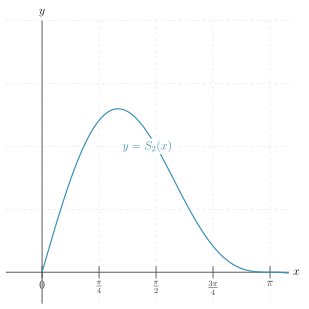
- Find the stationary points of \(S_2(x)\) for \(0\le x\le\pi\), and sketch this function.
- Show that if \(S_n(x)\) has a stationary point at \(x=x_0\), where \(0< x_0 < \pi\), then \[ \sin nx_0 = (1-\cos nx_0) \tan\tfrac12 x_0 \] and hence that \(S_n(x_0) \ge S_{n-1}(x_0)\). Deduce that if \(S_{n-1}(x) > 0\) for all \(x\) in the interval \(0 < x < \pi\), then \(S_{n}(x) > 0\) for all \(x\) in this interval.
- Prove that \(S_n(x)\ge0\) for \(n\ge1\) and \(0\le x\le\pi\).
Solution: \begin{align*} && \sin(r + \tfrac12)x - \sin(r - \tfrac12) x &= \sin rx \cos \tfrac12x + \cos r x\sin\tfrac12x - \sin r x \cos \tfrac12 x + \cos rx \sin \tfrac12 x \\ &&&= 2\cos r x \sin\tfrac12 x \\ \\ && S &= \cos x + \cos 2x + \cdots + \cos n x \\ && 2\sin \tfrac12 x S &= \sin(1 + \tfrac12)x - \sin \tfrac12 x + \\ &&&\quad+ \sin(2+\tfrac12)x - \sin(2- \tfrac12)x + \\ &&&\quad+ \sin(3+\tfrac12)x - \sin(3 - \tfrac12)x + \\ &&& \quad + \cdots + \\ &&&\quad + \sin(n+\tfrac12)x - \sin(n-\tfrac12)x \\ &&&=\sin(n+\tfrac12)x - \sin\tfrac12 x \\ \Rightarrow && S &= \frac{\sin(n+\tfrac12)x - \sin\tfrac12 x}{2 \sin \tfrac12 x} \end{align*}
- \(\,\) \begin{align*}
&& S_2(x) &= \sin x + \tfrac12 \sin 2 x \\
&& S'_2(x) &= \cos x + \cos 2x \\
&&&= \cos x + 2\cos^2 x - 1 \\
&&&= (2\cos x -1)(\cos x + 1) \\
\end{align*}
Therefore the turning points are \(\cos x= \frac12 \Rightarrow x = \frac{\pi}{3}\) and \(\cos x = -1 \Rightarrow x = \pi\)
- Suppose \(S_n(x)\) has a stationary point at \(x_0\), then $$ therefore \begin{align*} &&0 &= S_n'(x_0) \\ &&&= \cos x_0 + \cos 2x_0 + \cdots + \cos n x_0 \\ &&&= \frac{\sin(n+\tfrac12)x_0 - \sin \tfrac12x_0}{2 \sin \tfrac12 x_0} \\ \Rightarrow &&\sin\tfrac12 x_0&= \sin nx_0 \cos \tfrac12 x_0 + \cos nx_0 \sin \tfrac12x_0 \\ \Rightarrow && \sin nx_0 &= (1-\cos nx_0)\tan \tfrac12 x_0 \end{align*} Therefore \(S_n(x_0) -S_{n-1}(x_0) = \tfrac1n \sin n x_0 = \tfrac1n \underbrace{(1-\cos nx_0)}_{\geq 0}\underbrace{\tan\tfrac12 x_0}_{\geq 0} \geq 0\). Therefore if \(S_{n-1}(x) > 0\) for all \(x\) on \(0 < x < \pi\) then since \(S_n(x) > S_{n-1}(x)\) at the turning points and since they agree at the end points, it must be larger at all points inbetween.
- Notice that \(S_1(x) = \sin x \geq 0\) for all \(x \in [0,1]\) and by our previous argument we can show \(S_n > S_{n-1}\) inside the interval and equal on the boundary we must have \(S_n(x) \geq 0\) for \(x \in [0, \pi]\)
2014 Paper 3 Q4
- Let \[ I = \int_0^1 \bigl((y')^2 -y^2\bigr)\d x \qquad\text{and}\qquad I_1=\int_0^1 (y'+y\tan x)^2 \d x \,, \] where \(y\) is a given function of \(x\) satisfying \(y=0\) at \(x=1\). Show that \(I-I_1=0\) and deduce that \(I\ge0\). Show further that \(I=0\) only if \(y=0\) for all \(x\) (\(0\le x \le 1\)).
- Let \[ J = \int_0^1 \bigl((y')^2 -a^2y^2\bigr)\d x \,, \] where \(a\) is a given positive constant and \(y\) is a given function of \(x\), not identically zero, satisfying \(y=0\) at \(x=1\). By considering an integral of the form \[ \int_0^1 (y'+ay\tan bx)^2 \d x \,, \] where \(b\) is suitably chosen, show that \(J\ge0\). You should state the range of values of \(a\), in the form \(a < k\), for which your proof is valid. In the case \(a=k\), find a function \(y\) (not everywhere zero) such that \(J=0\).
Solution:
- \begin{align*} && I - I_1 &= \int_0^1 \left ( \left ( y' \right)^2 - y^2 \right) \d x - \int_0^1 \left ( y' + y \tan x \right)^2 \d x\\ &&&= \int_0^1 \left ( \left ( y' \right)^2 - y^2 \right) - \left ( y' + y \tan x \right)^2 \d x\\ &&&= \int_0^1 \left (-y^2-2yy' \tan x - y^2 \tan^2 x \right) \d x\\ &&&= \int_0^1 \left (-2yy' \tan x - y^2(1+ \tan^2 x )\right) \d x\\ &&&= \int_0^1 \left (-2yy' \tan x - y^2 \sec^2 x\right) \d x\\ &&&= \int_0^1 -\frac{\d}{\d x} \left (y^2 \tan x \right) \d x\\ &&&= \left [-y^2 \tan x \right]_0^1 \\ &&&= 0 \\ \\ \Rightarrow && I &= I_1 = \int_0^1 \left ( y' + y \tan x \right)^2 d x \geq 0 \end{align*} The only way \(I_0 = 0\) is is \(y' + y \tan x =0\), so \begin{align*} && \frac{\d y}{\d x} &= - y \tan x \\ \Rightarrow && \int \frac{1}{y} &= \int -\tan x \d x \\ \Rightarrow && \ln |y| &= \ln |\cos x| + C \\ \Rightarrow && y &= A \cos x \\ \Rightarrow && A &= 0 \Rightarrow y = 0 \end{align*}
- Let \(J_1 = \int_0^1 (y'+ay\tan ax)^2 \d x\), then \begin{align*} && J-J_1 &= \int_0^1 \left ( \left ( y' \right)^2 - a^2y^2 \right) - \left ( y' + ya \tan ax \right)^2 \d x\\ &&&= \int_0^1 \left (-a^2y^2-2yy' a \tan a x-y^2a^2 \tan^2 ax \right) \d x \\ &&&= \int_0^1 \left (-2yy' a \tan ax - a^2y^2(1+\tan^2 ax) \right) \d x \\ &&&= \int_0^1 \left (-2yy' a \tan ax - a^2y^2\sec^2 ax \right) \d x \\ &&&= \left [ - a y^2 \tan a x \right]_0^1 = 0 \end{align*} This is true if \(a < \frac{\pi}{2}\), since otherwise we might care about the order of the zero for \(y\) at \(x = 1\). Consider \(y = \cos \frac{\pi}{2} x\), then \(y' = -\frac{\pi}{2} \sin^2\frac{\pi}{2} x\) and \begin{align*} && \int_0^1 \frac{\pi^2}{4} \left (\sin^2 \frac{\pi}{2}x - \cos^2 \frac{\pi}{2} x \right) \d x &= -\frac{\pi^2}{4} \int_0^1 \cos(\pi x) \d x \\ &&&= 0 \end{align*}
2014 Paper 3 Q6
Starting from the result that \[ \.h(t) >0\ \mathrm{for}\ 0< t < x \Longrightarrow \int_0^x \.h(t)\ud t > 0 \,, \] show that, if \(\.f''(t) > 0\) for \(0 < t < x_0\) and \(\.f(0)=\.f'(0) =0\), then \(\.f(t)>0\) for \(0 < t < x_0\).
- Show that, for \(0 < x < \frac12\pi\), \[ \cos x \cosh x <1 \,. \]
- Show that, for \(0 < x < \frac12\pi\), \[ \frac 1 {\cosh x} < \frac {\sin x} x < \frac x {\sinh x} \,. \] %
- Show that, for \(0 < x < \frac12\pi\), \(\tanh x < \tan x\).
2014 Paper 3 Q10
Two particles \(X\) and \(Y\), of equal mass \(m\), lie on a smooth horizontal table and are connected by a light elastic spring of natural length \(a\) and modulus of elasticity \(\lambda\). Two more springs, identical to the first, connect \(X\) to a point \(P\) on the table and \(Y\) to a point \(Q\) on the table. The distance between \(P\) and \(Q\) is \(3a\). Initially, the particles are held so that \(XP=a\), \(YQ= \frac12 a\,\), and \(PXYQ\) is a straight line. The particles are then released. At time \(t\), the particle \(X\) is a distance \(a+x\) from \(P\) and the particle \(Y\) is a distance \(a+y\) from \(Q\). Show that \[ m \frac{\.d ^2 x}{\.d t^2} = -\frac\lambda a (2x+y) \] and find a similar expression involving \(\dfrac{\.d^2 y}{\.d t^2}\). Deduce that \[ x-y = A\cos \omega t +B \sin\omega t \] where \(A\) and \(B\) are constants to be determined and \(ma\omega^2=\lambda\). Find a similar expression for \(x+y\). Show that \(Y\) will never return to its initial position.
2013 Paper 1 Q4
- Show that, for \(n> 0\), \[ \int_0^{\frac14\pi} \tan^n x \,\sec^2 x \, \d x = \frac 1 {n+1} \; \text{ and } \int_0^{\frac14\pi} \!\! \sec ^n\! x \, \tan x \, \d x = \frac{(\sqrt 2)^n - 1}n \,. \]
- Evaluate the following integrals: \[ \displaystyle \int_0^{\frac14\pi} \!\! x\, \sec ^4 \! x\, \tan x \, \d x \, \text{ and } \int_0^{\frac14\pi} \!\! x^2 \sec ^2 \! x\, \tan x \, \d x \,. \]
Solution:
- \begin{align*} u = \tan x, \d u = \sec^2 x \d x: &&\int_0^{\pi/4} \tan^n x \sec^2 x \d x &= \int_0^1 u^n \d u \\ &&&= \frac{1}{n+1} \end{align*} \begin{align*} u = \sec x, \d u = \sec x \tan x \d x: &&\int_0^{\pi/4} \sec^n x \tan x \d x &= \int_{u=1}^{u=\sqrt{2}} u^{n-1} \d u \\ &&&= \left [ \frac{u^n}{n}\right] \\ &&&= \frac{(\sqrt{2})^n - 1}n \end{align*}
- \begin{align*} &&\int_0^{\frac14\pi} x \sec ^4 x \tan x \d x &= \left [x \frac{1}{4} \sec^4 x \right]_0^{\frac14\pi} - \frac14 \int_0^{\frac14\pi} \sec^4 x \d x \\ &&&= \frac{\pi}{4} - \frac14 \int_0^{\frac14\pi} \sec^2 x(1+ \tan^2 x) \d x \\ &&&= \frac{\pi}{4} - \frac14 \left [ \tan x+ \frac13 \tan^3 x \right] _0^{\frac14\pi} \\ &&&= \frac{\pi}{4} - \frac{1}{3} \end{align*} \begin{align*} \int_0^{\frac14\pi} \!\! x^2 \sec ^2 \! x\, \tan x \, \d x &= \left [x^2 \frac12 \tan^2 x \right]_0^{\frac14\pi} - \int_0^{\frac14\pi} x \tan^2 x \d x\\ &= \frac{\pi^2}{32} - \int_0^{\frac14\pi} x (\sec^2 x - 1) \d x\\ &= \frac{\pi^2}{32} - \left [x (-x + \tan x) \right]_0^{\frac14\pi} + \int_0^{\frac14\pi}-x + \tan x \d x \\ &= \frac{\pi^2}{32} - \frac{\pi}{4} (-\frac{\pi}{4} + 1) -\frac{\pi^2}{32} + \left [ -\ln \cos x \right]_0^{\pi/4} \\ &= \frac{\pi^2}{16}- \frac{\pi}{4} + \frac12 \ln 2 \end{align*}
2013 Paper 3 Q1
Given that \(t= \tan \frac12 x\), show that \(\dfrac {\d t}{\d x} = \frac12(1+t^2)\) and \( \sin x = \dfrac {2t}{1+t^2}\,\). Hence show that \[ \int_0^{\frac12\pi} \frac 1{1+a \sin x}\, \d x = \frac2 {\sqrt{1-a^2}} \arctan \frac{\sqrt{1-a}}{\sqrt{1+a}}\, \qquad \quad (0 < a < 1). \] Let \[ I_n = \int_0^{\frac12\pi} \frac{ \sin ^nx}{2+\sin x} \, \d x \qquad \quad (n\ge0). \] By considering \(I_{n+1}+2I_{n}\,\), or otherwise, evaluate \(I_3\).
Solution: Let \(t = \tan \frac12 x\), then \begin{align*} \frac{\d t}{\d x} &= \tfrac12 \sec^2 \tfrac12 t \\ &= \tfrac12 (1 + \tan^2 \tfrac12 ) \\ &= \tfrac12 (1 + t^2) \\ \\ \sin x &= 2 \sin \tfrac12 x \cos \tfrac12 \\ &= \frac{2 \frac{\sin \tfrac12 x}{ \cos \tfrac12x}}{\frac{1}{\cos^2 \tfrac12 x}} \\ &= \frac{2 \tan \tfrac12 x}{\sec^2 \tfrac12 } \\ &= \frac{2t }{1+t^2} \end{align*} Now consider \begin{align*} t = \tan \tfrac12 x: && \int_0^{\frac12\pi} \frac 1{1+a \sin x}\, \d x &= \int_{t=0}^{t = 1} \frac{1}{1 + a \frac{2t}{1+t^2}} \frac{2}{1+t^2} \d t \\ &&&= \int_0^1 \frac{2}{1+2at+t^2} \d t \\ &&&= \int_0^1 \frac{2}{(t+a)^2 + 1-a^2} \d t \\ (1-a^2) > 0: &&&= \left [ \frac{2}{\sqrt{1-a^2}} \arctan \frac{t+a}{\sqrt{1-a^2}} \right]_0^1 \\ &&&= \frac{2}{\sqrt{1-a^2}} \left ( \arctan \frac{1+a}{\sqrt{1-a^2}} - \arctan \frac{a}{\sqrt{1-a^2}} \right) \\ &&&= \frac{2}{\sqrt{1-a^2}} \arctan \left ( \frac{\frac{1+a}{\sqrt{1-a^2}}-\frac{a}{\sqrt{1-a^2}}}{1+\frac{1+a}{\sqrt{1-a^2}}\frac{a}{\sqrt{1-a^2}}} \right) \\ &&&= \frac{2}{\sqrt{1-a^2}} \arctan \left ( \frac{\frac{1}{\sqrt{1-a^2}}}{\frac{1+a}{1-a^2}} \right) \\ &&&= \frac{2}{\sqrt{1-a^2}} \arctan \left ( \frac{\sqrt{1-a}}{\sqrt{1+a}} \right) \end{align*} as required. Let \[ I_n = \int_0^{\frac12\pi} \frac{ \sin ^nx}{2+\sin x} \, \d x \qquad \quad (n\ge0). \] and consider \begin{align*} I_{n+1} + 2I_n &= \int_0^{\frac12\pi} \frac{ \sin ^{n+1}x+2\sin^{n} x}{2+\sin x} \, \d x \\ &= \int_0^{\frac12\pi} \frac{ \sin^n x (2 + \sin x)}{2+\sin x} \, \d x \\ &= \int_0^{\frac12\pi} \sin^n x \d x \end{align*} Therefore we can compute \begin{align*} I_0 &= \int_0^{\pi/2} \frac{1}{2 + \sin x} \d x \\ &= \frac12 \int_0^{\pi/2} \frac{1}{1 + \frac12 \sin x} \d x \\ &= \frac{1}{\sqrt{3/4}} \arctan \frac{\sqrt{1/2}}{\sqrt{3/2}} \\ &= \frac{2}{\sqrt{3}} \arctan \frac{1}{\sqrt{3}} \\ &= \frac{\pi}{3\sqrt{3}} \\ \\ I_1 &= \int_0^{\pi/2} 1 \d x - 2 I_0 \\ &= \frac{\pi}{2} - \frac{2\pi}{3\sqrt{3}} \\ I_2 &= \int_0^{\pi/2} \sin x \d x - 2I_1 \\ &= 1 - \pi + \frac{4\pi}{3\sqrt{3}} \\ I_3 &= \int_0^{\pi/2} \sin^2 x \d x - 2I_2 \\ &= \frac12 \int_0^{\pi/2} \sin^2 + \cos^2 x \d x - 2I_2 \\ &= \frac{\pi}{4} - 2 + 2\pi - \frac{8\pi}{3\sqrt{3}} \\ &= -2 + \frac{9\pi}{4} - \frac{8\pi}{3\sqrt{3}} \end{align*}