Problems
Filters
18 problems found
1994 Paper 3 Q14
Three points, \(P,Q\) and \(R\), are independently randomly chosen on the perimeter of a circle. Prove that the probability that at least one of the angles of the triangle \(PQR\) will exceed \(k\pi\) is \(3(1-k)^{2}\) if \(\frac{1}{2}\leqslant k\leqslant1.\) Find the probability if \(\frac{1}{3}\leqslant k\leqslant\frac{1}{2}.\)
1989 Paper 1 Q3
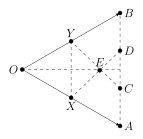
In the triangle \(OAB,\) \(\overrightarrow{OA}=\mathbf{a},\) \(\overrightarrow{OB}=\mathbf{b}\) and \(OA=OB=1\). Points \(C\) and \(D\) trisect \(AB\) (i.e. \(AC=CD=DB=\frac{1}{3}AB\)). \(X\) and \(Y\) lie on the line-segments \(OA\) and \(OB\) respectively, in such a way that \(CY\) and \(DX\) are perpendicular, and \(OX+OY=1\). Denoting \(OX\) by \(x\), obtain a condition relating \(x\) and \(\mathbf{a\cdot b}\), and prove that \[ \frac{8}{17}\leqslant\mathbf{a\cdot b}\leqslant1. \] If the angle \(AOB\) is as large as possible, determine the distance \(OE,\) where \(E\) is the point of intersection of \(CY\) and \(DX\).
Solution:
1987 Paper 1 Q9
\(ABC\) is a triangle whose vertices have position vectors \(\mathbf{a,b,c}\)brespectively, relative to an origin in the plane \(ABC\). Show that an arbitrary point \(P\) on the segment \(AB\) has position vector \[ \rho\mathbf{a}+\sigma\mathbf{b}, \] where \(\rho\geqslant0\), \(\sigma\geqslant0\) and \(\rho+\sigma=1\). Give a similar expression for an arbitrary point on the segment \(PC\), and deduce that any point inside \(ABC\) has position vector \[ \lambda\mathbf{a}+\mu\mathbf{b}+\nu\mathbf{c}, \] where \(\lambda\geqslant0\), \(\mu\geqslant0\), \(\nu\geqslant0\) and \(\lambda+\mu+\nu=1\). Sketch the region of the plane in which the point \(\lambda\mathbf{a}+\mu\mathbf{b}+\nu\mathbf{c}\) lies in each of the following cases:
- \(\lambda+\mu+\nu=-1\), \(\lambda\leqslant0\), \(\mu\leqslant0\), \(\nu\leqslant0\);
- \(\lambda+\mu+\nu=1\), \(\mu\leqslant0\), \(\nu\leqslant0\).
Solution:

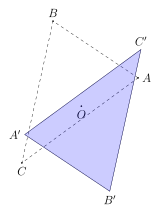
- This is equivalent to the area inside the triangle where every point (\(\mathbf{a}, \mathbf{b}, \mathbf{c}\)) has been send to it's negative (\(-\mathbf{a}, -\mathbf{b}, -\mathbf{c}\)),
ie
- Writing points as:
\begin{align*}
\lambda\mathbf{a}+\mu\mathbf{b}+\nu\mathbf{c} &= (1-\mu - \nu)\mathbf{a}+\mu\mathbf{b}+\nu\mathbf{c} \\
&= \mathbf{a} + (-\mu)(\mathbf{a}-\mathbf{b}) + (-\nu)(\mathbf{a} - \mathbf{c}) \\
&= \mathbf{a} + (-\mu)(\mathbf{a}-\mathbf{b}) + (-\nu)(\mathbf{a} - \mathbf{c}) + (1+\mu+\nu)\mathbf{0}\\
\end{align*}
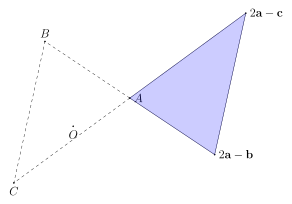
So this is a translation of \(\mathbf{a}\) of the triangle with vertices at \(\mathbf{0}, \mathbf{a-b}, \mathbf{a-c}\), or a triangle with vertices \(\mathbf{a}, 2\mathbf{a-b}, 2\mathbf{a-c}\).