1987 Paper 1 Q9
Year: 1987
Paper: 1
Question Number: 9
Course: LFM Pure and Mechanics
Section: Vectors
Difficulty: 1500.0
Banger: 1500.0
Problem
\(ABC\) is a triangle whose vertices have position vectors \(\mathbf{a,b,c}\)brespectively, relative to an origin in the plane \(ABC\). Show that an arbitrary point \(P\) on the segment \(AB\) has position vector
\[
\rho\mathbf{a}+\sigma\mathbf{b},
\]
where \(\rho\geqslant0\), \(\sigma\geqslant0\) and \(\rho+\sigma=1\).
Give a similar expression for an arbitrary point on the segment \(PC\), and deduce that any point inside \(ABC\) has position vector
\[
\lambda\mathbf{a}+\mu\mathbf{b}+\nu\mathbf{c},
\]
where \(\lambda\geqslant0\), \(\mu\geqslant0\), \(\nu\geqslant0\) and
\(\lambda+\mu+\nu=1\).
Sketch the region of the plane in which the point \(\lambda\mathbf{a}+\mu\mathbf{b}+\nu\mathbf{c}\)
lies in each of the following cases:
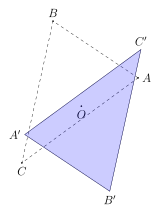
- \(\lambda+\mu+\nu=-1\), \(\lambda\leqslant0\), \(\mu\leqslant0\), \(\nu\leqslant0\);
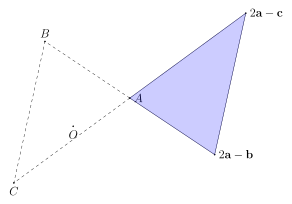
- \(\lambda+\mu+\nu=1\), \(\mu\leqslant0\), \(\nu\leqslant0\).
Solution

- This is equivalent to the area inside the triangle where every point (\(\mathbf{a}, \mathbf{b}, \mathbf{c}\)) has been send to it's negative (\(-\mathbf{a}, -\mathbf{b}, -\mathbf{c}\)),
ie
- Writing points as:
\begin{align*}
\lambda\mathbf{a}+\mu\mathbf{b}+\nu\mathbf{c} &= (1-\mu - \nu)\mathbf{a}+\mu\mathbf{b}+\nu\mathbf{c} \\
&= \mathbf{a} + (-\mu)(\mathbf{a}-\mathbf{b}) + (-\nu)(\mathbf{a} - \mathbf{c}) \\
&= \mathbf{a} + (-\mu)(\mathbf{a}-\mathbf{b}) + (-\nu)(\mathbf{a} - \mathbf{c}) + (1+\mu+\nu)\mathbf{0}\\
\end{align*}
So this is a translation of \(\mathbf{a}\) of the triangle with vertices at \(\mathbf{0}, \mathbf{a-b}, \mathbf{a-c}\), or a triangle with vertices \(\mathbf{a}, 2\mathbf{a-b}, 2\mathbf{a-c}\).
Rating Information
Difficulty Rating: 1500.0
Difficulty Comparisons: 0
Banger Rating: 1500.0
Banger Comparisons: 0
Show LaTeX source
Problem source
$ABC$ is a triangle whose vertices have position vectors $\mathbf{a,b,c}$brespectively, relative to an origin in the plane $ABC$. Show that an arbitrary point $P$ on the segment $AB$ has position vector
\[
\rho\mathbf{a}+\sigma\mathbf{b},
\]
where $\rho\geqslant0$, $\sigma\geqslant0$ and $\rho+\sigma=1$.
Give a similar expression for an arbitrary point on the segment $PC$, and deduce that any point inside $ABC$ has position vector
\[
\lambda\mathbf{a}+\mu\mathbf{b}+\nu\mathbf{c},
\]
where $\lambda\geqslant0$, $\mu\geqslant0$, $\nu\geqslant0$ and
$\lambda+\mu+\nu=1$.
Sketch the region of the plane in which the point $\lambda\mathbf{a}+\mu\mathbf{b}+\nu\mathbf{c}$
lies in each of the following cases:
\begin{questionparts}
\item $\lambda+\mu+\nu=-1$, $\lambda\leqslant0$, $\mu\leqslant0$, $\nu\leqslant0$;
\item $\lambda+\mu+\nu=1$, $\mu\leqslant0$, $\nu\leqslant0$.
\end{questionparts}
Solution source
\begin{center}
\begin{tikzpicture}[scale=1]

    \coordinate (O) at (0,0);
    \coordinate (A) at (2, 1);
    \coordinate (B) at (-1, 3);
    \coordinate (C) at (-2.1, -2);

    \coordinate (P) at ($(A)!0.4!(B)$);
    \coordinate (X) at ($(P)!0.3!(C)$);

    % \draw[->] (-3, 0) -- (3, 0);
    % \draw[->] (0,-1) -- (0,3);

    \node at (O) [below] {$O$};
    \node at (A) [right] {$A$};
    \node at (B) [above] {$B$};
    \node at (P) [above] {$P$};
    \node at (C) [below] {$C$};
    \node at (X) [above] {$X$};

    \filldraw (O) circle (0.6pt);
    \filldraw (A) circle (0.6pt);
    \filldraw (B) circle (0.6pt);
    \filldraw (P) circle (0.6pt);
    \filldraw (C) circle (0.6pt);
    \filldraw (X) circle (0.6pt);

    \draw (A) -- (B) -- (C) -- cycle;
    \draw (P) -- (C);

    \draw[->, dashed, red, thick] (O) -- (A);
    \draw[->, dashed, red, thick] (A) -- (P);
    \draw[->, dashed, red, thick] (P) -- (X);

    % \node[circle] at (O) {$O$};
\end{tikzpicture}
\end{center}


Suppose $P$ is a fraction $0 \leq k\leq 1$ along $AB$, then $\overrightarrow{OP} = \overrightarrow{OA} +\overrightarrow{AP} =  \overrightarrow{OA} +k\overrightarrow{AB} = \mathbf{a} + k(\mathbf{b} - \mathbf{a}) = \lambda \mathbf{b} + (1-k) \mathbf{a}$, ie an arbitrary point on $AB$ has the position vector where $(1-k) = \rho \geq 0$ and $k= \sigma \geq 0$ and $(1-\lambda) + \lambda = 1$.

Any point on the segment $PC$ will be of the form $l\mathbf{c} + (1-l) (k \mathbf{b} + (1-k) \mathbf{a})$ which has the form $\lambda \mathbf{a} + \mu \mathbf{b} + \nu \mathbf{c}$ where $\lambda + \mu + \nu = (1-l)(1-k) + (1-l)k + l = 1$ and all coefficients are positive.

\begin{questionparts}
\item This is equivalent to the area inside the triangle where every point ($\mathbf{a}, \mathbf{b}, \mathbf{c}$) has been send to it's negative ($-\mathbf{a}, -\mathbf{b}, -\mathbf{c}$),

ie

\begin{center}
\begin{tikzpicture}[scale=1]

    \coordinate (O) at (0,0);
    \coordinate (A) at (2, 1);
    \coordinate (B) at (-1, 3);
    \coordinate (C) at (-2.1, -2);

    % \coordinate (P) at ($(A)!0.4!(B)$);
    % \coordinate (X) at ($(P)!0.3!(C)$);

    % \draw[->] (-3, 0) -- (3, 0);
    % \draw[->] (0,-1) -- (0,3);

    \node at (O) [below] {$O$};
    \node at (A) [right] {$A$};
    \node at (B) [above] {$B$};
    % \node at (P) [above] {$P$};
    \node at (C) [below] {$C$};
    % \node at (X) [above] {$X$};

    \node at ($-1.0*(A)$) [left] {$A'$};
    \node at ($-1.0*(B)$) [below] {$B'$};
    \node at ($-1.0*(C)$) [above] {$C'$};

    \filldraw (O) circle (0.6pt);
    \filldraw (A) circle (0.6pt);
    \filldraw (B) circle (0.6pt);
    % \filldraw (P) circle (0.6pt);
    \filldraw (C) circle (0.6pt);
    % \filldraw (X) circle (0.6pt);

    \draw[dashed] (A) -- (B) -- (C) -- cycle;
    \draw ($-1.0*(A)$) -- ($-1.0*(B)$) -- ($-1.0*(C)$) -- cycle;
    \filldraw[color=blue, opacity=0.2] ($-1.0*(A)$) -- ($-1.0*(B)$) -- ($-1.0*(C)$) -- cycle;

\end{tikzpicture}
\end{center}

\item Writing points as:
\begin{align*}
\lambda\mathbf{a}+\mu\mathbf{b}+\nu\mathbf{c} &= (1-\mu - \nu)\mathbf{a}+\mu\mathbf{b}+\nu\mathbf{c} \\
&= \mathbf{a} + (-\mu)(\mathbf{a}-\mathbf{b}) + (-\nu)(\mathbf{a} - \mathbf{c}) \\
&=  \mathbf{a} + (-\mu)(\mathbf{a}-\mathbf{b}) + (-\nu)(\mathbf{a} - \mathbf{c}) + (1+\mu+\nu)\mathbf{0}\\
\end{align*}

So this is a translation of $\mathbf{a}$ of the triangle with vertices at $\mathbf{0}, \mathbf{a-b}, \mathbf{a-c}$, or a triangle with vertices $\mathbf{a}, 2\mathbf{a-b}, 2\mathbf{a-c}$.

\begin{center}
\begin{tikzpicture}[scale=1]

    \coordinate (O) at (0,0);
    \coordinate (A) at (2, 1);
    \coordinate (B) at (-1, 3);
    \coordinate (C) at (-2.1, -2);

    % \coordinate (P) at ($(A)!0.4!(B)$);
    % \coordinate (X) at ($(P)!0.3!(C)$);

    % \draw[->] (-3, 0) -- (3, 0);
    % \draw[->] (0,-1) -- (0,3);

    \node at (O) [below] {$O$};
    \node at (A) [right] {$A$};
    \node at (B) [above] {$B$};
    % \node at (P) [above] {$P$};
    \node at (C) [below] {$C$};
    % \node at (X) [above] {$X$};

    \coordinate (D) at ($2.0*(A)-1.0*(B)$);
    \coordinate (E) at ($2.0*(A)-1.0*(C)$);

    \node at (D) [right] {$2\mathbf{a}-\mathbf{b}$};
    \node at (E) [right] {$2\mathbf{a}-\mathbf{c}$};


    \filldraw (O) circle (0.6pt);
    \filldraw (A) circle (0.6pt);
    \filldraw (B) circle (0.6pt);
    % \filldraw (P) circle (0.6pt);
    \filldraw (C) circle (0.6pt);
    \filldraw (D) circle (0.6pt);
    \filldraw (E) circle (0.6pt);
    % \filldraw (X) circle (0.6pt);

    \draw[dashed] (A) -- (B) -- (C) -- cycle;
    \draw (A) -- (D) -- (E) -- cycle;
    \filldraw[color=blue, opacity=0.2] (A) -- (D) -- (E) -- cycle;

\end{tikzpicture}
\end{center}


\end{questionparts}