Problems
Filters
27 problems found
2006 Paper 2 Q7
An ellipse has equation $\dfrac{x^2}{a^2} +\dfrac {y^2}{b^2} = 1$. Show that the equation of the tangent at the point \((a\cos\alpha, b\sin\alpha)\) is \[ y=- \frac {b \cot \alpha} a \, x + b\, {\rm cosec\,}\alpha\,. \] The point \(A\) has coordinates \((-a,-b)\), where \(a\) and \(b\) are positive. The point \(E\) has coordinates \((-a,0)\) and the point \(P\) has coordinates \((a,kb)\), where \(0 < k < 1\). The line through \(E\) parallel to \(AP\) meets the line \(y=b\) at the point \(Q\). Show that the line \(PQ\) is tangent to the above ellipse at the point given by \(\tan(\alpha/2)=k\). Determine by means of sketches, or otherwise, whether this result holds also for \(k=0\) and \(k=1\).
2005 Paper 1 Q2
The point \(P\) has coordinates \(\l p^2 , 2p \r\) and the point \(Q\) has coordinates \(\l q^2 , 2q \r\), where \(p\) and~\(q\) are non-zero and \(p \neq q\). The curve \(C\) is given by \(y^2 = 4x\,\). The point \(R\) is the intersection of the tangent to \(C\) at \(P\) and the tangent to \(C\) at \(Q\). Show that \(R\) has coordinates \(\l pq , p+q \r\). The point \(S\) is the intersection of the normal to \(C\) at \(P\) and the normal to \(C\) at \(Q\). If \(p\) and \(q\) are such that \(\l 1 , 0 \r\) lies on the line \(PQ\), show that \(S\) has coordinates \(\l p^2 + q^2 + 1 , \, p+q \r\), and that the quadrilateral \(PSQR\) is a rectangle.
2005 Paper 3 Q5
Let \(P\) be the point on the curve \(y=ax^2+bx+c\) (where \(a\) is non-zero) at which the gradient is \(m\). Show that the equation of the tangent at \(P\) is \[ y-mx=c-\frac{(m-b)^2}{4a}\;. \] Show that the curves \(y=a_1 x^2+b_1 x+c_1\) and \(y=a_2 x^2+b_2 x+c_2\) (where \(a_1\) and \(a_2\) are non-zero) have a common tangent with gradient \(m\) if and only if \[ (a_2 -a_1 )m^2 + 2(a_1 b_2-a_2 b_1)m + 4a_1 a_2(c_2-c_1)+ a_2 b_1^2-a_1 b_2 ^2=0\;. \] Show that, in the case \(a_1 \ne a_2 \,\), the two curves have exactly one common tangent if and only if they touch each other. In the case \(a_1 =a_2\,\), find a necessary and sufficient condition for the two curves to have exactly one common tangent.
Solution: \begin{align*} && y' &= 2ax+b \\ \Rightarrow && m &= 2ax_t+b \\ \Rightarrow && x_t &= \frac{m-b}{2a} \end{align*} Therefore we must have \begin{align*} mx_t &= 2ax_t^2+bx_t \\ y - mx &= ax_t^2+bx_t+c - mx_t \\ &= ax_t^2+bx_t+c - (2ax_t^2+bx_t) \\ &= c - ax_t^2 \\ &= c-a\left (\frac{m-b}{2a} \right)^2 \\ &= c - \frac{(m-b)^2}{4a} \end{align*} They will have a common tangent if and only if the constant terms are equal, ie \begin{align*} && c_1 - \frac{(m-b_1)^2}{4a_1} &= c_2 - \frac{(m-b_2)^2}{4a_2} \\ \Leftrightarrow && (c_1-c_2) &= \frac{(m-b_1)^2}{4a_1} -\frac{(m-b_2)^2}{4a_2} \\ \Leftrightarrow && 4a_1a_2(c_1-c_2) &= a_2(m-b_1)^2-a_1(m-b_2)^2 \\ &&&= (a_2-a_1)m^2+2(a_1b_2-a_2b_1)m+a_2b_1^2-a_1b_2^2 \end{align*} as required. Treating this as a polynomial in \(m\), we can see that the two curves will have exactly one common tangent iff \(\Delta = 0\), ie: \begin{align*} && 0 &= \Delta \\ &&&= (2(a_1b_2-a_2b_1))^2 - 4 (a_2-a_1)(4a_1 a_2(c_2-c_1)+ a_2 b_1^2-a_1 b_2 ^2) \\ &&&= 4a_1^2b_2^2-8a_1a_2b_1b_2+4a_2b_1^2 - 4a_2^2b_1^2-4a_1^2b_2^2 + 4a_1a_2(b_1^2+b_2^2)-16(a_2-a_1)a_1a_2(c_2-c_1) \\ &&&=-8a_1a_2b_1b_2+4a_1a_2(b_1^2+b_2^2)-16(a_2-a_1)a_1a_2(c_2-c_1) \\ &&&=a_1a_2(4(b_1-b_2)^2-16(a_2-a_1)(c_2-c_1)) \\ &&&= 4a_1a_2((b_2-b_1)^2 - 4(a_2-a_1)(c_2-c_1) \end{align*} But this is just the discriminant of the difference, ie equivalent to the two parabolas just touching. (Assuming \(a_1-a_2 \neq 0\) and we do end up with a quadratic). If \(a_1 = a_2 = a\) then we need exactly one solution to \(2a(b_1-b_2)m +4a^2(c_2-c_1)+a(b_1^2-b_2^2) = 0\), ie \(b_1 \neq b_2\).
2002 Paper 1 Q4
Give a sketch of the curve \( \;\displaystyle y= \frac1 {1+x^2}\;\), for \(x\ge0\). Find the equation of the line that intersects the curve at \(x=0\) and is tangent to the curve at some point with \(x>0\,\). Prove that there are no further intersections between the line and the curve. Draw the line on your sketch. By considering the area under the curve for \(0\le x\le1\), show that \(\pi>3\,\). Show also, by considering the volume formed by rotating the curve about the \(y\) axis, that \(\ln 2 >2/3\,\). [Note: \(\displaystyle \int_0^ 1 \frac1 {1+x^2}\, \d x = \frac\pi 4\,.\;\)]
Solution:

2000 Paper 3 Q1
Sketch on the same axes the two curves \(C_1\) and \(C_2\), given by
Solution:

1998 Paper 2 Q6
Two curves are given parametrically by \[ x_{1}=(\theta+\sin\theta),\qquad y_{1}=(1+\cos\theta),\tag{1} \]and \[ x_{2}=(\theta-\sin\theta),\qquad y_{1}=-(1+\cos\theta),\tag{2} \] Find the gradients of the tangents to the curves at the points where \(\theta= \pi/2\) and \(\theta=3\pi/2\). Sketch, using the same axes, the curves for \(0\le\theta \le 2\pi\). Find the equation of the normal to the curve (1) at the point with parameter \(\theta\). Show that this normal is a tangent to the curve (2).
1992 Paper 3 Q9
The straight line \(OSA,\) where \(O\) is the origin, bisects the angle between the positive \(x\) and \(y\) axes. The ellipse \(E\) has \(S\) as focus. In polar coordinates with \(S\) as pole and \(SA\) as the initial line, \(E\) has equation \(\ell=r(1+e\cos\theta).\) Show that, at the point on \(E\) given by \(\theta=\alpha,\) the gradient of the tangent to the ellipse is given by \[ \frac{\mathrm{d}y}{\mathrm{d}x}=\frac{\sin\alpha-\cos\alpha-e}{\sin\alpha+\cos\alpha+e}. \] The points on \(E\) given by \(\theta=\alpha\) and \(\theta=\beta\) are the ends of a diameter of \(E\). Show that \[ \tan(\alpha/2)\tan(\beta/2)=-\frac{1+e}{1-e}. \] [Hint. A diameter of an ellipse is a chord through its centre.]
Solution:

1991 Paper 2 Q2
The equation of a hyperbola (with respect to axes which are displaced and rotated with respect to the standard axes) is \[ 3y^{2}-10xy+3x^{2}+16y-16x+15=0.\tag{\(\dagger\)} \] By differentiating \((\dagger)\), or otherwise, show that the equation of the tangent through the point \((s,t)\) on the curve is \[ y=\left(\frac{5t-3s+8}{3t-5s+8}\right)x-\left(\frac{8t-8s+15}{3t-5s+8}\right). \] Show that the equations of the asymptote (the limiting tangents as \(s\rightarrow\infty\)) are \[ y=3x-4\qquad\mbox{ and }\qquad3y=x-4. \] {[}Hint: You will need to find a relationship between \(s\) and \(t\) which is valid in the limit as \(s\rightarrow\infty.\){]} Show that the angle between one asymptote and the \(x\)-axis is the same as the angle between the other asymptote and the \(y\)-axis. Deduce the slopes of the lines that bisect the angles between the asymptotes and find the equations of the axes of the hyperbola.
Solution: \begin{align*} && 0 &= 3y^{2}-10xy+3x^{2}+16y-16x+15 \\ \Rightarrow && 0 &= 6y \frac{\d y}{\d x} - 10x \frac{\d y}{\d x} - 10y + 6x+ 16 \frac{\d y}{\d x } - 16 \\ &&&= \frac{\d y}{\d x} \left (6y - 10x +16 \right) - (10y-6x+16) \\ \Rightarrow && \frac{\d y}{\d x} &= \frac{5y-3x+8}{3y-5x+8} \\ \Rightarrow && \frac{y-t}{x-s} &= \frac{5t-3s+8}{3t-5s+8} \\ && y &= \left(\frac{5t-3s+8}{3t-5s+8}\right)x -\left(\frac{5t-3s+8}{3t-5s+8}\right)s + t \\ &&&= \left(\frac{5t-3s+8}{3t-5s+8}\right)x - \frac{(5ts-3s^2+8s)-(3t^2-5st+8t)}{3t-5s+8} \\ &&&= \left(\frac{5t-3s+8}{3t-5s+8}\right)x - \frac{(5ts-3s^2+8s)-(3t^2-5st+8t)}{3t-5s+8} \\ &&&= \left(\frac{5t-3s+8}{3t-5s+8}\right)x - \frac{8s-8t-(3s^2+3t^2-10st)}{3t-5s+8} \\ &&&= \left(\frac{5t-3s+8}{3t-5s+8}\right)x - \frac{8s-8t-(16s-16t-15)}{3t-5s+8} \\ &&&= \left(\frac{5t-3s+8}{3t-5s+8}\right)x - \frac{8t-8s+15}{3t-5s+8} \\ \end{align*} While \(x \to \infty\) we still have \(3 \frac{y^2}{x^2} - 10 \frac{y}{x} + 3 + 16 \frac{y}{x^2} - 16\frac{1}{x} + 15 \frac{1}{x^2} = 0\), ie if \(\frac{y}{x} = k\), then \(3k^2 - 10k + 3 \to 0 \Rightarrow k \to 3, \frac13\). Therefore, as \(s \to \infty\) we can write \begin{align*} && y &= \left(\frac{5\frac{t}{s}-3+8\frac{1}{s}}{3\frac{t}{s}-5+8\frac1{s}}\right)x - \frac{8\frac{t}s-8+15\frac{1}{s}}{3\frac{t}{s}-5+8\frac{1}{s}} \\ k \to 3: &&& \to \left(\frac{15-3}{9-5}\right)x - \frac{24-8}{9-5} \\ &&&= 3x - 4 \\ k \to \frac13: && &\to \left(\frac{\frac53-3}{1-5}\right)x - \frac{\frac83-8}{1-5} \\ &&&= \frac13 x - \frac43 \end{align*} Therefore the equations are \(y = 3x-4\) and \(3y=x-4\) The lines are parallel to \(y = 3x\) and \(y = \frac13x\), so by considering the triangles formed with the origin and a point \(1\) along the \(x\) or \(y\) axis we can see the angles are identical. This means the line \(y = x\) is parallel to one axis and \(y = -x\) is parallel to the other. They must meet where our two lines meet which is \((1,-1)\), so our lines are \(y = x-2\) and \(y = -x\)
1990 Paper 1 Q9
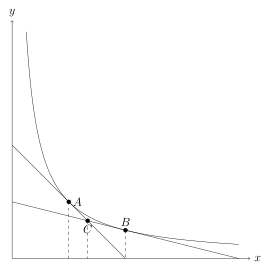
Let \(A\) and \(B\) be the points \((1,1)\) and \((b,1/b)\) respectively, where \(b>1\). The tangents at \(A\) and \(B\) to the curve \(y=1/x\) intersect at \(C\). Find the coordinates of \(C\). Let \(A',B'\) and \(C'\) denote the projections of \(A,B\) and \(C\), respectively, to the \(x\)-axis. Obtain an expression for the sum of the areas of the quadrilaterals \(ACC'A'\) and \(CBB'C'\). Hence or otherwise prove that, for \(z>0\), \[ \frac{2z}{2+z}\leqslant\ln\left(1+z\right)\leqslant z. \]
Solution:
1990 Paper 3 Q6
The transformation \(T\) from \(\begin{pmatrix} x \\ y \end{pmatrix}\) to \(\begin{pmatrix} X \\ Y \end{pmatrix}\) is given by \[ \begin{pmatrix}X\\ Y \end{pmatrix}=\frac{2}{5}\begin{pmatrix}9 & -2\\ -2 & 6 \end{pmatrix}\begin{pmatrix}x\\ y \end{pmatrix}. \] Show that \(T\) leaves the vector \(\begin{pmatrix} 1\\ 2 \end{pmatrix}\) unchanged in direction but multiplied by a scalar, and that \(\begin{pmatrix} 2\\ -1 \end{pmatrix}\) is similarly transformed. The circle \(C\) whose equation is \(x^{2}+y^{2}=1\) transforms under \(T\) to a curve \(E\). Show that \(E\) has equation \[ 8X^{2}+12XY+17Y^{2}=80, \] and state the area of the region bounded by \(E\). Show also that the greatest value of \(X\) on \(E\) is \(2\sqrt{17/5}.\) Find the equation of the tangent to \(E\) at the point which corresponds to the point \(\frac{1}{5}(3,4)\) on \(C\).
Solution: \begin{align*} T\begin{pmatrix}1\\ 2 \end{pmatrix} &= \frac{2}{5}\begin{pmatrix}9 & -2\\ -2 & 6 \end{pmatrix}\begin{pmatrix}1\\ 2 \end{pmatrix} \\ &= \frac25\begin{pmatrix}9 - 4\\ -2+12 \end{pmatrix} \\ &= \begin{pmatrix}2\\ 4 \end{pmatrix} \\ &= 2 \begin{pmatrix}1\\ 2 \end{pmatrix} \end{align*} \begin{align*} T\begin{pmatrix}1\\ 2 \end{pmatrix} &= \frac{2}{5}\begin{pmatrix}9 & -2\\ -2 & 6 \end{pmatrix}\begin{pmatrix}2\\ -1 \end{pmatrix} \\ &= \frac25\begin{pmatrix}18+2\\ -4-6 \end{pmatrix} \\ &= \begin{pmatrix}8\\ -4 \end{pmatrix} \\ &= 4 \begin{pmatrix}2\\ -1 \end{pmatrix} \end{align*} Consider $T^{-1} = \frac{5}{2} \frac{1}{50}\begin{pmatrix}6 & 2\\ 2 & 9 \end{pmatrix}\(, so \)T^{-1} \begin{pmatrix}X\\ Y \end{pmatrix} = \begin{pmatrix}x\\ y \end{pmatrix}$ and so: \begin{align*} x^2 + y^2 & = \begin{pmatrix}x& y \end{pmatrix}\begin{pmatrix}x\\ y \end{pmatrix} \\ &= \begin{pmatrix}X& Y \end{pmatrix} (T^{-1})^T T^{-1} \begin{pmatrix}X\\ Y \end{pmatrix} \\ &= \frac{1}{400}\begin{pmatrix}X& Y \end{pmatrix}\begin{pmatrix}6 & 2\\ 2 & 9 \end{pmatrix}\begin{pmatrix}6 & 2\\ 2 & 9 \end{pmatrix} \begin{pmatrix}X\\ Y \end{pmatrix} \\ &= \frac{1}{400}\begin{pmatrix}X& Y \end{pmatrix}\begin{pmatrix}6 & 2\\ 2 & 9 \end{pmatrix} \begin{pmatrix}6X+2Y\\ 2X+9Y \end{pmatrix} \\ &= \frac{1}{400}\begin{pmatrix}X& Y \end{pmatrix} \begin{pmatrix}6(6X+2Y)+2(2X+9Y)\\ 2(6X+2Y)+9(2X+9Y) \end{pmatrix} \\ &= \frac{1}{400}\begin{pmatrix}X& Y \end{pmatrix} \begin{pmatrix}40X+30Y\\ 30X +85Y \end{pmatrix} \\ &= \frac{1}{80}\begin{pmatrix}X& Y \end{pmatrix} \begin{pmatrix}8X+6Y\\ 6X +17Y \end{pmatrix} \\ &= \frac{1}{80} \l 8X^2 + 12XY + 17Y^2\r \end{align*} Therefore \(8X^2 + 12XY + 17Y^2 = 80\). The area will be \(\det T \cdot \pi = \frac{4}{25} \cdot 50 \cdot \pi = 8 \pi\). Differentiating we obtain \(2 \cdot 8 \cdot X \cdot \frac{dX}{dY} + 2 \cdot 6 \cdot X + 2 \cdot 6 \cdot Y \cdot \frac{dX}{dY} + 2 \cdot 17 Y \Rightarrow \frac{dX}{dY} = -\frac{6X + 17Y}{8X+6Y}\), at a maximum (or minimum, \(6X = -17Y\)). Therefore \begin{align*} \Rightarrow && 8X^2 + 12 \cdot \frac{6}{17}X^2 + 17 ( -\frac{6}{17} X)^2 &= 80 \\ \Rightarrow && \frac{100}{17}X^2 &= 80 \\ \Rightarrow &&X^2 &= \frac{17 \cdot 4}{5} \\ \Rightarrow && |X| = 2 \sqrt {\frac{17}{5}} \end{align*} The point \(\frac15 (3,4)\) maps to \begin{align*} \frac{2}{5}\frac{1}{5}\begin{pmatrix}9 & -2\\ -2 & 6 \end{pmatrix}\begin{pmatrix}3\\ 4 \end{pmatrix} &= \frac{2}{25} \begin{pmatrix}19\\ 18 \end{pmatrix} \end{align*} So the point is \((\frac{38}{25}, \frac{36}{25})\), with gradient \(\frac{dY}{dX} = -\frac{8X+6Y}{6X + 17Y}\) which is \(-\frac{8 \cdot 19+6 \cdot 18}{6\cdot 19 + 17 \cdot 18} = -\frac{13}{21}\) therefore the equation is \(21Y+13X = 50\)
1989 Paper 3 Q6
Show that, for a given constant \(\gamma\) \((\sin\gamma\neq0)\) and with suitable choice of the constants \(A\) and \(B\), the line with cartesian equation \(lx+my=1\) has polar equations \[ \frac{1}{r}=A\cos\theta+B\cos(\theta-\gamma). \] The distinct points \(P\) and \(Q\) on the conic with polar equations \[ \frac{a}{r}=1+e\cos\theta \] correspond to \(\theta=\gamma-\delta\) and \(\theta=\gamma+\delta\) respectively, and \(\cos\delta\neq0.\) Obtain the polar equation of the chord \(PQ.\) Hence, or otherwise, obtain the equation of the tangent at the point where \(\theta=\gamma.\) The tangents at \(L\) and \(M\) to a conic with focus \(S\) meet at \(T.\) Show that \(ST\) bisects the angle \(LSM\) and find the position of the intersection of \(ST\) and \(LM\) in terms of your chosen parameters for \(L\) and \(M.\)
Solution: \begin{align*} && \frac1{r} &= A \cos \theta + B \cos (\theta - \gamma) \\ &&&= A \cos \theta + B \cos \theta \cos \gamma + B \sin \theta \sin \gamma \\ &&&= (A+B \cos \gamma) \cos \theta + B \sin \gamma \sin \theta \\ \Longleftrightarrow && 1 &= (A+B \cos \gamma) x + B \sin \gamma y \end{align*} So if we choose \(B = \frac{m}{\sin \gamma}\) and \(A = l-m \cot \gamma\) we have the desired result. \begin{align*} && \frac{1 + e \cos (\gamma -\delta)}a &= A \cos (\gamma - \delta) + B \cos (\gamma - \delta - \gamma) \\ &&&= A \cos(\gamma-\delta) +B \cos \delta\\ && \frac{1 + e \cos (\gamma +\delta)}{a} &= A \cos (\gamma + \delta) + B \cos (\gamma + \delta - \gamma) \\ &&&= A \cos(\gamma + \delta) + B \cos \delta\\ \Rightarrow && \frac1{r} &= \frac{e}{a} \cos \theta + \frac{1}{a \cos \delta} \cos (\theta - \gamma) \\ \lim{\delta \to 0} &&\frac1{r} &= \frac{e}{a} \cos \theta+ \frac{1}{a} \cos (\theta - \gamma) \end{align*} Suppose we have have points \(L\) and \(M\) with \(\theta = \gamma_L, \gamma_M\) then our tangents are: \begin{align*} && \frac{a}{r} &= \cos \theta + \cos (\theta - \gamma_L) \\ && \frac{a}{r} &= \cos \theta + \cos (\theta - \gamma_M) \\ \Rightarrow && 0 &= \cos (\theta - \gamma_L) -\cos(\theta - \gamma_M) \\ &&&= - 2 \sin \frac{(\theta - \gamma_L)+(\theta - \gamma_M)}{2} \sin \frac{(\theta - \gamma_L)-(\theta - \gamma_M)}{2} \\ &&&= -2 \sin \left ( \theta - \frac{\gamma_L+\gamma_M}2 \right) \sin \left ( \frac{\gamma_M - \gamma_L}{2}\right) \\ \Rightarrow && \theta &= \frac{\gamma_L+\gamma_M}{2} \end{align*} Therefore clearly \(ST\) bisects \(LSM\). The line \(LM\) can be seen as the chord from the points \(\frac{\gamma_L+\gamma_M}{2} \pm \frac{\gamma_L-\gamma_M}{2}\), so the line is: \begin{align*} && \frac{a}{r} &= e \cos \theta + \frac{1}{\cos \left ( \frac{\gamma_L-\gamma_M}{2}\right)} \cos \left (\theta - \frac{\gamma_L+\gamma_M}{2} \right) \end{align*} and we want the point on the line where \(\theta =\frac{\gamma_L+\gamma_M}{2}\) so \begin{align*} && \frac{a}{r} &= e \cos \left ( \frac{\gamma_L+\gamma_M}{2} \right) + \frac{1}{\cos \left ( \frac{\gamma_L-\gamma_M}{2}\right)} \\ \Rightarrow && r &= \frac{a}{e \cos \left ( \frac{\gamma_L+\gamma_M}{2} \right) + \frac{1}{\cos \left ( \frac{\gamma_L-\gamma_M}{2}\right)}} \end{align*}
1988 Paper 3 Q8
Find the equations of the tangent and normal to the parabola \(y^{2}=4ax\) at the point \((at^{2},2at).\) For \(i=1,2,\) and 3, let \(P_{i}\) be the point \((at_{i}^{2},2at_{i}),\) where \(t_{1},t_{2}\) and \(t_{3}\) are all distinct. Let \(A_{1}\) be the area of the triangle formed by the tangents at \(P_{1},P_{2}\) and \(P_{3},\) and let \(A_{2}\) be the area of the triangle formed by the normals at \(P_{1},P_{2}\) and \(P_{3}.\) Using the fact that the area of the triangle with vertices at \((x_{1},y_{1}),(x_{2},y_{2})\) and \((x_{3},y_{3})\) is the absolute value of \[ \tfrac{1}{2}\det\begin{pmatrix}x_{1} & y_{1} & 1\\ x_{2} & y_{2} & 1\\ x_{3} & y_{3} & 1 \end{pmatrix}, \] show that \(A_{3}=(t_{1}+t_{2}+t_{3})^{2}A_{1}.\) Deduce a necessary and sufficient condition in terms of \(t_{1},t_{2}\) and \(t_{3}\) for the normals at \(P_{1},P_{2}\) and \(P_{3}\) to be concurrent.
Solution: \(\frac{dy}{dt} = 2a, \frac{dx}{dt} = 2at \Rightarrow \frac{dy}{dx} = \frac{1}{t}\). Therefore the equation of the tangent will be \(\frac{y - 2at}{x-at^2} = \frac{1}{t} \Rightarrow y = \frac1tx +at\) and normal will be \(\frac{y-2at}{x-at^2} = -t \Rightarrow y = t(at^2-x+2a)\). The tangents will meet when: \begin{align*} && \begin{cases} t_iy -x &= at_i^2 \\ t_j y - x &= at_j^2 \\ \end{cases} \\ \Rightarrow &&(t_i - t_j)y &= a(t_i-t_j)(t_i+t_j) \\ \Rightarrow && y &= a(t_i+t_j) \\ && x &= at_it_j \end{align*} The normals will meet when: \begin{align*} && \begin{cases} y +t_i x &= at_i^3+2at_i \\ y +t_j x &= at_j^3+2at_j \\ \end{cases} \\ \Rightarrow &&(t_i - t_j)x &= a(t_i-t_j)(t_i^2+t_it_j+t_j^2+2) \\ \Rightarrow && x&= a(t_i^2+t_it_j+t_j^2+2) \\ && y &= -at_it_j(t_i+t_j) \end{align*} Therefore the area of our triangles will be: \begin{align*} \tfrac{1}{2}\det\begin{pmatrix}at_1t_2 & a(t_1+t_2) & 1\\ at_2t_3 & a(t_2+t_3) & 1\\ at_3t_1 & a(t_3+t_1) & 1 \end{pmatrix} &= \frac{a^2}{2}\det\begin{pmatrix}t_1t_2 & (t_1+t_2) & 1\\ t_2t_3 & (t_2+t_3) & 1\\ t_3t_1 & (t_3+t_1) & 1 \end{pmatrix} \\ &= \frac{a^2}{2}\det\begin{pmatrix}t_1t_2 & (t_1+t_2) & 1\\ t_2(t_3-t_1) & (t_3-t_1) & 0\\ t_1(t_3-t_2) & (t_3-t_2) & 0 \end{pmatrix} \\ &= \frac{a^2}{2}|(t_2-t_1)(t_3-t_2)(t_1-t_3)| \end{align*} and \begin{align*} \tfrac{1}{2}\det\begin{pmatrix}a(t_1^2+t_1t_2+t_2^2+2) & -at_1t_2(t_1+t_2) & 1\\ a(t_2^2+t_2t_3+t_3^2+2) & -at_2t_3(t_2+t_3) & 1\\ a(t_3^2+t_3t_1+t_1^2+2) & -at_3t_1(t_3+t_1) & 1\\ \end{pmatrix} &= \frac{a^2}{2}\det\begin{pmatrix}(t_1^2+t_1t_2+t_2^2+2) & -t_1t_2(t_1+t_2) & 1\\ (t_2^2+t_2t_3+t_3^2+2) & -t_2t_3(t_2+t_3) & 1\\ (t_3^2+t_3t_1+t_1^2+2) & -t_3t_1(t_3+t_1) & 1\\ \end{pmatrix} \\ &= \frac{a^2}{2}\det\begin{pmatrix}(t_1^2+t_1t_2+t_2^2+2) & -t_1t_2(t_1+t_2) & 1\\ t_3^2-t_1^2+t_2(t_3-t_1) & t_2(t_1^2+t_1t_2-t_2t_3-t_3^2) & 0\\ t_3^2-t_2^2+t_1(t_3-t_2) & t_1(t_2^2+t_2t_1-t_1t_3-t_3^2) & 0\\ \end{pmatrix} \\ &= \frac{a^2}{2}\det\begin{pmatrix}(t_1^2+t_1t_2+t_2^2+2) & -t_1t_2(t_1+t_2) & 1\\ (t_3-t_1)(t_3+t_2+t_1) & t_2(t_1-t_3)(t_1+t_3+t_2) & 0\\ (t_3-t_2)(t_3+t_2+t_1) & t_1(t_2-t_3)(t_1+t_2+t_3)& 0\\ \end{pmatrix} \\ &= \frac{a^2}{2}(t_1+t_2+t_3)^2|(t_2-t_1)(t_3-t_2)(t_1-t_3)| \end{align*} as required. The normals will be concurrent iff the area of their triangle is \(0\). This is certainly true if \(t_1+t_2+t_3 = 0\). In fact the only if is also true, since no \(3\) tangents can be concurrent.