Problems
Filters
85 problems found
2014 Paper 2 Q6
By simplifying \(\sin(r+\frac12)x - \sin(r-\frac12)x\) or otherwise show that, for \(\sin\frac12 x \ne0\), \[ \cos x + \cos 2x +\cdots + \cos nx = \frac{\sin(n+\frac12)x - \sin\frac12 x}{2\sin\frac12x}\,. \] The functions \(S_n\), for \(n=1, 2, \dots\), are defined by \[ S_n(x) = \sum_{r=1}^n \frac 1 r \sin rx \qquad (0\le x \le \pi). \]
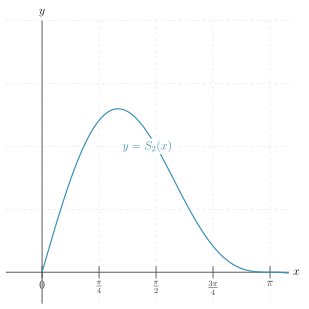
- Find the stationary points of \(S_2(x)\) for \(0\le x\le\pi\), and sketch this function.
- Show that if \(S_n(x)\) has a stationary point at \(x=x_0\), where \(0< x_0 < \pi\), then \[ \sin nx_0 = (1-\cos nx_0) \tan\tfrac12 x_0 \] and hence that \(S_n(x_0) \ge S_{n-1}(x_0)\). Deduce that if \(S_{n-1}(x) > 0\) for all \(x\) in the interval \(0 < x < \pi\), then \(S_{n}(x) > 0\) for all \(x\) in this interval.
- Prove that \(S_n(x)\ge0\) for \(n\ge1\) and \(0\le x\le\pi\).
Solution: \begin{align*} && \sin(r + \tfrac12)x - \sin(r - \tfrac12) x &= \sin rx \cos \tfrac12x + \cos r x\sin\tfrac12x - \sin r x \cos \tfrac12 x + \cos rx \sin \tfrac12 x \\ &&&= 2\cos r x \sin\tfrac12 x \\ \\ && S &= \cos x + \cos 2x + \cdots + \cos n x \\ && 2\sin \tfrac12 x S &= \sin(1 + \tfrac12)x - \sin \tfrac12 x + \\ &&&\quad+ \sin(2+\tfrac12)x - \sin(2- \tfrac12)x + \\ &&&\quad+ \sin(3+\tfrac12)x - \sin(3 - \tfrac12)x + \\ &&& \quad + \cdots + \\ &&&\quad + \sin(n+\tfrac12)x - \sin(n-\tfrac12)x \\ &&&=\sin(n+\tfrac12)x - \sin\tfrac12 x \\ \Rightarrow && S &= \frac{\sin(n+\tfrac12)x - \sin\tfrac12 x}{2 \sin \tfrac12 x} \end{align*}
- \(\,\) \begin{align*}
&& S_2(x) &= \sin x + \tfrac12 \sin 2 x \\
&& S'_2(x) &= \cos x + \cos 2x \\
&&&= \cos x + 2\cos^2 x - 1 \\
&&&= (2\cos x -1)(\cos x + 1) \\
\end{align*}
Therefore the turning points are \(\cos x= \frac12 \Rightarrow x = \frac{\pi}{3}\) and \(\cos x = -1 \Rightarrow x = \pi\)
- Suppose \(S_n(x)\) has a stationary point at \(x_0\), then $$ therefore \begin{align*} &&0 &= S_n'(x_0) \\ &&&= \cos x_0 + \cos 2x_0 + \cdots + \cos n x_0 \\ &&&= \frac{\sin(n+\tfrac12)x_0 - \sin \tfrac12x_0}{2 \sin \tfrac12 x_0} \\ \Rightarrow &&\sin\tfrac12 x_0&= \sin nx_0 \cos \tfrac12 x_0 + \cos nx_0 \sin \tfrac12x_0 \\ \Rightarrow && \sin nx_0 &= (1-\cos nx_0)\tan \tfrac12 x_0 \end{align*} Therefore \(S_n(x_0) -S_{n-1}(x_0) = \tfrac1n \sin n x_0 = \tfrac1n \underbrace{(1-\cos nx_0)}_{\geq 0}\underbrace{\tan\tfrac12 x_0}_{\geq 0} \geq 0\). Therefore if \(S_{n-1}(x) > 0\) for all \(x\) on \(0 < x < \pi\) then since \(S_n(x) > S_{n-1}(x)\) at the turning points and since they agree at the end points, it must be larger at all points inbetween.
- Notice that \(S_1(x) = \sin x \geq 0\) for all \(x \in [0,1]\) and by our previous argument we can show \(S_n > S_{n-1}\) inside the interval and equal on the boundary we must have \(S_n(x) \geq 0\) for \(x \in [0, \pi]\)
2013 Paper 1 Q6
By considering the coefficient of \(x^r\) in the series for \((1+x)(1+x)^n\), or otherwise, obtain the following relation between binomial coefficients: \[ \binom n r + \binom n {r-1} = \binom {n+1} r \qquad (1\le r\le n). \] The sequence of numbers \(B_0\), \(B_1\), \(B_2\), \(\ldots\) is defined by \[ B_{2m} = \sum_{j=0}^m \binom{2m-j}j \text{ and } B_{2m+1} = \sum_{k=0}^m \binom{2m+1-k}k . \] Show that \(B_{n+2} - B_{n+1} = B_{n}\,\) (\(n=0\), \(1\), \(2\), \(\ldots\,\)). What is the relation between the sequence \(B_0\), \(B_1\), \(B_2\), \(\ldots\) and the Fibonacci sequence \(F_0\), \(F_1\), \(F_2\), \(\ldots\) defined by \(F_0=0\), \(F_1=1\) and \(F_n = F_{n-1}+F_{n-2}\) for \(n\ge2\)?
Solution: The coefficient of \(x^{r-1}\) in \((1+x)^n\) is \(\binom{n}{r-1}\) and the coefficient of \(x^r\) in \((1+x)^n\) is \(\binom{n}{r}\). The only ways to get \(x^r\) in the expansion of \((1+x)(1+x)^n\) is to either multiply the \(x^r\) term from the second expansion by \(1\) or the \(x^{r-1}\) term by \(x\). This is \(\binom{n}{r-1} + \binom{n}{r}\). However, the coefficient of \(x^r\) in \((1+x)^{n+1}\) is \(\binom{n+1}r\), so \(\binom{n}{r} + \binom{n}{n-1} = \binom{n+1}r\). Claim: \(B_{n+2} - B_{n+1} = B_{n}\). Proof: Consider \(n\) even, ie \(n = 2m\) \begin{align*} B_{n+2} - B_{n+1} &= \sum_{j=0}^{m+1} \binom{2(m+1)-j}{j} - \sum_{j=0}^m \binom{2m+1-j}{j} \\ &= \binom{2(m+1)-(m+1)}{m+1} +\sum_{j=0}^m \left ( \binom{2(m+1)-j}{j} - \binom{2m+1-j}{j} \right) \\ &= 1 + \sum_{j=1}^m \binom{2m+1-j}{j-1} \\ &= 1 + \sum_{j=0}^{m-1} \binom{2m-j}{j} \\ &= \binom{m}{m} + \sum_{j=0}^{m-1} \binom{2m-j}{j} \\ &= \sum_{j=0}^{m} \binom{2m-j}{j} \\ &= B_n \end{align*} Consider \(n\) even, ie \(n = 2m+1\) \begin{align*} B_{n+2} - B_{n+1} &= \sum_{j=0}^{m+1} \binom{2(m+1)+1-j}{j} - \sum_{j=0}^{m+1} \binom{2(m+1)-j}{j} \\ &= \sum_{j=0}^{m+1} \left (\binom{2(m+1)+1-j}{j} - \binom{2(m+1)-j}{j}\right)\\ &= \sum_{j=1}^{m+1} \binom{2(m+1)-j}{j-1} \\ &= \sum_{j=0}^{m} \binom{2m+1-j}{j} \\ &= B_n \end{align*} as required. \(B_0 = 1, B_1 = 2\), therefore \(B_n = F_{n+2}\)
2013 Paper 3 Q3
The four vertices \(P_i\) (\(i= 1, 2, 3, 4\)) of a regular tetrahedron lie on the surface of a sphere with centre at \(O\) and of radius 1. The position vector of \(P_i\) with respect to \(O\) is \({\bf p}_i\) (\(i= 1, 2, 3, 4\)). Use the fact that \({\bf p}_1+ {\bf p}_2+{\bf p}_3+{\bf p}_4={\bf 0}\,\) to show that \({\bf p}_i \,.\, {\bf p}_j =-\frac13\,\) for \(i\ne j\). Let \(X\) be any point on the surface of the sphere, and let \(XP_i\) denote the length of the line joining \(X\) and \(P_i\) (\(i= 1, 2, 3, 4\)).
- By writing \((XP_i) ^2\) as \(({\bf p}_i- {\bf x)}\,.\,({\bf p}_i- {\bf x})\), where \({\bf x}\) is the position vector of \(X\) with respect to \(O\), show that \[ \sum_{i=1}^4(XP_i) ^2 =8\,. \]
- Given that \(P_1\) has coordinates \((0,0,1)\) and that the coordinates of \(P_2\) are of the form \((a,0,b)\), where \(a > 0\), show that \(a=2\sqrt2/3\) and \(b=-1/3\), and find the coordinates of \(P_3\) and \(P_4\).
- Show that \[ \sum_{i=1}^4 (XP_i)^4 = 4 \sum_{i=1}^4 (1- {\bf x}\,.\,{\bf p}_i)^2\,. \] By letting the coordinates of \(X\) be \( (x,y,z)\), show further that \(\sum\limits_{i=1}^4 (XP_i)^4\) is independent of the position of \(X\).
Solution: Note that \({\bf p}_i \cdot {\bf p}_i = 1\) and \({\bf p}_i \cdot {\bf p}_j\) are all equal when \(i \neq j\) by symmetry and commutativity. \begin{align*} && 0 &= {\bf p}_i \cdot \left ( {\bf p}_1+ {\bf p}_2+{\bf p}_3+{\bf p}_4 \right) \\ &&&= 1 + \sum_{j \neq i} {\bf p}_i \cdot {\bf p}_j \\ &&&= 1 + 3 {\bf p}_i \cdot {\bf p}_j \\ \Rightarrow && {\bf p}_i \cdot {\bf p}_j &= -\frac13 \end{align*}
- \(\,\) \begin{align*} && (XP_i)^2 &= ({\bf p}_i- {\bf x)}\,.\,({\bf p}_i- {\bf x}) \\ &&&= {\bf p}_i \cdot {\bf p}_i - 2 {\bf p}_i \cdot {\bf x} + {\bf x} \cdot {\bf x} \\ &&&= 2 - 2 {\bf p}_i \cdot {\bf x} \\ \Rightarrow && \sum_i (XP_i)^2 &= \sum_i \left (2 - 2 {\bf p}_i \cdot {\bf x} \right) \\ &&&= 8 - 2 \sum_i {\bf p}_i \cdot {\bf x} \\ &&&= 8 - 2 \left ( {\bf p}_1+ {\bf p}_2+{\bf p}_3+{\bf p}_4 \right) \cdot {\bf x} \\ &&&= 8 \end{align*}
- Notice we have \(1 = \left \|\begin{pmatrix} a \\0 \\b \end{pmatrix} \right \|= a^2 + b^2\) and \(-\frac13 = \begin{pmatrix} a \\0 \\b \end{pmatrix} \cdot \begin{pmatrix} 0 \\0 \\ 1 \end{pmatrix} = b\). So \(b = -1/3\) and \(a = \sqrt{1-b^2} = 2\sqrt{2}/3\). Suppose another of the vertices has coordinates \((u,v,w)\) we must have \begin{align*} && 1 &= u^2+v^2+w^2 \\ && -\frac13&=w \\ && -\frac13 &= \frac{2\sqrt{2}}3 u +\frac19 \\ \Rightarrow && u &= -\frac{\sqrt2}3 \\ \Rightarrow && 1 &= \frac19 + \frac29 + v^2 \\ \Rightarrow && v &= \pm \sqrt{\frac{2}{3}} \end{align*} So \(P_3, P_4 = (-\frac{\sqrt2}3, \pm \frac{\sqrt{6}}3, -\frac13)\)
- \(\,\) \begin{align*} && \sum_{i=1}^4 (XP_i)^4 &= \sum_i \left (2 - 2 {\bf p}_i \cdot {\bf x} \right)^2 \\ &&&= 4 \sum_i \left (1 - {\bf p}_i \cdot {\bf x} \right)^2 \\ &&&= 4 \sum_i (1 - 2{\bf p}_i \cdot {\bf x} + ({\bf p}_i \cdot {\bf x})^2) \\ &&&= 16 + 4\sum_i ({\bf p}_i \cdot {\bf x})^2 \\ &&&=16+ 4\left ( z^2+\left (\frac{2\sqrt{2}}3x-\frac13z \right)^2 +\left (-\frac{\sqrt{2}}3x-\frac{\sqrt{6}}3y-\frac13z \right)^2 +\left (-\frac{\sqrt{2}}3x+\frac{\sqrt{6}}3y-\frac13z \right)^2 \right) \\ &&&= 16+4 \left ( \frac43z^2 + \left (\frac89 + \frac29+\frac29 \right)x^2+\left (\frac69 + \frac69 \right)y^2 + 0xz + 0yz + 0zx \right) \\ &&&= 16+ 4\cdot\frac43(x^2+y^2+z^2) \\ &&&=16+\frac{16}{3}=\frac{64}{3} \end{align*}
2013 Paper 3 Q8
Evaluate \(\displaystyle \sum_{r=0}^{n-1} \e^{2i(\alpha + r\pi/n)}\) where \(\alpha\) is a fixed angle and \(n\ge2\). The fixed point \(O\) is a distance \(d\) from a fixed line \(D\). For any point \(P\), let \(s\) be the distance from \(P\) to \(D\) and let \(r\) be the distance from \(P\) to \(O\). Write down an expression for \(s\) in terms of \(d\), \(r\) and the angle \(\theta\), where \(\theta\) is as shown in the diagram below.

Solution: \begin{align*} \sum_{r=0}^{n-1} \e^{2i(\alpha + r\pi/n)} &= e^{2i\alpha} \sum_{r=0}^{n-1} \left (\e^{2i\pi/n} \right)^r \\ &= e^{2i\alpha} \frac{1-\left (\e^{2i\pi/n} \right)^n}{1-\e^{2i\pi/n} } \\ &= 0 \end{align*} \(d = s + r \cos \theta\) ie \(s = d - r \cos \theta\) Therefore \(d = \frac{r}{k} + r \cos \theta \Rightarrow r = \frac{kd}{1+k \cos \theta}\). The \(l_j\) will come from \(r(\alpha + \frac{j \pi}{n} )+r(\alpha + \pi + \frac{j \pi}{n} )\) \begin{align*} && l_j &= r(\alpha + \frac{(j-1) \pi}{n} )+r(\alpha + \pi + \frac{(j-1) \pi}{n} ) \\ &&&= \frac{kd}{1+k \cos \left ( \alpha + \frac{(j-1) \pi}{n}\right)}+\frac{kd}{1+k \cos \left ( \alpha+\pi+ \frac{(j-1) \pi}{n}\right)}\\ &&&= \frac{kd}{1+k \cos \left ( \alpha + \frac{(j-1) \pi}{n}\right)}+\frac{kd}{1-k \cos \left ( \alpha+ \frac{(j-1) \pi}{n}\right)}\\ &&&= \frac{2kd}{1-k^2 \cos^2 \left ( \alpha + \frac{(j-1) \pi}{n}\right)}\\ \Rightarrow && \sum_{j=1}^n \frac 1 {l_j} &= \sum_{j=0}^{n-1} \frac{1-k^2 \cos^2 \left ( \alpha + \frac{j \pi}{n}\right)}{2kd} \\ &&&= \frac{n}{2kd}-\frac{k^2}{2kd} \sum_{j=0}^{n-1} \cos^2 \left ( \alpha + \frac{j \pi}{n}\right) \\ &&&= \frac{n}{2kd}-\frac{k^2}{2kd} \sum_{j=0}^{n-1} \frac{1+ \cos \left ( 2\alpha + \frac{2j \pi}{n}\right)}{2} \\ &&&= \frac{n}{2kd}-\frac{nk^2}{2kd}-\frac{k^2}{4kd} \sum_{j=0}^{n-1}\cos \left ( 2\alpha + \frac{2j \pi}{n}\right) \\ &&&= \frac{n}{2kd}-\frac{nk^2}{2kd}-\frac{k^2}{4kd} \underbrace{\textrm{Re} \left ( \sum_{j=0}^{n-1}e^{ 2i(\alpha + \frac{j \pi}{n})} \right)}_{=0} \\ &&&= \frac{n}{2kd} - \frac{nk^2}{4kd} \\ &&&= \frac{n(2-k^2)}{4kd} \end{align*}
2013 Paper 3 Q12
A list consists only of letters \(A\) and \(B\) arranged in a row. In the list, there are \(a\) letter \(A\)s and \(b\) letter \(B\)s, where \(a\ge2\) and \(b\ge2\), and \(a+b=n\). Each possible ordering of the letters is equally probable. The random variable \(X_1\) is defined by \[ X_1 = \begin{cases} 1 & \text{if the first letter in the row is \(A\)};\\ 0 & \text{otherwise.} \end{cases} \] The random variables \(X_k\) (\(2 \le k \le n\)) are defined by \[ X_k = \begin{cases} 1 & \text{if the \((k-1)\)th letter is \(B\) and the \(k\)th is \(A\)};\\ 0 & \text{otherwise.} \end{cases} \] The random variable \(S\) is defined by \(S = \sum\limits_ {i=1}^n X_i\,\).
- Find expressions for \(\E(X_i)\), distinguishing between the cases \(i=1\) and \(i\ne1\), and show that \(\E(S)= \dfrac{a(b+1)}n\,\).
- Show that:
- for \(j\ge3\), \(\E(X_1X_j) = \dfrac{a(a-1)b}{n(n-1)(n-2)}\,\);
- \[ \sum\limits_{i=2}^{n-2} \bigg( \sum\limits_{j=i+2}^n \E(X_iX_j)\bigg) = \dfrac{a(a-1)b(b-1)}{2n(n-1)}\,\]
- \(\var(S) = \dfrac {a(a-1)b(b+1)}{n^2(n-1)}\,\).
Solution:
- Notice that \(\E[X_1] = \frac{a}{n}\) and consider \(\E[X_i]\) with \(i > 1\). the probability that this is \(1\) is \(\frac{b}{n} \cdot \frac{a}{n-1}\). So \begin{align*} && \E[S] &= \E[X_1] + \sum_{i=2}^n \E[X_i] \\ &&&= \frac{a}{n} + (n-1) \frac{ab}{n(n-1)} \\ &&&= \frac{a(b+1)}{n} \end{align*}
- The probability \(X_1X_j = 1\) is \(\frac{a}{n} \cdot \frac{b}{n-1} \cdot \frac{a-1}{n-2} = \frac{a(a-1)b}{n(n-1)(n-2)}\) since there is nothing special about the order, and the first is an \(A\) with probability \(\frac{a}{n}\) and given this occurs there are now \(a-1\) \(A\) and \(n-1\) letters left etc... Therefore \(\E[X_1X_j] = \frac{a(a-1)b}{n(n-1)(n-2)}\)
- \(\E[X_iX_j]\) when the pairs don't overlap is \(\frac{a}{n} \frac{b}{n-1} \frac{a-1}{n-2} \frac{b-1}{n-3}\), and so \begin{align*} && \sum\limits_{i=2}^{n-2} \bigg( \sum\limits_{j=i+2}^n \E(X_iX_j)\bigg) &= \sum\limits_{i=2}^{n-2} \bigg( \sum\limits_{j=i+2}^n \frac{a(a-1)b(b-1)}{n(n-1)(n-2)(n-3)}\bigg) \\ &&&= \frac{a(a-1)b(b-1)}{n(n-1)(n-2)(n-3)}\sum\limits_{i=2}^{n-2} \bigg( \sum\limits_{j=i+2}^n 1\bigg) \\ &&&= \frac{a(a-1)b(b-1)}{n(n-1)(n-2)(n-3)}\sum\limits_{i=2}^{n-2} (n-(i+1)) \\ &&&= \frac{a(a-1)b(b-1)}{n(n-1)(n-2)(n-3)} \left ((n-1)(n-3)-\frac{(n-2)(n-1)}{2}+1 \right) \\ &&&= \frac{a(a-1)b(b-1)}{n(n-1)(n-2)(n-3)} \left ( \frac{2n^2-8n-6-n^2+3n-2+2}{2}\right) \\ &&&= \frac{a(a-1)b(b-1)}{n(n-1)(n-2)(n-3)} \left ( \frac{n^2-5n-6}{2}\right) \\ &&&= \frac{a(a-1)b(b-1)}{2n(n-1)} \end{align*}
- We also need to consider the other cross terms. \(X_iX_{i+1}=0\). (Since \(X_i = 1\) means the \(i\)th letter is \(A\) and \(X_{i+1} = 1\) means the \(i\)th letter is \(B\)). It's the same story for \(X_1X_2\), and so all the cross terms are accounted for. Therefore \begin{align*} && \E[S^2] &= \E \left [\sum X_i^2 + 2\sum_{i \neq j} X_i X_j \right] \\ &&&= \frac{a(b+1)}{n} +2(n-2)\frac{a(a-1)b}{n(n-1)(n-2)}+ 2 \frac{a(a-1)b(b-1)}{2n(n-1)} \\ &&&= \frac{a(b+1)}{n} +\frac{2a(a-1)b}{n(n-1)} + \frac{a(a-1)b(b-1)}{n(n-1)} \\ &&&= \frac{a(b+1)}{n} +\frac{a(a-1)b(b+1)}{n(n-1)} \\ && \var[S] &= \E[S^2] - \left ( \E[S] \right)^2 \\ &&&= \frac{a(b+1)}{n} + \frac{a(a-1)b(b+1)}{n(n-1)} - \frac{a^2(b+1)^2}{n^2} \\ &&&= \frac{a(b+1) \left (n(n-1) + (a-1)b n -a(b+1)(n-1) \right)}{n^2(n-1)} \\ &&&= \frac{a(b+1) \left ( (n-a)(n-b-1) \right)}{n^2(n-1)} \\ &&&= \frac{a(b+1) \left ( b(a-1) \right)}{n^2(n-1)} \\ \end{align*}
2012 Paper 2 Q11
A small block of mass \(km\) is initially at rest on a smooth horizontal surface. Particles \(P_1\), \(P_2\), \(P_3\), \(\ldots\) are fired, in order, along the surface from a fixed point towards the block. The mass of the \(i\)th particle is \(im\) (\(i = 1, 2, \ldots\))and the speed at which it is fired is \(u/i\,\). Each particle that collides with the block is embedded in it. Show that, if the \(n\)th particle collides with the block, the speed of the block after the collision is \[ \frac{2nu}{2k +n(n+1)}\,. \] In the case \(2k = N(N+1)\), where \(N\) is a positive integer, determine the number of collisions that occur. Show that the total kinetic energy lost in all the collisions is \[ \tfrac12 mu^2\bigg( \sum_{n=2}^{N+1} \frac 1 n \bigg)\,. \]
Solution: \begin{align*} \text{COM}: && \sum_{i=1}^n im \cdot \frac{u}{i} &= \left ( km + \sum_{i=1}^n im \right) v \\ \Rightarrow && nu &= \left ( k + \frac{n(n+1)}{2} \right) v \\ \Rightarrow && v &= \frac{2nu}{2k + n(n+1)} \end{align*} If \(2k = N(N+1)\), there will be no more collisions when \(v_n > \frac{u}{n+1}\), ie \begin{align*} && \frac{u}{n+1} &<\frac{2nu}{2k + n(n+1)} \\ \Leftrightarrow && N(N+1) + n(n+1) &< 2n(n+1) \\ \Leftrightarrow && N(N+1) &< n(n+1) \\ \end{align*} Therefore \(n = N+1\) and there will be \(N+1\) collisions. The loss of kinetic energy is: \begin{align*} && \text{initial k.e.} &= \sum_{k=1}^{N+1} \frac12 im \cdot \frac{u^2}{i^2} \\ &&&= \frac12 m u^2 \left ( \sum_{k=1}^{N+1} \frac{1}{i}\right) \\ && \text{final k.e.} &= \frac12 \left ( k + \frac{(N+1)(N+2)}{2}\right)m \left ( \frac{2(N+1)u}{N(N+1)+(N+1)(N+2)} \right)^2 \\ &&&= \frac12 m u^2 \frac{2(N+1)^2}{(N+1)(2N+2)} \\ &&&= \frac12 mu^2 \\ \Rightarrow && \Delta \text{ k.e.} &= \frac12 m u^2 \left ( \sum_{k=2}^{N+1} \frac{1}{i}\right) \end{align*}
2012 Paper 3 Q4
- Show that \[ \sum_{n=1} ^\infty \frac{n+1}{n!} = 2\e - 1 \] and \[ \sum _{n=1}^\infty \frac {(n+1)^2}{n!} = 5\e-1\,. \] Sum the series $\displaystyle \sum _{n=1}^\infty \frac {(2n-1)^3}{n!} \,.$
- Sum the series $\displaystyle \sum_{n=0}^\infty \frac{(n^2+1)2^{-n}}{(n+1)(n+2)}\,$, giving your answer in terms of natural logarithms.
Solution:
- \begin{align*} \sum_{n=1}^{\infty} \frac{n+1}{n!} &= \sum_{n=1}^\infty \left ( \frac{1}{(n-1)!} + \frac{1}{n!} \right) \\ &= \sum_{n=0}^\infty \frac{1}{n!} + \sum_{n=1}^\infty \frac{1}{n!} \\ &= \sum_{n=0}^\infty \frac{1}{n!} + \sum_{n=0}^\infty \frac{1}{n!} - 1 \\ &= e + e - 1 \\ &= 2e-1 \end{align*} \begin{align*} \sum_{n=1}^{\infty} \frac{(n+1)^2}{n!} &= \sum_{n=1}^{\infty} \frac{n(n-1) + 3n + 1}{n!} \\ &= \sum_{n=2}^{\infty} \frac{1}{(n-2)!} + 3 \sum_{n=1}^\infty \frac1{(n-1)!} + \sum_{n=1}^\infty \frac{1}{n!} \\ &= \sum_{n=0}^{\infty} \frac{1}{n!} + 3 \sum_{n=0}^\infty \frac1{n!} + \sum_{n=0}^\infty \frac{1}{n!} -1 \\ &= 5e-1 \end{align*} \begin{align*} \sum_{n=1}^\infty \frac{(2n-1)^3}{n!} &= \sum_{n=1}^\infty \frac{8n^3-12n^2+6n-1}{n!} \\ &= \sum_{n=1}^\infty \frac{8n(n-1)(n-2)+12n^2-10n-1}{n!} \\ &= \sum_{n=1}^\infty \frac{8n(n-1)(n-2)+12n(n-1)+2n-1}{n!} \\ &= 8 e+12e+2e-(e-1) \\ &=21e+1 \end{align*}
- \begin{align*} \frac{n^2+1}{(n+1)(n+2)} &= \frac{n^2+3n+2-3n-1}{(n+1)(n+2)}\\ &= 1 - \frac{3n+1}{(n+1)(n+2)} \\ &= 1 + \frac{2}{n+1} - \frac{5}{n+2} \\ -\log(1-x) &= \sum_{n=1}^\infty \frac1{n}x^{n} \\ \log(2) &= \sum_{n=1}^\infty \frac{2^{-n}}{n} \\ \sum_{n=0}^\infty \frac{(n^2+1)2^{-n}}{(n+1)(n+2)} &= \sum_{n=0}^{\infty} 2^{-n} + 2 \sum_{n=0}^\infty \frac{2^{-n}}{n+1}-5 \sum_{n=0}^\infty \frac{2^{-n}}{n+2} \\ &= 2 + 2\log2-5 \sum_{n=2}^\infty \frac{2^{-n+2}}{n} \\ &= 2 + 2 \log 2 - 5 \left (2\log 2 - 2 \right) \\ &= 12-8\log2 \end{align*}
2011 Paper 2 Q7
The two sequences \(a_0\), \(a_1\), \(a_2\), \(\ldots\) and \(b_0\), \(b_1\), \(b_2\), \(\ldots\) have general terms \[ a_n = \lambda^n +\mu^n \text { \ \ \ and \ \ \ } b_n = \lambda^n - \mu^n\,, \] respectively, where \(\lambda = 1+\sqrt2\) and \(\mu= 1-\sqrt2\,\).
- Show that $\displaystyle \sum_{r=0}^nb_r = -\sqrt2 + \frac 1 {\sqrt2} \,a_{\low n+1}\,$, and give a corresponding result for \(\displaystyle \sum_{r=0}^na_r\,\).
- Show that, if \(n\) is odd, $$\sum_{m=0}^{2n}\left( \sum_{r=0}^m a_{\low r}\right) = \tfrac12 b_{n+1}^2\,,$$ and give a corresponding result when \(n\) is even.
- Show that, if \(n\) is even, $$\left(\sum_{r=0}^na_r\right)^{\!2} -\sum_{r=0}^n a_{\low 2r+1} =2\,,$$ and give a corresponding result when \(n\) is odd.
2010 Paper 2 Q8
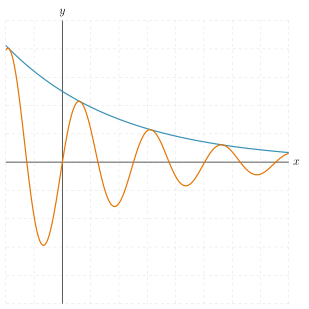
The curves \(C_1\) and \(C_2\) are defined by \[ y= \e^{-x} \quad (x>0) \quad \text{ and } \quad y= \e^{-x}\sin x \quad (x>0), \] respectively. Sketch roughly \(C_1\) and \(C_2\) on the same diagram. Let \(x_n\) denote the \(x\)-coordinate of the \(n\)th point of contact between the two curves, where \(0 < x_1 < x_2 < \cdots\), and let \(A_n\) denote the area of the region enclosed by the two curves between \(x_n\) and \(x_{n+1}\). Show that \[ A_n = \tfrac12(\e^{2\pi}-1) \e^{-(4n+1)\pi/2} \] and hence find \(\displaystyle \sum_{n=1}^\infty A_n\).
Solution:
2010 Paper 3 Q1
Let \(x_{\low1}\), \(x_{\low2}\), \ldots, \(x_n\) and \(x_{\vphantom {\dot A} n+1}\) be any fixed real numbers. The numbers \(A\) and \(B\) are defined by \[ A = \frac 1 n \sum_{k=1}^n x_{ \low k} \,, \ \ \ B= \frac 1 n \sum_{k=1}^n (x_{\low k}-A)^2 \,, \ \ \ \] and the numbers \(C\) and \(D\) are defined by \[ C = \frac 1 {n+1} \sum\limits_{k=1}^{n+1} x_{\low k} \,, \ \ \ D = \frac1{n+1} \sum_{k=1}^{n+1} (x_{\low k}-C)^2 \,. \]
- Express \( C\) in terms of \(A\), \(x_{\low n+1}\) and \(n\).
- Show that $ \displaystyle B= \frac 1 n \sum_{k=1}^n x_{\low k}^2 - A^2\,\(.
- Express \)D \( in terms of \)B\(, \)A\(, \)x_{\low n+1}\( and \)n$. Hence show that \((n + 1)D \ge nB\) for all values of \(x_{\low n+1}\), but that \(D < B\) if and only if \[ A-\sqrt{\frac{(n+1)B}{n}} < x_{\low n+1} < A+\sqrt{\frac{(n+1)B}{n}}\,. \]
2009 Paper 2 Q6
The Fibonacci sequence \(F_1\), \(F_2\), \(F_3\), \(\ldots\) is defined by \(F_1=1\), \(F_2= 1\) and \[ F_{n+1} = F_n+F_{n-1} \qquad\qquad (n\ge 2). \] Write down the values of \(F_3\), \(F_4\), \(\ldots\), \(F_{10}\). Let \(\displaystyle S=\sum_{i=1}^\infty \dfrac1 {F_i}\,\).
- Show that \(\displaystyle \frac 1{F_i} > \frac1{2F_{i-1}}\,\) for \(i\ge4\) and deduce that \(S > 3\,\). Show also that \(S < 3\frac23\,\).
- Show further that \(3.2 < S < 3.5\,\).
Solution: \begin{array}{c|r} n & F_n \\ \hline 1 & 1 \\ 2 & 1 \\ 3 & 2 \\ 4 & 3 \\ 5 & 5 \\ 6 & 8 \\ 7 & 13 \\ 8 & 21 \\ 9 & 34 \\ 10 & 55 \end{array} \begin{questionparts} \item Claim: \(\frac1{F_i} > \frac1{2F_{i-1}}\) for \(i \geq 4\). Proof: Since \(F_i = F_{i-1}+F_{i-2}\) and \(F_i > 1\) for \(i \geq 1\) we have \(F_i > F_{i-1}\) for \(i \geq 3\). In particular we have \(F_i = F_{i-1}+F_{i-2} < 2F_{i-1}\) for \(i -1 \geq 3\) or \(i \geq 4\). Therefore \(\frac{1}{F_i} > \frac1{2F_{i-1}}\)
2008 Paper 1 Q12
In this question, you may use without proof the results: \[ \sum_{r=1}^n r = \tfrac12 n(n+1) \qquad\text{and}\qquad \sum_{r=1}^n r^2 = \tfrac1 6 n(n+1)(2n+1)\,. \] The independent random variables \(X_1\) and \(X_2\) each take values \(1\), \(2\), \(\ldots\), \(N\), each value being equally likely. The random variable \(X\) is defined by \[ X= \begin{cases} X_1 & \text { if } X_1\ge X_2\\ X_2 & \text { if } X_2\ge X_1\;. \end{cases} \]
- Show that \(\P(X=r) = \dfrac{2r-1}{N^2}\,\) for \(r=1\), \(2\), \(\ldots\), \(N\).
- Find an expression for the expectation, \(\mu\), of \(X\) and show that \(\mu=67.165\) in the case \(N=100\).
- The median, \(m\), of \(X\) is defined to be the integer such that \(\P(X\ge m) \ge \frac 12\) and \(\P(X\le m)\ge \frac12\). Find an expression for \(m\) in terms of \(N\) and give an explicit value for \(m\) in the case \(N=100\).
- Show that when \(N\) is very large, \[ \frac \mu m \approx \frac {2\sqrt2}3\,. \]
Solution: \begin{align*} \P(X = r) &= \P(X_1 = r, X_2 \leq r) + \P(X_2 = r, X_1 < r) \\ &= \P(X_1 = r) \P(X_2 \leq r) + \P(X_2 = r)\P( X_1 < r) \\ &= \frac{1}{N} \frac{r}{N} + \frac{1}{N} \frac{r-1}{N} \\ &= \frac{2r-1}{N^2} \end{align*} \begin{align*} \E(X) &= \sum_{r=1}^N r \P(X = r) \\ &= \sum_{r=1}^N \frac{2r^2 - r}{N^2} \\ &= \frac{1}{N^2} \l \frac{N(N+1)(2N+1)}{3} - \frac{N(N+1)}{2} \r \\ &= \frac{N+1}{N} \l \frac{4N-1}{6} \r \end{align*} When \(N = 100\), this is equal to \(\frac{101 \cdot 399}{6 \cdot 100} = \frac{101 \cdot 133}{200} = 67.165\) \begin{align*} &&\frac12 &\leq \P(X \leq m) \\ &&&=\sum_{r=1}^m \P(X=r) \\ &&&=\sum_{r=1}^m \frac{2r-1}{N^2} \\ &&&= \frac{1}{N^2} \l m(m+1) - m \r \\ &&&= \frac{m^2}{N^2} \\ \Rightarrow && m^2 &\geq \frac{N^2}{2} \\ \Rightarrow && m &\geq \frac{N}{\sqrt{2}} \\ \Rightarrow && m &= \left \lceil \frac{N}{\sqrt{2}} \right \rceil \end{align*} When \(N = 100\), \(100/\sqrt{2} = \sqrt{2}50\). \(\sqrt{2} > 1.4 \Rightarrow 50\sqrt{2} > 70\) \(\sqrt{2} < 1.42 \Rightarrow 50 \sqrt{2} < 71\), therefore \(\displaystyle \left \lceil \frac{100}{\sqrt{2}} \right \rceil = 71\) \begin{align*} \lim_{N \to \infty} \frac{\frac{(N+1)(4N-1)}{6N}}{ \left \lceil\frac{N}{\sqrt{2}} \right \rceil} &= \lim_{N \to \infty} \frac{\sqrt{2}}{3}\l \frac{4N^2 +3N - 1}{2N^2} \r \tag{since the floor will be irrelevant}\\ &= \lim_{N \to \infty} \frac{\sqrt{2}}{3}\l 2 + \frac{3}{2N} - \frac{1}{N^2} \r \\ &= \lim_{N \to \infty} \frac{2\sqrt{2}}{3} \end{align*}
2008 Paper 3 Q2
Let \(S_k(n) \equiv \sum\limits_{r=0}^n r^k\,\), where \(k\) is a positive integer, so that \[ S_1(n) \equiv \tfrac12 n(n+1) \text{ and } S_2(n) \equiv \tfrac16 n(n+1)(2n+1)\,. \]
- By considering \(\sum\limits_{r=0}^n \left[ (r+1)^k-r^k\right]\, \), show that \[ kS_{k-1}(n)=(n+1)^k -(n+1) - \binom{k}{2} S_{k-2}(n) - \binom {k}{3} S_{k-3}(n) - \cdots - \binom{k}{k-1} S_{1}(n) \;. \tag{\(*\)} \] Obtain simplified expressions for \(S_3(n)\) and \(S_4(n)\).
- Explain, using \((*)\), why \(S_k(n)\) is a polynomial of degree \(k+1\) in \(n\). Show that in this polynomial the constant term is zero and the sum of the coefficients is 1.
Solution:
- \begin{align*} &&(n+1)^k &= \sum_{r=0}^n \left [ (r+1)^k - r^k \right] \\ &&&= \sum_{r=0}^n \left [ \left ( \binom{k}{0}r^k+\binom{k}1r^{k-1} + \binom{k}{2}r^{k-2} + \cdots + \binom{k}{k} 1 \right) - r^k\right] \\ &&&= \sum_{r=0}^n \left ( \binom{k}1r^{k-1} + \binom{k}{2}r^{k-2} + \cdots + \binom{k}{k} 1 \right) \\ &&&=k \sum_{r=0}^n r^{k-1} + \binom{k}{2}\sum_{r=0}^nr^{k-2} + \cdots + \binom{k}{k} \sum_{r=0}^n 1 \\ &&&= kS_{k-1}(n) + \binom{k}2 S_{k-2}(n) + \cdots +\binom{k}{k-1}S_1(n) + (n+1) \\ \Rightarrow && k S_{k-1}(n) &= (n+1)^k -(n+1) -\binom{k}2 S_{k-2}(n) - \cdots -\binom{k}{k-1}S_1(n) \\ && 4S_3(n) &= (n+1)^4-(n+1) - \binom{4}{2} \frac{n(n+1)(2n+1)}{6} - \binom{4}{3} \frac{n(n+1)}{2} \\ &&&= (n+1) \left ( (n+1)^3-1 - n(2n+1)-2n \right) \\ &&&= (n+1) \left ( n^3+3n^2+3n+1-1 - 2n^2-3n \right) \\ &&&= (n+1) \left ( n^3+n^2 \right) \\ &&&= n^2(n+1)^2 \\ \Rightarrow && S_3(n) &= \frac{n^2(n+1)^2}{4} \\ \\ &&5S_4(n) &=(n+1)^5-(n+1) - \binom{5}{2} \frac{n^2(n+1)^2}4 - \binom{5}{3} \frac{n(n+1)(2n+1)}{6} - \binom{5}{4} \frac{n(n+1)}{2} \\ &&&= (n+1) \left ((n+1)^4 - 1-\frac{5n^2(n+1)}{2} - \frac{5n(2n+1)}{3} -\frac{5n}{2}\right)\\ &&&= \frac{n+1}{6} \left (6(n+1)^4-6-15n^2(n+1)-10n(2n+1)-15n \right) \\ &&&= \frac{n+1}{6} \left (6n^4+24n^3+36n^2+24n+6 -6-15n^3-15n^2-20n^2-10n-15n\right) \\ &&&= \frac{n+1}{6} \left (6n^4+9n^3+n^2-n\right) \\ &&&= \frac{(n+1)n(2n+1)(3n^2+3n-1)}{6} \\ \Rightarrow && S_4(n) &= \frac{(n+1)n(2n+1)(3n^2+3n-1)}{30} \end{align*}
- Proceeding by induction, since \(S_k(n)\) is a polynomial of degree \(k+1\) for small \(k\), we can see that \[ (k+1)S_k(n) = \underbrace{(n+1)^{k+1}}_{\text{poly deg }=k+1} - \underbrace{(n+1)}_{\text{poly deg}=1} - \underbrace{\binom{k+1}{2}S_{k-1}(n)}_{\text{poly deg}=k} - \underbrace{\cdots}_{\text{polys deg}< k} - \underbrace{\binom{k+1}{k} S_1(n)}_{\text{poly deg}=1}\] therefore \(S_k(n)\) is a polynomial of degree \(k+1\) (in fact with leading coefficient \(\frac{1}{k+1}\). Since \(S_k(0) = \sum_{r=0}^{0} r^k = 0\) there is no constant term, and since \(S_k(1) = \sum_{r=0}^1 r^k = 1\) the sum of the coefficients is \(1\)
2008 Paper 3 Q10
A long string consists of \(n\) short light strings joined together, each of natural length \(\ell\) and modulus of elasticity \(\lambda\). It hangs vertically at rest, suspended from one end. Each of the short strings has a particle of mass \(m\) attached to its lower end. The short strings are numbered \(1\) to \(n\), the \(n\)th short string being at the top. By considering the tension in the \(r\)th short string, determine the length of the long string. Find also the elastic energy stored in the long string. A uniform heavy rope of mass \(M\) and natural length \(L_0\) has modulus of elasticity \(\lambda\). The rope hangs vertically at rest, suspended from one end. Show that the length, \(L\), of the rope is given by \[ L=L_0\biggl(1+ \frac{Mg}{2\lambda}\biggr), \] and find an expression in terms of \(L\), \(L_0\) and \(\lambda\) for the elastic energy stored in the rope.
2007 Paper 2 Q12
I have two identical dice. When I throw either one of them, the probability of it showing a 6 is \(p\) and the probability of it not showing a 6 is \(q\), where \(p+q=1\). As an experiment to determine \(p\), I throw the dice simultaneously until at least one die shows a 6. If both dice show a six on this throw, I stop. If just one die shows a six, I throw the other die until it shows a 6 and then stop.
- Show that the probability that I stop after \(r\) throws is \(pq^{r-1}(2-q^{r-1}-q^r)\), and find an expression for the expected number of throws. [{\bf Note:} You may use the result $\ds \sum_{r=0}^\infty rx^r = x(1-x)^{-2}\(.]
- In a large number of such experiments, the mean number of throws was \)m\(. Find an estimate for \)p\( in terms of \)m$.
Solution:
- \(\,\) \begin{align*} \mathbb{P}(\text{stop after r}) &= \mathbb{P}(\text{both stop at r}) + 2\mathbb{P}(\text{first stops before r second stops at r})\\ &= (q^2)^{r-1} p^2 + 2\cdot q^{r-1} p\cdot(1-q^{r-1}) \\ &= q^{r-1}p\left (2-2q^{r-1}+pq^{r-1} \right) \\ &= q^{r-1}p\left (2-q^{r-1}(1+p+q-p) \right) \\ &= q^{r-1}p\left (2-q^{r-1}-q^r\right) \\ \end{align*} \begin{align*} \E[\text{throws}] &= \sum_{r=1}^{\infty} r \mathbb{P}(\text{stop after r}) \\ &= \sum_{r=1}^{\infty} r q^{r-1}p\left (2-q^{r-1}-q^r\right) \\ &= \sum_{r=1}^{\infty} 2r q^{r-1}p-\sum_{r=1}^{\infty}r pq^{2r-2}-\sum_{r=1}^{\infty}r q^{2r-1}p \\ &=2p \sum_{r=1}^{\infty} r q^{r-1}-pq^{-2}\sum_{r=1}^{\infty}r q^{2r}-pq^{-1}\sum_{r=1}^{\infty}r q^{2r} \\ &= 2p(1-q)^{-2} - pq^{-2}q^2(1-q^2)^{-2}-pq^{-1}q^2(1-q^2)^{-2} \\ &= 2pp^{-2} -p(1+q)(1-q^2)^{-2} \\ &= 2p^{-1}-p(1+q)(1+q)^{-2}p^{-2} \\ &= 2p^{-1}-p^{-1}(1+q)^{-1} \\ &= \frac{2(1+q)-1}{p(1+q)} \\ &= \frac{1+2q}{p(1+q)} \\ &= \frac{3-2p}{p(2-p)} \end{align*}
- \(\,\) \begin{align*} && m &= \frac{3-2p}{p(2-p)} \\ \Rightarrow && 2mp-mp^2 &= 3-2p \\ \Rightarrow && 0 &= mp^2-(2m+2)p + 3 \\ \Rightarrow && p &= \frac{2m+2 \pm \sqrt{(2m+2)^2-12m}}{2m} \\ &&&= \frac{m+1- \sqrt{m^2-m + 1}}{m} \\ \end{align*} If we are looking for an approximation, we could say \(p^2 \approx 0\) and \(p \approx \frac{3}{2(m+1)}\)