Problems
Filters
35 problems found
2006 Paper 2 Q5
The notation \({\lfloor } x \rfloor\) denotes the greatest integer less than or equal to the real number \(x\). Thus, for example, \(\lfloor \pi\rfloor =3\,\), \(\lfloor 18\rfloor =18\,\) and \(\lfloor-4.2\rfloor = -5\,\).
- Two curves are given by \(y= x^2+3x-1\) and \(y=x^2 +3\lfloor x\rfloor -1\,\). Sketch the curves, for \(1\le x \le 3\,\), on the same axes. Find the area between the two curves for \(1\le x \le n\), where \(n\) is a positive integer.
- Two curves are given by \(y= x^2+3x-1\) and \(y=\lfloor x\rfloor ^2+3\lfloor x\rfloor -1\,\). Sketch the curves, for \(1\le x \le 3\,\), on the same axes. Show that the area between the two curves for \(1\le x \le n\), where \(n\) is a positive integer, is \[ \tfrac 16 (n-1)(3n+11)\,. \]
Solution:
- \(\,\)
The difference between the curves is \(3x - 3\lfloor x \rfloor\), which has area \(\frac32\) for each step. Therefore the area between the curves from \(1 \leq x \leq n\) is \(\frac32 (n-1)\)

- \(\,\)
The area between the curves is \(x^2 - \lfloor x \rfloor ^2 + 3(x - \lfloor x \rfloor)\). Looking at \begin{align*} && A &= \int_1^n \left ( x^2 - \lfloor x \rfloor ^2 \right )\d x \\ &&&= \frac{n^3-1^3}{3} - \sum_{k=1}^{n-1} k^2 \\ &&&= \frac{(n-1)(n^2+n+1)}{3} - \frac{(n-1)n(2n-1)}{6} \\ &&&= \frac{(n-1) \left (2n^2+2n+2-2n^2+n \right)}{6} \\ &&&= \frac{(n-1)(3n+2)}{6} \end{align*} Therefore the total area is \(\frac{(n-1)(3n+2)}{6}+\frac32(n-1) = \frac{(n-1)}{6}\left ( 3n+2+9\right) =\frac{(n-1)(3n+11)}{6}\)

2005 Paper 2 Q5
The angle \(A\) of triangle \(ABC\) is a right angle and the sides \(BC\), \(CA\) and \(AB\) are of lengths \(a\), \(b\) and \(c\), respectively. Each side of the triangle is tangent to the circle \(S_1\) which is of radius \(r\). Show that \(2r = b+c-a\). Each vertex of the triangle lies on the circle~\(S_2\). The ratio of the area of the region between~\(S_1\) and the triangle to the area of \(S_2\) is denoted by \(R\,\). Show that $$ \pi R = -(\pi-1)q^2 + 2\pi q -(\pi+1) \;, $$ where \(q=\dfrac{b+c}a\,\). Deduce that $$ R\le \frac1 {\pi( \pi - 1)} \;. $$
2005 Paper 2 Q10
The points \(A\) and \(B\) are \(180\) metres apart and lie on horizontal ground. A missile is launched from \(A\) at speed of \(100\,\)m\,s\(^{-1}\) and at an acute angle of elevation to the line \(AB\) of \(\arcsin \frac35\). A time \(T\) seconds later, an anti-missile missile is launched from \(B\), at speed of \(200\,\)m\,s\(^{-1}\) and at an acute angle of elevation to the line \(BA\) of \(\arcsin \frac45\). The motion of both missiles takes place in the vertical plane containing \(A\) and \(B\), and the missiles collide. Taking \(g =10\,\)m\,s\(^{-2}\) and ignoring air resistance, find \(T\). \noindent [Note that \(\arcsin \frac35\) is another notation for \(\sin^{-1} \frac35\,\).]
2005 Paper 3 Q5
Let \(P\) be the point on the curve \(y=ax^2+bx+c\) (where \(a\) is non-zero) at which the gradient is \(m\). Show that the equation of the tangent at \(P\) is \[ y-mx=c-\frac{(m-b)^2}{4a}\;. \] Show that the curves \(y=a_1 x^2+b_1 x+c_1\) and \(y=a_2 x^2+b_2 x+c_2\) (where \(a_1\) and \(a_2\) are non-zero) have a common tangent with gradient \(m\) if and only if \[ (a_2 -a_1 )m^2 + 2(a_1 b_2-a_2 b_1)m + 4a_1 a_2(c_2-c_1)+ a_2 b_1^2-a_1 b_2 ^2=0\;. \] Show that, in the case \(a_1 \ne a_2 \,\), the two curves have exactly one common tangent if and only if they touch each other. In the case \(a_1 =a_2\,\), find a necessary and sufficient condition for the two curves to have exactly one common tangent.
Solution: \begin{align*} && y' &= 2ax+b \\ \Rightarrow && m &= 2ax_t+b \\ \Rightarrow && x_t &= \frac{m-b}{2a} \end{align*} Therefore we must have \begin{align*} mx_t &= 2ax_t^2+bx_t \\ y - mx &= ax_t^2+bx_t+c - mx_t \\ &= ax_t^2+bx_t+c - (2ax_t^2+bx_t) \\ &= c - ax_t^2 \\ &= c-a\left (\frac{m-b}{2a} \right)^2 \\ &= c - \frac{(m-b)^2}{4a} \end{align*} They will have a common tangent if and only if the constant terms are equal, ie \begin{align*} && c_1 - \frac{(m-b_1)^2}{4a_1} &= c_2 - \frac{(m-b_2)^2}{4a_2} \\ \Leftrightarrow && (c_1-c_2) &= \frac{(m-b_1)^2}{4a_1} -\frac{(m-b_2)^2}{4a_2} \\ \Leftrightarrow && 4a_1a_2(c_1-c_2) &= a_2(m-b_1)^2-a_1(m-b_2)^2 \\ &&&= (a_2-a_1)m^2+2(a_1b_2-a_2b_1)m+a_2b_1^2-a_1b_2^2 \end{align*} as required. Treating this as a polynomial in \(m\), we can see that the two curves will have exactly one common tangent iff \(\Delta = 0\), ie: \begin{align*} && 0 &= \Delta \\ &&&= (2(a_1b_2-a_2b_1))^2 - 4 (a_2-a_1)(4a_1 a_2(c_2-c_1)+ a_2 b_1^2-a_1 b_2 ^2) \\ &&&= 4a_1^2b_2^2-8a_1a_2b_1b_2+4a_2b_1^2 - 4a_2^2b_1^2-4a_1^2b_2^2 + 4a_1a_2(b_1^2+b_2^2)-16(a_2-a_1)a_1a_2(c_2-c_1) \\ &&&=-8a_1a_2b_1b_2+4a_1a_2(b_1^2+b_2^2)-16(a_2-a_1)a_1a_2(c_2-c_1) \\ &&&=a_1a_2(4(b_1-b_2)^2-16(a_2-a_1)(c_2-c_1)) \\ &&&= 4a_1a_2((b_2-b_1)^2 - 4(a_2-a_1)(c_2-c_1) \end{align*} But this is just the discriminant of the difference, ie equivalent to the two parabolas just touching. (Assuming \(a_1-a_2 \neq 0\) and we do end up with a quadratic). If \(a_1 = a_2 = a\) then we need exactly one solution to \(2a(b_1-b_2)m +4a^2(c_2-c_1)+a(b_1^2-b_2^2) = 0\), ie \(b_1 \neq b_2\).
2003 Paper 1 Q10
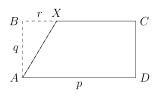
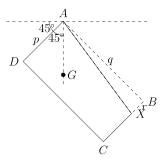
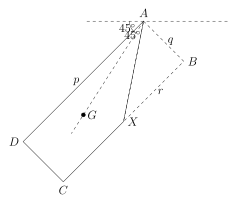
\(ABCD\) is a uniform rectangular lamina and \(X\) is a point on \(BC\,\). The lengths of \(AD\), \(AB\) and \(BX\) are \(p\,\), \(q\) and \(r\) respectively. The triangle \(ABX\) is cut off the lamina. Let \((a,b)\) be the position of the centre of gravity of the lamina, where the axes are such that the coordinates of \(A\,\), \(D\) and \(C\) are \((0,0)\,\), \((p,0)\) and \((p,q)\) respectively. Derive equations for \(a\) and \(b\) in terms of \(p\,\), \(q\) and \(r\,\). When the resulting trapezium is freely suspended from the point \(A\,\), the side \(AD\) is inclined at \(45^\circ\) below the horizontal. Show that \(\displaystyle r = q - \sqrt{q^2 - 3pq + 3p^2}\,\). You should justify carefully the choice of sign in front of the square root.
Solution:
2003 Paper 3 Q5
Find the coordinates of the turning point on the curve \(y = x^2 - 2bx + c\,\). Sketch the curve in the case that the equation \(x^2 - 2bx + c=0\) has two distinct real roots. Use your sketch to determine necessary and sufficient conditions on \(b\) and \(c\) for the equation \(x^2 - 2bx + c = 0\) to have two distinct real roots. Determine necessary and sufficient conditions on \(b\) and \(c\) for this equation to have two distinct positive roots. Find the coordinates of the turning points on the curve \(y = x^3 - 3b^2x + c\) (with \(b>0\)) and hence determine necessary and sufficient conditions on \(b\) and \(c\) for the equation \(x^3 - 3b^2x + c = 0\) to have three distinct real roots. Determine necessary and sufficient conditions on \(a\,\), \(b\) and \(c\) for the equation \(\l x - a \r^3 - 3b^2 \l x - a \r + c = 0\) to have three distinct positive roots. Show that the equation \(2x^3 - 9x^2 + 7x - 1 = 0\) has three distinct positive roots.
Solution: \begin{align*} y &= x^2-2bx+c \\ &= (x-b)^2+c-b^2 \end{align*} Therefore the turning point is at \((b,c-b^2)\)


2002 Paper 2 Q4
Give a sketch to show that, if \(\f(x) > 0\) for \(p < x < q\,\), then \(\displaystyle \int_p^{q} \f(x) \d x > 0\,\).
- By considering \(\f(x) = ax^2-bx+c\,\) show that, if \(a > 0\) and \(b^2 < 4ac\), then \(3b < 2a+6c\,\).
- By considering \(\f(x)= a\sin^2x - b\sin x + c\,\) show that, if \(a > 0\) and \(b^2< 4ac\), then \(4b < (a+2c)\pi\)
- Show that, if \(a > 0\), \(b^2 < 4ac\) and \(q > p > 0\,\), then $$ b\ln(q/p) < a\left(\frac1p -\frac1q\right) +c(q-p)\;. $$
Solution:
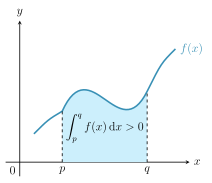
- If \(a > 0\) and \(b^2 < 4ac \Rightarrow \Delta < 0\) then \(f(x) = ax^2-bx+c > 0\) for all \(x\). Therefore \begin{align*} && 0 & < \int_0^1 (ax^2-bx+c) \d x\\ &&&= \frac13 a-\frac12b+c \\ \Rightarrow && 3b &< 2a+6c \end{align*}
- Similar logic tells us this must also be always positive, therefore \begin{align*} && 0 &< \int_0^{\pi} (a \sin^2 x - b \sin x +c ) \d x\\ &&&= \frac{\pi}{2}a - 2b+\pi c \\ \Rightarrow && 4b &< (a+2c)\pi \end{align*}
- Similar logic shows that \(f(x) = \frac{a}{x^2}-\frac{b}{x} +c>0\), therefore \begin{align*} && 0 &< \int_p^q \left (\frac{a}{x^2} - \frac{b}{x} + c\right) \d x \\ &&&=a\left (\frac{1}{p} - \frac{1}{q} \right) - b(\ln q - \ln p)+c(q-p) \\ \Rightarrow && b \ln (q/p) &,< a\left (\frac{1}{p} - \frac{1}{q} \right) +c(q-p) \end{align*}
2002 Paper 2 Q5
The numbers \(x_n\), where \(n=0\), \(1\), \(2\), \(\ldots\) , satisfy \[ x_{n+1} = kx_n(1-x_n) \;. \]
- Prove that, if \(0 < k < 4\) and \(0 < x_0 < 1\), then \(0 < x_n < 1\) for all \(n\,\).
- Given that \(x_0=x_1=x_2 = \cdots =a\,\), with \(a\ne0\) and \(a\ne1\), find \(k\) in terms of \(a\,\).
- Given instead that \(x_0=x_2=x_4 = \cdots = a\,\), with \(a\ne0\) and \(a\ne1\), show that \(ab^3 -b^2 +(1-a)=0\), where \(b=k(1-a)\,\). Given, in addition, that \(x_1 \ne a\), find the possible values of \(k\) in terms of \(a\,\).
Solution:
- Consider \(f(x) = x(1-x) = x - x^2 = \tfrac14 - (x - \tfrac12)^2\) which is clearly in \((0,\tfrac14)\) when \(x \in (0,1)\), therefore if \(0 < k < 4\) then \(f(x) \in (0, 1)\) and so by induction \(x_n \in (0,1)\).
- Suppose \(a = g(a)\) then \(a = ka(1-a) \Rightarrow 1 = k(1-a) \Rightarrow k = \frac{1}{1-a}\) (since \(a \neq 0, 1\))
- If \(g(g(a)) = a\) then \begin{align*} && a &= kg(a)(1-g(a)) \\ &&&= k^2a(1-a)(1-ka(1-a)) \\ &&&= -k^3a^2(1-a)^2 + k^2a(1-a) \\ \Rightarrow && 1 &= -k^3a(1-a)^2 + k^2(1-a) \\ \Rightarrow && 1-a &= -k^3a(1-a)^3+k^2(1-a)^2 \\ \Rightarrow && 1-a &= -ab^3+b^2 \\ \Rightarrow && 0 &= ab^3-b^2+(1-a) \end{align*} Note that \begin{align*} && 0 &= ab^3-b^2+(1-a) \\ &&&= (b-1)(ab^2-(1-a)b - (1-a)) \end{align*} and since \(b \neq 1\) (otherwise \(x_2 =0\) which is a contradiction) we must have \(b = \frac{1-a \pm \sqrt{(1-a)^2+4a(1-a)}}{2a} = \frac{1-a\pm \sqrt{1+2a-3a^2}}{2a}\) and so \(k = \frac{b}{1-a} = \frac{1-a \pm \sqrt{1+2a-3a^2}}{2a(1-a)}\)
2002 Paper 3 Q4
Show that if \(x\) and \(y\) are positive and \(x^3 + x^2 = y^3 - y^2\) then \(x < y\,\). Show further that if \(0 < x \le y - 1\), then \(x^3 + x^2 < y^3 - y^2\). Prove that there does not exist a pair of {\sl positive} integers such that the difference of their cubes is equal to the sum of their squares. Find all the pairs of integers such that the difference of their cubes is equal to the sum of their squares.
1996 Paper 1 Q11
A particle is projected under the influence of gravity from a point \(O\) on a level plane in such a way that, when its horizontal distance from \(O\) is \(c\), its height is \(h\). It then lands on the plane at a distance \(c+d\) from \(O\). Show that the angle of projection \(\alpha\) satisfies \[ \tan\alpha=\frac{h(c+d)}{cd} \] and that the speed of projection \(v\) satisfies \[ v^{2}=\frac{g}{2}\left(\frac{cd}{h}+\frac{(c+d)^{2}h}{cd}\right)\,. \]
1996 Paper 2 Q5
If $$ z^{4}+z^{3}+z^{2}+z+1=0\tag{*} $$ and \(u=z+z^{-1}\), find the possible values of \(u\). Hence find the possible values of \(z\). [Do not try to simplify your answers.] Show that, if \(z\) satisfies \((*)\), then \[z^{5}-1=0.\] Hence write the solutions of \((*)\) in the form \(z=r(\cos\theta+i\sin\theta)\) for suitable real \(r\) and \(\theta\). Deduce that \[\sin\frac{2\pi}{5}=\frac{\surd(10+2\surd 5)}{4} \ \ \hbox{and}\ \ \cos\frac{2\pi}{5}=\frac{-1+\surd 5}{4}.\]
Solution: \begin{align*} && 0 &= z^4+z^3+z^2+z+1 \\ \Rightarrow && 0 &= z^2+z+1+z^{-1}+z^{-2} \tag{\(z \neq 0\)} \\ &&&= \left ( z+z^{-1} \right)^2-2 + z+z^{-1} + 1 \\ &&&= u^2+u-1 \\ \Rightarrow && u &= \frac{-1 \pm \sqrt{5}}{2} \\ \Rightarrow && z+z^{-1} &= \frac{-1 \pm \sqrt{5}}{2} \\ \Rightarrow && 0 &= z^2-\left ( \frac{-1 \pm \sqrt{5}}{2}\right)z+1 \\ \Rightarrow && z &= \frac{\left ( \frac{-1 \pm \sqrt{5}}{2}\right) \pm \sqrt{\left ( \frac{-1 \pm \sqrt{5}}{2}\right)^2-4}}{2} \\ &&&= \frac{\left ( \frac{-1 \pm \sqrt{5}}{2}\right) \pm \sqrt{\frac{1+5\mp2\sqrt{5}-16}{4}}}{2} \\ &&&= \frac{\left ( \frac{-1 \pm \sqrt{5}}{2}\right) \pm \sqrt{\frac{-10\mp2\sqrt{5}-16}{4}}}{2} \\ &&&= \frac{-1\pm\sqrt{5}}{4} \pm i\frac{\sqrt{10\pm 2\sqrt{5}}}{4} \end{align*} Since \(z^4+z^3+z^2+z+1 = 0\) we can multiply both sides by \(z-1\) to obtain \(z^5-1 = 0\). Therefore if \(z = r(\cos \theta + i \sin \theta)\) we see that \(z^5 = 1 \Rightarrow r^5 (\cos 5 \theta + i \sin 5 \theta) = 1 \Rightarrow r = 1, 5 \theta = 2n \pi\) ie \(z = \cos \frac{2n\pi}{5} + i\sin \frac{2n \pi}{5}\). We are looking for a solution in the first quadrant, therefore \(\cos \frac{2\pi}{5} = \frac{-1 + \sqrt{5}}4\) and \(\sin \frac{2\pi}{5} = \frac{\sqrt{10+2\sqrt{5}}}{4}\)
1995 Paper 1 Q4
By applying de Moivre's theorem to \(\cos5\theta+\mathrm{i}\sin5\theta,\) expanding the result using the binomial theorem, and then equating imaginary parts, show that \[ \sin5\theta=\sin\theta\left(16\cos^{4}\theta-12\cos^{2}\theta+1\right). \] Use this identity to evaluate \(\cos^{2}\frac{1}{5}\pi\), and deduce that \(\cos\frac{1}{5}\pi=\frac{1}{4}(1+\sqrt{5}).\)
Solution: \begin{align*} && (\cos \theta + i \sin \theta)^n &= \cos n \theta + i \sin n \theta \\ n = 5: && \cos 5 \theta + i \sin 5 \theta &= (\cos \theta + i \sin \theta)^5 \\ \textrm{Im}: && \sin 5 \theta &= \binom{5}{1}\cos^4 \theta \sin \theta + \binom{5}{3} \cos^2 \theta (- \sin^3 \theta) + \binom{5}{5} \sin^5 \theta \\ &&&= \sin \theta (5\cos^4 \theta-10\cos^2 \theta \sin^2 \theta+\sin^4 \theta) \\ &&&= \sin \theta (5\cos^4 \theta-10\cos^2 \theta (1-\cos^2 \theta)+(1-\cos^2 \theta)^2) \\ &&&= \sin \theta((5+10+1)\cos^4 \theta +(-10-2)\cos^2 \theta + 1) \\ &&&= \sin \theta(16\cos^4 \theta -12\cos^2 \theta + 1) \\ \end{align*} Suppose \(\theta= \frac{\pi}{5}\), then \(\sin 5 \theta = 0, \sin \theta \neq 0\), therefore if \(c = \cos \theta\) we must have \begin{align*} && 0 &= 16c^4-12c^2+1 \\ \Rightarrow && c^2 &= \frac{3 \pm \sqrt{5}}{8} \\ &&&= \frac{6\pm 2\sqrt{5}}{16} \\ &&&= \frac{(1 \pm \sqrt{5})^2}{16} \\ \Rightarrow && c &= \pm \frac{1 \pm \sqrt{5}}{4} \end{align*} Since \(c > 0\) we either have \(\cos \frac15 \pi = \frac{1+\sqrt{5}}4\) or \(\cos \frac15 \pi = \frac{\sqrt{5}-1}4\), however \(\sqrt{5}-1 < 1.5\) and so \(\frac{\sqrt{5}-1}{4} < \frac12 = \cos \frac13 \pi\) we must have \(\cos \frac15 \pi = \frac{1+\sqrt{5}}4\)
1994 Paper 2 Q11
As part of a firework display a shell is fired vertically upwards with velocity \(v\) from a point on a level stretch of ground. When it reaches the top of its trajectory an explosion it splits into two equal fragments each travelling at speed \(u\) but (since momentum is conserved) in exactly opposite (not necessarily horizontal) directions. Show, neglecting air resistance, that the greatest possible distance between the points where the two fragments hit the ground is \(2uv/g\) if \(u\leqslant v\) and \((u^{2}+v^{2})/g\) if \(v\leqslant u.\)
Solution: Since \(v^2 - u^2 = 2as\) we have the initial height reached is \(\frac{v^2}{2g}\). At the point of explosion, the velocities are \(\pm \binom{u \cos \theta}{u \sin \theta}\) where \(0 \leq \theta < \frac{\pi}{2}\). Looking vertically: \begin{align*} && -\frac{v^2}{2g} &= \pm u \sin \theta t - \frac12gt^2 \\ \Rightarrow && t &= \frac{\mp u \sin \theta \pm \sqrt{u^2 \sin^2 \theta - 4 \cdot \left (-\frac12 g \right) \cdot (\frac{v^2}{2g})}}{2(-\frac12g)} \\ &&&= \frac{\pm u \sin \theta \mp \sqrt{u^2 \sin^2 \theta+v^2}}{g}\\ &&&= \frac{\pm u \sin \theta +\sqrt{u^2 \sin^2 \theta+v^2}}{g} \end{align*} Since we always want the positive \(t\). Then the horizontal distance travelled will be \begin{align*} && s &= u \cos \theta (t_1 + t_2) \\ &&&= u \cos \theta \frac{2\sqrt{u^2 \sin^2 \theta+v^2}}{g} \\ &&&= \frac{2u \cos \theta \sqrt{u^2 \sin^2 \theta + v^2}}{g} \\ &&s^2 &= \frac{4u^2}{g^2} \cos^2 \theta ({u^2 \sin^2 \theta + v^2}) \\ &&&= \frac{4u^2}{g^2} \left (-u^2\cos^4 \theta + (v^2+u^2)\cos^2 \theta \right) \\ &&&= \frac{4u^2}{g^2} \left (-u^2\left ( \cos^2 \theta - \frac{v^2+u^2}{2u^2}\right)^2 + \frac{(v^2+u^2)^2}{4u^2} \right) \\ &&&= \frac{(v^2+u^2)^2}{g^2} - \frac{4u^4}{g^2}\left ( \cos^2 \theta - \frac{v^2+u^2}{2u^2}\right)^2 \end{align*} If \(u \geq v\) then such a \(\theta\) exists such that we can achieve the maximum, ie \(s = \frac{v^2+u^2}{g}\). If not, then we will achieve our maximum when \(\cos \theta = 1\), ie \(\sin \theta = 0\) and \(s = \frac{2uv}{g}\)
1992 Paper 1 Q7
Let \(\mathrm{g}(x)=ax+b.\) Show that, if \(\mathrm{g}(0)\) and \(\mathrm{g}(1)\) are integers, then \(\mathrm{g}(n)\) is an integer for all integers \(n\). Let \(\mathrm{f}(x)=Ax^{2}+Bx+C.\) Show that, if \(\mathrm{f}(-1),\mathrm{f}(0)\) and \(\mathrm{f}(1)\) are integers, then \(\mathrm{f}(n)\) is an integer for all integers \(n\). Show also that, if \(\alpha\) is any real number and \(\mathrm{f}(\alpha-1),\) \(\mathrm{f}(\alpha)\) and \(\mathrm{f}(\alpha+1)\) are integers, then \(\mathrm{f}(\alpha+n)\) is an integer for all integers \(n\).
Solution: If \(g(0) \in \mathbb{Z} \Rightarrow b \in \mathbb{Z}\). If \(g(1) \in \mathbb{Z} \Rightarrow a+b \in \mathbb{Z} \Rightarrow a \in \mathbb{Z}\), therefore \(a \cdot n + b \in \mathbb{Z}\), in particular \(g(n) \in \mathbb{Z}\) for all integers \(n\). \(f(0) \in \mathbb{Z} \Rightarrow C \in \mathbb{Z}\), \(f(1) \in \mathbb{Z} = A+ B + C \in \mathbb{Z} \Rightarrow A+ B \in \mathbb{Z}\) \(f(-1) \in \mathbb{Z} = A- B + C \in \mathbb{Z} \Rightarrow A- B \in \mathbb{Z}\) \(\Rightarrow 2A, 2B \in \mathbb{Z}\) \begin{align*} f(n) &= An^2 + Bn + C \\ &= An^2-An + An+Bn + C \\ &= 2A \frac{n(n-1)}2 + (A+B)n + C \\ &\in \mathbb{Z} \end{align*} Consider \(g(x) = f(x + \alpha)\), therefore \(g(0), g(1), g(-1) \in \mathbb{Z} \Rightarrow g(n) \in \mathbb{Z} \Rightarrow f(n+\alpha) \in \mathbb{Z}\)
1992 Paper 3 Q3
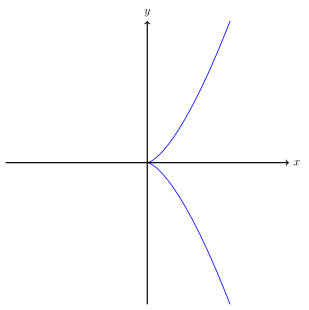
Sketch the curve \(C_{1}\) whose parametric equations are \(x=t^{2},\) \(y=t^{3}.\) The circle \(C_{2}\) passes through the origin \(O\). The points \(R\) and \(S\) with real non-zero parameters \(r\) and \(s\) respectively are other intersections of \(C_{1}\) and \(C_{2}.\) Show that \(r\) and \(s\) are roots of an equation of the form \[ t^{4}+t^{2}+at+b=0, \] where \(a\) and \(b\) are real constants. By obtaining a quadratic equation, with coefficients expressed in terms of \(r\) and \(s\), whose roots would be the parameters of any further intersections of \(C_{1}\) and \(C_{2},\) or otherwise, show that \(O\), \(R\) and \(S\) are the only real intersections of \(C_{1}\) and \(C_{2}.\)
Solution: