Problems
Filters
77 problems found
2017 Paper 1 Q8
Two sequences are defined by \(a_1 = 1\) and \(b_1 = 2\) and, for \(n \ge 1\), \begin{equation*} \begin{split} a_{n+1} & = a_n+ 2b_n \,, \\ b_{n+1} & = 2a_n + 5b_n \,. \end{split} \end{equation*} Prove by induction that, for all \(n \ge 1\), \[ a_n^2+2a_nb_n - b_n^2 = 1 \,. \tag{\(*\)}\]
- Let \(c_n = \dfrac{a_n}{b_n}\). Show that \(b_n \ge 2 \times 5^{n-1}\) and use \((*)\) to show that \[ c_n \to \sqrt 2 -1 \text{ as } n\to\infty\,. \]
- Show also that \(c_n > \sqrt2 -1\) and hence that \(\dfrac2 {c_n+1} < \sqrt2 < c_n+1\). Deduce that \(\dfrac{140}{99}< \sqrt{2} < \dfrac{99}{70 }\,\).
Solution: Claim \(a_n^2+2a_nb_n - b_n^2 = 1\) for all \(n \geq 1\) Proof: (By induction) Base case: (\(n = 1\)). When \(n = 1\) we have \(a_1^2 + 2a_1 b_1-b_1^2 = 1^2+2\cdot1\cdot2-2^2 = 1\) as required. (Inductive step). Now we assume our result is true for some \(n =k\), ie \(a_k^2+2a_kb_k - b_k^2 = 1\), now consider \(n = k+1\) \begin{align*} && a_{k+1}^2+2a_{k+1}b_{k+1} - b_{k+1}^2 &= (a_k+2b_k)^2+2(a_k+2b_k)(2a_k+5b_k) - (2a_k+5b_k)^2 \\ &&&= a_k^2+4a_kb_k+4b_k^2 +4a_k^2+18a_kb_k+20b_k^2 - 4a_k^2-20a_kb_k-25b_k^2 \\ &&&= (1+4-4)a_k^2+(4+18-20)a_kb_k +(4+20-25)b_k^2 \\ &&&= a_k^2+2a_kb_k -b_k^2 = 1 \end{align*} Therefore since our statement is true for \(n = 1\) and when it is true for \(n=k\) it is true for \(n=k+1\) by the POMI it is true for \(n \geq 1\)
- Notice that \(b_{n+1} \geq 5 b_n\) and therefore \(b_n \geq 5^{n-1} b_1 = 2\cdot 5^{n-1}\), so \begin{align*} && 1 &= a_n^2+2a_nb_n - b_n^2\\ \Rightarrow && \frac1{b_n^2} &= c_n^2 + 2c_n - 1 \\ \to && 0 &= c_n^2 + 2c_n - 1 \quad \text{ as } n\to \infty \\ \end{align*} This has roots \(c = -1 \pm \sqrt{2}\), and since \(c_n > 0\) it must tend to the positive value, ie \(c_n \to \sqrt{2}-1\)
- Notice that \(c_n^2 + 2c_n - 1 > 0\) so either \(c_n > \sqrt{2}-1\) or \(c_n < -1-\sqrt{2}\), but again, since \(c_n > 0\) we must have \(c_n > \sqrt{2}-1\). Therefore \(\sqrt{2} < c_n + 1\) and \(1+c_n > \sqrt{2} \Rightarrow \frac{1}{1+c_n} < \frac{\sqrt{2}}2 \Rightarrow \frac{2}{1+c_n} < \sqrt{2}\) \begin{array}{c|c|c} n & a_n & b_n \\ \hline 1 & 1 & 2 \\ 2 & 5 & 12 \\ 3 & 29 & 70 \end{array} Therefore \(c_3 = \frac{29}{70}\) and so \(\frac{2}{1 + \frac{29}{70}} = \frac{140}{99} < \sqrt{2} < \frac{29}{70} + 1 = \frac{99}{70}\)
2017 Paper 1 Q13
I have a sliced loaf which initially contains \(n\) slices of bread. Each time I finish setting a STEP question, I make myself a snack: either toast, using one slice of bread; or a sandwich, using two slices of bread. I make toast with probability \(p\) and I make a sandwich with probability \(q\), where \(p+q=1\), unless there is only one slice left in which case I must, of course, make toast. Let \(s_r\) (\(1 \le r \le n\)) be the probability that the \(r\)th slice of bread is the second of two slices used to make a sandwich and let \(t_r\) (\(1 \le r \le n\)) be the probability that the \(r\)th slice of bread is used to make toast. What is the value of \(s_1\)? Explain why the following equations hold: \begin{align*} \phantom{\hspace{2cm} (2\le r \le n-1)} t_r &= (s_{r-1}+ t_{r-1})\,p \hspace{2cm} (2\le r \le n-1)\,; \\ \phantom{\hspace{1.53cm} (2\le r \le n) } s_r &= 1- (s_{r-1} + t_{r-1}) \hspace{1.53cm} ( 2\le r \le n )\,. \end{align*} Hence, or otherwise, show that \(s_{r} = q(1-s_{r-1})\) for \(2\le r\le n-1\). Show further that \[ \phantom{\hspace{2.7cm} (1\le r\le n)\,,} s_r = \frac{q+(-q)^r}{1+q} \hspace{2.7cm} (1\le r\le n-1)\,, \, \hspace{0.14cm} \] and find the corresponding expression for \(t_r\). Find also expressions for \(s_n\) and \(t_n\) in terms of \(q\).
Solution: The \(1\)st slice of bread can only be the first slice in a sandwich or a slice of toast. Therefore \(s_1 = 0\) \begin{align*} && t_r &= \underbrace{s_{r-1}}_{r-1\text{th is the end of a sandwich}} \cdot \underbrace{p}_{\text{and we make toast}} + \underbrace{t_{r-1}}_{r-1\text{th is toast}} \cdot \underbrace{p}_{\text{and we make toast}} \\ &&&= (s_{r-1}+t_{r-1})p \\ \\ && s_r &= 1-\mathbb{P}(\text{previous slice is not the first of a sandwich}) \\ &&&= 1-(s_{r-1} + t_{r-1}) \\ \\ \Rightarrow && s_r &= 1 - \frac{t_r}{p} \\ \Rightarrow && t_r &= p - ps_r \\ \Rightarrow && s_r &= 1 - s_{r-1} - (p-ps_{r-1}) \\ &&&= 1 -p -(1-p)s_{r-1} \\ &&&= q(1-s_{r-1}) \end{align*} Therefore since \(s_r + qs_{r-1} = q\) we should look for a solution of the form \(s_r = A(-q)^r + B\). The particular solution will have \((1+q)B = q \Rightarrow B = \frac{q}{1+q}\), the initial condition will have \(s_1 = \frac{q}{1+q} +A(-q) = 0 \Rightarrow q = \frac{1}{1+q}\), so we must have \begin{align*} && s_r &= \frac{q+(-q)^r}{1+q}\\ \Rightarrow && t_r &= p(1-s_r) \\ &&&= p \frac{1+q-q-(-q)^r}{1+q} \\ &&&= \frac{(1-q)(1-(-q)^r)}{1+q} \\ && s_n &= 1-\frac{q+(-q)^{n-1}}{1+q} - \frac{p(1-(-q)^{n-1})}{1+q} \\ &&&= 1-\frac{1+(1-p)(-q)^{n-1}}{1+q}\\ &&&= 1-\frac{1-(-q)^n}{1+q}\\ &&&= \frac{q+(-q)^n}{1+q}\\ && t_n &=1-s_n \\ &&&=\frac{1-(-q)^n}{1+q} \end{align*}
2017 Paper 2 Q1
Note: In this question you may use without proof the result \( \dfrac{\d \ }{\d x}\big(\!\arctan x \big) = \dfrac 1 {1+x^2}\,\). Let \[ I_n = \int_0^1 x^n \arctan x \, \d x \;, \] where \(n=0\), 1, 2, 3, \(\ldots\) .
- Show that, for \(n\ge0\,\), \[ (n+1) I_n = \frac \pi 4 - \int _0^1 \frac {x^{n+1}}{1+x^2} \, \d x \, \] and evaluate \(I_0\).
- Find an expression, in terms of \(n\), for \((n+3)I_{n+2}+(n+1)I_{n}\,\). Use this result to evaluate \(I_4\).
- Prove by induction that, for \(n\ge1\), \[ (4n+1) I_{4n} =A - \frac12 \sum_{r=1}^{2n} (-1)^r \frac 1 {r} \,, \] where \(A\) is a constant to be determined.
Solution:
- \(\,\) \begin{align*} && I_n &= \int_0^1 x^n \arctan x \d x \\ &&&= \left [ \frac{x^{n+1}}{n+1} \arctan x\right]_0^1 - \int_0^1 \frac{x^{n+1}}{n+1} \frac{1}{1+x^2} \d x \\ &&&= \frac{1}{n+1} \frac{\pi}{4} - \frac{1}{n+1} \int_0^1 \frac{x^{n+1}}{1+x^2}\d x \\ \Rightarrow && (n+1)I_n &= \frac{\pi}{4} - \int_0^1 \frac{x^{n+1}}{1+x^2}\d x \\ && I_0 &= \frac{\pi}{4} - \int_0^1 \frac{x}{1+x^2} \d x \\ &&&= \frac{\pi}{4} - \left [\frac12 \ln(1+x^2) \right]_0^1 \\ &&&= \frac{\pi}{4} - \frac12 \ln 2 \end{align*}
- \(\,\) \begin{align*} && (n+3)I_{n+2} + (n+1)I_n &=\left ( \frac{\pi}{4} - \int_0^1 \frac{x^{n+3}}{1+x^2} \d x \right)+ \left (\frac{\pi}{4} - \int_0^1 \frac{x^{n+1}}{1+x^2} \d x \right) \\ &&&=\frac{\pi}{2}+ \int_0^1 \frac{x^{n+1}+x^{n+3}}{1+x^2} \d x \\ &&&=\frac{\pi}{2}+ \int_0^1 x^{n+1} \d x \\ &&&= \frac{\pi}{2} + \frac{1}{n+2} \\ && 3I_2 + I_0 &= \frac{\pi}{2} + \frac{1}{2} \\ \Rightarrow && 3I_2 &=\frac{\pi}{4} + \frac12 \ln 2 + \frac12 \\ && 5I_4 + 3I_2 &= \frac{\pi}{2} + \frac14 \\ \Rightarrow && 5I_4 &= \frac{\pi}{2} + \frac14 - \left ( \frac{\pi}{4} + \frac12 \ln 2 + \frac12\right) \\ &&&= \frac{\pi}4-\frac12 \ln 2-\frac14 \\ \Rightarrow && I_4 &= \frac15 \left (\frac{\pi}4-\frac12 \ln 2-\frac14 \right) \\ &&&= \frac1{20} \left (\pi - 2\ln 2 -1 \right) \end{align*}
- Claim: \[ (4n+1) I_{4n} =\frac{\pi}4-\frac12 \ln 2 - \frac12 \sum_{r=1}^{2n} (-1)^r \frac 1 {r} \,, \] Proof: Base case we have just shown above Assume true for \(n = k\), consider \(n = k+1\), then \begin{align*} && (4(k+1)+1) I_{4(k+1)} &= \frac{\pi}{2} + \frac{1}{4(k+1)} - (4k+3)I_{4k+2} \\ &&&= \frac{\pi}{2} + \frac{1}{4(k+1)} - \left (\frac{\pi}{2} + \frac{1}{2(2k+1)} - (4k+1)I_{4k} \right)\\ &&&= (4k+1)I_{4k} - \frac12 \left ( \frac{1}{2k+2} - \frac{1}{2k+1}\right) \\ &&&= \frac{\pi}4-\frac12 \ln 2 - \frac12 \sum_{r=1}^{2k} (-1)^r \frac 1 {r} - \frac12 \left ( \frac{1}{2k+2} - \frac{1}{2k+1}\right)\\ &&&= \frac{\pi}4-\frac12 \ln 2 - \frac12 \sum_{r=1}^{2(k+1)} (-1)^r \frac 1 {r} \\ \end{align*} as required.
2017 Paper 2 Q6
Let \[ S_n = \sum_{r=1}^n \frac 1 {\sqrt r \ } \,, \] where \(n\) is a positive integer.
- Prove by induction that \[ S_n \le 2\sqrt n -1\, . \]
- Show that \((4k+1)\sqrt{k+1} > (4k+3)\sqrt k\,\) for \(k\ge0\,\). Determine the smallest number \(C\) such that \[ S_n \ge 2\sqrt n + \frac 1 {2\sqrt n} -C \,.\]
Solution:
- Claim: \(S_n \leq 2\sqrt{n} -1\). Proof: (By induction) (Base case: \(n = 1\)). \(\frac{1}{\sqrt{1}} \leq 1 = 2 \cdot \sqrt1 - 1\). Therefore the base case is true. (Inductive step): Suppose our result is true for \(n = k\). Then consider \(n = k+1\). \begin{align*} && \sum_{r=1}^{k+1} \frac{1}{\sqrt{r}} &=\sum_{r=1}^{k} \frac{1}{\sqrt{r}} + \frac{1}{\sqrt{k+1}} \\ &&&\leq 2\sqrt{k} - 1 + \frac{1}{\sqrt{k+1}} \\ &&&= \frac{2 \sqrt{k}\sqrt{k+1}+1}{\sqrt{k+1}} - 1 \\ &&&\underbrace{\leq}_{AM-GM} \frac{(k+k+1)+1}{\sqrt{k+1}} - 1 \\ &&&=\frac{2(k+1)}{\sqrt{k+1}} - 1 \\ &&&= 2\sqrt{k+1}-1 \end{align*} Therefore, since if our statement is true for \(n = k\), it is also true for \(n = k+1\). By the principle of mathematical induction we can say that it is true for all \(n \geq 1, n \in \mathbb{Z}\)
- Claim: \((4k+1)\sqrt{k+1} > (4k+3)\sqrt k\,\) for \(k\ge0\,\) Proof: \begin{align*} && (4k+1)\sqrt{k+1} &> (4k+3)\sqrt k \\ \Leftrightarrow && (4k+1)^2(k+1) &> (4k+3)^2k \\ \Leftrightarrow && (16k^2+8k+1)(k+1) &> (16k^2 + 24k+9)k \\ \Leftrightarrow && 16 k^3 + 24 k^2 + 9 k +1&> 16k^3 + 24k^2+9k \end{align*} But this last inequality is clearly true, hence our original inequality is true. Suppose \(S_n \geq 2\sqrt{n} + \frac{1}{2 \sqrt{n}} - C\), then adding \(\frac{1}{\sqrt{n+1}}\) to both sides we have: \begin{align*} S_{n+1} &\geq 2\sqrt{n} + \frac{1}{2 \sqrt{n}} - C + \frac{1}{\sqrt{n+1}} \\ &= 2\sqrt{n+1} + \frac{1}{2\sqrt{n+1}} - C + \frac{1}{2\sqrt{n+1}} +\frac{1}{2 \sqrt{n}} +2(\sqrt{n} - \sqrt{n+1})\\ &= 2\sqrt{n+1} + \frac{1}{2\sqrt{n+1}} - C + \frac{1}{2\sqrt{n+1}} +\frac{1}{2 \sqrt{n}} -\frac{2}{\sqrt{n+1} + \sqrt{n}}\\ \end{align*} Therefore as long as the inequality is satisfied for \(n=1\), ie \(1 \geq 2\sqrt{1} + \frac{1}{2 \sqrt{1}} - C = \frac52 - C \Rightarrow C \geq \frac32\)
2016 Paper 3 Q1
Let \[ \displaystyle I_n= \int_{-\infty}^\infty \frac 1 {(x^2+2ax+b)^n} \, \d x \] where \(a\) and \(b\) are constants with \(b > a^2\), and \(n\) is a positive integer.
- By using the substitution \(x + a = \sqrt{b- a^2} \, \tan u\,\), or otherwise, show that \[ I_1 = \dfrac \pi {\sqrt{b-a^2}}\, . \]
- Show that \(2n(b - a^2)\, I_{n+1} =(2n - 1) \, I_n\,\).
- Hence prove by induction that \[ I_n =\frac{\pi}{2^{2n-2}( b - a^2)^{n-\frac12}} \, \binom {2n-2}{n-1} \]
Solution:
- \(\,\) \begin{align*} && I_1 &= \int_{-\infty}^{\infty} \frac{1}{x^2+2ax+b} \d x \\ &&&= \int_{-\infty}^{\infty} \frac{1}{b-a^2 +(x+a)^2} \d x \\ &&&= \left [ \frac{1}{\sqrt{b-a^2}} \tan^{-1} \frac{x+a}{\sqrt{b-a^2}} \right]_{-\infty}^{\infty} \\ &&&= \frac{\pi}{\sqrt{b-a^2}} \end{align*}
- \(\,\) Here is the corrected LaTeX code for the second part, maintaining your exact styling and notation.
- \(\,\) \begin{align*} && I_{n} &= \int_{-\infty}^{\infty} \frac{1}{(x^2+2ax+b)^{n}} \d x \\ &&&= \left[ \frac{x}{(x^2+2ax+b)^n} \right]_{-\infty}^{\infty} - \int_{-\infty}^\infty x \cdot \frac{-n(2x+2a)}{(x^2+2ax+b)^{n+1}} \d x \\ &&&= 0 + n \int_{-\infty}^\infty \frac{2x^2+2ax}{(x^2+2ax+b)^{n+1}} \d x \\ &&&= n \int_{-\infty}^\infty \frac{2(x^2+2ax+b) - (2ax+2b)}{(x^2+2ax+b)^{n+1}} \d x \\ &&&= 2n I_n - n \int_{-\infty}^\infty \frac{2ax+2b}{(x^2+2ax+b)^{n+1}} \d x \\ &&&= 2n I_n - n \int_{-\infty}^\infty \frac{a(2x+2a) + 2(b-a^2)}{(x^2+2ax+b)^{n+1}} \d x \\ &&&= 2n I_n - n \int_{-\infty}^\infty \frac{a(2x+2a)}{(x^2+2ax+b)^{n+1}} \d x - 2n(b-a^2) I_{n+1} \\ &&&= 2n I_n - n \left[ \frac{-a}{n(x^2+2ax+b)^n} \right]_{-\infty}^\infty - 2n(b-a^2) I{n+1} \\ &&&= 2n I_n - 0 - 2n(b-a^2) I_{n+1} \\ \Rightarrow && 2n(b-a^2)I_{n+1} &= (2n-1)I_n \end{align*}
- \(\,\) \begin{align*} && I_{n+1} &= \frac{2n-1}{2n(b-a^2)} I_n \\ &&&= \frac{2n-1}{2n(b-a^2)} \cdot \frac{2n-3}{2(n-1)(b-a^2)} I_{n-1} \\ &&&= \frac{2n-1}{2n(b-a^2)} \cdot \frac{2n-3}{2(n-1)(b-a^2)} \cdots I_{1} \\ &&&= \frac{(2n-1)(2n-3) \cdots 1}{2n \cdot 2(n-1) \cdots 2 (b-a^2)^n} \frac{\pi}{\sqrt{b-a^2}} \\ &&&= \frac{(2n-1)(2n-3) \cdots 1}{2^n n!} \frac{\pi}{(b-a^2)^{n+\frac12}} \\ &&&= \frac{(2n-1)(2n-3) \cdots 1 \cdot 2n \cdot 2(n-1) \cdots 2}{2^{2n} n!n!} \frac{\pi}{(b-a^2)^{n+\frac12}} \\ &&&= \frac{(2n)!}{2^{2n}n!n!}\frac{\pi}{(b-a^2)^{n+\frac12}} \\ &&&= \frac{\pi}{2^{2n}(b-a^2)^{n+\frac12}} \binom{2n}{n} \\ \Rightarrow && I_n &= \frac{\pi}{2^{2n-2}(b-a^2)^{n-\frac12}} \binom{2n-2}{n-1} \\ \end{align*}
2016 Paper 3 Q5
- By considering the binomial expansion of \((1+x)^{2m+1}\), prove that \[ \binom{ 2m \! +\! 1}{ m} < 2^{2m}\,, \] for any positive integer \(m\).
- For any positive integers \(r\) and \(s\) with \(r< s\), \(P_{r,s}\) is defined as follows: \(P_{r,s}\) is the product of all the prime numbers greater than \(r\) and less than or equal to \(s\), if there are any such primes numbers; if there are no such primes numbers, then \(P_{r,s}=1\,\). For example, \(P_{3,7}=35\), \(P_{7,10}=1\) and \(P_{14,18}=17\). Show that, for any positive integer \(m\), \(P_{m+1\,,\, 2m+1} \) divides \(\displaystyle \binom{ 2m \! +\! 1}{ m} \,,\) and deduce that \[ P_{m+1\,,\, 2m+1} < 2^{2m} \,. \]
- Show that, if \(P_{1,k} < 4^k\) for \(k = 2\), \(3\), \(\ldots\), \(2m\), then \( P_{1,2m+1} < 4^{2m+1}\,\).
- Prove that \(\P_{1,n} < 4^n\) for \(n\ge2\).
Solution:
- Notice that \((1+x)^{2m+1} = 1+\binom{2m+1}{1}x+\cdots + \binom{2m+1}{m}x^{m} + \binom{2m+1}{m+1} + \cdots\). Notice also that \(\binom{2m+1}{m} = \binom{2m+1}{m+1}\). Therefore evaluating at \(x = 1\), we see \(2^{2m+1} > \binom{2m+1}{m} + \binom{2m+1}{m+1} = 2 \binom{2m+1}{m} \Rightarrow \binom{2m+1}{m} < 2^{2m}\)
- Each prime dividing \(P_{m+1, 2m+1}\) divides the numerator of \(\binom{2m+1}{m}\) since it appears in \((2m+1)!\), but not the denominator, since they wont appear in \(m!\) or \((m+1)!\), and since they are prime they have to appear to divide it. Therefore the must divide \(\binom{2m+1}{m}\) and therefore \(P_{m+1,2m+1}\) must divide that binomail coefficient. Since \(a \mid b \Rightarrow a \leq b\) we must have \(P_{m+1, 2m+1} \leq \binom{2m+1}{m} < 2^{2m}\)
- Since \begin{align*} P_{1,2m+1} &= P_{1,m+1}P_{m+1, 2m+1} \tag{split into primes below \(m+1\) and abvoe} \\ &< 4^{m+1}P_{m+1,2m+1} \tag{use the condition from the question}\\ &<4^{m+1}2^{2m} \tag{use our inequality} \\ &= 4^{2m+1} \end{align*}
- We proceed by (strong) induction. Base case: (\(n = 2\)): \(P_{1,2} = 2 < 4^2 =16\) Suppose it is true for all \(k=2,3,\cdots,2m\) then it is true for \(k=2m+1\) by the previous part of the question. However it is also true for \(k=2m+2\), since that can never be prime (as n is now an even number bigger than 2). Therefore by the principle of mathematical induction it is true for all \(n\).
2015 Paper 1 Q8
Show that:
- \(1+2+3+ \cdots + n = \frac12 n(n+1)\);
- if \(N\) is a positive integer, \(m\) is a non-negative integer and \(k\) is a positive odd integer, then \((N-m)^k +m^k\) is divisible by \(N\).
Solution:
- \(\,\) \begin{align*} && S & = 1 +\quad 2\quad \;\;+ \quad 3 \quad+ \cdots + \quad n \\ && S &= n + (n-1) + (n-2) + \cdots + 1 \\ && 2S &= (n+1) + (n+1) + \cdots + (n+1) \\ \Rightarrow && S &= \frac12n(n+1) \end{align*}
- \(\,\) \begin{align*} && (N-m)^{k} + m^k&= \sum_{i=0}^k \binom{k}{i} N^{k-i} (-m)^{i} + m^k \\ &&&= N\sum_{i=0}^{k-1} \binom{k}{i}N^{k-i-1}(-m)^i -m^k+m^k \\ &&&= N\sum_{i=0}^{k-1} \binom{k}{i}N^{k-i-1}(-m)^i \end{align*} which is clearly divisible by \(N\).
2015 Paper 2 Q3
Three rods have lengths \(a\), \(b\) and \(c\), where \(a< b< c\). The three rods can be made into a triangle (possibly of zero area) if \(a+b\ge c\). Let \(T_{n}\) be the number of triangles that can be made with three rods chosen from \(n\) rods of lengths \(1\), \(2\), \(3\), \(\ldots\) , \(n\) (where \(n\ge3\)). Show that \(T_8-T_7 = 2+4+6\) and evaluate \(T_8 -T_6\). Write down expressions for \(T_{2m}-T_{2m-1}\) and \(T_{2m} - T_{2m-2}\). Prove by induction that \(T_{2m}=\frac 16 m (m-1)(4m+1)\,\), and find the corresponding result for an odd number of rods.
Solution: Every \(T_7\) triangle is valid, so we are interested in new triangles which have \(8\) has a longest side. We can have: \begin{array}{c|c|c} \text{longest} & \text{middle} & \text{shortest} \\ \hline 8 & 7 & 1-6 \\ 8 & 6 & 2-5 \\ 8 & 5 & 3-4 \end{array} which is \(6+4+2\) extra triangles. The new ones excluding all the sixes are: \begin{array}{c|c|c} \text{longest} & \text{middle} & \text{shortest} \\ \hline 8 & 7 & 1-6 \\ 8 & 6 & 2-5 \\ 8 & 5 & 3-4 \\ 7 & 6 & 1-5 \\ 7 & 5 & 2-4 \\ 7 & 4 & 3 \\ \end{array} Ie \(2+4+6 + 1 + 3+5\) \(T_{2m}-T_{2m-1} = 2 \frac{(m-1)m}{2} = m(m-1)\) and \(T_{2m}-T_{2m-2} = \frac{(2m-2)(2m-1)}{2}\) \(T_4 = 3\) (\(1,2,3\), \(1,3,4\), \(2,3,4\)) and \(\frac16 \cdot 2 \cdot 1 \cdot 9 = 3\) so the base case holds. Suppose it's true for some \(m = k\), then \begin{align*} && T_{2(k+1)} &= T_{2k} + \frac{2m(2m+1)}{2} \\ &&&= \frac{m(m-1)(4m+1)}{6} + \frac{6m(2m+1)}{6}\\ &&&= \frac{m(4m^2-3m-1+12m+6)}{6} \\ &&&= \frac{m(4m^2+9m+5)}{6}\\ &&&= \frac{m(4m+5)(m+1)}{6}\\ &&&= \frac{(m+1-1)(4(m+1)+5)(m+1)}{6}\\ \end{align*} as required, therefore it is true by induction. For odd numbers, we can see that \(T_{2m-1} = \frac{m(m-1)(4m+1)}{6} - m(m-1) = \frac{m(m-1)(4m-5)}{6}\)
2015 Paper 2 Q5
In this question, the \(\mathrm{arctan}\) function satisfies \(0\le \arctan x <\frac12 \pi\) for \(x\ge0\,\).
- Let \[ S_n= \sum_{m=1}^n \arctan \left(\frac1 {2m^2}\right) \,, \] for \(n=1, 2, 3, \ldots\) . Prove by induction that \[ \tan S_n = \frac n {n+1} \,. \] Prove also that \[ S_n = \arctan \frac n {n+1} \,. \]
- In a triangle \(ABC\), the lengths of the sides \(AB\) and \(BC\) are \(4n^2\) and \(4n^4-1\), respectively, and the angle at \(B\) is a right angle. Let \(\angle BCA = 2\alpha_n\). Show that \[ \sum_{n=1}^\infty \alpha_n = \tfrac14\pi \,. \]
Solution:
- Claim: \(\tan S_n = \frac n {n+1}\) Proof: (By Induction) Base case: (\(n=1\)): \begin{align*} && \tan \left ( \sum_{m=1}^1 \arctan \left ( \frac{1}{2m^2} \right) \right) &= \tan \left ( \arctan \left ( \frac{1}{2} \right) \right) \\ &&&= \frac12 = \frac{1}{1+1} \end{align*} Therefore the base case is true. Inductive step: Suppose our statement is true for some \(n = k\), ie \begin{align*} && \frac{k}{k+1} &= \tan \left ( \sum_{m=1}^k \arctan \left ( \frac{1}{2m^2} \right) \right) \\ \Rightarrow && \tan S_{k+1} &= \tan \left ( \sum_{m=1}^k \arctan \left ( \frac{1}{2m^2} \right) + \arctan \left ( \frac{1}{2 (k+1)^2} \right) \right) \\ &&&= \frac{\tan S_k + \tan \left ( \arctan \left ( \frac{1}{2 (k+1)^2} \right) \right)}{1-\tan S_k \tan \left ( \arctan \left ( \frac{1}{2 (k+1)^2} \right) \right)} \\ &&&= \frac{\frac{k}{k+1} + \frac{1}{2(k+1)^2}}{1-\frac{k}{k+1} \frac{1}{2(k+1)^2}} \\ &&&= \frac{2k(k+1)^2+(k+1)}{2(k+1)^3-k} \\ &&&= \frac{k+1}{(k+1)+1} \end{align*} Therefore it is true for \(n=k+1\). Conclusion: Therefore by the principle of mathematical induction since our statement is true for \(n=1\) and if it is true for \(n=k\) it is true for \(n=k+1\) it is true for all \(n\geq1\) Since \(S_n < \frac12 \pi\) for all \(n\), we must have \(\arctan \frac{n}{n+1} = S_n\)
- \(\tan (2\alpha_n) = \frac{4n^2}{4n^4-1} = \frac{2n^2+2n^2}{(2n^2)(2n^2)-1} = \frac{\frac{1}{2n^2}+\frac{1}{2n^2}}{1-\frac{1}{2n^2}\frac{1}{2n^2}} \Rightarrow \tan (\alpha_n) = \arctan \frac{1}{2n^2}\). In particular \(\displaystyle \sum_{n=1}^{N} \alpha_n = \arctan \frac{n}{n+1} \Rightarrow \sum_{n=1}^{\infty} \alpha_n \to \arctan 1 = \frac{\pi}{4} \)
2015 Paper 3 Q7
An operator \(\rm D\) is defined, for any function \(\f\), by \[ {\rm D}\f(x) = x\frac{\d\f(x)}{\d x} .\] The notation \({\rm D}^n\) means that \(\rm D\) is applied \(n\) times; for example \[ \displaystyle {\rm D}^2\f(x) = x\frac{\d\ }{\d x}\left( x\frac{\d\f(x)}{\d x} \right) \,. \] Show that, for any constant \(a\), \({\rm D}^2 x^a = a^2 x^a\,\).
- Show that if \(\P(x)\) is a polynomial of degree \(r\) (where \(r\ge1\)) then, for any positive integer \(n\), \({\rm D}^n\P(x)\) is also a polynomial of degree \(r\).
- Show that if \(n\) and \(m\) are positive integers with \(n < m\), then \({\rm D}^n(1-x)^m\) is divisible by \((1-x)^{m-n}\).
- Deduce that, if \(m\) and \(n\) are positive integers with \(n < m\), then \[ \sum_{r=0}^m (-1)^r \binom m r r^n =0 \, . \]
- [Not on original paper] Let \(\f_n(x) = D^n(1-x)^n\,\), where \(n\) is a positive integer. Prove that \(\f_n(1)=(-1)^nn!\, \).
Solution: \begin{align*} {\mathrm D}^2 x^a &= x\frac{\d\ }{\d x}\left( x\frac{\d}{\d x} \left ( x^a \right) \right) \\ &= x\frac{\d\ }{\d x}\left( ax^a \right) \\ &= a^2 x^a \end{align*}
- Claim: \({\mathrm D^n}(x^a) =a^n x^a\) Proof: Induct on \(n\). Base cases we have already seen, so consider \(D^{k+1}(x^a) = D(a^k x^a) = a^{k+1}x^a\) as required. Claim: \({\mathrm D}\) is linear, ie \({\mathrm D}(f(x) + g(x)) = {\mathrm D}(f(x)) + {\mathrm D}(g(x))\) Proof: \begin{align*} {\mathrm D}(f(x) + g(x)) &= x\frac{\d\ }{\d x}\left(f(x) + g(x) \right) \\ &= x\frac{\d\ }{\d x}f(x) + x\frac{\d\ }{\d x}g(x) \\ &= {\mathrm D}(f(x)) + {\mathrm D}(g(x)) \end{align*} Claim: If \(p(x)\) is a polynomial degree \(r\) then \({\mathrm D}^n p(x)\) is a polynomial degree \(n\). Proof: Since \({\mathrm D}\) is linear, it suffices to prove this for a monomial of degree \(n\), but this was already proven in the first question.
- Claim: If \(f(x)\) is some polynomial, \({\mathrm D}((1-x)^m f(x))\) is divisible by \((1-x)^{m-1}\) Proof: \({\mathrm D}((1-x)^mf(x)) = -xm(1-x)^{m-1}f(x) + (1-x)^mxf'(x) = x(1-x)^{m-1}((1-x)f'(x)-xf(x))\) as required. Therefore repeated application of \({\mathrm D}\) will reduce the factor of \(1-x\) by at most \(1\) each time as required.
- \begin{align*} {\mathrm D}^n(1-x)^m &= {\mathrm D}^n \left ( \sum_{r=0}^m \binom{m}{r}(-1)^r x^r\right) \\ &= \sum_{r=0}^m {\mathrm D}^n \left ( \binom{m}{r}(-1)^r x^r \right ) \\ &= \sum_{r=0}^m\binom{m}{r}(-1)^r r^n x^r \end{align*} Since the left-hand side is divisible by \(1-x\), if we substitute \(x = 1\), the sum must be \(0\), i.e., we get the desired result.
- On each application of \({\mathrm D}\) to \((1-x)^m f(x)\) we end up with a term in the form \(x(1-x)^{m-1}(x)\) and a term of the form \((1-x)^m\). After the latter term will be annihilated once we evaluate at \(x = 1\) because there will be insufficient applications to remove the factors of \(1-x\). Therefore we only need to focus on the term which does not get annihilated. This term is will be \((-x)^n n \cdot (n-1) \cdots 1\), so \(f_n(1) = (-1)^n n!\) as required. Alternatively: \begin{align*} {\mathrm D}^n((1-x)^n) &= D^{n-1}(-nx(1-x)^{n-1}) \\ &= -n{\mathrm D}^{n-1}(x(1-x)^{n-1}) \\ &= -n{\mathrm D}^{n-1}((x-1+1)(1-x)^{n-1}) \\ &= -n{\mathrm D}^{n-1}(-(1-x)^{n}+(1-x)^{n-1}) \\ &= -n{\mathrm D}^{n-1}(-(1-x)^{n})-n{\mathrm D}^{n-1}((1-x)^{n-1}) \\ \end{align*} Therefore, when this is evaluated at \(x = 1\), recursively, we will have \(f_n(1) = -nf_{n-1}(1)\), in particular, \(f_n(1) = (-1)^n n!\)
2014 Paper 1 Q6
- The sequence of numbers \(u_0, u_1, \ldots \) is given by \(u_0=u\) and, for \(n\ge 0\), \begin{equation} u_{n+1} =4u_n(1- u_n)\,. \tag{\(*\)} \end{equation} In the case \(u= \sin^2\theta\) for some given angle \(\theta\), write down and simplify expressions for \(u_1\) and \(u_2\) in terms of \(\theta\). Conjecture an expression for \(u_n\) and prove your conjecture.
- The sequence of numbers \(v_0, v_1, \ldots\) is given by $v_0= v \text{ and, for }n\ge 0$, \[ v_{n+1} = -pv_n^2 +qv_n +r\,, \] where \(p\), \(q\) and \(r\) are given numbers, with \(p\ne0\). Show that a substitution of the form \(v_n =\alpha u_n +\beta\), where \(\alpha\) and \(\beta\) are suitably chosen, results in the sequence \((*)\) provided that \[ 4pr = 8 +2q -q^2 \,. \] Hence obtain the sequence satisfying \(v_0=1\) and, for \(n\ge0\), \(v_{n+1} = -v_n^2 +2 v_n +2 \,\).
Solution:
- Suppose \(u_0 = u = \sin^2 \theta\) then \begin{align*} && u_1 &= 4 u_0 (1-u_0) \\ &&&= 4 \sin^2 \theta ( 1- \sin^2 \theta) \\ &&&= 4 \sin^2 \theta \cos^2 \theta \\ &&&= (2 \sin \theta \cos \theta)^2 \\ &&&= (\sin 2 \theta)^2 = \sin^2 2 \theta \\ \\ && u_2 & = 4u_1 (1-u_1) \\ &&&= 4 \sin^2 2\theta \cos^2 2 \theta \\ &&&= \sin^2 4 \theta \end{align*} Claim: \(u_n = \sin^2 2^n \theta\). Proof: (By Induction) Base case is clear, suppose it's true for \(n=k\), then \begin{align*} && u_{k+1} &= 4u_k(1-u_k) \\ &&&= 4 \sin^2 2^k \theta(1-\sin^2 2^k \theta) \\ &&&= (2 \sin 2^k \theta \cos 2^k \theta)^2 \\ &&&= (\sin 2^{k+1} \theta)^2 \\ &&&= \sin^2 2^{k+1} \theta \end{align*} Therefore since it is true for \(n = 1\) and if it's true for \(n = k\) it is true for \(n=k+1\) it must be true for all \(k\).
- Suppose \(v_n = \alpha u_n + \beta\) then \begin{align*} && (\alpha u_{n+1}+\beta) &= -p(\alpha u_n + \beta)^2 + q(\alpha u_n + \beta) + r \\ &&&= -p\alpha^2u_n^2+\alpha(q-2p\beta) u_n -p \beta^2 +q \beta+r \\ \Rightarrow && u_{n+1} &= u_n(q-2p\beta -p \alpha u_n) -(p\beta^2-(q-1)\beta-r) \end{align*} So if \(\alpha = \frac{4}{p}\) and \(q-2p\beta = 4\) ie \(\beta = \frac{q-4}{2p}\) then we also need the constant term to vanish, ie \begin{align*} 0 &&&= p\beta^2-(q-1)\beta+r \\ &&&= p \left (\frac{q-4}{2p} \right)^2 - (q-1) \frac{q-4}{2p} - r \\ \Rightarrow && 0 &= p(q-4)^2 -(q-1)(q-4)2p - 4p^2r \\ \Rightarrow && 0 &= (q-4)^2-2(q-1)(q-4)-4pr \\ &&&= q^2-8q+16-2q^2+10q-8-4pr \\ \Rightarrow && 4pr &= -q^2+2q+8 \end{align*} Suppose \(v_{n+1} = -v_n^2 + 2v_n +2\) then since \(4\cdot 1 \cdot 2 = 8\) and \(8 + 4 -4 = 8\) we can apply our method. \(v_n = 4u_n + \frac{-2}{2} = 4u_n -1 = 4\sin^2 (2^{n-1} \pi)-1\)
2014 Paper 2 Q6
By simplifying \(\sin(r+\frac12)x - \sin(r-\frac12)x\) or otherwise show that, for \(\sin\frac12 x \ne0\), \[ \cos x + \cos 2x +\cdots + \cos nx = \frac{\sin(n+\frac12)x - \sin\frac12 x}{2\sin\frac12x}\,. \] The functions \(S_n\), for \(n=1, 2, \dots\), are defined by \[ S_n(x) = \sum_{r=1}^n \frac 1 r \sin rx \qquad (0\le x \le \pi). \]
- Find the stationary points of \(S_2(x)\) for \(0\le x\le\pi\), and sketch this function.
- Show that if \(S_n(x)\) has a stationary point at \(x=x_0\), where \(0< x_0 < \pi\), then \[ \sin nx_0 = (1-\cos nx_0) \tan\tfrac12 x_0 \] and hence that \(S_n(x_0) \ge S_{n-1}(x_0)\). Deduce that if \(S_{n-1}(x) > 0\) for all \(x\) in the interval \(0 < x < \pi\), then \(S_{n}(x) > 0\) for all \(x\) in this interval.
- Prove that \(S_n(x)\ge0\) for \(n\ge1\) and \(0\le x\le\pi\).
Solution: \begin{align*} && \sin(r + \tfrac12)x - \sin(r - \tfrac12) x &= \sin rx \cos \tfrac12x + \cos r x\sin\tfrac12x - \sin r x \cos \tfrac12 x + \cos rx \sin \tfrac12 x \\ &&&= 2\cos r x \sin\tfrac12 x \\ \\ && S &= \cos x + \cos 2x + \cdots + \cos n x \\ && 2\sin \tfrac12 x S &= \sin(1 + \tfrac12)x - \sin \tfrac12 x + \\ &&&\quad+ \sin(2+\tfrac12)x - \sin(2- \tfrac12)x + \\ &&&\quad+ \sin(3+\tfrac12)x - \sin(3 - \tfrac12)x + \\ &&& \quad + \cdots + \\ &&&\quad + \sin(n+\tfrac12)x - \sin(n-\tfrac12)x \\ &&&=\sin(n+\tfrac12)x - \sin\tfrac12 x \\ \Rightarrow && S &= \frac{\sin(n+\tfrac12)x - \sin\tfrac12 x}{2 \sin \tfrac12 x} \end{align*}
- \(\,\) \begin{align*}
&& S_2(x) &= \sin x + \tfrac12 \sin 2 x \\
&& S'_2(x) &= \cos x + \cos 2x \\
&&&= \cos x + 2\cos^2 x - 1 \\
&&&= (2\cos x -1)(\cos x + 1) \\
\end{align*}
Therefore the turning points are \(\cos x= \frac12 \Rightarrow x = \frac{\pi}{3}\) and \(\cos x = -1 \Rightarrow x = \pi\)
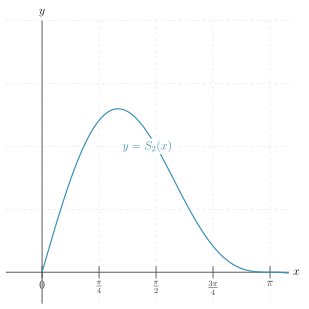
- Suppose \(S_n(x)\) has a stationary point at \(x_0\), then $$ therefore \begin{align*} &&0 &= S_n'(x_0) \\ &&&= \cos x_0 + \cos 2x_0 + \cdots + \cos n x_0 \\ &&&= \frac{\sin(n+\tfrac12)x_0 - \sin \tfrac12x_0}{2 \sin \tfrac12 x_0} \\ \Rightarrow &&\sin\tfrac12 x_0&= \sin nx_0 \cos \tfrac12 x_0 + \cos nx_0 \sin \tfrac12x_0 \\ \Rightarrow && \sin nx_0 &= (1-\cos nx_0)\tan \tfrac12 x_0 \end{align*} Therefore \(S_n(x_0) -S_{n-1}(x_0) = \tfrac1n \sin n x_0 = \tfrac1n \underbrace{(1-\cos nx_0)}_{\geq 0}\underbrace{\tan\tfrac12 x_0}_{\geq 0} \geq 0\). Therefore if \(S_{n-1}(x) > 0\) for all \(x\) on \(0 < x < \pi\) then since \(S_n(x) > S_{n-1}(x)\) at the turning points and since they agree at the end points, it must be larger at all points inbetween.
- Notice that \(S_1(x) = \sin x \geq 0\) for all \(x \in [0,1]\) and by our previous argument we can show \(S_n > S_{n-1}\) inside the interval and equal on the boundary we must have \(S_n(x) \geq 0\) for \(x \in [0, \pi]\)
2013 Paper 2 Q2
For \(n\ge 0\), let \[ I_n = \int_0^1 x^n(1-x)^n\d x\,. \]
- For \(n\ge 1\), show by means of a substitution that \[ \int_0^1 x^{n-1}(1-x)^n\d x = \int_0^1 x^n(1-x)^{n-1}\d x\, \] and deduce that \[ 2 \int_0^1 x^{n-1}(1-x)^n\d x = I_{n-1}\,. \] Show also, for \(n\ge1\), that \[ I_n = \frac n {n+1} \int_0^1 x^{n-1} (1-x)^{n+1} \d x \] and hence that \(I_n = \dfrac{n}{2(2n+1)} I_{n-1}\,.\)
- When \(n\) is a positive integer, show that \[ I_n = \frac{(n!)^2}{(2n+1)!}\,. \]
- Use the substitution \(x= \sin^2 \theta\) to show that \(I_{\frac12}= \frac \pi 8\), and evaluate \(I_{\frac32}\).
Solution:
- \(\,\) \begin{align*} u = 1-x, \d u = -\d x && \int_0^1 x^{n-1}(1-x)^n \d x &= \int_{u=1}^{u=0} (1-u)^{n-1}u^n (-1) \d u \\ &&&= \int_0^1 u^n (1-u)^{n-1} \d u \\ &&&= \int_0^1 x^n (1-x)^{n-1} \d x \\ \\ \Rightarrow && 2\int_0^1 x^{n-1}(1-x)^n \d x &= \int_0^1 \left ( x^{n-1}(1-x)^n + x^{n}(1-x)^{n-1} \right)\d x \\ &&&= \int_0^1x^{n-1}(1-x)^{n-1} \left ( (1-x) + x \right) \d x\\ &&&= I_{n-1} \\ \\ && I_n &= \left [x^n \cdot (-1)\frac{(1-x)^{n+1}}{n+1}\right]_0^1 + \int_0^1 n x^{n-1} \frac{(1-x)^{n+1}}{n+1} \d x\\ &&&= \frac{n}{n+1} \int_0^1 x^{n-1} (1-x)^{n+1} \d x \\ \\ && I_n &= \frac{n}{n+1} \int_0^1 x^{n-1} (1-x)^{n+1} \d x \\ &&&= \frac{n}{n+1} \int_0^1 \left ( x^{n-1} (1-x)^{n} - x^n(1-x)^n \right) \d x \\ &&&= \frac{n}{n+1} \left (\frac12 I_{n-1} - I_n \right) \\ \Rightarrow && I_n \cdot \left ( \frac{2n+1}{n+1} \right) &= \frac{n}{2(n+1)} I_{n-1}\\ \Rightarrow && I_n &= \frac{n}{2(2n+1)} I_{n-1} \end{align*}
- \(\,\) \begin{align*} && I_0 &= \int_0^1 1 \d x = 1 \\ \Rightarrow && I_1 &= \frac{1}{2 \cdot 3} \\ && I_n &= \frac{n}{2(2n+1)} \cdot \frac{n-1}{2(2n-1)}\cdot \frac{n-2}{2(2n-3)} \cdots \frac{1}{2 \cdot 3} \\ &&&= \frac{n!}{2^n (2n+1)(2n-1)(2n-3) \cdots 3} \\ &&&= \frac{n! (2n)(2n-2)\cdots 2}{2^n (2n+1)!} \\ &&&= \frac{(n!)^2 2^n}{2^n(2n+1)!} \\ &&&= \frac{(n!)^2}{(2n+1)^2} \end{align*}
- \(\,\) \begin{align*} && I_{\frac12} &= \int_0^1 \sqrt{x(1-x)} \d x\\ x = \sin^2 \theta, \d x = 2 \sin \theta \cos \theta \d \theta: &&&= \int_{\theta =0}^{\theta = \frac{\pi}{2}} \sin \theta \cos \theta 2 \sin \theta \cos \theta \d \theta \\ &&&= \frac12 \int_0^{\pi/2} \sin^2 2 \theta \d \theta \\ &&&= \frac12 \int_0^{\pi/2} \frac{1-\cos 2 \theta}{2} \d \theta \\ &&&= \frac14 \left [\theta - \frac12 \sin 2 \theta \right]_0^{\pi/2} \\ &&&= \frac{\pi}{8} \\ \\ && I_{\frac32} &= \frac{3/2}{2 \cdot ( 2 \cdot \frac32 + 1)} I_{\frac12} \\ &&&= \frac{3}{4 \cdot 4} \frac{\pi}{8} \\ &&&= \frac{3 \pi}{128} \end{align*}
2013 Paper 2 Q6
In this question, the following theorem may be used. Let \(u_1\), \(u_2\), \(\ldots\) be a sequence of (real) numbers. If the sequence is bounded above (that is, \(u_n\le b\) for all \(n\), where \(b\) is some fixed number) and increasing (that is, \(u_n \ge u_{n-1}\) for all \(n\)), then the sequence tends to a limit (that is, converges). The sequence \(u_1\), \(u_2\), \(\ldots\) is defined by \(u_1=1\) and \[ u_{n+1} = 1+\frac 1{u_n} \ \ \ \ \ \ \ \ \ \ (n\ge1)\,. \tag{\(*\)} \]
- Show that, for \(n\ge3\), \[ u_{n+2}-u_n = \frac{u_{n} - u_{n-2}}{(1+u_n)(1+u_{n-2})} . \]
- Prove, by induction or otherwise, that \(1\le u_n \le 2\) for all \(n\).
- Show that the sequence \(u_1\), \(u_3\), \(u_5\), \(\ldots\) tends to a limit, and that the sequence \(u_2\), \(u_4\), \(u_6\), \(\ldots\) tends to a limit. Find these limits and deduce that the sequence \(u_1\), \(u_2\), \(u_3\), \(\ldots\,\) tends to a limit. Would this conclusion change if the sequence were defined by \((*)\) and \(u_1=3\)?
Solution:
- \(\,\) \begin{align*} && u_{n+2} - u_n &= 1 + \frac{1}{u_{n+1}} - \left (1 + \frac{1}{u_{n-1}} \right) \\ &&&= \frac{1}{1 + \frac1{u_n}} - \frac{1}{1 + \frac{1}{u_{n-2}}} \\ &&&= \frac{u_n}{u_n+1} - \frac{u_{n-2}}{1+u_{n-2}} \\ &&&= \frac{u_n(1+u_{n-2}) - u_{n-2}(1+u_n)}{(1+u_n)(1+u_{n-2})} \\ &&&= \frac{u_n - u_{n-2}}{(1+u_n)(1+u_{n-2})} \end{align*}
- Claim: \(u_n \in [1,2]\) Proof: (By induction). Note that \(u_1 = 1, u_2 = 2\) so our claim is true for the first few terms. Note that if \(u_n \in [1,2]\), \(\frac{1}{u_n} \in [\tfrac12, 1]\) and \(1+\frac{1}{u_{n}} \in [\tfrac32,2] \subset [1,2]\). Therefore \(u_{n+1} \in [1,2]\). Therefore since \(u_1 \in [1,2]\) and \(u_n \in [1,2] \Rightarrow u_{n+1} \in [1,2]\) \(u_n \in [1,2]\) for all \(n \ge 1\)
- First notice that \(u_3 = \frac32 > u_1\) and therefore by the recursion we found in the first part, \(u_{2n+1}-u_{2n-1} > 0\) so \(u_{2k+1}\) is increasing and bounded, and so by our theorem converges to a limit. Suppose this limit is \(L\), then we must have \(L = 1 + \frac1{L} \Rightarrow L^2 - L - 1 = 0 \Rightarrow L = \frac{1+\sqrt5}{2}\) since it must be in \([1,2]\). Similarly, not that \(u_4 = \frac{5}{3} < u_2\) and so \(u_{2k+2} - u_{2k} < 0\) and \(-u_{2k}\) is increasing and bounded above. Therefore it tends to a limit (and so does \(u_{2k}\)). By the same reasoning as before, it's the same limit, \(\frac{1+\sqrt5}{2}\) and therefore the sequence converges. If \(u_1 = 3, u_2 = \frac43 \in [1,2]\) so we have our sequence being bounded and all the same logic will follow through.
2012 Paper 3 Q2
In this question, \(\vert x \vert <1\) and you may ignore issues of convergence.
- Simplify \[ (1-x)(1+x)(1+x^2)(1+x^4) \cdots (1+x^{2^n})\,, \] where \(n\) is a positive integer, and deduce that \[ \frac1{1-x} = (1+x)(1+x^2)(1+x^4) \cdots (1+x^{2^n}) + \frac {x^{2^{n+1}}}{1-x}\,. \] Deduce further that \[ \ln(1-x) = - \sum_{r=0}^\infty \ln \left (1+ x ^{2^r}\right) \,, \] and hence that \[ \frac1 {1-x} = \frac 1 {1+x} + \frac {2x}{1+x^2} + \frac {4x^3}{1+x^4} +\cdots\,. \]
- Show that \[ \frac{1+2x}{1+x+x^2} = \frac{1-2x}{1-x+x^2} + \frac{2x-4x^3}{1-x^2+x^4} + \frac {4x^3-8x^7}{1-x^4+x^8} + \cdots\,. \]
Solution:
- \begin{align*} (1-x)&(1+x)(1+x^2)(1+x^4) \cdots (1+x^{2^n}) \\ &= (1-x^2)(1+x^2)(1+x^4) \cdots (1+x^{2^n}) \\ &= (1-x^4)(1+x^4) \cdots (1+x^{2^n}) \\ &= 1-x^{2^{n+1}} \\ \end{align*} Therefore, \begin{align*} && \frac{1}{1-x} - \frac{x^{2^{n+1}}}{1-x} &= (1+x)(1+x^2)\cdots(1+x^{2^n}) \\ \Rightarrow && \frac{1}{1-x} &=(1+x)(1+x^2)\cdots(1+x^{2^n})+ \frac{x^{2^{n+1}}}{1-x} \\ \Rightarrow && -\ln (1-x) &= \sum_{r=0}^{\infty} \ln (1+x^{2^r}) \\ \Rightarrow && \ln(1-x) &= - \sum_{r=0}^{\infty} \ln (1+x^{2^r}) \\ \underbrace{\Rightarrow}_{\frac{\d}{\d x}} && \frac{1}{1-x} &= \sum_{r=0}^{\infty} \frac{2^r x^{2^r-1}}{1+x^{2^r}} \\ &&&= \frac{1}{1+x} + \frac{2x}{1+x^2} + \frac{4x^3}{1+x^4} + \cdots \end{align*}
- Consider \begin{align*}(1+x+x^2)&(1-x+x^2)(1-x^2+x^4)\cdots(1-x^{2^n}+x^{2^{n+1}}) \\ &= (1+x^2 + x^4)(1-x^2+x^4) \cdots (1-x^{2^n}+x^{2^{n+1}}) \\ &= (1-x^{2^{n+1}}+x^{2^{n+2}}) \\ \end{align*} Therefore, \begin{align*} && \frac{1}{1+x+x^2} &= (1-x+x^2)(1-x^2+x^4)\cdots(1-x^{2^n}+x^{2^{n+1}}) + \frac{x^{2^{n+1}}}{1+x+x^2} -\frac{x^{2^{n+2}}}{1+x+x^2} \\ \Rightarrow && -\ln(1+x+x^2) &= \sum_{r=0}^\infty \ln (1 - x^{2^r}+x^{2^{r+1}}) \\ \underbrace{\Rightarrow}_{\frac{\d}{\d x}} && -\frac{1+2x}{1+x+x^2} &= \sum_{r=0}^{\infty} \frac{ -2^r x^{2^r-1}+2^{r+1}x^{2^{r+1}-1}}{1 - x^{2^r}+x^{2^{r+1}}} \\ &&&= \frac{-1+2x}{1-x+x^2}+\frac{-2x+4x^3}{1-x^2+x^4} + \frac{-4x^3+8x^7}{1-x^4+x^8} + \cdots \end{align*} Which is the desired result when we multiply both sides by \(-1\)