Problems
Filters
137 problems found
2019 Paper 2 Q5
The sequence \(u_0, u_1, \ldots\) is said to be a constant sequence if \(u_n = u_{n+1}\) for \(n = 0, 1, 2, \ldots\). The sequence is said to be a sequence of period 2 if \(u_n = u_{n+2}\) for \(n = 0, 1, 2, \ldots\) and the sequence is not constant.
- A sequence of real numbers is defined by \(u_0 = a\) and \(u_{n+1} = f(u_n)\) for \(n = 0, 1, 2, \ldots\), where $$f(x) = p + (x - p)x,$$ and \(p\) is a given real number. Find the values of \(a\) for which the sequence is constant. Show that the sequence has period 2 for some value of \(a\) if and only if \(p > 3\) or \(p < -1\).
- A sequence of real numbers is defined by \(u_0 = a\) and \(u_{n+1} = f(u_n)\) for \(n = 0, 1, 2, \ldots\), where $$f(x) = q + (x - p)x,$$ and \(p\) and \(q\) are given real numbers. Show that there is no value of \(a\) for which the sequence is constant if and only if \(f(x) > x\) for all \(x\). Deduce that, if there is no value of \(a\) for which the sequence is constant, then there is no value of \(a\) for which the sequence has period 2. Is it true that, if there is no value of \(a\) for which the sequence has period 2, then there is no value of \(a\) for which the sequence is constant?
Solution:
- If \(f(a) = a\) then the sequence is constant, ie \(a = p+a^2-pa \Rightarrow 0 = (a-p)(a-1)\). Therefore \(a = 1, p\) If there sequence has period \(2\) then there must be a solution to \(f(f(x)) = x\), ie \begin{align*} && x &= p+(f(x)-p)f(x) \\ &&&= p+(p+(x-p)x-p)(p+(x-p)x) \\ &&&= p + (x-p)x(p+(x-p)x) \\ &&&= p+(x^2-px)(x^2-px+p) \\ \Rightarrow && 0 &= x^4-2px^3+(p+p^2)x^2-(p^2+1)x+p \\ &&&= (x-1)(x-p)(x^2-(p-1)x+1) \end{align*} The first two roots (\(x = 1, p\)) are constant sequences, so we need the second quadratic to have a root, ie \((p-1)^2-4 \geq 0 \Rightarrow p \geq 3 , p \leq -1\). We also need this root not to be \(1\) or \(p\), ie \(1-(p-1)+1 = 3-p \neq 0\) and \(p^2-(p-1)p + 1 = 1+p \neq 0\) so \(p \neq -1, 3\). Therefore \(p > 3\) or \(p < -1\).
- There exists a constant sequence iff there is a solution to \(f(x) = x\), ie \begin{align*} && x &= f(x) \\ &&&= q + (x-p)x \\ \Leftrightarrow && 0 &= x^2-(p+1)x + q \tag{has a solution} \\ \end{align*} But if it doesn't have a solution, clearly the RHS is always larger, and if it does have a solution then there is some point where the inequality doesn't hold. Suppose \(f(x) > x\) for all \(x\) then \(f(f(x)) > f(x) > x\) therefore there is no value where \(f(f(x)) = x\) which is required for any sequence of period 2. No, consider \(p = q = 0\) so \(f(x) = x^2\) then there cannot be a period \(2\) sequence by the first part, but also clearly \(u_n = 1\) is a valid constant sequence.
2019 Paper 2 Q8
The domain of the function f is the set of all \(2 \times 2\) matrices and its range is the set of real numbers. Thus, if \(M\) is a \(2 \times 2\) matrix, then \(f(M) \in \mathbb{R}\). The function f has the property that \(f(MN) = f(M)f(N)\) for any \(2 \times 2\) matrices \(M\) and \(N\).
- You are given that there is a matrix \(M\) such that \(f(M) \neq 0\). Let \(I\) be the \(2 \times 2\) identity matrix. By considering \(f(MI)\), show that \(f(I) = 1\).
- Let \(J = \begin{pmatrix} 0 & 1 \\ 1 & 0 \end{pmatrix}\). You are given that \(f(J) \neq 1\). By considering \(J^2\), evaluate \(f(J)\). Using \(J\), show that, for any real numbers \(a\), \(b\), \(c\) and \(d\), $$.f\left(\begin{pmatrix} a & b \\ c & d \end{pmatrix}\right) = -f\left(\begin{pmatrix} c & d \\ a & b \end{pmatrix}\right) = f\left(\begin{pmatrix} d & c \\ b & a \end{pmatrix}\right)$$
- Let \(K = \begin{pmatrix} 1 & 0 \\ 0 & k \end{pmatrix}\) where \(k \in \mathbb{R}\). Use \(K\) to show that, if the second row of the matrix \(A\) is a multiple of the first row, then \(f(A) = 0\).
- Let \(P = \begin{pmatrix} 1 & 1 \\ 0 & 1 \end{pmatrix}\). By considering the matrices \(P^2\), \(P^{-1}\), and \(K^{-1}PK\) for suitable values of \(k\), evaluate \(f(P)\).
Solution:
- Consider \(f(M) = f(MI) = f(M)f(I)\). Since \(f(M) \neq 0\) we can divide by \(f(M)\) to obtain \(f(I) = 1\)
- Let \(J = \begin{pmatrix} 0 & 1 \\ 1 & 0 \end{pmatrix}\), then \(J^2 = \begin{pmatrix} 1 & 0 \\ 0 & 1 \end{pmatrix} = I\). Therefore \(1 = f(I) = f(J^2) = f(J)f(J) \Rightarrow f(J) = \pm 1 \Rightarrow f(J) = -1\) since \(f(J) \neq 1\). \begin{align*} \begin{pmatrix} a & b \\ c & d \end{pmatrix}J &= \begin{pmatrix} a & b \\ c & d \end{pmatrix}\begin{pmatrix} 0 & 1 \\ 1 & 0 \end{pmatrix} \\ &= \begin{pmatrix} b & a \\ d & c \end{pmatrix} \\ J\begin{pmatrix} a & b \\ c & d \end{pmatrix} &= \begin{pmatrix} 0 & 1 \\ 1 & 0 \end{pmatrix}\begin{pmatrix} a & b \\ c & d \end{pmatrix} \\ &= \begin{pmatrix} c & d \\ a & b \end{pmatrix} \\ J\begin{pmatrix} a & b \\ c & d \end{pmatrix}J &=\begin{pmatrix} d & c \\ b & a \end{pmatrix} \end{align*} Therefore \(f\left(\begin{pmatrix} c & d \\ a & b \end{pmatrix}\right) = f \left (J\begin{pmatrix} a & b \\ c & d \end{pmatrix} \right) = f(J) f\left(\begin{pmatrix} a & b \\ c & d \end{pmatrix}\right) = -f\left(\begin{pmatrix} a & b \\ c & d \end{pmatrix}\right)\) and \(f\left(\begin{pmatrix} d & c \\ b & a \end{pmatrix}\right) = f\left(J\begin{pmatrix} a & b \\ c & d \end{pmatrix}J \right) = f(J)f\left(\begin{pmatrix} a & b \\ c & d \end{pmatrix}\right)f(J) = f\left(\begin{pmatrix} a & b \\ c & d \end{pmatrix}\right)\) as required.
- First consider \(O\) the matrix of \(0\), then \begin{align*} && JO &= O \\ \Rightarrow && f(JO) &= f(O) \\ \Rightarrow && f(J)f(O) &= f(O) \\ \Rightarrow && -f(O) &= f(O) \\ \Rightarrow && f(O) &= 0 \end{align*} Now consider \(K_{k} = \begin{pmatrix} 1 & 0 \\ 0 & k \end{pmatrix}\). Suppose \(A = \begin{pmatrix} a & b \\ ka & kb \end{pmatrix}\) then \begin{align*} K_{\frac1k}A &= \begin{pmatrix} 1 & 0 \\ 0 & \frac1k \end{pmatrix} \begin{pmatrix} a & b \\ ka & kb \end{pmatrix} \\ &= \begin{pmatrix} a & b \\ a & b \end{pmatrix} \end{align*} And so \(f(K_{\frac1k}A) = f\left ( \begin{pmatrix} a & b \\ a & b \end{pmatrix} \right) = - f \left ( \begin{pmatrix} a & b \\ a & b \end{pmatrix} \right) = 0\), therefore either \(f(K_{\frac1k}) = 0\) or \(f(A) = 0\), but we know that \(f(I) \neq 0\) therefore \(f(A) = 0\).
- Let \(P = \begin{pmatrix} 1 & 1 \\ 0 & 1 \end{pmatrix}\), then \(P^2 = \begin{pmatrix} 1 &2 \\ 0 & 1 \end{pmatrix}\), \(P^{-1} = \begin{pmatrix} 1 & -1 \\ 0 & 1 \end{pmatrix}\), \(K_k^{-1}PK_k = K_k^{-1}\begin{pmatrix} 1 & k \\ 0 & k \end{pmatrix} = \begin{pmatrix} 1 & k \\ 0 & 1 \end{pmatrix}\). If \(A\) has an inverse then \(f(A) \neq 0\) since \(1 = f(I) = f(A)f(A^{-1})\), in particular, \(f(A)f(A^{-1}) = 1\). Using this for \(K_2\) we have: \(f(P)^2 = f(P^2) = f(K_2^{-1}PK_2) = f(P)\) therefore \(f(P) = 0, 1\), but since \(f(P)\) has an inverse, \(f(P) \neq 0\) so \(f(P) = 1\)
2018 Paper 1 Q2
If \(x=\log_bc\,\), express \(c\) in terms of \(b\) and \(x\) and prove that $ \dfrac{\log_a c}{\log_a b} = \ds \log_b c \,$.
- Given that \(\pi^2 < 10\,\), prove that \[ \frac{1}{\log_2 \pi}+\frac{1}{\log_5 \pi} > 2\,. \]
- Given that \(\ds \log_2 \frac{\pi}{\e} > \frac{1}{5}\) and that \(\e^2 < 8\), prove that \(\ln \pi > \frac{17}{15}\,\).
- Given that \(\e^3 >20\), \, \(\pi^2 < 10\,\) and \(\log_{10}2 >\frac{3}{10}\,\), prove that \(\ln \pi < \frac{15}{13}\,\).
Solution: \(x = \log_bc\) means that \(b^x = c\) Therefore, we can write \(\frac{\log_ac}{\log_ab} = \frac{\log_ab^{x}}{\log_ab} = \frac{x \log_ab}{\log_ab} = x = \log_bc\), giving us the change of base rule. Rearranging the chance of base rule, we get \(\frac{1}{\log_bc} = \frac{\log_ab}{\log_ac}\)
- Since \(\pi^2 < 10\), we have \begin{align*} \Leftrightarrow && \pi^2 &< 10 \\ \Leftrightarrow && 2\log_{10} \pi &< 1 \\ \Leftrightarrow && 2 &< \frac{1}{\log_{10} \pi} \\ \Leftrightarrow && 2 &< \frac{\log_{10} 2 + \log_{10} 5}{\log_{10} \pi} \\ \Leftrightarrow && 2 &< \frac{\log_{10} 2}{\log_{10} \pi} + \frac{\log_{10} 5}{\log_{10} \pi} \\ \Leftrightarrow && 2 &< \frac1{\log_2\pi}+ \frac1{\log_5\pi} \\ \end{align*}
- Since \(e^2 < 8 \Rightarrow 2 < 3 \ln 2 \Rightarrow \ln 2 > \frac23\) \begin{align*} && \log_2 \frac{\pi}{e} &= \frac{\ln \frac{\pi}{e}}{\ln 2} \\ &&&= \frac{\ln \frac{\pi}{e}}{\ln 2} \\ &&&< \frac{3(\ln \pi - 1)}{2} \\ \Rightarrow && \frac{1}{5} &< \frac{3 \ln \pi - 1}{2} \\ \Rightarrow && \frac{2}{15} + 1 = \frac{17}{15}&< \ln \pi \end{align*}
- From the inequalities given we can set up two linear inequalities in \(\ln 2\) and \(\ln 5\) \begin{align*} && 20 &< e^3 \\ \Rightarrow && 2\ln 2 + \ln 5 &< 3 \tag{*}\\ \\ && \frac{3}{10} &< \log_{10} 2 \\ \Rightarrow && \frac{3}{10} &< \frac{\ln 2}{\ln 10} \\ \Rightarrow && 3 \ln 2 + 3 \ln 5 &< 10 \ln 2 \\ \Rightarrow && -7 \ln 2 + 3 \ln 5 &< 0 \tag{**}\\ \\ \\ && \pi^2 & < 10 \\ \Rightarrow && 2 \ln \pi &< \ln 2 + \ln 5 \tag{***}\\ \end{align*} It would be nice to combine \((*)\) and \((**)\) to bound \(\ln 2+ \ln 5\), so we want to use a linear combination such that \begin{align*} && \begin{cases} 2x -7y &= 1 \\ x + 3y &= 1\end{cases} \\ \Rightarrow && \begin{cases} y &= \frac1{13} \\ x &= \frac{10}{13}\end{cases} \\ \\ \Rightarrow && \ln 2 + \ln 5 < \frac{30}{13} + 0 \\ \Rightarrow && \ln \pi < \frac{15}{13} \end{align*}
2018 Paper 1 Q8
The functions \(\s\) and \(\c\) satisfy \(\s(0)= 0\,\), \(\c(0)=1\,\) and \[ \s'(x) = \c(x)^2 ,\] \[ \c'(x)=-\s(x)^2. \] You may assume that \(\s\) and \(\c\) are uniquely defined by these conditions.
- Show that \(\s(x)^3+\c(x)^3\) is constant, and deduce that \(\s(x)^3+\c(x)^3=1\,\).
- Show that \[ \frac{\d }{\d x} \, \Big( \s(x) \c(x) \Big) = 2\c(x)^3-1 \] and find (and simplify) an expression in terms of \(\c(x)\) for $\dfrac{\d }{\d x} \left( \dfrac{\s(x)}{\c(x)} \right) $.
- Find the integrals \[ \int \s(x)^2 \, \d x \ \ \ \ \ \ \text{and} \ \ \ \ \ \ \int \s(x)^5 \, \d x \,. \]
- Given that \(\s\) has an inverse function, \(\s^{-1}\), use the substitution \(u = \s(x)\) to show that \[ \int \frac{1}{(1-u^3)^{\frac{2}{3}}} \, \d u = \s^{-1}(u) \, + \text{constant}. \]
- Find, in terms of \(u\), the integrals \[ \int \frac{1}{{(1-u^3)}^{\frac{4}{3}}} \, \d u \ \ \ \ \ \ \text{and} \ \ \ \ \ \ \int {(1-u^3)}^{\frac{1}{3}} \, \d u \,. \]
Solution: \begin{questionparts} \item \begin{align*} && \dfrac{\d }{\d x} \left( \s(x)^3 + \c(x)^3 \right) &= 3\s(x)^2\s'(x) + 3\c(x)^2 \c'(x) \\ &&&= 3\s(x)^2\c(x)^2 - 3\c(x)^2\s(x)^2 \\ &&&= 0 \\ \\ \Rightarrow && \s(x)^3 + \c(x)^3 &= \text{constant} \\ &&&= \s(0)^3 + \c(0)^3 \\ &&&= 1 \end{align*} \item \begin{align*} \frac{\d }{\d x} \, \Big( \s(x) \c(x) \Big) &= \s'(x) \c(x) + \s(x)\c'(x) \\ &= \c(x)^3 - \s(x)^3 \\ &= \c(x)^3 - (1-\c(x)^3) \\ &= 2\c(x)^3 - 1 \\ \\ \dfrac{\d }{\d x} \left( \dfrac{\s(x)}{\c(x)} \right) &= \frac{\s'(x)\c(x) - \s(x)\c'(x)}{\c(x)^2} \\ &= \frac{\c(x)^3 + \s(x)^3}{\c(x)^2} \\ &= \frac{1}{\c(x)^2} \\ \end{align*} \item \begin{align*} \int \s(x)^2 \d x &= -\int -\s(x)^2 \d x \\ &= -\int \c'(x) \d x \\ &= - \s(x) +C \\ \\ \int \s(x)^5 \, \d x &= \int \s(x)^2 \s(x)^3 \d x \\ &= \int \s(x)^2 (1 - \c(x)^3) \d x \\ &= -\int \c'(x) (1 - \c(x)^3) \d x \\ &= - c(x) + \frac{\c(x)^4}{4} + C \end{align*} \item If \(u = \s(x), \frac{\d u}{\d x} = \c(x)^2\) \begin{align*} \int \frac{1}{(1-u^3)^{\frac{2}{3}}} \, \d u &= \int \frac{1}{(1-\s(x)^3)^{\frac{2}{3}}} \c(x)^2 \d x \\ &= \int 1 \d x \\ &= x + C \\ &= \s^{-1}(u) + C \\ \\ \int \frac{1}{{(1-u^3)^{\frac{4}{3}}}} \d u &= \int \frac1{(1-\s(x)^3)^{\frac43} }\c(x)^2 \d x \\ &= \int \frac1{(\c(x)^3)^{\frac43}} \c(x)^2 \d x \\ &= \int \frac1{\c(x)^2} \d x \\ &= \frac{\s(x)}{\c(x)} + C \\ &= \frac{u}{(1-u^3)^{\frac13}} + C \\ \end{align*} \begin{align*} && \int {(1-u^3)}^{\frac{1}{3}} \, \d u &= \int (1-s(x)^3)^{\frac13} c(x)^2 \d x \\ &&&= \int \c(x)^3 \d x = I\\ &&&= \int \c(x) s'(x) \d x \\ &&&= \left [\c(x) \s(x) \right] + \int \s(x)^2 s(x) \d x \\ &&&= \c(x) \s(x) + \int (1 - \c(x)^3) \d x + C \\ &&&= \c(x) \s(x) + x - I + C \\ \Rightarrow && I &= \frac{x + \c(x) \s(x)}{2} + k \\ \Rightarrow && &= \frac12 \l \s^{-1}(u) + u \sqrt[3](1-u^3)\r + k \end{align*}
2018 Paper 2 Q6
- Find all pairs of positive integers \((n,p)\), where \(p\) is a prime number, that satisfy \[ n!+ 5 =p \,. \]
- In this part of the question you may use the following two theorems:
- For \(n\ge 7\), \(1! \times 3! \times \cdots \times (2n-1)! > (4n)!\,\).
- For every positive integer \(n\), there is a prime number between \(2n\) and \(4n\).
Solution:
- Let \(n! + 5 = p\). If \(n \geq 5\) then \(5\) divides the LHS and so must also divide the RHS. Since \(n!+5 > 5\) this means the RHS cannot be prime. Therefore consider \(n = 1, 2, 3, 4\). \begin{align*} n = 1: && 1! + 5 = 6 &&\text{ nope} \\ n=2: && 2! + 5 = 7 && \checkmark \\ n=3: && 3! + 5 = 11 && \checkmark \\ n=4: && 4! + 5 = 29 && \checkmark \end{align*} Therefore the solutions are \((2,7), (3,11), (4,29)\).
- Suppose \(1! \times 3! \times \cdots \times (2n-1)! = m!\). If \(n \geq 7\) then \(m! > (4n)!\) (by the first theorem) in particular \(m > 4n\). Therefore (by the second theorem) the RHS is divisible by some prime which cannot divide the LHS. Therefore consider \(n = 1,2,3,4,5,6\) \begin{align*} n = 1: && 1! = 1 = 1! && \checkmark \\ n = 2: && 1! \times 3! = 6 = 3! && \checkmark \\ n = 3: && 1! \times 3! \times 5! = 6! && \checkmark \\ n = 4: && 1! \times 3! \times 5! \times 7! = 6! \times 7! = 10! && \checkmark \\ n = 5: && 1! \times 3! \times 5! \times 7! \times 9! = 10! 9! > 11! && \text{would need a factor of } 11\text{ so no} \\ n = 6: && 1! \times 3! \times 5! \times 7! \times 9! \times 11! = 10! 11! 9! > 13! && \text{would need a factor of } 13\text{ so no} \\ \end{align*} Therefore all solutions are \((1,1), (2,3), (3,6), (4,10)\)
2018 Paper 3 Q7
- Use De Moivre's theorem to show that, if \(\sin\theta\ne0\)\,, then \[ \frac{ \left(\cot \theta + \rm{i}\right)^{2n+1} -\left(\cot \theta - \rm{i}\right)^{2n+1}}{2\rm{i}} = \frac{\sin \left(2n+1\right)\theta} {\sin^{2n+1}\theta} \,, \] for any positive integer \(n\). Deduce that the solutions of the equation \[ \binom{2n+1}{1}x^{n}-\binom{2n+1}{3}x^{n-1} +\cdots + \left(-1\right)^{n}=0 \] are \[x=\cot^{2}\left(\frac{m\pi}{2n+1}\right) \] where \( m=1\), \(2\), \(\ldots\) , \(n\,\).
- Hence show that \[ \sum_{m=1}^n \cot^{2}\left(\frac{m\pi}{2n+1}\right) =\frac{n\left(2n-1\right)}{3}. \]
- Given that \(0<\sin \theta <\theta <\tan \theta\) for \(0 < \theta < \frac{1}{2}\pi\), show that \[ \cot^{2}\theta<\frac{1}{\theta^{2}}<1+\cot^{2}\theta. \] Hence show that \[ \sum^\infty_{m=1} \frac{1}{m^2}= \frac{\pi^2}{6}\,.\]
Solution:
- \begin{align*} \frac{\left(\cot \theta + i\right)^{2n+1} -\left(\cot \theta - i\right)^{2n+1}}{2i} &= \frac{1}{\sin^{2n+1} \theta}\frac{\left(\cos \theta + i \sin \theta \right)^{2n+1} -\left(\cos\theta - i\sin \theta\right)^{2n+1}}{2i} \\ &= \frac{1}{\sin^{2n+1} \theta} \frac{e^{i(2n+1) \theta} - e^{-i(2n+1) \theta} }{2i} \\ &=\frac{\sin (2n+1) \theta}{\sin^{2n+1} \theta} \end{align*} Notice that: \begin{align*} (\cot \theta + i)^{2n+1} - (\cot \theta - i)^{2n+1} &= \sum_{k=0}^{2n+1} \binom{2n+1}{k}(i)^k \cdot \cot^{2n+1-k} \theta - \sum_{k=0}^{2n+1} \binom{2n+1}{k}(-i)^k \cdot \cot^{2n+1-k} \theta \\ &= \sum_{k=0}^{2n+1} \binom{2n+1}{k} \l i^k - (-i)^k \r \cdot \cot^{2n+1-k} \theta \\ &= \sum_{l=0}^{n} \binom{2n+1}{2l+1} \l i^{2l+1} - (-i)^{2l+1} \r \cdot \cot^{2n+1-(2l+1)} \theta \\ &= \sum_{l=0}^{n} \binom{2n+1}{2l+1} 2i \cdot \cot^{2(n-l)} \theta \\ &= 2i\sum_{l=0}^{n} \binom{2n+1}{2l+1} \cot^{2(n-l)} \theta \\ \end{align*} Therefore if \(\theta\) satisfies \(\frac{\sin (2n+1) \theta}{\sin^{2n+1} \theta} = 0\) then \(z = \cot^2 \theta\) satisfies the equation. But \(\theta = \frac{m \pi}{2n+1}, m = 1, 2, \ldots, n\) are \(n\) distinct all the roots must be \(\cot^2 \frac{m \pi}{2n+1}\).
- Notice that the sum of the roots will be \(\displaystyle \frac{\binom{2n+1}{3}}{\binom{2n+1}{1}} = \frac{(2n+1)\cdot 2n \cdot (2n-1)}{3! \cdot (2n+1)} = \frac{n \cdot (2n-1)}{3}\) and so \[ \sum_{m=1}^n \cot^{2}\left(\frac{m\pi}{2n+1}\right) =\frac{n\left(2n-1\right)}{3}. \]
- For \(0 < \theta < \frac{1}{2}\pi\), \begin{align*} && 0 < \sin \theta < \theta < \tan \theta \\ \Leftrightarrow && 0 < \cot \theta < \frac{1}{\theta} < \frac{1}{\sin \theta} \\ \Leftrightarrow && 0 < \cot^2 \theta < \frac{1}{\theta^2} < \cosec^2 \theta = 1 + \cot^2 \theta\\ \end{align*} Therefore \begin{align*} && \sum_{n=1}^N \cot^2 \frac{n \pi}{2N+1} < \sum_{n=1}^N \frac{(2N+1)^2}{n^2 \pi^2} < N + \sum_{n=1}^N \cot^2 \frac{n \pi}{2N+1} \\ \Rightarrow && \frac{1}{(2N+1)^2} \frac{N(2N-1)}{3} < \sum_{n=1}^N \frac{1}{n^2 \pi^2} < \frac{1}{(2N+1)^2} \l \frac{N(2N-1)}{3} + 1 \r \\ \Rightarrow && \lim_{N \to \infty}\frac{1}{(2N+1)^2} \frac{N(2N-1)}{3} < \lim_{N \to \infty}\sum_{n=1}^N \frac{1}{n^2 \pi^2} < \lim_{N \to \infty}\frac{1}{(2N+1)^2} \l \frac{N(2N-1)}{3} + 1 \r \\ \Rightarrow && \frac{1}{6} \leq \lim_{N \to \infty}\sum_{n=1}^N \frac{1}{n^2 \pi^2} \leq \frac16 \\ \Rightarrow && \sum_{n=1}^N \frac{1}{n^2} = \frac{\pi^2}{6} \end{align*}
2017 Paper 1 Q7
The triangle \(ABC\) has side lengths \(\left| BC \right| = a\), \(\left| CA \right| = b\) and \(\left| AB \right| = c\). Equilateral triangles \(BXC\), \(CYA\) and \(AZB\) are erected on the sides of the triangle \(ABC\), with \(X\) on the other side of \(BC\) from \(A\), and similarly for \(Y\) and \(Z\). Points \(L\), \(M\) and \(N\) are the centres of rotational symmetry of triangles \(BXC\), \(CY\!A\) and \(AZB\) respectively.
- Show that \(| CM| = \dfrac {\ b} {\sqrt3} \,\) and write down the corresponding expression for \(| CL|\).
- Use the cosine rule to show that \[ 6 \left| LM \right|^2 = a^2+b^2+c^2 + 4\sqrt3 \, \Delta \,, \] where \(\Delta\) is the area of triangle \(ABC\). Deduce that \(LMN\) is an equilateral triangle. Show further that the areas of triangles \(LMN\) and \(ABC\) are equal if and only if \[ a^2+b^2 +c^2 = 4\sqrt3 \, \Delta \,. \]
- Show that the conditions \[ (a -b)^2 = -2ab \big( 1 -\cos(C-60^\circ)\big) \,\] and \[ a^2+b^2 +c^2 = 4\sqrt3 \, \Delta \] are equivalent. Deduce that the areas of triangles \(LMN\) and \(ABC\) are equal if and only if \(ABC\) is equilateral.
Solution:
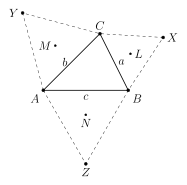
- Consider the equilateral triangle \(CYA\), notice that \(YM\) is a vertical line of symmetry, and \(\angle ACM = 30^\circ\) therefore \(\frac{AC/2}{CM} = \cos 30^\circ \Rightarrow |CM| = \frac{b}{2} \cdot \frac{2}{\sqrt{3}} = \frac{b}{\sqrt{3}}\). Similarly \(|CL| = \frac{a}{\sqrt{3}}\)
- \(\,\) \begin{align*} && |LM|^2 &= |CM|^2 + |CL|^2 - 2 \cdot |CM| \cdot |CL| \cdot \cos \angle MCL \\ &&&= \frac{b^2}{3} + \frac{a^2}{3} - 2 \frac{ab}{3} \cos \left (\angle CMA + \angle CAB + \angle BCL \right) \\ &&&= \frac13 \left (b^2 + a^2 - 2ab \cos \left ( \frac{\pi}{3} + \angle CAB \right) \right) \\ &&&= \frac13 \left (b^2 + a^2 - ab \cos \left ( \angle CAB \right) + \sqrt{3}ab \sin \angle CAB \right) \\ &&&= \frac13 \left (b^2 + a^2 - ab \cos \angle CAB + 2\sqrt{3} \Delta\right) \\ &&&= \frac13 \left (b^2 + a^2 - ab \left (\frac{a^2+b^2-c^2}{2ab} \right) + 2\sqrt{3} \Delta\right) \\ &&&= \frac13 \left ( \frac12(a^2+b^2+c^2) + 2\sqrt{3}\Delta \right) \\ \Rightarrow && 6|LM|^2 &= a^2 + b^2 + c^2 + 4\sqrt{3} \Delta \end{align*} However, nothing in our reasoning here was special about \(LM\), therefore \(LN\) and \(MN\) also equal this value, and we find that the triangle is equilateral. The area of equilateral triangle [LMN] is \(\frac{\sqrt{3}}4 |LM|^2\), ie \begin{align*} &&& \text{areas are equal} \\ \Leftrightarrow && \Delta &= \frac{\sqrt{3}}4 |LM|^2 \\ &&&= \frac{\sqrt{3}}4 \frac{a^2+b^2+c^2+4\sqrt{3}\Delta}{6} \\ &&&= \frac{\sqrt{3}}{24} (a^2+b^2+c^2) + \frac12 \Delta \\ \Leftrightarrow && \Delta &= \frac{\sqrt{3}}{12}(a^2+b^2+c^2)\\ \Leftrightarrow && 4\sqrt{3}\Delta &=a^2+b^2+c^2\\ \end{align*}
- \(\,\) \begin{align*} && (a-b)^2 &= -2ab(1 - \cos(C - 60^{\circ})) \\ \Leftrightarrow && a^2+b^2 - 2ab &=-2ab + 2ab \cos(C - 60^{\circ}) \\ \Leftrightarrow && a^2+b^2 &= ab \cos C+\sqrt{3}ab\sin C \\ \Leftrightarrow && a^2+b^2 &= ab \frac{a^2+b^2-c^2}{2ab} + 2\sqrt{3} \Delta \\ \Leftrightarrow && a^2+b^2+c^2 &= 4\sqrt{3}\Delta \end{align*} Since the LHS is non-positive, and the RHS is positive, the only way they can be equal is if they are both \(0\), ie \(a=b\) and \(C = 60^{\circ}\) ie \(ABC\) is equilateral.
2017 Paper 2 Q2
The sequence of numbers \(x_0\), \(x_1\), \(x_2\), \(\ldots\) satisfies \[ x_{n+1} = \frac{ax_n-1}{x_n+b} \,. \] (You may assume that \(a\), \(b\) and \(x_0\) are such that \(x_n+b\ne0\,\).) Find an expression for \(x_{n+2}\) in terms of \(a\), \(b\) and \(x_n\).
- Show that \(a+b=0\) is a necessary condition for the sequence to be periodic with period 2. Note: The sequence is said to be periodic with period \(k\) if \(x_{n+k} = x_n\) for all \(n\), and there is no integer \(m\) with \(0 < m < k\) such that \(x_{n+m} = x_n\) for all \(n\).
- Find necessary and sufficient conditions for the sequence to have period 4.
Solution: \begin{align*} x_{n+2} &= \frac{ax_{n+1}-1}{x_{n+1}+b} \\ &= \frac{a \frac{ax_n - 1}{x_n+b}-1}{\frac{ax_n - 1}{x_n+b}+b} \\ &= \frac{a(ax_n-1)-(x_n+b)}{ax_n-1+b(x_n+b)} \\ &= \frac{(a^2-1)x_n-(a+b)}{(a+b)x_n+b^2-1} \end{align*}
- If \(x_{n+2} = x_n\) then \begin{align*} && x_n &= \frac{(a^2-1)x_n-(a+b)}{(a+b)x_n+b^2-1} \\ \Rightarrow && 0 &=(a+b)x_n^2+(b^2-a^2)x_n+(a+b) \\ &&&= (a+b)(x_n^2+(a-b)x_n + 1) \end{align*} If \(x_{n+1} = x_n\) then \(x_n^2+(a-b)x_n + 1\) and since our sequence has period \(2\) rather than \(1\) it must be the case this is non-zero. Therefore \(a+b =0\).
- \begin{align*} x_{n+4} &= \frac{(a^2-1)x_{n+2}-(a+b)}{(a+b)x_{n+2}+b^2-1} \\ &= \frac{(a^2-1)\frac{(a^2-1)x_{n}-(a+b)}{(a+b)x_{n}+b^2-1} -(a+b)}{(a+b)\frac{(a^2-1)x_{n}-(a+b)}{(a+b)x_{n}+b^2-1} +b^2-1} \\ &= \frac{((a^2-1)^2-(a+b)^2)x_n -(a^2+b^2-2)(a+b)}{(a^2+b^2-2)(a+b)x_n + (b^2-1)^2-(a+b)^2} \end{align*} If \(x_{n+4} = x_n\) then \begin{align*} x_n &=\frac{((a^2-1)^2-(a+b)^2)x_n -(a^2+b^2-2)(a+b)}{(a^2+b^2-2)(a+b)x_n + (b^2-1)^2-(a+b)^2} \\ 0 &= (a^2+b^2-2)(a+b)x_n^2 + \l (b^2-1)^2-(a^2-1)^2 \r x_n+(a^2+b^2-2)(a+b) \\ &= (a^2+b^2-2)(a+b)x_n^2+(b^2-a^2)(a^2+b^2-2)x_n + (a^2+b^2-2)(a+b) \\ &= (a^2+b^2-2)(a+b)(x_n^2+(b-a)x_n + 1) \end{align*} Since we do not want \(x_n\) to be periodic with period \(1\) we must have the quadratic in \(x_n\) \(\neq 0\). If \(a+b = 0\) then \(x_n\) is periodic with period \(2\) since \(x_{n+2} = \frac{(a^2-1)x_n}{((-a)^2-1)} = x_n\). Therefore it is necessary that \(a^2+b^2-2 = 0\). If \(a^2+b^2-2= 0\) then \begin{align*} x_{n+4} &= \frac{((a^2-1)^2-(a+b)^2)x_n}{(b^2-1)^2-(a+b)^2} \\ &=\frac{((a^2-1)^2-(a+b)^2)x_n}{((2-a^2)-1)^2-(a+b)^2} \\ &=\frac{((a^2-1)^2-(a+b)^2)x_n}{((1-a^2)^2-(a+b)^2} \\ &= x_n \end{align*} Therefore it is sufficient too. So our conditions are \(a+b \neq 0, \, \, x_n^2+(a-b)x_n + 1 \neq 0\) and \(a^2+b^2-2 = 0\)
2017 Paper 2 Q4
The Schwarz inequality is \[ \left( \int_a^b \f(x)\, \g(x)\,\d x\right)^{\!\!2} \le \left( \int_a^b \big( \f(x)\big)^2 \d x \right) \left( \int_a^b \big( \g(x)\big)^2 \d x \right) . \tag{\(*\)} \]
- By setting \( \f(x)=1\) in \((*)\), and choosing \(\g(x)\), \(a\) and \(b\) suitably, show that for \(t> 0\,\), \[ \frac {\e^t -1}{\e^t+1} \le \frac t 2 \,. \]
- By setting \( \f(x)= x\) in \((*)\), and choosing \( \g(x)\) suitably, show that \[ \int_0^1\e^{-\frac12 x^2}\d x \ge 12 \big(1-\e^{-\frac14})^2 \,. \]
- Use \((*)\) to show that \[ \frac {64}{25\pi} \le \int_0^{\frac12\pi} \!\! {\textstyle \sqrt{\, \sin x\, } } \, \d x \le \sqrt{\frac \pi 2 } \,. \]
Solution:
- Let \(f(x) = 1, g(x) = e^x, a = 0, b = t\), so \begin{align*} && \left ( \int_0^t e^x \d x \right)^2 &\leq \left (\int_0^t 1^2 \d x \right) \cdot \left (\int_0^t (e^x)^2 \d x \right) \\ \Rightarrow && (e^t-1)^2 &\leq t \cdot (\frac12e^{2t} - \frac12) \\ \Rightarrow && \frac{e^t-1}{e^t+1} & \leq \frac{t}{2} \end{align*}
- Let \(f(x) = x, g(x) = e^{-\frac14 x^2}, a = 0, b = 1\) \begin{align*} && \left ( \int_0^1 xe^{-\frac14 x^2} \d x \right)^2 &\leq \left (\int_0^1 x^2 \d x \right) \cdot \left (\int_0^1 (e^{-\frac14x^2})^2 \d x \right) \\ \Rightarrow && \left ( \left [-2e^{-\frac14x^2} \right]_0^1 \right)^2 & \leq \frac{1}{3} \int_0^1 e^{-\frac12 x^2} \d x \\ \Rightarrow && \int_0^1 e^{-\frac12 x^2} \d x & \geq 12(1-e^{-\frac14})^2 \end{align*}
- Let \(f(x) = 1, g(x) = \sqrt{\sin x}, a = 0, b = \tfrac12 \pi\), then \begin{align*} && \left ( \int_0^{\frac12 \pi} \sqrt{\sin x} \d x \right)^2 &\leq \left (\int_0^{\frac12 \pi} 1^2 \d x \right) \cdot \left (\int_0^{\frac12 \pi}|\sin x| \d x \right) \\ &&&= \frac{\pi}{2} \cdot 1 \\ \Rightarrow && \int_0^{\frac12 \pi} \sqrt{\sin x} \d x & \leq \sqrt{\frac{\pi}{2}} \end{align*} Let \(f(x) =(\sin x)^{\frac14}, g(x) = \cos x, a = 0, b = \tfrac12 \pi\), so \begin{align*} && \left ( \int_0^{\frac12 \pi} (\sin x)^{\frac14} \cos x \d x \right)^2 &\leq \left (\int_0^{\frac12 \pi} \cos^2 x \d x \right) \cdot \left (\int_0^{\frac12 \pi}\sqrt{\sin x} \d x \right) \\ \Rightarrow &&\left ( \left [\frac45 (\sin x)^{\frac54} \right]_0^{\frac12 \pi} \right)^2 & \leq \frac{\pi}{4} \int_0^{\frac12 \pi}\sqrt{\sin x} \d x \\ \Rightarrow && \frac{64}{25\pi} &\leq \int_0^{\frac12 \pi}\sqrt{\sin x} \d x \end{align*}
2017 Paper 2 Q11
Two thin vertical parallel walls, each of height \(2a\), stand a distance \(a\) apart on horizontal ground. The projectiles in this question move in a plane perpendicular to the walls.
- A particle is projected with speed \(\sqrt{5ag}\) towards the two walls from a point \( A\) at ground level. It just clears the first wall. By considering the energy of the particle, find its speed when it passes over the first wall. Given that it just clears the second wall, show that the angle its trajectory makes with the horizontal when it passes over the first wall is \(45^\circ\,\). Find the distance of \(A\) from the foot of the first wall.
- A second particle is projected with speed \(\sqrt{5ag}\) from a point \(B\) at ground level towards the two walls. It passes a distance \(h\) above the first wall, where \(h>0\). Show that it does not clear the second wall.
Solution:
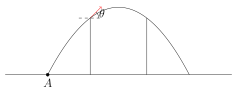
- \(\,\) \begin{align*} \bf{COE}: && \frac12 m \cdot 5ag &= mg\cdot 2a + \frac12 m v^2 \\ \Rightarrow && v^2 &= ag \\ && v &= \sqrt{ag} \end{align*} If it just clears the second wall, we must have: \begin{align*} && 0 &= \sqrt{ag} \sin \theta t - \frac12 gt^2 \\ \Rightarrow && t &= \frac{2\sqrt{ag}\sin \theta}{g} \\ && a &= \sqrt{ag} \cos \theta t \\ &&&=\sqrt{ag} \cos \theta \frac{2\sqrt{ag}\sin \theta}{g} \\ &&&= a \sin 2 \theta \\ \Rightarrow && \theta &= 45^{\circ} \end{align*} Imagine firing the particle backwards from the top of the wall at \(45^\circ\) then \begin{align*} && -2a &= \sqrt{ag}\cdot \left ( -\frac1{\sqrt{2}} \right) t - \frac12 g t^2 \\ \Rightarrow && 0 &= gt^2+\sqrt{2ag} t -4a \\ &&&= (\sqrt{g}t -\sqrt{2} \sqrt{a})(\sqrt{g}t +2\sqrt{2} \sqrt{a}) \\ \Rightarrow && t &= \sqrt{\frac{2a}{g}} \\ \Rightarrow && s &= \left ( -\frac1{\sqrt{2}} \right) \sqrt{ag} \sqrt{\frac{2a}{g}} \\ &&&= -a \end{align*} Therefore the \(A\) is \(a\) from the wall.
- When it passes over the first wall, \begin{align*} \bf{COE}: && \frac52amg &= (2a+h)mg + \frac12 m v^2 \\ \Rightarrow && v^2 &= (a-2h)g \end{align*} Now imagine firing a particle with this speed in any direction. The question is asking whether we can ever travel \(2a\) without descending more than \(h\). \begin{align*} && a &= \sqrt{(a-2h)g} \cos \beta t \\ \Rightarrow && t &= \frac{a}{\sqrt{(a-2h)g} \cos \beta}\\ && -h &= \sqrt{(a-2h)g} \sin \beta t - \frac12 g t^2 \\ &&&= a \tan \beta - \frac12 \frac{a^2}{(a-2h)} \sec^2 \beta \\ &&&= a \tan \beta - \frac{a^2}{2(a-2h)}(1+ \tan^2 \beta )\\ \Rightarrow && 0 &= \frac{a^2}{2(a-2h)} \tan^2 \beta-a \tan \beta + \frac{a^2-2ah+4h^2}{2(a-2h)} \\ && \Delta &= a^2 - \frac{a^2}{a-2h} \frac{a^2-2ah+4h^2}{a-2h} \\ &&&= \frac{a^2}{(a-2h)^2}\left ( a^2-4ah+4h^2-a^2+2ah-4h^2\right) \\ &&&= \frac{a^2}{(a-2h)^2}\left ( -2ah\right) < 0 \\ \end{align*} So there are no solutions if \(h > 0\)
2017 Paper 3 Q1
- Prove that, for any positive integers \(n\) and \(r\), \[ \frac{1}{^{n+r}\C_{r+1}} =\frac{r+1}{r} \left(\frac{1}{^{n+r-1}\C_{r}}-\frac{1}{^{n+r}\C_{r}}\right). \] Hence determine \[ \sum_{n=1}^{\infty}{\frac{1}{^{n+r}\C_{r+1}}} \,, \] and deduce that \ \(\displaystyle \sum_{n=2}^\infty \frac 1 {^{n+2}\C_3} = \frac12\,\).
- Show that, for \(n \ge 3\,\), \[ \frac{3!}{n^3} < \frac{1}{^{n+1}\C_{3}} \ \ \ \ \ \text{and} \ \ \ \ \ \frac{20}{^{n+1}\C_3} - \frac{1}{^{n+2}\C_{5}} < \frac{5!}{n^3} \,. \] By summing these inequalities for \(n \ge 3\,\), show that \[ \frac{115}{96} < \sum_{n=1}^{\infty}{\frac{1}{n^3}} < \frac{116}{96} \, . \]
Solution: \begin{align*} \frac{r+1}{r} \left(\frac{1}{^{n+r-1}\C_{r}}-\frac{1}{^{n+r}\C_{r}}\right) &= \frac{r+1}{r} \l \frac{r!(n-1)!}{(n+r-1)!} - \frac{r!n!}{(n+r)!} \r \\ &= \frac{(r+1)!(n-1)!}{r(n+r-1)!} \l 1 - \frac{n}{n+r} \r \\ &= \frac{(r+1)!(n-1)!}{r(n+r-1)!} \frac{r}{n+r} \\ &= \frac{(r+1)!n!}{(n+r)!} \\ &= \frac{1}{^{n+r}\C_{r+1}} \end{align*} \begin{align*} \sum_{n=1}^{\infty}{\frac{1}{^{n+r}\C_{r+1}}} &= \sum_{n=1}^{\infty} \l \frac{r+1}{r} \left(\frac{1}{^{n+r-1}\C_{r}}-\frac{1}{^{n+r}\C_{r}}\right) \r \\ &= \frac{r+1}{r} \sum_{n=1}^{\infty} \l \frac{1}{^{n+r-1}\C_{r}}-\frac{1}{^{n+r}\C_{r}} \r \\ &= \frac{r+1}{r} \lim_{N \to \infty} \sum_{n=1}^{N} \l \frac{1}{^{n+r-1}\C_{r}}-\frac{1}{^{n+r}\C_{r}} \r \\ &= \frac{r+1}{r} \lim_{N \to \infty} \l \frac{1}{^{1+r-1}\C_{r}} - \frac{1}{^{N+r}\C_{r}}\r \\ &= \frac{r+1}{r} \frac{1}{^{1+r-1}\C_{r}} \tag{since \(\frac{1}{^{N+r}\C_{r}} \to 0\)} \\ &= \frac{r+1}{r} \end{align*} When \(r = 2\), we have: \begin{align*} && \frac{3}{2} &= \sum_{n=1}^{\infty}{\frac{1}{^{n+2}\C_{3}}} \\ && &=\frac{1}{^{1+2}\C_{3}} + \sum_{n=2}^{\infty}{\frac{1}{^{n+2}\C_{3}}} \\ && &= 1 + \sum_{n=2}^{\infty}{\frac{1}{^{n+2}\C_{3}}} \\ \Rightarrow && \sum_{n=2}^{\infty}{\frac{1}{^{n+2}\C_{3}}} &= \frac12 \end{align*} \begin{align*} \frac{1}{^{n+1}\C_{3}} &= \frac{3!}{(n+1)n(n-1)} \\ &= \frac{3!}{n^3-n} \\ &> \frac{3!}{n^3} \end{align*} \begin{align*} \frac{20}{^{n+1}\C_3} - \frac{1}{^{n+2}\C_{5}} &= \frac{5!}{(n+1)n(n-1)} - \frac{5!}{(n+2)(n+1)n(n-1)(n-2)} \\ &= \frac{5!}{n^3} \frac{n^2}{n^2-1}\l 1- \frac{1}{n^2-4} \r \\ &= \frac{5!}{n^3} \frac{n^2}{n^2-1}\l \frac{n^2-5}{n^2-4} \r \\ &= \frac{5!}{n^3} \frac{n^2(n^2-5)}{(n^2-1)(n^2-4)} \\ &< \frac{5!}{n^3} \end{align*} Since \(k(k-5) < (k-1)(k-4) \Leftrightarrow 0 < 4\), this only makes sense if \(n \geq 3\) \begin{align*} &&\frac{3!}{n^3} &< \frac{1}{^{n+1}\C_{3}} \tag{if \(n \geq 3\)} \\ \Rightarrow &&\sum_{n=3}^\infty \frac{3!}{n^3} &< \sum_{n=3}^\infty \frac{1}{^{n+1}\C_{3}} \\ \Rightarrow && \frac{6}{1^3} + \frac{6}{2^3} + \sum_{n=3}^\infty \frac{3!}{n^3} &< \frac{6}{1^3} + \frac{6}{2^3} + \sum_{n=3}^\infty \frac{1}{^{n+1}\C_{3}} \\ \Rightarrow && \sum_{n=1}^\infty \frac{3!}{n^3} &< 6 + \frac{3}{4} + \sum_{n=2}^\infty \frac{1}{^{n+2}\C_{2+1}} \\ \Rightarrow && \sum_{n=1}^\infty \frac{3!}{n^3} &< 6 + \frac{3}{4} + \frac{1}{2} = \frac{29}{4} \\ \Rightarrow && \sum_{n=1}^\infty \frac{1}{n^3} &< \frac{29}{24} = \frac{116}{96} \\ \end{align*} \begin{align*} && \frac{20}{^{n+1}\C_3} - \frac{1}{^{n+2}\C_{5}} &< \frac{5!}{n^3} \\ \Rightarrow && \sum_{n=3}^\infty \l \frac{20}{^{n+1}\C_3} - \frac{1}{^{n+2}\C_{5}} \r &< \sum_{n=3}^\infty \frac{5!}{n^3} \\ \Rightarrow && \frac{120}{1^3} + \frac{120}{2^3} + \sum_{n=3}^\infty \frac{20}{^{n+1}\C_3} - \sum_{n=3}^\infty \frac{1}{^{n+2}\C_{5}} &< \frac{120}{1^3} + \frac{120}{2^3} + \sum_{n=3}^\infty \frac{5!}{n^3} \\ \Rightarrow && \frac{120}{1^3} + \frac{120}{2^3} + \sum_{n=2}^\infty \frac{20}{^{n+2}\C_{2+1}} - \sum_{n=1}^\infty \frac{1}{^{n+4}\C_{4+1}} &< \frac{120}{1^3} + \frac{120}{2^3} + \sum_{n=3}^\infty \frac{5!}{n^3} \\ \Rightarrow && \frac{120}{1^3} + \frac{120}{2^3} + \frac{20}{2} - \frac{4+1}{4} &< \sum_{n=1}^\infty \frac{5!}{n^3} \\ \Rightarrow && \frac{115}{96} &< \sum_{n=1}^\infty \frac{1}{n^3} \\ \end{align*}
2017 Paper 3 Q4
For any function \(\f\) satisfying \(\f(x) > 0\), we define the geometric mean, F, by \[ F(y) = e^{\frac{1}{y} \int_{0}^{y} \ln f(x) \, dx} \quad (y > 0). \]
- The function f satisfies \(\f(x) > 0\) and \(a\) is a positive number with \(a\ne1\). Prove that \[ F(y) = a^{\frac{1}{y} \int_{0}^{y} \log_a f(x) \, dx}. \]
- The functions f and g satisfy \(\f(x) > 0\) and \(\g(x) > 0\), and the function \(\h\) is defined by \(\h(x) = \f(x)\g(x)\). Their geometric means are F, G and H, respectively. Show that \(H(y)= \F(y) \G(y)\,\).
- Prove that, for any positive number \(b\), the geometric mean of \(b^x\) is \(\sqrt{b^y}\,\).
- Prove that, if \(\f(x)>0\) and the geometric mean of \(\f(x)\) is \(\sqrt{\f(y)}\,\), then \(\f(x) = b^x\) for some positive number \(b\).
Solution:
- \begin{align*} && a^{\frac{1}{y} \int_{0}^{y} \log_a f(x) \, dx} &= e^{\ln a \cdot \frac{1}{y} \int_{0}^{y} \log_a f(x) \, dx} \\ &&&= e^{\ln a \cdot \frac{1}{y} \int_{0}^{y} \frac{\ln f(x)}{\ln a} \, dx} \\ &&&= e^{ \frac{1}{y} \int_{0}^{y} \ln f(x) \, dx} \\ &&&= F(y) \end{align*}
- \(\,\) \begin{align*} && H(y) &= e^{\frac1y \int_0^y \ln h(x) \d x} \\ &&&= e^{\frac1y \int_0^y \ln (f(x)g(x))\d x} \\ &&&= e^{\frac1y \int_0^y \left ( \ln f(x)+\ln g(x) \right)\d x} \\ &&&= e^{\frac1y \int_0^y \ln f(x) \d x +\frac1y \int_0^y \ln g(x) \d x} \\ &&&= e^{\frac1y \int_0^y \ln f(x) \d x }e^{\frac1y \int_0^y \ln g(x) \d x} \\ &&&= F(y)G(y) \end{align*}
- Suppose \(f(x) = b^x\), then \begin{align*} && F(y) &= b^{\frac1y \int_0^y \log_b f(x) \d x} \\ &&&= b^{\frac1y \int_0^y x \d x}\\ &&&= b^{\frac1y \frac{y^2}{2}} \\ &&&= b^{\frac{y}2} = \sqrt{b^y} \end{align*}
- Suppose the geometric mean of \(f(x)\) is \(\sqrt{f(y)}\) then the geometric mean of \(f(x)^2\) is \(f(y)\) by the the second part.
2016 Paper 1 Q7
The set \(S\) consists of all the positive integers that leave a remainder of 1 upon division by 4. The set \(T\) consists of all the positive integers that leave a remainder of 3 upon division by 4.
- Describe in words the sets \(S \cup T\) and \(S \cap T\).
- Prove that the product of any two integers in \(S\) is also in \(S\). Determine whether the product of any two integers in \(T\) is also in \(T\).
- Given an integer in \(T\) that is not a prime number, prove that at least one of its prime factors is in \(T\).
- For any set \(X\) of positive integers,
an integer in \(X\) (other than 1) is said to be
\(X\)-prime if it cannot be expressed as the product of
two or more integers all in \(X\) (and all different from 1).
- \(\bf (a)\) Show that every integer in \(T\) is either \(T\)-prime or is the product of an odd number of \(T\)-prime integers.
- \(\bf (b)\) Find an example of an integer in \(S\) that can be expressed as the product of \(S\)-prime integers in two distinct ways. [Note: \(s_1s_2\) and \(s_2s_1\) are not counted as distinct ways of expressing the product of \(s_1\) and \(s_2\).]
Solution:
- \(S \cup T\) is the set of odd positive integers. \(S \cap T\) is the empty set.
- Suppose we have two integers in \(S\), say \(4n+1\) and \(4m+1\), so \((4n+1)(4m+1) = 16nm + 4(n+m) + 1 = 4(4nm + n+m) + 1\) which clearly is in \(S\). The product of any two integers in \(T\) is in \(S\), since \((4n+3)(4m+3) = 16nm + 12(n+m) + 9 = 4(4nm+3(n+m) + 2) + 1\)
- Suppose \(p \in T\) is not prime, then it must have prime factors. They must all be odd, so they are in \(T\) or \(S\). If they are all in \(S\) then \(p\) must also be in \(S\) (as the product of numbers in \(S\)) but this is a contraction. Therefore \(p\) must have a prime factor in \(T\).
- \(3, 7, 11, 19\) are all primes in \(T\). Notice therefore that any product of two of them must be \(S\)-prime. But then \((3 \times 7) \times (11 \times 19)\) and \((3 \times 11) \times (7 \times 19)\) are distinct factorisations into \(S\)-prime factors.
2016 Paper 2 Q5
In this question, the definition of \(\displaystyle\binom pq\) is taken to be \[ \binom pq = \begin{cases} \dfrac{p!}{q!(p-q)!} & \text{ if } p\ge q\ge0 \,,\\[4mm] 0 & \text{ otherwise } . \end{cases} \]
- Write down the coefficient of \(x^n\) in the binomial expansion for \((1-x)^{-N}\), where \(N\) is a positive integer, and write down the expansion using the \(\Sigma\) summation notation. By considering $ (1-x)^{-1} (1-x)^{-N} \, ,$ where \(N\) is a positive integer, show that \[ \sum_{j=0}^n \binom { N+j -1}{j} = \binom{N+n}{n}\,. \]
- Show that, for any positive integers \(m\), \(n\) and \(r\) with \(r\le m+n\), \[ \binom{m+n} r = \sum _{j=0}^r \binom m j \binom n {r-j} \,. \]
- Show that, for any positive integers \(m\) and \(N\), \[ \sum_{j=0}^n(-1)^{j} \binom {N+m} {n-j} \binom {m+j-1}{j } = \displaystyle \binom N n . \]
Solution:
- \(\frac{(-N)(-N-1)\cdots(-N-n+1)}{n!} = \binom{N+n-1}{n}\), so \[ (1-x)^{-N} = \sum_{n=0}^{\infty} \binom{N+n-1}{n} x^n\] \begin{align*} && (1-x)^{-N-1} &= (1-x)^{-1}(1-x)^{-N} \\ &&&= (1 + x + x^2 + \cdots)\left ( \sum_{n=0}^{\infty} \binom{N+n-1}{n} x^n\right)\\ [x^{n}]: && \binom{N+1+n-1}{n} &= \sum_{j=0}^n \underbrace{1}_{x^{n-j} \text{ from 1st bracket}}\cdot\underbrace{\binom{N+j-1}{j}}_{x^j\text{ from second bracket}} \\ \Rightarrow && \binom{N+n}{n} &= \sum_{j=0}^n \binom{N+j-1}{j} \end{align*}
- Consider \((1+x)^{m+n} = (1+x)^m(1+x)^n\) and consider the coefficient of \(x^r\) from each side. On the left hand side this is clearly \(\binom{m+n}{r}\) on the right hand side we can take \(x^j\) from \((1+x)^m\) and \(x^{n-j}\) from \((1+x)^n\) and \(j\) can take any value from \(0\) to \(r\), ie \[ \binom{m+n} r = \sum _{j=0}^r \binom m j \binom n {r-j} \]
- Consider \((1-x)^{-(N+m+1)} = (\)
2016 Paper 2 Q12
Starting with the result \(\P(A\cup B) = \P(A)+P(B) - \P(A\cap B)\), prove that \[ \P(A\cup B\cup C) = \P(A)+\P(B)+\P(C) - \P(A\cap B) - \P(B\cap C) - \P(C \cap A) + \P(A\cap B\cap C) \,. \] Write down, without proof, the corresponding result for four events \(A\), \(B\), \(C\) and \(D\). A pack of \(n\) cards, numbered \(1, 2, \ldots, n\), is shuffled and laid out in a row. The result of the shuffle is that each card is equally likely to be in any position in the row. Let \(E_i\) be the event that the card bearing the number \(i\) is in the \(i\)th position in the row. Write down the following probabilities:
- \(\P(E_i)\);
- \(\P(E_i\cap E_j)\), where \(i\ne j\);
- \(\P(E_i\cap E_j\cap E_k)\), where \(i\ne j\), \(j\ne k\) and \(k\ne i\).
Solution: \begin{align*} && \mathbb{P}(A \cup B \cup C) &= \mathbb{P}(A \cup B) + \mathbb{P}(C) - \mathbb{P}((A \cup B) \cap C) \tag{applying with \(A\cup B\) and \(C\)} \\ &&&= \mathbb{P}(A \cup B) + \mathbb{P}(C) - \mathbb{P}((A \cap C) \cup (B \cap C)) \\ &&&= \mathbb{P}(A)+\mathbb{P}(B) - \mathbb{P}(A\cap B) + \mathbb{P}(C) - \mathbb{P}((A \cap C) \cup (B \cap C)) \tag{applying with \(A\) and \(B\)}\\ &&&= \mathbb{P}(A)+\mathbb{P}(B) - \mathbb{P}(A\cap B) + \mathbb{P}(C) - \left ( \mathbb{P}(A \cap C) +\mathbb{P}(B \cap C) - \mathbb{P}( (A \cap C) \cap (B \cap C) )\right) \\ &&&= \mathbb{P}(A)+\mathbb{P}(B) +\mathbb{P}(C)- \mathbb{P}(A\cap B)- \mathbb{P}(A \cap C) -\mathbb{P}(B \cap C)+\mathbb{P}( A \cap B \cap C) \end{align*} \[ \mathbb{P}(A_1 \cup A_2 \cup A_3 \cup A_4) = \sum_i \mathbb{P}(A_i) - \sum_{i \neq j} \mathbb{P}(A_i \cap A_j) + \sum_{i \neq j \neq j} \mathbb{P}(A_i \cap A_j \cap A_k) - \mathbb{P}(A_1 \cap A_2 \cap A_3 \cap A_4) \]
- \(\mathbb{P}(E_i) = \frac{1}{n}\)
- \(\mathbb{P}(E_i \cap E_j) = \frac{1}{n} \cdot \frac{1}{n-1} = \frac{1}{n(n-1)}\)
- \(\mathbb{P})(E_i \cap E_j \cap E_k) = \frac{1}{n(n-1)(n-2)}\)