Problems
Filters
21 problems found
1990 Paper 2 Q12
A straight staircase consists of \(N\) smooth horizontal stairs each of height \(h\). A particle slides over the top stair at speed \(U\), with velocity perpendicular to the edge of the stair, and then falls down the staircase, bouncing once on every stair. The coefficient of restitution between the particle and each stair is \(e\), where \(e<1\). Show that the horizontal distance \(d_{n}\) travelled between the \(n\)th and \((n+1)\)th bounces is given by \[ d_{n}=U\left(\frac{2h}{g}\right)^{\frac{1}{2}}\left(e\alpha_{n}+\alpha_{n+1}\right), \] where \({\displaystyle \alpha_{n}=\left(\frac{1-e^{2n}}{1-e^{2}}\right)^{\frac{1}{2}}}\). If \(N\) is very large, show that \(U\) must satisfy \[ U=\left(\frac{L^{2}g}{2h}\right)^{\frac{1}{2}}\left(\frac{1-e}{1+e}\right)^{\frac{1}{2}}, \] where \(L\) is the horizontal distance between the edges of successive stairs.
1990 Paper 3 Q12
A uniform smooth wedge of mass \(m\) has congruent triangular end faces \(A_{1}B_{1}C_{1}\) and \(A_{2}B_{2}C_{2},\) and \(A_{1}A_{2},B_{1}B_{2}\) and \(C_{1}C_{2}\) are perpendicular to these faces. The points \(A,B\) and \(C\) are the midpoints of \(A_{1}A_{2},B_{1}B_{2}\) and \(C_{1}C_{2}\) respectively. The sides of the triangle \(ABC\) have lengths \(AB=AC=5a\) and \(BC=6a.\) The wedge is placed with \(BC\) on a smooth horizontal table, a particle of mass \(2m\) is placed at \(A\) on \(AC,\) and the system is released from rest. The particle slides down \(AC,\) strikes the table, bounces perfectly elastically and lands again on the table at \(D\). At this time the point \(C\) of the wedge has reached the point \(E\). Show that \(DE=\frac{192}{19}a.\)
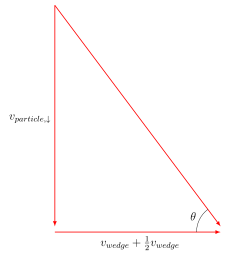
Solution: Conservation of energy, tells us that \(2m \cdot g \cdot 4a = 8amg\) is equal to \(\frac12 m v_{wedge}^2 + \frac12(2m)v_{particle}^2\). Conservation of momentum (horizontally) tells us that \(m v_{wedge}+2mv_{particle, \rightarrow} = 0 \Rightarrow v_{particle, \rightarrow} = -\frac12 v_{wedge}\).
1990 Paper 3 Q13
A particle \(P\) is projected, from the lowest point, along the smooth inside surface of a fixed sphere with centre \(O\). It leaves the surface when \(OP\) makes an angle \(\theta\) with the upward vertical. Find the smallest angle that must be exceeded by \(\theta\) to ensure that \(P\) will strike the surface below the level of \(O\). You may find it helpful to find the time at which the particle strikes the sphere.
Solution:

1988 Paper 3 Q13
A goalkeeper stands on the goal-line and kicks the football directly into the wind, at an angle \(\alpha\) to the horizontal. The ball has mass \(m\) and is kicked with velocity \(\mathbf{v}_{0}.\) The wind blows horizontally with constant velocity \(\mathbf{w}\) and the air resistance on the ball is \(mk\) times its velocity relative to the wind velocity, where \(k\) is a positive constant. Show that the equation of motion of the ball can be written in the form \[ \frac{\mathrm{d}\mathbf{v}}{\mathrm{d}t}+k\mathbf{v}=\mathbf{g}+k\mathbf{w}, \] where \(\mathbf{v}\) is the ball's velocity relative to the ground, and \(\mathbf{g}\) is the acceleration due to gravity. By writing down horizontal and vertical equations of motion for the ball, or otherwise, find its position at time \(t\) after it was kicked. On the assumption that the goalkeeper moves out of the way, show that if \(\tan\alpha=\left|\mathbf{g}\right|/(k\left|\mathbf{w}\right|),\) then the goalkeeper scores an own goal.
Solution: Applying \(\mathbf{F} = m\mathbf{a} = m \frac{\d \mathbf{v}}{dt}\) we have: \begin{align*} && m \frac{\d \mathbf{v}}{d t} &= m\mathbf{g} - mk(\mathbf{v} - \mathbf{w}) \\ \Rightarrow && \frac{\d \mathbf{v}}{d t} +k \mathbf{v} &= \mathbf{g} + k \mathbf{w} \\ \\ \Rightarrow && e^{k t} \l \frac{\d \mathbf{v}}{d t} +k \mathbf{v} \r &= e^{kt} ( \mathbf{g} + k \mathbf{w}) \\ \Rightarrow && \frac{\d}{\d t} \l e^{kt} \mathbf{v} \r &= e^{kt}( \mathbf{g} + k \mathbf{w}) \\ \Rightarrow && e^{kt} \mathbf{v} &= \frac{1}ke^{kt}( \mathbf{g} + k \mathbf{w}) + c \\ \Rightarrow && \mathbf{v}_0 &= \frac{1}{k} ( \mathbf{g} + k \mathbf{w})+c \\ \Rightarrow && \mathbf{v} &= e^{-kt} \l \mathbf{v_0} - \frac{1}{k}\mathbf{g} - \mathbf{w} \r + \frac{1}{k} \mathbf{g} + \mathbf{w} \\ \Rightarrow && \mathbf{x} &= -\frac{1}{k}e^{-kt} \l \mathbf{v_0} - \frac{1}{k}\mathbf{g} - \mathbf{w} \r + \frac{1}{k} \mathbf{g}t + \mathbf{w}t+C \\ \Rightarrow && \mathbf{0} &= -\frac{1}{k} \l \mathbf{v_0} - \frac{1}{k}\mathbf{g} - \mathbf{w} \r + C \\ \Rightarrow && \mathbf{x} &= \frac1{k}\l 1- e^{-kt} \r\l \mathbf{v_0} - \frac{1}{k}\mathbf{g} - \mathbf{w} \r + \frac{1}{k} \mathbf{g}t + \mathbf{w}t \end{align*} Position at time \(t\) is: \begin{align*} && x_x &= \frac1{k} ( 1-e^{-kt})(u_x - w)+wt \\ && x_y &= \frac1{k} ( 1-e^{-kt})(u_x \frac{g}{kw} - \frac{g}{k})+\frac{1}{k}gt \\ &&&= \frac{g}{kw} \left ( ( 1-e^{-kt})(u_x - w)+wt \right) \\ &&&= \frac{g}{kw} x_x \end{align*} Therefore if \(x_x\) is ever \(0\) then \(x_y\) will also be zero. But the ball must eventually hit the ground, and when it does, it will be in the process of scoring an own goal.
1987 Paper 1 Q11
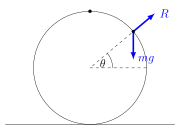
A smooth sphere of radius \(r\) stands fixed on a horizontal floor. A particle of mass \(m\) is displaced gently from equilibrium on top of the sphere. Find the angle its velocity makes with the horizontal when it loses contact with the sphere during the subsequent motion. By energy considerations, or otherwise, find the vertical component of the momentum of the particle as it strikes the floor.
Solution:
1987 Paper 1 Q12
\(\,\) \vspace{-1cm}
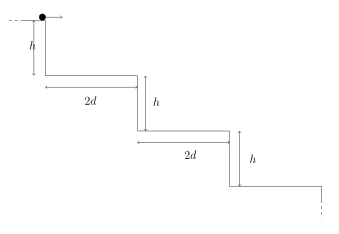
Solution: Considering the horizontal component, this will be constant as there are no forces acting in that direction. The first step will take the particle \(t = \sqrt{\frac{2h}g}\) to reach. At which point it will be travelling with speed \(v = \sqrt{2gh} \) (by energy considerations, \(mgh = \frac12 mv^2\)). To reach the second step must take twice as long (since the ball has to travel \(2d\) horizontally, rather than \(d\)). Since \(t = 2\sqrt{\frac{2h}g}\) we must have that: \begin{align*} && s &= ut + \frac12 gt^2 \\ \Rightarrow && h &= u 2\sqrt{\frac{2h}g} + \frac12 g \frac{8h}g \\ \Rightarrow && u &= -\frac{3}{2} h\sqrt{\frac{g}{2h}} \\ &&&= -\frac{3}{2\sqrt{2}} \sqrt{gh} \end{align*} Therefore, using Newton's experimental law, we must have that \(e = \frac{\frac{3}{2 \sqrt{2}} \sqrt{gh}}{\sqrt{2} \sqrt{gh}} = \frac{3}{4}\). Again by conservation of energy \(mgh + \frac12 \frac{9}{8} mgh = \frac12 mv^2 \Rightarrow v = \frac{5}{2\sqrt{2}} \sqrt{gh}\) when it lands on the next step. Therefore we would need the coefficient of restitution for the second (and subsequent steps) to be: \(\displaystyle \frac{\frac{3}{2\sqrt{2}} \sqrt{gh}}{\frac{5}{2\sqrt{2}} \sqrt{gh}} = \frac35\)