Problems
Filters
43 problems found
2012 Paper 2 Q13
In this question, you may assume that \(\displaystyle \int_0^\infty \!\!\! \e^{-x^2/2} \d x = \sqrt{\tfrac12 \pi}\,\). The number of supermarkets situated in any given region can be modelled by a Poisson random variable, where the mean is \(k\) times the area of the given region. Find the probability that there are no supermarkets within a circle of radius \(y\). The random variable \(Y\) denotes the distance between a randomly chosen point in the region and the nearest supermarket. Write down \(\P(Y < y)\) and hence show that the probability density function of \(Y\) is \(\displaystyle 2\pi y k \e^{-\pi k y^2}\) for \(y\ge0\). Find \(\E(Y)\) and show that \(\var(Y) = \dfrac{4-\pi}{4\pi k}\).
Solution: A circle radius \(y\) has a number of supermarkets \(X\) where \(X \sim Po(k \pi y^2)\). \[ \mathbb{P}(X = 0) = e^{-k\pi y^2} \frac{1}{0!} = e^{-k\pi y^2} \] The probability \(\mathbb{P}(Y < y) = 1-\mathbb{P}(Y \geq y) = 1-e^{-k\pi y^2}\), and in particular \(f_Y(y) = 2k\pi y e^{-k\pi y^2}\) (by differentiating). \begin{align*} && \mathbb{E}(Y) &= \int_0^\infty yf_Y(y) \d y \\ &&&= \int_0^\infty 2\pi y^2 k e^{-\pi k y^2} \d y \\ \sigma^2 = \frac{1}{2k\pi}:&&&= \pi k \sqrt{2 \pi}\sigma \int_{-\infty}^\infty \frac{1}{\sqrt{2 \pi} \sigma }y^2 e^{-\frac12 \cdot 2\pi k y^2} \d y \\ &&&=\pi k \sqrt{2 \pi}\sigma \mathbb{E}\left (N(0, \sigma^2)^2 \right) \\ &&&= \pi k \sqrt{2 \pi}\sigma\sigma^2 \\ &&&= \pi k \sqrt{2 \pi} \frac{1}{(2k\pi)^{3/2}} \\ &&&= \frac{1}{2\sqrt{k}} \end{align*} \begin{align*} && \mathbb{E}(Y^2) &= \int_0^\infty y^2f_Y(y) \d y \\ &&&= \int_0^\infty 2\pi y^3 k e^{-\pi k y^2} \d y \\ &&&= \int_0^{\infty}y^2 2y \pi k e^{-\pi k y^2} \d y \\ \\ &&&= \left [-y^2 e^{-\pi k y^2}\right]_0^{\infty}+\int_0^\infty 2ye^{-\pi k y^2} \d y \\ &&&= \left [-\frac{1}{\pi k}e^{-\pi k y^2} \right]_0^{\infty} \\ &&&= \frac{1}{\pi k} \\ \Rightarrow && \textrm{Var}(Y) &= \mathbb{E}(Y^2) - \left [ \mathbb{E}(Y)\right]^2 \\ &&&= \frac{1}{\pi k} - \frac{1}{4k} \\ &&&= \frac{4 - \pi}{4\pi k} \end{align*}
2012 Paper 3 Q12
- A point \(P\) lies in an equilateral triangle \(ABC\) of height 1. The perpendicular distances from \(P\) to the sides \(AB\), \(BC\) and \(CA\) are \(x_1\), \(x_2\) and \(x_3\), respectively. By considering the areas of triangles with one vertex at \(P\), show that \(x_1+x_2+x_3=1\). Suppose now that \(P\) is placed at random in the equilateral triangle (so that the probability of it lying in any given region of the triangle is proportional to the area of that region). The perpendicular distances from \(P\) to the sides \(AB\), \(BC\) and \(CA\) are random variables \(X_1\), \(X_2\) and \(X_3\), respectively. In the case \(X_1= \min(X_1,X_2,X_3)\), give a sketch showing the region of the triangle in which \(P\) lies. Let \(X= \min(X_1,X_2,X_3)\). Show that the probability density function for \(X\) is given by \[ \f(x) = \begin{cases} 6(1-3x) & 0 \le x \le \frac13\,, \\ 0 & \text{otherwise}\,. \end{cases} \] Find the expected value of \(X\).
- A point is chosen at random in a regular tetrahedron of height 1. Find the expected value of the distance from the point to the closest face. \newline [The volume of a tetrahedron is \(\frac13 \times \text{area of base}\times\text{height}\) and its centroid is a distance \(\frac14\times \text{height}\) from the base.]
2011 Paper 1 Q13
In this question, you may use without proof the following result: \[ \int \sqrt{4-x^2}\, \d x = 2 \arcsin (\tfrac12 x ) + \tfrac 12 x \sqrt{4-x^2} +c\,. \] A random variable \(X\) has probability density function \(\f\) given by \[ \f(x) = \begin{cases} 2k & -a\le x <0 \\[3mm] k\sqrt{4-x^2} & \phantom{-} 0\le x \le 2 \\[3mm] 0 & \phantom{-}\text{otherwise}, \end{cases} \] where \(k\) and \(a\) are positive constants.
- Find, in terms of \(a\), the mean of \(X\).
- Let \(d\) be the value of \(X\) such that \(\P(X> d)=\frac1 {10}\,\). Show that \(d < 0\) if \(2a> 9\pi\) and find an expression for \(d\) in terms of \(a\) in this case.
- Given that \(d=\sqrt 2\), find \(a\).
Solution: First notice that \begin{align*} && 1 &= \int_{-a}^2 f(x) \d x \\ &&&= 2ka + k\pi \\ \Rightarrow && k &= (\pi + 2a)^{-1} \end{align*}
- \(\,\) \begin{align*} && \E[X] &= \int_{-a}^2 x f(x) \d x\\ &&&= \int_{-a}^0 2kx \d x + k\int_0^{2} x\sqrt{4-x^2} \d x\\ &&&= \left [kx^2 \right]_{-a}^0 +k \left [-\frac13(4-x^2)^{\frac32} \right]_0^2 \\ &&&= -ka^2 + \frac83k \\ &&&= \frac{\frac83-a^2}{\pi + 2a} \end{align*}
- Consider \(\mathbb{P}(X < 0)\) then \(d < 0 \Leftrightarrow \mathbb{P}(X < 0) > \frac{9}{10}\) \begin{align*} && \frac{9}{10} &< \mathbb{P}(X < 0) \\ &&&= \int_{-a}^0 2k \d x \\ &&&= \frac{2a}{\pi+2a} \\ \Leftrightarrow && 9\pi &< 2a \\ \\ && \frac{9}{10} &= \int_{-a}^d 2k \d x \\ &&&= \frac{2(d+a)}{\pi + 2a} \\ \Rightarrow && 9\pi &= 2a + 20d \\ \Rightarrow && d &= \frac{2a-9\pi}{20} \end{align*}
- Suppose \(d=\sqrt 2\) then \begin{align*} && \frac1{10} &= \int_{\sqrt{2}}^2 f(x) \d x \\ &&&= \int_{\sqrt{2}}^2 k\sqrt{4-x^2} \d x \\ &&&= k\left [ 2 \sin^{-1} \tfrac12 x + \tfrac12 x \sqrt{4-x^2}\right]_{\sqrt{2}}^2 \\ &&&= k\left (\pi -\frac{\pi}{2} - 1 \right) \\ \Rightarrow && \pi + 2a &= 5\pi - 10 \\ \Rightarrow && a &= 2\pi-5 \end{align*}
2011 Paper 2 Q13
What property of a distribution is measured by its skewness?
- One measure of skewness, \(\gamma\), is given by \[ \displaystyle \gamma= \frac{ \E\big((X-\mu)^3\big)}{\sigma^3}\,, \] where \(\mu\) and \(\sigma^2\) are the mean and variance of the random variable \(X\). Show that \[ \gamma = \frac{ \E(X^3) -3\mu \sigma^2 - \mu^3}{\sigma^3}\,. \] The continuous random variable \(X\) has probability density function \(\f\) where \[ \f(x) = \begin{cases} 2x & \text{for } 0\le x\le 1\,, \\[2mm] 0 & \text{otherwise}\,. \end{cases} \] Show that for this distribution \(\gamma= -\dfrac{2\sqrt2}{5}\).
- The decile skewness, \(D\), of a distribution is defined by \[D= \frac { {\rm F}^{-1}(\frac9{10}) - 2{\rm F} ^{-1}(\frac12) + {\rm F}^{-1} (\frac1{10}) } {{\rm F}^{-1}(\frac9{10}) - {\rm F} ^{-1} (\frac1{10})}\,, \] where \({\rm F}^{-1}\) is the inverse of the cumulative distribution function. Show that, for the above distribution, \( D= 2 -\sqrt5\,.\) The Pearson skewness, \(P\), of a distribution is defined by \[ P = \frac{3(\mu-M)}{\sigma} \,,\] where \(M\) is the median. Find \(P\) for the above distribution and show that \(D > P > \gamma\,\).
Solution: Skewness is a measure of the symmetry (specifically the lack-thereof) in the distribution. How much mass is there on one side rather than another.
- \(\,\) \begin{align*} && \gamma &= \frac{\E \left [ (X - \mu)^3 \right ]}{\sigma^3} \\ &&&= \frac{\E \left [ X^3 - 3\mu X^2 + 3\mu^2 X - \mu^3 \right ]}{\sigma^3} \\ &&&= \frac{\E [ X^3 ]- 3\mu \E[X^2] + 3\mu^2 \E[X] - \mu^3 }{\sigma^3} \\ &&&= \frac{\E [ X^3 ]- 3\mu (\mu^2 + \sigma^2) + 3\mu^2\cdot \mu- \mu^3 }{\sigma^3} \\ &&&= \frac{\E [ X^3 ]- 3\mu \sigma^2 - \mu^3 }{\sigma^3} \\ \end{align*} \begin{align*} && f(x) &= \begin{cases} 2x & \text{for } 0\le x\le 1\,, \\[2mm] 0 & \text{otherwise}\,. \end{cases} \\ && \E[X] &= \int_0^1 2x^2 \d x \\ &&&= \frac23 \\ && \E[X^2] &= \int_0^1 2x^3 \d x \\ &&&= \frac12 \\ && \E[X^3] &= \int_0^1 2x^4 \d x \\ &&&= \frac25 \\ \\ && \mu &= \frac23 \\ && \sigma^2 &= \frac12 - \frac49 = \frac{1}{18} \\ && \gamma &= \frac{\frac25 - 3 \cdot \frac23 \cdot \frac1{18} - \frac8{27}}{\frac{1}{54\sqrt2}} \\ &&&= -\frac{2\sqrt2}{5} \end{align*}
- First note that \(\displaystyle F(x) = \int_0^x 2t \d t = x^2\) for \(x \in [0,1]\). In particular, \(F^{-1}(x) = \sqrt{x}\), so \begin{align*} && D &= \frac { {\rm F}^{-1}(\frac9{10}) - 2{\rm F} ^{-1}(\frac12) + {\rm F}^{-1} (\frac1{10}) } {{\rm F}^{-1}(\frac9{10}) - {\rm F} ^{-1} (\frac1{10})} \\ &&&= \frac{\sqrt{\frac9{10}} - 2 \sqrt{\frac5{10}} + \sqrt{\frac1{10}}}{\sqrt{\frac9{10}}-\sqrt{\frac1{10}}} \\ &&&= \frac{3-2\sqrt5+1}{3 - 1} \\ &&&= \frac{4-2\sqrt5}{2} = 2-\sqrt5 \end{align*} \begin{align*} && P &= \frac{3(\mu - M)}{\sigma} \\ &&&= \frac{3(\frac23 - \sqrt{\frac12})}{\frac{1}{3\sqrt2}} \\ &&&= 6 \sqrt2 - 9 \end{align*} First we compare \(P\) and \(D\), \(6\sqrt2-9\) and \(2-\sqrt5\) \begin{align*} && D & > P \\ \Leftrightarrow && 2-\sqrt5 &> 6\sqrt2 - 9 \\ \Leftrightarrow && 11 -6\sqrt2 &> \sqrt 5 \\ \Leftrightarrow && (121 + 72 - 132\sqrt2) & > 5 \\ \Leftrightarrow && 188 & > 132\sqrt2 \\ \Leftrightarrow && 47 & > 33 \sqrt 2\\ \Leftrightarrow && 2209 & > 2178 \end{align*} also \begin{align*} && P &> \gamma \\ \Leftrightarrow && 6\sqrt2 - 9 &> -\frac{2\sqrt2}{5} \\ \Leftrightarrow && 30\sqrt2 - 45 & > -2\sqrt2 \\ \Leftrightarrow && 32 \sqrt 2 &> 45 \\ \Leftrightarrow && 2048 &> 2025 \end{align*}
2009 Paper 2 Q12
A continuous random variable \(X\) has probability density function given by \[ \f(x) = \begin{cases} 0 & \mbox{for } x<0 \\ k\e^{-2 x^2} & \mbox{for } 0\le x< \infty \;,\\ \end{cases} \] where \(k\) is a constant.
- Sketch the graph of \(\f(x)\).
- Find the value of \(k\).
- Determine \(\E(X)\) and \(\var(X)\).
- Use statistical tables to find, to three significant figures, the median value of \(X\).
Solution:
- \par

- Let \(Y \sim N(0,\frac14)\), then: \begin{align*} &&\int_0^\infty \frac{1}{\sqrt{2 \pi \cdot \frac14}} e^{-2x^2} \, dx &= \frac12\\ \Rightarrow && \int_0^\infty e^{-2x^2} &= \frac{\sqrt{\pi}}{2 \sqrt{2}} \\ \Rightarrow && k &= \boxed{\frac{2\sqrt{2}}{\sqrt{\pi}}} \end{align*}
- \begin{align*} \mathbb{E}[X] &= \int_0^\infty x f(x) \, dx \\ &= \frac{2\sqrt{2}}{\sqrt{\pi}}\int_0^\infty x e^{-2x^2}\, dx \\ &= \frac{2\sqrt{2}}{\sqrt{\pi}} \left [-\frac{1}{4}e^{-2x^2} \right]_0^\infty \\ &= \frac{1}{\sqrt{2\pi}} \\ \end{align*} In order to calculate \(\mathbb{E}(X^2)\) it is useful to consider the related computation \(\mathbb{E}(Y^2)\). In fact, by symmetry, these will be the same values. Therefore \(\mathbb{E}(X^2) = \mathbb{E}(Y^2) = \mathrm{Var}(Y) = \frac{1}{4}\) (since \(\mathbb{E}(Y) = 0\)). Therefore \(\mathrm{Var}(Y) = \mathbb{E}(Y^2) - \mathbb{E}(Y)^2 = \frac14 - \frac{1}{2\pi}\)
- \begin{align*} && \mathbb{P}(X < x) &= \frac12 \\ \Leftrightarrow && 2\mathbb{P}(0 \leq Y < x) &= \frac12 \\ \Leftrightarrow && 2\l \mathbb{P}(Y < x) - \frac12 \r &= \frac12 \\ \Leftrightarrow && \mathbb{P}(Y < x)&= \frac34 \\ \Leftrightarrow && \mathbb{P}(\frac{Y-0}{1/2} < \frac{x}{1/2})&= \frac34 \\ \Leftrightarrow && \mathbb{P}(Z < \frac{x}{1/2})&= \frac34 \\ \Leftrightarrow && \Phi(2x)&= \frac34 \\ \Leftrightarrow && 2x &= 0.6744895\cdots \\ \Leftrightarrow && x &= 0.3372\cdots \\ \Leftrightarrow && &= 0.337 \, (3 \text{sf}) \\ \end{align*}
2009 Paper 3 Q13
- The point \(P\) lies on the circumference of a circle of unit radius and centre \(O\). The angle, \(\theta\), between \(OP\) and the positive \(x\)-axis is a random variable, uniformly distributed on the interval \(0\le\theta<2\pi\). The cartesian coordinates of \(P\) with respect to \(O\) are \((X,Y)\). Find the probability density function for \(X\), and calculate \(\var (X)\). Show that \(X\) and \(Y\) are uncorrelated and discuss briefly whether they are independent.
- The points \(P_i\) (\(i=1\), \(2\), \(\ldots\) , \(n\)) are chosen independently on the circumference of the circle, as in part (i), and have cartesian coordinates \((X_i, Y_i)\). The point \(\overline P\) has coordinates \((\overline X, \overline Y)\), where \(\overline X =\dfrac1n \sum\limits _{i=1}^n X_i\) and \(\overline Y =\dfrac1n \sum\limits _{i=1}^n Y_i\). Show that \(\overline X\) and \(\overline Y\) are uncorrelated. Show that, for large \(n\), \(\displaystyle \P\left(\vert \overline X \vert \le \sqrt{\frac2n}\right)\approx 0.95\,\).
Solution:
- \(X = \cos \theta\) \(\theta \sim U(0, 2\pi)\). Noting that \(\mathbb{P}(X \geq t ) = \frac{2}{2\pi}\cos^{-1} t\) so \(f_X(t) = \frac{1}{\pi} \frac{1}{\sqrt{1-x^2}}\) \begin{align*} && \E[X] &= 0 \tag{by symmetry} \\ && \E[X^2] &= \int_0^{2\pi} \cos^2 \theta \frac{1}{2 \pi} \d \theta \\ &&&= \frac{1}{2} \cdot 2\pi \cdot \frac{1}{2\pi} \\ &&&= \frac12 \\ \Rightarrow & &\var[X] &= \frac12 \\ \\ && \E[XY] &= \int_0^{2\pi} \cos \theta \sin \theta \frac{1}{2 \pi} \d \theta \\ &&&= \frac{1}{4\pi} \int_0^{2\pi} \sin 2\theta \d \theta \\ &&& =0 = \E[X]\E[Y] \end{align*} But note that clearly \(X\) and \(Y\) are not independent, since given \(X\) there are only two possible values of \(Y\).
- \(\,\) \begin{align*} && \E \left [ XY \right] &= \E \left [ \left ( \frac1n \sum_{i=1}^n X_i \right)\left ( \frac1n \sum_{i=1}^n Y_i\right) \right] \\ &&&= \frac{1}{n^2} \sum_{i=1}^n \sum_{j=1}^n \E [X_i Y_j] \\ &&&= 0 = \E[X] \E[Y] \end{align*} Therefore \(X\) and \(Y\) are uncorrelated. Note that \(\E[X_i] = 0, \var[X_i] = \frac12\) so we can apply the central limit theorem to see that \(X \approx N(0, \frac{1}{2n})\), in particular \begin{align*} && 0.95 &\approx \mathbb{P}(|Z| < 2) \\ &&&= \mathbb{P} \left ( \Big |\frac{X}{\sqrt{\frac{1}{2n}}} \Big | < 2 \right ) \\ &&&= \mathbb{P}\left (|X| < \sqrt{\frac{2}{n}} \right) \end{align*}
2007 Paper 2 Q14
The random variable \(X\) has a continuous probability density function \(\f(x)\) given by \begin{equation*} \f(x) = \begin{cases} 0 & \text{for } x \le 1 \\ \ln x & \text{for } 1\le x \le k\\ \ln k & \text{for } k\le x \le 2k\\ a-bx & \text{for } 2k \le x \le 4k \\ 0 & \text{for } x\ge 4k \end{cases} \end{equation*} where \(k\), \(a\) and \(b\) are constants.
- Sketch the graph of \(y=\f(x)\).
- Determine \(a\) and \(b\) in terms of \(k\) and find the numerical values of \(k\), \(a\) and \(b\).
- Find the median value of \(X\).
Solution:

- Since \(f(x)\) is continuous, \(a -bx\) joins \((2k, \ln k)\) and \((4k ,0)\). ie it has a gradient of \(\frac{-\ln k}{2k}\) and is zero at \(4k\), hence \(\displaystyle b = -\frac{\ln k}{2k}, a = 2\ln k\). The \(3\) sections have areas \(\int_1^k \ln x \d x = k \ln k -k +1\), \(k \ln k, k \ln k\). Therefore \begin{align*} &&1&= 3k\ln k - k +1 \\ \Rightarrow &&0 &= k(3\ln k - 1) \\ \Rightarrow &&\ln k &= \frac13 \\ \Rightarrow &&k &= e^{1/3} \\ && a &= \frac23 \\ && b&= -\frac16e^{-1/3} \end{align*}
- Clearly \(1 > k \ln k > \frac{1}{3}\), therefore the median must lie between \(k\) and \(2k\). So we need, \(\frac12\) to be the area of the rectangle + the triangle, ie: \begin{align*} && \frac12 &= k \ln k + (2k-M) \ln k \\ &&&= \frac13 k + \frac13 (2k - M) \\ \Rightarrow && M &= 3k - \frac32 \\ \Rightarrow && M &= 3e^{1/3} - \frac32 \end{align*}
2006 Paper 2 Q14
Sketch the graph of \[ y= \dfrac1 { x \ln x} \text{ for \(x>0\), \(x\ne1\)}.\] You may assume that \(x\ln x \to 0\) as \(x\to 0\). The continuous random variable \(X\) has probability density function \[ \f(x) = \begin{cases} \dfrac \lambda {x\ln x}& \text{for \(a\le x \le b\)}\;, \\[3mm] \ \ \ 0 & \text{otherwise }, \end{cases} \] where \(a\), \(b\) and \(\lambda\) are suitably chosen constants.
- In the case \(a=1/4\) and \(b=1/2\), find \(\lambda\,\).
- In the case \(\lambda=1\) and \(a>1\), show that \(b=a^\e\).
- In the case \(\lambda =1\) and \(a=\e\), show that \(\P(\e^{3/2}\le X \le \e^2)\approx \frac {31}{108}\,\).
- In the case \(\lambda =1\) and \(a=\e^{1/2}\), find \(\P(\e^{3/2}\le X \le \e^2)\;\).
Solution:
- \begin{align*} 1 &= \int_{1/4}^{1/2} \frac{\lambda}{x\ln x} \, dx \\ &= \lambda\left [ \ln |\ln x| \right ]_{1/4}^{1/2} \\ &= \lambda \l \ln |-\ln 2| - \ln |-2 \ln 2| \r \\ &= \lambda (-\ln 2) \end{align*} So \(\lambda = -\frac{1}{\ln 2} = \frac{1}{\ln \frac12}\)
- \begin{align*} 1 &= \int_{a}^{b} \frac{1}{x\ln x} \, dx \\ &= \left [ \ln |\ln x| \right ]_{a}^{b} \\ &= \l \ln \ln b - \ln \ln a \r \\ &= \ln \l \frac{\ln b}{\ln a} \r \\ \end{align*} So \(b = e^{a}\)
- If \(\lambda = 1, a = e, b = e^e\), then \begin{align*} \P(\e^{3/2}\le X \le \e^2) &= \int_{e^{3/2}}^{e^2} \frac{1}{x \ln x} \, dx \\ &= \left [ \ln \ln x \right]_{e^{3/2}}^{e^2} \\ &= \ln 2 - \ln \frac{3}{2} \\ &= \ln \frac{4}{3} \\ &= \ln \l 1 + \frac{1}{3} \r \\ &\approx \frac{1}{3} - \frac{1}{2 \cdot 3^2} + \frac{1}{3 \cdot 3^3} - \frac{1}{4 \cdot 3^4} \\ &= \frac{31}{108} \end{align*}
- Note that \(2 > e^{\frac12} > 1\) so \(a = e^{\frac12}, b = e^{\frac{e}2}\). Since \(3 > e \Rightarrow e^{3/2} > e^{\frac{e}{2}}\) this probability is out of range, therefore \(\P(\e^{3/2}\le X \le \e^2) = 0\)
2005 Paper 2 Q14
The probability density function \(\f(x)\) of the random variable \(X\) is given by $$\f(x) = k\left[{\phi}(x) + {\lambda}\g(x)\right]$$ where \({\phi}(x)\) is the probability density function of a normal variate with mean 0 and variance 1, \(\lambda \) is a positive constant, and \(\g(x)\) is a probability density function defined by \[ \g(x)= \begin{cases} 1/\lambda & \mbox{for \(0 \le x \le {\lambda}\)}\,;\\ 0& \mbox{otherwise} . \end{cases} \] Find \(\mu\), the mean of \(X\), in terms of \(\lambda\), and prove that \(\sigma\), the standard deviation of \(X\), satisfies. $$\sigma^2 = \frac{\lambda^4 +4{\lambda}^3+12{\lambda}+12} {12(1 + \lambda )^2}\;.$$ In the case \(\lambda=2\):
- draw a sketch of the curve \(y=\f(x)\);
- express the cumulative distribution function of \(X\) in terms of \(\Phi(x)\), the cumulative distribution function corresponding to \(\phi(x)\);
- evaluate \(\P(0 < X < \mu+2\sigma)\), given that \(\Phi (\frac 23 + \frac23 \surd7)=0.9921\).
Solution: \begin{align*} && 1 &= \int_{-\infty}^{\infty} f(x) \d x \\ &&&= k[1 + \lambda] \\ \Rightarrow && k &= \frac{1}{1+\lambda} \\ \\ && \mu &= \int_{-\infty}^\infty x f(x) \d x \\ &&&= k \int_{-\infty}^\infty x \phi(x) \d x + k \lambda \int_{-\infty}^{\infty} x g(x) \d x \\ &&&= k \cdot 0 + k \lambda \cdot \frac{\lambda}{2} \\ &&&= \frac{\lambda^2}{2(1+\lambda)} \\ \\ && \E[X^2] &= \int_{-\infty}^\infty x^2 f(x) \d x \\ &&&= k \int_{-\infty}^\infty x^2 \phi(x) \d x + k \lambda \int_{-\infty}^{\infty} x^2 g(x) \d x \\ &&&= k \cdot 1 + k \lambda \int_0^{\lambda} \frac{x^2}{\lambda} \d \lambda \\ &&&= k + \frac{k \lambda^3}{3} \\ &&&= \frac{3+\lambda^3}{3(1+\lambda)} \\ && \var[X] &= \frac{3+\lambda^3}{3(1+\lambda)} - \frac{\lambda^4}{4(1+\lambda)^2} \\ &&& = \frac{(3+\lambda^3)4(1+\lambda) - 3\lambda^4}{12(1+\lambda)^2} \\ &&&= \frac{\lambda^4+4\lambda^3+12\lambda + 12}{12(1+\lambda)^2} \end{align*}
- \(\,\)
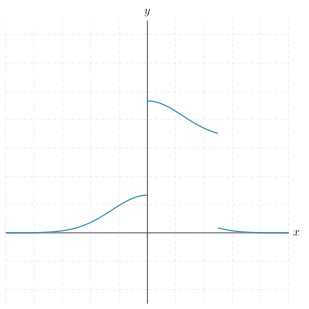
- \(\,\) \begin{align*} && \mathbb{P}(X \leq x) &= \int_{-\infty}^x f(x) \d x \\ &&&= \begin{cases} \frac13 \Phi(x) & \text{if } x < 0 \\ \frac13\Phi(x) + \frac13x & \text{if } 0 \leq x \leq 2 \\ \frac13 \Phi(x) + \frac23 & \text{if } 2 < x \end{cases} \end{align*} When \(\lambda = 2\), \(\mu = \frac{4}{6} = \frac23\), \(\sigma^2 = \frac{16+32+24+12}{12 \cdot 9} = \frac{7}{9}\), so \(\mu + 2 \sigma = \frac23 + \frac{2\sqrt7}{3}>2\). Therefore \begin{align*} && \P(0 < X < \mu + 2\sigma) &= \frac13 \Phi\left (\frac{2+2\sqrt{7}}{3} \right) + \frac23 - \Phi(0) \\ &&&= \tfrac13 \cdot 0.9921 +\tfrac23 - \tfrac12 \\ &&&= 0.4974 \end{align*}
2005 Paper 3 Q14
In this question, you may use the result \[ \displaystyle \int_0^\infty \frac{t^m}{(t+k)^{n+2}} \; \mathrm{d}t =\frac{m!\, (n-m)!}{(n+1)! \, k^{n-m+1}}\;, \] where \(m\) and \(n\) are positive integers with \(n\ge m\,\), and where \(k>0\,\). The random variable \(V\) has density function \[ \f(x) = \frac{C \, k^{a+1} \, x^a}{(x+k)^{2a+2}} \quad \quad (0 \le x < \infty) \;, \] where \(a\) is a positive integer. Show that \(\displaystyle C = \frac{(2a+1)!}{a! \, a!}\;\). Show, by means of a suitable substitution, that \[ \int_0^v \frac{x^a}{(x+k)^{2a+2}} \; \mathrm{d}x = \int_{\frac{k^2}{v}}^\infty \frac{u^a}{(u+k)^{2a+2}} \; \mathrm{d}u \] and deduce that the median value of \(V\) is \(k\). Find the expected value of \(V\). The random variable \(V\) represents the speed of a randomly chosen gas molecule. The time taken for such a particle to travel a fixed distance \(s\) is given by the random variable \(\ds T=\frac{s}{V}\). Show that \begin{equation} \mathbb{P}( T < t) = \ds \int_{\frac{s}{t}}^\infty \frac{C \, k^{a+1} \, x^a}{(x+k)^{2a+2}}\; \mathrm{d}x \tag{\( *\)} \end{equation} and hence find the density function of \(T\). You may find it helpful to make the substitution \(\ds u = \frac{s}{x}\) in the integral \((*)\). Hence show that the product of the median time and the median speed is equal to the distance \(s\), but that the product of the expected time and the expected speed is greater than \(s\).
Solution: \begin{align*} && f(x) &= \frac{C \, k^{a+1} \, x^a}{(x+k)^{2a+2}} \\ \Rightarrow && 1 &= \int_0^{\infty} f(x) \d x \\ &&&= \int_0^{\infty} \frac{C \, k^{a+1} \, x^a}{(x+k)^{2a+2}} \d x \\ &&&= Ck^{a+1} \int_0^{\infty} \frac{x^a}{(x+k)^{2a+2} }\d x \\ &&&= Ck^{a+1} \frac{a!(2a-a)!}{(2a+1)!k^{2a-a+1}} \\ &&&= C \frac{a!a!}{(2a+1)!} \\ \Rightarrow && C &= \frac{(2a+1)!}{a!a!} \end{align*} \begin{align*} && I &= \int_0^v \frac{x^a}{(x+k)^{2a+2}} \d x\\ u = k^2/x, \d x = -k^2u^{-2} \d u: &&&= \int_{u = +\infty}^{u = k^2/v} \frac{k^{2a}u^{-a}}{(k^2u^{-1} +k)^{2a+2}}(-k^2u^{-2}) \d u \\ &&&= \int_{u = +\infty}^{u = k^2/v} \frac{k^{2a-2a-2}u^{2a+2-a}}{(k +u)^{2a+2}}(-k^2u^{-2}) \d u \\ &&&= \int_{ k^2/v}^{\infty} \frac{u^{a}}{(k +u)^{2a+2}} \d u \\ \end{align*} At the median we want a value \(M\) such that \(M = k^2/M\) ie \(M = k\) \begin{align*} && \mathbb{E}(V) &= \int_0^{\infty} x f(x) \d x \\ &&&= \frac{(2a+1)!k^{a+1}}{a!a!} \int_0^{\infty} \frac{x^{a+1}}{(x+k)^{2a+2}} \d x \\ &&&= \frac{(2a+1)!k^{a+1}}{a!a!} \frac{(a+1)!(2a-(a+1))!}{(2a+1)!k^{2a-(a+1)+1}}\\ &&&= \frac{k^{a+1}}{a!} \frac{(a+1)(a-1)!}{k^{a}} \\ &&&= \frac{k(a+1)}{a} = \frac{a+1}a k \end{align*} \begin{align*} && \mathbb{P}(T < t) &= \mathbb{P}(\frac{s}{V} < t) \\ &&&= \mathbb{P}(V > \frac{s}{t}) \\ &&&= \int_{s/t}^{\infty} f(x) \d x \\ &&&= \int_{s/t}^{\infty} \frac{C \, k^{a+1} \, x^a}{(x+k)^{2a+2}} \d x \\ \\ \Rightarrow && f_T(t) &= \frac{\d}{\d t} \left ( \mathbb{P}(T < t)\right) \\ &&&= \frac{\d}{\d t} \left ( \int_{s/t}^{\infty} \frac{C \, k^{a+1} \, x^a}{(x+k)^{2a+2}} \d x \right) \\ &&&= - \frac{C \, k^{a+1} \, \left ( \frac{s}{t} \right)^a}{(\frac{s}{t}+k)^{2a+2}} \cdot \left (-\frac{s}{t^2} \right) \\ &&&= \frac{Ck^{a+1}s^{a+1}t^{2a+2}}{t^{a+2}(s+kt)^{2a+2}} \\ &&&= \frac{C(ks)^{a+1}t^a}{(s+kt)^{2a+2}} \\ &&&= \frac{C(\frac{s}{k})^{a+1}t^a}{(\frac{s}{k}+t)^{2a+2}} \end{align*} Therefore \(T\) follows the same distribution, but with parameter \(s/k\) rather than \(k\). In particular it has median \(s/k\) (and the product of the medians is \(s\)). However, the product of the expected time and expected speed is \(\frac{a+1}{a} k \frac{a+1}{a} \frac{s}{k} = \left ( \frac{a+1}{a} \right)^2s > s\)
2004 Paper 2 Q12
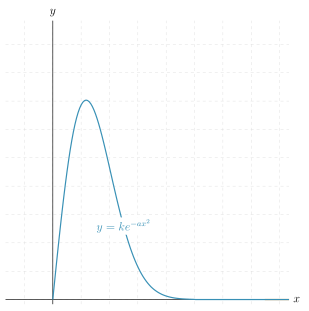
Sketch the graph, for \(x \ge 0\,\), of $$ y = kx\e^{-ax^2} \;, $$ where \(a\) and \(k\) are positive constants. The random variable \(X\) has probability density function \(\f(x)\) given by \begin{equation*} \f(x)= \begin{cases} kx\e^{-ax^2} & \text{for \(0 \le x \le 1\)}\\[3pt] 0 & \text{otherwise}. \end{cases} \end{equation*} Show that \(\displaystyle k=\frac{2a}{1-\e^{-a}}\) and find the mode \(m\) in terms of \(a\,\), distinguishing between the cases \(a < \frac12\) and \(a > \frac12\,\). Find the median \(h\) in terms of \(a\), and show that \(h > m\) if \(a > -\ln\left(2\e^{-1/2} - 1\right).\) Show that, \(-\ln\left(2\e^{-1/2}-1\right)> \frac12 \,\). Show also that, if \(a > -\ln\left(2\e^{-1/2} - 1\right) \,\), then $$ P(X > m \;\vert\; X < h) = {{2\e^{-1/2}-\e^{-a}-1} \over 1-\e^{-a}}\;. $$
Solution:
2003 Paper 3 Q12
Brief interruptions to my work occur on average every ten minutes and the number of interruptions in any given time period has a Poisson distribution. Given that an interruption has just occurred, find the probability that I will have less than \(t\) minutes to work before the next interruption. If the random variable \(T\) is the time I have to work before the next interruption, find the probability density function of \(T\,\). I need an uninterrupted half hour to finish an important paper. Show that the expected number of interruptions before my first uninterrupted period of half an hour or more is \(\e^3-1\). Find also the expected length of time between interruptions that are less than half an hour apart. Hence write down the expected wait before my first uninterrupted period of half an hour or more.
2001 Paper 3 Q14
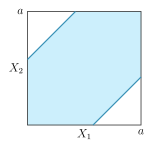
A random variable \(X\) is distributed uniformly on \([\, 0\, , \, a\,]\). Show that the variance of \(X\) is \({1 \over 12} a^2\). A sample, \(X_1\) and \(X_2\), of two independent values of the random variable is drawn, and the variance \(V\) of the sample is determined. Show that \(V = {1 \over 4} \l X_1 -X_2 \r ^2\), and hence prove that \(2 V\) is an unbiased estimator of the variance of X. Find an exact expression for the probability that the value of \(V\) is less than \({1 \over 12} a^2\) and estimate the value of this probability correct to one significant figure.
Solution: \begin{align*} && \E[X] &= \frac{a}{2}\tag{by symmetry} \\ &&\E[X^2] &= \int_0^a \frac{1}{a} x^2 \d x \\ &&&= \frac{a^3}{3a} = \frac{a^2}{3} \\ \Rightarrow && \var[X] &= \frac{a^2}{3} - \frac{a^2}{4} = \frac{a^2}{12} \\ \end{align*} \begin{align*} && V &=\frac{1}{2} \left ( \left ( X_1 - \frac{X_1+X_2}{2} \right )^2+\left ( X_2- \frac{X_1+X_2}{2} \right )^2 \right ) \\ &&&= \frac{1}{8} ((X_1 - X_2)^2 + (X_2 - X_1)^2 ) \\ &&&= \frac14 (X_1-X_2)^2 \\ \\ && \E[2V] &= \E \left [ \frac12 (X_1 - X_2)^2 \right] \\ &&&= \frac12 \E[X_1^2] - \E[X_1X_2] + \frac12 \E[X_2^2] \\ &&&= \frac{a^2}{3} - \frac{a^2}{4} = \frac{a^2}{12} \end{align*} Therefore \(2V\) is an unbiased estimator of the variance of \(X\).
1999 Paper 2 Q13
A stick is broken at a point, chosen at random, along its length. Find the probability that the ratio, \(R\), of the length of the shorter piece to the length of the longer piece is less than \(r\). Find the probability density function for \(R\), and calculate the mean and variance of \(R\).
Solution: Let \(X \sim U[0, \tfrac12]\) be the shorter piece, so \(R = \frac{X}{1-X}\), and \begin{align*} && \mathbb{P}(R \leq r) &= \mathbb{P}(\tfrac{X}{1-X} \leq r) \\ &&&= \mathbb{P}(X \leq r - rX) \\ &&&= \mathbb{P}((1+r)X \leq r) \\ &&&= \mathbb{P}(X \leq \tfrac{r}{1+r} ) \\ &&&= \begin{cases} 0 & r < 0 \\ \frac{2r}{1+r} & 0 \leq r \leq 1 \\ 1 & r > 1 \end{cases} \\ \\ && f_R(r) &= \begin{cases} \frac{2}{(1+r)^2} & 0 \leq r \leq 1 \\ 0 & \text{otherwise} \end{cases} \end{align*} Let \(Y \sim U[\tfrac12, 1]\) be the longer piece, then \(R = \frac{1-Y}{Y} = Y^{-1} - 1\) and \begin{align*} \E[R] &= \int_{\frac12}^1 (y^{-1}-1) 2 \d y \\ &= 2\left [\ln y - y \right]_{\frac12}^1 \\ &= -2 + 2\ln2 +2\frac12 \\ &= 2\ln2 -1 \\ \\ \E[R^2] &= \int_{\frac12}^1 (y^{-1}-1)^2 2 \d y\\ &= 2\left [-y^{-1} -2\ln y + 1 \right]_{\frac12}^1 \\ &= 2 \left ( 2 - 2\ln 2+\frac12\right) \\ &= 3-4\ln 2 \\ \var[R] &= 3 - 4 \ln 2 -(2\ln 2-1)^2 \\ &= 2 - 4(\ln 2)^2 \end{align*}
1998 Paper 2 Q13
A random variable \(X\) has the probability density function \[ \mathrm{f}(x)=\begin{cases} \lambda\mathrm{e}^{-\lambda x} & x\geqslant0,\\ 0 & x<0. \end{cases} \] Show that $${\rm P}(X>s+t\,\vert X>t) = {\rm P}(X>s).$$ The time it takes an assistant to serve a customer in a certain shop is a random variable with the above distribution and the times for different customers are independent. If, when I enter the shop, the only two assistants are serving one customer each, what is the probability that these customers are both still being served at time \(t\) after I arrive? One of the assistants finishes serving his customer and immediately starts serving me. What is the probability that I am still being served when the other customer has finished being served?
Solution: \begin{align*} && \mathbb{P}(X > t) &= \int_t^{\infty} \lambda e^{-\lambda x} \d x\\ &&&= \left[ -e^{-\lambda x} \right]_t^\infty \\ &&&= e^{-\lambda t}\\ \\ && \mathbb{P}(X > s + t | X > t) &= \frac{\mathbb{P}(X > s + t)}{\mathbb{P}(X > t)} \\ &&&= \frac{e^{-(s+t)\lambda}}{e^{-t\lambda}} \\ &&&= e^{-s\lambda} = \mathbb{P}(X > s) \end{align*} The probability both are still being served (independently) is \(\mathbb{P}(X > t)^2 = e^{-2\lambda t}\). The probability is exactly \(\frac12\). The property we proved in the first part of the questions shows the distribution is memoryless, ie we are both experiencing samples from the same distribution. Therefore we are equally likely to finish first.