Problems
Filters
22 problems found
1994 Paper 2 Q2
If \(\mathrm{Q}\) is a polynomial, \(m\) is an integer, \(m\geqslant1\) and \(\mathrm{P}(x)=(x-a)^{m}\mathrm{Q}(x),\) show that \[ \mathrm{P}'(x)=(x-a)^{m-1}\mathrm{R}(x) \] where \(\mathrm{R}\) is a polynomial. Explain why \(\mathrm{P}^{(r)}(a)=0\) whenever \(1\leqslant r\leqslant m-1\). (\(\mathrm{P}^{(r)}\) is the \(r\)th derivative of \(\mathrm{P}.\)) If \[ \mathrm{P}_{n}(x)=\frac{\mathrm{d}^{n}}{\mathrm{d}x^{n}}(x^{2}-1)^{n} \] for \(n\geqslant1\) show that \(\mathrm{P}_{n}\) is a polynomial of degree \(n\). By repeated integration by parts, or otherwise, show that, if \(n-1\geqslant m\geqslant0,\) \[ \int_{-1}^{1}x^{m}\mathrm{P}_{n}(x)\,\mathrm{d}x=0 \] and find the value of \[ \int_{-1}^{1}x^{n}\mathrm{P}_{n}(x)\,\mathrm{d}x. \] {[}Hint. \textit{You may use the formula \[ \int_{0}^{\frac{\pi}{2}}\cos^{2n+1}t\,\mathrm{d}t=\frac{(2^{2n})(n!)^{2}}{(2n+1)!} \] without proof if you need it. However some ways of doing this question do not use this formula.}{]}
Solution: \begin{align*} && P(x) &= (x-a)^mQ(x) \\ \Rightarrow && P'(x) &= m(x-a)^{m-1}Q(x) + (x-a)^mQ'(x) \\ &&&= (x-a)^{m-1}(\underbrace{mQ(x) + (x-a)Q'(x)}_{\text{a polynomial}}) \\ &&&= (x-a)^{m-1}R(x) \end{align*} Therefore \(P^{(r)}(a) = 0\) for \(1 \leq r \leq m-1\) since each time we differentiate we will have a factor of \((x-a)^{m-r}\) which is zero when we evaluate at \(x = a\). If \(P_n(x) = \frac{\d^n}{\d x^n}(x^2-1)^n\) then we are differentiating a degree \(2n\) polynomial \(n\) times. Each time we differentiate we reduce the degree by \(1\), therefore the degree of \(P_n\) is \(n\). \begin{align*} && \int_{-1}^1 x^mP_n(x) \d x &= \left [x^m \underbrace{\frac{\d^{n-1}}{\d x^{n-1}}\left ( (x-1)^{n} (x+1)^{n} \right)}_{\text{has a factor of }x-1\text{ and }x+1}\right]_{-1}^1 - \int_{-1}^1 mx^{m-1}\frac{\d^{n-1}}{\d x^{n-1}}\left ( (x-1)^{n} (x+1)^{n} \right) \d x\\ &&&= 0 - \int_{-1}^1 mx^{m-1}\frac{\d^{n-1}}{\d x^{n-1}}\left ( (x-1)^{n} (x+1)^{n} \right) \d x\\ &&&= -\left [mx^{m-1} \underbrace{\frac{\d^{n-2}}{\d x^{n-2}}\left ( (x-1)^{n} (x+1)^{n} \right)}_{\text{has a factor of }x-1\text{ and }x+1}\right]_{-1}^1+ \int_{-1}^1 m(m-1)x^{m-2}\frac{\d^{n-2}}{\d x^{n-2}}\left ( (x-1)^{n} (x+1)^{n} \right) \d x\\ &&&= m(m-1)\int_{-1}^1 x^{m-2}\frac{\d^{n-2}}{\d x^{n-2}}\left ( (x-1)^{n} (x+1)^{n} \right) \d x\\ &&& \cdots \\ &&&= (-1)^m m!\int_{-1}^1 \frac{\d^{n-m}}{\d x^{n-m}} \left ( (x-1)^{n} (x+1)^{n} \right) \d x\\ &&&= 0 \end{align*} If \(n = m\), we have \begin{align*} && \int_{-1}^1 x^n P_n(x) \d x&= (-1)^nn! \int_{-1}^1 (x^2-1)^n \d x \\ && &= (-1)^{2n}n! \cdot 2\int_{0}^1 (1-x^2)^n \d x \\ x = \sin \theta, \d x = \cos \theta \d \theta: &&&= 2 \cdot n!\int_{0}^{\pi/2} \cos^{2n} \theta \cdot \cos \theta \d \theta \\ &&&= 2 \cdot n!\int_{0}^{\pi/2} \cos^{2n+1} \theta \d \theta \\ &&&= 2 \cdot n!\frac{(2^{2n})(n!)^{2}}{(2n+1)!} \\ &&&= \frac{(2^{2n+1})(n!)^{3}}{(2n+1)!} \\ \end{align*}
1994 Paper 2 Q5
- Show that the equation \[ (x-1)^{4}+(x+1)^{4}=c \] has exactly two real roots if \(c>2,\) one root if \(c=2\) and no roots if \(c<2\).
- How many real roots does the equation \(\left(x-3\right)^{4}+\left(x-1\right)^{4}=c\) have?
- How many real roots does the equation \(\left|x-3\right|+\left|x-1\right|=c\) have?
- How many real roots does the equation \(\left(x-3\right)^{3}+\left(x-1\right)^{3}=c\) have?
Solution:
- \(\,\) \begin{align*} && c &= (x-1)^4+(x+1)^4 \\ &&&= 2x^4+12x^2+2 \\ \Rightarrow && 0 &= (x^2+6)^2-\frac{c}{2} - 35 \\ \Rightarrow && \underbrace{x^2+6}_{\geq 6} &= \pm \sqrt{35 + \frac{c}{2}}\\ \end{align*} Therefore there are two solutions if \(c > 2\), one solution if \(c = 2\) and no solutions otherwise.
- \(\,\) This equation is the same equation if \(y = x-2\), ie there are two solutions if \(c > 2\), one solution if \(c = 2\) and no solutions otherwise.
- Rewriting as \(|x-1|+|x+1| = c\) we have For \(x < -1\): \(1-x-1-x = -2x\) For \(-1 \leq x \leq 1\): \(1-x+x+1 = 2\) For \(x > 1\): \(x-1+x+1 = 2x\) Therefore there are infinitely many solutions if \(c = 2\) (the interval \([-3,-1]\)), two solutions if \(c > 2\) and none otherwise.
- Rewriting as \((x-1)^3+(x+1)^3\) we have \(x^3+6x = c\). Notice that \(3x^2+6 > 0\) so the function is increasing, ie there is one solution for all \(c\)
1990 Paper 1 Q3
Given a curve described by \(y=\mathrm{f}(x)\), and such that \(y\geqslant0\), a push-off of the curve is a new curve obtained as follows: for each point \((x,\mathrm{f}(x))\) with position vector \(\mathbf{r}\) on the original curve, there is a point with position vector \(\mathbf{s}\) on the new curve such that \(\mathbf{s-r}=\mathrm{p}(x)\mathbf{n},\) where \(\mathrm{p}\) is a given function and \(\mathbf{n}\) is the downward-pointing unit normal to the original curve at \(\mathbf{r}\).
- For the curve \(y=x^{k},\) where \(x>0\) and \(k\) is a positive integer, obtain the function \(\mathrm{p}\) for which the push-off is the positive \(x\)-axis, and find the value of \(k\) such that, for all points on the original curve, \(\left|\mathbf{r}\right|=\left|\mathbf{r-s}\right|\).
- Suppose that the original curve is \(y=x^{2}\) and \(\mathrm{p}\) is such that the gradient of the curves at the points with position vectors \(\mathbf{r}\) and \(\mathbf{s}\) are equal (for every point on the original curve). By writing \(\mathrm{p}(x)=\mathrm{q}(x)\sqrt{1+4x^{2}},\) where \(\mathrm{q}\) is to be determined, or otherwise, find the form of \(\mathrm{p}\).
Solution:
- Suppose we have \(y = x^k\), then the tangent at \((t,t^k)\) has gradient \(\frac{\d y}{\d x} = kx^{k-1} = kt^{k-1}\) and the normal has gradient \(-\frac1k x^{1-k}\). For the push-off to be the positive \(x\)-axis, we need \(p(x)\) to be the length of the line. The line will have the equation: \begin{align*} && \frac{y - t^k}{x - t} &= -\frac1k t^{1-k} \\ y = 0: && x-t &= \frac{kt^k}{t^{1-k}} \\ && x& =t + kt^{2k-1} \end{align*} The distance from \((t,t^k)\) to \((t+kt^{2k-1},0)\) is \(\sqrt{t^{2k} + k^2t^{4k-2}} = t^k \sqrt{1+k^2t^{2k-2}} = y \sqrt{1+k^2 \frac{y^2}{x^2}} = \frac{y}{x} \sqrt{x^2 + k^2y^2}\), ie \(p(x) = \frac{y}{x}\sqrt{x^2+k^2y^2}\) If \(\left|\mathbf{r}\right|=\left|\mathbf{r-s}\right|\), then we need \(\sqrt{x^2+y^2} = \frac{y}{x}\sqrt{x^2+ky^2}\), but clearly this is satisfied when \(k = 1\).
- The points are \((t, t^2)\) and the normal has graident \(-\frac{1}{2t}\), the normal vector is \(\frac{1}{\sqrt{1+\frac{1}{4t^2}}}\binom{1}{-\frac1{2t}} = \frac{1}{\sqrt{4t^2+1}} \binom{2t}{-1}\). If we write \(p(x) = q(x)\sqrt{4x^2+1}\) then the the new points are at \(\binom{t+q(t)2t}{t^2-\q(t)}\) an the gradient will be \(\frac{2t-q'(t)}{1+q'(t)2t+2q(t)}\). We need it to be the case that \begin{align*} && 2t &= \frac{2t-q'(t)}{1+2q(t)+2tq'(t)} \\ \Rightarrow && 4tq(t) &= -q'(t)(1+4t^2) \\ \Rightarrow && \frac{q'(t)}{q(t)} &= -\frac{4t}{1+4t^2} \\ \Rightarrow && \ln q(t) &= -\frac12 \ln(1+4t^2)+C \\ \Rightarrow && q(t) &= A(1+4t^2)^{-1/2} \\ \Rightarrow && p(x) &= A \end{align*} So the push-off's are constants.
1990 Paper 1 Q5
- Evaluate \[ \int_{1}^{3}\frac{1}{6x^{2}+19x+15}\,\mathrm{d}x\,. \]
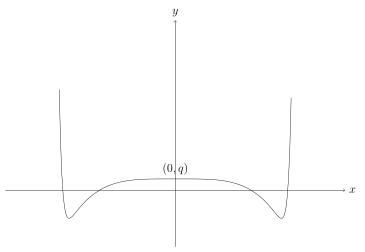
- Sketch the graph of the function \(\mathrm{f}\), where \(\mathrm{f}(x)=x^{1760}-x^{220}+q\), and \(q\) is a constant. Find the possible numbers of \textit{distinct }roots of the equation \(\mathrm{f}(x)=0\), and state the inequalities satisfied by \(q\).
Solution:
- \begin{align*} \int_{1}^{3}\frac{1}{6x^{2}+19x+15}\,\mathrm{d}x &= \int_1^3 \frac1{(2x+3)(3x+5)} \d x \\ &= \int_1^3 \l \frac{2}{2x+3} - \frac{3}{3x+5} \r \d x \\ &= \left [\ln(2x+3) - \ln(3x+5) \right ]_1^3 \\ &= \l \ln9 - \ln14 \r - \l \ln 5 - \ln 8 \r \\ &= \ln \frac{72}{70} \\ &= \ln \frac{36}{35} \end{align*}
- When \(q = 0\) the roots are \(-1, 0, 1\) There can be \(0, 2, 3, 4\) roots. There will be no roots if \(q > -\min (x^{1760} - x^{220})\) since the whole graph will be above the axis. There will be \(2\) roots if \(q = -\min (x^{1760} - x^{220})\) or \(q > 0\) There will be \(4\) roots if \(0 > q > -\min (x^{1760} - x^{220})\). There will be \(3\) roots if \(q =0\)
1990 Paper 3 Q7
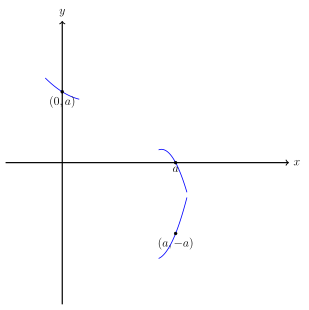
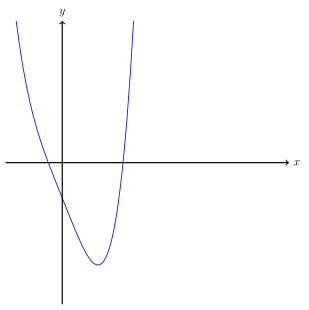
The points \(P\,(0,a),\) \(Q\,(a,0)\) and \(R\,(a,-a)\) lie on the curve \(C\) with cartesian equation \[ xy^{2}+x^{3}+a^{2}y-a^{3}=0,\qquad\mbox{ where }a>0. \] At each of \(P,Q\) and \(R\), express \(y\) as a Taylor series in \(h\), where \(h\) is a small increment in \(x\), as far as the term in \(h^{2}.\) Hence, or otherwise, sketch the shape of \(C\) near each of these points. Show that, if \((x,y)\) lies on \(C\), then \[ 4x^{4}-4a^{3}x-a^{4}\leqslant0. \] Sketch the graph of \(y=4x^{4}-4a^{3}x-a^{4}.\) Given that the \(y\)-axis is an asymptote to \(C\), sketch the curve \(C\).
Solution: \begin{align*} && 0 &= xy^{2}+x^{3}+a^{2}y-a^{3} \\ \frac{\d }{\d x} : && 0 &= y^2+2xyy' + 3x^2+a^2y' \\ \Rightarrow && y' &= -\frac{y^2+3x^2}{a^2+2xy} \\ \\ \frac{\d^2 }{\d x^2}: && 0 &= 2yy'+2yy'+2x(y')^2+2xyy''+6x+a^2y'' \\ \Rightarrow && y'' &= -\frac{4yy'+2x(y')^2+6x}{a^2+2xy} \\ \\ P: && y &= a \\ && y' &= -\frac{a^2}{a^2} = -1 \\ && y'' &= -\frac{-4a}{a^2} = \frac{4}{a} \\ \Rightarrow && y &\approx a - h+\frac{2}{a}h^2 \\ \\ Q: && y &= 0 \\ && y' &= -\frac{3a^2}{a^2} = -3 \\ && y'' &= -\frac{18a+6a}{a^2} = -\frac{24}{a} \\ \Rightarrow && y &\approx 0-3h-\frac{12}{a}h \\ \\ R: && y &= -a \\ && y' &= -\frac{a^2+3a^2}{a^2-2a^2} = 4 \\ && y'' &= -\frac{-16a+32a+6a}{a^2-2a^2} = \frac{22}{a} \\ \Rightarrow && y &\approx -a+4h + \frac{11}{a}h^2 \end{align*} Alternatively: \begin{align*} && 0 &= xy^{2}+x^{3}+a^{2}y-a^{3} \\ P(0,a): && y &\approx a + c_1h + c_2h^2 \\ && 0 &= h(a+c_1h)^2 + a^2(a + c_1h + c_2h^2)-a^3 \\ &&&= a^3-a^3 + (a^2+a^2c_1)h+(2ac_1+a^2c_2)h^2 \\ \Rightarrow && c_1 &=-1, c_2 =\frac{2}{a} \\ \Rightarrow && y &\approx a - h + \frac{2}{a}h^2 \\ \\ Q(a,0): && y &\approx c_1h + c_2h^2 \\ && 0 &= (a+h)(c_1h)^2+(a+h)^3+a^2(c_1h + c_2h^2 )-a^3 \\ &&&= a^3-a^3+(3a^2+a^2c_1)h + (ac_1^2+3a+a^2c_2)h^2 + \cdots \\ \Rightarrow && c_1 &=-3, c_2 = -\frac{12}{a} \\ \Rightarrow && y &\approx -3h -\frac{12}{a}h \\ \\ R(a,-a): && y &\approx -a + c_1h + c_2h^2 \\ && 0 &= (a+h)(-a + c_1h+c_2h^2)^2+(a+h)^3+a^2(-a + c_1h + c_2h^2)-a^3 \\ &&&= (a^2-2a^2c_1+3a^2+a^2c_1)h+(-2ac_1+c_1^2+\cdots)h^2 \\ \Rightarrow && c_1 &=4, c_2 = \frac{11}{a} \\ \Rightarrow && y &\approx -a + 4h + \frac{11}{a} \end{align*}

1989 Paper 3 Q5
Given that \(y=\cosh(n\cosh^{-1}x),\) for \(x\geqslant1,\) prove that \[ y=\frac{(x+\sqrt{x^{2}-1})^{n}+(x-\sqrt{x^{2}-1})^{n}}{2}. \] Explain why, when \(n=2k+1\) and \(k\in\mathbb{Z}^{+},\) \(y\) can also be expressed as the polynomial \[ a_{0}x+a_{1}x^{3}+a_{2}x^{5}+\cdots+a_{k}x^{2k+1}. \] Find \(a_{0},\) and show that
- \(a_{1}=(-1)^{k-1}2k(k+1)(2k+1)/3\);
- \(a_{2}=(-1)^{k}2(k-1)k(k+2)(2k+1)/15.\)
Solution: Recall, \(\cosh^{-1} x = \ln (x + \sqrt{x^2-1})\) \begin{align*} \cosh(n \cosh^{-1} x) &= \frac12 \left ( \exp(n \cosh^{-1} x) + \exp(-n\cosh^{-1}x) \right) \\ &= \frac12 \left ((x + \sqrt{x^2-1})^n + (x + \sqrt{x^2-1})^{-n} \right) \\ &= \frac12 \left ((x + \sqrt{x^2-1})^n + (x - \sqrt{x^2-1})^{n} \right) \\ \end{align*} When \(n = 2k+1\) \begin{align*} \cosh(n \cosh^{-1} x)&= \frac12 \left ((x + \sqrt{x^2-1})^n + (x - \sqrt{x^2-1})^{n} \right) \\ &= \frac12 \left (\sum_{i=0}^{2k+1}\binom{2k+1}{i}x^{2k+1-i}\left ( (\sqrt{x^2-1}^{i} + (-\sqrt{x^2-1})^{i} \right) \right) \\ &=\sum_{i=0}^{k} \binom{2k+1}{2i}x^{2k+1-2i}(x^2-1)^i \\ &=\sum_{i=0}^{k} \binom{2k+1}{2i}x^{2(k-i)+1}(x^2-1)^i \\ \end{align*} Which is clearly a polynomial with only odd degree terms. \begin{align*} a_0 &= \frac{\d y}{\d x} \vert_{x=0} \\ &= \sum_{i=0}^k\binom{2k+1}{2i} \left ( (2(k-i)+1)x^{2(k-i)}(x^2-1)^i + 2i\cdot x^{2(k-i)+2}(x^2-1) \right) \\ &= \binom{2k+1}{2k} (-1)^{k} \\ &= (-1)^k(2k+1) \end{align*}
- \begin{align*} a_1 &= \binom{2k+1}{2k}\binom{k}{1}(-1)^{k-1}+\binom{2k+1}{2(k-1)}(-1)^{k-1} \\ &=(-1)^{k-1}\cdot ( (2k+1)k + \frac{(2k+1)\cdot 2k \cdot (2k-1)}{3!}) \\ &= (-1)^{k-1}(2k+1)k\frac{3 + 2k-1}{3} \\ &= (-1)^{k-1}2(2k+1)k (k+1) \end{align*}
- \begin{align*} a_2 &= \binom{2k+1}{2k} \binom{k}{2}(-1)^{k-2} + \binom{2k+1}{2(k-1)} \binom{k-1}{1} (-1)^{k-2}+\binom{2k+1}{2(k-2)} (-1)^{k-2} \\ &= \binom{2k+1}{1} \binom{k}{2}(-1)^{k-2} + \binom{2k+1}{3} \binom{k-1}{1} (-1)^{k-2}+\binom{2k+1}{5} (-1)^{k-2} \\ &= (-1)^{k} \left (\binom{2k+1}{1} \frac{k(k-1)}{2} + \binom{2k+1}{3}(k-1)+\binom{2k+1}{5} \right) \\ &= (-1)^{k} \left ( \frac{(2k+1)k(k-1)}{2} + \frac{(2k+1)k(2k-1)}{3} + \frac{(2k+1)k(2k-1)(k-1)(2k-3)}{5\cdot2\cdot3} \right) \\ &= (-1)^k (2k+1)k\frac{1}{30} \left ( 15(k-1) + 10(2k-1)+(2k-1)(k-1)(2k-3) \right) \end{align*}
1988 Paper 1 Q7
The function \(\mathrm{f}\) is defined by \[ \mathrm{f}(x)=ax^{2}+bx+c. \] Show that \[ \mathrm{f}'(x)=\mathrm{f}(1)\left(x+\tfrac{1}{2}\right)+\mathrm{f}(-1)\left(x-\tfrac{1}{2}\right)-2\mathrm{f}(0)x. \] If \(a,b\) and \(c\) are real and such that \(\left|\mathrm{f}(x)\right|\leqslant1\) for \(\left|x\right|\leqslant1\), show that \(\left|\mathrm{f}'(x)\right|\leqslant4\) for \(\left|x\right|\leqslant1\). Find particular values of \(a,b\) and \(c\) such that, for the corresponding function \(\mathrm{f}\) of the above form \(\left|\mathrm{f}(x)\right|\leqslant1\) for all \(x\) with \(\left|x\right|\leqslant1\) and \(\mathrm{f}'(x)=4\) for some \(x\) satisfying \(\left|x\right|\leqslant1\).
Solution: Let \(f(x) = ax^2 + bx + c\) then \begin{align*} f'(x) &= 2ax + b \\ f(0) &= c \\ f(1) &= a+b+c \\ f(-1) &= a-b+c \\ f(1)+f(-1) &= 2(a+c) \\ f(1)-f(-1) &= 2b \\ f'(x) &= x(f(1)+f(-1)) + \frac12 (f(1) - f(-1)) - 2f(0)x \end{align*} as required. Since \(f'(x)\) is a straight line, the maximum value is either at \(1, -1\) or it's constant and either end suffices. \begin{align*} |f'(1)| & \leq |f(1)|\frac{3}{2} + |f(-1)| \frac12 + 2 |f(0)| \\ &\leq \frac{3}{2} + \frac12 + 2 \\ &= 4 \\ \\ |f'(-1)| & \leq |f(1)|\frac{1}{2} + |f(-1)| \frac32 + 2 |f(0)| \\ &\leq \frac{3}{2} + \frac12 + 2 \\ &= 4 \\ \end{align*} Therefore \(|f'(x)| \leq 4\). Suppose \(|f'(x)| = 4\) for some value in \(x \in [-1,1]\), then it must be either \(-1\) or \(1\). If \(f'(1) = 4\) then \(f(1) = 1, f(-1) = 1, f(0) = -1\) so \(f(x) = 1+ k(x^2-1) \Rightarrow f(x) = 1+2(x^2-1) = 2x^2 -1\). If \(f'(-1) = 4\) then \(f(1) = -1, f(-1) = -1, f(0) = 1 \Rightarrow f(x) = -2x^2 + 1\)