Problems
Filters
24 problems found
1992 Paper 3 Q9
The straight line \(OSA,\) where \(O\) is the origin, bisects the angle between the positive \(x\) and \(y\) axes. The ellipse \(E\) has \(S\) as focus. In polar coordinates with \(S\) as pole and \(SA\) as the initial line, \(E\) has equation \(\ell=r(1+e\cos\theta).\) Show that, at the point on \(E\) given by \(\theta=\alpha,\) the gradient of the tangent to the ellipse is given by \[ \frac{\mathrm{d}y}{\mathrm{d}x}=\frac{\sin\alpha-\cos\alpha-e}{\sin\alpha+\cos\alpha+e}. \] The points on \(E\) given by \(\theta=\alpha\) and \(\theta=\beta\) are the ends of a diameter of \(E\). Show that \[ \tan(\alpha/2)\tan(\beta/2)=-\frac{1+e}{1-e}. \] [Hint. A diameter of an ellipse is a chord through its centre.]
Solution:

1992 Paper 3 Q10
Sketch the curve \(C\) whose polar equation is \[ r=4a\cos2\theta\qquad\mbox{ for }-\tfrac{1}{4}\pi<\theta<\tfrac{1}{4}\pi. \] The ellipse \(E\) has parametric equations \[ x=2a\cos\phi,\qquad y=a\sin\phi. \] Show, without evaluating the integrals, that the perimeters of \(C\) and \(E\) are equal. Show also that the areas of the regions enclosed by \(C\) and \(E\) are equal.
Solution:

1991 Paper 3 Q5
The curve \(C\) has the differential equation in polar coordinates \[ \frac{\mathrm{d}^{2}r}{\mathrm{d}\theta^{2}}+4r=5\sin3\theta,\qquad\text{for }\quad\frac{\pi}{5}\leqslant\theta\leqslant\frac{3\pi}{5}, \] and, when \(\theta=\dfrac{\pi}{2},\) \(r=1\) and \(\dfrac{\mathrm{d}r}{\mathrm{d}\theta}=-2.\) Show that \(C\) forms a closed loop and that the area of the region enclosed by \(C\) is \[ \frac{\pi}{5}+\frac{25}{48}\left[\sin\left(\frac{\pi}{5}\right)-\sin\left(\frac{2\pi}{5}\right)\right]. \]
Solution: First we seek the complementary function. \begin{align*} && \frac{\mathrm{d}^{2}r}{\mathrm{d}\theta^{2}}+4r &= 0 \\ \Rightarrow && r &= A \sin 2\theta + B \cos 2 \theta \end{align*} Next we seek a particular integral, of the form \(r = C \sin 3 \theta\). \begin{align*} && \frac{\mathrm{d}^{2}r}{\mathrm{d}\theta^{2}}+4r &= 5 \sin 3 \theta \\ \Rightarrow && -9C \sin 3 \theta + 4C \sin 3 \theta &= 5 \sin 3 \theta \\ \Rightarrow && C &= -1 \\ \end{align*} So our general solution is \(A \sin 2\theta + B \cos 2 \theta -\sin 3 \theta\). Plugging in boundary conditions we obtain: \begin{align*} \theta = \frac{\pi}{2}, r = 1: &&1 &= -B +1 \\ \Rightarrow && B &= 0 \\ \theta = \frac{\pi}{2}, \frac{\d r}{\d \theta} = -2: && -2 &= -2A \\ \Rightarrow && A &= 1 \end{align*} So the general solution is \(r = \sin 2 \theta - \sin 3 \theta = 2 \sin \left ( \frac{-\theta}{2} \right) \cos \left (\frac{5 \theta}{2} \right)\) First notice that for \(\theta \in \left [\frac{\pi}{5}, \frac{3 \pi}{5} \right]\) this is positive, and it is zero on the end points, therefore we are tracing out a a loop. The area of the loop will be: \begin{align*} A &= \int_{\pi/5}^{3\pi/5} \frac12 \left ( \sin 2 \theta - \sin 3 \theta \right)^2 \d \theta \\ &= \frac12\int_{\pi/5}^{3\pi/5} \sin^2 2\theta + \sin^2 3 \theta - 2 \sin 2 \theta \cos 3 \theta \d \theta \\ &= \frac12\int_{\pi/5}^{3\pi/5} \frac{1-2 \cos 4 \theta}{2} + \frac{1-2 \cos6 \theta}{2} - \sin5 \theta-\cos\theta \d \theta \\ &= \frac12 \left [\theta - \frac14 \sin 4 \theta-\frac16 \sin 6 \theta + \frac15 \cos 5 \theta - \sin \theta \right]_{\pi/5}^{3\pi/5} \\ &= \frac{\pi}{5} +\frac{25}{48}\left [ \sin\left(\frac{\pi}{5}\right)-\sin\left(\frac{2\pi}{5}\right) \right] \end{align*}
1991 Paper 3 Q9
The parametric equations \(E_{1}\) and \(E_{2}\) define the same ellipse, in terms of the parameters \(\theta_{1}\) and \(\theta_{2}\), (though not referred to the same coordinate axes). \begin{alignat*}{2} E_{1}:\qquad & x=a\cos\theta_{1}, & \quad & y=b\sin\theta_{1},\\ E_{2}:\qquad & x=\dfrac{k\cos\theta_{2}}{1+e\cos\theta_{2}}, & \quad & y=\dfrac{k\sin\theta_{2}}{1+e\cos\theta_{2}}, \end{alignat*} where \(0< b< a,\) \(0< e< 1\) and \(0< k\). Find the position of the axes for \(E_{2}\) relative to the axes for \(E_{1}\) and show that \(k=a(1-e^{2})\) and \(b^{2}=a^{2}(1-e^{2}).\) {[}The standard polar equation of an ellipse is \(r=\dfrac{\ell}{1+e\cos\theta}.]\) By considering expressions for the length of the perimeter of the ellipse, or otherwise, prove that \[ \int_{0}^{\pi}\sqrt{1-e^{2}\cos^{2}\theta}\,\mathrm{d}\theta=\int_{0}^{\pi}\frac{1-e^{2}}{(1+e\cos\theta)^{2}}\sqrt{1+e^{2}+2e\cos\theta}\,\mathrm{d}\theta. \] Given that \(e\) is so small that \(e^{6}\) may be neglected, show that the value of either integral is \[ \tfrac{1}{64}\pi(64-16e^{2}-3e^{4}). \]
1990 Paper 2 Q9
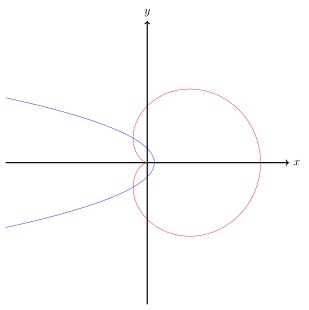
Show by means of a sketch that the parabola \(r(1+\cos\theta)=1\) cuts the interior of the cardioid \(r=4(1+\cos\theta)\) into two parts. Show that the total length of the boundary of the part that includes the point \(r=1,\theta=0\) is \(18\sqrt{3}+\ln(2+\sqrt{3}).\)
Solution:
1989 Paper 2 Q5
- Show that in polar coordinates, the gradient of any curve at the point
\((r,\theta)\) is
\[
\left.\left(\frac{\mathrm{d}r}{\mathrm{d}\theta}\tan\theta+r\right)\right/\left(\frac{\mathrm{d}r}{\mathrm{d}\theta}-r\tan\theta\right).
\]

- A mirror is designed so that any ray of light which hits one side of the mirror and which is parallel to a certain fixed line \(L\) is reflected through a fixed point \(O\) on \(L\). For any ray hitting the mirror, the normal to the mirror at the point of reflection bisects the angle between the incident ray and the reflected ray, as shown in the figure. Prove that the mirror intersects any plane containing \(L\) in a parabola.
Solution:
- Suppose our curve is \(r(\theta)\), then \(y = r \sin \theta, x = r \cos \theta\) and \begin{align*} && \frac{\d y}{\d \theta} &= \frac{\d r}{\d \theta} \sin \theta + r \cos \theta \\ && \frac{\d x}{\d \theta} &= \frac{\d r}{\d \theta} \cos \theta - r \sin \theta \\ \Rightarrow && \frac{\d y}{\d x} &= \frac{\d y}{\d \theta} \Bigg / \frac{\d x}{\d \theta} \\ &&&= \frac{\frac{\d r}{\d \theta} \sin \theta + r \cos \theta}{\frac{\d r}{\d \theta} \cos \theta - r \sin \theta} \\ &&&= \frac{\frac{\d r}{\d \theta} \tan\theta + r }{\frac{\d r}{\d \theta} - r \tan\theta} \end{align*} as required.
- Set up a system of polar coordinates such that the origin is at \(O\) and all points in the plane containing \(L\) are represented by \((r, \theta)\). The constraint we have is that the angle of the normal, is \(\frac12 \theta\). Let \(\tan \tfrac12 \theta = t\), then \(\tan \theta = \frac{2t}{1-t^2}\) \begin{align*} && \tan \frac12 \theta &= -\frac{\frac{\d r}{\d \theta} - r \tan\theta}{\frac{\d r}{\d \theta} \tan\theta + r } \\ \Rightarrow && t &= -\frac{r'-r\frac{2t}{1-t^2}}{r' \frac{2t}{1-t^2}+r} \\ &&&= \frac{2tr-(1-t^2)r'}{2tr'+(1-t^2)r} \\ \Rightarrow && (2t^2+1-t^2)r' &= (2t-t+t^3)r \\ && (1+t^2)r' &= t(t^2+1) r \\ \Rightarrow && r' &= t r \\ \Rightarrow && \frac{\d r}{\d \theta} &= \tan \tfrac12 \theta r \\ \Rightarrow && \int \frac1r \d r &= \int \tan \frac12 \theta \d \theta \\ && \ln r &= -2\ln \cos \tfrac12 \theta+C \\ \Rightarrow && r\cos^2 \frac12 \theta &= C \\ \Rightarrow && r + r\cos \theta &= D \\ \Rightarrow && r &= D-x \\ \Rightarrow && x^2 + y^2 &= D^2 - 2Dx + x^2 \\ \Rightarrow && y^2 &= D^2-2Dx \end{align*} Therefore it is a parabola
1989 Paper 3 Q6
Show that, for a given constant \(\gamma\) \((\sin\gamma\neq0)\) and with suitable choice of the constants \(A\) and \(B\), the line with cartesian equation \(lx+my=1\) has polar equations \[ \frac{1}{r}=A\cos\theta+B\cos(\theta-\gamma). \] The distinct points \(P\) and \(Q\) on the conic with polar equations \[ \frac{a}{r}=1+e\cos\theta \] correspond to \(\theta=\gamma-\delta\) and \(\theta=\gamma+\delta\) respectively, and \(\cos\delta\neq0.\) Obtain the polar equation of the chord \(PQ.\) Hence, or otherwise, obtain the equation of the tangent at the point where \(\theta=\gamma.\) The tangents at \(L\) and \(M\) to a conic with focus \(S\) meet at \(T.\) Show that \(ST\) bisects the angle \(LSM\) and find the position of the intersection of \(ST\) and \(LM\) in terms of your chosen parameters for \(L\) and \(M.\)
Solution: \begin{align*} && \frac1{r} &= A \cos \theta + B \cos (\theta - \gamma) \\ &&&= A \cos \theta + B \cos \theta \cos \gamma + B \sin \theta \sin \gamma \\ &&&= (A+B \cos \gamma) \cos \theta + B \sin \gamma \sin \theta \\ \Longleftrightarrow && 1 &= (A+B \cos \gamma) x + B \sin \gamma y \end{align*} So if we choose \(B = \frac{m}{\sin \gamma}\) and \(A = l-m \cot \gamma\) we have the desired result. \begin{align*} && \frac{1 + e \cos (\gamma -\delta)}a &= A \cos (\gamma - \delta) + B \cos (\gamma - \delta - \gamma) \\ &&&= A \cos(\gamma-\delta) +B \cos \delta\\ && \frac{1 + e \cos (\gamma +\delta)}{a} &= A \cos (\gamma + \delta) + B \cos (\gamma + \delta - \gamma) \\ &&&= A \cos(\gamma + \delta) + B \cos \delta\\ \Rightarrow && \frac1{r} &= \frac{e}{a} \cos \theta + \frac{1}{a \cos \delta} \cos (\theta - \gamma) \\ \lim{\delta \to 0} &&\frac1{r} &= \frac{e}{a} \cos \theta+ \frac{1}{a} \cos (\theta - \gamma) \end{align*} Suppose we have have points \(L\) and \(M\) with \(\theta = \gamma_L, \gamma_M\) then our tangents are: \begin{align*} && \frac{a}{r} &= \cos \theta + \cos (\theta - \gamma_L) \\ && \frac{a}{r} &= \cos \theta + \cos (\theta - \gamma_M) \\ \Rightarrow && 0 &= \cos (\theta - \gamma_L) -\cos(\theta - \gamma_M) \\ &&&= - 2 \sin \frac{(\theta - \gamma_L)+(\theta - \gamma_M)}{2} \sin \frac{(\theta - \gamma_L)-(\theta - \gamma_M)}{2} \\ &&&= -2 \sin \left ( \theta - \frac{\gamma_L+\gamma_M}2 \right) \sin \left ( \frac{\gamma_M - \gamma_L}{2}\right) \\ \Rightarrow && \theta &= \frac{\gamma_L+\gamma_M}{2} \end{align*} Therefore clearly \(ST\) bisects \(LSM\). The line \(LM\) can be seen as the chord from the points \(\frac{\gamma_L+\gamma_M}{2} \pm \frac{\gamma_L-\gamma_M}{2}\), so the line is: \begin{align*} && \frac{a}{r} &= e \cos \theta + \frac{1}{\cos \left ( \frac{\gamma_L-\gamma_M}{2}\right)} \cos \left (\theta - \frac{\gamma_L+\gamma_M}{2} \right) \end{align*} and we want the point on the line where \(\theta =\frac{\gamma_L+\gamma_M}{2}\) so \begin{align*} && \frac{a}{r} &= e \cos \left ( \frac{\gamma_L+\gamma_M}{2} \right) + \frac{1}{\cos \left ( \frac{\gamma_L-\gamma_M}{2}\right)} \\ \Rightarrow && r &= \frac{a}{e \cos \left ( \frac{\gamma_L+\gamma_M}{2} \right) + \frac{1}{\cos \left ( \frac{\gamma_L-\gamma_M}{2}\right)}} \end{align*}
1988 Paper 3 Q10
Four greyhounds \(A,B,C\) and \(D\) are held at positions such that \(ABCD\) is a large square. At a given instant, the dogs are released and \(A\) runs directly towards \(B\) at constant speed \(v\), \(B\) runs directly towards \(C\) at constant speed \(v\), and so on. Show that \(A\)'s path is given in polar coordinates (referred to an origin at the centre of the field and a suitable initial line) by \(r=\lambda\mathrm{e}^{-\theta},\) where \(\lambda\) is a constant. Generalise this result to the case of \(n\) dogs held at the vertices of a regular \(n\)-gon (\(n\geqslant3\)).
Solution:


1987 Paper 2 Q12
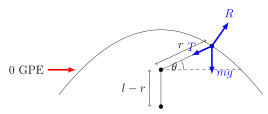
A long, inextensible string passes through a small fixed ring. One end of the string is attached to a particle of mass \(m,\) which hangs freely. The other end is attached to a bead also of mass \(m\) which is threaded on a smooth rigid wire fixed in the same vertical plane as the ring. The curve of the wire is such that the system can be in static equilibrium for all positions of the bead. The shortest distance between the wire and the ring is \(d(>0).\) Using plane polar coordinates centred on the ring, find the equation of the curve. The bead is set in motion. Assuming that the string remains taut, show that the speed of the bead when it is a distance \(r\) from the ring is \[ \left(\frac{r}{2r-d}\right)^{\frac{1}{2}}v, \] where \(v\) is the speed of the bead when \(r=d.\)
Solution: