Problems

Filters
Clear Filters

19 problems found

1989 Paper 1 Q3
D: 1516.0 B: 1516.0

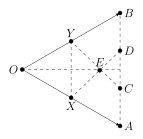
In the triangle \(OAB,\) \(\overrightarrow{OA}=\mathbf{a},\) \(\overrightarrow{OB}=\mathbf{b}\) and \(OA=OB=1\). Points \(C\) and \(D\) trisect \(AB\) (i.e. \(AC=CD=DB=\frac{1}{3}AB\)). \(X\) and \(Y\) lie on the line-segments \(OA\) and \(OB\) respectively, in such a way that \(CY\) and \(DX\) are perpendicular, and \(OX+OY=1\). Denoting \(OX\) by \(x\), obtain a condition relating \(x\) and \(\mathbf{a\cdot b}\), and prove that \[ \frac{8}{17}\leqslant\mathbf{a\cdot b}\leqslant1. \] If the angle \(AOB\) is as large as possible, determine the distance \(OE,\) where \(E\) is the point of intersection of \(CY\) and \(DX\).


Solution:
TikZ diagram
Denoting \(\overrightarrow{OY}\) by \(\mathbf{y}\) and \(\overrightarrow{OC}\) by \(\mathbf{c}\) etc, we have: \begin{align*} \mathbf{c} &= \frac23 \mathbf{a} + \frac13 \mathbf{b} \\ \mathbf{d} &= \frac13 \mathbf{a} + \frac23 \mathbf{b} \\ \mathbf{x} &= \lambda \mathbf{a} \\ \mathbf{y} &= (1-\lambda) \mathbf{b} \\ 0 &= (\mathbf{d}-\mathbf{x}) \cdot (\mathbf{c} - \mathbf{y}) \\ &=((\frac13 -\lambda)\mathbf{a} + \frac23 \mathbf{b})\cdot(\frac23 \mathbf{a} + (\frac13-1+\lambda) \mathbf{b} ) \\ &= \frac{2}{3} \cdot (\frac13-\lambda) +\frac23 \cdot(\lambda - \frac23)+(\frac{4}{9}+(\frac13-\lambda)(-\frac23+\lambda))\mathbf{a}\cdot\mathbf{b} \\ &= -\frac{2}{9} + (\frac{4}{9} - \frac{2}{9}+\lambda-\lambda^2)\mathbf{a}\cdot \mathbf{b} \\ &= - \frac{2}{9} + (\frac{2}{9} + \lambda - \lambda^2)\mathbf{a}\cdot \mathbf{b} \\ \mathbf{a}\cdot \mathbf{b} &= \frac{2/9}{2/9+\lambda - \lambda^2} \end{align*} Since \(0 \leq \lambda - \lambda^2 \leq \frac14\), \(\frac{\frac29}{\frac29+\frac14} = \frac8{17} \leq \mathbf{a}\cdot\mathbf{b} \leq 1\) If \(\angle AOB\) is as large as possible, \(\mathbf{a}\cdot\mathbf{b}\) is as small as possible, ie \(\lambda = \frac12\) and \(\mathbf{a}\cdot \mathbf{b} = \frac{8}{17}\) First notice that the length \(OM\) to the midpoint of \(AB\) is \(\sqrt{\frac14 (\mathbf{a}+\mathbf{b})\cdot(\mathbf{a}+\mathbf{b})} = \sqrt{\frac14 (2 + 2\mathbf{a}\cdot \mathbf{b})} = \sqrt{\frac12 + \frac4{17}} = \sqrt{\frac{25}{34}} = \frac{5}{\sqrt{34}}\) Notice that \(XYE\) and \(DCE\) are similar triangles, and so the heights satisfy \(\frac{h_1}{h_2} = \frac{\frac12}{\frac13} = \frac32\). Therefore the length \(OE\) is \(\frac12 \frac{5}{\sqrt{34}} + \frac{3}{5} \frac12 \frac{5}{\sqrt{34}} = \frac{8}{10} \frac{5}{\sqrt{34}} = \frac{4}{\sqrt{34}}\)

1988 Paper 1 Q6
D: 1500.0 B: 1516.0

The complex numbers \(z_{1},z_{2},\ldots,z_{6}\) are represented by six distinct points \(P_{1},P_{2},\ldots,P_{6}\) in the Argand diagram. Express the following statements in terms of complex numbers:

  1. \(\overrightarrow{P_{1}P_{2}}=\overrightarrow{P_{5}P_{4}}\) and \(\overrightarrow{P_{2}P_{3}}=\overrightarrow{P_{6}P_{5}}\,\);
  2. \(\overrightarrow{P_{2}P_{4}}\) is perpendicular to \(\overrightarrow{P_{3}P_{6}}\,\).
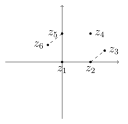
If \((i)\) holds, show that \(\overrightarrow{P_{3}P_{4}}=\overrightarrow{P_{1}P_{6}}\,\). Suppose that the statements \((i)\) and \((ii)\) both hold, and that \(z_{1}=0,\) \(z_{2}=1,\) \(z_{3}=z,\) \(z_{5}=\mathrm{i}\) and \(z_{6}=w.\) Determine the conditions which \(\mathrm{Re}(z)\) and \(\mathrm{Re}(w)\) must satisfy in order that \(P_{1}P_{2}P_{3}P_{4}P_{5}P_{6}\) should form a convex hexagon. Find the distance between \(P_{3}\) and \(P_{6}\) when \(\tan(\angle P_{3}P_{2}P_{6})=-2/3.\)


Solution:

  1. \(\overrightarrow{P_{1}P_{2}}=\overrightarrow{P_{5}P_{4}}\) is equivalent to \(z_2 - z_1 = z_4 - z_5\). \(\overrightarrow{P_{2}P_{3}}=\overrightarrow{P_{6}P_{5}}\) is equivalent to \(z_3-z_2 = z_5 - z_6\).
  2. \(\overrightarrow{P_{2}P_{4}}\) is perpendicular to \(\overrightarrow{P_{3}P_{6}}\,\) is equivalent to \(\frac{z_4 - z_2}{z_6-z_3} \in i\mathbb{R}\)
If \(z_2 - z_1 =z_4 - z_5\) and \(z_3-z_2 = z_5 - z_6\) then adding we get \(z_3 - z_1 = z_4 - z_6\) or \(z_4 - z_3 = z_6-z_1\), which is equivalent to \(\overrightarrow{P_{3}P_{4}}=\overrightarrow{P_{1}P_{6}}\,\).
TikZ diagram
\(\textrm{Re}(z) > 1, \textrm{Re}(w) < 0, \textrm{Re}(z) +\textrm{Re}(w)=1\). (We only need one of the first two constraints, since the other is implied by the former). Since \(\overrightarrow{P_{2}P_{4}}\) is perpendicular to \(\overrightarrow{P_{3}P_{6}}\,\) we must have that \(\textrm{Im}(z) = \textrm{Im}(w)\). Combined with the vector logic we must have that \(\textrm{Im}(z) = \frac12\). Let \(z = a + \frac12i\) and \(w = (1-a) + \frac12i\). Since \(w - 1 = k(3-2i)(z-1)\) (the angle constraint) we must have that: \begin{align*} &&-a+\frac12i &= k(3-2i)((a-1) \frac12i) \\ &&&= k( 3 a - 2+(\frac72 - 2 a)i) \\ \Rightarrow && \frac{3a-2}{-a} &= \frac{\frac72-2a}{\frac12} \\ \Rightarrow && 3a-2&= 4a^2-7a \\ \Rightarrow && 0 &= 4a^2-10a+2 \\ \Rightarrow && a &= \frac{5 \pm \sqrt{17}}{4} \end{align*} Since \(a > 1, a = \frac{5 +\sqrt{17}}{4}\) and the distance is: \begin{align*} \left | z - w \right | &= | a+\frac12i - ((1-a) +\frac12i ) | \\ &= |2a-1| \\ &= \frac{5+\sqrt{17}}{2}-1 \\ &= \frac{3+\sqrt{17}}{2} \end{align*}

1988 Paper 1 Q8
D: 1500.0 B: 1468.0

\(ABCD\) is a skew (non-planar) quadrilateral, and its pairs of opposite sides are equal, i.e. \(AB=CD\) and \(BC=AD\). Prove that the line joining the midpoints of the diagonals \(AC\) and \(BD\) is perpendicular to each diagonal.


Solution: Let \(\mathbf{a}\) denote the vector position of \(A\) and similarly for \(B, C, D\). Then we know that \((\mathbf{b}-\mathbf{a})\cdot(\mathbf{b}-\mathbf{a})=(\mathbf{c}-\mathbf{d})\cdot(\mathbf{c}-\mathbf{d})\) and \((\mathbf{b}-\mathbf{c})\cdot(\mathbf{b}-\mathbf{c})=(\mathbf{a}-\mathbf{d})\cdot(\mathbf{a}-\mathbf{d})\). Subtracting these two equations we see that \(|\mathbf{a}|^2 -2\mathbf{a}\cdot\mathbf{b}+2\mathbf{c}\cdot\mathbf{b} - |\mathbf{c}|^2 = |\mathbf{c}|^2-2\mathbf{c}\cdot\mathbf{d}+2\mathbf{a}\cdot\mathbf{d}-|\mathbf{a}|^2\) or \(2|\mathbf{a}|^2 -2\mathbf{a}\cdot\mathbf{b}+2\mathbf{c}\cdot\mathbf{b} - 2|\mathbf{c}|^2 +2\mathbf{c}\cdot\mathbf{d}-2\mathbf{a}\cdot\mathbf{d}=0\) The midpoints of the diagonals \(AC\) and \(BD\) are \(\frac{\mathbf{a}+\mathbf{c}}{2}\) and \(\frac{\mathbf{b}+\mathbf{d}}{2}\), so the line is parallel to: \(\mathbf{a}-\mathbf{b}+\mathbf{c}-\mathbf{d}\). The diagonals are parallel to \(\mathbf{a}-\mathbf{c}\) and \(\mathbf{b}-\mathbf{d}\). So it suffices to prove that \((\mathbf{a}-\mathbf{b}+\mathbf{c}-\mathbf{d}) \cdot (\mathbf{a}-\mathbf{c}) = 0\) (since the other will follow by symmetry, \begin{align*} (\mathbf{a}-\mathbf{b}+\mathbf{c}-\mathbf{d}) \cdot (\mathbf{a}-\mathbf{c}) &= |\mathbf{a}|^2-\mathbf{a}\cdot\mathbf{b}-\mathbf{a}\cdot \mathbf{d}+\mathbf{b}\cdot \mathbf{c}-|\mathbf{c}|^2+\mathbf{c}\cdot \mathbf{d} \\ \end{align*} But this is exactly half the equation we determined earlier, so we are done.

1987 Paper 3 Q8
D: 1500.0 B: 1485.0

Show that, if the lengths of the diagonals of a parallelogram are specified, then the parallogram has maximum area when the diagonals are perpendicular. Show also that the area of a parallelogram is less than or equal to half the square of the length of its longer diagonal. The set \(A\) of points \((x,y)\) is given by \begin{alignat*}{1} \left|a_{1}x+b_{1}y-c_{1}\right| & \leqslant\delta,\\ \left|a_{2}x+b_{2}y-c_{2}\right| & \leqslant\delta, \end{alignat*} with \(a_{1}b_{2}\neq a_{2}b_{1}.\) Sketch this set and show that it is possible to find \((x_{1},y_{1}),(x_{2},y_{2})\in A\) with \[ (x_{1}-x_{2})^{2}+(y_{1}-y_{2})^{2}\geqslant\frac{8\delta^{2}}{\left|a_{1}b_{2}-a_{2}b_{1}\right|}. \]


Solution: In a parallelogram the diagonals meet at their mid points. Fixing one diagonal, we can look at the two triangles formed by the other diagonal. Suppose the angle between them is \(\theta\). Then the area of the triangles will be \(\frac12 \frac{l_1}{2} \frac{l_2}2 \sin \theta+\frac12 \frac{l_1}{2} \frac{l_2}2 \sin (\pi -\theta) = \frac{l_1l_2}{4} \sin \theta\). This will be true on both sides. Therefore we can maximise this area by setting \(\theta = \frac{\pi}{2}\).

TikZ diagram
Consider the (darker) shaded area. This is our set \(A\). The area of the set is indifferent to a parallel shift in the lines, so without loss of generality, we can consider \(c_1 = 0, c_2 = 0\), so our lines meet at the origin. Now also consider the linear transformation \(\begin{pmatrix} a_1 & b_1 \\ a_2 & b_2 \end{pmatrix}^{-1}\) which takes the coordinate axes to these lines. This will take the square \([-\delta, \delta] \times [-\delta, \delta]\) which has area \(4\delta^2\) to our square, which will have area \(\frac{4 \delta^2}{ |a_1b_2 - a_2b_1|}\). If we consider the length of the two diagonals of this area, \(l_1, l_2\) we know that \(\frac{l_1l_2}2 \sin \theta = \frac{4 \delta^2}{|a_1b_2 - a_2b_1|}\), if we consider the larger of \(l_1\) and \(l_2\) (wlog \(l_1\)) we must have that \(\frac{l_1^2}{2} \geq \frac{4 \delta^2}{|a_1b_2 - a_2b_1|}\) and so points on opposite ends of the diagonal will satisfy the inequality in the question.