Problems
Filters
17 problems found
1987 Paper 1 Q12
\(\,\) \vspace{-1cm}
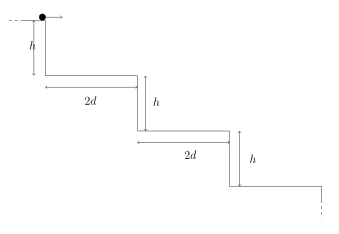
Solution: Considering the horizontal component, this will be constant as there are no forces acting in that direction. The first step will take the particle \(t = \sqrt{\frac{2h}g}\) to reach. At which point it will be travelling with speed \(v = \sqrt{2gh} \) (by energy considerations, \(mgh = \frac12 mv^2\)). To reach the second step must take twice as long (since the ball has to travel \(2d\) horizontally, rather than \(d\)). Since \(t = 2\sqrt{\frac{2h}g}\) we must have that: \begin{align*} && s &= ut + \frac12 gt^2 \\ \Rightarrow && h &= u 2\sqrt{\frac{2h}g} + \frac12 g \frac{8h}g \\ \Rightarrow && u &= -\frac{3}{2} h\sqrt{\frac{g}{2h}} \\ &&&= -\frac{3}{2\sqrt{2}} \sqrt{gh} \end{align*} Therefore, using Newton's experimental law, we must have that \(e = \frac{\frac{3}{2 \sqrt{2}} \sqrt{gh}}{\sqrt{2} \sqrt{gh}} = \frac{3}{4}\). Again by conservation of energy \(mgh + \frac12 \frac{9}{8} mgh = \frac12 mv^2 \Rightarrow v = \frac{5}{2\sqrt{2}} \sqrt{gh}\) when it lands on the next step. Therefore we would need the coefficient of restitution for the second (and subsequent steps) to be: \(\displaystyle \frac{\frac{3}{2\sqrt{2}} \sqrt{gh}}{\frac{5}{2\sqrt{2}} \sqrt{gh}} = \frac35\)
1987 Paper 2 Q13
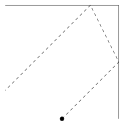
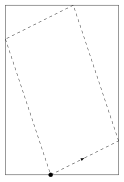
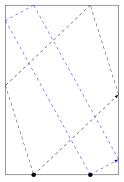
Ice snooker is played on a rectangular horizontal table, of length \(L\) and width \(B\), on which a small disc (the puck) slides without friction. The table is bounded by smooth vertical walls (the cushions) and the coefficient of restitution between the puck and any cushion is \(e\). If the puck is hit so that it bounces off two adjacent cushions, show that its final path (after two bounces) is parallel to its original path. The puck rests against the cushion at a point which divides the side of length \(L\) in the ratio \(z:1\). Show that it is possible, whatever \(z\), to hit the puck so that it bounces off the three other cushions in succession clockwise and returns to the spot at which it started. By considering these paths as \(z\) varies, explain briefly why there are two different ways in which, starting at any point away from the cushions, it is possible to perform a shot in which the puck bounces off all four cushions in succession clockwise and returns to its starting point.
Solution: