Problems
Filters
38 problems found
2009 Paper 2 Q10
\(\,\)
2009 Paper 3 Q11
A comet in deep space picks up mass as it travels through a large stationary dust cloud. It is subject to a gravitational force of magnitude \(M\!f\) acting in the direction of its motion. When it entered the cloud, the comet had mass \(M\) and speed \(V\). After a time \(t\), it has travelled a distance \(x\) through the cloud, its mass is \(M(1+bx)\), where~\(b\) is a positive constant, and its speed is \(v\).
- In the case when \(f=0\), write down an equation relating \(V\), \(x\), \(v\) and \(b\). Hence find an expression for \(x\) in terms of \(b\), \(V\) and \(t\).
- In the case when \(f\) is a non-zero constant, use Newton's second law in the form \[ \text{force} = \text{rate of change of momentum} \] to show that \[ v = \frac{ft+V}{1+bx}\,. \] Hence find an expression for \(x\) in terms of \(b\), \(V\), \(f\) and \(t\). Show that it is possible, if \(b\), \(V\) and \(f\) are suitably chosen, for the comet to move with constant speed. Show also that, if the comet does not move with constant speed, its speed tends to a constant as \(t\to\infty\).
2006 Paper 1 Q11
Particles \(A_1\), \(A_2\), \(A_3\), \(\ldots\), \(A_n\) (where \(n\ge 2\)) lie at rest in that order in a smooth straight horizontal trough. The mass of \(A_{n-1}\) is \(m\) and the mass of \(A_n\) is \(\lambda m\), where \(\lambda>1\). Another particle, \(A_0\), of mass \(m\), slides along the trough with speed \(u\) towards the particles and collides with \(A_1\). Momentum and energy are conserved in all collisions.
- Show that it is not possible for there to be exactly one particle moving after all collisions have taken place.
- Show that it is not possible for \(A_{n-1}\) and \(A_n\) to be the only particles moving after all collisions have taken place.
- Show that it is not possible for \(A_{n-2}\), \(A_{n-1}\) and \(A_n\) to be the only particles moving after all collisions have taken place.
- Given that there are exactly two particles moving after all collisions have taken place, find the speeds of these particles in terms of \(u\) and \(\lambda\).
2006 Paper 2 Q10
Three particles, \(A\), \(B\) and \(C\), of masses \(m\), \(km\) and \(3m\) respectively, are initially at rest lying in a straight line on a smooth horizontal surface. Then \(A\) is projected towards \(B\) at speed \(u\). After the collision, \(B\) collides with \(C\). The coefficient of restitution between \(A\) and \(B\) is \(\frac12\) and the coefficient of restitution between \(B\) and \(C\) is \(\frac14\).
- Find the range of values of \(k\) for which \(A\) and \(B\) collide for a second time.
- Given that \(k=1\) and that \(B\) and \(C\) are initially a distance \(d\) apart, show that the time that elapses between the two collisions of \(A\) and \(B\) is \(\dfrac{60d}{13u}\,\).
Solution:
- After the first collision, it takes \(B\), \(\frac{d}{v_B} = \frac{d}{u} \frac{2(k+1)}{3} = \frac{4d}{3u}\) to collide with \(C\). During which time \(B\) and \(A\) have been moving apart with speed \(\frac12u\) and so are a distance \(\frac{2d}{3}\) apart. After the second collision, \(w_B = \frac{3(4\cdot 1 - 3)}{8(1+1)(1+3)}u = \frac{3}{64}u\) and \(v_A = \frac{1}{4}u\) so they are moving together at speed \(\frac{16-3}{64}u = \frac{13}{64}u\). It will take them \(\frac{2d}{3} \div \frac{13}{64}u = \frac{128d}{3 \times 13u}\) to do this for a total time of \(\frac{128d}{3 \times 13u} + \frac{4d}{3u} = \frac{(128+52)d}{3 \times 13 u} = \frac{60d}{13u}\)
2006 Paper 3 Q11
A lift of mass \(M\) and its counterweight of mass \(M\) are connected by a light inextensible cable which passes over a fixed frictionless pulley. The lift is constrained to move vertically between smooth guides. The distance between the floor and the ceiling of the lift is \(h\). Initially, the lift is at rest, and the distance between the top of the lift and the pulley is greater than \(h\). A small tile of mass \(m\) becomes detached from the ceiling of the lift and falls to the floor of the lift. Show that the speed of the tile just before the impact is \[ \sqrt{\frac{(2M-m)gh \;}{M}}\;. \] The coefficient of restitution between the tile and the floor of the lift is \(e\). Given that the magnitude of the impulsive force on the lift due to tension in the cable is equal to the magnitude of the impulsive force on the counterweight due to tension in the cable, show that the loss of energy of the system due to the impact is \(mgh(1-e^2)\). Comment on this result.
2005 Paper 1 Q10
Three collinear, non-touching particles \(A\), \(B\) and \(C\) have masses \(a\), \(b\) and \(c\), respectively, and are at rest on a smooth horizontal surface. The particle \(A\) is given an initial velocity \(u\) towards~\(B\). These particles collide, giving \(B\) a velocity \(v\) towards \(C\). These two particles then collide, giving \(C\) a velocity \(w\). The coefficient of restitution is \(e\) in both collisions. Determine an expression for \(v\), and show that \[ \displaystyle w = \frac {abu \l 1+e \r^2}{\l a + b \r \l b+c \r}\;. \] Determine the final velocities of each of the three particles in the cases:
- \(\displaystyle \frac ab = \frac bc = e\,\);
- \(\displaystyle \frac ba = \frac cb = e\,\).
2005 Paper 3 Q9
Two particles, A and B, move without friction along a horizontal line which is perpendicular to a vertical wall. The coefficient of restitution between the two particles is \(e\) and the coefficient of restitution between particle B and the wall is also \(e\), where \( 0< e < 1\). The mass of particle~A is \(4em\) (with \(m > 0\)), and the mass of particle B is \((1-e)^2m\)\,. Initially, A is moving towards the wall with speed \((1-e)v\) (where \(v > 0\)) and B is moving away from the wall and towards A with speed \(2ev\). The two particles collide at a distance \(d\) from the wall. Find the speeds of A and B after the collision. When B strikes the wall, it rebounds along the same line. Show that a second collision will take place, at a distance \(de\) from the wall. Deduce that further collisions will take place. Find the distance from the wall at which the \(n\)th collision takes place, and show that the times between successive collisions are equal.
2002 Paper 1 Q11
\(\,\)
2001 Paper 2 Q10
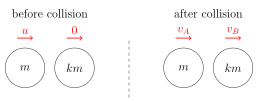
Two particles \(A\) and \(B\) of masses \(m\) and \(km\), respectively, are at rest on a smooth horizontal surface. The direction of the line passing through \(A\) and \(B\) is perpendicular to a vertical wall which is on the other side of \(B\) from \(A\). The particle \(A\) is now set in motion towards \(B\) with speed \(u\). The coefficient of restitution between \(A\) and \(B\) is \(e_1\) and between \(B\) and the wall is \(e_2\). Show that there will be a second collision between \(A\) and \(B\) provided $$ k< \frac {1+e_2(1+e_1)} {e_1}\;. $$ Show that, if \(e_1=\frac13\), \(e_2=\frac12\) and \(k<5\), then the kinetic energy of \(A\) and \(B\) immediately after \(B\) rebounds from the wall is greater than \(mu^2/27\).
Solution: First collision:
2000 Paper 1 Q10
Three particles \(P_1\), \(P_2\) and \(P_3\) of masses \(m_{1}\), \(m_{2}\) and \(m_{3}\) respectively lie at rest in a straight line on a smooth horizontal table. \(P_1\) is projected with speed \(v\) towards \(P_2\) and brought to rest by the collision. After \(P_2\) collides with \(P_3\), the latter moves forward with speed \(v\). The coefficients of restitution in the first and second collisions are \(e\) and \(e'\), respectively. Show that \[ e'= \frac{m_{2}+m_{3}-m_{1}}{m_{1}}. \] Show that \(2m_1\ge m_2 +m_3\ge m_1\) for such collisions to be possible. If \(m_1\), \(m_3\) and \(v\) are fixed, find, in terms of \(m_1\), \(m_3\) and \(v\), the largest and smallest possible values for the final energy of the system.
2000 Paper 3 Q9
Two small discs of masses \(m\) and \(\mu m\) lie on a smooth horizontal surface. The disc of mass \(\mu m\) is at rest, and the disc of mass \(m\) is projected towards it with velocity \(\mathbf{u}\). After the collision, the disc of mass \(\mu m\) moves in the direction given by unit vector \(\mathbf{n}\). The collision is perfectly elastic.
- Show that the speed of the disc of mass \(\mu m\) after the collision is \ \ $ \dfrac {2\mathbf{u} \cdot \mathbf{n}}{1+\mu}. $
- Given that the two discs have equal kinetic energy after the collision, find an expression for the cosine of the angle between \(\bf n\) and \(\bf u\) and show that \(3-\sqrt8\le \mu \le 3+\sqrt8\).
Solution:
- In the direction of \(\mathbf{n}\), Conservation of momentum gives: \(m \mathbf{u} \cdot \mathbf{n} = m v_m + \mu m v_{\mu m}\) Newton's experimental law gives: \(\frac{\mathbf{u} \cdot \mathbf{n}}{v_{\mu m} - v_m} = 1\) Therefore \begin{align*} && \mathbf{u} \cdot \mathbf{n} &= v_m + \mu v_{\mu m} \\ && \mathbf{u} \cdot \mathbf{n} &= v_{\mu m} - v_m \\ \Rightarrow && 2 \mathbf{u} \cdot \mathbf{n} &= (1 + \mu)v_{\mu m} \\ \Rightarrow && v_{\mu m} &= \frac{2 \mathbf{u} \cdot \mathbf{n}}{1 + \mu} \\ \end{align*}
- Kinetic energy after the collision for the second mass is: \(\frac12 m \mu \frac{4 (\mathbf{u} \cdot \mathbf{n})^2 }{(1 + \mu)^2}\) For the first mass the final speed (in the direction \(\mathbf{n}\) is: \(\mathbf{u} \cdot \mathbf{n}- \frac{2 \mathbf{u} \cdot \mathbf{n}}{1 + \mu} = \frac{(\mu - 1) \mathbf{u} \cdot \mathbf{n}}{1 + \mu}\) It's velocity perpendicular to \(\mathbf{n}\) is unchanged, which is \(\mathbf{u} - (\mathbf{u} \cdot \mathbf{n}) \mathbf{n}\), so it's speed squared is \(\mathbf{u}\cdot \mathbf{u} - (\mathbf{u} \cdot \mathbf{n})^2\) Therefore the total kinetic energy is: \(\frac12 m \frac{(\mu - 1)^2 (\mathbf{u} \cdot \mathbf{n})^2}{(1 + \mu)} + \frac12 m (\mathbf{u}\cdot \mathbf{u} - (\mathbf{u} \cdot \mathbf{n})^2)\) Therefore since the kinetic energies are equal we have: \begin{align*} && \frac12 m \frac{(\mu - 1)^2 (\mathbf{u} \cdot \mathbf{n})^2}{(1 + \mu)} + \frac12 m (\mathbf{u}\cdot \mathbf{u} - (\mathbf{u} \cdot \mathbf{n})^2) &= \frac12 m \mu \frac{4 (\mathbf{u} \cdot \mathbf{n})^2 }{(1 + \mu)^2} \\ \Rightarrow && \frac{(\mu - 1)^2 (\mathbf{u} \cdot \mathbf{n})^2}{(1 + \mu)} + (\mathbf{u}\cdot \mathbf{u} - (\mathbf{u} \cdot \mathbf{n})^2) &= \mu \frac{4 (\mathbf{u} \cdot \mathbf{n})^2 }{(1 + \mu)^2} \\ \Rightarrow && (\mathbf{u} \cdot \mathbf{n})^2 \l 1 + \frac{4\mu}{(1+ \mu)^2} - \frac{(1-\mu)^2}{(1+ \mu)^2} \r &= (\mathbf{u} \cdot \mathbf{u}) \\ \Rightarrow && (\mathbf{u} \cdot \mathbf{n})^2 \l \frac{(1 + \mu)^2 + 4\mu - (1-\mu)^2}{(1+ \mu)^2} \r &= (\mathbf{u} \cdot \mathbf{u}) \\ \Rightarrow && (\mathbf{u} \cdot \mathbf{n})^2 \l \frac{8\mu}{(1+ \mu)^2} \r &= (\mathbf{u} \cdot \mathbf{u}) \\ \Rightarrow && \cos^2 \theta &=\frac{(1 + \mu)^2}{8\mu} \\ \end{align*} We need \begin{align*} && \frac{(1 + \mu)^2}{8\mu} & \leq 1 \\ \Rightarrow && 1 +2 \mu + \mu^2 \leq 8 \mu \\ \Rightarrow && 1 - 6 \mu + \mu^2 \leq 0 \end{align*} This quadratic has roots at \(3 \pm \sqrt{8}\) and therefore our quadratic inequality is satisfied if: \(\boxed{3 - \sqrt{8} \leq \mu \leq 3 + \sqrt{8}}\)
1999 Paper 2 Q10
\(N\) particles \(P_1\), \(P_2\), \(P_3\), \(\ldots\), \(P_N\) with masses \(m\), \(qm\), \(q^2m\), \(\ldots\) , \({q^{N-1}}m\), respectively, are at rest at distinct points along a straight line in gravity-free space. The particle \(P_1\) is set in motion towards \(P_2\) with velocity \(V\) and in every subsequent impact the coefficient of restitution is \(e\), where \(0 < e < 1\). Show that after the first impact the velocities of \(P_1\) and \(P_2\) are $$ {\left({{1-eq}\over{1+q}}\right)}V \mbox{ \ \ \ and \ \ \ } {\left({{1+e}\over{1+q}}\right)}V, $$ respectively. Show that if \(q \le e\), then there are exactly \(N-1\) impacts and that if \(q=e\), then the total loss of kinetic energy after all impacts have occurred is equal to $$ {1\over 2}{me}{\left(1-e^{N-1}\right)}{V^2}. $$
1999 Paper 3 Q10
A chain of mass \(m\) and length \(l\) is composed of \(n\) small smooth links. It is suspended vertically over a horizontal table with its end just touching the table, and released so that it collapses inelastically onto the table. Calculate the change in momentum of the \((k+1)\)th link from the bottom of the chain as it falls onto the table. Write down an expression for the total impulse sustained by the table in this way from the whole chain. By approximating the sum by an integral, show that this total impulse is approximately \[ {\textstyle \frac23} m \surd(2gl) \] when \(n\) is large.
1998 Paper 3 Q10
Two identical spherical balls, moving on a horizontal, smooth table, collide in such a way that both momentum and kinetic energy are conserved. Let \({\bf v}_1\) and \({\bf v}_2\) be the velocities of the balls before the collision and let \({\bf v}'_1\) and \({\bf v}'_2\) be the velocities of the balls after the collision, where \({\bf v}_1\), \({\bf v}_2\), \({\bf v}'_1\) and \({\bf v}'_2\) are two-dimensional vectors. Write down the equations for conservation of momentum and kinetic energy in terms of these vectors. Hence show that their relative speed is also conserved. Show that, if one ball is initially at rest but after the collision both balls are moving, their final velocities are perpendicular. Now suppose that one ball is initially at rest, and the second is moving with speed \(V\). After a collision in which they lose a proportion \(k\) of their original kinetic energy (\(0\le k\le 1\)), the direction of motion of the second ball has changed by an angle \(\theta\). Find a quadratic equation satisfied by the final speed of the second ball, with coefficients depending on \(k\), \(V\) and \(\theta\). Hence show that \(k\le \frac{1}{2}\).
Solution: \begin{align*} \text{COM}: && \mathbf{v}_1+\mathbf{v}_2 &= \mathbf{v}_1'+\mathbf{v}_2' \tag{1}\\ \text{COE}: && \mathbf{v}_1\cdot\mathbf{v}_1+\mathbf{v}_2\cdot\mathbf{v}_2 &= \mathbf{v}_1'\cdot\mathbf{v}_1'+\mathbf{v}_2'\cdot\mathbf{v}_2' \tag{2} \\ \\ (1): && (\mathbf{v}_1+\mathbf{v}_2 )\cdot(\mathbf{v}_1+\mathbf{v}_2 ) &= (\mathbf{v}_1'+\mathbf{v}_2' )\cdot(\mathbf{v}_1'+\mathbf{v}_2' ) \\ \Rightarrow && \mathbf{v}_1 \cdot \mathbf{v}_2 &= \mathbf{v}_1'\cdot \mathbf{v}_2' \\ && \text{Initial relative speed}^2 &= |\mathbf{v}_1 - \mathbf{v}_2|^2 \\ &&&= (\mathbf{v}_1 - \mathbf{v}_2) \cdot (\mathbf{v}_1 - \mathbf{v}_2) \\ &&&= \mathbf{v}_1\cdot \mathbf{v}_1 - 2 \mathbf{v}_1\cdot \mathbf{v}_2 + \mathbf{v}_2\cdot \mathbf{v}_2 \\ &&&= \mathbf{v}_1'\cdot\mathbf{v}_1'+\mathbf{v}_2'\cdot\mathbf{v}_2' -2 \mathbf{v}_1\cdot\mathbf{v}_2\\ &&&= \mathbf{v}_1'\cdot\mathbf{v}_1'+\mathbf{v}_2'\cdot\mathbf{v}_2' -2 \mathbf{v}_1'\cdot\mathbf{v}_2'\\ &&&= | \mathbf{v}_1'-\mathbf{v}_2'|^2 \\ &&&= \text{Final relative speed}^2 \end{align*} Since \(\mathbf{v}_1 \cdot 0 = 0\) we must have \(\mathbf{v}_1'\cdot\mathbf{v}_2' = \mathbf{v}_1\cdot0 = 0\) therefore their final velocities are perpendicular. We now must have \begin{align*} \text{COM}: && \mathbf{v}_1+\mathbf{v}_2 &= \mathbf{v}_1'+\mathbf{v}_2' \tag{3}\\ \Delta\text{E}: && (1-k)(\mathbf{v}_1\cdot\mathbf{v}_1+\mathbf{v}_2\cdot\mathbf{v}_2) &= \mathbf{v}_1'\cdot\mathbf{v}_1'+\mathbf{v}_2'\cdot\mathbf{v}_2' \tag{4} \\ \\ && 0 + \mathbf{v}_2 &= \mathbf{v}_1' + \mathbf{v}_2' \\ \Rightarrow && V^2 &= ( \mathbf{v}_1' + \mathbf{v}_2' ) \cdot ( \mathbf{v}_1' + \mathbf{v}_2' ) \\ &&&= \mathbf{v}_1'\cdot\mathbf{v}_1'+\mathbf{v}_2'\cdot\mathbf{v}_2' +2 \mathbf{v}_1'\cdot \mathbf{v}_2' \\ &&&= (1-k)V^2 + 2 (\mathbf{v}_2-\mathbf{v}_2') \cdot \mathbf{v}_2' \\ &&&= (1-k)V^2 + 2 \mathbf{v}_2 \cdot \mathbf{v}_2'-2\mathbf{v}_2'\cdot \mathbf{v}_2' \\ &&&= (1-k)V^2 + 2Vx \cos \theta - 2x^2 \\ \Rightarrow && 0 &= -kV^2 + 2Vx \cos \theta -2x^2 \\ \Delta \geq 0: && 0 &\leq 4V^2 \cos^2 \theta -8kV^2 \\ \Rightarrow && k &\leq \frac12\cos^2\theta \leq \frac12 \end{align*}
1997 Paper 2 Q10
\noindent{\it In this question the effect of gravity is to be neglected.} A small body of mass \(M\) is moving with velocity \(v\) along the axis of a long, smooth, fixed, circular cylinder of radius \(L\). An internal explosion splits the body into two spherical fragments, with masses \(qM\) and \((1-q)M\), where \(q\le\frac{1}{2}\). After bouncing perfectly elastically off the cylinder (one bounce each) the fragments collide and coalesce at a point \(\frac{1}{2}L\) from the axis. Show that \(q=\frac{3}{ 8}\). The collision occurs at a time \(5L/v\) after the explosion. Find the energy imparted to the fragments by the explosion, and find the velocity after coalescence.