Problems
Filters
18 problems found
1993 Paper 1 Q5
If \(z=x+\mathrm{i}y\) where \(x\) and \(y\) are real, define \(\left|z\right|\) in terms of \(x\) and \(y\). Show, using your definition, that if \(z_{1},z_{2}\in\mathbb{C}\) then \(\left|z_{1}z_{2}\right|=\left|z_{1}\right|\left|z_{2}\right|.\) Explain, by means of a diagram, or otherwise, why \(\left|z_{1}+z_{2}\right|\leqslant\left|z_{1}\right|+\left|z_{2}\right|.\) Suppose that \(a_{j}\in\mathbb{C}\) and \(\left|a_{j}\right|\leqslant1\) for \(j=1,2,\ldots,n.\) Show that, if \(\left|z\right|\leqslant\frac{1}{2},\) then \[ \left|a_{n}z^{n}+a_{n-1}z^{n-1}+\cdots+a_{1}z\right|<1, \] and deduce that any root \(w\) of the equation \[ a_{n}z^{n}+a_{n-1}z^{n-1}+\cdots+a_{1}z+1=0 \] must satisfy \(\left|x\right|>\frac{1}{2}.\)
1992 Paper 1 Q4
Sketch the following subsets of the complex plane using Argand diagrams. Give reasons for your answers.
- \(\{z:\mathrm{Re}((1+\mathrm{i})z)\geqslant0\}.\)
- \(\{z: |z^{2}| \leqslant2,\mathrm{Re}(z^{2})\geqslant0\}.\)
- \(\{z=z_{1}+z_{2}:\left|z_{1}\right|=2,\left|z_{2}\right|=1\}.\)
Solution:
- Multiplication by \(1+i\) rotates by \(45^{\circ}\) anticlockwise

- \(|z| \leq \sqrt{2}\), \(\textrm{Re}(z^2) \geq 0\) means \(\textrm{Re}{z} \geq \textrm{Im}{z}\)

- These are all points within \(1\) unit from a circle radius \(2\) units.

1992 Paper 2 Q10
Let \(\alpha\) be a fixed angle, \(0 < \alpha \leqslant\frac{1}{2}\pi.\) In each of the following cases, sketch the locus of \(z\) in the Argand diagram (the complex plane):
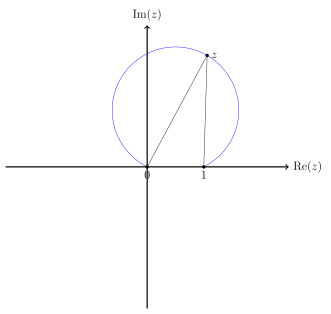
- \({\displaystyle \arg\left(\frac{z-1}{z}\right)=\alpha,}\)
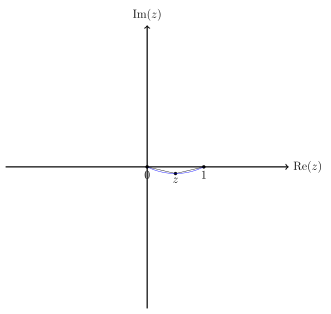
- \({\displaystyle \arg\left(\frac{z-1}{z}\right)=\alpha-\pi,}\)
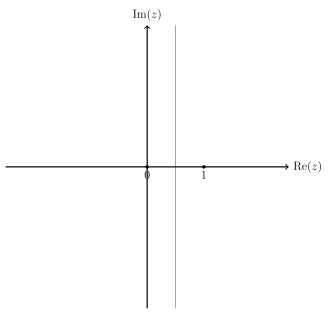
- \(|\dfrac{z-1}{z}|=1.\)
Solution: