Problems
Filters
36 problems found
2008 Paper 3 Q4
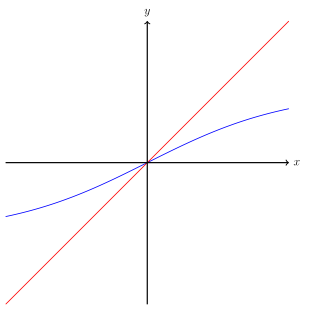
- Show, with the aid of a sketch, that \(y> \tanh (y/2)\) for \(y>0\) and deduce that \begin{equation} \textrm{arcosh} x > \dfrac{x-1}{\sqrt{x^2-1}} \text{ for } x>1. \tag{\(*\)} \end{equation}
- By integrating \((*)\), show that $\textrm{arcosh} x > 2 \dfrac{{x-1}}{\sqrt{x^2-1}} \( for \)x>1$.
- Show that $\textrm{arcosh} x >3 \dfrac{\sqrt{x^2-1}}{{x+2}} \( for \)x>1$.
Solution:
- If \(y = \textrm{arcosh} x \), then \(\tanh\textrm{arcosh} x/2 = \sqrt{\frac{\cosh \textrm{arcosh} x-1}{\cosh \textrm{arcosh} x+1}} = \sqrt{\frac{x-1}{x+1}} = \frac{x-1}{\sqrt{x^2-1}}\)
- \begin{align*} \int \textrm{arcosh} x \d x &= \left [x \textrm{arcosh} x \right] - \int \frac{x}{\sqrt{x^2-1}} \d x \\ &= x \textrm{arcosh} x - \sqrt{x^2-1}+C \\ \int \frac{x-1}{\sqrt{x^2-1}} &= \sqrt{x^2-1} - \textrm{arcosh} x +C \end{align*} Therefore \begin{align*} && \int_1^x \textrm{arcosh} t \d t &> \int_1^x \frac{t-1}{\sqrt{t^2-1}} \d t \\ \Rightarrow && x \textrm{arcosh} x - \sqrt{x^2-1} - 0 &> \sqrt{x^2-1} - \textrm{arcosh} x - 0 \\ \Rightarrow && (x+1) \textrm{arcosh} x &> 2\sqrt{x^2-1} \\ \Rightarrow && \textrm{arcosh} x & > 2\frac{\sqrt{x^2-1}}{x+1} \\ &&&= 2 \frac{\sqrt{x-1}}{\sqrt{x+1}} \\ &&&= 2 \frac{x-1}{\sqrt{x^2-1}} \end{align*}
- Integrating both sides again, \begin{align*} && \int_1^x \textrm{arcosh} t \d t &> 2 \int_1^x \frac{t-1}{\sqrt{t^2-1}} \d t \\ \Rightarrow && x \textrm{arcosh} x - \sqrt{x^2-1} &> 2\left (\sqrt{x^2-1} - \textrm{arcosh}x \right) \\ \Rightarrow && (x+2)\textrm{arcosh} x &> 3 \sqrt{x^2-1} \\ \Rightarrow && \textrm{arcosh} x &> 3 \frac{\sqrt{x^2-1}}{x+2} \end{align*}
2007 Paper 3 Q5
Let \(y = \ln (x^2-1)\,\), where \(x >1\), and let \(r\) and \(\theta\) be functions of \(x\) determined by \(r= \sqrt{x^2-1}\) and \(\coth\theta= x\). Show that \[ \frac {\d y}{\d x} = \frac {2\cosh \theta}{r} \text{ and } \frac {\d^2 y}{\d x^2} = -\frac {2 \cosh 2\theta}{r^2}\,, \] and find an expression in terms of \(r\) and \(\theta\) for \(\dfrac {\d^3 y}{\d x^3}\,\). Find, with proof, a similar formula for \(\dfrac{\d^n y}{\d x^n}\) in terms of \(r\) and \(\theta\).
Solution: \begin{align*} && y &= \ln(x^2 -1) \\ && r &= \sqrt{x^2-1} \\ && \coth \theta &= x \\ && r &= \sqrt{\coth^2 \theta - 1} = \sqrt{\textrm{cosech}^2 \theta} = \textrm{cosech} \theta \\ && \frac{\d y}{\d x} &= \frac{2x}{x^2-1} \\ &&&= \frac{2 \coth \theta}{r^2} \\ &&&= \frac{2 \cosh \theta}{\sinh \theta \cdot r \cdot \textrm{cosech} \theta } \\ &&&= \frac{2 \cosh \theta}{r } \\ \\ && \frac{\d^2 y}{\d x^2} &= \frac{2(x^2-1)-4x^2}{(x^2-1)^2} \\ &&&= \frac{-2(1+x^2)}{r^2 \textrm{cosech}^2 r} \\ &&&= -\frac{2(1 + \coth^2 \theta) \sinh^2 \theta}{r^2} \\ &&&= -\frac{2(\sinh^2 \theta + \cosh^2 \theta)}{r^2} \\ &&&= -\frac{2 \cosh 2 \theta}{r^2} \\ \\ && \frac{\d^3 y}{\d x^3} &= \frac{-4x(x^2-1)^2-(-2x^2-2)\cdot2(x^2-1)\cdot 2x}{(x^2-1)^4} \\ &&&= \frac{-4x(x^2-1)+8x(x^2+1)}{(x^2-1)^3}\\ &&&= \frac{4x^3+12x}{(x^2-1)^3} \\ &&&=\frac{\sinh^3 \theta (4\coth^3 \theta + 12\coth \theta )}{r^3} \\ &&&=\frac{4\cosh^3 \theta + 12\cosh \theta \sinh^2 \theta}{r^3} \\ &&&= \frac{4 \cosh 3 \theta}{r^3} \\ \end{align*} Claim: \(\frac{\d^n y}{\d x^n} = (-1)^{n+1}\frac{2(n-1)!\cosh n \theta}{r^n}\) Proof: By induction. Base cases already proven \begin{align*} \frac{\d r}{\d x} &= \frac{x}{\sqrt{x^2-1}} = \frac{\coth \theta}{\textrm{cosech} \theta} = \cosh \theta \\ \frac{\d \theta}{\d x} &= - \sinh^2 \theta \\ \\ \frac{\d^{n+1} y}{\d x^{n+1}} &= (-1)^{n+1}(n-1)!\frac{\d}{\d x} \left ( \frac{2\cosh n \theta}{r^n}\right) \\ &= (-1)^{n+1}\frac{2 n \sinh n \theta \cdot r^n \cdot \frac{\d \theta}{\d x}- 2\cosh n \theta \cdot nr^{n-1} \frac{\d r}{\d x} }{r^{2n}} \\ &= (-1)^{n+2}\frac{2n( \cosh n \theta\cosh \theta + r\sinh n \theta \sinh^2 \theta) }{r^{n+1}} \\ &= (-1)^{n+2}n!\frac{2\cosh(n+1) \theta }{r^{n+1}} \\ \end{align*} We can think of this as \(\ln(x^2-1) = \ln(x+1)+\ln(x-1)\) and also note \(x \pm 1 = \coth \theta \pm 1 = \frac{\cosh \theta \pm \sinh \theta}{\sinh \theta} = \frac{e^{\pm \theta}}{\sinh \theta}\) \begin{align*} && \frac{\d^n}{\d x^n} \ln(x^2-1) &= (n-1)!(-1)^{n-1} \left ( \frac{1}{(x+1)^n} + \frac{1}{(x-1)^n} \right) \\ &&&= (-1)^{n-1}(n-1)! \left ( \frac{\sinh^n \theta}{e^{n\theta}} + \frac{\sinh^n \theta}{e^{-n\theta}} \right) \\ &&&= (-1)^{n-1} (n-1)!2\cosh n \theta \cdot \sinh^n \theta \\ &&&= (-1)^{n-1}(n-1)! \frac{2 \cosh n \theta }{r^n} \end{align*}
2006 Paper 3 Q7
- Solve the equation \(u^2+2u\sinh x -1=0\) giving \(u\) in terms of \(x\). Find the solution of the differential equation \[ \left( \frac{\d y}{\d x}\right)^{\!2} +2 \frac{\d y}{\d x} \sinh x -1 = 0 \] that satisfies \(y=0\) and \(\dfrac {\d y}{\d x} >0\) at \(x=0\).
- Find the solution, not identically zero, of the differential equation \[ \sinh y \left( \frac{\d y}{\d x}\right)^{\!2} +2 \frac{\d y}{\d x} -\sinh y = 0 \] that satisfies \(y=0\) at \(x=0\), expressing your solution in the form \(\cosh y=\f(x)\). Show that the asymptotes to the solution curve are \(y=\pm(-x+\ln 4)\).
2005 Paper 3 Q6
In this question, you may use without proof the results \[ 4 \cosh^3 y - 3 \cosh y = \cosh (3y) \ \ \ \ \text{and} \ \ \ \ \mathrm{arcosh} \, y = \ln ( y+\sqrt{y^2-1}). \] \noindent[ {\bf Note: } \(\mathrm{arcosh}y\) is another notation for \(\cosh^{-1}y\,\)] Show that the equation \(x^3 - 3a^2x = 2a^3 \cosh T\) is satisfied by \( 2a \cosh \l \frac13 T \r\) and hence that, if \(c^2\ge b^3>0\), one of the roots of the equation \(x^3-3bx=2c\) is \(\ds u+\frac{b}{u}\), where \(u = (c+\sqrt{c^2-b^3})^{\frac13}\;\). Show that the other two roots of the equation \(x^3-3bx=2c\) are the roots of the quadratic equation \[\ds x^2 + \Big( u+\frac{b}{u}\Big) x + u^2+\frac{b^2}{u^2}-b=0\, ,\] and find these roots in terms of \(u\), \(b\) and \(\omega\), where \(\omega = \frac{1}{2}(-1 + \mathrm{i}\sqrt{3})\). Solve completely the equation \(x^3-6x=6\,\).
2004 Paper 3 Q1
Show that \[ \int_0^a \frac{\sinh x}{2\cosh^2 x -1} \, \mathrm{d} x = \frac{1}{2 \sqrt{2}} \ln \l \frac{\sqrt{2}\cosh a -1}{\sqrt{2}\cosh a +1}\r + \frac{1}{2 \sqrt{2}} \ln \l \frac{\sqrt{2}+1}{\sqrt{2}-1}\r \] and find \[ \int_0^a \frac{\cosh x}{1+2\sinh^2 x} \, \mathrm{d} x \, . \] Hence show that \[ \int_0^\infty \frac{\cosh x - \sinh x}{1+2\sinh^2 x} \, \mathrm{d} x = \frac{\pi}{2\sqrt{2}} - \frac{1}{2 \sqrt{2}} \ln \l \frac{\sqrt{2}+1}{\sqrt{2}-1}\r \, . \] By substituting \(u = \e^x\) in this result, or otherwise, find \[ \int_1^\infty \frac{1}{1+u^4} \, \mathrm{d} u \, . \]
1996 Paper 3 Q1
Define \(\cosh x\) and \(\sinh x\) in terms of exponentials and prove, from your definitions, that \[ \cosh^{4}x-\sinh^{4}x=\cosh2x \] and \[ \cosh^{4}x+\sinh^{4}x=\tfrac{1}{4}\cosh4x+\tfrac{3}{4}. \] Find \(a_{0},a_{1},\ldots,a_{n}\) in terms of \(n\) such that \[ \cosh^{n}x=a_{0}+a_{1}\cosh x+a_{2}\cosh2x+\cdots+a_{n}\cosh nx. \] Hence, or otherwise, find expressions for \(\cosh^{2m}x-\sinh^{2m}x\) and \(\cosh^{2m}x+\sinh^{2m}x,\) in terms of \(\cosh kx,\) where \(k=0,\ldots,2m.\)
Solution: \begin{align*} \cosh x &= \frac12 (e^x + e^{-x}) \\ \sinh x &= \frac12 (e^x - e^{-x}) \\ \end{align*} \begin{align*} \cosh^4x -\sinh^4 x &= (\cosh^2x -\sinh^2 x)(\cosh^2x +\sinh^2 x) \\ &= \left ( \frac14 \left (e^{2x}+2+e^{-2x} \right)- \frac14 \left (e^{2x}-2+e^{-2x} \right) \right)(\cosh^2x +\sinh^2 x) \\ &= (\cosh^2x +\sinh^2 x) \\ &= \left ( \frac14 \left (e^{2x}+2+e^{-2x} \right)+ \frac14 \left (e^{2x}-2+e^{-2x} \right) \right) \\ &= \frac{1}{4} \left (2e^{2x}+2e^{-2x} \right) \\ &= \frac12 \left ( e^{2x}+e^{-2x} \right) \\ &= \cosh 2x \\ \\ \cosh^4x +\sinh^4 x &= \frac1{2^4}\left (e^{4x}+4e^{2x}+6+4e^{-2x}+e^{-4x} \right)+\frac1{2^4}\left (e^{4x}-4e^{2x}+6-4e^{-2x}+e^{-4x} \right) \\ &= \frac18 (e^{4x}+e^{-4x}) + \frac{3}{4} \\ &= \frac14 \cosh 4x + \frac34 \end{align*} \begin{align*} \cosh^n x &=\frac{1}{2^n} \left ( e^{x}+e^{-x} \right)^n \\ &= \frac{1}{2^n} \sum_{k=0}^n \binom{n}{k} e^{kx}e^{-(n-k)x} \\ &= \frac{1}{2^n} \sum_{k=0}^n \binom{n}{k} e^{2kx-nx} \\ &= \frac{1}{2^n} \left ( \binom{n}{n} \left(e^{nx}+e^{-nx} \right) + \binom{n}{n-1}\left(e^{(n-2)x}+e^{-(n-2)x} \right) + \cdots + \binom{n}{n-k} \left( e^{(n-2k)x}+e^{-(n-2k)x} \right) + \cdots \right) \\ &= \frac{1}{2^{n-1}} \cosh nx + \frac{1}{2^{n-1}} \binom{n}{n-1} \cosh (n-2)x + \cdots + \frac{1}{2^{n-1}} \binom{n}{n-k} \cosh (n-2k)x + \cdots \end{align*} ie \begin{align*} \cosh^{2m} x &= \frac{1}{2^{2m-1}} \cosh 2m x + \frac{2m}{2^{2m-1}} \cosh(2(m-1)x) + \cdots + \frac{1}{2^{2m-1}}\binom{2m}{k} \cosh (2(m-k)x) +\cdots+ \frac{1}{2^{2m-1}} \binom{2m}{m} \\ \sinh^{2m} x &= \frac{1}{2^{2m-1}} \cosh 2m x - \frac{2m}{2^{2m-1}} \cosh(2(m-1)x) + \cdots + (-1)^{k}\frac{1}{2^{2m-1}}\binom{2m}{k} \cosh (2(m-k)x) +\cdots+ (-1)^m\frac{1}{2^{2m-1}} \binom{2m}{m} \\ \cosh^{2m} x -\sinh^{2m} x &= \frac{m}{2^{2m-3}} \cosh (2(m-1)x) + \cdots + \frac{1}{2^{2m-2}} \binom{2m}{2k+1}\cosh(2(m-2k-1)x) + \cdots\\ \cosh^{2m} x +\sinh^{2m} x &= \frac{1}{2^{2m-2}} \cosh (2mx) + \cdots + \frac{1}{2^{2m-2}} \binom{2m}{2k}\cosh(2(m-2k)x) + \cdots \end{align*}
1994 Paper 3 Q1
Calculate \[ \int_{0}^{x}\mathrm{sech}\, t\,\mathrm{d}t. \] Find the reduction formula involving \(I_{n}\) and \(I_{n-2}\), where \[ I_{n}=\int_{0}^{x}\mathrm{sech}^{n}t\,\mathrm{d}t \] and, hence or otherwise, find \(I_{5}\) and \(I_{6}.\)
Solution: \begin{align*} && \int_0^x \mathrm{sech}\, t \d t &= \int_0^x \frac{2}{e^t+e^{-t}} \d t \\ &&&= \int_0^x \frac{2e^t}{e^{2t}+1} \d t \\ &&&= \left [2 \arctan e^t \right ]_0^x \\ &&&= 2\tan^{-1}e^x- \frac{\pi}{2} \end{align*} \begin{align*} && I_n &= \int_0^x \mathrm{sech}^n\, t \d t \\ &&&= \int_0^x \mathrm{sech}^{n-2}\, t \mathrm{sech}^2\, t \d t \\ &&&= \left [ \mathrm{sech}^{n-2}\, t \cdot \tanh t\right ]_0^x - \int_0^x (n-2) \mathrm{sech}^{n-3} \, t \cdot (- \tanh t \mathrm{sech}\, t) \tanh t \d t \\ &&&= \mathrm{sech}^{n-2}\, x \cdot \tanh x+(n-2)\int_0^x \mathrm{sech}^{n-2} t \tanh^2 t \d t \\ &&&= \mathrm{sech}^{n-2}\, x \cdot \tanh x+(n-2)\int_0^x \mathrm{sech}^{n-2} t (1-\mathrm{sech}^2 \, t) \d t \\ &&&= \mathrm{sech}^{n-2}\, x \cdot \tanh x+(n-2)I_{n-2}-(n-2)I_n \\ \Rightarrow && (n-1)I_n &= \mathrm{sech}^{n-2}\, x \cdot \tanh x+(n-2)I_{n-2} \\ \Rightarrow && I_n &= \frac{1}{n-1} \left ( \mathrm{sech}^{n-2}\, x \cdot \tanh x+(n-2)I_{n-2} \right) \\ \end{align*} \begin{align*} I_1 &= 2\tan^{-1}e^x- \frac{\pi}{2} \\ I_3 &= \frac12 \left ( \mathrm{sech}\, x \cdot \tanh x+ 2\tan^{-1}e^x- \frac{\pi}{2}\right) \\ &= \frac12 \mathrm{sech}\, x \cdot \tanh x+ \tan^{-1}e^x- \frac{\pi}{4} \\ I_5 &= \frac14 \left (\mathrm{sech}^3\, x \cdot \tanh x + 3 \left ( \frac12 \mathrm{sech}\, x \cdot \tanh x+ \tan^{-1}e^x- \frac{\pi}{4} \right) \right) \\ &= \frac14 \mathrm{sech}^3\, x \cdot \tanh x +\frac38 \mathrm{sech}\, x \cdot \tanh x+\frac34 \tan^{-1}e^x- \frac{3\pi}{16} \\ \\ I_2 &= \tanh x \\ I_4 &= \frac13 \left ( \mathrm{sech}^2 x\tanh x +2\tanh x\right) \\ &= \frac13 \mathrm{sech}^2 x\tanh x +\frac23 \tanh x \\ I_6 &= \frac15 \left ( \mathrm{sech}^4 x \tanh x+4\left ( \frac13 \mathrm{sech}^2 x\tanh x +\frac23 \tanh x \right) \right) \\ &= \frac15 \mathrm{sech}^4 x \tanh x + \frac4{15}\mathrm{sech}^2 x\tanh x + \frac{8}{15} \tanh x \end{align*}
1994 Paper 3 Q13
During his performance a trapeze artist is supported by two identical ropes, either of which can bear his weight. Each rope is such that the time, in hours of performance, before it fails is exponentially distributed, independently of the other, with probability density function \(\lambda\exp(-\lambda t)\) for \(t\geqslant0\) (and 0 for \(t < 0\)), for some \(\lambda > 0.\) A particular rope has already been in use for \(t_{0}\) hours of performance. Find the distribution for the length of time the artist can continue to use it before it fails. Interpret and comment upon your result. Before going on tour the artist insists that the management purchase two new ropes of the above type. Show that the probability density function of the time until both ropes fail is \[ \mathrm{f}(t)=\begin{cases} 2\lambda\mathrm{e}^{-\lambda t}(1-\mathrm{e}^{-\lambda t}) & \text{ if }t\geqslant0,\\ 0 & \text{ otherwise.} \end{cases} \] If each performance lasts for \(h\) hours, find the probability that both ropes fail during the \(n\)th performance. Show that the probability that both ropes fail during the same performance is \(\tanh(\lambda h/2)\).
Solution: This is the memoryless property of the exponential distribution so it has the same distribution as when \(t = 0\). Let \(T\) be the time the rope fails, then \begin{align*} && \mathbb{P}(T > t | T > t_0) &= \frac{\mathbb{P}(T > t)}{\mathbb{P}(T > t_0)} \\ &&&= \frac{e^{-\lambda t}}{e^{-\lambda t_0}} \\ &&&= e^{-\lambda(t-t_0)} \end{align*} This means that each rope (as long as it hasn't broken) can be considered "as good as new". Suppose \(T_1, T_2 \sim Exp(\lambda)\) are the time to failures for each rope, then \begin{align*} && \mathbb{P}(\max(T_1, T_2) < t) &= \mathbb{P}(T_1 < t, T_2 < t) \\ &&&= (1-e^{-\lambda t})^2 \\ \Rightarrow && f(t) &= 2(1-e^{-\lambda t}) \cdot (\lambda e^{-\lambda t}) \\ &&&= 2\lambda e^{-\lambda t}(1-e^{-\lambda t}) \end{align*} Therefore \(\max(T_1, T_2) \sim Exp(2\lambda)\) and the pdf is as described. \begin{align*} && \mathbb{P}(\text{both fail during the }n\text{th}) &= \left ( \int_{(n-1)h}^{nh} \lambda e^{-\lambda t} \d t \right)^2 \\ &&&=\left (\left [ -e^{-\lambda t}\right]_{(n-1)h}^{nh} \right)^2 \\ &&&= \left ( e^{-\lambda (n-1)h}( 1-e^{-\lambda h}) \right)^2 \\ &&&= e^{-2(n-1)h\lambda}(e^{-\lambda h}-1)^2 \\ \\ && \mathbb{P}(\text{both fail in same performance}) &= \sum_{n=1}^{\infty} \mathbb{P}(\text{both fail during the }n\text{th}) \\ &&&= \sum_{n=1}^{\infty}e^{-2(n-1)h\lambda}(e^{-\lambda h}-1)^2 \\ &&&= (e^{-\lambda h}-1)^2 \frac{1}{1-e^{-2h\lambda}} \\ &&&= \frac{e^{-\lambda h}-1}{1+e^{-h\lambda}} \\ &&&= \tanh(\lambda h/2) \end{align*}
1993 Paper 3 Q1
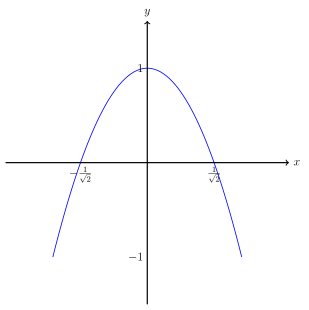
The curve \(P\) has the parametric equations $$ x= \sin\theta, \quad y=\cos2\theta \qquad\hbox{ for }-\pi/2 \le \theta \le \pi/2. $$ Show that \(P\) is part of the parabola \(y=1-2x^2\) and sketch \(P\). Show that the length of \(P\) is \(\surd (17) + {1\over 4} \sinh^{-1}4\). Obtain the volume of the solid enclosed when \(P\) is rotated through \(2\pi\) radians about the line \(y=-1\).
Solution: First notice that \(y = \cos 2 \theta = 1 - 2\sin^2 \theta = 1- 2x^2\), therefore \(P\) is lies on that parabola.
1993 Paper 3 Q7
The real numbers \(x\) and \(y\) satisfy the simultaneous equations $$ \sinh (2x) = \cosh y \qquad\hbox{and}\qquad \sinh(2y) = 2 \cosh x. $$ Show that \(\sinh^2 y\) is a root of the equation $$ 4t^3 + 4t^2 -4t -1=0 $$ and demonstrate that this gives at most one valid solution for \(y\). Show that the relevant value of \(t\) lies between \(0.7\) and \(0.8\), and use an iterative process to find \(t\) to 6 decimal places. Find \(y\) and hence find \(x\), checking your answers and stating the final answers to four decimal places.
Solution: Let \(t = \sinh^2 y\), then \begin{align*} && \sinh(2x) &= \cosh y \tag{1}\\ && \sinh(2y) &= 2 \cosh x \tag{2} \\ \\ && \cosh(2x) &= 2 \cosh^2 x -1 \\ (2): &&&= \frac12 \sinh^2(2y) -1 \\ && 1 &= \left (\frac12 \sinh^2(2y) -1 \right)^2 - \cosh^2 y \\ &&&= \frac14 \sinh^4(2y)-\sinh^2(2y)+1-\cosh^2 y \\ \Rightarrow && 0 &= \frac14 (\cosh^2 (2y)-1)^2- (\cosh^2 (2y)-1) - \cosh^2 y \\ &&&= \frac14 \left ( \left (1+2\sinh^2 y \right)^2-1 \right)^2 -\left ( \left (1+2\sinh^2 y \right)^2 -1\right) - (1 + \sinh^2 y ) \\ &&&= \frac14 \left ( 1 + 4t+4t^2 -1\right)^2 - \left ( 1+4t+4t^2-1\right) - (1 + t) \\ &&&= \frac14 (4t + 4t^2)^2 - (4t+4t^2)-1-t \\ &&&= 4(t+t^2)^2 - 4t^2-5t-1 \\ &&&= 4t^4+8t^3+4t^2-4t^2-5t-1 \\ &&& = 4t^4+8t^3-5t-1 \\ &&&= (t+1)(4t^3+4t^2-4t-1) \end{align*} Since \(\sinh^2 y\) is positive, we must be a root of the second cubic. Let \(f(t) = 4t^3+4t^2-4t-1\), then \(f(0) = -1\) and \(f'(t) = 12t^2+8t-4 = 4(t+1)(3t-1)\), so we have turning points at \(-1\) and \(\frac13\). Since \(f(-1) = 3 > 0\) and \(f(0) < 0\) we must have exactly one root larger than zero. Therefore there is a unique root. \(f(0.7) = -0.468 < 0\) \(f(0.8) = 0.408 > 0\) since \(f\) is continuous and changes sign, the root must fall in the interval \((0.7, 0.8)\). Let \(t_{n+1} = t_n - \frac{f(t_n)}{f'(t_n)}\), and \(t_0 = 0.75\), then \begin{align*} t_0 &= 0.75 \\ t_1 &= 0.7571428571 \\ t_2 &= 0.7570684728 \\ t_3 &= 0.7570684647 \end{align*} So \(t \approx 0.757068\), \(\sinh y \approx 0.870097\), \(y \approx 0.786474\), \(x \approx 0.546965\)
1992 Paper 2 Q2
Suppose that \(y\) satisfies the differential equation \[ y=x\frac{\mathrm{d}y}{\mathrm{d}x}-\cosh\left(\frac{\mathrm{d}y}{\mathrm{d}x}\right).\tag{*} \] By differentiating both sides of \((*)\) with respect to \(x\), show that either \[ \frac{\mathrm{d}^{2}y}{\mathrm{d}x^{2}}=0\qquad\mbox{ or }\qquad x-\sinh\left(\frac{\mathrm{d}y}{\mathrm{d}x}\right)=0. \] Find the general solutions of each of these two equations. Determine the solutions of \((*)\).
Solution: \begin{align*} && y & =x\frac{\mathrm{d}y}{\mathrm{d}x}-\cosh\left(\frac{\mathrm{d}y}{\mathrm{d}x}\right) \\ \Rightarrow && \frac{\d y}{\d x} &= \frac{\d y}{\d x} + x\frac{\d ^2 y}{\d x^2} - \sinh \left ( \frac{\d y}{\d x} \right) \frac{\d^2 y}{\d x^2} \\ \Rightarrow && 0 &= \frac{\d^2 y}{\d x^2} \left ( x - \sinh \left ( \frac{\d y}{\d x}\right)\right) \end{align*} Therefore \(\frac{\d^2y}{\d x^2} = 0\) or \( x - \sinh \left ( \frac{\d y}{\d x}\right) = 0\) as required. \begin{align*} && \frac{\d ^2 y}{\d x^2} &= 0 \\ \Rightarrow && y &= ax + b \\ \\ && 0 &= x - \sinh \left ( \frac{\d y}{\d x}\right) \\ \Rightarrow && \frac{\d y}{\d x} &= \sinh^{-1} (x) \\ \Rightarrow && y &= x \sinh^{-1} x - \sqrt{x^2+1} + C \end{align*} Since it is necessary the solution satisfies one of those equations, we just need to check if either of these types of solutions work for our differential equation, ie \begin{align*} && ax + b &\stackrel{?}{=} ax - \cosh(a) \\ \Rightarrow && b &= -\cosh(a) \\ \Rightarrow && y &= ax -\cosh(a) \\ \\ && x \sinh^{-1} x - \sqrt{x^2+1} + C &\stackrel{?}{=} x\sinh^{-1} x - \cosh ( \sinh^{-1} x) \\ &&&= \sinh^{-1} x -\sqrt{x^2+1} \\ \Rightarrow && C &= 0 \end{align*} Therefore the general solutions are, \(y = ax - \cosh(a)\) and \(y = x \sinh^{-1} x - \sqrt{x^2+1}\)
1992 Paper 2 Q8
Calculate the following integrals
- \({\displaystyle \int\frac{x}{(x-1)(x^{2}-1)}\,\mathrm{d}x}\);
- \({\displaystyle \int\frac{1}{3\cos x+4\sin x}\,\mathrm{d}x}\);
- \({\displaystyle \int\frac{1}{\sinh x}\,\mathrm{d}x}.\)
Solution:
- \begin{align*} \int\frac{x}{(x-1)(x^{2}-1)}\,\mathrm{d}x &= \int \frac{x}{(x-1)^2 (x+1)} \d x \\ &= \int \frac{1}{2(x-1)^2} + \frac{1}{4(x-1)} - \frac{1}{4(x+1)} \d x \\ &= -\frac12 (x-1)^{-1} + \frac14 \ln(x-1) - \frac14 \ln (x+1) + C \end{align*}
- \begin{align*} \int \frac{1}{3 \cos x + 4 \sin x } \d x &= \int \frac{1}{5 \cos (x - \cos^{-1}(3/5))} \d x \\ &= \frac15 \int \sec (x - \cos^{-1}(3/5)) \d x\\ &= \frac15 \left (\ln | \sec (x - \cos^{-1}(3/5)) + \tan (x - \cos^{-1}(3/5)) | \right) + C \end{align*}
- \begin{align*} \int \frac{1}{\sinh x} \d x &= \int \frac{2}{e^x - e^{-x}} \\ &= \int \frac{2e^x}{e^{2x}-1} \d x \\ &=\int \frac{e^x}{e^x-1} - \frac{e^x}{e^x+1} \d x \\ &= \ln (e^x - 1) + \ln (e^x+1) + C \end{align*}
1992 Paper 3 Q1
- Given that \[ \mathrm{f}(x)=\ln(1+\mathrm{e}^{x}), \] prove that \(\ln[\mathrm{f}'(x)]=x-\mathrm{f}(x)\) and that \(\mathrm{f}''(x)=\mathrm{f}'(x)-[\mathrm{f}'(x)]^{2}.\) Hence, or otherwise, expand \(\mathrm{f}(x)\) as a series in powers of \(x\) up to the term in \(x^{4}.\)
- Given that \[ \mathrm{g}(x)=\frac{1}{\sinh x\cosh2x}, \] explain why \(\mathrm{g}(x)\) can not be expanded as a series of non-negative powers of \(x\) but that \(x\mathrm{g}(x)\) can be so expanded. Explain also why this latter expansion will consist of even powers of \(x\) only. Expand \(x\mathrm{g}(x)\) as a series as far as the term in \(x^{4}.\)
Solution:
- \begin{align*} && f(x) &= \ln (1+e^x) \\ && f'(x) &= \frac{1}{1+e^x} \cdot e^x \\ &&&= \frac{e^x}{1+e^x} \\ \Rightarrow && \ln [f'(x)] &= x - \ln (1+e^x) \\ &&&= x - f(x) \\ \\ \Rightarrow && \frac{f''(x)}{f'(x)} &= 1 - f'(x) \\ \Rightarrow && f''(x) &= f'(x) - [f'(x)]^2 \\ && f'''(x) &= f''(x) - 2f'(x) f''(x) \\ && f^{(4)}(x) &= f'''(x) - 2[f''(x)]^2-2f'(x)f'''(x) \end{align*} \begin{align*} f(0) &= \ln 2 \\ f'(0) &= \tfrac12 \\ f''(0) &= \tfrac12 -\tfrac14 \\ &= \tfrac 14 \\ f'''(0) &= \tfrac14 - 2 \tfrac12 \tfrac 14 \\ &= 0 \\ f^{(4)}(0) &= -2 \cdot \tfrac1{16} \\ &= -\frac18 \end{align*} Therefore \(f(x) = \ln 2 + \tfrac12 x + \tfrac18 x^2 - \frac1{8 \cdot 4!} x^4 + O(x^5)\)
- As \(x \to 0\), \(g(x) \to \infty\) therefore there can be no power series about \(0\). But as \(x \to 0, x g(x) \not \to \infty\) as \(\frac{x}{\sinh x}\) is well behaved. We can also notice that \(x g(x)\) is an even function, since \(\cosh x\) is even and \(\frac{x}{\sinh x}\) is even, therefore the power series will consist of even powers of \(x\) \begin{align*} \lim_{x \to 0} \frac{x}{\sinh x \cosh 2 x} &= \lim_{x \to 0} \frac{x}{\sinh x} \cdot \lim_{x \to 0} \frac{1}{\cosh2 x} \\ &= 1 \end{align*} Notice that \begin{align*} \frac{x}{\sinh x \cosh 2 x} &= \frac{4x}{(e^x - e^{-x})(e^{2x}+e^{-2x})} \\ &= \frac{4x}{(2x + \frac{x^3}{3} + \cdots)(2 + 4x^2 + \frac43 x^4 + \cdots )} \\ &= \frac{1}{1+\frac{x^2}{6}+\frac{x^4}{5!} + \cdots } \frac{1}{1 + 2x^2 + \frac23 x^4 + \cdots } \\ &= \left (1-(\frac{x^2}{6} + \frac{x^4}{5!})+ (\frac{x^2}{6} )^2 + O(x^6)\right) \left (1-(2x^2+\frac23 x^4)+ (2x^2)^2 + O(x^6)\right) \\ &= \left (1 - \frac16 x^2 + \frac{7}{360} x^4 + O(x^6) \right) \left (1 - 2x^2+ \frac{10}3x^4 + O(x^6) \right) \\ &= 1 - \frac{13}{6} x^2 + \frac{1327}{360}x^4 + O(x^6) \end{align*}
1991 Paper 2 Q8
Solve the quadratic equation \(u^{2}+2u\sinh x-1=0\), giving \(u\) in terms of \(x\). Find the solution of the differential equation \[ \left(\frac{\mathrm{d}y}{\mathrm{d}x}\right)^{2}+2\frac{\mathrm{d}y}{\mathrm{d}x}\sinh x-1=0 \] which satisfies \(y=0\) and \(y'>0\) at \(x=0\). Find the solution of the differential equation \[ \sinh x\left(\frac{\mathrm{d}y}{\mathrm{d}x}\right)^{2}+2\frac{\mathrm{d}y}{\mathrm{d}x}-\sinh x=0 \] which satisfies \(y=0\) at \(x=0\).
Solution: \begin{align*} && 0 &= u^2 + 2u \sinh x -1 \\ &&&= u^2 + u(e^x-e^{-x})-e^{x}e^{-x} \\ &&&= (u-e^{-x})(u+e^x) \\ \Rightarrow && u &= e^{-x}, -e^x \end{align*} \begin{align*} && 0 &= \left(\frac{\mathrm{d}y}{\mathrm{d}x}\right)^{2}+2\frac{\mathrm{d}y}{\mathrm{d}x}\sinh x-1 \\ \Rightarrow && \frac{\d y}{\d x} &= e^{-x}, -e^x \\ \Rightarrow && y &= -e^{-x}+C, -e^x+C \\ y(0) = 0: && C &= 1\text{ both cases } \\ y'(0) > 0: && y &= 1-e^{-x} \end{align*} \begin{align*} && 0 &= \sinh x u^2 + 2u -\sinh x \\ \Rightarrow && u &= \frac{-2 \pm \sqrt{4+4\sinh^2 x}}{2\sinh x} \\ &&&= \frac{-1 \pm \cosh x}{\sinh x} = - \textrm{cosech }x \pm \textrm{coth}x \\ \\ && 0 &= \sinh x\left(\frac{\mathrm{d}y}{\mathrm{d}x}\right)^{2}+2\frac{\mathrm{d}y}{\mathrm{d}x}-\sinh x \\ \Rightarrow && \frac{\d y}{\d x} &= - \textrm{cosech }x \pm \textrm{coth}x \\ \Rightarrow && y &= -\ln \left ( \tanh \frac{x}{2} \right) \pm \ln \sinh x+C \end{align*} For \(x \to 0\) to be defined, we need \(+\), so \begin{align*} && y &= \ln \left (\frac{\sinh x}{\tanh \frac{x}{2}} \right) + C \\ && y &= \ln \left (\frac{2\sinh \frac{x}{2} \cosh \frac{x}{2}}{\tanh \frac{x}{2}} \right)+C \\ &&&= \ln \left (2 \cosh^2 x \right) + C \\ y(0) = 0: && 0 &= \ln 2+C \\ \Rightarrow && y &= \ln(2 \cosh^2 x) -\ln 2 \\ && y &= 2 \ln (\cosh x) \end{align*}
1991 Paper 3 Q6
The transformation \(T\) from \(\binom{x}{y}\) to \(\binom{x'}{y'}\) in two-dimensional space is given by \[ \begin{pmatrix}x'\\ y' \end{pmatrix}=\begin{pmatrix}\cosh u & \sinh u\\ \sinh u & \cosh u \end{pmatrix}\begin{pmatrix}x\\ y \end{pmatrix}, \] where \(u\) is a positive real constant. Show that the curve with equation \(x^{2}-y^{2}=1\) is transformed into itself. Find the equations of two straight lines through the origin which transform into themselves. A line, not necessary through the origin, which has gradient \(\tanh v\) transforms under \(T\) into a line with gradient \(\tanh v'\). Show that \(v'=v+u\). The lines \(\ell_{1}\) and \(\ell_{2}\) with gradients \(\tanh v_{1}\) and \(\tanh v_{2}\) transform under \(T\) into lines with gradients \(\tanh v_{1}'\) and \(\tanh v_{2}'\) respectively. Find the relation satisfied by \(v_{1}\) and \(v_{2}\) that is the necessary and sufficient for \(\ell_{1}\) and \(\ell_{2}\) to intersect at the same angle as their transforms. In the case when \(\ell_{1}\) and \(\ell_{2}\) meet at the origin, illustrate in a diagram the relation between \(\ell_{1}\), \(\ell_{2}\) and their transforms.