Problems
Filters
21 problems found
1992 Paper 3 Q15
A goat \(G\) lies in a square field \(OABC\) of side \(a\). It wanders randomly round its field, so that at any time the probability of its being in any given region is proportional to the area of this region. Write down the probability that its distance, \(R\), from \(O\) is less than \(r\) if \(0 < r\leqslant a,\) and show that if \(r\geqslant a\) the probability is \[ \left(\frac{r^{2}}{a^{2}}-1\right)^{\frac{1}{2}}+\frac{\pi r^{2}}{4a^{2}}-\frac{r^{2}}{a^{2}}\cos^{-1}\left(\frac{a}{r}\right). \] Find the median of \(R\) and probability density function of \(R\). The goat is then tethered to the corner \(O\) by a chain of length \(a\). Find the conditional probability that its distance from the fence \(OC\) is more than \(a/2\).
1990 Paper 2 Q15
A target consists of a disc of unit radius and centre \(O\). A certain marksman never misses the target, and the probability of any given shot hitting the target within a distance \(t\) from \(O\) it \(t^{2}\), where \(0\leqslant t\leqslant1\). The marksman fires \(n\) shots independently. The random variable \(Y\) is the radius of the smallest circle, with centre \(O\), which encloses all the shots. Show that the probability density function of \(Y\) is \(2ny^{2n-1}\) and find the expected area of the circle. The shot which is furthest from \(O\) is rejected. Show that the expected area of the smallest circle, with centre \(O\), which encloses the remaining \((n-1)\) shots is \[ \left(\frac{n-1}{n+1}\right)\pi. \]
Solution: Another way to describe \(Y\) is the maximum distance of any shot from \(O\). Let \(X_i\), \(1 \leq i \leq n\) be the \(n\) shots then, \begin{align*} F_Y(y) &= \mathbb{P}(Y \leq y) \\ &= \mathbb{P}(X_i \leq y \text{ for all } i) \\ &= \prod_{i=1}^n \mathbb{P}(X_i \leq y) \tag{each shot independent}\\ &= \prod_{i=1}^n y^2\\ &= y^{2n} \end{align*} Therefore \(f_Y(y) = \frac{\d}{\d y} (y^{2n}) = 2n y^{2n-1}\). \begin{align*} \mathbb{E}(\pi Y^2) &= \int_0^1\pi y^2 \f_Y(y) \d y \\ &=\pi \int_0^1 2n y^{2n+1} \d y \\ &=\left ( \frac{n}{n+1} \right )\pi \end{align*}. Let \(Z\) be the distance of the second furthest shot, then: \begin{align*} && F_Z(z) &= \mathbb{P}(Z \leq z) \\ &&&= \mathbb{P}(X_i \leq z \text{ for at least } n - 1\text{ different } i) \\ &&&= n\mathbb{P}(X_i \leq z \text{ for all but 1}) + \mathbb{P}(X_i \leq z \text{ for all } i) \\ &&&= n \left ( \prod_{i=1}^{n-1} \mathbb{P}(X_i \leq z) \right) \mathbb{P}(X_n > z) + z^{2n} \\ &&&= nz^{2n-2}(1-z^2) + z^{2n} \\ &&&= nz^{2n-2} -(n-1)z^{2n} \\ \Rightarrow && f_Z(z) &= n(2n-2)z^{2n-3}-2n(n-1)z^{2n-1} \\ \Rightarrow && \mathbb{E}(\pi Z^2) &= \int_0^1 \pi z^2 \left (n(2n-2)z^{2n-3}-2n(n-1)z^{2n-1} \right) \d z \\ &&&= \pi \left ( \frac{n(2n-2)}{2n} - \frac{2n(n-1)}{2n+2}\right) \\ &&&= \left ( \frac{n-1}{n+1} \right) \pi \end{align*}
1990 Paper 3 Q16
- A rod of unit length is cut into pieces of length \(X\) and \(1-X\); the latter is then cut in half. The random variable \(X\) is uniformly distributed over \([0,1].\) For some values of \(X\) a triangle can be formed from the three pieces of the rod. Show that the conditional probability that, if a triangle can be formed, it will be obtuse-angled is \(3-2\sqrt{2.}\)
- The bivariate distribution of the random variables \(X\) and \(Y\) is uniform over the triangle with vertices \((1,0),(1,1)\) and \((0,1).\) A pair of values \(x,y\) is chosen at random from this distribution and a (perhaps degenerate) triangle \(ABC\) is constructed with \(BC=x\) and \(CA=y\) and \(AB=2-x-y.\) Show that the construction is always possible and that \(\angle ABC\) is obtuse if and only if \[ y>\frac{x^{2}-2x+2}{2-x}. \] Deduce that the probability that \(\angle ABC\) is obtuse is \(3-4\ln2.\)
Solution:
- The construction is possible if \(x + y > 2-x-y \Rightarrow x+y > 1\) (which is as the triangle is above the diagonal line), and \(x + (2-x-y) > y \Rightarrow 1 > y\) (true as the triangle is below the horizontal line) and \(y + (2-x-y) > x \Rightarrow 1 > x\) (true as the triangle is left of the vertical arrow). By the cosine rule: \begin{align*} && y^2 &= x^2 + (2-x-y)^2 - 2 x (2-x-y) \cos \angle ABC \\ \Rightarrow && \cos \angle ABC &= \frac{x^2+(2-x-y)^2 - y^2}{2x(2-x-y)} \\ &&&= \frac{4+2x^2-4x-4y+2xy}{2x(2-x-y)} \\ \underbrace{\Rightarrow}_{\cos \angle ABC < 0} && 0 &> 4+2x^2-4x-4y+2xy \\ \Rightarrow && 0 &> 2x^2-4x+4 - 2(x-2)y \\ \Rightarrow && y &> \frac{x^2-2x+2}{2-x} \\ &&&= -x + \frac{2}{2-x} \end{align*}
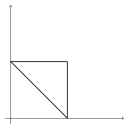 Therefore the area we want is: \begin{align*} A &= 1 - \int_0^1 \left ( -x + \frac{2}{2-x} \right)\d x \\ &= 1 - \left [-\frac12 x^2 - 2 \ln(2-x) \right]_0^1 \\ &= 1 + \frac12 -2 \ln 2 \\ &= \frac32 - 2 \ln 2 \end{align*} Therefore the relative area is: \(\frac{\frac32 - 2 \ln 2}{1/2} = 3 - 4 \ln 2\)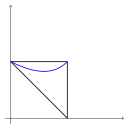
1989 Paper 2 Q15
Two points are chosen independently at random on the perimeter (including the diameter) of a semicircle of unit radius. What is the probability that exactly one of them lies on the diameter? Let the area of the triangle formed by the two points and the midpoint of the diameter be denoted by the random variable \(A\).
- Given that exactly one point lies on the diameter, show that the expected value of \(A\) is \(\left(2\pi\right)^{-1}\).
- Given that neither point lies on the diameter, show that the expected value of \(A\) is \(\pi^{-1}\). [You may assume that if two points are chosen at random on a line of length \(\pi\) units, the probability density function for the distance \(X\) between the two points is \(2\left(\pi-x\right)/\pi^{2}\) for \(0\leqslant x\leqslant\pi.\)]
Solution:
- \begin{align*} \mathbb{E}(A \mid \text{exactly one point on diameter}) &= \int_{-1}^1\int_0^\pi \frac12 (x-0)\cdot 1 \cdot \sin(\pi - \theta) \frac{1}{\pi} \d \theta \frac{1}{2} \d x \\ &= \int_{-1}^1\frac1{2\pi} x \d x \cdot \left [ -\cos \theta \right]_0^\pi \\ &= \frac{1}{2\pi} \end{align*}

- \begin{align*} \mathbb{E}(A \mid \text{no point on diameter}) &= \int_0^{\pi} \frac12 \cdot 1 \cdot 1 \cdot \sin x \cdot 2(\pi - x)/\pi^2 \d x \\ &= \frac1{\pi^2} \int_0^\pi \sin x (\pi - x) \d x \\ &= \frac1{\pi^2} \int_0^\pi x\sin x \d x \\ &= \frac1{\pi^2} \left [ \sin x - x \cos x \right]_0^{\pi} \\ &= \frac{1}{\pi} \end{align*}

1987 Paper 1 Q15
A point \(P\) is chosen at random (with uniform distribution) on the circle \(x^{2}+y^{2}=1\). The random variable \(X\) denotes the distance of \(P\) from \((1,0)\). Find the mean and variance of \(X\). Find also the probability that \(X\) is greater than its mean.
Solution: Consider the angle from the origin, then \(P = (\cos \theta, \sin \theta)\) where \(\theta \sim U(0, 2\pi)\), and \(X = \sqrt{(\cos \theta - 1)^2 + \sin^2 \theta}\) \begin{align*} \mathbb{E}[X] &= \int_0^{2\pi} \sqrt{(\cos \theta - 1)^2 + \sin^2 \theta} \frac1{2\pi} \d \theta \\ &= \frac1{2\pi}\int_0^{2\pi} \sqrt{2 - 2\cos \theta} \d \theta \\ &= \frac{1}{2\pi}\int_0^{2\pi} \sqrt{4\sin^2 \frac{\theta}{2}} \d \theta \\ &= \frac{1}{\pi}\int_0^{2\pi} \left |\sin \frac{\theta}{2} \right| \d \theta \\ &= \frac{1}{\pi} \left [ -2\cos \frac{\theta}{2} \right]_0^{2\pi} \\ &= \frac1{\pi} \l 2 + 2\r \\ &= \frac{4}{\pi} \end{align*} \begin{align*} \mathbb{E}(X^2) &= \frac1{2\pi}\int_0^{2\pi} (\cos \theta - 1)^2 + \sin^2 \theta \d \theta \\ &= \frac1{2\pi}\int_0^{2\pi} 2 - 2 \cos \theta \d \theta \\ &= \frac{4\pi}{2\pi} \\ &= 2 \\ \end{align*} \(\Rightarrow\) \(\mathrm{Var}(X) = \mathbb{E}(X^2) - \mathbb{E}(X)^2 = 2 - \frac{16}{\pi^2} = \frac{2\pi^2 - 16}{\pi^2}\).

1987 Paper 2 Q15
A train of length \(l_{1}\) and a lorry of length \(l_{2}\) are heading for a level crossing at speeds \(u_{1}\) and \(u_{2}\) respectively. Initially the front of the train and the front of the lorry are at distances \(d_{1}\) and \(d_{2}\) from the crossing. Find conditions on \(u_{1}\) and \(u_{2}\) under which a collision will occur. On a diagram with \(u_{1}\) and \(u_{2}\) measured along the \(x\) and \(y\) axes respectively, shade in the region which represents collision. Hence show that if \(u_{1}\) and \(u_{2}\) are two independent random variables, both uniformly distributed on \((0,V)\), then the probability of a collision in the case when initially the back of the train is nearer to the crossing than the front of the lorry is \[ \frac{l_{1}l_{2}+l_{2}d_{1}+l_{1}d_{2}}{2d_{2}\left(l_{2}+d_{2}\right)}. \] Find the probability of a collision in each of the other two possible cases.