Problems
Filters
86 problems found
2014 Paper 3 Q13
I play a game which has repeated rounds. Before the first round, my score is \(0\). Each round can have three outcomes:
- my score is unchanged and the game ends;
- my score is unchanged and I continue to the next round;
- my score is increased by one and I continue to the next round.
- Suppose in the first round, the game ends. Show that the probability generating function conditional on this happening is 1.
- Suppose in the first round, the game continues to the next round with no change in score. Show that the probability generating function conditional on this happening is \(G(t)\).
- By comparing the coefficients of \(t^n\), show that $ G(t) = a + bG(t) + ctG(t)\,. $ Deduce that, for \(n\ge0\), \[ P(N=n) = \frac{ac^n}{(1-b)^{n+1}}\,. \]
- Show further that, for \(n\ge0\), \[ P(N=n) = \frac{\mu^n}{(1+\mu)^{n+1}}\,, \] where \(\mu=\E(N)\).
Solution:
- If the game ends in the first round then the score is exactly \(0\) and the pgf is \(1\cdot x^0 = 1\)
- If the game moves onto the next round with no change in the first round then it's as if nothing happened, therefore the pgf is the original pgf \(G(t)\)
- If the game moves into the next round with the score increased by one, then the pgf is \(tG(t)\) since all the scores are increased by \(1\). Therefore \begin{align*} && G(t) &= \E[t^N] \\ &&&= \E[\E[t^N | \text{first round}]] \\ &&&= a + bG(t) + ctG(t) \\ \Rightarrow && G(t)(1-b-ct) = a \\ \Rightarrow && G(t) &= \frac{a}{(1-b)-ct} \\ &&&= \frac{a}{(1-b)} \frac{1}{1- \left(\frac{c}{1-b}\right)t} \\ &&&= \sum_{n=0}^\infty \frac{a}{1-b} \frac{c^n}{(1-b)^n} t^n\\ &&&= \sum_{n=0}^{\infty} \frac{ac^n}{(1-b)^{n+1}}t^n \end{align*} Therefore by comparing coefficients, \(\mathbb{P}(N=n) = \frac{ac^n}{(1-b)^{n+1}}\)
- \(\,\) \begin{align*} && \E[N] &= G'(1) \\ &&&= \frac{ac}{((1-b)-c)^2} \\ &&&= \frac{ac}{a^2} = \frac{c}{a} \\ \\ && \frac{\mu^n}{(1+\mu)^{n+1}} &= \frac{c^na^{-n}}{(a+c)^{n+1}a^{-n-1}} \\ &&&= \frac{ac^n}{(a+c)^{n+1}}\\ &&&= \frac{ac^n}{(1-b)^{n+1}}\\ &&&= \mathbb{P}(N=n) \end{align*} as required
2013 Paper 1 Q12
Each day, I have to take \(k\) different types of medicine, one tablet of each. The tablets are identical in appearance. When I go on holiday for \(n\) days, I put \(n\) tablets of each type in a container and on each day of the holiday I select \(k\) tablets at random from the container.
- In the case \(k=3\), show that the probability that I will select one tablet of each type on the first day of a three-day holiday is \(\frac9{28}\). Write down the probability that I will be left with one tablet of each type on the last day (irrespective of the tablets I select on the first day).
- In the case \(k=3\), find the probability that I will select one tablet of each type on the first day of an \(n\)-day holiday.
- In the case \(k=2\), find the probability that I will select one tablet of each type on each day of an \(n\)-day holiday, and use Stirling's approximation \[ n!\approx \sqrt{2n\pi} \left(\frac n\e\right)^n \] to show that this probability is approximately \(2^{-n} \sqrt{n\pi\;}\).
Solution:
- The probability the first is different to the second is \(\frac68\), the probability the third is different to both of the first two is \(\frac37\) therefore the probability is \(\frac{6}{8} \cdot \frac37 = \frac9{28}\) Whatever pills we are left with on the last day is essentially the same random choice as we make on the first day, therefore \(\frac9{28}\)
- The probability the first is different to the second is \(\frac{2n}{3n-1}\), the probability the third is different to both of the first two is \(\frac{n}{3n-2}\) therefore the probability is \(\frac{2n^2}{(3n-1)(3n-2)}\). [We can also view this as \(\frac{(3n) \cdot (2n) \cdot n}{(3n) \cdot (3n-1) \cdot (3n-2)}\)]
- Suppose describe the pills as \(B\) and \(R\) and also number them, then we must have a sequence of the form: \[ B_1R_1 \, B_2R_2 \, B_3R_3 \, \cdots \, B_{n}R_n \] However, we can also rearrange the order of the \(B\) and \(R\) pills in \(n!\) ways each, and also the order of the pairs in \(2^n\) ways. There are \((2n)!\) orders we could have taken the pills out therefore the probability is \begin{align*} && P &= \frac{2^n (n!)^2}{(2n)!} = \frac{2^n}{\binom{2n}{n}} \\ &&&\approx \frac{2^n \cdot 2n \pi \left ( \frac{n}{e} \right)^{2n}}{\sqrt{2 \cdot 2n \cdot \pi} \left ( \frac{2n}{e} \right)^{2n}} \\ &&&= \frac{2^n \sqrt{n \pi} \cdot n^{2n} \cdot e^{-2n}}{2^{2n} \cdot n^{2n} \cdot e^{-2n}} \\ &&&= 2^{-n} \sqrt{n \pi} \end{align*} There is a nice way to think about this question using conditional probability. Suppose we are drawing out of an infinitely supply of \(R\) and \(B\) pills, then each day there is a \(\frac12\) chance of getting different pills. Therefore over \(n\) days there is a \(2^{-n}\) chance of getting different pills. Conditional on the balanced total we see that \begin{align*} && \mathbb{P}(\text{balanced every day} |\text{balanced total}) &= \frac{\mathbb{P}(\text{balanced every day})}{\mathbb{P}(\text{balanced total})} \end{align*} We have already seen the term that is balanced total is \(\frac{1}{2^{2n}}\binom{2n}{n}\), but we can also approximate the balanced total using a normal approximation. \(B(2n, \tfrac12) \approx N(n, \frac{n}{2})\) and so: \begin{align*} \mathbb{P}(X = n) &\approx \mathbb{P}\left (n-0.5 \leq \sqrt{\tfrac{n}{2}} Z + n \leq n+0.5 \right) \\ &= \mathbb{P}\left (- \frac1{\sqrt{2n}} \leq Z \leq \frac{1}{\sqrt{2n}} \right) \\ &= \int_{- \frac1{\sqrt{2n}}}^{\frac1{\sqrt{2n}}} \frac{1}{\sqrt{2\pi}} e^{-x^2/2} \d x \approx \frac{2}{\sqrt{2n}} \frac{1}{\sqrt{2\pi}} \\ &\approx \frac{1}{\sqrt{n\pi}} \end{align*}
2012 Paper 1 Q12
Fire extinguishers may become faulty at any time after manufacture and are tested annually on the anniversary of manufacture. The time \(T\) years after manufacture until a fire extinguisher becomes faulty is modelled by the continuous probability density function \[ f(t) = \begin{cases} \frac{2t}{(1+t^2)^2}& \text{for \(t\ge0\)}\,,\\[4mm] \ \ \ \ 0& \text{otherwise}. \end{cases} \] A faulty fire extinguisher will fail an annual test with probability \(p\), in which case it is destroyed immediately. A non-faulty fire extinguisher will always pass the test. All of the annual tests are independent. Show that the probability that a randomly chosen fire extinguisher will be destroyed exactly three years after its manufacture is \(p(5p^2-13p +9)/10\). Find the probability that a randomly chosen fire extinguisher that was destroyed exactly three years after its manufacture was faulty 18 months after its manufacture.
Solution: The probability it becomes faulty in each year is: \begin{align*} \mathbb{P}(\text{faulty in Y}1) &= \int_0^1 \frac{2t}{(1+t^2)^2} \, dt \\ &= \left [ -\frac{1}{(1+t^2)} \right]_0^1 \\ &= 1 - \frac{1}{2} = \frac{1}{2} \\ \mathbb{P}(\text{faulty in Y}2) &= \frac{1}{2} - \frac{1}{5} = \frac{3}{10} \\ \mathbb{P}(\text{faulty in Y}3) &= \frac{1}{5} - \frac{1}{10} = \frac{1}{10} \end{align*} The probability of failing for the first time after exactly \(3\) years is: \begin{align*} \mathbb{P}(\text{faulty in Y1, }PPF) &+ \mathbb{P}(\text{faulty in Y2, }PF) + + \mathbb{P}(\text{faulty in Y3, }F) \\ &= \frac12 (1-p)^2p + \frac3{10}(1-p)p + \frac1{10}p \\ &= \frac{p}{10} \l 5(1-p)^2 + 3(1-p) + 1 \r \\ &= \frac{p}{10} \l 5 - 10p + 5p^2 + 3 -3p +1 \r \\ &= \frac{p}{10} \l 9 - 13p + 5p^2 \r \end{align*} as required. The probability that a randomly chosen fire extinguisher that was destroyed exactly three years after its manufacture was faulty 18 months after its manufacture is: \begin{align*} \mathbb{P}(\text{faulty 18 months after} | \text{fails after 3 tries}) &= \frac{\mathbb{P}(\text{faulty 18 months after and fails after 3 tries})}{\mathbb{P}(\text{fails after exactly 3 tries})} \end{align*} We can compute \(\mathbb{P}(\text{faulty 18 months after and fails after 3 tries})\) by looking at \(2\) cases, fails between \(12\) months and \(18\) years, and between \(0\) years and \(1\) year. \begin{align*} \mathbb{P}(\text{faulty between 1y and 18m}) &= \int_{1}^{\frac32} \frac{2t}{(1+t^2)^2} \, dt \\ &= \left [ -\frac{1}{(1+t^2)} \right]_{1}^{\frac32} \\ &= \frac12 - \frac{4}{13} = \frac{5}{26} \\ \end{align*} So the probability is: \begin{align*} \mathbb{P} &= \frac{\frac{5}{26}(1-p)p + \frac12(1-p)^2p}{\frac{p}{10} \l 9 - 13p + 5p^2 \r} \\ &= \frac{\frac{25}{13}(1-p) + 5(1-p)^2}{9 - 13p + 5p^2} \\ &= \frac{5}{13} \frac{(1-p)\l 5 + 13(1-p) \r}{9 - 13p + 5p^2} \\ &= \frac{5}{13} \frac{(1-p)\l 18 - 13p \r}{9 - 13p + 5p^2} \\ \end{align*}
2011 Paper 1 Q12
I am selling raffle tickets for \(\pounds1\) per ticket. In the queue for tickets, there are \(m\) people each with a single \(\pounds1\) coin and \(n\) people each with a single \(\pounds2\) coin. Each person in the queue wants to buy a single raffle ticket and each arrangement of people in the queue is equally likely to occur. Initially, I have no coins and a large supply of tickets. I stop selling tickets if I cannot give the required change.
- In the case \(n=1\) and \(m\ge1\), find the probability that I am able to sell one ticket to each person in the queue.
- By considering the first three people in the queue, show that the probability that I am able to sell one ticket to each person in the queue in the case \(n=2\) and \(m\ge2\) is \(\dfrac{m-1}{m+1}\,\).
- Show that the probability that I am able to sell one ticket to each person in the queue in the case \(n=3\) and \(m\ge3\) is \(\dfrac{m-2}{m+1}\,\).
Solution:
- The only way you wont be able to sell to them is if they are first, ie \(\frac1{m+1}\)
- If \(n=2\), the the only way you fail to sell to them is if one comes first or they both appear before two people with pound coins, ie \(2\) or \(122\). These have probabilities \(\frac{2}{m+2}\) and \(\frac{m}{m+2} \cdot \frac{2}{m+1} \frac{1}{m} = \frac{2}{(m+1)(m+2)}\). Therefore the total probability you don't sell all the tickets is \(\frac{2}{m+2}\left ( 1 + \frac{1}{m+1} \right) = \frac{2}{m+2} \frac{m+2}{m+1} = \frac{2}{m+1}\). Therefore the probability you do sell all the tickets is \(1 - \frac{2}{m+1} = \frac{m-1}{m+1}\)
- The only ways to fail when \(n=3\) are: \(2\), \(122\), or if all three \(2\)s appear before three \(1\)s. this can happen in \(11222\), \(12122\) These happen with probability: \begin{align*} 2: && \frac{3}{m+3} \\ 122: && \frac{m}{m+3} \cdot \frac{3}{m+2} \cdot \frac{2}{m+1} \\ 11222: && \frac{m(m-1) 6}{(m+3)(m+2)(m+1)m(m-1)} \\ 12122: && \frac{m(m-1) 6}{(m+3)(m+2)(m+1)m(m-1)} \\ \end{align*} Therefore the total probability is: \begin{align*} P &= \frac{1}{(m+3)(m+2)(m+1)} \left (3(m+2)(m+1)+6m + 12 \right) \\ &= \frac{1}{(m+3)(m+2)(m+1)} \left (3(m+1)(m+2) \right) \\ &= \frac{3}{m+1} \end{align*} and the result follows
2011 Paper 2 Q12
Xavier and Younis are playing a match. The match consists of a series of games and each game consists of three points. Xavier has probability \(p\) and Younis has probability \(1-p\) of winning the first point of any game. In the second and third points of each game, the player who won the previous point has probability \(p\) and the player who lost the previous point has probability \(1-p\) of winning the point. If a player wins two consecutive points in a single game, the match ends and that player has won; otherwise the match continues with another game.
- Let \(w\) be the probability that Younis wins the match. Show that, for \(p\ne0\), \[ w = \frac{1-p^2}{2-p}. \] Show that \(w>\frac12\) if \(p<\frac12\), and \(w<\frac12\) if \(p>\frac12\). Does \(w\) increase whenever \(p\) decreases?
- If Xavier wins the match, Younis gives him \(\pounds1\); if Younis wins the match, Xavier gives him \(\pounds k\). Find the value of \(k\) for which the game is `fair' in the case when \(p =\frac23\).
- What happens when \(p = 0\)?
Solution:
- We can be in several states.
- No points played
- Y just won the last point
- X just won the last point
- Y won the game
- X won the game
- If \(p = \frac23\) then \(w = \frac{1-\frac49}{2-\frac23} = \frac{5}{12}\). The game is fair if \(\mathbb{E}(result) = 0\), ie \(\frac{5}{12} \cdot k - \frac{7}{12} 1 \Rightarrow k = \frac{7}{5} = 1.4\)
- If \(p = 0\) then they will keep playing forever, since no-one can win two points in a row.
2008 Paper 2 Q12
In the High Court of Farnia, the outcome of each case is determined by three judges: the ass, the beaver and the centaur. Each judge decides its verdict independently. Being simple creatures, they make their decisions entirely at random. Past verdicts show that the ass gives a guilty verdict with probability \(p\), the beaver gives a guilty verdict with probability \(p/3\) and the centaur gives a guilty verdict with probability \(p^2\). Let \(X\) be the number of guilty verdicts given by the three judges in a case. Given that \(\E(X)= 4/3\), find the value of \(p\). The probability that a defendant brought to trial is guilty is \(t\). The King pronounces that the defendant is guilty if at least two of the judges give a guilty verdict; otherwise, he pronounces the defendant not guilty. Find the value of \(t\) such that the probability that the King pronounces correctly is \(1/2\).
Solution: \begin{align*} && \mathbb{E}(X) &= p + \frac{p}{3} + p^2 = \frac43p+p^2 \\ \Rightarrow && \frac43 &= \frac43p+p^2 \\ \Rightarrow && 0 &= 3p^2+4p-4 \\ &&&= (3p-2)(p+2) \\ \Rightarrow && p &= \frac23, -2 \end{align*} Since \(p \in [0,1]\) we must have \(p = \frac23\). \begin{align*} && \mathbb{P}(\text{correct verdict}) &= t p+ (1-t) (1-p) \\ &&&= t(2p-1)+(1-p)\\ \Rightarrow && \frac12 &= t(2p-1)+(1-p) \\ \Rightarrow && t &= \frac{\frac12-(1-p)}{2p-1} \\ &&&= \frac{2p-1}{2(2p-1)} = \frac12 \end{align*} (so it doesn't depend at all on what the judges are doing, the only way to be fair is if the trials happen at random!)
2007 Paper 1 Q12
- A bag contains \(N\) sweets (where \(N \ge 2\)), of which \(a\) are red. Two sweets are drawn from the bag without replacement. Show that the probability that the first sweet is red is equal to the probability that the second sweet is red.
- There are two bags, each containing \(N\) sweets (where \(N \ge 2\)). The first bag contains \(a\) red sweets, and the second bag contains \(b\) red sweets. There is also a biased coin, showing Heads with probability \(p\) and Tails with probability \(q\), where \(p+q = 1\). The coin is tossed. If it shows Heads then a sweet is chosen from the first bag and transferred to the second bag; if it shows Tails then a sweet is chosen from the second bag and transferred to the first bag. The coin is then tossed a second time: if it shows Heads then a sweet is chosen from the first bag, and if it shows Tails then a sweet is chosen from the second bag. Show that the probability that the first sweet is red is equal to the probability that the second sweet is red.
2007 Paper 1 Q13
A bag contains eleven small discs, which are identical except that six of the discs are blank and five of the discs are numbered, using the numbers 1, 2, 3, 4 and 5. The bag is shaken, and four discs are taken one at a time without replacement. Calculate the probability that:
- all four discs taken are numbered;
- all four discs taken are numbered, given that the disc numbered ``3'' is taken first;
- exactly two numbered discs are taken, given that the disc numbered ``3'' is taken first;
- exactly two numbered discs are taken, given that the disc numbered ``3'' is taken;
- exactly two numbered discs are taken, given that a numbered disc is taken first;
- exactly two numbered discs are taken, given that a numbered disc is taken.
Solution: There are many ways to do the counting in each question, possibly the clearest way is to always consider the order in which discs are taken, although all methods should work equally well. For some examples Bayes rule also offers a fast solution.
- There are we are choose \(4\) objects in order from \(5\) (ie \({^5\P_4}\)) to obtain valid draws, this is out of a total of picking \(4\) objects from \(11\) (\({^{11}\P_4}\)). Ie the probability is: \(\displaystyle \frac{{^5\P_4}}{{^{11}\P_4}} = \frac{5! \cdot 7!}{11!} = \frac{1}{66}\) Alternatively, there are \(\binom{5}{4}\) ways to choose four numbered discs, out of \(\binom{11}{4}\) ways to choose four discs. ie \(\displaystyle \binom{5}{4} \Big / \binom{11}{4} = \frac{5 \cdot 4! \cdot 7!}{11!} = \frac{5 \cdot 4 \cdot 3 \cdot 2}{11 \cdot 10 \cdot 9 \cdot 8} = \frac1{66}\)
- \begin{align*} \mathbb{P}(\text{all four discs are numbered} | \text{first disc is 3}) &= \frac{\mathbb{P}(\text{all four discs are numbered and first disc is 3})}{\mathbb{P}( \text{first disc is 3})} \\ &= \frac{^4\P_3 \big / {^{11}\P_4}}{1/11} \\ &= 11\cdot \frac{4!}{1!} \Bigg / \frac{11!}{7!} \\ &= \frac{4! \cdot 7! \cdot 11}{11!} \\ &= \frac{4\cdot 3 \cdot 2}{10 \cdot 9 \cdot 8} \\ &= \frac{1}{30} \end{align*} Alternatively, \begin{align*} \mathbb{P}(\text{all four discs are numbered} | \text{first disc is 3}) &= \frac{\mathbb{P}(\text{all four discs are numbered and first disc is 3})}{\mathbb{P}( \text{first disc is 3})} \\ &= \frac{\binom{4}{3} \Bigg / 11 \cdot \binom{10}{3}}{1/11} \\ &= \frac{1}{30} \end{align*} Where we are calculating this as "choose one number", then "choose 3 more", which can happen ending up with 3, number, number, number in \(\binom{4}{3}\) ways, and there are \(11 \cdot \binom{10}{3}\) was overall. Another alternative using Bayes rule: \begin{align*} \mathbb{P}(\text{all four discs are numbered} | \text{first disc is 3}) &= \mathbb{P}( \text{first disc is 3} | \text{all four discs are numbered}) \frac{ \mathbb{P}( \text{all four discs are numbered} }{ \mathbb{P}( \text{first disc is 3} )} \\ &= \frac{\frac{1}{5} \cdot \frac{1}{66}}{\frac{1}{11}} \\ &= \frac1{30} \end{align*}
- \begin{align*} \mathbb{P}(\text{exactly two discs are numbered} | \text{first disc is 3}) &=\frac{\mathbb{P}(\text{exactly two discs are numbered and first disc is 3})}{\mathbb{P}( \text{first disc is 3})} \\ &= \frac{3 \cdot {^4\P_1} \cdot {^{6}\P_2} \big / {^{11}\P_4}}{\frac1{11} } \\ &= \frac12 \end{align*} Alternatively, \begin{align*} \mathbb{P}(\text{exactly two discs are numbered} | \text{first disc is 3}) &=\frac{\mathbb{P}(\text{exactly two discs are numbered and first disc is 3})}{\mathbb{P}( \text{first disc is 3})} \\ &= \frac{\binom{4}{1}\binom{6}{2} \Big / 11 \cdot \binom{10}{3}}{1/11} \\ &= \frac12 \end{align*}
- \begin{align*} \mathbb{P}(\text{exactly two discs are numbered} | \text{3 taken}) &= \frac{\mathbb{P}(\text{exactly two discs are numbered and 3 taken})}{\mathbb{P}( \text{3 taken})} \\ &= \frac{\binom{4}{1}\binom{6}{2} \Big / \binom{11}{4}}{\frac{4}{11}} \\ &= \frac{\frac{2}{11}}{\frac4{11}} \\ &= \frac12 \end{align*} Using Bayes rule: \(\mathbb{P}( \text{3 taken}) = \frac{1}{11} + \frac{10}{11}\frac{1}{10} + \frac{10}{11}\frac{9}{10}\frac{1}{9} + \frac{10}{11}\frac{9}{10}\frac89\frac18 = \frac{4}{11}\) \begin{align*} \mathbb{P}(\text{exactly two discs are numbered} | \text{3 taken}) &= \frac{\mathbb{P}(\text{3 taken | exactly two discs are numbered})\mathbb{P}(\text{exactly two discs are numbered})}{\mathbb{P}( \text{3 taken})} \\ &= \frac{\frac{4}{10} \cdot \binom{5}{2} \binom{6}{2} \Big / \binom{11}{4}}{4/11} \\ &= \frac{\frac4{10}{5 / 11}}{4/11} \\ &= \frac{1}{2} \end{align*}
- \begin{align*} \mathbb{P}(\text{exactly two discs are numbered} | \text{numbered disc first}) &= \frac{\mathbb{P}(\text{exactly two discs are numbered and numbered disc first})}{\mathbb{P}( \text{numbered disc first})} \\ &= \frac{3 \cdot {^5\P_1}\cdot{^4\P_1}\cdot{^6\P_2} \Big / {^{11}\P_4}}{\frac{5}{11}} \\ &= \frac{1}{2} \end{align*}
- \begin{align*} \mathbb{P}(\text{exactly two discs are numbered} | \text{numbered disc taken}) &= \frac{\mathbb{P}(\text{exactly two discs are numbered and numbered disc taken})}{\mathbb{P}(\text{numbered disc taken})} \\ &= \frac{\mathbb{P}(\text{exactly two discs are numbered})}{1 - \mathbb{P}(\text{not numbered discs taken})} \\ &= \frac{\binom{5}{2}\binom{6}{2} \Big / \binom{11}{4}}{1 - \binom{6}{4} \Big / \binom{11}{4}} \\ &= \frac{\frac{5}{11}}{\frac{21}{22}} \\ &= \frac{10}{21} \neq \frac12 \end{align*}
2007 Paper 1 Q14
The discrete random variable \(X\) has a Poisson distribution with mean \(\lambda\).
- Sketch the graph \(y=\l x+1 \r \e^{-x}\), stating the coordinates of the turning point and the points of intersection with the axes. It is known that \(\P(X \ge 2) = 1-p\), where \(p\) is a given number in the range \(0 < p <1\). Show that this information determines a unique value (which you should not attempt to find) of \(\lambda\).
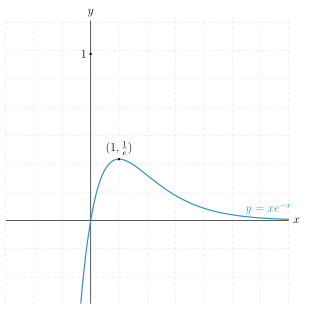
- It is known (instead) that \(\P \l X = 1 \r = q\), where \(q\) is a given number in the range \(0 < q <1\). Show that this information determines a unique value of \(\lambda\) (which you should find) for exactly one value of \(q\) (which you should also find).
- It is known (instead) that \(\P \l X = 1 \, \vert \, X \le 2 \r = r\), where \(r\) is a given number in the range \(0 < r < 1\). Show that this information determines a unique value of \(\lambda\) (which you should find) for exactly one value of \(r\) (which you should also find).
Solution: Let \(X \sim Po(\lambda)\), then
- \(\,\)
Suppose \(\mathbb{P}(X \geq 2) = 1-p\) then \(\mathbb{P}(X=0) + \mathbb{P}(X=1) = p\), ie \(e^{-\lambda} +\lambda e^{-\lambda} = p\) If \(f(x) = (1+x)e^{-x}\) we have see it is strictly decreasing on \(x \geq 0\) and takes all values from \(1\) to \(0\), therefore we can find a unique value such that \(f(\lambda) = p\) which is our desired \(\lambda\).
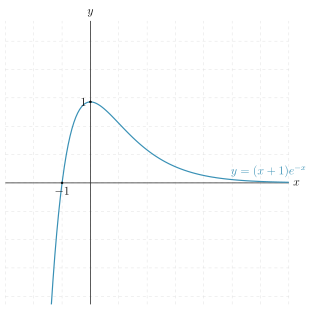
- Note that \(\mathbb{P}(X = 1) = \lambda e^{-\lambda}\)
Sketching \(y = xe^{-x}\) and finding it's turning point we can see that there is a unique value of \(\lambda = 1\) when \(q = \frac{1}{e}\), otherwise there is either no solution (\(p > \frac1{e}\)) or two solutions (\(0 < q > \frac1{e}\)).
- Suppose \(\mathbb{P}(X = 1 | X \leq 2) = r\), ie \begin{align*} && r &= \frac{\lambda e^{-\lambda}}{e^{-\lambda} + \lambda e^{-\lambda} + \frac12 \lambda^2 e^{-\lambda}} \\ &&&= \frac{2\lambda}{2+2\lambda+\lambda^2} \\ \Rightarrow && 0 &= r\lambda^2 + 2(r-1) \lambda + 2r\\ \Rightarrow && \Delta &= 4(r-1)^2 - 4\cdot r \cdot 2 r \\ &&&= 4((r-1)^2-2r^2) \\ &&&= 4(r-1-\sqrt{2}r)(r-1+\sqrt{2}r) \\ &&&= -4((\sqrt{2}-1)r + 1)((1+\sqrt{2})r-1) \end{align*} Therefore our quadratic in \(r\) has a unique solution if \(r = \frac{1}{1+\sqrt{2}}\). If it has a positive solution then note since \(2r > 0\) both solutions are positive, so \(\lambda\) is not unique by excluding other solutions.
2007 Paper 2 Q12
I have two identical dice. When I throw either one of them, the probability of it showing a 6 is \(p\) and the probability of it not showing a 6 is \(q\), where \(p+q=1\). As an experiment to determine \(p\), I throw the dice simultaneously until at least one die shows a 6. If both dice show a six on this throw, I stop. If just one die shows a six, I throw the other die until it shows a 6 and then stop.
- Show that the probability that I stop after \(r\) throws is \(pq^{r-1}(2-q^{r-1}-q^r)\), and find an expression for the expected number of throws. [{\bf Note:} You may use the result $\ds \sum_{r=0}^\infty rx^r = x(1-x)^{-2}\(.]
- In a large number of such experiments, the mean number of throws was \)m\(. Find an estimate for \)p\( in terms of \)m$.
Solution:
- \(\,\) \begin{align*} \mathbb{P}(\text{stop after r}) &= \mathbb{P}(\text{both stop at r}) + 2\mathbb{P}(\text{first stops before r second stops at r})\\ &= (q^2)^{r-1} p^2 + 2\cdot q^{r-1} p\cdot(1-q^{r-1}) \\ &= q^{r-1}p\left (2-2q^{r-1}+pq^{r-1} \right) \\ &= q^{r-1}p\left (2-q^{r-1}(1+p+q-p) \right) \\ &= q^{r-1}p\left (2-q^{r-1}-q^r\right) \\ \end{align*} \begin{align*} \E[\text{throws}] &= \sum_{r=1}^{\infty} r \mathbb{P}(\text{stop after r}) \\ &= \sum_{r=1}^{\infty} r q^{r-1}p\left (2-q^{r-1}-q^r\right) \\ &= \sum_{r=1}^{\infty} 2r q^{r-1}p-\sum_{r=1}^{\infty}r pq^{2r-2}-\sum_{r=1}^{\infty}r q^{2r-1}p \\ &=2p \sum_{r=1}^{\infty} r q^{r-1}-pq^{-2}\sum_{r=1}^{\infty}r q^{2r}-pq^{-1}\sum_{r=1}^{\infty}r q^{2r} \\ &= 2p(1-q)^{-2} - pq^{-2}q^2(1-q^2)^{-2}-pq^{-1}q^2(1-q^2)^{-2} \\ &= 2pp^{-2} -p(1+q)(1-q^2)^{-2} \\ &= 2p^{-1}-p(1+q)(1+q)^{-2}p^{-2} \\ &= 2p^{-1}-p^{-1}(1+q)^{-1} \\ &= \frac{2(1+q)-1}{p(1+q)} \\ &= \frac{1+2q}{p(1+q)} \\ &= \frac{3-2p}{p(2-p)} \end{align*}
- \(\,\) \begin{align*} && m &= \frac{3-2p}{p(2-p)} \\ \Rightarrow && 2mp-mp^2 &= 3-2p \\ \Rightarrow && 0 &= mp^2-(2m+2)p + 3 \\ \Rightarrow && p &= \frac{2m+2 \pm \sqrt{(2m+2)^2-12m}}{2m} \\ &&&= \frac{m+1- \sqrt{m^2-m + 1}}{m} \\ \end{align*} If we are looking for an approximation, we could say \(p^2 \approx 0\) and \(p \approx \frac{3}{2(m+1)}\)
2006 Paper 1 Q12
Oxtown and Camville are connected by three roads, which are at risk of being blocked by flooding. On two of the three roads there are two sections which may be blocked. On the third road there is only one section which may be blocked. The probability that each section is blocked is \(p\). Each section is blocked independently of the other four sections. Show that the probability that Oxtown is cut off from Camville is \(p^3 \l 2-p \r^2\). I want to travel from Oxtown to Camville. I choose one of the three roads at random and find that my road is not blocked. Find the probability that I would not have reached Camville if I had chosen either of the other two roads. You should factorise your answer as fully as possible. Comment briefly on the value of this probability in the limit \(p\to1\).
2006 Paper 1 Q13
A very generous shop-owner is hiding small diamonds in chocolate bars. Each diamond is hidden independently of any other diamond, and on average there is one diamond per kilogram of chocolate.
- I go to the shop and roll a fair six-sided die once. I decide that if I roll a score of \(N\), I will buy \(100N\) grams of chocolate. Show that the probability that I will have no diamonds is \[ \frac{\e^{-0.1}}{ 6} \l \frac{1 - \e^{-0.6} }{ 1 - \e^{-0.1}} \r \] Show also that the expected number of diamonds I find is 0.35.
- Instead, I decide to roll a fair six-sided die repeatedly until I score a 6. If I roll my first 6 on my \(T\)th throw, I will buy \(100T\) grams of chocolate. Show that the probability that I will have no diamonds is \[ \frac{\e^{-0.1}}{ 6 - 5\e^{-0.1}} \] Calculate also the expected number of diamonds that I find. (You may find it useful to consider the the binomial expansion of \(\l 1 - x \r^{-2}\).)
Solution: Not that the number of diamonds per kilogram is \(1\) so we are assuming it is \(Po(M)\) where \(M\) is the mass in kg. In particular \(\E[X] = M\) and \(\mathbb{P}(X = 0) = e^{-M}\)
- \(\,\) \begin{align*} && \mathbb{P}(\text{no diamonds}) &= \sum_{n=1}^6\mathbb{P}(\text{no diamonds and roll }n) \\ &&&= \sum_{n=1}^6 \tfrac16 e^{-\frac{n}{10}} \\ &&&= \frac{e^{-0.1}}6 \left ( \frac{1-e^{-0.6}}{1-e^{-0.1}}\right) \\ && \E[\text{diamonds}] &= \sum_{n=1}^6 \E(\text{diamonds}|N = n)\mathbb{P}(N = n) \\ &&&= \sum_{n=1}^6 0.1n \cdot \frac16 \\ &&&= 0.1 \cdot \frac{7}{2} = 0.35 \end{align*}
- \(\mathbb{P}(T = k) = \left ( \frac56 \right)^{t-1} \frac16\), so \begin{align*} && \mathbb{P}(\text{no diamonds}) &= \sum_{n=1}^\infty\mathbb{P}(\text{no diamonds and }T=n) \\ &&&= \sum_{n=1}^\infty e^{-0.1n} \left ( \frac56 \right)^{n-1} \frac16 \\ &&&= \frac{e^{-0.1}}{6} \frac1{1- \frac56 e^{-0.1}} \\ &&&= \frac{e^{-0.1}}{6 - 5e^{-0.1}} \\ \\ && \E[\text{diamonds}] &= \sum_{n=1}^\infty \E(\text{diamonds}|T = n)\mathbb{P}(T = n) \\ &&&= \sum_{n=1}^\infty 0.1n \cdot \left ( \frac56 \right)^{n-1} \frac16 \\ &&&= \frac{0.1}{6} \sum_{n=1}^\infty n \cdot \left ( \frac56 \right)^{n-1} \\ &&&= \frac{1}{60} \frac{1}{(1- \tfrac56)^2} \\ &&&= \frac{6}{10} = \frac35 \end{align*}
2006 Paper 2 Q12
A cricket team has only three bowlers, Arthur, Betty and Cuba, each of whom bowls 30 balls in any match. Past performance reveals that, on average, Arthur takes one wicket for every 36 balls bowled, Betty takes one wicket for every 25 balls bowled, and Cuba takes one wicket for every 41 balls bowled.
- In one match, the team took exactly one wicket, but the name of the bowler was not recorded. Using a binomial model, find the probability that Arthur was the bowler.
- Show that the average number of wickets taken by the team in a match is approximately 3. Give with brief justification a suitable model for the number of wickets taken by the team in a match and show that the probability of the team taking at least five wickets in a given match is approximately \(\frac15\). [You may use the approximation \(\e^3 = 20\).]
Solution:
- \(\,\) \begin{align*} && \mathbb{P}(\text{Arthur took wicket and exactly one wicket}) &= \binom{30}{1} \frac{1}{36} \left ( \frac{35}{36} \right)^{29} \binom{30}{0} \left ( \frac{24}{25} \right)^{30} \binom{30}{0} \left ( \frac{40}{41} \right)^{30}\\ &&&= \frac{30 \cdot 35^{29} \cdot 24^{30} \cdot 40^{30}}{36^{30} \cdot 25^{30} \cdot {41}^{30}}\\ &&&= \frac{1}{35} N\\ && \mathbb{P}(\text{B took wicket and exactly one wicket}) &= \binom{30}{0}\left ( \frac{35}{36} \right)^{30} \binom{30}{1} \frac{1}{25} \left ( \frac{24}{25} \right)^{29} \binom{30}{0} \left ( \frac{40}{41} \right)^{30}\\ &&&= \frac{1}{24} N \\ && \mathbb{P}(\text{C took wicket and exactly one wicket}) &= \binom{30}{0}\left ( \frac{35}{36} \right)^{30} \binom{30}{0}\left ( \frac{24}{25} \right)^{30} \binom{30}{1} \frac{1}{41} \left ( \frac{40}{41} \right)^{29}\\ &&&= \frac{1}{40} N \\ && \mathbb{P}(\text{Arthur took wicket} | \text{exactly one wicket}) &= \frac{ \mathbb{P}(\text{Arthur took wicket and exactly one wicket}) }{ \mathbb{P}(\text{exactly one wicket}) } \\ &&&= \frac{ \frac{1}{35} N}{\frac1{35} N + \frac{1}{24}N + \frac{1}{40} N} \\ &&&= \frac{3}{10} \end{align*} Alternatively, we could look at: \begin{align*} && \mathbb{P}(X_A = 1 | X_A + X_B + X_C =1) &= \frac{\mathbb{P}(X_A = 1, X_B = 0,X_C = 0)}{\mathbb{P}(X_A = 1, X_B = 0,X_C = 0)+\mathbb{P}(X_A = 0, X_B = 1,X_C = 0)+\mathbb{P}(X_A = 0, X_B = 0,X_C = 1)} \\ &&&= \frac{\frac{\mathbb{P}(X_A = 1)}{\mathbb{P}(X_A=0)}}{\frac{\mathbb{P}(X_A = 1)}{\mathbb{P}(X_A=0)}+\frac{\mathbb{P}(X_B = 1)}{\mathbb{P}(X_B=0)}+\frac{\mathbb{P}(X_C = 1)}{\mathbb{P}(X_C=0)}} \end{align*} and we can calculate these relatively likelihoods in a similar way to above.
- \(\,\) \begin{align*} && \mathbb{E}(\text{number of wickets}) &= \mathbb{E} \left ( \sum_{i=1}^{90} \mathbb{1}_{i\text{th ball is a wicket}} \right) \\ &&&= \sum_{i=1}^{90} \mathbb{E} \left (\mathbb{1}_{i\text{th ball is a wicket}} \right) \\ &&&= 30 \cdot \frac{1}{36} + 30 \cdot \frac{1}{25} + 30 \cdot \frac{1}{41} \\ &&&\approx 1 + 1 + 1 = 3 \end{align*} We might model the number of wickets taken as \(Po(\lambda)\), where \(\lambda\) is the average number of wickets taken. We can think of this roughly as the Poisson approximation to the binomial where \(N\) is large and \(Np\) is small. Assuming we use \(Po(3)\) we have \begin{align*} && \mathbb{P}(\text{at least 5 wickets}) &= 1-\mathbb{P}(\text{4 or fewer wickets}) \\ &&&= 1- e^{-3} \left (1 + \frac{3}{1} + \frac{3^2}{2} + \frac{3^3}{6} + \frac{3^4}{24} \right) \\ &&&= 1 - \frac{1}{20} \left ( 1 + 3 + \frac{9}{2} + \frac{9}{2} + \frac{27}{8} \right) \\ &&&= 1 - \frac{1}{20} \left (13 + 3\tfrac38 \right) \\ &&&\approx 1 - \frac{16}{20} = \frac15 \end{align*}
2006 Paper 2 Q13
I know that ice-creams come in \(n\) different sizes, but I don't know what the sizes are. I am offered one of each in succession, in random order. I am certainly going to choose one - the bigger the better - but I am not allowed more than one. My strategy is to reject the first ice-cream I am offered and choose the first one thereafter that is bigger than the first one I was offered; if the first ice-cream offered is in fact the biggest one, then I have to put up with the last one, however small. Let \(\P_n(k)\) be the probability that I choose the \(k\)th biggest ice-cream, where \(k=1\) is the biggest and \(k=n\) is the smallest.
- Show that \(\P_4(1) = \frac{11}{24}\) and find \(\P_4(2)\), \(\P_4(3)\) and \(\P_4(4)\).
- Find an expression for \(\P_n(1)\).
2005 Paper 1 Q12
- The probability that a hobbit smokes a pipe is 0.7 and the probability that a hobbit wears a hat is 0.4. The probability that a hobbit smokes a pipe but does not wear a hat is \(p\). Determine the range of values of \(p\) consistent with this information.
- The probability that a wizard wears a hat is 0.7; the probability that a wizard wears a cloak is 0.8; and the probability that a wizard wears a ring is 0.4. The probability that a wizard does not wear a hat, does not wear a cloak and does not wear a ring is 0.05. The probability that a wizard wears a hat, a cloak and also a ring is 0.1. Determine the probability that a wizard wears exactly two of a hat, a cloak, and a ring. The probability that a wizard wears a hat but not a ring, given that he wears a cloak, is \(q\). Determine the range of values of \(q\) consistent with this information.
Solution:
- \(\,\)
The overlap can be at most 0.4, which would mean \(p =0.7-0.4 = 0.3\) It must be at least 0.1, which would mean \(p =0.7-0.1 = 0.6\) so \(0.3 \leq p \leq 0.6\)

- Notice that: \begin{align*} && 1 &= 0.05 + 0.7 -(hc+hr+0.1) + \\ &&&\quad\quad 0.8 - (hc+cr + 0.1) + \\ &&&\quad \quad \quad 0.4 - (hr+cr+0.1) +\\ &&&\quad \quad \quad \quad hc+hr+cr+0.1 \\ && &= 0.05 +0.7+0.8+0.4 - (hc+hr+cr)-2\cdot 0.1 \\ \Rightarrow && hc+hr+cr &=0.05 +0.7 + 0.8 + 0.4 - 0.2-1 \\ \Rightarrow && \mathbb{P}(\text{exactly 2}) &= 0.75 \end{align*} Notice \(q = \frac{hc}{0.8}\) Notice that we must have: \(hc, hr cr \geq 0\) as well as \(hc+hr+cr = 0.75\) \begin{align*} && \mathbb{P}(\text{only hat}) &= 0.7 -(hc+hr+0.1) \geq 0 \\ \Rightarrow && hc+hr & \leq 0.6 \\ && \mathbb{P}(\text{only cloak}) &= 0.8 - (hc+cr + 0.1)\geq 0 \\ \Rightarrow &&hc+cr & \leq 0.7 \\ && \mathbb{P}(\text{only ring}) &= 0.4 - (hr+cr+0.1) \geq 0 \\ \Rightarrow && hc+hr & \leq 0.3 \\ \end{align*} To find the minimum for \(hc\) we want to maximise \(hr+cr = 0.3\), so \(hc = 0.75 - 0.3 = 0.45\). To find the maximum for \(hc\) we want to minimise \(hr\) and \(cr\) \(cr \leq 0.7 - hc\) and \(hr \leq 0.6 - hc\) so \(0.75 \leq hc + (0.6 - hc) + (0.7 - hc) = 1.3-hc\) so \(hc \leq 1.3 - 0.75 = 0.55\) Therefore the range for \(q\) is \(\frac{.45}{.8}\) to \(\frac{.55}{.8}\) or \(\frac9{16} \leq q \leq \frac{11}{16}\)
