Problems
Filters
78 problems found
2016 Paper 3 Q7
Let \(\omega = \e^{2\pi {\rm i}/n}\), where \(n\) is a positive integer. Show that, for any complex number \(z\), \[ (z-1)(z-\omega) \cdots (z - \omega^{n-1}) = z^n -1\,. \] The points \(X_0, X_1, \ldots\, X_{n-1}\) lie on a circle with centre \(O\) and radius 1, and are the vertices of a regular polygon.
- The point \(P\) is equidistant from \(X_0\) and \(X_1\). Show that, if \(n\) is even, \[ |PX_0| \times |PX_1 |\times \,\cdots\, \times |PX_{n-1}| = |OP|^n +1\, ,\] where \(|PX_ k|\) denotes the distance from \(P\) to \(X_k\). Give the corresponding result when \(n\) is odd. (There are two cases to consider.)
- Show that \[ |X_0 X_1|\times |X_0 X_2|\times \,\cdots\, \times |X_0 X_{n-1}| =n\,. \]
Solution: Notice that \(\omega^n = e^{2\pi i} = 1\), so \(\omega\) is a root of \(z^n - 1\), notice also that \((\omega^k)^n =1\) so therefore the \(n\) roots are \(1, \omega, \omega^2, \cdots, \omega^{n-1}\) and so \((z-1)(z-\omega) \cdots (z-\omega^{n-1}) = C(z^n-1)\). By considering the coefficient of \(z^n\) we can see that \(C = 1\).
- \(P\) lies on the perpendicular bisect of \(1\) and \(\omega\), so \(p = re^{\pi i/n}\), where \(r\) can be positive or negative, but \(|r| = |OP|\). \begin{align*} && |PX_0| \times |PX_1| \times \cdots \times |PX_{n-1}| &= |(p-1)(p-\omega) \cdots (p-\omega^{n-1})| \\ &&&= |p^n - 1| \\ &&&= |r^ne^{\pi i} - 1| \\ &&&= |-|OP|^n - 1| \tag{since \(n\) even} \\ &&&= |OP|^n+1 \end{align*} If \(n\) is odd, depending on the sign of \(r\) we get \(|OP|^n+1\) or \(||OP|^n-1|\).
- \(\,\) \begin{align*} && (z-\omega) \cdots(z-\omega^{n-1}) &= \frac{z^n-1}{z-1} \\ &&&= 1 + z +\cdots + z^{n-1} \\ && |X_0X_1| \times |X_0X_2| \times \cdots \times |X_0X_{n-1}| &= |(1 - \omega)\cdots(1-\omega^{n-1})| \\ &&&= 1+1+1^2+\cdots + 1^{n-1} \\ &&&= n \end{align*}
2015 Paper 3 Q4
- If \(a\), \(b\) and \(c\) are all real, show that the equation \[ z^3+az^2+bz+c=0 \tag{\(*\)} \] has at least one real root.
- Let \[ S_1= z_1+z_2+z_3, \ \ \ \ S_2= z_1^2 + z_2^2 + z_3^2, \ \ \ \ S_3= z_1^3 + z_2^3 + z_3^3\,, \] where \(z_1\), \(z_2\) and \(z_3\) are the roots of the equation \((*)\). Express \(a\) and \(b\) in terms of \(S_1\) and \(S_2\), and show that \[ 6c =- S_1^3 + 3 S_1S_2 - 2S_3\,. \]
- The six real numbers \(r_k\) and \(\theta_k\) (\(k=1, \ 2, \ 3\)), where \(r_k>0\) and \(-\pi < \theta_k <\pi\), satisfy \[ \textstyle \sum\limits _{k=1}^3 r_k \sin (\theta_k) = 0\,, \ \ \ \ \textstyle \sum\limits _{k=1}^3 r_k^2 \sin (2\theta_k) = 0\,, \ \ \ \ \ \textstyle \sum\limits _{k=1}^3 r_k^3 \sin (3\theta_k) = 0\, . \] Show that \(\theta_k=0\) for at least one value of \(k\). Show further that if \(\theta_1=0\) then \(\theta_2 = - \theta_3\,\).
Solution:
- Let \(z \in \mathbb{R}\) and let \(z \to \pm \infty\) then \(z^3 + az^2 + bz + c\) changes sign, therefore somewhere it must have a real root.
- \begin{align*} &&z^3 + az^2 + bz + c &= (z-z_1)(z-z_2)(z-z_3) \\ && &= z^3 - (z_1+z_2+z_3)z^2 + (z_1z_2 + z_2z_3+z_3z_1)z - (z_1z_2z_3) \\ \\ \Rightarrow && S_1 &= z_1+z_2+z_3 \\ &&&= -a \\ \\ \Rightarrow && S_2 &= z_1^2+z_2^2+z_3^2 \\ &&&= (z_1+z_2+z_3)^2 - 2(z_1z_2 + z_2z_3+z_3z_1) \\ &&&= a^2 - 2b \\ \Rightarrow && a &= -S_1 \\ && b &= \frac12 \l S_1^2 - S_2\r \\ \\ && 0 &= z_i^3 + az_i^2+bz_i+c \\ \Rightarrow && 0 &= S_3 + aS_2+bS_1+3c \\ &&&= S_3 -S_1S_2 + \frac12 \l S_1^2 - S_2\r S_1 + 3c \\ \Rightarrow && 0 &= 2S_3 - 3S_1S_2 + S_1^3 + 6c \end{align*}
- Let \(z_k= r_ke^{i \theta_k}\), then we have \(\textrm{Im}(S_k) = 0\) and so the polynomial with roots \(z_k\) has real coefficients, and therefore at least one root is real. This root will have \(\theta_k = 0\). Moreover, since if \(w\) is a root of a real polynomial \(\overbar{w}\) is also a root, and therefore if \(\theta_1 = 0\), we must have that \(z_2\) and \(z_3\) are complex conjugate, ie \(\theta_2 = - \theta_3\)
2015 Paper 3 Q6
- Let \(w\) and \(z\) be complex numbers, and let \(u= w+z\) and \(v=w^2+z^2\). Prove that \(w\) and \(z\) are real if and only if \(u\) and \(v\) are real and \(u^2\le2v\).
- The complex numbers \(u\), \(w\) and \(z\) satisfy the equations \begin{align*} w+z-u&=0 \\ w^2+z^2 -u^2 &= - \tfrac 23 \\ w^3+z^3 -\lambda u &= -\lambda\, \end{align*} where \(\lambda \) is a positive real number. Show that for all values of \(\lambda\) except one (which you should find) there are three possible values of \(u\), all real. Are \(w\) and \(z\) necessarily real? Give a proof or counterexample.
Solution:
- Notice that \(u^2 = v+2wz\), so \(w,z\) are roots of the quadratic \(t^2 -ut+\frac{u^2-v}{2}\). Therefore they are both real if \(u^2 \geq 2(u^2-v) \Rightarrow 2v \geq u^2\).
- \begin{align*} && w+z &= u \\ && w^2+z^2 &= u^2 - \tfrac23 \\ && w^3+z^3 &= \lambda(u-1) \\ \\ && wz &= \frac{u^2 - (u^2-\tfrac23)}{2} = \tfrac13\\ \\ && (w+z)(w^2+z^2) &= w^3+z^3+wz(w+z) \\ &&u(u^2-\tfrac23)&= \lambda(u-1)+\frac13u \\ \Rightarrow && u^3-u&= \lambda (u-1) \\ \Rightarrow && 0 &= (u-1)(u(u+1) - \lambda) \\ \Rightarrow && 0 &= (u-1)(u^2+u - \lambda) \end{align*} Therefore there will be at most 3 values for \(u\), unless \(1\) is a root of \(u^2+u-\lambda\), ie \(\lambda = 2\). Suppose \(u = 1\), then we have: \(w+z = 1, wz = 1/3 \Rightarrow w,z = \frac{-1 \pm \sqrt{-1/3}}{2}\) which are clearly complex.
2014 Paper 3 Q5
A quadrilateral drawn in the complex plane has vertices \(A\), \(B\), \(C\) and \(D\), labelled anticlockwise. These vertices are represented, respectively, by the complex numbers \(a\), \(b\), \(c\) and \(d\). Show that \(ABCD\) is a parallelogram (defined as a quadrilateral in which opposite sides are parallel and equal in length) if and only if \(a+c =b+d\,\). Show further that, in this case, \(ABCD\) is a square if and only if \({\rm i}(a-c)=b-d\). Let \(PQRS\) be a quadrilateral in the complex plane, with vertices labelled anticlockwise, the internal angles of which are all less than \(180^\circ\). Squares with centres \(X\), \(Y\), \(Z\) and \(T\) are constructed externally to the quadrilateral on the sides \(PQ\), \(QR\), \(RS\) and \(SP\), respectively.
- If \(P\) and \(Q\) are represented by the complex numbers \(p\) and \(q\), respectively, show that \(X\) can be represented by \[ \tfrac 12 \big( p(1+{\rm i} ) + q (1-{\rm i})\big) \,. \]
- Show that \(XY\!ZT\) is a square if and only if \(PQRS\) is a parallelogram.
Solution: The vector representing the side \(AB\) is \(b - a\) and the vector representing the side \(DC\) is \(c - d\). \(ABCD\) is a parallelogram if and only if these opposite sides are parallel and equal in length, which is given by \(b - a = c - d\), or equivalently \(a + c = b + d\). Similarly, if \(a + c = b + d\), then \(c - b = d - a\), so the side \(BC\) is parallel and equal in length to the side \(AD\). Thus, \(a + c = b + d\) is the necessary and sufficient condition for \(ABCD\) to be a parallelogram. In a parallelogram, the shape is a square if and only if the diagonals are equal in length and perpendicular to each other. The diagonals are represented by the vectors \(c - a\) and \(d - b\). For these to be equal in length and perpendicular, one must be a \(90^\circ\) rotation of the other. Since \(A, B, C, D\) are labeled anticlockwise, a \(90^\circ\) anticlockwise rotation of the vector \(\vec{AC}\) (which is \(c-a\)) would point in the direction of \(\vec{DB}\) (which is \(b-d\) if we consider the relative orientation). Specifically: \(i(c - a) = d - b \implies -i(a - c) = d - b \implies i(a - c) = b - d\). Thus, \(ABCD\) is a square if and only if \(i(a - c) = b - d\).
- The midpoint of the side \(PQ\) is \(\frac{1}{2}(p + q)\). To find the centre \(X\) of the square built externally on \(PQ\), we start at the midpoint and move a distance equal to half the side length in a direction perpendicular to \(PQ\). Since \(P, Q, R, S\) are anticlockwise, the outward direction is a \(90^\circ\) clockwise rotation of the vector \(\vec{PQ}\). A clockwise rotation of \(90^\circ\) corresponds to multiplication by \(-i\). \[ x = \frac{p+q}{2} + (-i)\left(\frac{q-p}{2}\right) = \frac{p + q - iq + ip}{2} = \frac{1}{2} \big( p(1+i) + q(1-i) \big) \]
- From part (i), we have the representations for the centres: \begin{align*} x &= \tfrac{1}{2}(p(1+i) + q(1-i)) \\ y &= \tfrac{1}{2}(q(1+i) + r(1-i)) \\ z &= \tfrac{1}{2}(r(1+i) + s(1-i)) \\ t &= \tfrac{1}{2}(s(1+i) + p(1-i)) \end{align*} As shown in the first part of the problem, \(XYZT\) is a square if and only if: (1) \(x+z = y+t\) (it is a parallelogram) (2) \(i(x-z) = y-t\) (it is a square) First, examine condition (1): \begin{align*} x+z - (y+t) &= \tfrac{1}{2} \big[ (p+r)(1+i) + (q+s)(1-i) - (q+s)(1+i) - (r+p)(1-i) \big] \\ &= \tfrac{1}{2} \big[ (p+r)(1+i - (1-i)) - (q+s)(1+i - (1-i)) \big] \\ &= \tfrac{1}{2} \big[ (p+r)(2i) - (q+s)(2i) \big] \\ &= i(p+r - (q+s)) \end{align*} Thus, \(x+z = y+t\) if and only if \(p+r = q+s\), which is the condition that \(PQRS\) is a parallelogram. Next, examine condition (2): \begin{align*} i(x-z) &= \tfrac{1}{2} i \big[ p(1+i) + q(1-i) - r(1+i) - s(1-i) \big] \\ &= \tfrac{1}{2} \big[ p(i-1) + q(i+1) - r(i-1) - s(i+1) \big] \\ y-t &= \tfrac{1}{2} \big[ q(1+i) + r(1-i) - s(1+i) - p(1-i) \big] \\ \text{So, } i(x-z) - (y-t) &= \tfrac{1}{2} \big[ p(i-1 + 1-i) + q(i+1 - 1-i) + r(-i+1 - 1+i) + s(-i-1 + 1+i) \big] \\ &= 0 \end{align*} Since \(i(x-z) = y-t\) is an identity (always true for any \(PQRS\)), \(XYZT\) is a square if and only if it is a parallelogram. As established above, this occurs if and only if \(PQRS\) is a parallelogram.
2013 Paper 3 Q4
Show that \((z-\e^{i\theta})(z-\e^{-i\theta})=z^2 -2z\cos\theta +1\,\). Write down the \((2n)\)th roots of \(-1\) in the form \(\e^{i\theta}\), where \(-\pi <\theta \le \pi\), and deduce that \[ z^{2n} +1 = \prod_{k=1}^n \left(z^2-2z \cos\left( \tfrac{(2k-1)\pi}{2n}\right) +1\right) \,. \] Here, \(n\) is a positive integer, and the \(\prod\) notation denotes the product.
- By substituting \(z=i\) show that, when \(n\) is even, \[ \cos \left(\tfrac \pi {2n}\right) \cos \left(\tfrac {3\pi} {2n}\right) \cos \left(\tfrac {5\pi} {2n}\right) \cdots \cos \left(\tfrac{(2n-1) \pi} {2n}\right) = {(-1\vphantom{\dot A})}^{\frac12 n} 2^{1-n} \,. \]
- Show that, when \(n\) is odd, \[ \cos^2 \left(\tfrac \pi {2n}\right) \cos ^2 \left(\tfrac {3\pi} {2n}\right) \cos ^2 \left(\tfrac {5\pi} {2n}\right) \cdots \cos ^2 \left(\tfrac{(n-2) \pi} {2n}\right) = n 2^{1-n} \,. \] You may use without proof the fact that \(1+z^{2n}= (1+z^2)(1-z^2+z^4 - \cdots + z^{2n-2})\,\) when \(n\) is odd.
Solution: \begin{align*} && (z-e^{i \theta})(z-e^{-i\theta}) &= z^2 - (e^{i\theta}+e^{-i\theta})z + 1 \\ &&&= z^2-2\cos \theta z + 1 \end{align*} The \(2n\)th roots of \(-1\) are \(e^{\frac{i (2k+1)\pi}{2n}}, k \in \{-n, \cdots, n-1 \}\) or \(e^{\frac{i k \pi}{2n}}, k \in \{-2n+1, -2n+3, \cdots, 2n-3, 2n-1 \}\) \begin{align*} && z^{2n}+1 &= (z-e^{-i(2n-1)/2n})\cdot (z-e^{-i(2n-3)/2n})\cdots (z-e^{i(2n-3)/2n})\cdot (z-e^{i(2n-1)/2n}) \\ &&&= \prod_{k=1}^n \left (z - e^{i \frac{2k-1}{2n}\pi} \right)\left (z - e^{-i \frac{2k-1}{2n}\pi} \right)\\ &&&= \prod_{k=1}^n \left (z^2 - 2z \cos \left ( \frac{(2k-1)\pi}{2n}\right) + 1 \right) \end{align*}
- \begin{align*} && i^{2n} + 1 &= \prod_{k=1}^n \left (i^2 - 2i \cos \left ( \frac{(2k-1)\pi}{2n}\right) + 1 \right) \\ \Rightarrow && (-1)^n + 1 &= (-1)^n2^ni^n\prod_{k=1}^n \cos \left ( \frac{(2k-1)\pi}{2n}\right) \\ \Rightarrow && \prod_{k=1}^n \cos \left ( \frac{(2k-1)\pi}{2n}\right) &= 2^{1-n}(-1)^{n/2} \tag{if \(n\equiv 0\pmod{2}\)} \end{align*}
- When \(n\) is odd, we notice that two of the roots are \(i\) and \(-i\), if we exclude those, (ie by factoring out \(z^2+1\), we see that \begin{align*} && 1-z^2+z^4-\cdots + z^{2n-2} &= \prod_{k=1, 2k-1\neq n}^n \left (z^2-2z \cos \left ( \frac{(2k-1)\pi}{2n} \right)+1 \right) \\ &&&= \prod_{k=1}^{(n-1)/2} \left (z^2-2z \cos \left ( \frac{(2k-1)\pi}{2n} \right)+1 \right) \prod_{k=(n+1)/2}^{n} \left (z^2-2z \cos \left ( \frac{(2k-1)\pi}{2n} \right)+1 \right)\\ &&&= \prod_{k=1}^{(n-1)/2} \left (z^2-2z \cos \left ( \frac{(2k-1)\pi}{2n} \right)+1 \right) \prod_{k=1}^{(n-1)/2} \left (z^2+2z \cos \left ( \frac{(2k-1)\pi}{2n} \right)+1 \right)\\ \Rightarrow && 1-i^2 + i^4 + \cdots + i^{2n-2} &= \prod_{k=1}^{(n-1)/2} \left (2 \cos \left ( \frac{(2k-1)\pi}{2n} \right) \right) \prod_{k=1}^{(n-1)/2} \left (2 \cos \left ( \frac{(2k-1)\pi}{2n} \right) \right)\\ \Rightarrow && n &= 2^{n-1} \prod_{k=1}^{(n-1)/2}\cos^2 \left ( \frac{(2k-1)\pi}{2n} \right) \\ \Rightarrow && \prod_{k=1}^{(n-1)/2}\cos^2 \left ( \frac{(2k-1)\pi}{2n} \right) &= n2^{1-n} \end{align*}
2013 Paper 3 Q6
Let \(z\) and \(w\) be complex numbers. Use a diagram to show that \(\vert z-w \vert \le \vert z\vert + \vert w \vert\,.\) For any complex numbers \(z\) and \(w\), \(E\) is defined by \[ E = zw^* + z^*w +2 \vert zw \vert\,. \]
- Show that \(\vert z-w\vert^2 = \left( \vert z \vert + \vert w\vert\right)^2 -E\,\), and deduce that \(E\) is real and non-negative.
- Show that \(\vert 1-zw^*\vert^2 = \left ( 1 +\vert zw \vert \right)^2 -E\,\).
Solution:
- \(\,\) \begin{align*} && |z-w|^2 &= (z-w)(z^*-w^*) \\ &&&= zz^* - wz^*-zw^* + ww^* \\ &&&= |z|^2+|w|^2 - E + 2|zw| \\ &&&= (|z|+|w|)^2 - E \\ \Rightarrow && E &= (|z|+|w|)^2 - |z-w|^2 &\in \mathbb{R} \end{align*} and by the triangle inequality \(|z|+|w| \geq |z-w|\), so \(E \geq 0\)
- \(\,\) \begin{align*} && |1-zw^*|^2 &= (1-zw^*)(1-z^*w) \\ &&&= 1 - zw^*-z^*w + |zw|^2 \\ &&&= 1 - E + 2|zw| + |zw|^2 \\ &&&= (1+|zw|)^2 - E \end{align*} \begin{align*} && \frac{|z-w|^2}{|1-zw^*|^2} &= \frac{(|z|+|w|)^2-E}{(1+|zw|)^2-E} \\ \Leftrightarrow && (1+|zw|^2)|z-w|^2 -E|z-w|^2 &= (|z|+|w|)^2|1-zw^*|^2-E|1-zw^*|^2\\ \Leftrightarrow && (1+|zw|^2)|z-w|^2-(|z|+|w|)^2|1-zw^*|^2 &= E(|z-w|^2-|1-zw^*|^2)\\ &&&= E(|z|^2-zw^*-z^*w+|w|^2-1+zw^*+z^*w-|z|^2|w|^2) \\ &&&= E(|z|^2+|w|^2-1-|z|^2|w|^2) \\ &&&= -E(1-|z|^2)(1-|w|^2) \\ &&&\leq 0 \\ \Leftrightarrow&& (1+|zw|^2)|z-w|^2& \leq (|z|+|w|)^2|1-zw^*|^2\\ \Leftrightarrow&& \frac{|z-w|^2}{|1-zw^*|^2} &\leq \frac{(|z|+|w|)^2}{(1+|zw|)^2}\\ \Leftrightarrow && \frac{|z-w|}{|1-zw^*|} &\leq \frac{(|z|+|w|)}{(1+|zw|)}\\ \end{align*} Yes, this inequality holds if \(|z|, |w|\) are the same side of \(1\) and is reversed otherwise.
2013 Paper 3 Q8
Evaluate \(\displaystyle \sum_{r=0}^{n-1} \e^{2i(\alpha + r\pi/n)}\) where \(\alpha\) is a fixed angle and \(n\ge2\). The fixed point \(O\) is a distance \(d\) from a fixed line \(D\). For any point \(P\), let \(s\) be the distance from \(P\) to \(D\) and let \(r\) be the distance from \(P\) to \(O\). Write down an expression for \(s\) in terms of \(d\), \(r\) and the angle \(\theta\), where \(\theta\) is as shown in the diagram below.

Solution: \begin{align*} \sum_{r=0}^{n-1} \e^{2i(\alpha + r\pi/n)} &= e^{2i\alpha} \sum_{r=0}^{n-1} \left (\e^{2i\pi/n} \right)^r \\ &= e^{2i\alpha} \frac{1-\left (\e^{2i\pi/n} \right)^n}{1-\e^{2i\pi/n} } \\ &= 0 \end{align*} \(d = s + r \cos \theta\) ie \(s = d - r \cos \theta\) Therefore \(d = \frac{r}{k} + r \cos \theta \Rightarrow r = \frac{kd}{1+k \cos \theta}\). The \(l_j\) will come from \(r(\alpha + \frac{j \pi}{n} )+r(\alpha + \pi + \frac{j \pi}{n} )\) \begin{align*} && l_j &= r(\alpha + \frac{(j-1) \pi}{n} )+r(\alpha + \pi + \frac{(j-1) \pi}{n} ) \\ &&&= \frac{kd}{1+k \cos \left ( \alpha + \frac{(j-1) \pi}{n}\right)}+\frac{kd}{1+k \cos \left ( \alpha+\pi+ \frac{(j-1) \pi}{n}\right)}\\ &&&= \frac{kd}{1+k \cos \left ( \alpha + \frac{(j-1) \pi}{n}\right)}+\frac{kd}{1-k \cos \left ( \alpha+ \frac{(j-1) \pi}{n}\right)}\\ &&&= \frac{2kd}{1-k^2 \cos^2 \left ( \alpha + \frac{(j-1) \pi}{n}\right)}\\ \Rightarrow && \sum_{j=1}^n \frac 1 {l_j} &= \sum_{j=0}^{n-1} \frac{1-k^2 \cos^2 \left ( \alpha + \frac{j \pi}{n}\right)}{2kd} \\ &&&= \frac{n}{2kd}-\frac{k^2}{2kd} \sum_{j=0}^{n-1} \cos^2 \left ( \alpha + \frac{j \pi}{n}\right) \\ &&&= \frac{n}{2kd}-\frac{k^2}{2kd} \sum_{j=0}^{n-1} \frac{1+ \cos \left ( 2\alpha + \frac{2j \pi}{n}\right)}{2} \\ &&&= \frac{n}{2kd}-\frac{nk^2}{2kd}-\frac{k^2}{4kd} \sum_{j=0}^{n-1}\cos \left ( 2\alpha + \frac{2j \pi}{n}\right) \\ &&&= \frac{n}{2kd}-\frac{nk^2}{2kd}-\frac{k^2}{4kd} \underbrace{\textrm{Re} \left ( \sum_{j=0}^{n-1}e^{ 2i(\alpha + \frac{j \pi}{n})} \right)}_{=0} \\ &&&= \frac{n}{2kd} - \frac{nk^2}{4kd} \\ &&&= \frac{n(2-k^2)}{4kd} \end{align*}
2012 Paper 3 Q6
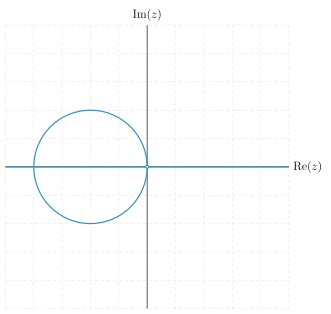
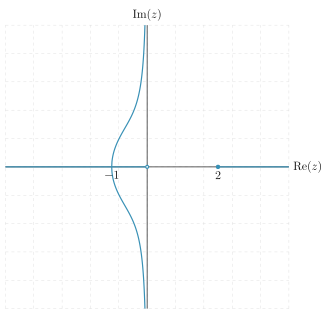
Let \(x+{\rm i} y\) be a root of the quadratic equation \(z^2 + pz +1=0\), where \(p\) is a real number. Show that \(x^2-y^2 +px+1=0\) and \((2x+p)y=0\). Show further that either \(p=-2x\) or \(p=-(x^2+1)/x\) with \(x\ne0\). Hence show that the set of points in the Argand diagram that can (as \(p\) varies) represent roots of the quadratic equation consists of the real axis with one point missing and a circle. This set of points is called the root locus of the quadratic equation. Obtain and sketch in the Argand diagram the root locus of the equation \[ pz^2 +z+1=0\, \] and the root locus of the equation \[ pz^2 + p^2z +2=0\,.\]
Solution: \begin{align*} && 0 &= z^2 + pz + 1\\ &&&= (x+iy)^2 + (x+iy)p + 1 \\ &&& = (x^2-y^2+px+1) + (2xy+py)i \\ \Rightarrow && 0 &= x^2 - y^2 + px + 1 \\ && 0 &= (2x+p)y \\ \Rightarrow && p &= -2x \\ \text{ or } && y &= 0 \\ \Rightarrow && p &= -(x^2+1)/x \end{align*} Therefore as \(p\) varies with either have \(y = 0\) and \(x\) taking any real value except \(0\) ie the real axis minus the origin. Or \(p = -2x\) and \(-y^2-x^2+1 = 0 \Rightarrow x^2 + y^2 = 1\) which is a circle. Suppose \(pz^2 + z + 1 = 0\) \begin{align*} && 0 &= pz^2 + z +1\\ &&&= p(x+iy)^2 + (x+iy) + 1\\ &&&= (px^2-py^2+x+1) + (2xyp + y) i \\ \Rightarrow && 0 &= (2xp+1)y \\ \Rightarrow && y & = 0, p = \frac{-(x+1)}{x^2}, x \neq 0 \\ \text{ or } && p &= -\frac{1}{2x}\\ \Rightarrow && 0 &= -\frac{1}{2}x + \frac{y^2}{2x} + x + 1 \\ &&&= \frac{y^2 - x^2 +2x^2 + 2x}{2x} \\ &&&= \frac{(x+1)^2+y^2-1}{2x} \end{align*} So we either have the real axis (except \(0\)) or a circle radius \(1\) centre \((-1, 0)\) (excluding \(x = 0\)).
2011 Paper 3 Q3
Show that, provided \(q^2\ne 4p^3\), the polynomial \[ \hphantom{(p\ne0, \ q\ne0)\hspace{2cm}} x^3-3px +q \hspace {2cm} (p\ne0, \ q\ne0) \] can be written in the form \[ a(x-\alpha)^3 + b(x-\beta)^3\,, \] where \(\alpha\) and \(\beta\) are the roots of the quadratic equation \(pt^2 -qt +p^2=0\), and \(a\) and \(b\) are constants which you should express in terms of \(\alpha\) and \(\beta\). Hence show that one solution of the equation \(x^3-24x+48=0\,\) is \[ x= \frac{2 (2-2^{\frac13})}{1-2^{\frac13}} \] and obtain similar expressions for the other two solutions in terms of \(\omega\), where \(\omega = \mathrm{e}^{2\pi\mathrm{i}/3}\,\). Find also the roots of \(x^3-3px +q=0\) when \(p=r^2\) and \(q= 2r^3\) for some non-zero constant \(r\).
2011 Paper 3 Q8
The complex numbers \(z\) and \(w\) are related by \[ w= \frac{1+\mathrm{i}z}{\mathrm{i}+z}\,. \] Let \(z=x+\mathrm{i}y\) and \(w=u+\mathrm{i}v\), where \(x\), \(y\), \(u\) and \(v\) are real. Express \(u\) and \(v\) in terms of \(x\) and \(y\).
- By setting \(x=\tan(\theta/2)\), or otherwise, show that if the locus of \(z\) is the real axis \(y=0\), \(-\infty < x < \infty\), then the locus of \(w\) is the circle \(u^2+v^2=1\) with one point omitted.
- Find the locus of \(w\) when the locus of \(z\) is the line segment \(y=0\), \(-1 < x < 1\,\).
- Find the locus of \(w\) when the locus of \(z\) is the line segment \(x=0\), \(-1 < y < 1\,\).
- Find the locus of \(w\) when the locus of \(z\) is the line \(y=1\), \(-\infty < x < \infty\,\).
Solution: \begin{align*} w &= \frac{1+iz}{i+z} \\ &= \frac{1-y+ix}{x+i(1+y)} \\ &= \frac{((1-y)+ix)(x-i(1+y))}{x^2+(1+y)^2} \\ &= \frac{x(1-y)+x(1+y)}{x^2+(1+y)^2}+\frac{x^2+y^2-1}{x^2+(1+y)^2}i \\ &= \frac{2x}{x^2+(y+1)^2}+\frac{x^2+y^2-1}{x^2+(1+y)^2}i \end{align*} Therefore \(u = \frac{2x}{x^2+(y+1)^2}, v = \frac{x^2+y^2-1}{x^2+(1+y)^2}\)
- Suppose \(z = \tan(\theta/2) = t\) then \(u = \frac{2t}{t^2+1} = \sin \theta, v = \frac{t^2-1}{t^2+1} = \cos \theta\), ie \(u+iv\) is the unit circle, where \(-\frac{\pi}{2} < \theta/2 < \frac{\pi}{2}\) or \(-\pi < \theta < \pi\), ie excluding the point \((\sin \pi, \cos \pi) = (0,1)\).
- When \(-1 < x < 1\) we have \(-\frac{\pi}{4} < \frac{\theta}{2} < \frac{\pi}{4}\) ie \(-\frac{\pi}{2} < \theta < \frac{\pi}{2}\), ie the lower half of the unit circle.
- When \(x = 0, -1 < y < 1\) we have \(u = 0, v = \frac{y^2-1}{(1+y)^2}\) which is the negative imaginary axis.
- We have \(u = \frac{2t}{t^2+4}, v = \frac{t^2}{t^2+4}\), ie \(u^2 + v^2 = v\), ie \(u^2+(v-\frac12)^2 = \frac12^2\), so a circle centre \(\frac12i\) radius \(\frac12\), missing out \((0,1)\)
2010 Paper 3 Q3
For any given positive integer \(n\), a number \(a\) (which may be complex) is said to be a primitive \(n\)th root of unity if \(a^n=1\) and there is no integer \(m\) such that \(0 < m < n\) and \(a^m = 1\). Write down the two primitive 4th roots of unity. Let \({\rm C}_n(x)\) be the polynomial such that the roots of the equation \({\rm C}_n(x)=0\) are the primitive \(n\)th roots of unity, the coefficient of the highest power of \(x\) is one and the equation has no repeated roots. Show that \({\rm C}_4(x) = x^2+1\,\).
- Find \({\rm C}_1(x)\), \({\rm C}_2(x)\), \({\rm C}_3(x)\), \({\rm C}_5(x)\) and \({\rm C}_6(x)\), giving your answers as unfactorised polynomials.
- Find the value of \(n\) for which \({\rm C}_n(x) = x^4 + 1\).
- Given that \(p\) is prime, find an expression for \({\rm C}_p(x)\), giving your answer as an unfactorised polynomial.
- Prove that there are no positive integers \(q\), \(r\) and \(s\) such that \({\rm C}_q(x) \equiv {\rm C}_r(x) {\rm C}_s(x)\,\).
Solution: The primitive 4th roots of unity are \(i\) and \(-i\). (Since the other two roots of \(x^4-1\) are also roots of \(x^2-1\) \({\rm C}_4(x) = (x-i)(x+i) = x^2+1\) as required.
- \(\,\) \begin{align*} && {\rm C}_1 (x) &= x-1 \\ && {\rm C}_2 (x) &= x+1 \\ && {\rm C}_3 (x) &= x^2+x+1 \\ && {\rm C}_5 (x) &= x^4+x^3+x^2+x+1 \\ && {\rm C}_6 (x) &= x^2-x+1 \\ \end{align*}
- Since \((x^4+1)(x^4-1) = x^8-1\) we must have \(n \mid 8\). But \(n \neq 1,2,4\) so \(n = 8\).
- \({\rm C}_p(x) = x^{p-1} +x^{p-2}+\cdots+x+1\)
- Suppose \({\rm C_q}(x) \equiv {\rm C}_r(x){\rm C}_s(x)\), then if \(\omega\) is a primitive \(q\)th root of unity we must \({\rm C}_q(\omega) = 0\), but that means that one of \({\rm C}_r(\omega)\), \({\rm C}_s(\omega)\) is \(0\). But that's only possible if \(r\) or \(s\) \(=q\). If this were the case, then what would the other value be? There are no possible values, hence it's not possible.
2009 Paper 3 Q6
Show that $\big\vert \e^{\i\beta} -\e^{\i\alpha}\big\vert = 2\sin\frac12 (\beta-\alpha)\,\( for \)0<\alpha<\beta<2\pi\,$. Hence show that \[ \big\vert \e^{\i\alpha} -\e^{\i\beta}\big\vert \; \big\vert \e^{\i\gamma} -\e^{\i\delta}\big\vert + \big\vert \e^{\i\beta} -\e^{\i\gamma}\big\vert \; \big\vert \e^{\i\alpha} -\e^{\i\delta}\big\vert = \big\vert \e^{\i\alpha} -\e^{\i\gamma}\big\vert \; \big\vert \e^{\i\beta} -\e^{\i\delta}\big\vert \,, \] where \(0<\alpha<\beta<\gamma<\delta<2\pi\). Interpret this result as a theorem about cyclic quadrilaterals.
2008 Paper 2 Q1
A sequence of points \((x_1,y_1)\), \((x_2,y_2)\), \(\ldots\) in the cartesian plane is generated by first choosing \((x_1,y_1)\) then applying the rule, for \(n=1\), \(2\), \(\ldots\), \[ (x_{n+1}, y_{n+1}) = (x_n^2-y_n^2 +a, \; 2x_ny_n+b+2)\,, \] where \(a\) and \(b\) are given real constants.
- In the case \(a=1\) and \(b=-1\), find the values of \((x_1,y_1)\) for which the sequence is constant.
- Given that \((x_1,y_1) = (-1,1)\), find the values of \(a\) and \(b\) for which the sequence has period 2.
2008 Paper 3 Q7
The points \(A\), \(B\) and \(C\) in the Argand diagram are the vertices of an equilateral triangle described anticlockwise. Show that the complex numbers \(a\), \(b\) and \(c\) representing \(A\), \(B\) and \(C\) satisfy \[2c= (a+b) +\mathrm{i}\sqrt3(b-a).\] Find a similar relation in the case that \(A\), \(B\) and \(C\) are the vertices of an equilateral triangle described clockwise.
- The quadrilateral \(DEFG\) lies in the Argand diagram. Show that points \(P\), \(Q\), \(R\) and \(S\) can be chosen so that \(PDE\), \(QEF\), \(RFG\) and \(SGD\) are equilateral triangles and \(PQRS\) is a parallelogram.
- The triangle \(LMN\) lies in the Argand diagram. Show that the centroids \(U\), \(V\) and \(W\) of the equilateral triangles drawn externally on the sides of \(LMN\) are the vertices of an equilateral triangle. \noindent [{\bf Note:} The {\em centroid} of a triangle with vertices represented by the complex numbers \(x\),~\(y\) and~\(z\) is the point represented by \(\frac13(x+y+z)\,\).]
2007 Paper 3 Q6
The distinct points \(P\), \(Q\), \(R\) and \(S\) in the Argand diagram lie on a circle of radius \(a\) centred at the origin and are represented by the complex numbers \(p\), \(q\), \(r\) and \(s\), respectively. Show that \[ pq = -a^2 \frac {p-q}{p^*-q^*}\,. \] Deduce that, if the chords \(PQ\) and \(RS\) are perpendicular, then \(pq+rs=0\). The distinct points \(A_1\), \(A_2\), \(\ldots\), \(A_n\) (where \(n\ge3\)) lie on a circle. The points \hbox{\(B_1\), \(B_2\), \(\ldots\), \(B_{n}\)} lie on the same circle and are chosen so that the chords \(B_1B_2\), \(B_2B_3\), \(\ldots\), \(B_nB_{1}\) are perpendicular, respectively, to the chords \(A_1A_2\), \(A_2A_3\), \(\ldots\), \(A_nA_1\). Show that, for \(n=3\), there are only two choices of \(B_1\) for which this is possible. What is the corresponding result for \(n=4\)? State the corresponding results for values of \(n\) greater than 4.