Problems
Filters
49 problems found
2011 Paper 3 Q8
The complex numbers \(z\) and \(w\) are related by \[ w= \frac{1+\mathrm{i}z}{\mathrm{i}+z}\,. \] Let \(z=x+\mathrm{i}y\) and \(w=u+\mathrm{i}v\), where \(x\), \(y\), \(u\) and \(v\) are real. Express \(u\) and \(v\) in terms of \(x\) and \(y\).
- By setting \(x=\tan(\theta/2)\), or otherwise, show that if the locus of \(z\) is the real axis \(y=0\), \(-\infty < x < \infty\), then the locus of \(w\) is the circle \(u^2+v^2=1\) with one point omitted.
- Find the locus of \(w\) when the locus of \(z\) is the line segment \(y=0\), \(-1 < x < 1\,\).
- Find the locus of \(w\) when the locus of \(z\) is the line segment \(x=0\), \(-1 < y < 1\,\).
- Find the locus of \(w\) when the locus of \(z\) is the line \(y=1\), \(-\infty < x < \infty\,\).
Solution: \begin{align*} w &= \frac{1+iz}{i+z} \\ &= \frac{1-y+ix}{x+i(1+y)} \\ &= \frac{((1-y)+ix)(x-i(1+y))}{x^2+(1+y)^2} \\ &= \frac{x(1-y)+x(1+y)}{x^2+(1+y)^2}+\frac{x^2+y^2-1}{x^2+(1+y)^2}i \\ &= \frac{2x}{x^2+(y+1)^2}+\frac{x^2+y^2-1}{x^2+(1+y)^2}i \end{align*} Therefore \(u = \frac{2x}{x^2+(y+1)^2}, v = \frac{x^2+y^2-1}{x^2+(1+y)^2}\)
- Suppose \(z = \tan(\theta/2) = t\) then \(u = \frac{2t}{t^2+1} = \sin \theta, v = \frac{t^2-1}{t^2+1} = \cos \theta\), ie \(u+iv\) is the unit circle, where \(-\frac{\pi}{2} < \theta/2 < \frac{\pi}{2}\) or \(-\pi < \theta < \pi\), ie excluding the point \((\sin \pi, \cos \pi) = (0,1)\).
- When \(-1 < x < 1\) we have \(-\frac{\pi}{4} < \frac{\theta}{2} < \frac{\pi}{4}\) ie \(-\frac{\pi}{2} < \theta < \frac{\pi}{2}\), ie the lower half of the unit circle.
- When \(x = 0, -1 < y < 1\) we have \(u = 0, v = \frac{y^2-1}{(1+y)^2}\) which is the negative imaginary axis.
- We have \(u = \frac{2t}{t^2+4}, v = \frac{t^2}{t^2+4}\), ie \(u^2 + v^2 = v\), ie \(u^2+(v-\frac12)^2 = \frac12^2\), so a circle centre \(\frac12i\) radius \(\frac12\), missing out \((0,1)\)
2009 Paper 1 Q8
- The equation of the circle \(C\) is \[ (x-2t)^2 +(y-t)^2 =t^2, \] where \(t\) is a positive number. Show that \(C\) touches the line \(y=0\,\). Let \(\alpha\) be the acute angle between the \(x\)-axis and the line joining the origin to the centre of \(C\). Show that \(\tan2\alpha=\frac43\) and deduce that \(C\) touches the line \(3y=4x\,\).
- Find the equation of the incircle of the triangle formed by the lines \(y=0\), \(3y=4x\) and \(4y+3x=15\,\). Note: The incircle of a triangle is the circle, lying totally inside the triangle, that touches all three sides.
Solution:
- This is a circle centre \((2t,t)\) with radius \(t\). Therefore it is exactly \(t\) away from the line \(y = 0\) so just touches that line. Not that \(\tan \alpha = \frac{t}{2t} = \frac12\) so \(\tan 2\alpha = \frac{2\tan \alpha}{1-\tan^2\alpha} = \frac{1}{1-\frac14} = \frac43\). Therefore the line \(y = \frac43x\) or \(3y = 4x\) is tangent to \(C\).
- Note that \(3y=4x\) and \(4y+3x=15\) are perpendicular, so this is a right-angled triangle with incenter \((2t,t)\) for some \(t\) and hypotenuse \(15\) We can find the third coordinate when \(3y-4x = 0\) and \(4y+3x = 15\) meet, ie \((\frac{9}{5}, \frac{12}5)\) The incentre lies on the bisector of the right angle at this point, which is the line through \((\frac{9}{5}, \frac{12}5)\) and \((\frac{15}{2}, 0)\), so \begin{align*} && \frac{2t-\frac{12}{5}}{t - \frac{9}{5}} &= \frac{-\frac{12}{5}}{\frac{15}2-\frac95} \\ \Rightarrow && \frac{10t-12}{5t-9} &= \frac{-24}{57} = -\frac{8}{19} \\ \Rightarrow && 190t - 12 \cdot 19 &= -40t + 72 \\ \Rightarrow && t &= 2 \end{align*} Therefore the center is \((4, 2)\) and the equation is \((x-4)^2+(y-2)^2=2^2\)
2009 Paper 3 Q1
The points \(S\), \(T\), \(U\) and \(V\) have coordinates \((s,ms)\), \((t,mt)\), \((u,nu)\) and \((v,nv)\), respectively. The lines \(SV\) and \(UT\) meet the line \(y=0\) at the points with coordinates \((p,0)\) and \((q,0)\), respectively. Show that \[ p = \frac{(m-n)sv}{ms-nv}\,, \] and write down a similar expression for \(q\). Given that \(S\) and \(T\) lie on the circle \(x^2 + (y-c)^2 = r^2\), find a quadratic equation satisfied by \(s\) and by \(t\), and hence determine \(st\) and \(s+t\) in terms of \(m\), \(c\) and \(r\). Given that \(S\), \(T\), \(U\) and \(V\) lie on the above circle, show that \(p+q=0\).
2008 Paper 3 Q3
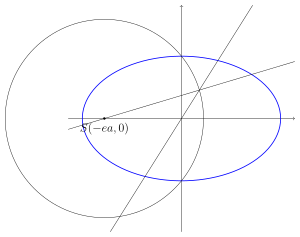
The point \(P(a\cos\theta\,,\, b\sin\theta)\), where \(a>b>0\), lies on the ellipse \[\dfrac {x^2}{a^2} + \dfrac {y^2}{b^2}=1\,.\] The point \(S(-ea\,,\,0)\), where \(b^2=a^2(1-e^2)\,\), is a focus of the ellipse. The point \(N\) is the foot of the perpendicular from the origin, \(O\), to the tangent to the ellipse at \(P\). The lines \(SP\) and \(ON\) intersect at \(T\). Show that the \(y\)-coordinate of \(T\) is \[\dfrac{b\sin\theta}{1+e\cos\theta}\,.\] Show that \(T\) lies on the circle with centre \(S\) and radius \(a\).
Solution: Find the gradient of the tangent of the ellipse at \(P\): \begin{align*} && \frac{2x}{a^2} + \frac{2y}{b^2} \frac{\d y}{\d x} &= 0 \\ \Rightarrow && \frac{\d y}{\d x} &= - \frac{2xb^2}{2ya^2} \\ &&&=- \frac{a \cos \theta b^2}{b \sin \theta a^2} \\ &&&=-\frac{b}{a} \cot \theta \end{align*} Therefore the gradient of \(ON\) is \(\frac{a}{b} \tan \theta\). \begin{align*} && y &= \frac{a}{b} \tan \theta x \\ && \frac{y-0}{x-(-ea)} &= \frac{b\sin \theta-0}{a\cos \theta -(-ea)} \\ && y &= \frac{b \sin \theta}{a(e+\cos \theta)}(x+ea) \\ \Rightarrow && y &= \frac{b \sin \theta}{a(\cos \theta+e)}\frac{b}{a} \cot \theta y+ \frac{eb \sin \theta}{\cos \theta + e} \\ &&&= \frac{b^2 \cos \theta}{a^2(\cos \theta +e)}y + \frac{eb \sin \theta}{\cos \theta + e} \\ \Rightarrow && (\cos \theta+e)y &= (1-e^2)\cos \theta y +eb \sin \theta\\ && e(1+e\cos \theta)y &= eb \sin \theta \\ \Rightarrow && y &= \frac{b \sin \theta}{1+e\cos \theta} \\ && x &= \frac{b \sin \theta}{1+e\cos \theta} \frac{b}{a} \cot \theta \\ &&&= \frac{b^2 \cos \theta}{a(1+e\cos \theta)} \end{align*} Therefore \(\displaystyle T\left (\frac{b^2 \cos \theta}{a(1+e\cos \theta)}, \frac{b \sin \theta}{1+e\cos \theta} \right)\). Finally, we can look at the distance of \(T\) from \(S\) \begin{align*} && d^2 &= \left (\frac{b^2 \cos \theta}{a(1+e\cos \theta)}-(-ea) \right)^2 + \left (\frac{b \sin \theta}{1+e\cos \theta} -0\right)^2 \\ &&&= \frac{\left (b^2 \cos \theta+ea^2(1+e\cos\theta)\right)^2 + \left ( ab \sin \theta\right)^2}{a^2(1+e\cos \theta)^2} \\ &&&= \frac{b^4\cos^2\theta+e^2a^4(1+e\cos\theta)^2+2ea^2b^2(1+e\cos\theta)+a^2b^2\sin^2\theta}{a^2(1+e\cos\theta)^2} \\ &&&= \frac{a^4(1-e^2)^2\cos^2\theta+e^2a^4(1+e\cos\theta)^2+2ea^2a^2(1-e^2)(1+e\cos\theta)+a^4(1-e^2)\sin^2\theta}{a^2(1+e\cos\theta)^2} \\ &&&= a^2 \left ( \frac{(1-e^2)^2\cos^2\theta+e^2(1+e\cos\theta)^2+2e(1-e^2)(1+e\cos\theta)+(1-e^2)(1-\cos^2\theta)}{(1+e\cos\theta)^2} \right) \\ &&&= a^2 \left ( \frac{e^2(1+e\cos\theta)^2+(1-e^2)((1-e^2)\cos^2\theta+2e(1+e\cos\theta)+(1-\cos^2\theta))}{(1+e\cos\theta)^2} \right) \\ &&&= a^2 \left ( \frac{e^2(1+e\cos\theta)^2+(1-e^2)(1+e\cos\theta)^2}{(1+e\cos\theta)^2} \right) \\ &&&= a^2 \end{align*} Therefore a circle radius \(a\) centre \(S\).
2007 Paper 3 Q6
The distinct points \(P\), \(Q\), \(R\) and \(S\) in the Argand diagram lie on a circle of radius \(a\) centred at the origin and are represented by the complex numbers \(p\), \(q\), \(r\) and \(s\), respectively. Show that \[ pq = -a^2 \frac {p-q}{p^*-q^*}\,. \] Deduce that, if the chords \(PQ\) and \(RS\) are perpendicular, then \(pq+rs=0\). The distinct points \(A_1\), \(A_2\), \(\ldots\), \(A_n\) (where \(n\ge3\)) lie on a circle. The points \hbox{\(B_1\), \(B_2\), \(\ldots\), \(B_{n}\)} lie on the same circle and are chosen so that the chords \(B_1B_2\), \(B_2B_3\), \(\ldots\), \(B_nB_{1}\) are perpendicular, respectively, to the chords \(A_1A_2\), \(A_2A_3\), \(\ldots\), \(A_nA_1\). Show that, for \(n=3\), there are only two choices of \(B_1\) for which this is possible. What is the corresponding result for \(n=4\)? State the corresponding results for values of \(n\) greater than 4.
2005 Paper 1 Q6
- The point \(A\) has coordinates \(\l 5 \, , 16 \r\) and the point \(B\) has coordinates \(\l -4 \, , 4 \r\). The variable point \(P\) has coordinates \(\l x \, , y \r\,\) and moves on a path such that \(AP=2BP\). Show that the Cartesian equation of the path of \(P\) is \[ \displaystyle \l x+7 \r^2 + y^2 =100 \;. \]
- The point \(C\) has coordinates \(\l a \, , 0 \r\) and the point \(D\) has coordinates \(\l b \, , 0 \r\), where \(a\ne b\). The variable point \(Q\) moves on a path such that \[ QC = k \times QD\;, \] where \(k>1\,\). Given that the path of \(Q\) is the same as the path of \(P\), show that \[ \frac{a+7}{b+7}=\frac{a^2+51}{b^2+51}\;. \] Show further that \((a+7)(b+7)=100\,\).
Solution:
- Since \(AP = 2BP\) we also have \(|AP|^2 = 4|BP|^2\) ie \begin{align*} && (x-5)^2 + (y-16)^2 &= 4(x+4)^2 + 4(y-4)^2 \\ \Rightarrow && x^2 - 10x+25 + y^2 -32y + 256 &= 4x^2+32x+64+4y^2-32y+64 \\ \Rightarrow && 281 &= 3x^2+42x+3y^2+128\\ && 281 &= 3(x+7)^2-147+3y^2+128 \\ \Rightarrow && 300 &= 3(x+7)^2 + 3y^2 \\ && 100 &= (x+7)^2 + y^2 \end{align*}
- Since \(|QC|^2 = k^2 |QD|^2\), \begin{align*} && (x-a)^2 + y^2 &= k^2 (x-b)^2 + k^2y^2 \\ \Rightarrow && x^2-2ax+a^2 &= k^2x^2-2k^2bx+k^2b^2 + (k^2-1)y^2 \\ && a^2-k^2b^2 &= (k^2-1)x^2-2(k^2b-a)x + (k^2-1)y^2 \\ && a^2-k^2b^2&= (k^2-1)\left(x-\frac{k^2b-a}{k^2-1}\right)^2-(k^2-1)\left(\frac{k^2b-a}{k^2-1}\right)^2+(k^2-1)y^2 \\ && \frac{a^2-k^2b^2}{k^2-1}+\left(\frac{k^2b-a}{k^2-1}\right)^2&= \left(x-\frac{k^2b-a}{k^2-1}\right)^2+y^2 \\ \Rightarrow && -7 &= \frac{k^2b-a}{k^2-1} \tag{*} \\ && 100 &= \frac{a^2-k^2b^2}{k^2-1}+\left(\frac{k^2b-a}{k^2-1}\right)^2 \\ &&&= \frac{a^2-k^2b^2}{k^2-1}+7^2 \\ \Rightarrow && 51 &= \frac{a^2-k^2b^2}{k^2-1} \tag{**} \\ (*) \Rightarrow && k^2(b+7)&= a+7 \\ (**) \Rightarrow && k^2(51+b^2)&= a^2+51 \\ \Rightarrow && \frac{a^2+51}{b^2+51} &= \frac{a+7}{b+7} \\ \\ \Rightarrow && a^2b+51b+7a^2 &= ab^2+51a+7b^2 \\ && 0 &= ab(b-a)-51(b-a)+7(b-a)(b+a) \\ &&&= (b-a)(ab+7(b+a)-51) \\ &&&= (b-a)((a+7)(b+7)-100) \\ \Rightarrow && 100 &= (a+7)(b+7) \end{align*} Since \(a \neq b\)
2005 Paper 3 Q8
In this question, \(a\) and \(c\) are distinct non-zero complex numbers. The complex conjugate of any complex number \(z\) is denoted by \(z^*\). Show that \[ |a - c|^2 = aa^* + cc^* -ac^* - ca^* \] and hence prove that the triangle \(OAC\) in the Argand diagram, whose vertices are represented by \(0\), \(a\) and \(c\) respectively, is right angled at \(A\) if and only if \(2aa^* = ac^*+ca^*\,\). Points \(P\) and \(P'\) in the Argand diagram are represented by the complex numbers \(ab\) and \(\ds \frac{a}{b^*}\,\), where \(b\) is a non-zero complex number. A circle in the Argand diagram has centre \(C\) and passes through the point \(A\), and is such that \(OA\) is a tangent to the circle. Show that the point \(P\) lies on the circle if and only if the point \(P'\) lies on the circle. Conversely, show that if the points represented by the complex numbers \(ab\) and \(\ds \frac{a}{b^*}\), for some non-zero complex number \(b\) with \(bb^* \ne 1\,\), both lie on a circle centre \(C\) in the Argand diagram which passes through \(A\), then \(OA\) is a tangent to the circle.
2003 Paper 2 Q4
The line \(y=d\,\), where \(d>0\,\), intersects the circle \(x^2+y^2=R^2\) at \(G\) and \(H\). Show that the area of the minor segment \(GH\) is equal to \begin{equation} R^2\arccos \left({d \over R}\right) -d\sqrt{R^2 - d^2}\;. \tag {\(*\)} \end{equation} In the following cases, the given line intersects the given circle. Determine how, in each case, the expression \((*)\) should be modified to give the area of the minor segment.
- Line: \(y=c\,\); \ \ \ circle: \((x-a)^2+(y-b)^2=R^2\,\).
- Line: \(y=mx+c\, \); \ \ \ circle: \(x^2+y^2=R^2\,\).
- Line: \(y=mx+c\,\); \ \ \ circle: \((x-a)^2+(y-b)^2=R^2\,\).
2003 Paper 3 Q7
In the \(x\)--\(y\) plane, the point \(A\) has coordinates \((a\,,0)\) and the point \(B\) has coordinates \((0\,,b)\,\), where \(a\) and \(b\) are positive. The point \(P\,\), which is distinct from \(A\) and \(B\), has coordinates~\((s,t)\,\). \(X\) and \(Y\) are the feet of the perpendiculars from \(P\) to the \(x\)--axis and \(y\)--axis respectively, and \(N\) is the foot of the perpendicular from \(P\) to the line \(AB\,\). Show that the coordinates \((x\,,y)\) of \(N\) are given by \[ x= \frac {ab^2 -a(bt-as)}{a^2+b^2} \;, \ \ \ y = \frac{a^2b +b(bt-as)}{a^2+b^2} \;. \] Show that, if $\ds \ \left( \frac{t-b} s\right)\left( \frac t {s-a}\right) = -1\;\(, then \)N$ lies on the line \(XY\,\). Give a geometrical interpretation of this result.
2002 Paper 1 Q1
Show that the equation of any circle passing through the points of intersection of the ellipse \((x+2)^2 +2y^2 =18\) and the ellipse \(9(x-1)^2 +16y^2 = 25\) can be written in the form \[ x^2-2ax +y^2 =5-4a\;. \]
Solution: \begin{align*} && (x+2)^2 +2y^2 &=18 \\ && 9(x-1)^2 +16y^2 &= 25 \\ \Rightarrow && 2y^2 &= 18 - (x+2)^2 \\ && 16y^2 &= 25 - 9(x-1)^2 \\ \Rightarrow && 25-9(x-1)^2 &= 8 \cdot 18 - 8(x+2)^2 \\ \Rightarrow && 25 -9+18x-9x^2 &= 144 -32- 32x +8x^2 \\ \Rightarrow && 0 &= 96 - 50x+x^2 \\ &&&= (x-48)(x-2) \\ \Rightarrow && x &= 2,48 \\ \Rightarrow && 2y^2 &= 2, 18-50^2 \\ \Rightarrow && (x,y) &= (2,\pm1) \end{align*} Therefore any circle must have it's centre on there perpendicular bisector of \((2, \pm 1)\), ie on the \(x\)-axis. Therefore it will have equation \((x-a)^2+y^2 = r^2\) and also contain the point \((2,1)\), therefore: \begin{align*} r^2 &= (2-a)^2 + 1^2 \\ &= 4 -2a+a^2 + 1 \\ &= 5-2a+a^2 \end{align*} and the equation is: \begin{align*} && (x-a)^2 + y^2 &= 5-4a+a^2 \\ \Rightarrow && x^2-2ax+a^2 +y^2 &= 5-4a+a^2 \\ \Rightarrow && x^2-2ax+y^2 &= 5-4a \end{align*} as required.
2001 Paper 3 Q8
- Prove that the equations $$ \left|z - (1 + \mathrm{i}) \right|^2 = 2 \eqno(*) $$ and $$ \qquad \quad \ \left|z - (1 - \mathrm{i}) \right|^2 = 2 \left|z - 1 \right|^2 $$ describe the same locus in the complex \(z\)--plane. Sketch this locus.
- Prove that the equation $$ \arg \l {z - 2 \over z} \r = {\pi \over 4} \eqno(**) $$ describes part of this same locus, and show on your sketch which part.
- The complex number \(w\) is related to \(z\) by \[ w = {2 \over z}\;. \] Determine the locus produced in the complex \(w\)--plane if \(z\) satisfies \((*)\). Sketch this locus and indicate the part of this locus that corresponds to \((**)\).
2001 Paper 3 Q10
Three ships \(A\), \(B\) and \(C\) move with velocities \({\bf v}_1\), \({\bf v}_2\) and \(\bf u\) respectively. The velocities of \(A\) and \(B\) relative to \(C\) are equal in magnitude and perpendicular. Write down conditions that \(\bf u\), \({\bf v}_1\) and \({\bf v}_2\) must satisfy and show that \[ \left| {\bf u} -{\textstyle\frac12} \l {\bf v}_1 + {\bf v}_2 \r \right|^2 = \left|{\textstyle\frac12} \l {\bf v}_1 - {\bf v}_2 \r \right|^2 \] and \[ \l {\bf u} -{\textstyle\frac12} \l {\bf v}_1 + {\bf v}_2 \r \r \cdot \l {\bf v}_1 - {\bf v}_2 \r = 0 \;. \] Explain why these equations determine, for given \({\bf v}_1\) and \({\bf v}_2\), two possible velocities for \(C\,\), provided \({\bf v}_1 \ne {\bf v}_2 \,\). If \({\bf v}_1\) and \({\bf v}_2\) are equal in magnitude and perpendicular, show that if \({\bf u} \ne {\bf 0}\) then \({\bf u} = {\bf v}_1 + {\bf v}_2\,\).
2000 Paper 2 Q7
The line \(l\) has vector equation \({\bf r} = \lambda {\bf s}\), where \[ {\bf s} = (\cos\theta+\sqrt3\,) \; {\bf i} +(\surd2\;\sin\theta)\;{\bf j} +(\cos\theta-\sqrt3\,)\;{\bf k} \] and \(\lambda\) is a scalar parameter. Find an expression for the angle between \(l\) and the line \mbox{\({\bf r} = \mu(a\, {\bf i} + b\,{\bf j} +c\, {\bf k})\)}. Show that there is a line \(m\) through the origin such that, whatever the value of \(\theta\), the acute angle between \(l\) and \(m\) is \(\pi/6\). A plane has equation \(x-z=4\sqrt3\). The line \(l\) meets this plane at \(P\). Show that, as \(\theta\) varies, \(P\) describes a circle, with its centre on \(m\). Find the radius of this circle.
1999 Paper 1 Q2
A point moves in the \(x\)-\(y\) plane so that the sum of the squares of its distances from the three fixed points \((x_{1},y_{1})\), \((x_{2},y_{2})\), and \((x_{3},y_{3})\) is always \(a^{2}\). Find the equation of the locus of the point and interpret it geometrically. Explain why \(a^2\) cannot be less than the sum of the squares of the distances of the three points from their centroid. [The centroid has coordinates \((\bar x, \bar y)\) where \(3\bar x = x_1+x_2+x_3,\) $3\bar y =y_1+y_2+y_3. $]
Solution: \begin{align*} && a^2 &= d_1^2 + d_2^2 + d_3^2 \\ &&&= (x-x_1)^2+(y-y_1)^2 + (x-x_2)^2+(y-y_2)^2 + (x-x_3)^2+(y-y_3)^2 \\ &&&= \sum (x-\bar{x}+\bar{x}-x_i)^2 + \sum (y-\bar{y}+\bar{y}-y_i)^2 \\ &&&= \sum \left ( (x-\bar{x})^2+(\bar{x}-x_i)^2 + 2(x-\bar{x})(\bar{x}-x_i) \right)+ \sum \left ( (y-\bar{y})^2+(\bar{y}-y_i)^2 + 2(y-\bar{y})(\bar{y}-y_i) \right)\\ &&&= 3(x-\bar{x})^2 + \sum (\bar{x}-x_i)^2 + 6x\bar{x} -6\bar{x}^2-2x\sum x_i+2\bar{x}\sum x_i + \\ &&&\quad\quad\quad 3(y-\bar{y})^2 + \sum (\bar{y}-y_i)^2 + 6y\bar{y} -6\bar{y}^2-2y\sum y_i+2\bar{y}\sum y_i \\ &&&= 3(x-\bar{x})^2 + \sum (\bar{x}-x_i)^2+3(y-\bar{y})^2 + \sum (\bar{y}-y_i)^2 \\ \\ \Rightarrow && (x-\bar{x})^2+(y-\bar{y})^2 &= \frac13\left ( a^2- \sum \left((\bar{x}-x_i)^2+(\bar{y}-y_i)^2 \right) \right) \end{align*} Therefore the locus is a circle, centre \((\bar{x}, \bar{y})\). radius \(\sqrt{\frac13(a^2 - \text{sum of squares distances of centroid to vertices}})\). \(a^2\) cannot be less than this distance, because clearly the right hand side is always bigger than it!
1998 Paper 1 Q4
Prove that the rectangle of greatest perimeter which can be inscribed in a given circle is a square. The result changes if, instead of maximising the sum of lengths of sides of the rectangle, we seek to maximise the sum of \(n\)th powers of the lengths of those sides for \(n\geqslant 2\). What happens if \(n=2\)? What happens if \(n=3\)? Justify your answers.
Solution: We can always rotate the circle so that sides are parallel to the \(x\) and \(y\) axes. Therefore if one corner is \((a,b)\) the other coordinates are \((-a,b), (a,-b), (-a,-b)\) and the perimeter will be \(4(a+b)\). Therefore we wish to maximise \(4(a+b)\) subject to \(a^2+b^2 = \text{some constant}\). Notice that \(\frac{a+b}{2} \leq \sqrt{\frac{a^2+b^2}{2}}\) with equality when \(a = b\), therefore the maximum is a square. If \(n = 2\) then we are looking at \(2((2a)^2+(2b)^2) = 8(a^2+b^2)\) which is constant for all rectangles. If \(n=3\) we are maximising \(16(a^3+b^3) = 16(a^3+(c^2-a^2)^{3/2})\) which is maximised when \(a = 0, c\)