Problems
Filters
31 problems found
2004 Paper 1 Q1
- Express \(\left(3+2\sqrt{5} \, \right)^3\) in the form \(a+b\sqrt{5}\) where \(a\) and \(b\) are integers.
- Find the positive integers \(c\) and \(d\) such that \(\sqrt[3]{99-70\sqrt{2}\;}\) = \(c - d\sqrt{2} \,\).
- Find the two real solutions of \(x^6 - 198 x^3 + 1 = 0 \,\).
Solution:
- \begin{align*} (3+2\sqrt{5})^3 &= 3^3 + 3 \cdot 3^2 \cdot 2\sqrt{5} + 3 \cdot 3 \cdot (2 \sqrt{5})^2 + (2\sqrt{5})^3 \\ &= 27 + 180 + (54+40)\sqrt{5} \\ &= 207 + 94\sqrt{5} \end{align*}
- \begin{align*} && (c-d\sqrt{2})^3 &= c^3+6cd -(3c^2d+2d^3)\sqrt{2} \\ \Rightarrow && 99 &= c(c^2+6d^2) \\ && 70 &= d(3c^2+2d^2) \\ \Rightarrow && c & \mid 99, d \mid 70 \\ && c &= 3, d = 2 \end{align*}
- \begin{align*} && 0 &= x^6 - 198x^3 + 1 \\ \Rightarrow && 0 &= (x^3-99)^2+1-99^2 \\ \Rightarrow && x^3 &= 99 \pm \sqrt{99^2-1} \\ &&&= 99 \pm 10 \sqrt{98} \\ &&&= 99 \pm 70 \sqrt{2} \\ \Rightarrow && x &= 3 \pm 2 \sqrt{2} \end{align*}
2003 Paper 1 Q5
- In the binomial expansion of \((2x+1/x^{2})^{6}\;\) for \(x\ne0\), show that the term which is independent of \(x\) is \(240\). Find the term which is independent of \(x\) in the binomial expansion of \((ax^3+b/x^{2})^{5n}\,\).
- Let \(\f(x) =(x^6+3x^5)^{1/2}\,\). By considering the expansion of \((1+3/x)^{1/2}\,\) show that the term which is independent of \(x\) in the expansion of \(\f(x)\) in powers of \(1/x\,\), for \( \vert x\vert>3\,\), is \(27/16\,\). Show that there is no term independent of \(x\,\) in the expansion of \(\f(x)\) in powers of \(x\,\), for \( \vert x\vert<3\,\).
Solution:
- The terms will all be of the form \(x^{6-3k}\), so we are looking for \(\binom{6}{2}2^{4} \cdot 1^2 = 6 \cdot 5 \cdot 8 = 240\) The terms will be \(x^{(5n-k)3 -2k} = x^{15n-5k}\), so we want \(k = 3n\), \(\binom{5n}{3n}a^{5n-3n}b^{5n-2n} = \binom{5n}{3n}a^{2n}b^{3n}\)
- Let \(f(x) = (x^6+3x^5)^{1/2}\) If \(|x| > 3\), then consider \begin{align*} && f(x) &= x^3(1+3/x)^{1/2} \\ &&&= x^3 \left (1 + \frac12 \frac{3}{x} +\frac{1}{2!} \frac12\cdot \frac{-1}{2} \left ( \frac{3}{x} \right)^2 + \frac{1}{3!} \frac{1}{2} \cdot \frac{-1}{2} \cdot \frac{-3}{2} \left (\frac{3}{x} \right)^3 + \cdots \right) \\ &&&= \cdots \frac{1}{6} \frac{3}{8} 27x^0 + \cdots \\ &&&= \cdots + \frac{27}{16} + \cdots \end{align*} If \(|x| < 3\) we can consider \(f(0) = 0\) and notice that there must be no term independent of \(x\)
2003 Paper 3 Q3
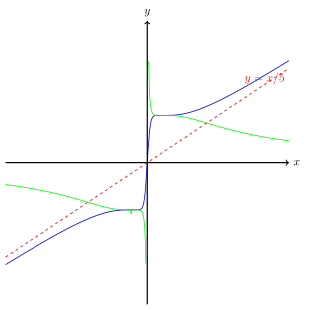
If \(m\) is a positive integer, show that \(\l 1+x \r^m + \l 1-x \r^m \ne 0\) for any real \(x\,\). The function \(\f\) is defined by \[ \f (x) = \frac{ (1+x )^m - ( 1-x )^m}{ (1+x )^m + (1-x )^m} \;. \] Find and simplify an expression for \(\f'(x)\). In the case \(m=5\,\), sketch the curves \(y = \f (x)\) and \(\displaystyle y = \frac1 { \f (x )}\;\).
Solution: If \(m\) is even, clearly that expression is positive since it's the sum of two (different) squares. If \(m\) is odd, then we can expand it as a sum of powers of \(x^2\) with a leading coefficient of \(1\) so it is also positive. \begin{align*} && f (x) = \frac{ (1+x )^m - ( 1-x )^m}{ (1+x )^m + (1-x )^m} \\ && f'(x) &= \frac{(m(1+x )^{m-1} + m( 1-x )^{m-1})((1+x)^m + (1-x)^m ) - ((1+x )^m - ( 1-x )^m)(m(1+x)^{m-1} - m(1-x)^{m-1} )}{\l (1+x)^m + (1-x)^m \r^2} \\ &&&= \frac{2m(1+x)^m(1-x)^{m-1}+2m(1+x)^{m-1}(1-x)^m}{\l (1+x)^m + (1-x)^m \r^2} \\ &&&= \frac{2m(1+x)^{m-1}(1-x)^{m-1}(1+x+1-x)}{\l (1+x)^m + (1-x)^m \r^2} \\ &&&= \frac{4m(1+x)^{m-1}(1-x)^{m-1}}{\l (1+x)^m + (1-x)^m \r^2} \\ \end{align*}
2001 Paper 2 Q1
Use the binomial expansion to obtain a polynomial of degree \(2\) which is a good approximation to \(\sqrt{1-x}\) when \(x\) is small.
- By taking \(x=1/100\), show that \(\sqrt{11}\approx79599/24000\), and estimate, correct to 1 significant figure, the error in this approximation. (You may assume that the error is given approximately by the first neglected term in the binomial expansion.)
- Find a rational number which approximates \(\sqrt{1111}\) with an error of about \(2 \times {10}^{-12}\).
Solution: \begin{align*} && \sqrt{1-x} &= (1-x)^{\frac12} \\ &&&= 1 -\frac12x+\frac{\frac12 \cdot \left (-\frac12 \right)}{2!}x^2 + \frac{\frac12 \cdot \left (-\frac12 \right) \cdot \left (-\frac32 \right)}{3!} x^3\cdots \\ &&&\approx 1-\frac12x - \frac18x^2 \end{align*}
- \(\,\) \begin{align*} && \frac{3\sqrt{11}}{10} &= \sqrt{1-1/100} \\ &&&\approx 1 - \frac{1}2 \frac{1}{100} - \frac{1}{8} \frac{1}{100^2} \\ &&&= \frac{80000-400-1}{80000} \\ &&&= \frac{79599}{80000}\\ \Rightarrow && \sqrt{11} &\approx \frac{79599}{24000} \\ \\ &&\text{error} &\approx \frac{1}{16} \frac{10}3 \frac{1}{100^3} \\ &&&= \frac{1}{48} 10^{-5} \\ &&&\approx 2 \times 10^{-7} \end{align*}
- Taking \(x = 1/10^4\) we have \begin{align*} && \frac{3 \sqrt{1111}}{100} &= \sqrt{1-1/10^4} \\ &&&\approx 1 - \frac12 \frac1{10^4} - \frac18 \frac{1}{10^8} \\ &&&= \frac{799959999}{800000000} \\ \Rightarrow && \sqrt{1111} & \approx \frac{266653333}{8000000} \\ \\ && \text{error} &\approx \frac{100}{3} \frac{1}{16} \frac{1}{10^{12}} \\ &&&= \frac{1}{48} \frac{1}{10^{10}} \\ &&&\approx 2 \times 10^{-12} \end{align*}
2000 Paper 1 Q2
Show that the coefficient of \(x^{-12}\) in the expansion of \[ \left(x^{4}-\frac{1}{x^{2}}\right)^{5} \left(x-\frac{1}{x}\right)^{6} \] is \(-15\), and calculate the coefficient of \(x^2\). Hence, or otherwise, calculate the coefficients of \(x^4\) and \(x^{38}\) in the expansion of \[ (x^2-1)^{11}(x^4+x^2+1)^5. \]
Solution: The powers of \(x\) in the first bracket will be \(x^{20}, x^{14}, \cdots, x^{-10}\). The powers of \(x\) in the second bracket will be \(x^6, x^4, \cdots, x^{-6}\). Therefore we can achieve \(x^{-12}\) in only one way: \begin{array}{c|c|c|c|c} 1\text{st bracket} & 2\text{nd bracket} & 1\text{st coef} & 2\text{nd coef} & \text{prod} \\ \hline x^{-10} & x^{-2} & \binom{5}{5}(-1)^5 = -1 & \binom{6}{4}(-1)^4 = 15& -15 \\ \end{array} We can achieve \(x^2\) as follows: \begin{array}{c|c|c|c|c} 1\text{st bracket} & 2\text{nd bracket} & 1\text{st coef} & 2\text{nd coef} & \text{prod} \\ \hline x^{-4} & x^{6} & \binom{5}{4}(-1)^4 = 5 & \binom{6}{0}(-1)^0 = 1& 5 \\ x^{2} & x^{0} & \binom{5}{3}(-1)^3 = -10 & \binom{6}{3}(-1)^3 = -20 & 200 \\ x^{8} & x^{-6} & \binom{5}{2}(-1)^2 = 10 & \binom{6}{6}(-1)^6 = 1 & 10 \end{array} Therefore the coefficient is \(215\) \((x^2-1)(x^4+x^2+1) = x^6-1\), therefore \begin{align*} (x^2-1)^{11}(x^4+x^2+1)^5 &= (x^2-1)^6(x^6-1)^5 \\ &= x^6\left(x-\frac1x\right)^6(x^6-1)^6 \\ &= x^6\left(x-\frac1x\right)^6\left(x^2\left(x^4-\frac{1}{x^2}\right)\right)^5 \\ &= x^6\left(x-\frac1x\right)^6x^{10}\left(x^4-\frac{1}{x^2}\right)^5 \\ &= x^{16}\left(x-\frac1x\right)^6\left(x^4-\frac{1}{x^2}\right)^6 \\ \end{align*} Therefore the coefficient of \(x^4\) is the coefficient of \(x^{4-16} = x^{-12}\) in our original expression, ie \(-15\). Similarly, the coefficient of \(x^{38}\) is the coefficient of \(x^{38-16} = x^{22}\), which can only be achieved in one way: \begin{array}{c|c|c|c|c} 1\text{st bracket} & 2\text{nd bracket} & 1\text{st coef} & 2\text{nd coef} & \text{prod} \\ \hline x^{20} & x^{2} & \binom{5}{0}(-1)^0 = 1 & \binom{6}{2}(-1)^2 = 15& 15 \\ \end{array} Therefore the coefficient is \(15\)
1998 Paper 2 Q2
Use the first four terms of the binomial expansion of \((1-1/50)^{1/2}\), writing \(1/50 = 2/100\) to simplify the calculation, to derive the approximation \(\sqrt 2 \approx 1.414214\). Calculate similarly an approximation to the cube root of 2 to six decimal places by considering \((1+N/125)^a\), where \(a\) and \(N\) are suitable numbers. [You need not justify the accuracy of your approximations.]
Solution: \begin{align*} && (1-1/50)^{1/2} &= 1 + \frac12 \cdot \left ( -\frac1{50} \right) + \frac1{2!} \frac12 \cdot \left ( -\frac12 \right)\cdot \left ( -\frac1{50} \right)^2 + \frac1{3!} \frac12 \cdot \left ( -\frac12 \right) \cdot \left ( -\frac32 \right)\cdot \left ( -\frac1{50} \right)^3 + \cdots \\ &&&=1-\frac{1}{100} - \frac12 \frac1{10000} -\frac12 \frac1{1000000} +\cdots \\ &&&= 0.9899495 + \cdots \\ \Rightarrow && \frac{7\sqrt{2}}{10} &\approx 0.9899495 \\ \Rightarrow && \sqrt{2} &\approx \frac{9.899495}{7} \\ &&&\approx 1.414214 \end{align*} \begin{align*} && (1 + 3/125)^{1/3} &= \frac{\sqrt[3]{125+3}}{5} \\ &&& = \frac{8\sqrt[3]{2}}{10} \\ && (1 + 3/125)^{1/3} &= 1 + \frac13 \left ( \frac{3}{125} \right) + \frac1{2!} \cdot \frac{1}{3} \cdot \left ( -\frac23\right) \left ( \frac{3}{125}\right)^2 +\cdots \\ &&&= 1+ \frac{8}{1000} - \frac{64}{1000000} \\ &&&= 1.007936 \\ \Rightarrow && \sqrt[3]{2} &= \frac{10.07936}{8} \\ &&&= 1.259920 \end{align*}
1998 Paper 3 Q11
Consider a simple pendulum of length \(l\) and angular displacement \(\theta\), which is {\bf not} assumed to be small. Show that $$ {1\over 2}l \left({\d\theta\over \d t}\right)^2 = g(\cos\theta -\cos\gamma)\,, $$ where \(\gamma\) is the maximum value of \(\theta\). Show also that the period \(P\) is given by $$ P= 2 \sqrt{l\over g} \int_0^\gamma \left( \sin^2(\gamma/2)-\sin^2(\theta/2) \right)^{-{1\over 2}} \,\d\theta \,. $$ By using the substitution \(\sin(\theta/2)=\sin(\gamma/2) \sin\phi\), and then finding an approximate expression for the integrand using the binomial expansion, show that for small values of \(\gamma\) the period is approximately $$ 2\pi \sqrt{l\over g} \left(1+{\gamma^2\over 16}\right) \,. $$
1997 Paper 2 Q12
The game of Cambridge Whispers starts with the first participant Albert flipping an un-biased coin and whispering to his neighbour Bertha whether it fell `heads' or `tails'. Bertha then whispers this information to her neighbour, and so on. The game ends when the final player Zebedee whispers to Albert and the game is won, by all players, if what Albert hears is correct. The acoustics are such that the listeners have, independently at each stage, only a probability of 2/3 of hearing correctly what is said. Find the probability that the game is won when there are just three players. By considering the binomial expansion of \((a+b)^n+(a-b)^n\), or otherwise, find a concise expression for the probability \(P\) that the game is won when is it played by \(n\) players each having a probability \(p\) of hearing correctly. % Show in particular that, if \(n\) is even, %\(P(n,1/10) = P(n,9/10)\).% How do you explain this apparent anomaly? To avoid the trauma of a lost game, the rules are now modified to require Albert to whisper to Bertha what he hears from Zebedee, and so keep the game going, if what he hears from Zebedee is not correct. Find the expected total number of times that Albert whispers to Bertha before the modified game ends. \noindent [You may use without proof the fact that \(\sum_1^\infty kx^{k-1}=(1-x)^{-2}\) for \(\vert x\vert<1\).]
1996 Paper 1 Q2
- Show that \[ \int_{0}^{1}\left(1+(\alpha-1)x\right)^{n}\,\mathrm{d}x=\frac{\alpha^{n+1}-1}{(n+1)(\alpha-1)} \] when \(\alpha\neq1\) and \(n\) is a positive integer.
- Show that if \(0\leqslant k\leqslant n\) then the coefficient of \(\alpha^{k}\) in the polynomial \[ \int_{0}^{1}\left(\alpha x+(1-x)\right)^{n}\,\mathrm{d}x \] is \[ \binom{n}{k}\int_{0}^{1}x^{k}(1-x)^{n-k}\,\mathrm{d}x\,. \]
- Hence, or otherwise, show that \[ \int_{0}^{1}x^{k}(1-x)^{n-k}\,\mathrm{d}x=\frac{k!(n-k)!}{(n+1)!}\,. \]
Solution:
- \begin{align*} u = 1+(\alpha-1)x: && \int_0^1 (1 + (\alpha - 1)x)^n \d x &= \int_{u=1}^{u=\alpha} u^n \frac{1}{\alpha - 1} \d u \\ &&&= \left [\frac{u^{n+1}}{(n+1)(\alpha-1)} \right]_1^\alpha \\ &&&= \frac{\alpha^{n+1}-1}{(n+1)(\alpha-1)} \end{align*}
- \begin{align*} && \int_0^1 (\alpha x + (1-x))^n \d x &= \int_0^1 \sum_{k=0}^n \binom{n}{k} \alpha^k x^k (1-x)^{n-k} \d x \\ &&&= \sum_{k=0}^n \alpha^k \int_0^1 \binom{n}{k} x^k (1-x)^{n-k} \d x \end{align*} Therefore the coefficient of \(\alpha^k\) is \(\displaystyle \int_0^1 \binom{n}{k} x^k (1-x)^{n-k} \d x\)
- The coefficient of \(\alpha^{k}\) in \(\displaystyle \frac{\alpha^{n+1}-1}{(n+1)(\alpha-1)}\) is \(\displaystyle \frac1{n+1}\). Therefore \begin{align*} && \frac1{n+1} &= \binom{n}{k} \int_0^1 x^k(1-x)^{n-k} \d x \\ \Rightarrow && \int_0^1 x^k (1-x)^{n-k} \d x &= \frac{k!(n-k)!}{(n+1)n!} \\ &&&= \frac{k!(n-k)!}{(n+1)!} \end{align*}
1996 Paper 2 Q1
- Find the coefficient of \(x^{6}\) in \[(1-2x+3x^{2}-4x^{3}+5x^{4})^{3}.\] You should set out your working clearly.
- By considering the binomial expansions of \((1+x)^{-2}\) and \((1+x)^{-6}\), or otherwise, find the coefficient of \(x^{6}\) in \[(1-2x+3x^{2}-4x^{3}+5x^{4}-6x^{5}+7x^{6})^{3}.\]
Solution:
- We can obtain a \(6\) from \(4+2+0, 4+1+1, 3+3+0, 3+2+1, 2+2+2\). So \(x^6\) from \(4,2,0\) can happen in \(6\) ways and gets us a coefficient of \(1 \cdot 3 \cdot 5\). \(x^6\) from \(4,1,1\) can happen in \(3\) ways and gets us a coefficient of \(5 \cdot (-2) \cdot (-2)\). \(x^6\) from \(3,3,0\) can happen in \(3\) ways and gets us a coefficient of \((-4) \cdot (-4) \cdot 1\). \(x^6\) from \(3,2,1\) can happen in \(6\) ways and gets us a coefficient of \((-4) \cdot 3 \cdot (-2)\). \(x^6\) from \(2,2,2\) can happen in \(1\) ways and gets us a coefficient of \(3 \cdot 3 \cdot 3\). This leaves us with a total coefficient of: \(6 \cdot 15 + 3 \cdot 20 + 3 \cdot 16 + 6 \cdot 24 + 1 \cdot 27 = 369\)
- \begin{align*} (1+x)^{-2} &= 1 + (-2)x+\frac{(-2)\cdot(-3)}{2!} x^2 + \frac{(-2)(-3)(-4)}{3!}x^3 + \cdots \\ &= 1 -2x+3x^2-4x^3+5x^4+\cdots \\ \end{align*} The coefficient of \(x^6\) in the expansion of \((1+x)^{-6}\) will be \(\frac{(-6)(-7)(-8)(-9)(-10)(-11)}{6!} = \frac{11!}{6!5!} = 462\). The coefficient of \(x^6\) in the expansion of \((1 -2x+3x^2-4x^3+5x^4+\cdots)^3\) will be the same as the coefficient of \(x^6\) in the expansion of \((1 -2x+3x^2-4x^3+5x^4-6x^5+7x^6)^3\), ie it will be \(462\)
1996 Paper 3 Q1
Define \(\cosh x\) and \(\sinh x\) in terms of exponentials and prove, from your definitions, that \[ \cosh^{4}x-\sinh^{4}x=\cosh2x \] and \[ \cosh^{4}x+\sinh^{4}x=\tfrac{1}{4}\cosh4x+\tfrac{3}{4}. \] Find \(a_{0},a_{1},\ldots,a_{n}\) in terms of \(n\) such that \[ \cosh^{n}x=a_{0}+a_{1}\cosh x+a_{2}\cosh2x+\cdots+a_{n}\cosh nx. \] Hence, or otherwise, find expressions for \(\cosh^{2m}x-\sinh^{2m}x\) and \(\cosh^{2m}x+\sinh^{2m}x,\) in terms of \(\cosh kx,\) where \(k=0,\ldots,2m.\)
Solution: \begin{align*} \cosh x &= \frac12 (e^x + e^{-x}) \\ \sinh x &= \frac12 (e^x - e^{-x}) \\ \end{align*} \begin{align*} \cosh^4x -\sinh^4 x &= (\cosh^2x -\sinh^2 x)(\cosh^2x +\sinh^2 x) \\ &= \left ( \frac14 \left (e^{2x}+2+e^{-2x} \right)- \frac14 \left (e^{2x}-2+e^{-2x} \right) \right)(\cosh^2x +\sinh^2 x) \\ &= (\cosh^2x +\sinh^2 x) \\ &= \left ( \frac14 \left (e^{2x}+2+e^{-2x} \right)+ \frac14 \left (e^{2x}-2+e^{-2x} \right) \right) \\ &= \frac{1}{4} \left (2e^{2x}+2e^{-2x} \right) \\ &= \frac12 \left ( e^{2x}+e^{-2x} \right) \\ &= \cosh 2x \\ \\ \cosh^4x +\sinh^4 x &= \frac1{2^4}\left (e^{4x}+4e^{2x}+6+4e^{-2x}+e^{-4x} \right)+\frac1{2^4}\left (e^{4x}-4e^{2x}+6-4e^{-2x}+e^{-4x} \right) \\ &= \frac18 (e^{4x}+e^{-4x}) + \frac{3}{4} \\ &= \frac14 \cosh 4x + \frac34 \end{align*} \begin{align*} \cosh^n x &=\frac{1}{2^n} \left ( e^{x}+e^{-x} \right)^n \\ &= \frac{1}{2^n} \sum_{k=0}^n \binom{n}{k} e^{kx}e^{-(n-k)x} \\ &= \frac{1}{2^n} \sum_{k=0}^n \binom{n}{k} e^{2kx-nx} \\ &= \frac{1}{2^n} \left ( \binom{n}{n} \left(e^{nx}+e^{-nx} \right) + \binom{n}{n-1}\left(e^{(n-2)x}+e^{-(n-2)x} \right) + \cdots + \binom{n}{n-k} \left( e^{(n-2k)x}+e^{-(n-2k)x} \right) + \cdots \right) \\ &= \frac{1}{2^{n-1}} \cosh nx + \frac{1}{2^{n-1}} \binom{n}{n-1} \cosh (n-2)x + \cdots + \frac{1}{2^{n-1}} \binom{n}{n-k} \cosh (n-2k)x + \cdots \end{align*} ie \begin{align*} \cosh^{2m} x &= \frac{1}{2^{2m-1}} \cosh 2m x + \frac{2m}{2^{2m-1}} \cosh(2(m-1)x) + \cdots + \frac{1}{2^{2m-1}}\binom{2m}{k} \cosh (2(m-k)x) +\cdots+ \frac{1}{2^{2m-1}} \binom{2m}{m} \\ \sinh^{2m} x &= \frac{1}{2^{2m-1}} \cosh 2m x - \frac{2m}{2^{2m-1}} \cosh(2(m-1)x) + \cdots + (-1)^{k}\frac{1}{2^{2m-1}}\binom{2m}{k} \cosh (2(m-k)x) +\cdots+ (-1)^m\frac{1}{2^{2m-1}} \binom{2m}{m} \\ \cosh^{2m} x -\sinh^{2m} x &= \frac{m}{2^{2m-3}} \cosh (2(m-1)x) + \cdots + \frac{1}{2^{2m-2}} \binom{2m}{2k+1}\cosh(2(m-2k-1)x) + \cdots\\ \cosh^{2m} x +\sinh^{2m} x &= \frac{1}{2^{2m-2}} \cosh (2mx) + \cdots + \frac{1}{2^{2m-2}} \binom{2m}{2k}\cosh(2(m-2k)x) + \cdots \end{align*}
1992 Paper 3 Q2
The matrices \(\mathbf{I}\) and \(\mathbf{J}\) are \[ \mathbf{I}=\begin{pmatrix}1 & 0\\ 0 & 1 \end{pmatrix}\quad\mbox{ and }\quad\mathbf{J}=\begin{pmatrix}1 & 1\\ 1 & 1 \end{pmatrix} \] respectively and \(\mathbf{A}=\mathbf{I}+a\mathbf{J},\) where \(a\) is a non-zero real constant. Prove that \[ \mathbf{A}^{2}=\mathbf{I}+\tfrac{1}{2}[(1+2a)^{2}-1]\mathbf{J}\quad\mbox{ and }\quad\mathbf{A}^{3}=\mathbf{I}+\tfrac{1}{2}[(1+2a)^{3}-1]\mathbf{J} \] and obtain a similar form for \(\mathbf{A}^{4}.\) If \(\mathbf{A}^{k}=\mathbf{I}+p_{k}\mathbf{J},\) suggest a suitable form for \(p_{k}\) and prove that it is correct by induction, or otherwise.
Solution: If $\mathbf{J}=\begin{pmatrix}1 & 1\\ 1 & 1 \end{pmatrix}\(, them \)\mathbf{J}^2=\begin{pmatrix}2 & 2\\ 2 & 2 \end{pmatrix} = 2\mathbf{J}\(. Therefore \)\mathbf{J}^n = 2\mathbf{J}^{n-1} = 2^{n-1}\mathbf{J}$ Let \(\mathbf{A}=\mathbf{I}+a\mathbf{J}\) then \begin{align*} \mathbf{A}^2 &=\l \mathbf{I}+a\mathbf{J}\r^2 \\ &= \mathbf{I}+2a\mathbf{J} + a^2\mathbf{J}^2 \\ &= \mathbf{I}+2a\mathbf{J} + 2a^2\mathbf{J} \\ &= \mathbf{I}+(2a+ 2a^2)\mathbf{J} \\ &= \mathbf{I}+\frac12(1+4a+ 4a^2-1)\mathbf{J} \\ &= \mathbf{I}+\frac12((1+2a)^2-1)\mathbf{J} \\ \end{align*} \begin{align*} \mathbf{A}^3 &=\l \mathbf{I}+a\mathbf{J}\r^3 \\ &= \mathbf{I}+3a\mathbf{J} + a^2\mathbf{J} + a^3\mathbf{J}^3 \\ &= \mathbf{I}+3a\mathbf{J} + 6a^2\mathbf{J} + 4a^3\mathbf{J} \\ &= \mathbf{I}+(3a+ 6a^3+4a^3)\mathbf{J} \\ &= \mathbf{I}+\frac12(1+3\cdot2a+3\dot4a^2+ 8a^3-1)\mathbf{J} \\ &= \mathbf{I}+\frac12((1+2a)^3-1)\mathbf{J} \\ \end{align*} \begin{align*} \mathbf{A}^4 &=\l \mathbf{I}+a\mathbf{J}\r^4 \\ &= \mathbf{I}+4a\mathbf{J} + 6a^2\mathbf{J}^2 + 4a^3\mathbf{J}^3+a^4\mathbf{J}^4 \\ &= \mathbf{I}+4a\mathbf{J} + 12a^2\mathbf{J} + 16a^3\mathbf{J}+8a^4\mathbf{J}\\ &= \mathbf{I}+(4a+ 12a^3+16a^3+8a^4)\mathbf{J} \\ &= \mathbf{I}+\frac12(1+4\cdot2a+6\cdot4a^2+ 4\cdot8a^3+16a^4-1)\mathbf{J} \\ &= \mathbf{I}+\frac12((1+2a)^4-1)\mathbf{J} \\ \end{align*} Claim: \(\mathbf{A}^k = \mathbf{I} + \frac12 ((1+2a)^{k}-1)\mathbf{J}\) Proof: Firstly, note that \(\mathbf{I}\) commutes with everything, so we can just apply the binomial theorem as if we were using real numbers: \begin{align*} \mathbf{A}^k &=\l \mathbf{I}+a\mathbf{J}\r^k \\ &= \sum_{i=0}^k \binom{k}{i}a^i\mathbf{J}^i \\ &= \mathbf{I} + \sum_{i=1}^k \binom{k}{i}a^i2^{i-1}\mathbf{J} \\ &= \mathbf{I} + \frac12\l\sum_{i=1}^k \binom{k}{i}a^i2^{i}\r\mathbf{J} \\ &= \mathbf{I} + \frac12\l\sum_{i=0}^k \binom{k}{i}a^i2^{i} - 1\r\mathbf{J} \\ &= \mathbf{I} + \frac12\l(1+2a)^k - 1\r\mathbf{J} \end{align*} as required
1991 Paper 3 Q9
The parametric equations \(E_{1}\) and \(E_{2}\) define the same ellipse, in terms of the parameters \(\theta_{1}\) and \(\theta_{2}\), (though not referred to the same coordinate axes). \begin{alignat*}{2} E_{1}:\qquad & x=a\cos\theta_{1}, & \quad & y=b\sin\theta_{1},\\ E_{2}:\qquad & x=\dfrac{k\cos\theta_{2}}{1+e\cos\theta_{2}}, & \quad & y=\dfrac{k\sin\theta_{2}}{1+e\cos\theta_{2}}, \end{alignat*} where \(0< b< a,\) \(0< e< 1\) and \(0< k\). Find the position of the axes for \(E_{2}\) relative to the axes for \(E_{1}\) and show that \(k=a(1-e^{2})\) and \(b^{2}=a^{2}(1-e^{2}).\) {[}The standard polar equation of an ellipse is \(r=\dfrac{\ell}{1+e\cos\theta}.]\) By considering expressions for the length of the perimeter of the ellipse, or otherwise, prove that \[ \int_{0}^{\pi}\sqrt{1-e^{2}\cos^{2}\theta}\,\mathrm{d}\theta=\int_{0}^{\pi}\frac{1-e^{2}}{(1+e\cos\theta)^{2}}\sqrt{1+e^{2}+2e\cos\theta}\,\mathrm{d}\theta. \] Given that \(e\) is so small that \(e^{6}\) may be neglected, show that the value of either integral is \[ \tfrac{1}{64}\pi(64-16e^{2}-3e^{4}). \]
1989 Paper 3 Q5
Given that \(y=\cosh(n\cosh^{-1}x),\) for \(x\geqslant1,\) prove that \[ y=\frac{(x+\sqrt{x^{2}-1})^{n}+(x-\sqrt{x^{2}-1})^{n}}{2}. \] Explain why, when \(n=2k+1\) and \(k\in\mathbb{Z}^{+},\) \(y\) can also be expressed as the polynomial \[ a_{0}x+a_{1}x^{3}+a_{2}x^{5}+\cdots+a_{k}x^{2k+1}. \] Find \(a_{0},\) and show that
- \(a_{1}=(-1)^{k-1}2k(k+1)(2k+1)/3\);
- \(a_{2}=(-1)^{k}2(k-1)k(k+2)(2k+1)/15.\)
Solution: Recall, \(\cosh^{-1} x = \ln (x + \sqrt{x^2-1})\) \begin{align*} \cosh(n \cosh^{-1} x) &= \frac12 \left ( \exp(n \cosh^{-1} x) + \exp(-n\cosh^{-1}x) \right) \\ &= \frac12 \left ((x + \sqrt{x^2-1})^n + (x + \sqrt{x^2-1})^{-n} \right) \\ &= \frac12 \left ((x + \sqrt{x^2-1})^n + (x - \sqrt{x^2-1})^{n} \right) \\ \end{align*} When \(n = 2k+1\) \begin{align*} \cosh(n \cosh^{-1} x)&= \frac12 \left ((x + \sqrt{x^2-1})^n + (x - \sqrt{x^2-1})^{n} \right) \\ &= \frac12 \left (\sum_{i=0}^{2k+1}\binom{2k+1}{i}x^{2k+1-i}\left ( (\sqrt{x^2-1}^{i} + (-\sqrt{x^2-1})^{i} \right) \right) \\ &=\sum_{i=0}^{k} \binom{2k+1}{2i}x^{2k+1-2i}(x^2-1)^i \\ &=\sum_{i=0}^{k} \binom{2k+1}{2i}x^{2(k-i)+1}(x^2-1)^i \\ \end{align*} Which is clearly a polynomial with only odd degree terms. \begin{align*} a_0 &= \frac{\d y}{\d x} \vert_{x=0} \\ &= \sum_{i=0}^k\binom{2k+1}{2i} \left ( (2(k-i)+1)x^{2(k-i)}(x^2-1)^i + 2i\cdot x^{2(k-i)+2}(x^2-1) \right) \\ &= \binom{2k+1}{2k} (-1)^{k} \\ &= (-1)^k(2k+1) \end{align*}
- \begin{align*} a_1 &= \binom{2k+1}{2k}\binom{k}{1}(-1)^{k-1}+\binom{2k+1}{2(k-1)}(-1)^{k-1} \\ &=(-1)^{k-1}\cdot ( (2k+1)k + \frac{(2k+1)\cdot 2k \cdot (2k-1)}{3!}) \\ &= (-1)^{k-1}(2k+1)k\frac{3 + 2k-1}{3} \\ &= (-1)^{k-1}2(2k+1)k (k+1) \end{align*}
- \begin{align*} a_2 &= \binom{2k+1}{2k} \binom{k}{2}(-1)^{k-2} + \binom{2k+1}{2(k-1)} \binom{k-1}{1} (-1)^{k-2}+\binom{2k+1}{2(k-2)} (-1)^{k-2} \\ &= \binom{2k+1}{1} \binom{k}{2}(-1)^{k-2} + \binom{2k+1}{3} \binom{k-1}{1} (-1)^{k-2}+\binom{2k+1}{5} (-1)^{k-2} \\ &= (-1)^{k} \left (\binom{2k+1}{1} \frac{k(k-1)}{2} + \binom{2k+1}{3}(k-1)+\binom{2k+1}{5} \right) \\ &= (-1)^{k} \left ( \frac{(2k+1)k(k-1)}{2} + \frac{(2k+1)k(2k-1)}{3} + \frac{(2k+1)k(2k-1)(k-1)(2k-3)}{5\cdot2\cdot3} \right) \\ &= (-1)^k (2k+1)k\frac{1}{30} \left ( 15(k-1) + 10(2k-1)+(2k-1)(k-1)(2k-3) \right) \end{align*}
1988 Paper 2 Q1
The function \(\mathrm{f}\) is defined, for \(x\neq1\) and \(x\neq2\) by \[ \mathrm{f}(x)=\frac{1}{\left(x-1\right)\left(x-2\right)} \] Show that for \(\left|x\right|<1\) \[ \mathrm{f}(x)=\sum_{n=0}^{\infty}x^{n}-\frac{1}{2}\sum_{n=0}^{\infty}\left(\frac{x}{2}\right)^{n} \] and that for \(1<\left|x\right|<2\) \[ \mathrm{f}(x)=-\sum_{n=1}^{\infty}x^{-n}-\frac{1}{2}\sum_{n=0}^{\infty}\left(\frac{x}{2}\right)^{n} \] Find an expression for \(\mbox{f}(x)\) which is valid for \(\left|x\right|>2\).
Solution: \begin{align*} && \f(x) &= \frac1{(x-1)(x-2)} \\ &&&=\frac{1}{x-2} -\frac{1}{x-1} \\ \end{align*} Therefore, for \(|x| < 1\) \begin{align*} && \f(x) &=\frac{1}{x-2} -\frac{1}{x-1} \\ &&&= -\frac12 \frac{1}{1-\frac{x}{2}} + \frac{1}{1-x} \\ &&&= \sum_{n=0}^{\infty} x^n - \frac12 \sum_{n=0}^\infty \l \frac{x}2 \r^2 \end{align*} where both geometric series converge since \(|x| < 1\) and \(|\frac{x}{2}| < 1\) When \(1 < |x|< 2 \Rightarrow |\frac{1}{x}| < 1\), we must have: \begin{align*} && \f(x) &=\frac{1}{x-2} -\frac{1}{x-1} \\ &&&= -\frac12 \frac{1}{1-\frac{x}{2}} + \frac1{x}\frac{1}{1-\frac{1}{x}} \\ &&&= - \frac12 \sum_{n=0}^\infty \l \frac{x}2 \r^2 - \frac{1}{x} \sum_{n=0}^{\infty} x^{-n} \\ &&&= - \frac12 \sum_{n=0}^\infty \l \frac{x}2 \r^2 - \sum_{n=1}^{\infty} x^{-n} \\ \end{align*} Finally, when \(|x| > 2\), ie \(|\frac{2}{x}| < 1\) we have \begin{align*} && \f(x) &=\frac{1}{x-2} -\frac{1}{x-1} \\ &&& =\frac1{x} \frac{1}{1-\frac{2}{x}} - \frac{1}{x}\frac{1}{1-\frac{1}{x}} \\ &&&= \frac1{x} \sum_{n=0}^{\infty} \l \frac{2}{x} \r^n - \sum_{n=1}^{\infty}x^{-n} \\ &&&= \sum_{n=1}^{\infty} 2^{n-1} x^{-n} - \sum_{n=1}^{\infty}x^{-n} \\ \end{align*}