Problems
Filters
29 problems found
1998 Paper 1 Q9
Two small spheres \(A\) and \(B\) of equal mass \(m\) are suspended in contact by two light inextensible strings of equal length so that the strings are vertical and the line of centres is horizontal. The coefficient of restitution between the spheres is \(e\). The sphere \(A\) is drawn aside through a very small distance in the plane of the strings and allowed to fall back and collide with the other sphere \(B\), its speed on impact being \(u\). Explain briefly why the succeeding collisions will all occur at the lowest point. (Hint: Consider the periods of the two pendulums involved.) Show that the speed of sphere \(A\) immediately after the second impact is \(\frac{1}{2}u(1+e^{2})\) and find the speed, then, of sphere \(B\).
1998 Paper 3 Q11
Consider a simple pendulum of length \(l\) and angular displacement \(\theta\), which is {\bf not} assumed to be small. Show that $$ {1\over 2}l \left({\d\theta\over \d t}\right)^2 = g(\cos\theta -\cos\gamma)\,, $$ where \(\gamma\) is the maximum value of \(\theta\). Show also that the period \(P\) is given by $$ P= 2 \sqrt{l\over g} \int_0^\gamma \left( \sin^2(\gamma/2)-\sin^2(\theta/2) \right)^{-{1\over 2}} \,\d\theta \,. $$ By using the substitution \(\sin(\theta/2)=\sin(\gamma/2) \sin\phi\), and then finding an approximate expression for the integrand using the binomial expansion, show that for small values of \(\gamma\) the period is approximately $$ 2\pi \sqrt{l\over g} \left(1+{\gamma^2\over 16}\right) \,. $$
1997 Paper 3 Q6
Suppose that \(y_n\) satisfies the equations \[(1-x^2)\frac{{\rm d}^2y_n}{{\rm d}x^2}-x\frac{{\rm d}y_n}{{\rm d}x}+n^2y_n=0,\] \[y_n(1)=1,\quad y_n(x)=(-1)^ny_n(-x).\] If \(x=\cos\theta\), show that \[\frac{{\rm d}^2y_n}{{\rm d}\theta^2}+n^2y_n=0,\] and hence obtain \(y_n\) as a function of \(\theta\). Deduce that for \(|x|\leqslant1\) \[y_0=1,\quad y_1=x,\] \[y_{n+1}-2xy_n+y_{n-1}=0.\]
1996 Paper 2 Q11
A particle hangs in equilibrium from the ceiling of a stationary lift, to which it is attached by an elastic string of natural length \(l\) extended to a length \(l+a\). The lift now descends with constant acceleration \(f\) such that \(0 < f < g/2\). Show that the extension \(y\) of the string from its equilibrium length satisfies the differential equation $$ {{\rm d}^2 y \over {\rm d} t^2} +{g \over a}\, y = g-f. $$ Hence show that the string never becomes slack and the amplitude of the oscillation of the particle is \(af/g\). After a time \(T\) the lift stops accelerating and moves with constant velocity. Show that the string never becomes slack and the amplitude of the oscillation is now \[\frac{2af}{g}|\sin {\textstyle \frac{1}{2}}\omega T|,\] where \(\omega^{2}=g/a\).
1996 Paper 3 Q11
A smooth circular wire of radius \(a\) is held fixed in a vertical plane with light elastic strings of natural length \(a\) and modulus \(\lambda\) attached to the upper and lower extremities, \(A\) and \(C\) respectively, of the vertical diameter. The other ends of the two strings are attached to a small ring \(B\) which is free to slide on the wire. Show that, while both strings remain taut, the equation for the motion of the ring is $$2ma \ddot\theta=\lambda(\cos\theta-\sin\theta)-mg\sin\theta,$$ where \(\theta\) is the angle \( \angle{CAB}\). Initially the system is at rest in equilibrium with \(\sin\theta=\frac{3}{5}\). Deduce that \(5\lambda=24mg\). The ring is now displaced slightly. Show that, in the ensuing motion, it will oscillate with period approximately $$10\pi\sqrt{a\over91g}\,.$$
1995 Paper 1 Q10
A small ball of mass \(m\) is suspended in equilibrium by a light elastic string of natural length \(l\) and modulus of elasticity \(\lambda.\) Show that the total length of the string in equilibrium is \(l(1+mg/\lambda).\) If the ball is now projected downwards from the equilibrium position with speed \(u_{0},\) show that the speed \(v\) of the ball at distance \(x\) below the equilibrium position is given by \[ v^{2}+\frac{\lambda}{lm}x^{2}=u_{0}^{2}. \] At distance \(h\), where \(\lambda h^{2} < lmu_{0}^{2},\) below the equilibrium position is a horizontal surface on which the ball bounces with a coefficient of restitution \(e\). Show that after one bounce the velocity \(u_{1}\) at \(x=0\) is given by \[ u_{1}^{2}=e^{2}u_{0}^{2}+\frac{\lambda}{lm}h^{2}(1-e^{2}), \] and that after the second bounce the velocity \(u_{2}\) at \(x=0\) is given by \[ u_{2}^{2}=e^{4}u_{0}^{2}+\frac{\lambda}{lm}h^{2}(1-e^{4}). \]
1995 Paper 3 Q3
What is the general solution of the differential equation \[ \frac{\mathrm{d}^{2}x}{\mathrm{d}t^{2}}+2k\frac{\mathrm{d}x}{\mathrm{d}t}+x=0 \] for each of the cases: (i) \(k>1;\) (ii) \(k=1\); (iii) \(0 < x < 1\)? In case (iii) the equation represents damped simple harmonic motion with damping factor \(k\). Let \(x(0)=0\) and let \(x_{1},x_{2},\ldots,x_{n},\ldots\) be the sequence of successive maxima and minima, so that if \(x_{n}\) is a maximum then \(x_{n+1}\) is the next minimum. Show that \(\left|x_{n+1}/x_{n}\right|\) takes a value \(\alpha\) which is independent of \(n\), and that \[ k^{2}=\frac{(\ln\alpha)^{2}}{\pi^{2}+(\ln\alpha)^{2}}. \]
Solution: The auxiliary equation is \(\lambda^2 + 2k\lambda + 1 = (\lambda + k)^2+1-k^2 = 0\) (i) If \(k > 1\) then the solution is \(A\exp \left ({(-k + \sqrt{k^2-1})t} \right)+B\exp\left((-k-\sqrt{k^2-1})t \right)\). (ii) If \(k = 1\) then the solution is \(x = (A+Bt)e^{-kt}\) (iii) If \(k < 1\) then the solution is \(x = Ae^{-kt} \sin \left ( \sqrt{1-k^2} t \right)+Be^{-kt} \cos \left ( \sqrt{1-k^2} t \right)\) If \(x(0) = 0\) then \begin{align*} && x &= Ae^{-kt} \sin(\sqrt{1-k^2}t)\\ && \dot{x} &= Ae^{-kt} \left (-k \sin(\sqrt{1-k^2}t)+\sqrt{1-k^2} \cos(\sqrt{1-k^2}t) \right) \\ (\dot{x} =0): && \tan (\sqrt{1-k^2}t) &= \frac{\sqrt{1-k^2}}{k}\\ \end{align*} Therefore maxima and minima occur every \(\frac{\pi}{\sqrt{1-k^2}}\), so \begin{align*} && \frac{x_{n+1}}{x_n} &= \exp\left ( -\frac{k\pi}{\sqrt{1-k^2}} \right) \frac{\sin\left (\sqrt{1-k^2}\left(t+\frac{\pi}{\sqrt{1-k^2}}\right)\right)}{\sin(\sqrt{1-k^2}t)} \\ &&&= \exp\left ( -\frac{k\pi}{\sqrt{1-k^2}} \right) \left (-1+0 \right)\\ &&&= -\exp\left ( -\frac{k\pi}{\sqrt{1-k^2}} \right) \\ \Rightarrow && \ln \alpha &= - \frac{k\pi}{\sqrt{1-k^2}} \\ \Rightarrow && (\ln \alpha)^2 &= \frac{k^2\pi^2}{1-k^2} \\ \Rightarrow && (1-k^2)(\ln \alpha)^2 &= k^2 \pi^2 \\ \Rightarrow && k^2(\pi^2+(\ln \alpha)^2) &= (\ln \alpha)^2 \\ \Rightarrow && k^2 &= \frac{(\ln \alpha)^2}{\pi^2 + (\ln \alpha)^2} \end{align*}
1994 Paper 2 Q10
A truck is towing a trailer of mass \(m\) across level ground by means of an elastic rope of natural length \(l\) whose modulus of elasticity is \(\lambda.\) At first the rope is slack and the trailer stationary. The truck then accelerates until the rope becomes taut and thereafter the truck travels in a straight line at a constant speed \(u\). Assuming that the effect of friction on the trailer is negligible, show that the trailer will collide with the truck at a time \[ \pi\left(\frac{lm}{\lambda}\right)^{\frac{1}{2}}+\frac{l}{u} \] after the rope first becomes taut.
1994 Paper 3 Q9
A smooth, axially symmetric bowl has its vertical cross-sections determined by \(s=2\sqrt{ky},\) where \(s\) is the arc-length measured from its lowest point \(V\), and \(y\) is the height above \(V\). A particle is released from rest at a point on the surface at a height \(h\) above \(V\). Explain why \[ \left(\frac{\mathrm{d}s}{\mathrm{d}t}\right)^{2}+2gy \] is constant. Show that the time for the particle to reach \(V\) is \[ \pi\sqrt{\frac{k}{2g}}. \] Two elastic particles of mass \(m\) and \(\alpha m,\) where \(\alpha<1,\) are released simultaneously from opposite sides of the bowl at heights \(\alpha^{2}h\) and \(h\) respectively. If the coefficient of restitution between the particles is \(\alpha,\) describe the subsequent motion.
1993 Paper 2 Q13
The force \(F\) of repulsion between two particles with positive charges \(Q\) and \(Q'\) is given by \(F=kQQ'/r^{2},\) where \(k\) is a positive constant and \(r\) is the distance between the particles. Two small beads \(P_{1}\) and \(P_{2}\) are fixed to a straight horizontal smooth wire, a distance \(d\) apart. A third bead \(P_{3}\) of mass \(m\) is free to move along the wire between \(P_{1}\) and \(P_{3}.\) The beads carry positive electrical charges \(Q_{1},Q_{2}\) and \(Q_{3}.\) If \(P_{3}\) is in equilibrium at a distance \(a\) from \(P_{1},\) show that \[ a=\frac{d\sqrt{Q_{1}}}{\sqrt{Q_{1}}+\sqrt{Q_{2}}}. \] Suppose that \(P_{3}\) is displaced slightly from its equilibrium position and released from rest. Show that it performs approximate simple harmonic motion with period \[ \frac{\pi d}{(\sqrt{Q_{1}}+\sqrt{Q_{2}})^{2}}\sqrt{\frac{2md\sqrt{Q_{1}Q_{2}}}{kQ_{3}}.} \] {[}You may use the fact that \(\dfrac{1}{(a+y)^{2}}\approx\dfrac{1}{a^{2}}-\dfrac{2y}{a^{3}}\) for small \(y.\){]}
1991 Paper 2 Q12
A particle is attached to one end \(B\) of a light elastic string of unstretched length \(a\). Initially the other end \(A\) is at rest and the particle hangs at rest at a distance \(a+c\) vertically below \(A\). At time \(t=0\), the end \(A\) is forced to oscillate vertically, its downwards displacement at time \(t\) being \(b\sin pt\). Let \(x(t)\) be the downwards displacement of the particle at time \(t\) from its initial equilibrium position. Show that, while the string remains taut, \(x(t)\) satisfies \[ \frac{\mathrm{d}^{2}x}{\mathrm{d}t^{2}}=-n^{2}(x-b\sin pt), \] where \(n^{2}=g/c\), and that if \(0 < p < n\), \(x(t)\) is given by \[ x(t)=\frac{bn}{n^{2}-p^{2}}(n\sin pt-p\sin nt). \] Write down a necessary and sufficient condition that the string remains taut throughout the subsequent motion, and show that it is satisfied if \(pb < (n-p)c.\)
1989 Paper 3 Q13
The points \(A,B,C,D\) and \(E\) lie on a thin smooth horizontal table and are equally spaced on a circle with centre \(O\) and radius \(a\). At each of these points there is a small smooth hole in the table. Five elastic strings are threaded through the holes, one end of each beging attached at \(O\) under the table and the other end of each being attached to a particle \(P\) of mass \(m\) on top of the table. Each of the string has natural length \(a\) and modulus of elasticity \(\lambda.\) If \(P\) is displaced from \(O\) to any point \(F\) on the table and released from rest, show that \(P\) moves with simple harmonic motion of period \(T\), where \[ T=2\pi\sqrt{\frac{am}{5\lambda}}. \] The string \(PAO\) is replaced by one of natural length \(a\) and modulus \(k\lambda.\) \(P\) is displaced along \(OA\) from its equilibrium position and released. Show that \(P\) still moves in a straight line with simple harmonic motion, and, given that the period is \(T/2,\) find \(k\).
Solution:

1987 Paper 1 Q13
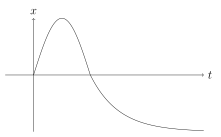
A particle of mass \(m\) moves along the \(x\)-axis. At time \(t=0\) it passes through \(x=0\) with velocity \(v_{0} > 0\). The particle is acted on by a force \(\mathrm{F}(x)\), directed along the \(x\)-axis and measured in the direction of positive \(x\), which is given by \[ \mathrm{F}(x)=\begin{cases} -m\mu^{2}x & \qquad(x\geqslant0),\\ -m\kappa\dfrac{\mathrm{d}x}{\mathrm{d}t} & \qquad(x < 0), \end{cases} \] where \(\mu\) and \(\kappa\) are positive constants. Obtain the particle's subsequent position as a function of time, and give a rough sketch of the \(x\)-\(t\) graph.
Solution: Using Newton's second law in the form, \(\F(x) = m \ddot{x}\). Our two different differential equations can be solved as follows: When \(x \geq 0\) \(-\mu^2x = \ddot{x} \Rightarrow x = A\sin \mu t + B \cos \mu t\) when \(x \geq 0\). And when \(x < 0\) \(-\kappa \dot{x} = \ddot{x} \Rightarrow \dot{x} = Ce^{-\kappa t} \Rightarrow x = De^{-\kappa t} + E\) when \(x < 0\) Following the trajectory of the particle: At \(t = 0, x = 0, \dot{x} = v_0 > 0\), so \(x = \frac{v_0}{\mu} \sin \mu t\) until \(t = \frac{\pi}{\mu}\). When \(t = \frac{\pi}{\mu}\) the particle will head into the negative \(x\)-axis with velocity \(-v_0\). At which point our initial conditions for our differential equations give us that \(De^{-\frac{\pi\kappa}{\mu}} + E = 0, -\kappa De^{-\frac{\pi\kappa}{\mu}} = -v_0 \Rightarrow De^{-\frac{\pi\kappa}{\mu}} = \frac{v_0}{\kappa}, E = -\frac{v_0}{\kappa}\). To summarise: \[ x(t) = \begin{cases} \frac{v_0}{\mu} \sin \mu t & 0 \leq t \leq \frac{\pi}{\mu} \\ -\frac{v_0}{\kappa} \l 1-e^{-\kappa(t-\frac{\pi}{\mu})}\r & t > \frac{\pi}{\mu}\end{cases}\]
1987 Paper 2 Q14
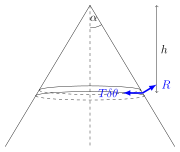
A thin uniform elastic band of mass \(m,\) length \(l\) and modulus of elasticity \(\lambda\) is pushed on to a smooth circular cone of vertex angle \(2\alpha,\) in such a way that all elements of the band are the same distance from the vertex. It is then released from rest. Let \(x(t)\) be the length of the band at time \(t\) after release, and let \(t_{0}\) be the time at which the band becomes slack. Assuming that a small element of the band which subtends an angle \(\delta\theta\) at the axis of the cone experiences a force, due to the tension \(T\) in the band, of magnitude \(T\delta\theta\) directed towards the axis, and ignoring the effects of gravity, show that \[ \frac{\mathrm{d}^{2}x}{\mathrm{d}t^{2}}+\frac{4\pi^{2}\lambda}{ml}(x-l)\sin^{2}\alpha=0,\qquad(0< t< t_{0}). \] Find the value of \(t_{0}.\)
Solution: