Problems
Filters
29 problems found
1995 Paper 3 Q8
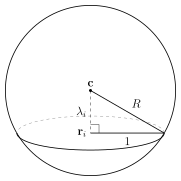
A plane \(\pi\) in 3-dimensional space is given by the vector equation \(\mathbf{r}\cdot\mathbf{n}=p,\) where \(\mathbf{n}\) is a unit vector and \(p\) is a non-negative real number. If \(\mathbf{x}\) is the position vector of a general point \(X\), find the equation of the normal to \(\pi\) through \(X\) and the perpendicular distance of \(X\) from \(\pi\). The unit circles \(C_{i},\) \(i=1,2,\) with centres \(\mathbf{r}_{i},\) lie in the planes \(\pi_{i}\) given by \(\mathbf{r}\cdot\mathbf{n}_{i}=p_{i},\) where the \(\mathbf{n}_{i}\) are unit vectors, and \(p_{i}\) are non-negative real numbers. Prove that there is a sphere whose surface contains both circles only if there is a real number \(\lambda\) such that \[ \mathbf{r}_{1}+\lambda\mathbf{n}_{1}=\mathbf{r}_{2}\pm\lambda\mathbf{n}_{2}. \] Hence, or otherwise, deduce the necessary conditions that \[ (\mathbf{r}_{1}-\mathbf{r}_{2})\cdot(\mathbf{n}_{1}\times\mathbf{n}_{2})=0 \] and that \[ (p_{1}-\mathbf{n}_{1}\cdot\mathbf{r}_{2})^{2}=(p_{2}-\mathbf{n}_{2}\cdot\mathbf{r}_{1})^{2}. \] Interpret each of these two conditions geometrically.
Solution: The equation of the normal to \(\pi\) through \(X\) is \(\mathbf{x} + \lambda \mathbf{n}\). The distance is \(|\mathbf{x}\cdot \mathbf{n}-p|\) We know that the centre of the sphere must lie above the centre of the circle following the normal, ie \(\mathbf{c} = \mathbf{r}_1+\lambda_1 \mathbf{n}_1 = \mathbf{r}_2+\lambda_2 \mathbf{n}_2\)
1994 Paper 1 Q1
My house has an attic consisting of a horizontal rectangular base of length \(2q\) and breadth \(2p\) (where \(p < q\)) and four plane roof sections each at angle \(\theta\) to the horizontal. Show that the length of the roof ridge is independent of \(\theta\) and find the volume of the attic and the surface area of the roof.
Solution:

1994 Paper 3 Q3
Describe geometrically the possible intersections of a plane with a sphere. Let \(P_{1}\) and \(P_{2}\) be the planes with equations \begin{alignat*}{1} 3x-y-1 & =0,\\ x-y+1 & =0, \end{alignat*} respectively, and let \(S_{1}\) and \(S_{2}\) be the spheres with equations \begin{alignat*}{1} x^{2}+y^{2}+z^{2} & =7,\\ x^{2}+y^{2}+z^{2}-6y-4z+10 & =0, \end{alignat*} respectively. Let \(C_{1}\) be the intersection of \(P_{1}\) and \(S_{1},\) let \(C_{2}\) be the intersection of \(P_{2}\) and \(S_{2}\) and let \(L\) be the intersection of \(P_{1}\) and \(P_{2}.\) Find the points where \(L\) meets each of \(S_{1}\) and \(S_{2}.\) Determine, giving your reasons, whether the circles \(C_{1}\) and \(C_{2}\) are linked.
1993 Paper 1 Q8
- Prove that the intersection of the surface of a sphere with a plane is always a circle, a point or the empty set. Prove that the intersection of the surfaces of two spheres with distinct centres is always a circle, a point or the empty set. {[}If you use coordinate geometry, a careful choice of origin and axes may help.{]}
- The parish council of Little Fitton have just bought a modern sculpture entitled `Truth, Love and Justice pouring forth their blessings on Little Fitton.' It consists of three vertical poles \(AD,BE\) and \(CF\) of heights 2 metres, 3 metres and 4 metres respectively. Show that \(\angle DEF=\cos^{-1}\frac{1}{5}.\) Vandals now shift the pole \(AD\) so that \(A\) is unchanged and the pole is still straight but \(D\) is vertically above \(AB\) with \(\angle BAD=\frac{1}{4}\pi\) (in radians). Find the new angle \(\angle DEF\) in radians correct to four figures.
1993 Paper 2 Q4
Two non-parallel lines in 3-dimensional space are given by \(\mathbf{r}=\mathbf{p}_{1}+t_{1}\mathbf{m}_{1}\) and \(\mathbf{r}=\mathbf{p}_{2}+t_{2}\mathbf{m}_{2}\) respectively, where \(\mathbf{m}_{1}\) and \(\mathbf{m}_{2}\) are unit vectors. Explain by means of a sketch why the shortest distance between the two lines is \[ \frac{\left|(\mathbf{p}_{1}-\mathbf{p}_{2})\cdot(\mathbf{m}_{1}\times\mathbf{m}_{2})\right|}{\left|(\mathbf{m}_{1}\times\mathbf{m}_{2})\right|}. \]
- Find the shortest distance between the lines in the case \[ \mathbf{p}_{1}=(2,1,-1)\qquad\mathbf{p}_{2}=(1,0,-2)\qquad\mathbf{m}_{1}=\tfrac{1}{5}(4,3,0)\qquad\mathbf{m}_{2}=\tfrac{1}{\sqrt{10}}(0,-3,1). \]
- Two aircraft, \(A_{1}\) and \(A_{2},\) are flying in the directions given by the unit vectors \(\mathbf{m}_{1}\) and \(\mathbf{m}_{2}\) at constant speeds \(v_{1}\) and \(v_{2}.\) At time \(t=0\) they pass the points \(\mathbf{p}_{1}\) and \(\mathbf{p}_{2}\), respectively. If \(d\) is the shortest distance between the two aircraft during the flight, show that \[ d^{2}=\frac{\left|\mathbf{p}_{1}-\mathbf{p}_{2}\right|^{2}\left|v_{1}\mathbf{m}_{1}-v_{2}\mathbf{m}_{2}\right|^{2}-[(\mathbf{p}_{1}-\mathbf{p}_{2})\cdot(v_{1}\mathbf{m}_{1}-v_{2}\mathbf{m}_{2})]^{2}}{\left|v_{1}\mathbf{m}_{1}-v_{2}\mathbf{m}_{2}\right|^{2}}. \]
- Suppose that \(v_{1}\) is fixed. The pilot of \(A_{2}\) has chosen \(v_{2}\) so that \(A_{2}\) comes as close as possible to \(A_{1}.\) How close is that, if \(\mathbf{p}_{1},\mathbf{p}_{2},\mathbf{m}_{1}\) and \(\mathbf{m}_{2}\) are as in (i)?
1993 Paper 3 Q8
A square pyramid has its base vertices at the points \(A\) \((a,0,0)\), \(B\) \((0,a,0)\), \(C\) \((-a,0,0)\) and \(D\) \((0,-a,0)\), and its vertex at \(E\) \((0,0,a)\). The point \(P\) lies on \(AE\) with \(x\)-coordinate \(\lambda a\), where \(0<\lambda<1\), and the point \(Q\) lies on \(CE\) with \(x\)-coordinate \(-\mu a\), where \(0<\mu<1\). The plane \(BPQ\) cuts \(DE\) at \(R\) and the \(y\)-coordinate of \(R\) is \(-\gamma a\). Prove that $$ \gamma = {\lambda \mu \over \lambda + \mu - \lambda \mu}. $$ Show that the quadrilateral \(BPRQ\) cannot be a parallelogram.
1993 Paper 3 Q11
In this question, all gravitational forces are to be neglected. A rigid frame is constructed from 12 equal uniform rods, each of length \(a\) and mass \(m,\) forming the edges of a cube. Three of the edges are \(OA,OB\) and \(OC,\) and the vertices opposite \(O,A,B\) and \(C\) are \(O',A',B'\) and \(C'\) respectively. Forces act along the lines as follows, in the directions indicated by the order of the letters: \begin{alignat*}{3} 2mg\mbox{ along }OA, & \qquad & mg\mbox{ along }AC', & \qquad & \sqrt{2}mg\mbox{ along }O'A,\\ \sqrt{2}mg\mbox{ along }OA', & & 2mg\mbox{ along }C'B, & & mg\mbox{ along }A'C. \end{alignat*}
- The frame is freely pivoted at \(O\). Show that the direction of the line about which it will start to rotate is $\begin{pmatrix}1\\ 1\\ 2 \end{pmatrix}$ with respect to axes along \(OA\), \(OB\) and \(OC\) respectively.
- Show that the moment of inertia of the rod \(OA\) about the axis \(OO'\) is \(2ma^2/9\) and about a parallel axis through its mid-point is \(ma^2/18\). Hence find the moment of inertia of \(B'C\) about \(OO'\) and show that the moment of inertia of the frame about \(OO'\) is \(14ma^2/3\). If the frame is freely pivoted about the line \(OO'\) and the forces continue to act along the specified lines, find the initial angular acceleration of the frame.
1992 Paper 3 Q5
The tetrahedron \(ABCD\) has \(A\) at the point \((0,4,-2)\). It is symmetrical about the plane \(y+z=2,\) which passes through \(A\) and \(D\). The mid-point of \(BC\) is \(N\). The centre, \(Y\), of the sphere \(ABCD\) is at the point \((3,-2,4)\) and lies on \(AN\) such that \(\overrightarrow{AY}=3\overrightarrow{YN}.\) Show that \(BN=6\sqrt{2}\) and find the coordinates of \(B\) and \(C\). The angle \(AYD\) is \(\cos^{-1}\frac{1}{3}.\) Find the coordinates of \(D\). [There are two alternative answers for each point.]
Solution: Since \(B\) and \(C\) are reflections of each other in the plane \(y+z=2\) (since that's what it means to be symmetrical), we must have that \(N\) also lies on the plane \(y+z=2\). Since \(\overrightarrow{AY}=3\overrightarrow{YN}.\) we must have \(\overrightarrow{AN}=\overrightarrow{AY}+\overrightarrow{YN} = \frac43\overrightarrow{AY} = \frac43\begin{pmatrix} 3\\-6\\6\end{pmatrix} = \begin{pmatrix} 4\\-8\\8\end{pmatrix}\) and \(N\) is the point \((4,-4,6)\) (which fortunately is on our plane as expected). \(Y\) is the point \((3,-2,4)\) \(|\overrightarrow{AY}| = \sqrt{3^2+(-6)^2+6^2} = 3\sqrt{1+4+4} = 9\)

1991 Paper 2 Q10
A straight stick of length \(h\) stands vertically. On a sunny day, the stick casts a shadow on flat horizontal ground. In cartesian axes based on the centre of the Earth, the position of the Sun may be taken to be \(R(\cos\theta,\sin\theta,0)\) where \(\theta\) varies but \(R\) is constant. The positions of the base and tip of the stick are \(a(0,\cos\phi,\sin\phi)\) and \(b(0,\cos\phi,\sin\phi)\), respectively, where \(b-a=h\). Show that the displacement vector from the base of the stick to the tip of the shadow is \[ Rh(R\cos\phi\sin\theta-b)^{-1}\begin{pmatrix}-\cos\theta\\ -\sin^{2}\phi\sin\theta\\ \cos\phi\sin\phi\sin\theta \end{pmatrix}. \] {[}`Stands vertically' means that the centre of the Earth, the base of the stick and the tip of the stick are collinear, `horizontal' means perpendicular to the stick.
1991 Paper 3 Q4
The point \(P\) moves on a straight line in three-dimensional space. The position of \(P\) is observed from the points \(O_{1}(0,0,0)\) and \(O_{2}(8a,0,0).\) At times \(t=t_{1}\) and \(t=t_{1}'\), the lines of sight from \(O_{1}\) are along the lines \[ \frac{x}{2}=\frac{z}{3},y=0\quad\mbox{ and }\quad x=0,\frac{y}{3}=\frac{z}{4} \] respectively. At times \(t=t_{2}\) and \(t=t_{2}'\), the lines of sight from \(O_{2}\) are \[ \frac{x-8a}{-3}=\frac{y}{1}=\frac{z}{3}\quad\mbox{ and }\quad\frac{x-8a}{-4}=\frac{y}{2}=\frac{z}{5} \] respectively. Find an equation or equations for the path of \(P\).
1989 Paper 1 Q12
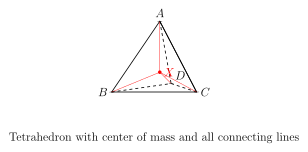
A regular tetrahedron \(ABCD\) of mass \(M\) is made of 6 identical uniform rigid rods, each of length \(2a.\) Four light elastic strings \(XA,XB,XC\) and \(XD\), each of natural length \(a\) and modulus of elasticity \(\lambda,\) are fastened together at \(X\), the other end of each string being attached to the corresponding vertex. Given that \(X\) lies at the centre of mass of the tetrahedron, find the tension in each string. The tetrahedron is at rest on a smooth horizontal table, with \(B,C\) and \(D\) touching the table, and the ends of the strings at \(X\) attached to a point \(O\) fixed in space. Initially the centre of mass of the tetrahedron coincides with \(O.\) Suddenly the string \(XA\) breaks, and the tetrahedron as a result rises vertically off the table. If the maximum height subsequently attained is such that \(BCD\) is level with the fixed point \(O,\) show that (to 2 significant figures) \[ \frac{Mg}{\lambda}=0.098. \]
Solution:
1989 Paper 3 Q2
The points \(A,B\) and \(C\) lie on the surface of the ground, which is an inclined plane. The point \(B\) is 100m due north of \(A,\) and \(C\) is 60m due east of \(B\). The vertical displacements from \(A\) to \(B,\) and from \(B\) to \(C\), are each 5m downwards. A plane coal seam lies below the surface and is to be located by making vertical bore-holes at \(A,B\) and \(C\). The bore-holes strike the coal seam at 95m, 45m and 76m below \(A,B\) and \(C\) respectively. Show that the coal seam is inclined at \(\cos^{-1}(\frac{4}{5})\) to the horizontal. The coal seam comes to the surface along a line. Find the bearing of this line.
Solution: Set up a coordinate system so that \(x\) is E-W, \(y\) is N-S and \(z\) is the vertical direction. Also assume \(B\) is the origin, then, \(A = \begin{pmatrix} 0 \\ -100 \\ 5\end{pmatrix}, B = \begin{pmatrix} 0 \\ 0 \\ 0\end{pmatrix}, C= \begin{pmatrix} 60 \\ 0\\ -5\end{pmatrix},\). The coal seam has points: \(\begin{pmatrix} 0 \\ -100 \\ -90\end{pmatrix}, \begin{pmatrix} 0 \\ 0 \\ -45\end{pmatrix}, \begin{pmatrix} 60 \\ 0\\ -81\end{pmatrix},\) Therefore we can find the normal to the coal seam: \begin{align*} \mathbf{n} &= \left (\begin{pmatrix} 0 \\ -100 \\ -90\end{pmatrix} - \begin{pmatrix} 0 \\ 0 \\ -45\end{pmatrix}\right ) \times \left ( \begin{pmatrix} 60 \\ 0\\ -81\end{pmatrix} - \begin{pmatrix} 0 \\ 0 \\ -45\end{pmatrix}\right ) \\ &= \begin{pmatrix} 0 \\ - 100 \\ -45\end{pmatrix} \times \begin{pmatrix} 60 \\ 0 \\ -36\end{pmatrix} \\ &= \begin{pmatrix} 3600 \\ -60 \cdot 45 \\ 60 \cdot 100 \end{pmatrix} \\ &= 300\begin{pmatrix} 12 \\ -9 \\ 20\end{pmatrix} \end{align*} To measure the incline \(\theta\) to the horizontal we can take a dot with \(\hat{\mathbf{k}}\), to see: \begin{align*} \cos \theta &= \frac{20}{\sqrt{12^2+(-9)^2+20^2} \sqrt{1^2+0^2+0^2}} \\ &= \frac{20}{25} \\ &= \frac{4}{5} \end{align*} Therefore the angle is \(\cos^{-1} \tfrac 45\) The equation of the seam is \(12x - 9y + 20z = -900\). The equation of the surface is \(5x + 3y + 60z = 0\) We can compute the direction of the overlap again with a cross product: \begin{align*} \mathbf{d} &= \begin{pmatrix} 12 \\ -9 \\ 20\end{pmatrix} \times \begin{pmatrix} 5 \\ 3 \\ 60\end{pmatrix} \\ &= \begin{pmatrix} -600 \\ -620 \\ 81 \end{pmatrix} \end{align*} To get the bearing of this vector we just need to look at the \(x\) and \(y\) components, so it will be \(\tan^{-1} \frac{600}{620} = \tan^{-1} \frac{30}{31}\)
1988 Paper 2 Q10
The surface \(S\) in 3-dimensional space is described by the equation \[ \mathbf{a}\cdot\mathbf{r}+ar=a^{2}, \] where \(\mathbf{r}\) is the position vector with respect to the origin \(O\), \(\mathbf{a}(\neq\mathbf{0})\) is the position vector of a fixed point, \(r=\left|\mathbf{r}\right|\) and \(a=\left|\mathbf{a}\right|.\) Show, with the aid of a diagram, that \(S\) is the locus of points which are equidistant from the origin \(O\) and the plane \(\mathbf{r}\cdot\mathbf{a}=a^{2}.\) The point \(P\), with position vector \(\mathbf{p},\) lies in \(S\), and the line joining \(P\) to \(O\) meets \(S\) again at \(Q\). Find the position vector of \(Q\). The line through \(O\) orthogonal to \(\mathbf{p}\) and \(\mathbf{a}\) meets \(S\) at \(T\) and \(T'\). Show that the position vectors of \(T\) and \(T'\) are \[ \pm\frac{1}{\sqrt{2ap-a^{2}}}\mathbf{a}\times\mathbf{p}, \] where \(p=\left|\mathbf{p}\right|.\) Show that the area of the triangle \(PQT\) is \[ \frac{ap^{2}}{2p-a}. \]
Solution: The plane is the same as the plane \((\mathbf{r} - \mathbf{a}) \cdot \mathbf{a} = 0\), ie the plane through \(\mathbf{a}\) whose normal is parallel to \(\mathbf{a}\) The distance from \(\mathbf{r}\) to the plane therefore is \(\lambda\) where \(\mathbf{r}+\lambda \frac{1}{a}\mathbf{a}\) must be on the plane, ie \((\mathbf{r}+\frac{\lambda}{a} \mathbf{a} - \mathbf{a})\cdot \mathbf{a} = 0 \Rightarrow \lambda = \frac{a^2-\mathbf{a} \cdot \mathbf{r}}{a}\) But if \(\mathbf{a} \cdot \mathbf{r} = a^2 - ar\) then \(\lambda = r\), ie the distance to the plane is the same as the distance to the origin. \(\mathbf{q} = k \mathbf{p}\) and so \(\mathbf{a} \cdot k \mathbf{p} + a |k|p = a^2\) if \(k > 0\) we will find \(k = 1\) the position vector we already know about, therefore suppose \(k < 0\) so: \begin{align*} && \mathbf{a} \cdot k \mathbf{p} - ka p &= a^2 \\ \Rightarrow && k(a^2-ap)-kap &= a^2 \\ \Rightarrow && k(a^2-2ap) &= a^2 \\ \Rightarrow && k &= \frac{a^2}{a^2-2ap} \end{align*} Therefore \(\mathbf{q} = \frac{a^2}{a^2-2ap} \mathbf{p}\) The line through \(O\) orthogonal to \(\mathbf{p}\) and \(\mathbf{a}\) will be parallel to \(\mathbf{a} \times \mathbf{p}\). Therefore we should consider points of the from \(s \mathbf{a} \times \mathbf{p}\) on the surface \(S\). \begin{align*} && s\mathbf{a} \cdot ( \mathbf{a} \times \mathbf{p}) + sa^2p |\sin \theta| &= a^2 \end{align*} The angle between \(\cos \theta = \frac{\mathbf{a} \cdot \mathbf{p}}{ap} = \frac{a^2-ap}{ap} \Rightarrow |\sin \theta| = \sqrt{1-\frac{(a-p)^2}{p^2}} = \frac{1}{p} \sqrt{2ap-a^2}\) Therefore \(sa^2 \sqrt{2ap-a^2} = a^2 \Rightarrow s = \frac{1}{\sqrt{2ap-a^2}}\) and so the points are as required. Noting that \(|\mathbf{p} \times \mathbf{t}| = |\frac{1}{p \sin \theta}\mathbf{p} \times (\mathbf{p} \times \mathbf{a}) | = |\frac{1}{p \sin \theta}p^2a \sin \theta | = pa\) The area of triangle \(PQT\) is : \begin{align*} \frac12 | (\mathbf{p} - \mathbf{t}) \times (\mathbf{q} - \mathbf{t}) | &= \frac12 |\mathbf{p} \times \mathbf{q} - \mathbf{t} \times \mathbf{q} - \mathbf{p} \times \mathbf{t} - \mathbf{t} \times \mathbf{t}| \\ &= \frac12 |\mathbf{t} \times (\mathbf{p} - \mathbf{q})| \\ &= \frac12 \cdot (1 - \frac{a^2}{a^2-2ap})| \mathbf{t} \times \mathbf{p}| \\ &= \frac12 \frac{2ap}{a^2-2ap} \cdot ap \\ &= \frac{ap^2}{a^2-ap} \end{align*}
1987 Paper 2 Q8
Let \(\mathbf{r}\) be the position vector of a point in three-dimensional space. Describe fully the locus of the point whose position vector is \(\mathbf{r}\) in each of the following four cases:
- \(\left(\mathbf{a-b}\right) \cdot \mathbf{r}=\frac{1}{2}(\left|\mathbf{a}\right|^{2}-\left|\mathbf{b}\right|^{2});\)
- \(\left(\mathbf{a-r}\right)\cdot\left(\mathbf{b-r}\right)=0;\)
- \(\left|\mathbf{r-a}\right|^{2}=\frac{1}{2}\left|\mathbf{a-b}\right|^{2};\)
- \(\left|\mathbf{r-b}\right|^{2}=\frac{1}{2}\left|\mathbf{a-b}\right|^{2}.\)
Solution:
- \(\mathbf{n} \cdot \mathbf{r} = 0\) is the equation of a plane with normal \(\mathbf{n}\). \(\mathbf{n} \cdot (\mathbf{r}-\mathbf{a}) = 0\) is the equation of a plane through \(\mathbf{a}\) with normal \(\mathbf{n}\). Our expression is: \begin{align*} && \left(\mathbf{a-b}\right) \cdot \mathbf{r}&=\frac{1}{2}(\left|\mathbf{a}\right|^{2}-\left|\mathbf{b}\right|^{2}) \\ &&&=\frac{1}{2}(\mathbf{a}-\mathbf{b})\cdot(\mathbf{a}+\mathbf{b}) \\ \Leftrightarrow && \left(\mathbf{a-b}\right) \cdot \left ( \mathbf{r} - \frac12 (\mathbf{a}+\mathbf{b}) \right) &= 0 \end{align*} So this is a plane through \(\frac12 (\mathbf{a}+\mathbf{b})\) perpendicular to \(\mathbf{a}-\mathbf{b}\). ie the plane halfway between \(\mathbf{a}\) and \(\mathbf{b}\) perpendicular to the line between them.
- \begin{align*} && 0 &= \left(\mathbf{a-r}\right)\cdot\left(\mathbf{b-r}\right) \\ &&&= \mathbf{a} \cdot \mathbf{b} - \mathbf{r} \cdot (\mathbf{a}+\mathbf{b}) + \mathbf{r}\cdot\mathbf{r} \\ &&&= \left ( \mathbf{r}- \frac12(\mathbf{a}+\mathbf{b}) \right) \cdot \left ( \mathbf{r}- \frac12(\mathbf{a}+\mathbf{b}) \right) - \frac14 \left (\mathbf{a}\cdot\mathbf{a}+2\mathbf{a}\cdot\mathbf{b} + \mathbf{b}\cdot\mathbf{b} \right) +\mathbf{a}\cdot\mathbf{b} \\ &&&= \left | \mathbf{r} - \frac12 \left (\mathbf{a}+\mathbf{b} \right) \right|^2 - \left |\frac12 \left ( \mathbf{a} - \mathbf{b}\right) \right|^2 \end{align*} Therefore this is a sphere, centre \(\frac12 \left (\mathbf{a}+\mathbf{b} \right)\) radius \(\left |\frac12 \left ( \mathbf{a} - \mathbf{b}\right) \right|\)
- This is a sphere centre \(\mathbf{a}\) radius \(\frac1{\sqrt{2}} \left|\mathbf{a-b}\right|\)
- This is a sphere centre \(\mathbf{b}\) radius \(\frac1{\sqrt{2}} \left|\mathbf{a-b}\right|\)