Problems
Filters
298 problems found
1990 Paper 2 Q1
Prove that both \(x^{4}-2x^{3}+x^{2}\) and \(x^{2}-8x+17\) are non-negative for all real \(x\). By considering the intervals \(x\leqslant0\), \(0 < x\leqslant2\) and \(x > 2\) separately, or otherwise, prove that the equation \[ x^{4}-2x^{3}+x^{2}-8x+17=0 \] has no real roots. Prove that the equation \(x^{4}-x^{3}+x^{2}-4x+4=0\) has no real roots.
Solution: \begin{align*} x^4 - 2x^3+x^2 &= x^2(x^2-2x+1) \\ &= x^2(x-1)^2 > 0 \end{align*} Since \(x\)and \(x-1\) can't both be zero, and square cannot be negative. \begin{align*} x^2 - 8x+17 &= (x-4)^2 +1 \geq 1 > 0 \end{align*} If \(x \leq 2\) then \(x^4 - 2x^3+x^2 > 0\) and \(17-8x \geq 1\) so \(x^4-2x^3+x^2-8x+17 > 0\) If \(x > 2\) then \(x^4-2x^3 = x^3(x-2) \geq 0\) and \(x^2-8x+17 > 0\) so \(x^4-2x^3+x^2-8x+17 > 0\), so for all real numbers our polynomial is positive and therefore cannot have any roots. Note that: \(x^4-x^3+x^2 = x^2(x^2-x+1) > 0\) and \(x^2-4x+4 =(x-2)^2 \geq 0\) If \(x < 1\) then \(x^4-x^3+x^2 > 0\) and \(4(1-x) > 0\) so \(x^4-x^3+x^2-4x+4 > 0\). If \(x > 1\) then \(x^4-x^3 = x^3(x-1) > 0\) and \(x^2-4x+4 \geq 0\) therefore \(x^4-x^3+x^2-4x+4 > 0\). Therefore \(x^4-x^3+x^2-4x+4 > 0\) for all real \(x\) and hence there are no real roots.
1990 Paper 2 Q6
Let \(a,b,c,d,p\) and \(q\) be positive integers. Prove that:
- if \(b > a\) and \(c > 1,\) then \(bc\geqslant2c\geqslant2+c\);
- if \(a < b\) and \(d < c\), then \(bc-ad\geqslant a+c\);
- if \({\displaystyle \frac{a}{b} < p < \frac{c}{d}}\), then \(\left(bc-ad\right)p\geqslant a+c\);
- if \({\displaystyle \frac{a}{b} < \frac{p}{q} < \frac{c}{d}},\) then \({\displaystyle p\geqslant\frac{a+c}{bc-ad}}\) and \({\displaystyle q\geqslant\frac{b+d}{bc-ad}}\).
Solution:
- If \(b > a\) and \(c > 1\) then \(c \geq 2 \underbrace{\Rightarrow}_{\times c} bc \geq 2c = c+c \underbrace{\geq}_{c \geq 2} 2 + c\)
- If \(a < b\) and \(d < c\) then \(b \geq a+1\) and \(c \geq d+1\) so \begin{align*} bc - ad &\underbrace{\geq}_{b \geq a+1} (a+1)c - ad \\ &\underbrace{\geq}_{d \leq c-1} (a+1)c - a(c-1) \\ &= a+c \end{align*}
- If \(\displaystyle \frac{a}{b} < p < \frac{c}{d}\) then \(a < pb\) and \(pd < c\) so by the previous part \((pb)c - a(pd) \geq a + c \Leftrightarrow (bc-ad)p \geq a+c\).
- If \(\displaystyle \frac{a}{b} < \frac{p}{q} < \frac{c}{d}\) then \(\displaystyle \frac{qa}{b} < p < \frac{qc}{d}\) and so by the previous part we must have \((bc-ad)qp \geq q(a+c) \Rightarrow p \geq \frac{a+c}{bc-ad}\). Similarly we have \(\frac{d}{c} < \frac{q}{p} < \frac{b}{a}\) and so \(q \geq \frac{b+d}{bc-ad}\)
1990 Paper 2 Q13
A thin non-uniform rod \(PQ\) of length \(2a\) has its centre of gravity a distance \(a+d\) from \(P\). It hangs (not vertically) in equilibrium suspended from a small smooth peg \(O\) by means of a light inextensible string of length \(2b\) which passes over the peg and is attached at its ends to \(P\) and \(Q\). Express \(OP\) and \(OQ\) in terms of \(a,b\) and \(d\). By considering the angle \(POQ\), or otherwise, show that \(d < a^{2}/b\).
Solution:

1990 Paper 2 Q14
The identical uniform smooth spherical marbles \(A_{1},A_{2},\ldots,A_{n},\) where \(n\geqslant3,\) each of mass \(m,\) lie in that order in a smooth straight trough, with each marble touching the next. The marble \(A_{n+1},\) which is similar to \(A_{n}\) but has mass \(\lambda m,\) is placed in the trough so that it touches \(A_{n}.\) Another marble \(A_{0},\) identical to \(A_{n},\) slides along the trough with speed \(u\) and hits \(A_{1}.\) It is given that kinetic energy is conserved throughout.
- Show that if \(\lambda<1,\) there is a possible subsequent motion in which only \(A_{n}\) and \(A_{n+1}\) move (and \(A_{0}\) is reduced to rest), but that if \(\lambda>1,\) such a motion is not possible.
- If \(\lambda>1,\) show that a subsequent motion in which only \(A_{n-1},A_{n}\) and \(A_{n+1}\) move is not possible.
- If \(\lambda>1,\) find a possible subsequent motion in which only two marbles move.
Solution: Without loss of generality, let \(m = u = 1\).
- \begin{align*} \text{COM}: && 1&= v_n + \lambda v_{n+1} \\ && &= v_n + \lambda v_{n+1}\\ \text{COE}: && \frac12 &= \frac12 v_n^2 + \frac12 \lambda v_{n+1}^2 \\ && 1 &= v_n^2 +\lambda v_{n+1}^2 \\ \\ \Rightarrow && v_n^2 + 2\lambda v_n v_{n+1} + \lambda^2 v_{n+1}^2 &= v_n^2 + \lambda v_{n+1}^2 \\ && \lambda v_{n+1}^2 &= v_{n+1}^2 - 2 v_n v_{n+1} \\ && \lambda v_{n+1} &= (v_{n+1} - 2v_n) \\ && (1-\lambda)v_{n+1} &= 2v_n \end{align*} Since \(v_{n+1} > v_n > 0\) this is only possible if \(\lambda < 1\)
- \begin{align*} \text{COM}: && 1&= v_{n-1}+v_n+\lambda v_{n+1} \\ && 1&= v_{n-1} + v_n + \lambda v_{n+1} \\ \text{COE}: && \frac12 &= \frac12 v_{n-1}^2+\frac12v_n^2+\frac12\lambda v_{n+1}^2 \\ && 1&= v_{n-1}^2 + v_n^2 + \lambda v_{n+1}^2 \\ \\ \Rightarrow && 1 &= v_{n-1}^2 + v_n^2 + \lambda \frac{(1-v_{n-1}-v_n)^2}{\lambda^2} \\ &&&= v_{n-1}^2 + v_n^2 + \frac{(1-v_{n-1}-v_n)^2}{\lambda} \\ \Rightarrow && 1 &< v_{n-1}^2 + v_n^2 + (1-v_{n-1}-v_n)^2 \\ &&&= 2v_{n-1}^2+2v_n^2 + 1-2v_{n-1}-2v_{n-2} +2v_{n-1}v_n\\ \Rightarrow && v_{n-1}+v_n & <(v_{n-1}+v_n)^2 - v_{n-1}v_n \end{align*} but this cannot be true since \(0 < v_{n-1}+v_n < 1\) and \(v_n v_{n-1} > 0\)
- The only way this is possible is if the first and last marble are moving. \begin{align*} \text{COM}: && 1 &= v_0 +\lambda v_{n+1} \\ \text{COE}: && \frac12 &= \frac12 v_0^2 + \frac12 \lambda^2 v_{n+1} \\ && 1 &= v_0^2 + \lambda v_{n+1}^2 \\ \Rightarrow && 2v_0 + \lambda v_{n+1} &= v_{n+1} \\ \Rightarrow && v_{n+1} &=\frac{2}{1-\lambda} v_0 \\ \Rightarrow && v_0 &= \frac{1-\lambda}{1+\lambda} \\ && v_{n+1} &= \frac{2}{1+\lambda} \end{align*} which will work since \(v_0\) can travel backwards.
1990 Paper 3 Q2
The distinct points \(O\,(0,0,0),\) \(A\,(a^{3},a^{2},a),\) \(B\,(b^{3},b^{2},b)\) and \(C\,(c^{3},c^{2},c)\) lie in 3-dimensional space.
- Prove that the lines \(OA\) and \(BC\) do not intersect.
- Given that \(a\) and \(b\) can vary with \(ab=1,\) show that \(\angle AOB\) can take any value in the interval \(0<\angle AOB<\frac{1}{2}\pi\), but no others.
Solution:
- The line \(OA\) is \(\lambda \begin{pmatrix} a^3 \\ a^2 \\ a \end{pmatrix}\). The line \(BC\) is \(\begin{pmatrix} b^3 \\ b^2 \\ b \end{pmatrix} + \mu \begin{pmatrix} c^3-b^3 \\ c^2-b^2 \\ c-b \end{pmatrix}\). If these lies are concurrent then there would be \(\mu\) and \(\lambda\) such that they are equal, and in particular, \begin{align*} && \frac{b^2 + \mu(c^2-b^2)}{b + \mu (c-b)} &= \frac{b^3 + \mu(c^3-b^3)}{b^2 + \mu (c^2-b^2)} \\ \Leftrightarrow && (b^2 + \mu(c^2-b^2))^2 &= (b+\mu(c-b))(b^3+\mu(c^3-b^3)) \\ && b^4 +2\mu b^2 (c^2-b^2) + \mu^2 (c^2-b^2) &= b^4 + \mu(c-b)b^3 + \mu b(c^3-b^3) + \mu^2 (c-b)(c^3-b^3) \\ \Leftrightarrow && 2\mu b^2 (c+b) + \mu^2(c-b)(c+b)^2 &= \mu (b^3 + b(c^2+bc+b^2)) + \mu^2 (c^3-b^3) \\ && \mu = 0 & \Rightarrow a = b \\ \Leftrightarrow && b^2c - bc^2 &= \mu (c^3-b^3-(c-b)(c+b)^2) \\ \Leftrightarrow && bc(b-c) &= \mu (c-b)(c^2+bc+b^2-c^2-2bc-b^2) \\ \Leftrightarrow && bc &= \mu (bc) \\ \Leftrightarrow && \mu &= 1 \\ && \mu = -1 & \Rightarrow a = c \end{align*} Therefore there are no solutions.
- \begin{align*} \cos \angle AOB &= \frac{ab+a^2b^2+a^3b^3}{\sqrt{a^2+a^4+a^6}\sqrt{b^2+b^4+b^6}} \\ &= \frac{3}{\sqrt{1 + a^2 + a^4} \sqrt{1 + b^2 + b^4}} \\ &> 0 \end{align*} Therefore the angle satisfies \(\angle AOB < \tfrac12 \pi\). We cannot achieve \(0\), since that would require \(a = b = 1\), therefore it falls in the range \(0 < \angle AOB < \tfrac12 \pi\)
1990 Paper 3 Q7
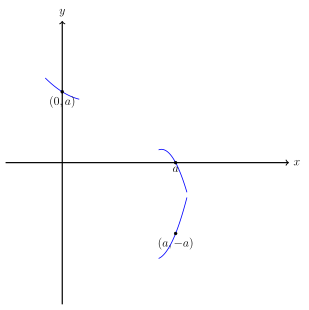
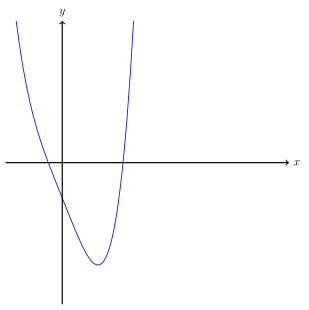
The points \(P\,(0,a),\) \(Q\,(a,0)\) and \(R\,(a,-a)\) lie on the curve \(C\) with cartesian equation \[ xy^{2}+x^{3}+a^{2}y-a^{3}=0,\qquad\mbox{ where }a>0. \] At each of \(P,Q\) and \(R\), express \(y\) as a Taylor series in \(h\), where \(h\) is a small increment in \(x\), as far as the term in \(h^{2}.\) Hence, or otherwise, sketch the shape of \(C\) near each of these points. Show that, if \((x,y)\) lies on \(C\), then \[ 4x^{4}-4a^{3}x-a^{4}\leqslant0. \] Sketch the graph of \(y=4x^{4}-4a^{3}x-a^{4}.\) Given that the \(y\)-axis is an asymptote to \(C\), sketch the curve \(C\).
Solution: \begin{align*} && 0 &= xy^{2}+x^{3}+a^{2}y-a^{3} \\ \frac{\d }{\d x} : && 0 &= y^2+2xyy' + 3x^2+a^2y' \\ \Rightarrow && y' &= -\frac{y^2+3x^2}{a^2+2xy} \\ \\ \frac{\d^2 }{\d x^2}: && 0 &= 2yy'+2yy'+2x(y')^2+2xyy''+6x+a^2y'' \\ \Rightarrow && y'' &= -\frac{4yy'+2x(y')^2+6x}{a^2+2xy} \\ \\ P: && y &= a \\ && y' &= -\frac{a^2}{a^2} = -1 \\ && y'' &= -\frac{-4a}{a^2} = \frac{4}{a} \\ \Rightarrow && y &\approx a - h+\frac{2}{a}h^2 \\ \\ Q: && y &= 0 \\ && y' &= -\frac{3a^2}{a^2} = -3 \\ && y'' &= -\frac{18a+6a}{a^2} = -\frac{24}{a} \\ \Rightarrow && y &\approx 0-3h-\frac{12}{a}h \\ \\ R: && y &= -a \\ && y' &= -\frac{a^2+3a^2}{a^2-2a^2} = 4 \\ && y'' &= -\frac{-16a+32a+6a}{a^2-2a^2} = \frac{22}{a} \\ \Rightarrow && y &\approx -a+4h + \frac{11}{a}h^2 \end{align*} Alternatively: \begin{align*} && 0 &= xy^{2}+x^{3}+a^{2}y-a^{3} \\ P(0,a): && y &\approx a + c_1h + c_2h^2 \\ && 0 &= h(a+c_1h)^2 + a^2(a + c_1h + c_2h^2)-a^3 \\ &&&= a^3-a^3 + (a^2+a^2c_1)h+(2ac_1+a^2c_2)h^2 \\ \Rightarrow && c_1 &=-1, c_2 =\frac{2}{a} \\ \Rightarrow && y &\approx a - h + \frac{2}{a}h^2 \\ \\ Q(a,0): && y &\approx c_1h + c_2h^2 \\ && 0 &= (a+h)(c_1h)^2+(a+h)^3+a^2(c_1h + c_2h^2 )-a^3 \\ &&&= a^3-a^3+(3a^2+a^2c_1)h + (ac_1^2+3a+a^2c_2)h^2 + \cdots \\ \Rightarrow && c_1 &=-3, c_2 = -\frac{12}{a} \\ \Rightarrow && y &\approx -3h -\frac{12}{a}h \\ \\ R(a,-a): && y &\approx -a + c_1h + c_2h^2 \\ && 0 &= (a+h)(-a + c_1h+c_2h^2)^2+(a+h)^3+a^2(-a + c_1h + c_2h^2)-a^3 \\ &&&= (a^2-2a^2c_1+3a^2+a^2c_1)h+(-2ac_1+c_1^2+\cdots)h^2 \\ \Rightarrow && c_1 &=4, c_2 = \frac{11}{a} \\ \Rightarrow && y &\approx -a + 4h + \frac{11}{a} \end{align*}

1990 Paper 3 Q10
By considering the graphs of \(y=kx\) and \(y=\sin x,\) show that the equation \(kx=\sin x,\) where \(k>0,\) may have \(0,1,2\) or \(3\) roots in the interval \((4n+1)\frac{\pi}{2} < x < (4n+5)\frac{\pi}{2},\) where \(n\) is a positive integer. For a certain given value of \(n\), the equation has exactly one root in this interval. Show that \(k\) lies in an interval which may be written \(\sin\delta < k < \dfrac{2}{(4n+1)\pi},\) where \(0 < \delta < \frac{1}{2}\pi\) and \[ \cos\delta=\left((4n+5)\frac{\pi}{2}-\delta\right)\sin\delta. \] Show that, if \(n\) is large, then \(\delta\approx\dfrac{2}{(4n+5)\pi}\) and obtain a second, improved, approximation.
Solution:

- be below \(((4n+1)\tfrac{\pi}{2}, 1)\) and
- not touch the second gradient
1989 Paper 1 Q3
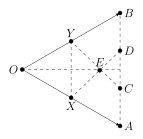
In the triangle \(OAB,\) \(\overrightarrow{OA}=\mathbf{a},\) \(\overrightarrow{OB}=\mathbf{b}\) and \(OA=OB=1\). Points \(C\) and \(D\) trisect \(AB\) (i.e. \(AC=CD=DB=\frac{1}{3}AB\)). \(X\) and \(Y\) lie on the line-segments \(OA\) and \(OB\) respectively, in such a way that \(CY\) and \(DX\) are perpendicular, and \(OX+OY=1\). Denoting \(OX\) by \(x\), obtain a condition relating \(x\) and \(\mathbf{a\cdot b}\), and prove that \[ \frac{8}{17}\leqslant\mathbf{a\cdot b}\leqslant1. \] If the angle \(AOB\) is as large as possible, determine the distance \(OE,\) where \(E\) is the point of intersection of \(CY\) and \(DX\).
Solution:
1989 Paper 1 Q10
A spaceship of mass \(M\) is travelling at constant speed \(V\) in a straight line when it enters a force field which applies a resistive force acting directly backwards and of magnitude \(M\omega(v^{2}+V^{2})/v\), where \(v\) is the instantaneous speed of the spaceship, and \(\omega\) is a positive constant. No other forces act on the spaceship. Find the distance travelled from the edge of the force field until the speed is reduced to \(\frac{1}{2}V\). As soon as the spaceship has travelled this distance within the force field, the field is altered to a constant resistive force, acting directly backwards, whose magnitude is within 10% of that of the force acting on the spaceship immediately before the change. If \(z\) is the extra distance travelled by the spaceship before coming instantaneously to rest, determine limits between which \(z\) must lie.
Solution: Using Newton's second law, we have: \begin{align*} && -M\omega(v^2+V^2)/v &= M v \frac{\d v}{\d x} \\ \Rightarrow && \frac{v^2}{v^2+V^2} \frac{\d v}{\d x} &= -\omega \\ \Rightarrow && \omega X &= \int_{V/2}^V \frac{v^2}{v^2+V^2} \d v \\ &&&= \int_{V/2}^V \l 1 - \frac{V^2}{v^2+V^2} \r \d v \\ &&&= \left [v - V\tan^{-1} \frac{v}{V} \right]_{V/2}^V \\ &&&= V \l \frac12 - \tan^{-1} 1 + \tan^{-1} \frac12 \r \\ \Rightarrow X &= \frac{V}{\omega} \l \tan^{-1} \frac12 + \frac12 - \frac{\pi}{4} \r \end{align*}. The resistive force just before the field changes is \(M \omega (\frac{V^2}{4} + V^2)/\frac{V}{2} = \frac52MV\omega\). Therefor the constant resistive force is between \(\frac{11}4MV\omega\) and \(\frac{9}{4}MV \omega\) and acceleration is \(\frac{11}{4}V\omega, \frac{9}{4}V\omega\). Since \(v^2 = u^2 + 2as \Rightarrow s = \frac{v^2-u^2}{2a} = \frac{\frac{V^2}{4}}{2kV\omega} = \frac{V}{8k\omega}\) therefore \(z \in \left [ \frac{V}{22\omega},\frac{V}{18 \omega} \right]\)
1989 Paper 1 Q11
A shot-putter projects a shot at an angle \(\theta\) above the horizontal, releasing it at height \(h\) above the level ground, with speed \(v\). Show that the distance \(R\) travelled horizontally by the shot from its point of release until it strikes the ground is given by \[ R=\frac{v^{2}}{2g}\sin2\theta\left(1+\sqrt{1+\frac{2hg}{v^{2}\sin^{2}\theta}}\right). \] The shot-putter's style is such that currently \(\theta=45^{\circ}\). Determine (with justification) whether a small decrease in \(\theta\) will increase \(R\). [Air resistance may be neglected.]
Solution: Notice that \(u_x = v \cos \theta, u_y = v \sin \theta\). We are interested in the time taken for the shot to hit the ground. \(-h = u_y t -\frac12 g t^2\) since our distance will be \(v \cos \theta \cdot t\). Solving this quadratic for \(t\) we obtain: \begin{align*} && 0 &= h + v \sin \theta \cdot t - \frac12 g \cdot t^2 \\ \Rightarrow && t_\pm &= \frac{-v \sin \theta \pm \sqrt{v^2 \sin^2 \theta+2hg}}{-g} \\ \Rightarrow && t_- &= \frac{v \sin \theta+v\sin \theta \sqrt{1 + \frac{2hg}{v^2 \sin^2 \theta}}}{g} \\ \Rightarrow && v \cos \theta t_{-} &= \frac{v^2}{g} \cos \theta \sin \theta \left( 1 + \sqrt{1 + \frac{2hg}{v^2 \sin^2 \theta}} \right) \\ &&&= \frac{v^2}{2g} \sin 2 \theta \left( 1 + \sqrt{1 + \frac{2hg}{v^2 \sin^2 \theta}} \right) \end{align*} Differentiating \(R\) wrt to \(\theta\) at \(\frac{\pi}{4}\) we obtain: \begin{align*} \frac{\d R}{\d \theta} &= \frac{v^2}{2g} \left (2 \cos 2 \theta + 2 \cos 2 \theta \sqrt{1 + \frac{2hg}{v^2 \sin^2 \theta}} + \sin 2\theta \left ( 1 + \frac{2hg}{v^2 \sin^2 \theta}\right)^{-\frac12} \frac12 \frac{2hg} {v^2}(-2) \frac{\cos \theta}{\sin^3 \theta}\right) \\ \frac{\d R}{\d \theta} \biggr \rvert_{\theta = \frac{\pi}{4}} &=\frac{v^2}{2g}\left(0+0- 4\left ( 1 + \frac{4hg}{v^2 }\right)^{-\frac12} \frac{hg} {v^2} \right) \\ &< 0 \end{align*} Therefore, since \(R\) is locally decreasing in \(\theta\) he should reduce his angle of projection slightly.
1989 Paper 2 Q4
The function \(\mathrm{f}\) is defined by \[ \mathrm{f}(x)=\frac{\left(x-a\right)\left(x-b\right)}{\left(x-c\right)\left(x-d\right)}\qquad\left(x\neq c,\ x\neq d\right), \] where \(a,b,c\) and \(d\) are real and distinct, and \(a+b\neq c+d\). Show that \[ \frac{x\mathrm{f}'(x)}{\mathrm{f}(x)}=\left(1-\frac{a}{x}\right)^{-1}+\left(1-\frac{b}{x}\right)^{-1}-\left(1-\frac{c}{x}\right)^{-1}-\left(1-\frac{d}{x}\right)^{-1}, \] \((x\neq0,x\neq a,x\neq b)\) and deduce that when \(\left|x\right|\) is much larger than each of \(\left|a\right|,\left|b\right|,\left|c\right|\) and \(\left|d\right|,\) the gradient of \(\mathrm{f}(x)\) has the same sign as \((a+b-c-d).\) It is given that there is a real value of real value of \(x\) for which \(\mathrm{f}(x)\) takes the real value \(z\) if and only if \[ [\left(c-d\right)^{2}z+\left(a-c\right)\left(b-d\right)+\left(a-d\right)\left(b-c\right)]^{2}\geqslant4\left(a-c\right)\left(b-d\right)\left(a-d\right)\left(b-c\right). \] Describe briefly a method by which this result could be proved, but do not attempt to prove it. Given that \(a < b\) and \(a < c < d\), make sketches of the graph of \(\mathrm{f}\) in the four distinct cases which arise, indicating the cases for which the range of \(\mathrm{f}\) is not the whole of \(\mathbb{R}.\)
Solution: Notice that \(\ln f(x) = \ln (x - a) + \ln (x-b) - \ln (x-c) - \ln (x-d)\) therefore: \begin{align*} \frac{\d}{\d x}: && \frac{f'(x)}{f(x)} &= (x-a)^{-1}+(x-b)^{-1}-(x-c)^{-1} - (x-d)^{-1} \\ &&&= \frac{1}{x} \left ( (1-\frac{a}{x})^{-1}+(1-\frac{b}{x})^{-1}-(1-\frac{c}{x})^{-1} - (1-\frac{d}{x})^{-1}\right) \end{align*} Multiplying by \(x\) gives the desired result. When \(|x|\) is very large then: \begin{align*} \frac{x f'(x)}{f(x)} &\approx 1 + \frac{a}{x} + o(\frac{1}{x^2})+ 1 + \frac{b}{x} + o(\frac{1}{x^2})-(1 + \frac{c}{x} + o(\frac{1}{x^2}))-(1 + \frac{d}{x} + o(\frac{1}{x^2})) \\ &= \frac{a+b-c-d}{x} + o(x^{-2}) \end{align*} Dividing by \(x\) we obtain \(\frac{f'(x)}{f(x)} \approx \frac{a+b-c-d}{x^2} + o(x^{-3})\) if \(|x|\) is sufficiently large this will be dominated by the \(\frac{a+b-c-d}{x^2}\) term which will have the same sign as \((a+b-c-d)\). When \(|x|\) is very large all of the brackets will have the same sign, and therefore \(f(x)\) will be positive, and so \(f'(x)\) must have the same sign as \(a+b-c-d\). To prove this result, we could set \(f(x) = k\) and rearrange to form a quadratic in \(x\). We could then check the discriminant is non-zero. Case 1: \(a < c < d < b\) and \(a+b > c+d \Rightarrow\) not all values reached and approx asymtope from below on the right and above on the left.


1989 Paper 2 Q12
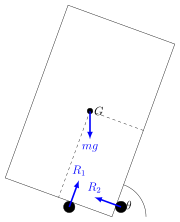
A uniform rectangular lamina of sides \(2a\) and \(2b\) rests in a vertical plane. It is supported in equilibrium by two smooth pegs fixed in the same horizontal plane, a distance \(d\) apart, so that one corner of the lamina is below the level of the pegs. Show that if the distance between this (lowest) corner and the peg upon which the side of length \(2a\) rests is less than \(a\), then the distance between this corner and the other peg is less than \(b\). Show also that \[ b\cos\theta-a\sin\theta=d\cos2\theta, \] where \(\theta\) is the acute angle which the sides of length \(2b\) make with the horizontal.
Solution:
1989 Paper 3 Q10
- Prove that \[ \sum_{r=1}^{n}r(r+1)(r+2)(r+3)(r+4)=\tfrac{1}{6}n(n+1)(n+2)(n+3)(n+4)(n+5) \] and deduce that \[ \sum_{r=1}^{n}r^{5}<\tfrac{1}{6}n(n+1)(n+2)(n+3)(n+4)(n+5). \]
- Prove that, if \(n>1,\) \[ \sum_{r=0}^{n-1}r^{5}>\tfrac{1}{6}(n-5)(n-4)(n-3)(n-2)(n-1)n. \]
- Let \(\mathrm{f}\) be an increasing function. If the limits \[ \lim_{n\rightarrow\infty}\sum_{r=0}^{n-1}\frac{a}{n}\mathrm{f}\left(\frac{ra}{n}\right)\qquad\mbox{ and }\qquad\lim_{n\rightarrow\infty}\sum_{r=1}^{n}\frac{a}{n}\mathrm{f}\left(\frac{ra}{n}\right) \] both exist and are equal, the definite integral \({\displaystyle \int_{0}^{a}\mathrm{f}(x)\,\mathrm{d}x}\) is defined to be their common value. Using this definition, prove that \[ \int_{0}^{a}x^{5}\,\mathrm{d}x=\tfrac{1}{6}a^6. \]
Solution:
- Claim: \[ \sum_{r=1}^{n}r(r+1)(r+2)(r+3)(r+4)=\tfrac{1}{6}n(n+1)(n+2)(n+3)(n+4)(n+5) \] Proof: (By Induction) Base case: (n=1) \begin{align*} LHS &= 1 \cdot 2 \cdot 3 \cdot 4 \cdot 5 = 5! \\ RHS &= \frac16 1 \cdot 2 \cdot 3 \cdot 4 \cdot 5 \cdot 6 = 5! \end{align*} Therefore the base case is true. Inductive step: Suppose our statement is true for some \(n=k\), then consider \(n = k+1\) \begin{align*} \sum_{r=1}^{k+1} r(r+1)(r+2)(r+3)(r+4) &= \sum_{r=1}^{k} r(r+1)(r+2)(r+3)(r+4) + (k+1)(k+2)(k+3)(k+4)(k+5) \\ &\underbrace{=}_{\text{assumption}} \frac16 k(k+1)(k+2)(k+3)(k+4)(k+5) + (k+1)(k+2)(k+3)(k+4)(k+5) \\ &= (k+1)(k+2)(k+3)(k+4)(k+5) \l \frac{k}{6} +1\r \\ &= \frac16 (k+1)(k+2)(k+3)(k+4)(k+5)(k+6) \end{align*} Therefore our statement is true for \(n = k+1\). Therefore since our statement is true for \(n=1\) and if it is true for \(n=k\) then it is true for \(n = k+1\) by the principle of mathematical induction it is true for all \(n \geq 1\) Since \begin{align*} \sum_{r=1}^{n}r^5 &< \sum_{r=1}^{n}r(r+1)(r+2)(r+3)(r+4) \\ &= \frac16 n(n+1)(n+2)(n+3)(n+4)(n+5) \end{align*}
- \begin{align*}\sum_{r=0}^{n-1} r^5 &> \sum_{r=0}^{n-1} (r-4)(r-3)(r-2)(r-1)r \\ &= \sum_{r=0}^{n-5} r(r+1)(r+2)(r+3)(r+4) \\ &= \frac16 (n-5)(n-4)(n-3)(n-2)(n-1)n \end{align*}
- Let \(f(x) = x^5\) \begin{align*} S_{1,n} &= \sum_{r=0}^{n-1}\frac{a}{n}f\left(\frac{ra}{n}\right) \\ &= \sum_{r=0}^{n-1}\frac{a}{n}\left(\frac{ra}{n}\right)^5 \\ &=\frac{a^6}{n^6} \sum_{r=0}^{n-1}r^5\\ \end{align*} Therefore \(\frac{a^6}6 \frac{(n-5)(n-4)(n-3)(n-2)(n-1)n}{n^6} < S_{1,n} < \frac{a^6}6 \frac{(n-1)n(n+1)(n+2)(n+3)(n+4)}{n^6}\) and so \(\lim_{n\to\infty} S_{1,n} = \frac{a^6}{6}\). Similarly, \begin{align*} S_{2,n} &= \sum_{r=1}^{n}\frac{a}{n}f\left(\frac{ra}{n}\right) \\ &= \sum_{r=1}^{n}\frac{a}{n}\left(\frac{ra}{n}\right)^5 \\ &= \frac{a^6}{n^6} \sum_{r=1}^{n} r^5 \end{align*} Therefore \(\frac{a^6}6 \frac{(n-4)(n-3)(n-2)(n-1)n(n+1)}{n^6} < S_{2,n} < \frac{a^6}6 \frac{n(n+1)(n+2)(n+3)(n+4)(n+5)}{n^6}\) and so \(\lim_{n\to\infty} S_{2,n} = \frac{a^6}{6}\). Since both limits exist are are equal, we have \[ \int_{0}^{a}x^{5}\,\mathrm{d}x=\tfrac{1}{6}a^6. \]
1988 Paper 1 Q3
Two points \(P\) and \(Q\) lie within, or on the boundary of, a square of side 1cm, one corner of which is the point \(O\). Show that the length of at least one of the lines \(OP,PQ\) and \(QO\) must be less than or equal to \((\sqrt{6}-\sqrt{2})\) cm.
Solution: First note that \((\sqrt{6} - \sqrt{2})^2 = 8 - 2\sqrt{12} = 8 - 4\sqrt{3}\) and since \(49 > 16 \times 3\) \(\sqrt{6}-\sqrt{2} > 1\). Therefore we can assume without loss of generality that \(P\) and \(Q\) both do not lie on the same side as each other, a side containing \(O\), otherwise one of those lengths would be \(1 \text{ cm} < (\sqrt{6}-\sqrt{2}) \text{ cm} \). Let \(O = (0,0)\), \(P = (1,x)\), \(Q = (y,1)\), then our lengths squared are: \(1 + x^2, 1 + y^2, (1-x)^2+(1-y)^2\). To maximise the length of the smallest side, each side should be equal in length (otherwise we could increase the length of the smallest side by moving the point between the shortest side and the longest side (without affecting the other side). Therefore \(x = y\) and \(1+x^2 = 2(1-x)^2 \Rightarrow x^2-4x+1 = 0 \Rightarrow x = 2 - \sqrt{3} \). Therefore the distances are all \(\sqrt{1+7-4\sqrt{3}} = \sqrt{8-4\sqrt{3}} = (\sqrt{6}-\sqrt{2}) \text{ cm}\)
1988 Paper 1 Q7
The function \(\mathrm{f}\) is defined by \[ \mathrm{f}(x)=ax^{2}+bx+c. \] Show that \[ \mathrm{f}'(x)=\mathrm{f}(1)\left(x+\tfrac{1}{2}\right)+\mathrm{f}(-1)\left(x-\tfrac{1}{2}\right)-2\mathrm{f}(0)x. \] If \(a,b\) and \(c\) are real and such that \(\left|\mathrm{f}(x)\right|\leqslant1\) for \(\left|x\right|\leqslant1\), show that \(\left|\mathrm{f}'(x)\right|\leqslant4\) for \(\left|x\right|\leqslant1\). Find particular values of \(a,b\) and \(c\) such that, for the corresponding function \(\mathrm{f}\) of the above form \(\left|\mathrm{f}(x)\right|\leqslant1\) for all \(x\) with \(\left|x\right|\leqslant1\) and \(\mathrm{f}'(x)=4\) for some \(x\) satisfying \(\left|x\right|\leqslant1\).
Solution: Let \(f(x) = ax^2 + bx + c\) then \begin{align*} f'(x) &= 2ax + b \\ f(0) &= c \\ f(1) &= a+b+c \\ f(-1) &= a-b+c \\ f(1)+f(-1) &= 2(a+c) \\ f(1)-f(-1) &= 2b \\ f'(x) &= x(f(1)+f(-1)) + \frac12 (f(1) - f(-1)) - 2f(0)x \end{align*} as required. Since \(f'(x)\) is a straight line, the maximum value is either at \(1, -1\) or it's constant and either end suffices. \begin{align*} |f'(1)| & \leq |f(1)|\frac{3}{2} + |f(-1)| \frac12 + 2 |f(0)| \\ &\leq \frac{3}{2} + \frac12 + 2 \\ &= 4 \\ \\ |f'(-1)| & \leq |f(1)|\frac{1}{2} + |f(-1)| \frac32 + 2 |f(0)| \\ &\leq \frac{3}{2} + \frac12 + 2 \\ &= 4 \\ \end{align*} Therefore \(|f'(x)| \leq 4\). Suppose \(|f'(x)| = 4\) for some value in \(x \in [-1,1]\), then it must be either \(-1\) or \(1\). If \(f'(1) = 4\) then \(f(1) = 1, f(-1) = 1, f(0) = -1\) so \(f(x) = 1+ k(x^2-1) \Rightarrow f(x) = 1+2(x^2-1) = 2x^2 -1\). If \(f'(-1) = 4\) then \(f(1) = -1, f(-1) = -1, f(0) = 1 \Rightarrow f(x) = -2x^2 + 1\)