Problems
Filters
233 problems found
1990 Paper 3 Q16
- A rod of unit length is cut into pieces of length \(X\) and \(1-X\); the latter is then cut in half. The random variable \(X\) is uniformly distributed over \([0,1].\) For some values of \(X\) a triangle can be formed from the three pieces of the rod. Show that the conditional probability that, if a triangle can be formed, it will be obtuse-angled is \(3-2\sqrt{2.}\)
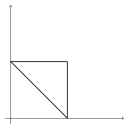
- The bivariate distribution of the random variables \(X\) and \(Y\) is uniform over the triangle with vertices \((1,0),(1,1)\) and \((0,1).\) A pair of values \(x,y\) is chosen at random from this distribution and a (perhaps degenerate) triangle \(ABC\) is constructed with \(BC=x\) and \(CA=y\) and \(AB=2-x-y.\) Show that the construction is always possible and that \(\angle ABC\) is obtuse if and only if \[ y>\frac{x^{2}-2x+2}{2-x}. \] Deduce that the probability that \(\angle ABC\) is obtuse is \(3-4\ln2.\)
Solution:
- The construction is possible if \(x + y > 2-x-y \Rightarrow x+y > 1\) (which is as the triangle is above the diagonal line), and \(x + (2-x-y) > y \Rightarrow 1 > y\) (true as the triangle is below the horizontal line) and \(y + (2-x-y) > x \Rightarrow 1 > x\) (true as the triangle is left of the vertical arrow). By the cosine rule: \begin{align*} && y^2 &= x^2 + (2-x-y)^2 - 2 x (2-x-y) \cos \angle ABC \\ \Rightarrow && \cos \angle ABC &= \frac{x^2+(2-x-y)^2 - y^2}{2x(2-x-y)} \\ &&&= \frac{4+2x^2-4x-4y+2xy}{2x(2-x-y)} \\ \underbrace{\Rightarrow}_{\cos \angle ABC < 0} && 0 &> 4+2x^2-4x-4y+2xy \\ \Rightarrow && 0 &> 2x^2-4x+4 - 2(x-2)y \\ \Rightarrow && y &> \frac{x^2-2x+2}{2-x} \\ &&&= -x + \frac{2}{2-x} \end{align*}
 Therefore the area we want is: \begin{align*} A &= 1 - \int_0^1 \left ( -x + \frac{2}{2-x} \right)\d x \\ &= 1 - \left [-\frac12 x^2 - 2 \ln(2-x) \right]_0^1 \\ &= 1 + \frac12 -2 \ln 2 \\ &= \frac32 - 2 \ln 2 \end{align*} Therefore the relative area is: \(\frac{\frac32 - 2 \ln 2}{1/2} = 3 - 4 \ln 2\)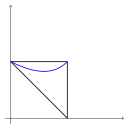
1989 Paper 1 Q1

Solution: \(AG = r\), therefore the area is: \begin{align*} A &= [AHG] - 2*[ABC] + [CDE] \\ &= \frac12 \pi r^2 - \pi h^2 + \frac12 \pi (r-2h)^2 \\ &= \frac12 \pi \l r^2 - 2h^2 + r^2 -4rh+4h^2 \r \\ &= \frac12 \pi \l 2r^2 -4rh + 2h^2\r \\ &= \pi (r-h)^2 \end{align*} This is the same area as a circle radius \(r-h\) But \(HD = r + (r-2d) = 2(r-d)\), ie the circle with diameter \(HD\) has radius \(r-h\) as required. Suppose \(A = (-h, 0), C = (h, 0), B = (0, h)\) then our parabola is \(y = \frac1{h}(h^2-x^2)\)

1989 Paper 1 Q2
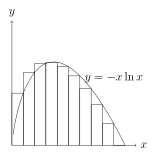
For \(x>0\) find \(\int x\ln x\,\mathrm{d}x\). By approximating the area corresponding to \(\int_{0}^{1}x\ln(1/x)\, \d x\) by \(n\) rectangles of equal width and with their top right-hand vertices on the curve \(y=x\ln(1/x)\), show that, as \(n\rightarrow\infty\), \[ \frac{1}{2}\left(1+\frac{1}{n}\right)\ln n-\frac{1}{n^{2}}\left[\ln\left(\frac{n!}{0!}\right)+\ln\left(\frac{n!}{1!}\right)+\ln\left(\frac{n!}{2!}\right)+\cdots+\ln\left(\frac{n!}{(n-1)!}\right)\right]\rightarrow\frac{1}{4}. \] {[}You may assume that \(x\ln x\rightarrow0\) as \(x\rightarrow0\).{]}
Solution: Integrating by parts we obtain: \begin{align*} \int x \ln x \, \d x &= [\frac12 x^2 \ln x] - \int \frac12x^2 \cdot \frac1x \d x \\ &= \frac12 x^2 \ln x - \frac14 x^2 + C \end{align*}
1989 Paper 2 Q6
The function \(\mathrm{f}\) satisfies the condition \(\mathrm{f}'(x)>0\) for \(a\leqslant x\leqslant b\), and \(\mathrm{g}\) is the inverse of \(\mathrm{f}.\) By making a suitable change of variable, prove that \[ \int_{a}^{b}\mathrm{f}(x)\,\mathrm{d}x=b\beta-a\alpha-\int_{\alpha}^{\beta}\mathrm{g}(y)\,\mathrm{d}y, \] where \(\alpha=\mathrm{f}(a)\) and \(\beta=\mathrm{f}(b)\). Interpret this formula geometrically, in the case where \(\alpha\) and \(a\) are both positive. Prove similarly and interpret (for \(\alpha>0\) and \(a>0\)) the formula \[ 2\pi\int_{a}^{b}x\mathrm{f}(x)\,\mathrm{d}x=\pi(b^{2}\beta-a^{2}\alpha)-\pi\int_{\alpha}^{\beta}\left[\mathrm{g}(y)\right]^{2}\,\mathrm{d}y. \]
Solution: Let \(u = f(x)\) then \(\frac{\d u}{\d x} = f'(x)\) and \begin{align*} \int_a^b f(x) \d x &\underbrace{=}_{\text{IBP}} \left [ xf(x) \right]_a^b - \int_a^b x f'(x) \d x \\ &\underbrace{=}_{u = f(x)} b \beta - a \alpha - \int_{u = f(a) = \alpha}^{u = f(b) = \beta} g(u) \d u \\ &= b \beta - a \alpha - \int_{\alpha}^{\beta} g(u) \d u \end{align*}

1989 Paper 2 Q15
Two points are chosen independently at random on the perimeter (including the diameter) of a semicircle of unit radius. What is the probability that exactly one of them lies on the diameter? Let the area of the triangle formed by the two points and the midpoint of the diameter be denoted by the random variable \(A\).
- Given that exactly one point lies on the diameter, show that the expected value of \(A\) is \(\left(2\pi\right)^{-1}\).
- Given that neither point lies on the diameter, show that the expected value of \(A\) is \(\pi^{-1}\). [You may assume that if two points are chosen at random on a line of length \(\pi\) units, the probability density function for the distance \(X\) between the two points is \(2\left(\pi-x\right)/\pi^{2}\) for \(0\leqslant x\leqslant\pi.\)]
Solution:
- \begin{align*} \mathbb{E}(A \mid \text{exactly one point on diameter}) &= \int_{-1}^1\int_0^\pi \frac12 (x-0)\cdot 1 \cdot \sin(\pi - \theta) \frac{1}{\pi} \d \theta \frac{1}{2} \d x \\ &= \int_{-1}^1\frac1{2\pi} x \d x \cdot \left [ -\cos \theta \right]_0^\pi \\ &= \frac{1}{2\pi} \end{align*}

- \begin{align*} \mathbb{E}(A \mid \text{no point on diameter}) &= \int_0^{\pi} \frac12 \cdot 1 \cdot 1 \cdot \sin x \cdot 2(\pi - x)/\pi^2 \d x \\ &= \frac1{\pi^2} \int_0^\pi \sin x (\pi - x) \d x \\ &= \frac1{\pi^2} \int_0^\pi x\sin x \d x \\ &= \frac1{\pi^2} \left [ \sin x - x \cos x \right]_0^{\pi} \\ &= \frac{1}{\pi} \end{align*}

1989 Paper 3 Q15
The continuous random variable \(X\) is uniformly distributed over the interval \([-c,c].\) Write down expressions for the probabilities that:
- \(n\) independently selected values of \(X\) are all greater than \(k\),
- \(n\) independently selected values of \(X\) are all less than \(k\),
Solution:
- \begin{align*} \mathbb{P}(n\text{ independent values of }X > k) &= \prod_{i=1}^n \mathbb{P}(X > k) \\ &= \left ( \frac{c-k}{2c}\right)^n \end{align*}
- \begin{align*} \mathbb{P}(n\text{ independent values of }X < k) &= \prod_{i=1}^n \mathbb{P}(X < k) \\ &= \left ( \frac{k+c}{2c}\right)^n \end{align*}
1988 Paper 1 Q9
Find the following integrals:
- \(\ {\displaystyle \int_{1}^{\mathrm{e}}\frac{\ln x}{x^{2}}\,\mathrm{d}x}\,,\)
- \(\ {\displaystyle \int\frac{\cos x}{\sin x\sqrt{1+\sin x}}\,\mathrm{d}x.}\)
Solution:
- \begin{align*} \int_{1}^{\mathrm{e}}\frac{\ln x}{x^{2}}\,\mathrm{d}x &= \left [-\frac{\ln x}{x} \right]_1^e + \int_1^e \frac{1}{x^2} \, \d x \\ &= -\frac{1}{e} + \left [ -\frac{1}{x} \right]_1^e \\ &= 1 - \frac{2}{e} \end{align*}
- \begin{align*} \int\frac{\cos x}{\sin x\sqrt{1+\sin x}}\,\mathrm{d}x &= \int \frac{2u}{(u^2-1)u} \d u \tag{\(u^2 = 1+\sin x\)} \\ &= \int \frac{1}{u-1} - \frac{1}{u+1} \d u \\ &= \ln(u-1) - \ln (u+1) + C \\ &= \ln \l \frac{u-1}{u+1} \r + C \\ &= \ln \l \frac{\sqrt{\sin x + 1} + 1}{\sqrt{\sin x + 1} -1} \r + C \end{align*}
1988 Paper 1 Q16
Wondergoo is applied to all new cars. It protects them completely against rust for three years, but thereafter the probability density of the time of onset of rust is proportional to \(t^{2}/(1+t^{2})^{2}\) for a car of age \(3+t\) years \((t\geqslant0)\). Find the probability that a car becomes rusty before it is \(3+t\) years old. Every car is tested for rust annually on the anniversary of its manufacture. If a car is not rusty, it will certainly pass; if it is rusty, it will pass with probability \(\frac{1}{2}.\) Cars which do not pass are immediately taken off the road and destroyed. What is the probability that a randomly selected new car subsequently fails a test taken on the fifth anniversary of its manufacture? Find also the probability that a car which was destroyed immediately after its fifth anniversary test was rusty when it passed its fourth anniversary test.
Solution: Given the probability density after \(3\) years is proportional to \(\frac{t^2}{(1+t^2)^2}\) then we must have that: \begin{align*} && 1 &= A \int_0^{\infty} \frac{t^2}{(1+t^2)^2} \, \d t \\ &&&= A \left [ -\frac12 \frac{t}{1+t^2} \right]_0^{\infty} + \frac{A}2 \int_0^{\infty} \frac{1}{1+t^2} \d t \\ &&&= \frac{A}{2} \frac{\pi}{2} \\ \Rightarrow && A &= \frac{4}{\pi} \end{align*} In order to fail a test on the fifth anniversary, there are two possibilities for when we went faulty. We could have gone faulty before \(4\) years, got lucky once and then failed the second test, or gone faulty in the next year and then failed the first test. \begin{align*} \P(\text{rusty before } 4 \text{ years}) &=\frac{4}{\pi} \int_0^1 \frac{t^2}{(1+t^2)^2} \d t \\ &= \frac{4}{\pi} \left [ -\frac12 \frac{t}{1+t^2} \right]_0^{1} + \frac{2}{\pi} \int_0^{1} \frac{1}{1+t^2} \d t \\ &= -\frac{1}{\pi} + \frac{2}{\pi} \frac{\pi}{4} \\ &= \frac12 - \frac{1}{\pi} \\ &\approx 0.181690\cdots \\ \\ \P(\text{rusty before } 5 \text{ years}) &=\frac{4}{\pi} \int_0^1 \frac{t^2}{(1+t^2)^2} \d t \\ &= \frac{4}{\pi} \left [ -\frac12 \frac{t}{1+t^2} \right]_0^{2} + \frac{2}{\pi} \int_0^{2} \frac{1}{1+t^2} \d t \\ &= -\frac{4}{5\pi} + \frac{2}{\pi} \tan^{-1} 2 \\ &\approx 0.450184\cdots \\ \end{align*} Therefore: \begin{align*} \P(\text{fails 5th anniversary}) &= \P(\text{rusty before } 4 \text{ years}) \P(\text{pass one, fail other}) + \\ & \quad \quad + \P(\text{rusty between 4 and 5 years}) \P(\text{fail}) \\ &= 0.181690\cdots \cdot \frac{1}{4} + \frac{1}{2} ( 0.450184\cdots- 0.181690\cdots) \\ &= \frac{1}{2} 0.450184\cdots - \frac{1}{4} 0.181690\cdots \\ &= 0.1796688\cdots \\ &= 18.0\%\,\, (3\text{ s.f.}) \end{align*} We also must have that: \begin{align*} \P(\text{rusty at 4 years}|\text{destroyed at 5}) &= \frac{\P(\text{rusty at 4 years and destroyed at 5})}{\P(\text{destroyed at 5})} \\ &= \frac{0.181690\cdots \cdot \frac{1}{4}}{\frac{1}{2} 0.450184\cdots - \frac{1}{4} 0.181690\cdots} \\ &= 0.252811\cdots \\ &= 25.3\%\,\,(3\text{ s.f.}) \end{align*}
1988 Paper 2 Q7
The integral \(I\) is defined by \[ I=\int_{1}^{2}\frac{(2-2x+x^{2})^{k}}{x^{k+1}}\,\mathrm{d}x \] where \(k\) is a constant. Show that \[ I=\int_{0}^{1}\frac{(1+x^{2})^{k}}{(1+x)^{k+1}}\,\mathrm{d}x=\int_{0}^{\frac{1}{4}\pi}\frac{\mathrm{d}\theta}{\left[\sqrt{2}\cos\theta\cos\left(\frac{1}{4}\pi-\theta\right)\right]^{k+1}}=2\int_{0}^{\frac{1}{8}\pi}\frac{\mathrm{d}\theta}{\left[\sqrt{2}\cos\theta\cos\left(\frac{1}{4}\pi-\theta\right)\right]^{k+1}}. \] Hence show that \[ I=2\int_{0}^{\sqrt{2}-1}\frac{(1+x^{2})^{k}}{(1+x)^{k+1}}\,\mathrm{d}x \] Deduce that \[ \int_{1}^{\sqrt{2}}\left(\frac{2-2x^{2}+x^{4}}{x^{2}}\right)^{k}\frac{1}{x}\,\mathrm{d}x=\int_{1}^{\sqrt{2}}\left(\frac{2-2x+x^{2}}{x}\right)^{k}\frac{1}{x}\,\mathrm{d}x \]
Solution: \begin{align*} I &=\int_{1}^{2}\frac{(2-2x+x^{2})^{k}}{x^{k+1}}\,\mathrm{d}x \\ u = x-1 &, \quad \d u = \d x \\ &= \int_{u = 0}^{u=1} \frac{(u^2+1)^k}{(u+1)^{k+1}} \d u \\ &= \boxed{\int_0^1 \frac{(1+x^2)^k}{(1+x)^{k+1}} \d x} \\ x = \tan \theta &, \quad \d x = \sec^2 \theta \d \theta \\ &= \int_{\theta = 0}^{\theta = \pi/4} \frac{\sec^{2k+2} \theta }{(1 + \tan \theta)^{k+1}} \d \theta \\ &= \int_0^{\pi/4} \frac{\d \theta}{\cos^{2k+2} \theta (\frac{\sin \theta + \cos \theta}{\cos \theta})^{k+1}} \\ &= \int_0^{\pi/4} \frac{\d \theta}{\cos^{k+1} \theta ({\sin \theta + \cos \theta})^{k+1}} \\ &= \int_0^{\pi/4} \frac{\d \theta}{\cos^{k+1} \theta (\sqrt{2} \cos (\frac{\pi}{4} - \theta))^{k+1}} \\ I &= \boxed{ \int_0^{\pi/4} \frac{\d \theta}{(\sqrt{2}\cos \theta \cos (\frac{\pi}{4} - \theta))^{k+1}}} \\ \end{align*} Since \(f(\theta) = \cos \theta \cos (\frac{\pi}{4} - \theta)\) is symmetric about \(\frac{\pi}{8}\) this integral is twice the integral to \(\frac{\pi}{8}\). \(\tan 2 \theta = \frac{2\tan \theta}{1 - \tan^2 \theta} \Rightarrow 1 = \frac{2 \tan \frac{\pi}{8}}{1 - \tan^2 \frac{\pi}{8}} \Rightarrow \tan \frac{\pi}{8} = \sqrt{2}-1\). Therefore, using the same substitution we must have: \[ I=2\int_{0}^{\sqrt{2}-1}\frac{(1+x^{2})^{k}}{(1+x)^{k+1}}\,\mathrm{d}x \] Let \(u = x^2\), then \(\d u = 2 x\d x\) \begin{align*} \int_{1}^{\sqrt{2}}\left(\frac{2-2x^{2}+x^{4}}{x^{2}}\right)^{k}\frac{1}{x}\,\mathrm{d}x &= \int_{u = 1}^{u = 2} \l \frac{2-2u+u^2}{u}\r^k \frac{1}{2u} \d u \\ &= \frac12 I \\ &= \int_{0}^{\sqrt{2}-1}\frac{(1+x^{2})^{k}}{(1+x)^{k+1}}\,\mathrm{d}x \\ u = 1+x & \quad \d u = \d x \\ &= \int_1^{\sqrt{2}} \frac{(1+(u-1)^2)^k}{u^{k+1}} \d u \\ &= \int_{1}^{\sqrt{2}}\left(\frac{2-2u+u^{2}}{u}\right)^{k}\frac{1}{u}\,\mathrm{d}x \\ &= \int_{1}^{\sqrt{2}}\left(\frac{2-2x+x^{2}}{x}\right)^{k}\frac{1}{x}\,\mathrm{d}x \end{align*}
1988 Paper 2 Q11
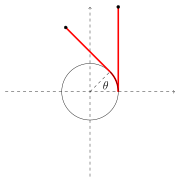
A heavy particle lies on a smooth horizontal table, and is attached to one end of a light inextensible string of length \(L\). The other end of the string is attached to a point \(P\) on the circumference of the base of a vertical post which is fixed into the table. The base of the post is a circle of radius \(a\) with its centre at a point \(O\) on the table. Initially, at time \(t=0\), the string is taut and perpendicular to the line \(OP.\) The particle is then struck in such a way that the string starts winding round the post and remains taut. At a later time \(t\), a length \(a\theta(t)\ (< L)\) of the string is in contact with the post. Using cartesian axes with origin \(O\), find the position and velocity vectors of the particle at time \(t\) in terms of \(a,L,\theta\) and \(\dot{\theta},\) and hence show that the speed of the particle is \((L-a\theta)\dot{\theta}.\) If the initial speed of the particle is \(v\), show that the particle hits the post at a time \(L^{2}/(2av).\)
Solution:
1988 Paper 3 Q1
Sketch the graph of \[ y=\frac{x^{2}\mathrm{e}^{-x}}{1+x}, \] for \(-\infty< x< \infty.\) Show that the value of \[ \int_{0}^{\infty}\frac{x^{2}\mathrm{e}^{-x}}{1+x}\,\mathrm{d}x \] lies between \(0\) and \(1\).
Solution:

1988 Paper 3 Q7
For \(n=0,1,2,\ldots,\) the functions \(y_{n}\) satisfy the differential equation \[ \frac{\mathrm{d}^{2}y_{n}}{\mathrm{d}x^{2}}-\omega^{2}x^{2}y_{n}=-(2n+1)\omega y_{n}, \] where \(\omega\) is a positive constant, and \(y_{n}\rightarrow0\) and \(\mathrm{d}y_{n}/\mathrm{d}x\rightarrow0\) as \(x\rightarrow+\infty\) and as \(x\rightarrow-\infty.\) Verify that these conditions are satisfied, for \(n=0\) and \(n=1,\) by \[ y_{0}(x)=\mathrm{e}^{-\lambda x^{2}}\qquad\mbox{ and }\qquad y_{1}(x)=x\mathrm{e}^{-\lambda x^{2}} \] for some constant \(\lambda,\) to be determined. Show that \[ \frac{\mathrm{d}}{\mathrm{d}x}\left(y_{m}\frac{\mathrm{d}y_{n}}{\mathrm{d}x}-y_{n}\frac{\mathrm{d}y_{m}}{\mathrm{d}x}\right)=2(m-n)\omega y_{m}y_{n}, \] and deduce that, if \(m\neq n,\) \[ \int_{-\infty}^{\infty}y_{m}(x)y_{n}(x)\,\mathrm{d}x=0. \]
Solution: \begin{align*} && y_0(x) &= e^{-\lambda x^2} \\ && \lim_{x \to \pm \infty} y_0(x) &= 0 \Leftrightarrow \lambda > 0 \\ && \lim_{x \to \pm \infty} y'_0(x) &= \lim_{x \to \pm \infty} 2x\lambda e^{-\lambda x^2} \\ &&&= 0\Leftrightarrow \lambda > 0 \\ && y''_0(x) &= 4x^2 \lambda^2 e^{-\lambda x^2} + 2\lambda e^{-\lambda x^2} \\ \\ && y''_0 - \omega^2 x^2 y_0+(2\cdot 0 + 1) \omega y_0 &= e^{-\lambda x^2} \l 4x^2 \lambda^2 + 2 \lambda - \omega^2 x^2 + \omega\r \\ &&&=0 \Leftrightarrow \lambda = \pm \frac{\omega}{2} \end{align*} Therefore \(y_0\) satisfies if \(\lambda = \frac{\omega}{2}\) Similarly for \(y_1\), \begin{align*} && y_1(x) &= xe^{-\lambda x^2} \\ && \lim_{x \to \pm \infty} y_1(x) &= 0 \Leftrightarrow \lambda > 0 \\ && \lim_{x \to \pm \infty} y'_1(x) &= \lim_{x \to \pm \infty} \l -2x^2 \lambda e^{-\lambda x^2} + e^{-\lambda x^2} \r \\ &&&= 0\Leftrightarrow \lambda > 0 \\ && y''_0(x) &= e^{-\lambda x^2} \l 4x^3 \lambda^2-4x\lambda - 2x\lambda \r \\ &&&= e^{-\lambda x^2} \l 4x^3 \lambda^2-6x\lambda \r \\ && y''_1 - \omega^2 x^2 y_1+(2\cdot 1 + 1) \omega y_1 &= e^{-\lambda x^2} \l 4x^3\lambda^2-6x\lambda-\omega^2x^3+3\omega x\r \\ &&&=0 \Leftrightarrow \lambda = \pm \frac{\omega}{2} \end{align*} Therefore \(y_1\) satisfies if \(\lambda = \frac{\omega}{2}\) \begin{align*} \frac{\mathrm{d}}{\mathrm{d}x}\left(y_{m}\frac{\mathrm{d}y_{n}}{\mathrm{d}x}-y_{n}\frac{\mathrm{d}y_{m}}{\mathrm{d}x}\right) &= y'_my'_n+y_my''_n - y'_ny'_m-y_ny''_m \\ &= y_my''_n - y_ny''_m \\ &= y_m(\omega^2 x^2 y_n - (2n+1)\omega y_n) - y_n(\omega^2 x^2 y_m - (2m+1)\omega y_m) \\ &= y_my_n (2m-2n)\omega \\ &= 2(m-n) \omega y_my_n \end{align*} Therefore: \begin{align*} \int_{-\infty}^{\infty} y_m(x)y_n(x) \d x &= \int_{-\infty}^{\infty} \frac{1}{2(m-n)} \frac{\mathrm{d}}{\mathrm{d}x}\left(y_{m}\frac{\mathrm{d}y_{n}}{\mathrm{d}x}-y_{n}\frac{\mathrm{d}y_{m}}{\mathrm{d}x}\right) \d x \\ &= \frac{1}{2(m-n)} \left [ y_{m}\frac{\mathrm{d}y_{n}}{\mathrm{d}x}-y_{n}\frac{\mathrm{d}y_{m}}{\mathrm{d}x}\right]_{-\infty}^{\infty} \\ &\to 0 \end{align*} This condition is known as Orthogonality. In fact this question is talking about a Sturm-Liouville orthogonality condition, in particular for the quantum harmonic oscillator, and the eigenfunctions are related to Hermite polynomials.
1987 Paper 1 Q5
Using the substitution \(x=\alpha\cos^{2}\theta+\beta\sin^{2}\theta,\) show that, if \(\alpha<\beta\), \[ \int_{\alpha}^{\beta}\frac{1}{\sqrt{(x-\alpha)(\beta-x)}}\,\mathrm{d}x=\pi. \] What is the value of the above integral if \(\alpha>\beta\)? Show also that, if \(0<\alpha<\beta\), \[ \int_{\alpha}^{\beta}\frac{1}{x\sqrt{(x-\alpha)(\beta-x)}}\,\mathrm{d}x=\frac{\pi}{\sqrt{\alpha\beta}}. \]
Solution: Using the suggested substitution, we can find. \begin{align*} && x &=\alpha\cos^{2}\theta+\beta\sin^{2}\theta \\ && x-\alpha &=\alpha(\cos^{2}\theta-1)+\beta\sin^{2}\theta \\ &&& = (\beta - \alpha) \sin^2 \theta \\ && \beta - x &= -\alpha\cos^{2}\theta+\beta(1-\sin^{2}\theta) \\ &&&= (\beta-\alpha)\cos^2 \theta \\ && x &=\alpha\cos^{2}\theta+\beta\sin^{2}\theta \\ \Rightarrow && \frac{dx}{d\theta} &= (\beta - \alpha) 2 \cos \theta \sin\theta \\ \\ &&\int_{\alpha}^{\beta}\frac{1}{\sqrt{(x-\alpha)(\beta-x)}}\,\mathrm{d}x &= \int_0^{\pi/2} \frac{1}{(\beta - \alpha)\sin\theta \cos \theta} (\beta - \alpha) 2 \cos \theta \sin \theta \, d \theta \\ &&&= \int_0^{\pi/2} \frac{1}{\bcancel{(\beta - \alpha)}\bcancel{\sin\theta \cos \theta}} \bcancel{(\beta - \alpha)} 2 \bcancel{\cos \theta \sin \theta} \, d \theta \\ &&&= \int_0^{\pi/2} 2 d \theta \\ && &= 2 \frac{\pi}{2} = \boxed{\pi} \end{align*} If \(\alpha > \beta\) we can rewrite the integral as: \begin{align*} \int_{\alpha}^{\beta}\frac{1}{\sqrt{(x-\alpha)(\beta-x)}}\,\mathrm{d}x &= \int_{\alpha}^{\beta}\frac{1}{\sqrt{(x-\beta)(\alpha-x)}}\,\mathrm{d}x \\ &= -\int_{\beta}^{\alpha}\frac{1}{\sqrt{(x-\beta)(\alpha-x)}}\,\mathrm{d}x \\ &= -\pi \end{align*} Where the last step we are directly using the first integral with the use of \(\alpha\) and \(\beta\) reversed. Finally, using the substitution \(xt = 1\), we fortunately lose the \(\frac1{x}\) term: \begin{align*} && x &= \frac{1}{t} \\ && \frac{dx}{dt} &= -\frac1{t^2} \\ \\ && \int_{\alpha}^{\beta}\frac{1}{x\sqrt{(x-\alpha)(\beta-x)}}\,\mathrm{d}x &= \int_{\alpha}^{\beta}\frac{t}{\sqrt{(\frac{1}{t}-\alpha)(\beta-\frac{1}{t})}} \frac{-1}{t^2}\,\mathrm{d}t \\ && &= \int_{\frac1{\alpha}}^{\frac1\beta}\frac{-1}{\sqrt{(1-t\alpha)(t\beta-1)}}\,\mathrm{d}t \\ && &= \int_{\frac1{\alpha}}^{\frac1\beta}\frac{-1}{\sqrt{\alpha\beta}\sqrt{(\frac1{\alpha}-t)(t-\frac1{\beta})}}\,\mathrm{d}t \\ && &= \frac1{\sqrt{\alpha\beta}}\int_{\frac1{\alpha}}^{\frac1\beta}\frac{-1}{\sqrt{(\frac1{\alpha}-t)(t-\frac1{\beta})}}\,\mathrm{d}t \\ &&&= \boxed{\frac{\pi}{\sqrt{\alpha\beta}}} \end{align*} Where again the last step we are using the intermediate integral, with the roles of \(\alpha\) and \(\beta\) replaced with \(\frac{1}{\beta}\) and \(\frac1{\alpha}\)
1987 Paper 1 Q6
Let \(y=\mathrm{f}(x)\), \((0\leqslant x\leqslant a)\), be a continuous curve lying in the first quadrant and passing through the origin. Suppose that, for each non-negative value of \(y\) with \(0\leqslant y\leqslant\mathrm{f}(a)\), there is exactly one value of \(x\) such that \(\mathrm{f}(x)=y\); thus we may write \(x=\mathrm{g}(y)\), for a suitable function \(\mathrm{g}.\) For \(0\leqslant s\leqslant a,\) \(0\leqslant t\leqslant \mathrm{f}(a)\), define \[ \mathrm{F}(s)=\int_{0}^{s}\mathrm{f}(x)\,\mathrm{d}x,\qquad\mathrm{G}(t)=\int_{0}^{t}\mathrm{g}(y)\,\mathrm{d}y. \] By a geometrical argument, show that \[ \mathrm{F}(s)+\mathrm{G}(t)\geqslant st.\tag{*} \] When does equality occur in \((*)\)? Suppose that \(y=\sin x\) and that the ranges of \(x,y,s,t\) are restricted to \(0\leqslant x\leqslant s\leqslant\frac{1}{2}\pi,\) \(0\leqslant y\leqslant t\leqslant1\). By considering \(s\) such that the equality holds in \((*)\), show that \[ \int_{0}^{t}\sin^{-1}y\,\mathrm{d}y=t\sin^{-1}t-\left(1-\cos(\sin^{-1}t)\right). \] Check this result by differentiating both sides with respect to \(t\).
Solution:

1987 Paper 1 Q8
Explain why the use of the substitution \(x=\dfrac{1}{t}\) does not demonstrate that the integrals \[ \int_{-1}^{1}\frac{1}{(1+x^{2})^{2}}\,\mathrm{d}x\quad\mbox{ and }\quad\int_{-1}^{1}\frac{-t^{2}}{(1+t^{2})^{2}}\,\mathrm{d}t \] are equal. Evaluate both integrals correctly.
Solution: When we apply the substitution \(x = \frac1{t}\), \(t\) runs from \(-1 \to -\infty\) as \(x\) goes from \(-1 \to 0\). Then it runs from \(\infty \to 1\) as \(x\) runs from \(0 \to 1\). So we would be able to show that: \[ \int_{-1}^{1}\frac{1}{(1+x^{2})^{2}}\,\mathrm{d}x = \int_{-1}^{-\infty}\frac{-t^{2}}{(1+t^{2})^{2}}\,\mathrm{d}t + \int_{\infty}^1 \frac{-t^{2}}{(1+t^{2})^{2}}\,\mathrm{d}t \] Let \(x = \tan u, \d x = \sec^2 u \d u\) \begin{align*} \int_{-1}^1 \frac1{(1+x^2)^2} \d x &= \int_{u = -\pi/4}^{u = \pi/4} \frac{\sec^2 u}{(1+\tan^2 u)^2} \d u \\ &= \int_{u = -\pi/4}^{u = \pi/4} \frac{1}{\sec^2 u} \d u \\ &= \int_{-\pi/4}^{\pi/4} \cos^2 u \d u \\ &= \int_{-\pi/4}^{\pi/4} \frac{1 + \cos 2 u}{2} \d u \\ &= \left [ \frac{2u + \sin 2u}{4} \right]_{-\pi/4}^{\pi/4} \\ &= \frac{\pi}{4} + \frac{1}{2} \end{align*} Let \(t = \tan u, \d t = \sec^2 u \d u\) \begin{align*} \int_{-1}^1 \frac{-t^2}{(1+t^2)^2} \d x &= \int_{u = -\pi/4}^{u = \pi/4} \frac{-\tan^2 u \sec^2 u}{(1+\tan^2 u)^2} \d u \\ &= -\int_{u = -\pi/4}^{u = \pi/4} \frac{\tan^2 u}{\sec^2 u} \d u \\ &= -\int_{-\pi/4}^{\pi/4} \sin^2 u \d u \\ &= -\int_{-\pi/4}^{\pi/4} \frac{1 - \cos 2 u}{2} \d u \\ &= -\left [ \frac{2u - \sin 2u}{4} \right]_{-\pi/4}^{\pi/4} \\ &= \frac{1}{2}-\frac{\pi}{4} \end{align*}