Problems
Filters
298 problems found
1999 Paper 2 Q2
Consider the quadratic equation $$ nx^2+2x \sqrt{pn^2+q} + rn + s = 0, \tag{*} $$ where \(p>0\), \(p\neq r\) and \(n=1\), \(2\), \(3\), \(\ldots\) .
- For the case where \(p=3\), \(q=50\), \(r=2\), \(s=15\), find the set of values of \(n\) for which equation \((*)\) has no real roots.
- Prove that if \(p < r\) and \(4q(p-r) > s^2\), then \((*)\) has no real roots for any value of \(n\).
- If \(n=1\), \(p-r=1\) and \(q={s^2}/8\), show that \((*)\) has real roots if, and only if, \(s \le 4-2\sqrt{2}\ \) or \(\ s \ge 4+2\sqrt{2}\).
Solution:
- \(\,\) \begin{align*} && 0 &= nx^2 + 2\sqrt{3n^2+50}x + 2n + 15 \\ && 0 &> \Delta = 4(3n^2+5) - 4\cdot n \cdot (2n + 15) \\ \Leftrightarrow && 0 &> n^2-15n+5\\ \text{cv}: && n &= \frac{15 \pm \sqrt{225 - 20}}{2} \\ &&&\approx \frac{15\pm14.x}{2}\\ \Leftrightarrow &&n &\in \{1, 2, \cdots, 14\} \end{align*}
- \(\,\) \begin{align*} && 0 &> \Delta = 4(pn^2+q) - 4\cdot n \cdot (rn+s) \\ \Leftrightarrow && 0&>(p-r)n^2-sn+q \end{align*} Which is always true if \(r > p\) and \(s^2 < 4q(p-r)\)
- \(\,\) \begin{align*} && 0 &= x^2 + 2\sqrt{p+q}x+ r+s \\ && 0 &\leq \Delta = 4(p+q) - 4(r+s) \\ && 0 &\leq 1 + s^2/8 - s \\ \text{c.v}: && s &= \frac{1 \pm \sqrt{1-4 \cdot \frac{1}{8}}}{2\cdot\frac18} \\ &&&= 4 \pm 4\sqrt{\frac12} \\ &&&= 4 \pm 2\sqrt{2} \\ \Rightarrow && s \leq 4 - 2\sqrt{2} &\text{ or } s \geq 4 + 2\sqrt{2} \end{align*}
1999 Paper 2 Q3
Let $$ {\rm S}_n(x)=\mathrm{e}^{x^3}{{\d^n}\over{\d x^n}}{(\mathrm{e}^{-x^3})}.$$ Show that \({\rm S}_2(x)=9x^4-6x\) and find \({\rm S}_3(x)\). Prove by induction on \(n\) that \({\rm S}_n(x)\) is a polynomial. By means of your induction argument, determine the order of this polynomial and the coefficient of the highest power of \(x\). Show also that if \(\displaystyle \frac{\d S_n}{\d x}=0\) for some value \(a\) of \(x\), then \(S_n(a)S_{n+1}(a)\le0\).
Solution: \begin{align*} && S_2(x) &= e^{x^3} \frac{d^2}{\d x^2} \left [e^{-x^3} \right] \\ &&&= e^{x^3} \frac{d}{\d x} \left [e^{-x^3}(-3x^2) \right] \\ &&&= e^{x^3} \left [e^{-x^3}(9x^4-6x) \right] \\ &&&=9x^4-6x \\ \\ && S_3(x) &= e^{x^3} \frac{\d^3}{\d x^3} \left [ e^{-x^3} \right]\\ &&&= e^{x^3} \frac{\d}{\d x} \left [ e^{-x^3}(9x^4-6x) \right ] \\ &&&= e^{x^3} e^{-x^3}\left [ (-3x^2)(9x^4-6x)+(36x^3-6) \right ] \\ &&&= -27x^6 +54x^3-6 \end{align*} Claim: \(S_n\) is a polynomial of degree \(2n\) with leading coefficient \((-3)^n\). Proof: Clearly this is true for \(n = 1, 2, 3\) by demonstration. Suppose it is true for some \(n = k\), then \begin{align*} && S_k(x) &= e^{x^2} \frac{\d^k}{\d x^k} \left [ e^{x^3}\right] \\ && (-3)^kx^{2k} +\cdots &= e^{x^3} \frac{\d^k}{\d x^k} \left [ e^{x^3}\right] \\ \Rightarrow && \frac{\d^k}{\d x^k} \left [ e^{x^3}\right] &= e^{-x^3} \left ( (-3)^kx^{2k} +\cdots\right) \\ \Rightarrow && \frac{\d^k}{\d x^k}\left [ e^{x^3}\right] &= e^{-x^3} (-3x^2)\left ( (-3)^kx^{2k} +\cdots\right) + e^{-x^3} S_k'(x) \\ &&&= e^{-x^3} \left (\underbrace{ (-3)^{k+1}x^{2k+2} + \cdots + S_k'(x)}_{\deg =2k+2}\right) \\ \Rightarrow && S_{k+1}(x) &= (-3)^{k+1}x^{2k+2} + \cdots + S_k'(x) \end{align*} And therefore \(S_{k+1}\) is a polynomial degree \(2(k+1)\) with leading coefficient \((-3)^{k+1}\) so by induction it's true for all \(n\). If \(S'_n(a) = 0\) then \(S_{n+1}(a) = (-3a^2)S_n(a) + S_n'(a) \Rightarrow S_{n+1}(a)S_n(a) = -3 (aS_n(a))^2 \leq 0\)
1999 Paper 2 Q5
Show that if \(\alpha\) is a solution of the equation $$ 5{\cos x} + 12{\sin x} = 7, $$ then either $$ {\cos }{\alpha} = \frac{35 -12\sqrt{120}}{169} $$ or \(\cos \alpha\) has one other value which you should find. Prove carefully that if \(\frac{1}{2}\pi< \alpha < \pi\), then \(\alpha < \frac{3}{4}\pi\).
Solution: \begin{align*} && 5 \cos x + 12\sin x &= 7 \\ \Rightarrow && 5 \cos x - 7 &= -12 \sin x \\ \Rightarrow && 25 \cos^2 x - 70\cos x + 49 &= 144 \sin^2 x \\ \Rightarrow && 25 \cos^2 x - 70\cos x + 49 &= 144 (1-\cos^2 x) \\ \Rightarrow && 169 \cos^2 x - 70 \cos x -95 &= 0 \\ \Rightarrow && \cos \alpha &= \frac{70 \pm \sqrt{70^2 - 4 \cdot 169 \cdot (-95)}}{2 \cdot 169} \\ &&&= \frac{35 \pm \sqrt{35^2 + 169 \cdot 95} }{169} \\ &&&= \frac{35 \pm 12\sqrt{120}}{169} \end{align*} If \(\frac12 \pi < \alpha < \pi\) then \(\cos \alpha\) is negative, in particular \(\cos \alpha = \frac{35 -12\sqrt{120}}{169}\). Since \(\cos\) is decreasing over this range, if \(\cos \alpha > \cos \frac34 \pi = -\frac{\sqrt{2}}2\), then we will have shown \(\alpha < \frac34 \pi\) \begin{align*} && \cos \alpha &= \frac{35 - 12 \sqrt{120}}{169} \\ &&&> \frac{35 - 12 \cdot \sqrt{121}}{169} \\ &&&= \frac{35 - 12 \cdot 11}{169} \\ &&&= \frac{35 - 132}{169} \\ &&&= -\frac{97}{169} \\ &&&> -\frac{8}{13} \end{align*} but \(\left ( \frac{8}{13} \right)^2 = \frac{64}{169} < \frac12\), so we are done.
1999 Paper 2 Q11
An automated mobile dummy target for gunnery practice is moving anti-clockwise around the circumference of a large circle of radius \(R\) in a horizontal plane at a constant angular speed \(\omega\). A shell is fired from \(O\), the centre of this circle, with initial speed \(V\) and angle of elevation \(\alpha\). Show that if \(V^2 < gR\), then no matter what the value of \(\alpha\), or what vertical plane the shell is fired in, the shell cannot hit the target. Assume now that \(V^2 > gR\) and that the shell hits the target, and let \(\beta\) be the angle through which the target rotates between the time at which the shell is fired and the time of impact. Show that \(\beta\) satisfies the equation $$ g^2{{\beta}^4} - 4{{\omega}^2}{V^2}{{\beta}^2} +4{R^2}{{\omega}^4}=0. $$ Deduce that there are exactly two possible values of \(\beta\). Let \(\beta_1\) and \(\beta_2\) be the possible values of \(\beta\) and let \(P_1\) and \(P_2\) be the corresponding points of impact. By considering the quantities \((\beta_1^2 +\beta_2^2) \) and \(\beta_1^2\beta_2^2\,\), or otherwise, show that the linear distance between \(P_1\) and \(P_2\) is \[ 2R \sin\Big( \frac\omega g \sqrt{V^2-Rg}\Big) \;. \]
Solution: \begin{align*} && 0 &= V\sin \alpha t-\frac12 gt^2 \\ \Rightarrow && t &= \frac{2V \sin \alpha}{g} \\ && R &= V \cos \alpha \, t \\ &&&= \frac{2V^2 \sin \alpha \cos \alpha}{g} \\ &&&= \frac{V^2 \sin 2 \alpha}{g} \end{align*} Therefore the max distance is \(\frac{V^2}{g}\), therefore we cannot hit the target if \(R > \frac{V^2}{g} \Rightarrow gR > V^2\). We have \(\beta = \omega t \Rightarrow t = \frac{\beta}{\omega}\) \begin{align*} && \sin \alpha &= \frac{gt}{2V} \\ && \cos \alpha &= \frac{R}{Vt} \\ \Rightarrow && 1 &= \left (\frac{gt}{2V} \right)^2 + \left ( \frac{R}{Vt} \right)^2 \\ &&&= \left (\frac{g\beta}{2V \omega} \right)^2 + \left ( \frac{R\omega}{V\beta} \right)^2 \\ &&&= \frac{g^2 \beta^2}{4 V^2 \omega^2} + \frac{R^2 \omega^2}{V^2 \beta ^2} \\ \Rightarrow && 4V^2 \omega^2 \beta^2 &= g^2 \beta^4 + 4R^2 \omega^4 \\ \Rightarrow && 0 &= g^2 \beta^4 - 4\omega^2 V^2 \beta^2+4R^2\omega^4 \end{align*} This (quadratic) equation in terms of \(\beta^2\) has two solution if \(\Delta = 16\omega^4V^4-16g^2R^2\omega^4 =16\omega^4(V^4-g^2R^2) > 0\) since \(V^2 > gR\). Since \(\beta > 0\) there are exactly two solutions, once we have values for \(\beta\). First notice, \begin{align*} && \beta_1^2 + \beta_2^2 &= \frac{4\omega^2V^2}{g^2} \\ && \beta_1^2\beta_2^2 &= \frac{4R^2\omega^4}{g^2} \end{align*} Then notice the positions of \(P_1\) and \(P_2\) are \((R\cos \beta_1 , R\sin \beta_1)\) and \((R\cos \beta_2, R\sin \beta_2)\). \begin{align*} && d^2 &= R^2\left ( \cos \beta_1 - \cos \beta_2 \right)^2 + R^2 \left ( \sin \beta_1 - \sin \beta_2 \right)^2 \\ &&&= 2R^2 - 2R^2(\cos \beta_1 \cos \beta_2 + \sin \beta_1 \sin \beta_2) \\ &&&= 2R^2-2R^2\cos(\beta_1 - \beta_2) \\ &&&= 2R^2 \left (1-\cos(\sqrt{(\beta_1-\beta_2)^2} \right ) \\ &&&= 2R^2 \left (1 - \cos\left ( \sqrt{\frac{4\omega^2 V^2}{g^2} - \frac{4R\omega^2}{g}} \right) \right) \\ &&&= 2R^2 \left (1 - \cos\left (\frac{2\omega}{g} \sqrt{V^2 - Rg} \right) \right) \\ &&&= 4 R^2 \sin^2 \left (\frac{\omega}{g} \sqrt{V^2 - Rg} \right) \end{align*} which gives us the required result.
1999 Paper 3 Q2
- Let \(\f(x)=(1+x^2)\e^x\). Show that \(\f'(x)\ge 0\) and sketch the graph of \(\f(x)\). Hence, or otherwise, show that the equation \[ (1+x^2)\e^x = k, \] where \(k\) is a constant, has exactly one real root if \(k>0\) and no real roots if \(k\le 0\).
- Determine the number of real roots of the equation $$ (\e^x-1) - k \tan^{-1} x=0 $$ in the cases (a) \(0< k\le 2/\pi\) and (b) \(2/\pi < k < 1\).
Solution:
- \(\,\) \begin{align*}
&& f(x) &= (1+x^2)e^x \\
&& f'(x) &= 2xe^x + (1+x^2)e^x \\
&&&= (1+x)^2e^x \geq 0
\end{align*}
As \(x \to -\infty\), \(f(x) \to 0\) and as \(x \to \infty\), \(f(x) \to +\infty\) and since \(f\) is strictly increasing we have exactly one solution to \(f(x) = k\) on \((0,\infty)\). Since \(f(x) > 0\) there are no solutions if \(k \leq 0\).
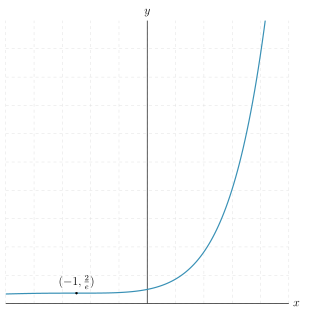
- Considering the function \(g(x) = (e^x-1)-k\tan^{-1} x \) then \(g'(x) = e^x - \frac{k}{1+x^2}\) therefore \(g'(x)\) has exactly one turning point when \(k > 0\) and \(0\) otherwise at the root of \(f(x) = k\) Notice also that \(g(0) = 0\) so we already have one solution, and \(g'(0) = 1 - k > 0\). Notice from our sketch that if \(0 < k < 1\) the root for \(f(x) = k\) has \(x \leq 0\), so our turning point is to the left of the origin and we are interested in the behaviour of \(g(x)\) as \(x \to -\infty\). (ie do we cross the axis again). \(\lim_{x \to -\infty} \left [ e^x - 1 - k \tan^{-1} x \right] = 0 - 1 +k \frac{\pi}{2} = k \frac{\pi}{2} - 1\). if this is positive, ie if \(k > \frac{2}{\pi}\) there are two solutions, otherwise there is only one real root.
1999 Paper 3 Q4
A polyhedron is a solid bounded by \(F\) plane faces, which meet in \(E\) edges and \(V\) vertices. You may assume \textit{Euler's formula}, that \(V-E+F=2\). In a regular polyhedron the faces are equal regular \(m\)-sided polygons, \(n\) of which meet at each vertex. Show that $$ F={4n\over h} \,, $$ where \(h=4-(n-2)(m-2)\). By considering the possible values of \(h\), or otherwise, prove that there are only five regular polyhedra, and find \(V\), \(E\) and \(F\) for each.
Solution: Note that each of the \(F\) faces have \(m\) edges. If we count edges from each face we will get \(mF\) edges, but this counts each edge twice, so \(E = \frac{m}{2}F\). Similarly each edge goes into \(2\) vertices, but this counts each vertex \(n\) times, therefore \(V = \frac{2E}{n} = \frac{m}{n}F\) Therefore \begin{align*} && 2 &= V - E + F \\ &&&= \frac{m}{n}F - \frac{m}{2}F + F \\ &&&= F \left ( \frac{2m-nm+2n}{2n} \right) \\ &&&= F \left ( \frac{4-(n-2)(m-2)}{2n} \right) \\ \Rightarrow && F &= \frac{4n}{4-(n-2)(m-2)} = \frac{4n}{h} \end{align*} Notice that \(1 \leq h \leq 4\), so If \(h = 4\), then \(n = 2\) or \(m = 2\) but we can't have two-sided polygons or polyhedra with two faces making a vertex so this is not possible. If \(h = 3\) then \((n-2)(m-2) = 1\) and \(3 \mid n\), so we have \(n = 3, m = 3\). ie we have triangular faces meeting at \(3\) per point. We also have \(F = \frac{4 \cdot 3 }3\) which is \(4\) faces so this is a tetrahedron and \((V,E, F) = (4, 6, 4)\) If \(h = 2\) then \((n-2)(m-2) = 2\): Case 1: \(n = 4, m = 3\) which is four triangles meeting at each vertex with \((V,E,F) = (6, 12, 8)\), ie an octohedron. Case 2: \(n = 3, m = 4\) so we have three squares meeting at each vertex, with \((V,E,F) = (8,12,6)\) which is a cube. If \(h = 1\) then \((n-2)(m-2) = 3\) Case 1: \(n = 5, m = 3\) which is five triangles meeting at each vertex, with \((V,E,F) = ( 12,30, 20)\) ie an icosahedron. Case 2: \(n = 3, m = 5\) which is three pentagons meeting at each vertex, with \((V,E,F) = (20, 30,12)\) which is a dodecahedron. These are all the possible cases and hence we have found the five platonic solids.
1998 Paper 1 Q3
Which of the following statements are true and which are false? Justify your answers.
- \(a^{\ln b}=b^{\ln a}\) for all \(a,b>0\).
- \(\cos(\sin\theta)=\sin(\cos\theta)\) for all real \(\theta\).
- There exists a polynomial \(\mathrm{P}\) such that \(|\mathrm{P}(\theta)-\cos\theta|\leqslant 10^{-6}\) for all real \(\theta\).
- \(x^{4}+3+x^{-4}\geqslant 5\) for all \(x>0\).
Solution:
- True. \begin{align*} && \ln a \cdot \ln b &= \ln b \cdot \ln a \\ \Leftrightarrow && \exp ( \ln a \cdot \ln b) &= \exp ( \ln b \cdot \ln a) \\ \Leftrightarrow && \exp ( \ln a )^{\ln b} &= \exp ( \ln b )^{\ln a} \\ \Leftrightarrow && a^{\ln b} &= b^{\ln a} \\ \end{align*}
- False. Consider \(\theta = 0\). We'd need \(\cos 0 = 1 = \sin 1\), but \(0 < 1 < \frac{\pi}{2}\) so \(\sin 1 \neq 1\)
- False. If the polynomial has positive degree, then as \(n \to \infty\), \(\P(x) \to \pm \infty\), in particular it must be well outside the interval \([-1,1]\). Therefore it can't be within \(10^{-6}\) of \(\cos \theta\) which is confined to that interval. The only polynomial which is restricted to that range are constants, but then \(|\cos 0 - c| \leq 10^{-6}\) and \(|\cos \pi - c| \leq 10^{-6}\) \(2 = |1-(-1)| \leq |1-c| + |-1-c| \leq 2\cdot 10^{-6}\) contradiction.
- True. \begin{align*} && (x^2-x^{-2})^2 &\geq 0 \\ \Leftrightarrow && x^4-2+x^{-4} &\geq0 \\ \Leftrightarrow && x^4+3+x^{-4} &\geq 5 \\ \end{align*}
1998 Paper 1 Q4
Prove that the rectangle of greatest perimeter which can be inscribed in a given circle is a square. The result changes if, instead of maximising the sum of lengths of sides of the rectangle, we seek to maximise the sum of \(n\)th powers of the lengths of those sides for \(n\geqslant 2\). What happens if \(n=2\)? What happens if \(n=3\)? Justify your answers.
Solution: We can always rotate the circle so that sides are parallel to the \(x\) and \(y\) axes. Therefore if one corner is \((a,b)\) the other coordinates are \((-a,b), (a,-b), (-a,-b)\) and the perimeter will be \(4(a+b)\). Therefore we wish to maximise \(4(a+b)\) subject to \(a^2+b^2 = \text{some constant}\). Notice that \(\frac{a+b}{2} \leq \sqrt{\frac{a^2+b^2}{2}}\) with equality when \(a = b\), therefore the maximum is a square. If \(n = 2\) then we are looking at \(2((2a)^2+(2b)^2) = 8(a^2+b^2)\) which is constant for all rectangles. If \(n=3\) we are maximising \(16(a^3+b^3) = 16(a^3+(c^2-a^2)^{3/2})\) which is maximised when \(a = 0, c\)
1998 Paper 2 Q5
Define the modulus of a complex number \(z\) and give the geometric interpretation of \(\vert\,z_1-z_2\,\vert\) for two complex numbers \(z_1\) and \(z_2\). On the basis of this interpretation establish the inequality $$\vert\,z_1+z_2\,\vert\le \vert\,z_1\,\vert+\vert\,z_2\,\vert.$$ Use this result to prove, by induction, the corresponding inequality for \(\vert\,z_1+\cdots+z_n\,\vert\). The complex numbers \(a_1,\,a_2,\,\ldots,\,a_n\) satisfy \(|a_i|\le 3\) (\(i=1, 2, \ldots , n\)). Prove that the equation $$a_1z+a_2z^2\cdots +a_nz^n=1$$ has no solution \(z\) with \(\vert\,z\,\vert\le 1/4\).
Solution: Suppose \(z = a+ib\), where \(a,b \in \mathbb{R}\) then the modulus of \(z\), \(|z| = \sqrt{a^2+b^2}\). Noting the similarity to the Pythagorean theorem, we can say that \(|z_1 - z_2|\) is the distance between \(z_1\) and \(z_2\) in the Argand diagram. \begin{align*} |z_1 + z_2| &= |(z_1 - 0) + (0 -z_2)| \\ &\underbrace{\leq}_{\text{the direct distance is shorter than going via }0} |z_1 - 0| + |0 - z_2| \\ &= |z_1| + |-z_2| \\ &= |z_1| + |z_2| \end{align*} Claim: \(\displaystyle \vert\,z_1+\cdots+z_n\,\vert \leq \sum_{i=1}^n |z_i|\) Proof: (By Induction) Base Case: \(n = 1, 2\) have been proven. Inductive step, suppose it is true for \(n = k\), then consider \(n = k+1\), ie \begin{align*} \vert\,z_1+\cdots+z_k+z_{k+1}\,\vert &\leq \vert\,z_1+\cdots+z_k\vert + \vert z_{k+1}\,\vert \\ &\underbrace{\leq}_{\text{inductive hypothesis}} \sum_{i=1}^k |z_i| + |z_{k+1}| \\ &= \sum_{i=1}^{k+1} |z_i| \end{align*} Therefore if our hypothesis is true for \(n = k\) it is true for \(n = k+1\), and so since it is true for \(n = 1\) it is true by the principle of mathematical induction for all integers \(n \geq 1\). Suppose \(|z| \leq 1/4\), then consider: \begin{align*} \vert a_1z+a_2z^2+\cdots +a_nz^n \vert &\leq \vert a_1 z\vert + \vert a_2z^2\vert + \cdots + \vert a_n z_n\ \vert \\ &= \vert a_1\vert\vert z\vert + \vert a_2\vert\vert z^2\vert + \cdots + \vert a_n\vert\vert z^n\ \vert \\ &\leq 3\left ( |z| + |z|^2 + \cdots + |z|^n \right) \\ &\leq 3 \left ( \frac{1}{4} + \frac1{4^2} + \cdots + \frac{1}{4^n} \right) \\ &< 3 \frac{1/4}{1-1/4} \\ &= 1 \end{align*} Therefore we cannot have equality and there are no solutions.
1998 Paper 2 Q7
\begin{eqnarray*} {\rm f}(x)&=& \tan x-x,\\ {\rm g}(x)&=& 2-2\cos x-x\sin x,\\ {\rm h}(x)&=& 2x+x\cos 2x-\tfrac{3}{2}\sin 2x,\\ {\rm F}(x)&=& {x(\cos x)^{1/3}\over\sin x}. \end{eqnarray*} \vspace{1mm}
- By considering \(\f(0)\) and \(\f'(x)\), show that \(\f(x)>0\)
for \(0
- Show similarly that \(\g(x)>0\) for \(0
- Show that \(\h(x)>0\) for \(0
- By considering \(\displaystyle {{\rm F}'(x)\over {\rm F}(x)}\), show that \({\rm F}'(x)<0\) for \(0
- Show similarly that \(\g(x)>0\) for \(0
1998 Paper 2 Q14
The staff of Catastrophe College are paid a salary of \(A\) pounds per year. With a Teaching Assessment Exercise impending it is decided to try to lower the student failure rate by offering each lecturer an alternative salary of \(B/(1+X)\) pounds, where \(X\) is the number of his or her students who fail the end of year examination. Dr Doom has \(N\) students, each with independent probability \(p\) of failure. Show that she should accept the new salary scheme if $$A(N+1)p < B(1-(1-p)^{N+1}).$$ Under what circumstances could \(X\), for Dr Doom, be modelled by a Poisson random variable? What would Dr Doom's expected salary be under this model?
Solution: \begin{align*} && \E[\text{salary}] &= B\sum_{k=0}^N \frac{1}{1+k}\binom{N}{k}p^k(1-p)^{N-k} \\ \\ && (q+x)^N &= \sum_{k=0}^N \binom{N}{k}x^kq^{N-k} \\ \Rightarrow && \int_0^p(q+x)^N \d x &= \sum_{k=0}^N \binom{N}{k} \frac{p^{k+1}}{k+1}q^{N-k} \\ && \frac{(q+p)^{N+1}-q^{N+1}}{N+1} &= \frac{p}{B} \E[\text{salary}] \\ \Rightarrow && \E[\text{salary}] &= B\frac{1-q^{N+1}}{p(N+1)} \end{align*} Therefore if \(Ap(N+1) < B(1-(1-p)^{N+1})\) the expected value of the new salary is higher. (Whether or not the new salary is worth it in a risk adjusted sense is for the birds). We could model \(X\) by a Poisson random variable if \(N\) is large and \(Np = \lambda \) is small. Suppose \(X \approx Po(\lambda)\) then \begin{align*} \E \left [\frac{B}{1+X} \right] &= B\sum_{k=0}^\infty \frac{1}{1+k}\frac{e^{-\lambda}\lambda^k}{k!} \\ &= \frac{B}{\lambda} \sum_{k=0}^\infty e^{-\lambda} \frac{\lambda^{k+1}}{(k+1)!} \\ &= \frac{B}{\lambda}e^{-\lambda}(e^{\lambda}-1) \\ &= \frac{B(1-e^{-\lambda})}{\lambda} = B \frac{1-e^{-Np}}{Np} \end{align*}
1998 Paper 3 Q1
Let $$ {\rm f}(x)=\sin^2x + 2 \cos x + 1 $$ for \(0 \le x \le 2\pi\). Sketch the curve \(y={\rm f}(x)\), giving the coordinates of the stationary points. Now let $$ \hspace{0.6in}{\rm g}(x)={a{\rm f}(x)+b \over c{\rm f}(x)+d} \hspace{0.8in} ad\neq bc\,,\; d\neq -3c\,,\; d\neq c\;. $$ Show that the stationary points of \(y={\rm g}(x)\) occur at the same values of \(x\) as those of \(y={\rm f}(x)\), and find the corresponding values of \({\rm g}(x)\). Explain why, if \(d/c <-3\) or \(d/c>1\), \(|{\rm g}(x)|\) cannot be arbitrarily large.
1998 Paper 3 Q10
Two identical spherical balls, moving on a horizontal, smooth table, collide in such a way that both momentum and kinetic energy are conserved. Let \({\bf v}_1\) and \({\bf v}_2\) be the velocities of the balls before the collision and let \({\bf v}'_1\) and \({\bf v}'_2\) be the velocities of the balls after the collision, where \({\bf v}_1\), \({\bf v}_2\), \({\bf v}'_1\) and \({\bf v}'_2\) are two-dimensional vectors. Write down the equations for conservation of momentum and kinetic energy in terms of these vectors. Hence show that their relative speed is also conserved. Show that, if one ball is initially at rest but after the collision both balls are moving, their final velocities are perpendicular. Now suppose that one ball is initially at rest, and the second is moving with speed \(V\). After a collision in which they lose a proportion \(k\) of their original kinetic energy (\(0\le k\le 1\)), the direction of motion of the second ball has changed by an angle \(\theta\). Find a quadratic equation satisfied by the final speed of the second ball, with coefficients depending on \(k\), \(V\) and \(\theta\). Hence show that \(k\le \frac{1}{2}\).
Solution: \begin{align*} \text{COM}: && \mathbf{v}_1+\mathbf{v}_2 &= \mathbf{v}_1'+\mathbf{v}_2' \tag{1}\\ \text{COE}: && \mathbf{v}_1\cdot\mathbf{v}_1+\mathbf{v}_2\cdot\mathbf{v}_2 &= \mathbf{v}_1'\cdot\mathbf{v}_1'+\mathbf{v}_2'\cdot\mathbf{v}_2' \tag{2} \\ \\ (1): && (\mathbf{v}_1+\mathbf{v}_2 )\cdot(\mathbf{v}_1+\mathbf{v}_2 ) &= (\mathbf{v}_1'+\mathbf{v}_2' )\cdot(\mathbf{v}_1'+\mathbf{v}_2' ) \\ \Rightarrow && \mathbf{v}_1 \cdot \mathbf{v}_2 &= \mathbf{v}_1'\cdot \mathbf{v}_2' \\ && \text{Initial relative speed}^2 &= |\mathbf{v}_1 - \mathbf{v}_2|^2 \\ &&&= (\mathbf{v}_1 - \mathbf{v}_2) \cdot (\mathbf{v}_1 - \mathbf{v}_2) \\ &&&= \mathbf{v}_1\cdot \mathbf{v}_1 - 2 \mathbf{v}_1\cdot \mathbf{v}_2 + \mathbf{v}_2\cdot \mathbf{v}_2 \\ &&&= \mathbf{v}_1'\cdot\mathbf{v}_1'+\mathbf{v}_2'\cdot\mathbf{v}_2' -2 \mathbf{v}_1\cdot\mathbf{v}_2\\ &&&= \mathbf{v}_1'\cdot\mathbf{v}_1'+\mathbf{v}_2'\cdot\mathbf{v}_2' -2 \mathbf{v}_1'\cdot\mathbf{v}_2'\\ &&&= | \mathbf{v}_1'-\mathbf{v}_2'|^2 \\ &&&= \text{Final relative speed}^2 \end{align*} Since \(\mathbf{v}_1 \cdot 0 = 0\) we must have \(\mathbf{v}_1'\cdot\mathbf{v}_2' = \mathbf{v}_1\cdot0 = 0\) therefore their final velocities are perpendicular. We now must have \begin{align*} \text{COM}: && \mathbf{v}_1+\mathbf{v}_2 &= \mathbf{v}_1'+\mathbf{v}_2' \tag{3}\\ \Delta\text{E}: && (1-k)(\mathbf{v}_1\cdot\mathbf{v}_1+\mathbf{v}_2\cdot\mathbf{v}_2) &= \mathbf{v}_1'\cdot\mathbf{v}_1'+\mathbf{v}_2'\cdot\mathbf{v}_2' \tag{4} \\ \\ && 0 + \mathbf{v}_2 &= \mathbf{v}_1' + \mathbf{v}_2' \\ \Rightarrow && V^2 &= ( \mathbf{v}_1' + \mathbf{v}_2' ) \cdot ( \mathbf{v}_1' + \mathbf{v}_2' ) \\ &&&= \mathbf{v}_1'\cdot\mathbf{v}_1'+\mathbf{v}_2'\cdot\mathbf{v}_2' +2 \mathbf{v}_1'\cdot \mathbf{v}_2' \\ &&&= (1-k)V^2 + 2 (\mathbf{v}_2-\mathbf{v}_2') \cdot \mathbf{v}_2' \\ &&&= (1-k)V^2 + 2 \mathbf{v}_2 \cdot \mathbf{v}_2'-2\mathbf{v}_2'\cdot \mathbf{v}_2' \\ &&&= (1-k)V^2 + 2Vx \cos \theta - 2x^2 \\ \Rightarrow && 0 &= -kV^2 + 2Vx \cos \theta -2x^2 \\ \Delta \geq 0: && 0 &\leq 4V^2 \cos^2 \theta -8kV^2 \\ \Rightarrow && k &\leq \frac12\cos^2\theta \leq \frac12 \end{align*}
1997 Paper 1 Q6
Find constants \(a_{0}\), \(a_{1}\), \(a_{2}\), \(a_{3}\), \(a_{4}\), \(a_{5}\), \(a_{6}\) and \(b\) such that \[x^{4}(1-x)^{4}=(a_{6}x^{6}+a_{5}x^{5}+a_{4}x^{4}+a_{3}x^{3}+ a_{2}x^{2}+a_{1}x+a_{0})(x^{2}+1)+b.\] Hence, or otherwise, prove that \[\int_{0}^{1}\frac{x^{4}(1-x)^{4}}{1+x^{2}}{\rm d}x =\frac{22}{7}-\pi.\] Evaluate \(\displaystyle{\int_{0}^{1}x^{4}(1-x)^{4}{\rm d}x}\) and deduce that \[\frac{22}{7}>\pi>\frac{22}{7}-\frac{1}{630}.\]
Solution: Plugging in \(x = i\) we obtain \((1-i)^4 = (-2i)^2 = -4 \Rightarrow b = -4\). \begin{align*} x^4(1-x)^4 &= x^4(1-4x+6x^2-4x^3+x^4) \\ &= x^8-4x^7+6x^6-4x^5+x^4 \\ &= x^6(x^2+1) - x^6 -4x^7+6x^6-4x^5+x^4 \\ &= x^6(x^2+1) -4x^5(x^2+1)+4x^5 +5x^6-4x^5+x^4 \\ &= (x^6-4x^5)(x^2+1) +5x^4(x^2+1)-5x^4+x^4 \\ &= (x^6-4x^5+5x^4)(x^2+1) -4x^2(x^2+1)+4x^2 \\ &= (x^6-4x^5+5x^4-4x^2)(x^2+1) +4(x^2+1)-4 \\ &= (x^6-4x^5+5x^4-4x^2+4)(x^2+1) -4 \\ \end{align*} So \begin{align*} \int_0^1 \frac{x^4(1-x)^4}{1+x^2} \d x &= \int_0^1 (x^6-4x^5+5x^4-4x^2+4) - \frac{4}{1+x^2} \d x \\ &= \frac17 - \frac46+1-\frac43+4 - \pi \\ &= \frac{22}7 - \pi \end{align*} \begin{align*} \int_0^1 x^4(1-x)^4 \d x &= B(5,5) \\ &= \frac{4!4!}{9!} \\ &= \frac1{630} \end{align*} Therefore since \(0 < \frac{x^4(1-x)^4}{1+x^2} < x^4(1-x)^4\) we must have that \begin{align*} && 0 &< \frac{22}7 - \pi \\ \Rightarrow && \pi & < \frac{22}{7} \\ && \frac{22}{7} - \pi &< \frac1{630} \\ \Rightarrow && \frac{22}{7} - \frac1{630} &< \pi \end{align*} which is what we wanted.
1997 Paper 1 Q8
By considering the maximum of \(\ln x-x\ln a\), or otherwise, show that the equation \(x=a^{x}\) has no real roots if \(a > e^{1/e}\). How many real roots does the equation have if \(0 < a < 1\)? Justify your answer.
Solution: \begin{align*} && y &= \ln x - x \ln a \\ \Rightarrow && y' &= \frac1x - \ln a \\ && y'' &= -\frac{1}{x^2} \end{align*} Therefore the maximum is when \(x = \frac{1}{\ln a}\) and \(y_{max} = -\ln \ln a - 1\). If \(y_{max} < 0\) then \(y \neq 0\). But that's equivalent to \(a > e^{1/e}\). \begin{align*} && 0 &> -\ln \ln a - 1 \\ \Leftrightarrow && 1 &> - \ln \ln a \\ \Leftrightarrow && \ln \ln a &>-1 \\ \Leftrightarrow && \ln a &> e^{-1} \\ \Leftrightarrow && a & > e^{1/e} \end{align*} If \(0 < a < 1\) then, when \(x\) is small, \(\ln x - x \ln a\) is large and negative. When \(x\) is large and positive \(\ln x\) is positive and \(-x \ln a\) is positive. We also notice there is no turning point. Hence exactly one solution