Problems
Filters
298 problems found
2001 Paper 2 Q10
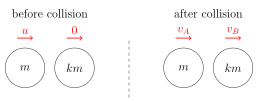
Two particles \(A\) and \(B\) of masses \(m\) and \(km\), respectively, are at rest on a smooth horizontal surface. The direction of the line passing through \(A\) and \(B\) is perpendicular to a vertical wall which is on the other side of \(B\) from \(A\). The particle \(A\) is now set in motion towards \(B\) with speed \(u\). The coefficient of restitution between \(A\) and \(B\) is \(e_1\) and between \(B\) and the wall is \(e_2\). Show that there will be a second collision between \(A\) and \(B\) provided $$ k< \frac {1+e_2(1+e_1)} {e_1}\;. $$ Show that, if \(e_1=\frac13\), \(e_2=\frac12\) and \(k<5\), then the kinetic energy of \(A\) and \(B\) immediately after \(B\) rebounds from the wall is greater than \(mu^2/27\).
Solution: First collision:
2001 Paper 2 Q11
A two-stage missile is projected from a point \(A\) on the ground with horizontal and vertical velocity components \(u\) and \(v\), respectively. When it reaches the highest point of its trajectory an internal explosion causes it to break up into two fragments. Immediately after this explosion one of these fragments, \(P\), begins to move vertically upwards with speed \(v_e\), but retains the previous horizontal velocity. Show that \(P\) will hit the ground at a distance \(R\) from \(A\) given by $$ \frac{gR}u = v+v_e + \sqrt{v_e^2 +v^2}\, . $$ It is required that the range \(R\) should be greater than a certain distance \(D\) (where \(D> 2uv/g\)). Show that this requirement is satisfied if \[ v_e> \frac{gD}{2u}\left( \frac{gD-2uv}{gD-uv}\right). \] \noindent[{\sl The effect of air resistance is to be neglected.}]
2001 Paper 3 Q3
Consider the equation \[ x^2 - b x + c = 0 \;, \] where \(b\) and \(c\) are real numbers.
- Show that the roots of the equation are real and positive if and only if \(b>0\) and \phantom{} \(b^2\ge4c>0\), and sketch the region of the \(b\,\)-\(c\) plane in which these conditions hold.
- Sketch the region of the \(b\,\)-\(c\) plane in which the roots of the equation are real and less than \(1\) in magnitude.
2000 Paper 1 Q1
To nine decimal places, \(\log_{10}2=0.301029996\) and \(\log_{10}3=0.477121255\).
- Calculate \(\log_{10}5\) and \(\log_{10}6\) to three decimal places. By taking logs, or otherwise, show that \[ 5\times 10^{47} < 3^{100} < 6\times 10^{47}. \] Hence write down the first digit of \(3^{100}\).
- Find the first digit of each of the following numbers: \(2^{1000}\); \ \(2^{10\,000}\); \ and \(2^{100\, 000}\).
Solution:
- \begin{align*} \log_{10}5 &= \log_{10} 10 - \log_{10}2 \\ &= 1- \log_{10} 2 \\ &= 0.699\\ \\ \log_{10} 6 &= \log_{10} 2 + \log_{10} 3 \\ &= 0.301029996+0.477121255 \\ &= 0.778 \end{align*} \begin{align*} && 5 \times 10^{47} < 3^{100} < 6 \times 10^{47} \\ \Leftrightarrow && 47 + \log_{10} 5 < 100 \log_{10} 3 < \log_{10} 6 + 47 \\ \Leftrightarrow &&47.699< 47.71 < 47.778 \\ \end{align*} Which is true. Therefore the first digit of \(3^{100}\) is 5.
- \(\log_{10} 2^{1000} = 1000 \log_{10} 2 = 301.02\cdots\). Therefore it starts with a \(1\). \(\log_{10}2^{10\, 000} = 10\,000 \log_{10} 2 = 3010.2\) therefore this also starts with a \(1\). \(\log_{10} 2^{100\, 000} = 100\,000 \log_{10} 2 = 30102.9996\) therefore it starts with a \(9\)
2000 Paper 1 Q4
- Show that, for \(0\le x\le 1\), the largest value of \(\displaystyle \frac{x^6}{(x^2+1)^4}\) is \(\frac1{16}\).
- Find constants \(A\), \(B\), \(C\) and \(D\) such that, for all \(x\), \[ \frac{1}{(x^2+1)^4}= \frac{\d \ }{\d x} \left( \frac{Ax^5+Bx^3+Cx}{(x^2+1)^3}\right) +\frac{Dx^6}{(x^2+1)^4}. \]
- Hence, or otherwise, prove that \[ \frac{11}{24} \le \int_{0}^{1}\frac{1}{(x^{2}+1)^{4}}\, \d x \le \frac{11}{24} + \frac 1{16} \; . \]
Solution:
- \(x^2 + 1 \geq 2x \Rightarrow \frac{1}{x^2+1} \leq \frac1{2x} \Rightarrow \frac{x^6}{(x^2+1)^4}\leq \frac{x^6}{16x^2} = \frac1{16}x^2 \leq \frac1{16}\) with equality when \(x = 1\)
- \(\,\) \begin{align*} && RHS &= \frac{\d \ }{\d x} \left( \frac{Ax^5+Bx^3+Cx}{(x^2+1)^3}\right) +\frac{Dx^6}{(x^2+1)^4} \\ &&&= \frac{(5Ax^4+3Bx^2+C)(x^2+1)^3-6x(x^2+1)^2(Ax^5+Bx^3+Cx)}{(x^2+1)^6}+\frac{Dx^6}{(x^2+1)^4} \\ &&&= \frac{(5Ax^4+3Bx^2+C)(x^2+1)-6x(Ax^5+Bx^3+Cx)+Dx^6}{(x^2+1)^4} \\ &&&= \frac{(D-A) x^6 + (5A-3B) x^4 + (3B-5C)x^2 + C}{(x^2+1)^4} \\ \Rightarrow && C &= 1 \\ && 3B &= 5 \quad\quad\quad\Rightarrow B = \frac53 \\ && 5A &= 3B = 5\Rightarrow A = 1 \\ && D &= A \quad\quad \Rightarrow D = 1 \end{align*}
- So \begin{align*} && I &= \int_{0}^{1}\frac{1}{(x^{2}+1)^{4}}\, \d x \\ &&&= \int_{0}^{1}\frac{\d \ }{\d x} \left( \frac{Ax^5+Bx^3+Cx}{(x^2+1)^3}\right) +\frac{Dx^6}{(x^2+1)^4} \, \d x \\ &&&= \left [ \frac{Ax^5+Bx^3+Cx}{(x^2+1)^3} \right]_0^1 + \int_{0}^{1}\frac{Dx^6}{(x^2+1)^4} \, \d x \\ &&& \leq \frac{A+B+C}{8} + \frac1{16} \\ &&&= \frac{2+\frac53}{8} + \frac1{16} = \frac{11}{24} + \frac{1}{16} \\ && I &\geq \left [ \frac{Ax^5+Bx^3+Cx}{(x^2+1)^3} \right]_0^1 = \frac{11}{24} \end{align*}
2000 Paper 1 Q7
Let \[ {\f}(x)=a x-\frac{x^{3}}{1+x^{2}}, \] where \(a\) is a constant. Show that, if \(a\ge 9/8\), then \(\mathrm{f}' (x) \ge0\) for all \(x\).
Solution: \begin{align*} && f(x) &= a x-\frac{x^{3}}{1+x^{2}} \\ \Rightarrow && f'(x) &= a - \frac{3x^2(1+x^2)-x^3 \cdot 2 x}{(1+x^2)^2} \\ &&&= a - \frac{-x^4+3x^2}{(1+x^2)^2} \\ &&&= a - \frac{-t^2+3t}{(1+t)^2} \\ &&&= \frac{a+2at+at^2-t^2-3t}{(1+t)^2} \\ &&&= \frac{(a-1)t^2+(2a-3)t+a}{(1+t)^2} \\ \\ && 0 \leq \Delta &= (2a-3)^2 - 4 \cdot (a-1) \cdot a \\ &&&= 4a^2-12a+9 - 4a^2+4a \\ &&&= -8a + 9 \\ \Leftrightarrow && a &\geq 9/8 \end{align*} Therefore if \(a \geq 9/8\) the numerator is always non-negative and \(f'(x) \geq 0\)
2000 Paper 1 Q10
Three particles \(P_1\), \(P_2\) and \(P_3\) of masses \(m_{1}\), \(m_{2}\) and \(m_{3}\) respectively lie at rest in a straight line on a smooth horizontal table. \(P_1\) is projected with speed \(v\) towards \(P_2\) and brought to rest by the collision. After \(P_2\) collides with \(P_3\), the latter moves forward with speed \(v\). The coefficients of restitution in the first and second collisions are \(e\) and \(e'\), respectively. Show that \[ e'= \frac{m_{2}+m_{3}-m_{1}}{m_{1}}. \] Show that \(2m_1\ge m_2 +m_3\ge m_1\) for such collisions to be possible. If \(m_1\), \(m_3\) and \(v\) are fixed, find, in terms of \(m_1\), \(m_3\) and \(v\), the largest and smallest possible values for the final energy of the system.
2000 Paper 2 Q12
Tabulated values of \({\Phi}(\cdot)\), the cumulative distribution function of a standard normal variable, should not be used in this question. Henry the commuter lives in Cambridge and his working day starts at his office in London at 0900. He catches the 0715 train to King's Cross with probability \(p\), or the 0720 to Liverpool Street with probability \(1-p\). Measured in minutes, journey times for the first train are \(N(55,25)\) and for the second are \(N(65,16)\). Journey times from King's Cross and Liverpool Street to his office are \(N(30,144)\) and \(N(25,9)\), respectively. Show that Henry is more likely to be late for work if he catches the first train. Henry makes \(M\) journeys, where \(M\) is large. Writing \(A\) for \(1-{\Phi}(20/13)\) and \(B\) for \(1-{\Phi}(2)\), find, in terms of \(A\), \(B\), \(M\) and \(p\), the expected number, \(L\), of times that Henry will be late and show that for all possible values of \(p\), $$BM \le L \le AM.$$ Henry noted that in 3/5 of the occasions when he was late, he had caught the King's Cross train. Obtain an estimate of \(p\) in terms of \(A\) and \(B\). [A random variable is said to be \(N\left({{\mu}, {\sigma}^2}\right)\) if it has a normal distribution with mean \({\mu}\) and variance \({\sigma}^2\).]
Solution: If Henry catches the first train, his journey time is \(N(55+30,25+144) = N(85,13^2)\). He is on time if the journey takes less than \(105\) minutes, \(\frac{20}{13}\) std above the mean. If he catches the second train, his journey times is \(N(65+25, 16+9) = N(90, 5^2)\). He is on time if his journey takes less than \(80\) minutes, ie \(\frac{10}{5} = 2\) standard deviations above the mean. This is more likely than from the first train. \(A = 1 - \Phi(20/13)\) is the probability he is late from the first train. \(B = 1 - \Phi(2)\) is the probability he is late from the second train. The expected number of lates is \(L = M \cdot p \cdot A + M \cdot (1-p) \cdot B\), since \(B \leq A\) we must have \(BM \leq L \leq AM\) \begin{align*} && \frac35 &= \frac{pA}{pA + (1-p)B} \\ \Rightarrow && 3(1-p)B &= 2pA \\ \Rightarrow && p(2A+3B) &= 3B \\ \Rightarrow && p &= \frac{3B}{2A+3B} \end{align*}
2000 Paper 3 Q4
The function \(\f(x)\) is defined by $$ \f(x) = \frac{x( x - 2 )(x-a)}{ x^2 - 1}. $$ Prove algebraically that the line \(y = x + c\) intersects the curve \(y = \f ( x )\) if \(\vert a \vert \ge1\), but there are values of \(c\) for which there are no points of intersection if \(\vert a \vert <1\). Find the equation of the oblique asymptote of the curve \(y=\f(x)\). Sketch the graph in the two cases
- \(a<-1\)
- \(-1 < a < -\frac12\)
Solution: \begin{align*} && x+ c &= f(x) \\ \Rightarrow && (x+c)(x^2-1) &= x(x-2)(x-a) \\ \Rightarrow && x^3 + cx^2-x-c &= x^3-(2+a)x^2+2ax \\ \Rightarrow && 0 &= (c+2+a)x^2-(1+2a)x-c \\ && 0 &\leq \Delta = (1+2a)^2 + 4(2+c+a)c \\ &&&= 4c^2+(4a+8)c + (1+2a)^2 \\ && \Delta_c &= 16(a+2)^2-16(1+2a)^2 \\ &&&= 16(1-a)(3a+3) \\ &&&= 48(1-a^2) \end{align*} Therefore if \(|a| \geq 1\) we must have \(\Delta_c \leq 0\) which means \(\Delta \geq 0\) and so there are always solutions. If \(|a| < 1\) there are values for \(c\) where \(\Delta < 0\) and there would be no solutions. \begin{align*} && y &= \frac{x^3-(2+a)x^2+2ax}{x^2-1} \\ &&&= \frac{(x^2-1)(x-(2+a))+(2a+1)x-(2+a)}{x^2-1} \\ &&&= x - (2+a) + \frac{(2a+1)x-(2+a)}{x^2-1} \end{align*} therefore the oblique asymptote has equation \(y = x - (2+a)\)


2000 Paper 3 Q7
Given that $$\e = 1 + {1 \over 1 !} + {1 \over 2 !} + {1 \over 3 !} + \cdots + {1 \over r !} + \cdots \; ,$$ use the binomial theorem to show that $$ {\left( 1 + {1 \over n} \right)}^{\!n} < \e $$ for any positive integer \(n\). The product \({\rm P }( n )\) is defined, for any positive integer \(n\), by $$ {\rm P} ( n ) = {3 \over 2} \cdot {5 \over 4} \cdot {9 \over 8} \cdot \ldots \cdot {2^n + 1 \over 2^n} . $$ Use the arithmetic-geometric mean inequality, $$ {a_1 + a_2 + \cdots + a_n \over n} \ge \ {\left( a_1 \cdot a_2 \cdot \ldots \cdot a_n \right)}^{1 \over n}\,, $$ to show that \({\rm P }( n ) < \e\) for all \(n\) . Explain briefly why \({\rm P} ( n )\) tends to a limit as \(n\to\infty\). Show that this limit, \(L\), satisfies \(2 < L\le\e\).
2000 Paper 3 Q9
Two small discs of masses \(m\) and \(\mu m\) lie on a smooth horizontal surface. The disc of mass \(\mu m\) is at rest, and the disc of mass \(m\) is projected towards it with velocity \(\mathbf{u}\). After the collision, the disc of mass \(\mu m\) moves in the direction given by unit vector \(\mathbf{n}\). The collision is perfectly elastic.
- Show that the speed of the disc of mass \(\mu m\) after the collision is \ \ $ \dfrac {2\mathbf{u} \cdot \mathbf{n}}{1+\mu}. $
- Given that the two discs have equal kinetic energy after the collision, find an expression for the cosine of the angle between \(\bf n\) and \(\bf u\) and show that \(3-\sqrt8\le \mu \le 3+\sqrt8\).
Solution:
- In the direction of \(\mathbf{n}\), Conservation of momentum gives: \(m \mathbf{u} \cdot \mathbf{n} = m v_m + \mu m v_{\mu m}\) Newton's experimental law gives: \(\frac{\mathbf{u} \cdot \mathbf{n}}{v_{\mu m} - v_m} = 1\) Therefore \begin{align*} && \mathbf{u} \cdot \mathbf{n} &= v_m + \mu v_{\mu m} \\ && \mathbf{u} \cdot \mathbf{n} &= v_{\mu m} - v_m \\ \Rightarrow && 2 \mathbf{u} \cdot \mathbf{n} &= (1 + \mu)v_{\mu m} \\ \Rightarrow && v_{\mu m} &= \frac{2 \mathbf{u} \cdot \mathbf{n}}{1 + \mu} \\ \end{align*}
- Kinetic energy after the collision for the second mass is: \(\frac12 m \mu \frac{4 (\mathbf{u} \cdot \mathbf{n})^2 }{(1 + \mu)^2}\) For the first mass the final speed (in the direction \(\mathbf{n}\) is: \(\mathbf{u} \cdot \mathbf{n}- \frac{2 \mathbf{u} \cdot \mathbf{n}}{1 + \mu} = \frac{(\mu - 1) \mathbf{u} \cdot \mathbf{n}}{1 + \mu}\) It's velocity perpendicular to \(\mathbf{n}\) is unchanged, which is \(\mathbf{u} - (\mathbf{u} \cdot \mathbf{n}) \mathbf{n}\), so it's speed squared is \(\mathbf{u}\cdot \mathbf{u} - (\mathbf{u} \cdot \mathbf{n})^2\) Therefore the total kinetic energy is: \(\frac12 m \frac{(\mu - 1)^2 (\mathbf{u} \cdot \mathbf{n})^2}{(1 + \mu)} + \frac12 m (\mathbf{u}\cdot \mathbf{u} - (\mathbf{u} \cdot \mathbf{n})^2)\) Therefore since the kinetic energies are equal we have: \begin{align*} && \frac12 m \frac{(\mu - 1)^2 (\mathbf{u} \cdot \mathbf{n})^2}{(1 + \mu)} + \frac12 m (\mathbf{u}\cdot \mathbf{u} - (\mathbf{u} \cdot \mathbf{n})^2) &= \frac12 m \mu \frac{4 (\mathbf{u} \cdot \mathbf{n})^2 }{(1 + \mu)^2} \\ \Rightarrow && \frac{(\mu - 1)^2 (\mathbf{u} \cdot \mathbf{n})^2}{(1 + \mu)} + (\mathbf{u}\cdot \mathbf{u} - (\mathbf{u} \cdot \mathbf{n})^2) &= \mu \frac{4 (\mathbf{u} \cdot \mathbf{n})^2 }{(1 + \mu)^2} \\ \Rightarrow && (\mathbf{u} \cdot \mathbf{n})^2 \l 1 + \frac{4\mu}{(1+ \mu)^2} - \frac{(1-\mu)^2}{(1+ \mu)^2} \r &= (\mathbf{u} \cdot \mathbf{u}) \\ \Rightarrow && (\mathbf{u} \cdot \mathbf{n})^2 \l \frac{(1 + \mu)^2 + 4\mu - (1-\mu)^2}{(1+ \mu)^2} \r &= (\mathbf{u} \cdot \mathbf{u}) \\ \Rightarrow && (\mathbf{u} \cdot \mathbf{n})^2 \l \frac{8\mu}{(1+ \mu)^2} \r &= (\mathbf{u} \cdot \mathbf{u}) \\ \Rightarrow && \cos^2 \theta &=\frac{(1 + \mu)^2}{8\mu} \\ \end{align*} We need \begin{align*} && \frac{(1 + \mu)^2}{8\mu} & \leq 1 \\ \Rightarrow && 1 +2 \mu + \mu^2 \leq 8 \mu \\ \Rightarrow && 1 - 6 \mu + \mu^2 \leq 0 \end{align*} This quadratic has roots at \(3 \pm \sqrt{8}\) and therefore our quadratic inequality is satisfied if: \(\boxed{3 - \sqrt{8} \leq \mu \leq 3 + \sqrt{8}}\)
1999 Paper 1 Q2
A point moves in the \(x\)-\(y\) plane so that the sum of the squares of its distances from the three fixed points \((x_{1},y_{1})\), \((x_{2},y_{2})\), and \((x_{3},y_{3})\) is always \(a^{2}\). Find the equation of the locus of the point and interpret it geometrically. Explain why \(a^2\) cannot be less than the sum of the squares of the distances of the three points from their centroid. [The centroid has coordinates \((\bar x, \bar y)\) where \(3\bar x = x_1+x_2+x_3,\) $3\bar y =y_1+y_2+y_3. $]
Solution: \begin{align*} && a^2 &= d_1^2 + d_2^2 + d_3^2 \\ &&&= (x-x_1)^2+(y-y_1)^2 + (x-x_2)^2+(y-y_2)^2 + (x-x_3)^2+(y-y_3)^2 \\ &&&= \sum (x-\bar{x}+\bar{x}-x_i)^2 + \sum (y-\bar{y}+\bar{y}-y_i)^2 \\ &&&= \sum \left ( (x-\bar{x})^2+(\bar{x}-x_i)^2 + 2(x-\bar{x})(\bar{x}-x_i) \right)+ \sum \left ( (y-\bar{y})^2+(\bar{y}-y_i)^2 + 2(y-\bar{y})(\bar{y}-y_i) \right)\\ &&&= 3(x-\bar{x})^2 + \sum (\bar{x}-x_i)^2 + 6x\bar{x} -6\bar{x}^2-2x\sum x_i+2\bar{x}\sum x_i + \\ &&&\quad\quad\quad 3(y-\bar{y})^2 + \sum (\bar{y}-y_i)^2 + 6y\bar{y} -6\bar{y}^2-2y\sum y_i+2\bar{y}\sum y_i \\ &&&= 3(x-\bar{x})^2 + \sum (\bar{x}-x_i)^2+3(y-\bar{y})^2 + \sum (\bar{y}-y_i)^2 \\ \\ \Rightarrow && (x-\bar{x})^2+(y-\bar{y})^2 &= \frac13\left ( a^2- \sum \left((\bar{x}-x_i)^2+(\bar{y}-y_i)^2 \right) \right) \end{align*} Therefore the locus is a circle, centre \((\bar{x}, \bar{y})\). radius \(\sqrt{\frac13(a^2 - \text{sum of squares distances of centroid to vertices}})\). \(a^2\) cannot be less than this distance, because clearly the right hand side is always bigger than it!
1999 Paper 1 Q6
- Find the greatest and least values of \(bx+a\) for \(-10\leqslant x \leqslant 10\), distinguishing carefully between the cases \(b>0\), \(b=0\) and \(b<0\).
- Find the greatest and least values of \(cx^{2}+bx+a\), where \(c\ge0\), for \(-10\leqslant x \leqslant 10\), distinguishing carefully between the cases that can arise for different values of \(b\) and \(c\).
Solution:
- Case \(b > 0\). Then \(bx+a\) is increasing and the greatest value is \(10b+a\), and the least value \(a-10b\) Case \(b=0\), then \(a\) is constant and the greatest and least value is \(a\) Case \(b < 0\), then \(bx+a\) is decreasing and the greatest value is \(-10b+a\) and the least value is \(10b+a\)
- If \(c = 0\) we have the same cases as above. If \( c > 0\) the consider \(2cx+b\). if \(b-20c > 0\) then our function is increasing on our interval and the greatest value is \(100c+10b+a\) and the least value is \(100c-10b+a\) If \(20c+b < 0\) then our function is decreasing and that calculation is reversed. If neither of these are true, then the minimum will be when \(x = - \frac{b}{2c}\) and the max at one end point.
1999 Paper 1 Q8
The function \(\f\) satisfies \(0\leqslant\f(t)\leqslant K\) when \(0\leqslant t\leqslant x\). Explain by means of a sketch, or otherwise, why \[0\leqslant\int_{0}^{x} \f (t)\,{\mathrm d}t \leqslant Kx.\] By considering \(\displaystyle \int_{0}^{1}\frac{t}{n(n-t)}\,{\mathrm d}t\), or otherwise, show that, if \(n>1\), \[ 0\le \ln \left( \frac n{n-1}\right) -\frac 1n \le \frac 1 {n-1} - \frac 1n \] and deduce that \[ 0\le \ln N -\sum_{n=2}^N \frac1n \le 1. \] Deduce that as \(N\to \infty\) \[ \sum_{n=1}^N \frac1n \to\infty. \] Noting that \(2^{10}=1024\), show also that if \(N<10^{30}\) then \[ \sum_{n=1}^N \frac1n <101. \]
1999 Paper 1 Q12
- Prove that if \(x>0\) then \(x+x^{-1}\ge2.\;\) I have a pair of six-faced dice, each with faces numbered from 1 to 6. The probability of throwing \(i\) with the first die is \(q_{i}\) and the probability of throwing \(j\) with the second die is \(r_{j}\) (\(1\le i,j \le 6\)). The two dice are thrown independently and the sum noted. By considering the probabilities of throwing 2, 12 and 7, show the sums \(2, 3, \dots, 12\) are not equally likely.
- The first die described above is thrown twice and the two numbers on the die noted. Is it possible to find values of \(q_{j}\) so that the probability that the numbers are the same is less than \(1/36\)?
Solution:
- Notice that if \(x > 0\) we must have \begin{align*} && \left ( \sqrt{x} - \frac{1}{\sqrt{x}} \right)^2 &\geq 0 \\ \Leftrightarrow && x - 2 + x^{-1} & \geq 0 \\ \Leftrightarrow && x + x^{-1} & \geq 2 \end{align*} Let \(S\) be the sum, and assume all probabilities are equal \begin{align*} && \mathbb{P}(S = 2) &= q_1 r_1 \\ && \mathbb{P}(S = 12) &= q_6 r_6 \\ && \mathbb{P}(S = 7) &= \sum_{i=1}^6 q_i r_{7-i} \\ \Rightarrow && q_1r_1 &= q_6r_6 \\ \Rightarrow && q_1r_6+q_6r_1 &\leq q_1r_1 \\ \Rightarrow && \frac{r_6}{r_1} + \frac{q_6}{q_1} &\leq 1 \\ \Rightarrow && q_1r_6+q_6r_1 &\leq q_6r_6 \\ \Rightarrow && \frac{q_1}{q_6} + \frac{r_1}{r_6} &\leq 1 \\ \Rightarrow && \frac{r_6}{r_1} + \frac{q_6}{q_1}+\frac{q_1}{q_6} + \frac{r_1}{r_6} &\leq 2\\ \text{but} && \frac{r_6}{r_1} + \frac{q_6}{q_1}+\frac{q_1}{q_6} + \frac{r_1}{r_6} &\geq 4 \end{align*} Since we have a contradiction they cannot all be equal.
- We would like \(\displaystyle \sum q_i^2 \leq 1/36\) (subject to \(\displaystyle \sum q_i = 1\), clearly this cannot be true since: \begin{align*} && 1 &= \left ( \sum_{i=1}^6 q_i \right)^2 \\ &&&= \sum_{i=1}^6 q_i^2 + \sum_{i \neq j} 2q_i q_j \\ &&&\leq \sum_{i=1}^6 q_i^2 + 5\sum_{i=1}^6 q_i^2 \\ &&&=6 \sum_{i=1}^6 q_i^2 \\ \Rightarrow && \sum_{i=1}^6 q_i^2 &\geq 1/6 > 1/36 \end{align*} [For a weaker solution to the last part, notice that the largest value of \(q_i\) is \(\geq 1/6\) and therefore \(q_{max}^2 \geq 1/36\), but if equality holds then the other values must also be non-zero, and therefore the inequality cannot hold]