Problems
Filters
219 problems found
1996 Paper 2 Q10
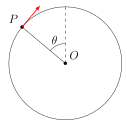
The plot of `Rhode Island Red and the Henhouse of Doom' calls for the heroine to cling on to the circumference of a fairground wheel of radius \(a\) rotating with constant angular velocity \(\omega\) about its horizontal axis and then let go. Let \(\omega_{0}\) be the largest value of \(\omega\) for which it is not possible for her subsequent path to carry her higher than the top of the wheel. Find \(\omega_{0}\) in terms of \(a\) and \(g\). If \(\omega>\omega_{0}\) show that the greatest height above the top of the wheel to which she can rise is \[\frac{a}{2}\left(\frac{\omega}{\omega_{0}} -\frac{\omega_{0}}{\omega}\right)^{\!\!2}.\]
Solution:
1996 Paper 3 Q4
Find the integers \(k\) satisfying the inequality \(k\leqslant2(k-2).\) Given that \(N\) is a strictly positive integer consider the problem of finding strictly positive integers whose sum is \(N\) and whose product is as large as possible. Call this largest possible product \(P(N).\) Show that \(P(5)=2\times3, P(6)=3^{2}, P(7)=2^{2}\times3, P(8)=2\times3^{2}\) and \(P(9)=3^{3}.\) Find \(P(1000)\) explaining your reasoning carefully.
Solution: \begin{align*} && k &\leq 2(k-2) \\ \Rightarrow && 4 &\leq k \end{align*} Lemma: Suppose we construct \(N \neq \) (optimally) as a sum out of \(a_1 + \cdots +a_k\), then \(a_i \in \{2, 3\}\). Proof: Suppose not, suppose some \(a_i > 3\). Then from our earlier inequality, the sum \(a_1 + \cdots +a_{i-1} + 2 + (a_i - 2) + \cdots \) has the same sum, but a larger product. Therefore \(a_i \leq 3\). Suppose also some \(a_i = 1\), then we could replace \(a_1\) with \(a_1+1\) and remove \(a_i\), leaving us again with the same sum but larger product. (Assuming \(N \neq 1\)) \(5 = 2+3\) is the only way to write \(5\) as a sum of \(2\)s and \(3\)s, therefore \(P(5) = 2\times 3\) \(6 = 2 + 2 + 2 = 3 + 3\) and we can immediately see that \(2^3 = 8 < 3^2 = 9\), so \(P(6) = 3^2\) and whenever we have three \(2\)s we should replace them with two \(3\)s. So \(7 = 2 + 2 + 3 \Rightarrow P(7) = 2^2 \times 3\) \(8 = 3 + 3 + 2 \Rightarrow P(8) = 2\times 3^2\) \(9 = 3 + 3 + 3 \Rightarrow P(9) = 3^3\) Suppose \(1000 = 2n + 3m\), considered \(\pmod{3}\) we can see that \(n \equiv 2 \pmod{3}\) therefore we should have \(1000 = 2 + 2 + \underbrace{3 + \cdots + 3}_{332\text{ }3\text{s}}\) and so \(P(1000) = 2^2 \times 3^{332}\)
1996 Paper 3 Q9
A particle of mass \(m\) is at rest on top of a smooth fixed sphere of radius \(a\). Show that, if the particle is given a small displacement, it reaches the horizontal plane through the centre of the sphere at a distance % at least $$a(5\sqrt5+4\sqrt23)/27$$ from the centre of the sphere. [Air resistance should be neglected.]
1995 Paper 1 Q11
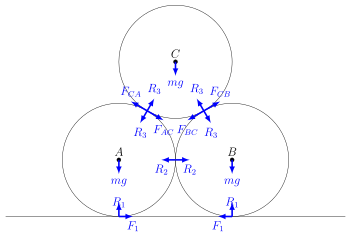
Two identical uniform cylinders, each of mass \(m,\) lie in contact with one another on a horizontal plane and a third identical cylinder rests symmetrically on them in such a way that the axes of the three cylinders are parallel. Assuming that all the surfaces in contact are equally rough, show that the minimum possible coefficient of friction is \(2-\sqrt{3}.\)
Solution:
1995 Paper 1 Q14
- Find the maximum value of \(\sqrt{p(1-p)}\) as \(p\) varies between \(0\) and \(1\).
- Suppose that a proportion \(p\) of the population is female. In order to estimate \(p\) we pick a sample of \(n\) people at random and find the proportion of them who are female. Find the value of \(n\) which ensures that the chance of our estimate of \(p\) being more than \(0.01\) in error is less than 1\%.
- Discuss how the required value of \(n\) would be affected if (a) \(p\) were the proportion of people in the population who are left-handed; (b) \(p\) were the proportion of people in the population who are millionaires.
Solution:
- \(\,\) \begin{align*} && \sqrt{p(1-p)} &= \sqrt{p-p^2} \\ &&&= \sqrt{\tfrac14-(\tfrac12-p)^2} \\ &&&\leq \sqrt{\tfrac14} = \tfrac12 \end{align*} Therefore the maximum is \(\tfrac12\) when \(p=\frac12\)
- Notice that our estimate \(\hat{p}\) will (for large \(n\)) be follow a normal distribution \(N(p, pq/n)\) by either the normal approximation to the binomial or central limit theorem. We would like \(0.01 > \mathbb{P}\left ( |\hat{p}-p| < 0.01 \right)\) or in other words \begin{align*} && 0.01 &> \mathbb{P}\left ( |\hat{p}-p| > 0.01 \right) \\ &&&=\mathbb{P}\left ( |\sqrt{\frac{pq}{n}}Z+p-p| > 0.01 \right) \\ &&&= \mathbb{P} \left (|Z|>\frac{0.01\sqrt{n}}{\sqrt{pq}}\right) \end{align*} therefore we need \(\frac{0.01\sqrt{n}}{\sqrt{pq}}> 2.58 \Rightarrow n > 258^2 pq \approx 2^{14} \approx 16\,000\), where we are using \(pq = \frac14\) as the worst case possibility and \(258 \approx 256 = 2^8\)
- If we were looking at when we are looking at left handed people (maybe ~\(10\%\), we would be looking at \(pq = \frac{9}{100}\) so we need a smaller sample). If we are looking at millionaires (an even smaller again percentage), we would need an even smaller sample. This is surprising since you would expect you would need a larger sample to accurately gauge smaller proportions. However, this surprise can be resolved by considering that this is an absolute error. For smaller values the relative error is larger, but the absolute error is smaller.
1995 Paper 2 Q5
The famous film star Birkhoff Maclane is sunning herself by the side of her enormous circular swimming pool (with centre \(O\)) at a point \(A\) on its circumference. She wants a drink from a small jug of iced tea placed at the diametrically opposite point \(B\). She has three choices:
- to swim directly to \(B\).
- to choose \(\theta\) with \(0<\theta<\pi,\) to run round the pool to a point \(X\) with \(\angle AOX=\theta\) and then to swim directly from \(X\) to \(B\).
- to run round the pool from \(A\) to \(B\).
1995 Paper 2 Q9
\noindent
1995 Paper 2 Q12
Bread roll throwing duels at the Drones' Club are governed by a strict etiquette. The two duellists throw alternatively until one is hit, when the other is declared the winner. If Percy has probability \(p>0\) of hitting his target and Rodney has probability \(r>0\) of hitting his, show that, if Percy throws first, the probability that he beats Rodney is \[ \frac{p}{p+r-pr}. \] Algernon, Bertie and Cuthbert decide to have a three sided duel in which they throw in order \(\mathrm{A,B,C,A,B,C,}\ldots\) except that anyone who is hit must leave the game. Cuthbert always his target, Bertie hits his target with probability \(3/5\) and Algernon hits his target with probability \(2/5.\) Bertie and Cuthbert will always aim at each other if they are both still in the duel. Otherwise they aim at Algernon. With his first shot Algernon may aim at either Bertie or Cuthbert or deliberately miss both. Faced with only one opponent Algernon will aim at him. What are Algernon's changes of winning if he:
- sep}{3mm}
- \(\bf (i)\) hits Cuthbert with his first shot?
- \(\bf (ii)\) hits Bertie with his first shot?
- \(\bf (iii)\) misses with his first shot?
1995 Paper 2 Q13
Fly By Night Airlines run jumbo jets which seat \(N\) passengers. From long experience they know that a very small proportion \(\epsilon\) of their passengers fail to turn up. They decide to sell \(N+k\) tickets for each flight. If \(k\) is very small compared with \(N\) explain why they might expect \[ \mathrm{P}(r\mbox{ passengers fail to turn up})=\frac{\lambda^{r}}{r!}\mathrm{e}^{-\lambda} \] approximately, with \(\lambda=N\epsilon.\) For the rest of the question you may assume that the formula holds exactly. Each ticket sold represents \(\pounds A\) profit, but the airline must pay each passenger that it cannot fly \(\pounds B\) where \(B>A>0.\) Explain why, if \(r\) passengers fail to turn up, its profit, in pounds, is \[ A(N+k)-B\max(0,k-r), \] where \(\max(0,k-r)\) is the larger of \(0\) and \(k-r.\) Write down the expected profit \(u_{k}\) when \(k=0,1,2\) and \(3.\) Find \(v_{k}=u_{k+1}-u_{k}\) for general \(k\) and show that \(v_{k}>v_{k+1}.\) Show also that \[ v_{k}\rightarrow A-B \] as \(k\rightarrow\infty.\) Advise Fly By Night on how to choose \(k\) to maximise its expected profit \(u_{k}.\)
1995 Paper 3 Q9
A thin circular disc of mass \(m\), radius \(r\) and with its centre of mass at its centre \(C\) can rotate freely in a vertical plane about a fixed horizontal axis through a point \(O\) of its circumference. A particle \(P\), also of mass \(m,\) is attached to the circumference of the disc so that the angle \(OCP\) is \(2\alpha,\) where \(\alpha\leqslant\pi/2\).
- In the position of stable equilibrium \(OC\) makes an angle \(\beta\) with the vertical. Prove that \[ \tan\beta=\frac{\sin2\alpha}{2-\cos2\alpha}. \]
- The density of the disc at a point distant \(x\) from \(C\) is \(\rho x/r.\) Show that its moment of inertia about the horizontal axis through \(O\) is \(8mr^{2}/5\).
- The mid-point of \(CP\) is \(Q\). The disc is held at rest with \(OQ\) horizontal and \(C\) lower than \(P\) and it is then released. Show that the speed \(v\) with which \(C\) is moving when \(P\) passes vertically below \(O\) is given by \[ v^{2}=\frac{15gr\sin\alpha}{2(2+5\sin^{2}\alpha)}. \] Find the maximum value of \(v^{2}\) as \(\alpha\) is varied.
1995 Paper 3 Q10
A cannon is situated at the bottom of a plane inclined at angle \(\beta\) to the horizontal. A (small) cannon ball is fired from the cannon at an initial speed \(u.\) Ignoring air resistance, find the angle of firing which will maximise the distance up the plane travelled by the cannon ball and show that in this case the ball will land at a distance \[ \frac{u^{2}}{g(1+\sin\beta)} \] from the cannon.
1995 Paper 3 Q11
A ship is sailing due west at \(V\) knots while a plane, with an airspeed of \(kV\) knots, where \(k>\sqrt{2},\) patrols so that it is always to the north west of the ship. If the wind in the area is blowing from north to south at \(V\) knots and the pilot is instructed to return to the ship every thirty minutes, how long will her outward flight last? Assume that the maximum distance of the plane from the ship during the above patrol was \(d_{w}\) miles. If the air now becomes dead calm, and the pilot's orders are maintained, show that the ratio \(d_{w}/d_{c}\) of \(d_{w}\) to the new maximum distance, \(d_{c}\) miles, of the plane from the ship is \[ \frac{k^{2}-2}{2k(k^{2}-1)}\sqrt{4k^{2}-2}. \]
1995 Paper 3 Q13
A message of \(10^{k}\) binary digits is sent along a fibre optic cable with high probabilities \(p_{0}\) and \(p_{1}\) that the digits 0 and 1, respectively, are received correctly. If the probability of a digit in the original message being a 1 is \(\alpha,\) find the probability that the entire message is received correctly. Find the probability \(\beta\) that a randomly chosen digit in the message is received as a 1 and show that \(\beta=\alpha\) if, and only if \[ \alpha=\frac{q_{0}}{q_{1}+q_{0}}, \] where \(q_{0}=1-p_{0}\) and \(q_{1}=1-p_{1}.\) If this condition is satisfied and the received message consists entirely of zeros, what is the probability that it is correct? If now \(q_{0}=q_{1}=q\) and \(\alpha=\frac{1}{2},\) find the approximate value of \(q\) which will ensure that a message of one million binary digits has a fifty-fifty chance of being received entirely correctly. The probability of error \(q\) is proportional to the square of the length of the cable. Initially the length is such that the probability of a message of one million binary bits, among which 0 and 1 are equally likely, being received correctly is \(\frac{1}{2}.\) What would this probability become if a booster station were installed at its mid-point, assuming that the booster station re-transmits the received version of the message, and assuming that terms of order \(q^{2}\) may be ignored?
1994 Paper 1 Q1
My house has an attic consisting of a horizontal rectangular base of length \(2q\) and breadth \(2p\) (where \(p < q\)) and four plane roof sections each at angle \(\theta\) to the horizontal. Show that the length of the roof ridge is independent of \(\theta\) and find the volume of the attic and the surface area of the roof.
Solution:

1994 Paper 1 Q9
A cannon-ball is fired from a cannon at an initial speed \(u\). After time \(t\) it has reached height \(h\) and is at a distance \(\sqrt{x^{2}+h^{2}}\) from the cannon. Ignoring air resistance, show that \[ \tfrac{1}{4}g^{2}t^{4}-(u^{2}-gh)t^{2}+h^{2}+x^{2}=0. \] Hence show that if \(u^{2}>2gh\) then the horizontal range for a given height \(h\) and initial speed \(u\) is less than or equal to \[ \frac{u\sqrt{u^{2}-2gh}}{g}. \] Show that there is always an angle of firing for which this value is attained.
Solution: Suppose it is fired with angle to the horizontal \(\alpha\), then \begin{align*} \rightarrow: && x &= u\cos \alpha \cdot t \\ \uparrow: && h &= u \sin \alpha \cdot t - \frac12 g t^2 \\ \Rightarrow && u\cos \alpha &= \frac{x}{t} \\ && u \sin \alpha &= \frac{h + \frac12 gt^2}{t} \\ \Rightarrow && u^2 &= \frac{x^2}{t^2} + \frac{(h + \frac12 gt^2)^2}{t^2} \\ \Rightarrow && 0 &= x^2+h^2-u^2t^2+ght^2+\tfrac14 g^2 t^4 \\ &&&= \tfrac14 g^2 t^4 - (u^2 - gh)t^2 + h^2 + x^2 \end{align*} For a distance \(x\) to be achievable there must be a root to this quadratic in \(t^2\), ie \begin{align*} && 0 &\leq \Delta = (u^2-gh)^2 - 4 \cdot \tfrac14 g^2 (h^2 + x^2) \\ \Rightarrow && x^2 &\leq \frac{(u^2-gh)^2}{g^2} - h^2 \\ &&&= \frac{u^4+g^2h^2 - 2ghu^2-g^2h^2}{g^2} \\ &&&= \frac{u^2(u^2-2gh)}{g^2} \\ \Rightarrow && x &\leq \frac{u\sqrt{u^2-2gh}}{g} \end{align*} This is achieved when \begin{align*} && t^2 &= \frac{u^2-gh}{\tfrac12g^2}\\ &&&= \frac{2(u^2-gh)}{g^2} \\ \Rightarrow && \cos \alpha &= \frac{u\sqrt{u^2-2gh}}{g} \cdot \frac{g}{\sqrt{2(u^2-gh)}} \frac{1}{u} \\ &&&= \frac{1}{\sqrt{2}} \end{align*} ie when \(\alpha = \frac{\pi}{4}\)