Problems
Filters
298 problems found
2006 Paper 2 Q6
By considering a suitable scalar product, prove that \[ (ax+by+cz)^2 \le (a^2+b^2+c^2)(x^2+y^2+z^2) \] for any real numbers \(a\), \(b\), \(c\), \(x\), \(y\) and \(z\). Deduce a necessary and sufficient condition on \(a\), \(b\), \(c\), \(x\), \(y\) and \(z\) for the following equation to hold: \[ (ax+by+cz)^2 = (a^2+b^2+c^2)(x^2+y^2+z^2) \,. \]
- Show that \((x+2y+2z)^2 \le 9(x^2+y^2+z^2)\) for all real numbers \(x\), \(y\) and \(z\).
- Find real numbers \(p\), \(q\) and \(r\) that satisfy both \[ p^2+4q^2+9r^2 = 729 \text{ and } 8p+8q+3r = 243\,. \]
Solution: Consider \(\begin{pmatrix} a \\ b \\ c \end{pmatrix}\), \(\begin{pmatrix} x \\ y \\ z \end{pmatrix}\), then we know that \begin{align*} && \begin{pmatrix} a \\ b \\ c \end{pmatrix} \cdot \begin{pmatrix} x \\ y \\ z \end{pmatrix} &= \sqrt{a^2+b^2+c^2} \sqrt{x^2+y^2+z^2} \cos \theta \\ \Rightarrow && (ax+by+cz)^2 &= (a^2+b^2+c^2)(x^2+y^2+z^2) \cos^2 \theta \\ &&&\leq (a^2+b^2+c^2)(x^2+y^2+z^2) \end{align*} For equality to hold, we must have that the vectors are parallel, ie \(\begin{pmatrix} a \\ b \\ c \end{pmatrix} = \lambda \begin{pmatrix} x \\ y \\ z \end{pmatrix}\)
- By applying our inequality from the first part with \(a=1, b = 2, c=2\) we have \((x+2y+2z)^2 \leq (1+2^2+2^2)(x^2+y^2+z^2) = 9(x^2+y^2+z^2)\)
- Since \begin{align*} && (p^2+(2q)^2+(3r)^2)\left (8^2 +4^2+1^2 \right) &\geq (8p+8q+3r)^2 \\ \Leftrightarrow && 729 \cdot 81 &\geq 243^2 \\ &&3^6 \cdot 3^4 &\geq 3^{10} \end{align*} Therefore we must be in the equality case, ie \(p = 8\lambda, 2q = 4\lambda, 3r = \lambda\) as well as \(64\lambda + 16\lambda +\lambda = 243 \Rightarrow 81\lambda = 243 \Rightarrow \lambda = 3\) so we have \[ (p,q,r) = \left (24, 6, 1 \right) \]
2006 Paper 2 Q9
A painter of weight \(kW\) uses a ladder to reach the guttering on the outside wall of a house. The wall is vertical and the ground is horizontal. The ladder is modelled as a uniform rod of weight \(W\) and length \(6a\). The ladder is not long enough, so the painter stands the ladder on a uniform table. The table has weight \(2W\) and a square top of side \(\frac12 a\) with a leg of length \(a\) at each corner. The foot of the ladder is at the centre of the table top and the ladder is inclined at an angle \(\arctan 2\) to the horizontal. The edge of the table nearest the wall is parallel to the wall. The coefficient of friction between the foot of the ladder and the table top is \(\frac12\). The contact between the ladder and the wall is sufficiently smooth for the effects of friction to be ignored.
- Show that, if the legs of the table are fixed to the ground, the ladder does not slip on the table however high the painter stands on the ladder.
- It is given that \(k=9\) and that the coefficient of friction between each table leg and the ground is \(\frac13\). If the legs of the table are not fixed to the ground, so that the table can tilt or slip, determine which occurs first when the painter slowly climbs the ladder.
2006 Paper 2 Q10
Three particles, \(A\), \(B\) and \(C\), of masses \(m\), \(km\) and \(3m\) respectively, are initially at rest lying in a straight line on a smooth horizontal surface. Then \(A\) is projected towards \(B\) at speed \(u\). After the collision, \(B\) collides with \(C\). The coefficient of restitution between \(A\) and \(B\) is \(\frac12\) and the coefficient of restitution between \(B\) and \(C\) is \(\frac14\).
- Find the range of values of \(k\) for which \(A\) and \(B\) collide for a second time.
- Given that \(k=1\) and that \(B\) and \(C\) are initially a distance \(d\) apart, show that the time that elapses between the two collisions of \(A\) and \(B\) is \(\dfrac{60d}{13u}\,\).
Solution:
- After the first collision, it takes \(B\), \(\frac{d}{v_B} = \frac{d}{u} \frac{2(k+1)}{3} = \frac{4d}{3u}\) to collide with \(C\). During which time \(B\) and \(A\) have been moving apart with speed \(\frac12u\) and so are a distance \(\frac{2d}{3}\) apart. After the second collision, \(w_B = \frac{3(4\cdot 1 - 3)}{8(1+1)(1+3)}u = \frac{3}{64}u\) and \(v_A = \frac{1}{4}u\) so they are moving together at speed \(\frac{16-3}{64}u = \frac{13}{64}u\). It will take them \(\frac{2d}{3} \div \frac{13}{64}u = \frac{128d}{3 \times 13u}\) to do this for a total time of \(\frac{128d}{3 \times 13u} + \frac{4d}{3u} = \frac{(128+52)d}{3 \times 13 u} = \frac{60d}{13u}\)
2005 Paper 1 Q3
In this question \(a\) and \(b\) are distinct, non-zero real numbers, and \(c\) is a real number.
- Show that, if \(a\) and \(b\) are either both positive or both negative, then the equation \[ \displaystyle \frac {x }{ x-a} + \frac{x }{ x-b} = 1 \] has two distinct real solutions.
- Show that, if \(c\ne1\), the equation \[\displaystyle \frac x { x-a} + \frac{x}{ x-b} = 1 + c\] has exactly one real solution if \(\displaystyle c^2 = - \frac {4ab}{\l a - b \r ^2}\) Show that this condition can be written \(\displaystyle c^2= 1 - \l \frac {a+b}{a-b} \r ^2 \) and deduce that it can only hold if \(0 < c^2 \le 1\,\).
Solution:
- \(\,\) \begin{align*} && 1 &= \frac{x}{x-a} + \frac{x}{x-b} \\ \Leftrightarrow && (x-a)(x-b) &= x(2x-a-b) \\ \Leftrightarrow && 0 &= x^2-ab \end{align*} Therefore if \(a,b\) are both positive or both negative, \(ab > 0\) and there are two distinct solutions \(x = \pm \sqrt{ab}\)
- \(\,\) \begin{align*} && 1+c &= \frac{x}{x-a} + \frac{x}{x-b} \\ \Leftrightarrow && (1+c)(x-a)(x-b) &= x(2x-a-b) \\ \Leftrightarrow && 0 &= (c-1)x^2-c(a+b)x+ab(1+c) \\ \\ && 0 &= \Delta = c^2(a+b)^2 - 4 \cdot(c-1)\cdot ab(1+c) \\ &&&= c^2(a+b)^2-4ab(c^2-1) \\ &&&= c^2 ((a+b)^2-4ab)+4ab \\ &&&= c^2(a-b)^2+4ab \\ \Rightarrow && c^2 &= -\frac{4ab}{(a-b)^2} \\ &&&= -\frac{(a+b)^2-(a-b)^2}{(a-b)^2} \\ &&&= 1 - \left ( \frac{a+b}{a-b} \right)^2 \end{align*} Note that \(c^2 \geq 0\) and \(1-x^2 \leq 1\) so \(0 \leq c^2 \leq 1\). \(c^2 = 0 \Rightarrow ab = 0\), but this is not possible since \(a,b \neq 0\), therefore \(0 < c^2 \leq 1\)
2005 Paper 1 Q12
- The probability that a hobbit smokes a pipe is 0.7 and the probability that a hobbit wears a hat is 0.4. The probability that a hobbit smokes a pipe but does not wear a hat is \(p\). Determine the range of values of \(p\) consistent with this information.
- The probability that a wizard wears a hat is 0.7; the probability that a wizard wears a cloak is 0.8; and the probability that a wizard wears a ring is 0.4. The probability that a wizard does not wear a hat, does not wear a cloak and does not wear a ring is 0.05. The probability that a wizard wears a hat, a cloak and also a ring is 0.1. Determine the probability that a wizard wears exactly two of a hat, a cloak, and a ring. The probability that a wizard wears a hat but not a ring, given that he wears a cloak, is \(q\). Determine the range of values of \(q\) consistent with this information.
Solution:
- \(\,\)
The overlap can be at most 0.4, which would mean \(p =0.7-0.4 = 0.3\) It must be at least 0.1, which would mean \(p =0.7-0.1 = 0.6\) so \(0.3 \leq p \leq 0.6\)

- Notice that: \begin{align*} && 1 &= 0.05 + 0.7 -(hc+hr+0.1) + \\ &&&\quad\quad 0.8 - (hc+cr + 0.1) + \\ &&&\quad \quad \quad 0.4 - (hr+cr+0.1) +\\ &&&\quad \quad \quad \quad hc+hr+cr+0.1 \\ && &= 0.05 +0.7+0.8+0.4 - (hc+hr+cr)-2\cdot 0.1 \\ \Rightarrow && hc+hr+cr &=0.05 +0.7 + 0.8 + 0.4 - 0.2-1 \\ \Rightarrow && \mathbb{P}(\text{exactly 2}) &= 0.75 \end{align*} Notice \(q = \frac{hc}{0.8}\) Notice that we must have: \(hc, hr cr \geq 0\) as well as \(hc+hr+cr = 0.75\) \begin{align*} && \mathbb{P}(\text{only hat}) &= 0.7 -(hc+hr+0.1) \geq 0 \\ \Rightarrow && hc+hr & \leq 0.6 \\ && \mathbb{P}(\text{only cloak}) &= 0.8 - (hc+cr + 0.1)\geq 0 \\ \Rightarrow &&hc+cr & \leq 0.7 \\ && \mathbb{P}(\text{only ring}) &= 0.4 - (hr+cr+0.1) \geq 0 \\ \Rightarrow && hc+hr & \leq 0.3 \\ \end{align*} To find the minimum for \(hc\) we want to maximise \(hr+cr = 0.3\), so \(hc = 0.75 - 0.3 = 0.45\). To find the maximum for \(hc\) we want to minimise \(hr\) and \(cr\) \(cr \leq 0.7 - hc\) and \(hr \leq 0.6 - hc\) so \(0.75 \leq hc + (0.6 - hc) + (0.7 - hc) = 1.3-hc\) so \(hc \leq 1.3 - 0.75 = 0.55\) Therefore the range for \(q\) is \(\frac{.45}{.8}\) to \(\frac{.55}{.8}\) or \(\frac9{16} \leq q \leq \frac{11}{16}\)

2005 Paper 2 Q3
Give a sketch, for \(0 \le x \le \frac{1}{2}\pi\), of the curve $$ y = (\sin x - x\cos x)\;, $$ and show that \(0\le y \le 1\,\). Show that:
- \(\displaystyle \int_0^{\frac{1}{2}\pi}\,y\;\d x = 2 -\frac \pi 2 \)
- \(\displaystyle \int_0^{\frac{1}{2}\pi}\,y^2\,\d x = \frac{\pi^3}{48}-\frac \pi 8 \)
Solution:
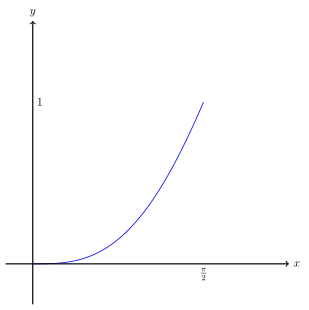
- \(\,\) \begin{align*} \int_0^{\frac{1}{2}\pi}\,y\;\d x &= \int_0^{\frac{1}{2}\pi} (\sin x - x \cos x) \d x \\ &= \left [-\cos x \right]_0^{\frac{1}{2}\pi} +\left [ -x \sin x \right]_0^{\frac{1}{2}\pi} + \int_0^{\frac{1}{2}\pi} \sin x \d x \\ &= 1-\frac{\pi}{2} + 1 = 2 - \frac{\pi}{2} \end{align*}
- \(\,\) \begin{align*} \int_0^{\frac{1}{2}\pi}y^2\d x &= \int_0^{\frac{1}{2}\pi} (\sin x - x \cos x)^2 \d x \\ &= \int_0^{\frac{1}{2}\pi} (\sin^2x - 2x\sin x \cos x+x^2\cos^2 x) \d x\\ &= \int_0^{\frac{1}{2}\pi} (\sin^2x -x \sin 2x+\tfrac12x^2(\cos 2 x + 1)) \d x\\ &= \frac{\pi}{4} + \frac{\pi^3}{48} + \int_0^{\frac{1}{2}\pi} (-x \sin 2x+\tfrac12x^2\cos 2 x) \d x \\ &= \frac{\pi}{4} + \frac{\pi^3}{48} + \left [\frac12 x \cos 2x +\frac14 x^2 \sin2x\right]_0^{\frac{1}{2}\pi}-\int_0^{\frac{1}{2}\pi}(\tfrac12 \cos 2x +\tfrac12 x \sin 2x) \d x\\ &= \frac{\pi}{4} + \frac{\pi^3}{48} - \frac{\pi}{4} - \left [ \frac14 \sin 2x \right]_0^{\frac{1}{2}\pi} - \int_0^{\frac{1}{2}\pi} \tfrac12 x \sin 2x \d x\\ &= \frac{\pi^3}{48} - \left( \left[ -\frac14 x \cos 2x \right]_0^{\frac{1}{2}\pi} - \int_0^{\frac{1}{2}\pi} -\frac14 \cos 2x \d x \right)\\ &= \frac{\pi^3}{48} - \left( \frac{\pi}{8} + \left[ \frac18 \sin 2x \right]_0^{\frac{1}{2}\pi} \right)\\ &= \frac{\pi^3}{48} - \frac{\pi}{8} \end{align*}
2005 Paper 2 Q5
The angle \(A\) of triangle \(ABC\) is a right angle and the sides \(BC\), \(CA\) and \(AB\) are of lengths \(a\), \(b\) and \(c\), respectively. Each side of the triangle is tangent to the circle \(S_1\) which is of radius \(r\). Show that \(2r = b+c-a\). Each vertex of the triangle lies on the circle~\(S_2\). The ratio of the area of the region between~\(S_1\) and the triangle to the area of \(S_2\) is denoted by \(R\,\). Show that $$ \pi R = -(\pi-1)q^2 + 2\pi q -(\pi+1) \;, $$ where \(q=\dfrac{b+c}a\,\). Deduce that $$ R\le \frac1 {\pi( \pi - 1)} \;. $$
2005 Paper 2 Q7
The position vectors, relative to an origin \(O\), at time \(t\) of the particles \(P\) and \(Q\) are $$\cos t \; {\bf i} + \sin t\;{\bf j} + 0 \; {\bf k} \text{ and } \cos (t+\tfrac14{\pi})\, \big[{\tfrac32}{\bf i} + { \tfrac {3\sqrt{3}}2} {\bf k}\big] + 3\sin(t+\tfrac14{\pi}) \; {\bf j}\;,$$ respectively, where \(0\le t \le 2\pi\,\).
- Give a geometrical description of the motion of \(P\) and \(Q\).
- Let \(\theta\) be the angle \(POQ\) at time \(t\) that satisfies \(0\le\theta\le\pi\,\). Show that \[ \cos\theta = \tfrac{3\surd2}{8} -\tfrac14 \cos( 2t +\tfrac14 \pi)\;. \]
- Show that the total time for which \(\theta \ge \frac14 \pi\) is \(\tfrac32 \pi\,\).
Solution:
- \(P\) is travelling in a unit circle about the origin in the \(\mathbf{i}-\mathbf{j}\) plane. \(Q\) is travelling in a circle (also about the origin, but in a different plane with radius \(3\)).
- \(\,\) \begin{align*} && \mathbf{p}\cdot \mathbf{q} &= |\mathbf{p}||\mathbf{q}| \cos \theta \\ \Rightarrow && \cos \theta &= \frac{\tfrac32\cos t \cos(t + \tfrac{\pi}4)+3\sin t \sin (t + \tfrac{\pi}{4})}{3} \\ &&&= \tfrac12\cos t \cos(t + \tfrac{\pi}4)+\sin t \sin (t + \tfrac{\pi}{4}) \\ &&&= \tfrac14 (\cos (2t + \tfrac{\pi}{4}) + \cos(\tfrac{\pi}{4} ))+\tfrac12(\cos(\tfrac{\pi}{4})-\cos(2t + \tfrac{\pi}{4})) \\ &&&= \tfrac{3\sqrt{2}}8 - \tfrac14 \cos ( 2t +\tfrac{\pi}{4}) \end{align*}
- If \(\theta \geq \frac14\pi\), then \(\cos \theta \leq \frac{\sqrt{2}}2\) \begin{align*} && \frac{\sqrt{2}}2 & \geq \frac{3\sqrt{2}}8 - \frac14 \cos ( 2t +\tfrac{\pi}{4}) \\ \Rightarrow && \frac{\sqrt{2}}2 &\geq -\cos(2t + \tfrac{\pi}{4}) \\ \Rightarrow && \cos(2t + \tfrac{\pi}{4}) &\geq -\frac{1}{\sqrt{2}} \\ \Rightarrow && 2t + \tfrac{\pi}{4} &\not\in (\tfrac{3\pi}{4},\tfrac{5\pi}{4}) \cup (\tfrac{11\pi}{4},\tfrac{13\pi}{4}) \\ \Rightarrow && t &\not\in (\tfrac{\pi}{4}, \tfrac{\pi}{2})\cup (\tfrac{5\pi}{4}, \tfrac{3\pi}{2}) \end{align*} which is is a time of \(\frac{\pi}{2}\), therefore the left over time is \(\frac32\pi\)
2005 Paper 3 Q1
Show that \(\sin A = \cos B\) if and only if \(A = (4n+1)\frac{\pi}{2}\pm B\) for some integer \(n\). Show also that \(\big\vert\sin x \pm \cos x \big\vert \le \sqrt{2}\) for all values of \(x\) and deduce that there are no solutions to the equation \(\sin\left( \sin x \right) = \cos \left( \cos x \right)\). Sketch, on the same axes, the graphs of \(y= \sin \left( \sin x \right)\) and \(y = \cos \left( \cos x \right)\). Sketch, not on the previous axes, the graph of \(y= \sin \left(2 \sin x \right)\).
Solution: \begin{align*} && \sin A &= \cos B \\ \Leftrightarrow && 0 &= \sin A - \cos B \\ &&&= \sin A - \sin ( \frac{\pi}{2} - B) \\ &&&= 2 \sin \left ( \frac{A + B - \frac{\pi}{2}}{2} \right) \cos \left (\frac{A - B + \frac\pi2}{2} \right) \\ \Leftrightarrow && n \pi &= \frac{A+B - \frac{\pi}{2}}{2}, n\pi + \frac{\pi}{2} = \frac{A-B+\frac{\pi}{2}}{2} \\ \Leftrightarrow && A \pm B &= 2n\pi + \frac{\pi}{2} \\ &&&= (4n+1) \frac{\pi}{2} \end{align*} \begin{align*} |\sin x \pm \cos x| &= | \sqrt{2} \sin(x \pm \frac{\pi}{4} )| \\ & \leq \sqrt{2} \end{align*} Therefore if \(\sin(\sin x) = \cos (\cos x)\) we must have that \(|\sin x \pm \cos x| = |(4n+1) \frac{\pi}{2}| \geq \frac{\pi}{2} > 1.5 > \sqrt{2}\) contradiction.


2005 Paper 3 Q10
Two thin discs, each of radius \(r\) and mass \(m\), are held on a rough horizontal surface with their centres a distance \(6r\) apart. A thin light elastic band, of natural length \(2\pi r\) and modulus \(\dfrac{\pi mg}{12}\), is wrapped once round the discs, its straight sections being parallel. The contact between the elastic band and the discs is smooth. The coefficient of static friction between each disc and the horizontal surface is \(\mu\), and each disc experiences a force due to friction equal to \(\mu mg\) when it is sliding. The discs are released simultaneously. If the discs collide, they rebound and a half of their total kinetic energy is lost in the collision.
- Show that the discs start sliding, but come to rest before colliding, if and only if \mbox{\(\frac23 <\mu <1\)}.
- Show that, if the discs collide at least once, their total kinetic energy just before the first collision is \(\frac43 mgr(2-3\mu)\).
- Show that if \(\frac 4 9 > \mu^2 >\frac{5}{27}\) the discs come to rest exactly once after the first collision.
2005 Paper 3 Q14
In this question, you may use the result \[ \displaystyle \int_0^\infty \frac{t^m}{(t+k)^{n+2}} \; \mathrm{d}t =\frac{m!\, (n-m)!}{(n+1)! \, k^{n-m+1}}\;, \] where \(m\) and \(n\) are positive integers with \(n\ge m\,\), and where \(k>0\,\). The random variable \(V\) has density function \[ \f(x) = \frac{C \, k^{a+1} \, x^a}{(x+k)^{2a+2}} \quad \quad (0 \le x < \infty) \;, \] where \(a\) is a positive integer. Show that \(\displaystyle C = \frac{(2a+1)!}{a! \, a!}\;\). Show, by means of a suitable substitution, that \[ \int_0^v \frac{x^a}{(x+k)^{2a+2}} \; \mathrm{d}x = \int_{\frac{k^2}{v}}^\infty \frac{u^a}{(u+k)^{2a+2}} \; \mathrm{d}u \] and deduce that the median value of \(V\) is \(k\). Find the expected value of \(V\). The random variable \(V\) represents the speed of a randomly chosen gas molecule. The time taken for such a particle to travel a fixed distance \(s\) is given by the random variable \(\ds T=\frac{s}{V}\). Show that \begin{equation} \mathbb{P}( T < t) = \ds \int_{\frac{s}{t}}^\infty \frac{C \, k^{a+1} \, x^a}{(x+k)^{2a+2}}\; \mathrm{d}x \tag{\( *\)} \end{equation} and hence find the density function of \(T\). You may find it helpful to make the substitution \(\ds u = \frac{s}{x}\) in the integral \((*)\). Hence show that the product of the median time and the median speed is equal to the distance \(s\), but that the product of the expected time and the expected speed is greater than \(s\).
Solution: \begin{align*} && f(x) &= \frac{C \, k^{a+1} \, x^a}{(x+k)^{2a+2}} \\ \Rightarrow && 1 &= \int_0^{\infty} f(x) \d x \\ &&&= \int_0^{\infty} \frac{C \, k^{a+1} \, x^a}{(x+k)^{2a+2}} \d x \\ &&&= Ck^{a+1} \int_0^{\infty} \frac{x^a}{(x+k)^{2a+2} }\d x \\ &&&= Ck^{a+1} \frac{a!(2a-a)!}{(2a+1)!k^{2a-a+1}} \\ &&&= C \frac{a!a!}{(2a+1)!} \\ \Rightarrow && C &= \frac{(2a+1)!}{a!a!} \end{align*} \begin{align*} && I &= \int_0^v \frac{x^a}{(x+k)^{2a+2}} \d x\\ u = k^2/x, \d x = -k^2u^{-2} \d u: &&&= \int_{u = +\infty}^{u = k^2/v} \frac{k^{2a}u^{-a}}{(k^2u^{-1} +k)^{2a+2}}(-k^2u^{-2}) \d u \\ &&&= \int_{u = +\infty}^{u = k^2/v} \frac{k^{2a-2a-2}u^{2a+2-a}}{(k +u)^{2a+2}}(-k^2u^{-2}) \d u \\ &&&= \int_{ k^2/v}^{\infty} \frac{u^{a}}{(k +u)^{2a+2}} \d u \\ \end{align*} At the median we want a value \(M\) such that \(M = k^2/M\) ie \(M = k\) \begin{align*} && \mathbb{E}(V) &= \int_0^{\infty} x f(x) \d x \\ &&&= \frac{(2a+1)!k^{a+1}}{a!a!} \int_0^{\infty} \frac{x^{a+1}}{(x+k)^{2a+2}} \d x \\ &&&= \frac{(2a+1)!k^{a+1}}{a!a!} \frac{(a+1)!(2a-(a+1))!}{(2a+1)!k^{2a-(a+1)+1}}\\ &&&= \frac{k^{a+1}}{a!} \frac{(a+1)(a-1)!}{k^{a}} \\ &&&= \frac{k(a+1)}{a} = \frac{a+1}a k \end{align*} \begin{align*} && \mathbb{P}(T < t) &= \mathbb{P}(\frac{s}{V} < t) \\ &&&= \mathbb{P}(V > \frac{s}{t}) \\ &&&= \int_{s/t}^{\infty} f(x) \d x \\ &&&= \int_{s/t}^{\infty} \frac{C \, k^{a+1} \, x^a}{(x+k)^{2a+2}} \d x \\ \\ \Rightarrow && f_T(t) &= \frac{\d}{\d t} \left ( \mathbb{P}(T < t)\right) \\ &&&= \frac{\d}{\d t} \left ( \int_{s/t}^{\infty} \frac{C \, k^{a+1} \, x^a}{(x+k)^{2a+2}} \d x \right) \\ &&&= - \frac{C \, k^{a+1} \, \left ( \frac{s}{t} \right)^a}{(\frac{s}{t}+k)^{2a+2}} \cdot \left (-\frac{s}{t^2} \right) \\ &&&= \frac{Ck^{a+1}s^{a+1}t^{2a+2}}{t^{a+2}(s+kt)^{2a+2}} \\ &&&= \frac{C(ks)^{a+1}t^a}{(s+kt)^{2a+2}} \\ &&&= \frac{C(\frac{s}{k})^{a+1}t^a}{(\frac{s}{k}+t)^{2a+2}} \end{align*} Therefore \(T\) follows the same distribution, but with parameter \(s/k\) rather than \(k\). In particular it has median \(s/k\) (and the product of the medians is \(s\)). However, the product of the expected time and expected speed is \(\frac{a+1}{a} k \frac{a+1}{a} \frac{s}{k} = \left ( \frac{a+1}{a} \right)^2s > s\)
2004 Paper 1 Q8
A sequence \(t_0\), \(t_1\), \(t_2\), \(...\) is said to be strictly increasing if \(t_{n+1} > t_n\) for all \(n\ge{0}\,\).
- The terms of the sequence \(x_0\,\), \(x_1\,\), \(x_2\,\), \(\ldots\) satisfy $$ \ds x_{n+1}=\frac{x_n^2 +6}{5} $$ for \(n\ge{0}\,\). Prove that if \(x_0 > 3\) then the sequence is strictly increasing.
- The terms of the sequence \(y_0\,\), \(y_1\,\), \(y_2\,\), \(\ldots\) satisfy $$ \ds y_{n+1}= 5-\frac 6 {y_n} $$ for \(n\ge{0}\,\). Prove that if \(2 < y_0 < 3\) then the sequence is strictly increasing but that \(y_n<3\) for all \(n\,\).
Solution:
- Suppose \(x_n> 3\) then \begin{align*} && x_{n+1} &= \frac{x_n^2+9-3}{5} \\ &&& \geq \frac{2\sqrt{x_n^2 \cdot 9} - 3}{5} \\ &&&= \frac{6x_n -3}{5} = x_n + \frac{x_n-3}{5} \\ &&&> x_n > 3 \end{align*} Therefore if \(x_i > 3 \Rightarrow x_{i+1} > x_i\) and \(x_{i+1} > 3\) so by induction \(x_n\) strictly increasing for all \(n\).
- Suppose \(2 < y_n < 3\) then \begin{align*} && y_{n+1} &= 5 - \frac6{y_n} \\ &&&< 5 - \frac63 = 3 \\ \\ && y_{n+1} &= 5 - \frac4{y_n} - \frac{2}{y_n} \\ \\ &&&= y_n + 5 - \frac{2}{y_n} - \left ( y_n + \frac4{y_n} \right) \\ &&&\geq y_n + 5 - \frac{2}{y_n} - 2\sqrt{y_n \frac{4}{y_n}} \\ &&&= y_n + 1 - \frac{2}{y_n} \\ &&&> y_n \end{align*} Therefore if \(y_n \in (2,3)\) we have \(y_{n+1} \in ( y_n, 3)\) and so \(y_n\) is strictly increasing and bounded.
2004 Paper 1 Q9
A particle is projected over level ground with a speed \(u\) at an angle \(\theta\) above the horizontal. Derive an expression for the greatest height of the particle in terms of \(u\), \(\theta\) and \(g\). A particle is projected from the floor of a horizontal tunnel of height \({9\over 10}d\). Point \(P\) is \({1\over 2}d\) metres vertically and \(d\) metres horizontally along the tunnel from the point of projection. The particle passes through point \(P\) and lands inside the tunnel without hitting the roof. Show that \[ \arctan \textstyle {3 \over 5} < \theta < \arctan \, 3 \;. \]
Solution: \begin{align*} && v^2 &= u^2 + 2as \\ (\uparrow): && 0 &= (u \sin \theta)^2 - 2gh \\ \Rightarrow && h &= \frac{u^2 \sin^2 \theta}{2g} \end{align*} To avoid hitting the ceiling \begin{align*} && \frac9{10}d &>\frac{u^2 \sin^2 \theta}{2g} \\ \Rightarrow && \frac{gd}{u^2}&>\frac{5\sin^2 \theta}{9} \\ \end{align*} In order to pass through \(P\) we need \begin{align*} && d &= u \cos \theta t \\ && \frac12 d &= u \sin \theta t - \frac12 g t^2 \\ \Rightarrow && \frac12 &= \tan \theta - \frac12 \frac{g d}{u^2} \sec^2 \theta \\ &&&<\tan \theta - \frac12 \frac{5 \sin^2 \theta}{9\cos^2 \theta} \\ \Rightarrow && 0 & >5 \tan^2 \theta -18\tan \theta +9 \\ &&&= (5\tan \theta - 3)(\tan \theta - 3) \\ \\ \Rightarrow && \tan \theta &\in \left ( \frac35, 3\right) \\ && \theta &= \left (\arctan \tfrac35, \arctan 3 \right) \end{align*}
2004 Paper 1 Q10
A particle is travelling in a straight line. It accelerates from its initial velocity \(u\) to velocity \(v\), where \(v > \vert u \vert > 0\,\), travelling a distance \(d_1\) with uniform acceleration of magnitude \(3a\,\). It then comes to rest after travelling a further distance \(d_2\,\) with uniform deceleration of magnitude \(a\,\). Show that
- if \(u>0\) then \(3d_1 < d_2\,\);
- if \(u<0\) then \(d_2 < 3d_1 < 2d_2\,\).
2004 Paper 2 Q1
Find all real values of \(x\) that satisfy:
- \( \ds \sqrt{3x^2+1} + \sqrt{x} -2x-1=0 \;;\)
- \( \ds \sqrt{3x^2+1} - 2\sqrt{x} +x-1=0 \;;\)
- \( \ds \sqrt{3x^2+1} - 2\sqrt{x} -x+1=0 \;.\)
Solution:
- \(\,\) \begin{align*} && 0 &= \sqrt{3x^2+1} + \sqrt{x} -2x-1 \\ \Rightarrow && 2x+1 &= \sqrt{3x^2+1} + \sqrt{x} \\ \Rightarrow && 4x^2+4x+1 &= 3x^2+1+x+2\sqrt{x(3x^2+1)} \\ \Rightarrow && x^2+3x &= 2\sqrt{x(3x^2+1)} \\ \Rightarrow && x^2(x^2+6x+9) &= 4x(3x^2+1) \\ \Rightarrow && 0 &= x^4-6x^3+9x^2-4x \\ &&&= x(x-4)(x-1)^2 \end{align*} So clearly we have \(x = 0, x = 1, x = 4\). \(x = 0\) works, \(x = 1\) works, \(x = 4\) works.
- \(\,\) \begin{align*} && 0 &= \sqrt{3x^2+1} - 2\sqrt{x} +x-1 \\ \Rightarrow && 1-x &= \sqrt{3x^2+1}-2\sqrt{x} \\ \Rightarrow && x^2-2x+1 &= 3x^2+1+4x-4\sqrt{x(3x^2+1)} \\ \Rightarrow && x^2+3x &= 2\sqrt{x(3x^2+1)} \\ \Rightarrow && 0 &= x(x-4)(x-1)^2 \end{align*} Again we must check \(x = 0, x = 1, x = 4\). \(x = 0,1\) work, but \(x = 4\) is not a solution.
- \(\,\) \begin{align*} && 0 &= \sqrt{3x^2+1} - 2\sqrt{x} -x+1 \\ \Rightarrow && x-1 &= \sqrt{3x^2+1} - 2\sqrt{x} \\ \Rightarrow && x^2-2x+1 &= 3x^2+1+4x-4\sqrt{x(3x^2+1)} \\ \Rightarrow && x^2+3x &= 2\sqrt{x(3x^2+1)}\\ \Rightarrow && 0 &= x(x-4)(x-1)^2 \end{align*} So again, we need to check \(x = 0, 1, 4\). \(x = 0, 4\) work, but \(x = 1\) fails.