Problems
Filters
218 problems found
2001 Paper 3 Q8
- Prove that the equations $$ \left|z - (1 + \mathrm{i}) \right|^2 = 2 \eqno(*) $$ and $$ \qquad \quad \ \left|z - (1 - \mathrm{i}) \right|^2 = 2 \left|z - 1 \right|^2 $$ describe the same locus in the complex \(z\)--plane. Sketch this locus.
- Prove that the equation $$ \arg \l {z - 2 \over z} \r = {\pi \over 4} \eqno(**) $$ describes part of this same locus, and show on your sketch which part.
- The complex number \(w\) is related to \(z\) by \[ w = {2 \over z}\;. \] Determine the locus produced in the complex \(w\)--plane if \(z\) satisfies \((*)\). Sketch this locus and indicate the part of this locus that corresponds to \((**)\).
2000 Paper 1 Q3
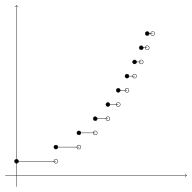
For any number \(x\), the largest integer less than or equal to \(x\) is denoted by \([x]\). For example, \([3.7]=3\) and \([4]=4\). Sketch the graph of \(y=[x]\) for \(0\le x<5\) and evaluate \[ \int_0^5 [x]\;\d x. \] Sketch the graph of \(y=[\e^{x}]\) for \(0\le x< \ln n\), where \(n\) is an integer, and show that \[ \int_{0}^{\ln n}[\e^{x}]\, \d x =n\ln n - \ln (n!). \]
Solution:

2000 Paper 1 Q6
Show that \[ x^2-y^2 +x+3y-2 = (x-y+2)(x+y-1) \] and hence, or otherwise, indicate by means of a sketch the region of the \(x\)-\(y\) plane for which $$ x^2-y^2 +x+3y>2. $$ Sketch also the region of the \(x\)-\(y\) plane for which $$ x^2-4y^2 +3x-2y<-2. $$ Give the coordinates of a point for which both inequalities are satisfied or explain why no such point exists.
Solution: \begin{align*} && (x-y+2)(x+y-1) &= (x-y)(x+y)-(x-y)+2(x+y)-2 \\ &&&= x^2-y^2+x+3y-2 \end{align*}


2000 Paper 3 Q1
Sketch on the same axes the two curves \(C_1\) and \(C_2\), given by
Solution:

2000 Paper 3 Q4
The function \(\f(x)\) is defined by $$ \f(x) = \frac{x( x - 2 )(x-a)}{ x^2 - 1}. $$ Prove algebraically that the line \(y = x + c\) intersects the curve \(y = \f ( x )\) if \(\vert a \vert \ge1\), but there are values of \(c\) for which there are no points of intersection if \(\vert a \vert <1\). Find the equation of the oblique asymptote of the curve \(y=\f(x)\). Sketch the graph in the two cases
- \(a<-1\)
- \(-1 < a < -\frac12\)
Solution: \begin{align*} && x+ c &= f(x) \\ \Rightarrow && (x+c)(x^2-1) &= x(x-2)(x-a) \\ \Rightarrow && x^3 + cx^2-x-c &= x^3-(2+a)x^2+2ax \\ \Rightarrow && 0 &= (c+2+a)x^2-(1+2a)x-c \\ && 0 &\leq \Delta = (1+2a)^2 + 4(2+c+a)c \\ &&&= 4c^2+(4a+8)c + (1+2a)^2 \\ && \Delta_c &= 16(a+2)^2-16(1+2a)^2 \\ &&&= 16(1-a)(3a+3) \\ &&&= 48(1-a^2) \end{align*} Therefore if \(|a| \geq 1\) we must have \(\Delta_c \leq 0\) which means \(\Delta \geq 0\) and so there are always solutions. If \(|a| < 1\) there are values for \(c\) where \(\Delta < 0\) and there would be no solutions. \begin{align*} && y &= \frac{x^3-(2+a)x^2+2ax}{x^2-1} \\ &&&= \frac{(x^2-1)(x-(2+a))+(2a+1)x-(2+a)}{x^2-1} \\ &&&= x - (2+a) + \frac{(2a+1)x-(2+a)}{x^2-1} \end{align*} therefore the oblique asymptote has equation \(y = x - (2+a)\)


1999 Paper 1 Q4
Sketch the following subsets of the \(x\)-\(y\) plane:
- \(|x|+|y|\le 1\) ;
- \(|x-1|+|y-1|\le 1 \) ;
- \(|x-1|-|y+1|\le 1 \) ;
- \(|x|\, |y-2|\le 1\) .
Solution:


1999 Paper 2 Q7
The curve \(C\) has equation $$ y = \frac x {\sqrt{x^2-2x+a}}\; , $$ where the square root is positive. Show that, if \(a>1\), then \(C\) has exactly one stationary point. Sketch \(C\) when (i) \(a=2\) and (ii) \(a=1\).
Solution: \begin{align*} && y &= \frac x {\sqrt{x^2-2x+a}} \\ && y' &= \frac{\sqrt{x^2-2x+a} - \frac{x(x-1)}{\sqrt{x^2-2x+a}}}{x^2-2x+a} \\ &&&= \frac{-x+a}{(x^2-2x+a)^{3/2}} \end{align*} Since the denominator is always positive, the only stationary point is when \(x = a\)


1999 Paper 3 Q2
- Let \(\f(x)=(1+x^2)\e^x\). Show that \(\f'(x)\ge 0\) and sketch the graph of \(\f(x)\). Hence, or otherwise, show that the equation \[ (1+x^2)\e^x = k, \] where \(k\) is a constant, has exactly one real root if \(k>0\) and no real roots if \(k\le 0\).
- Determine the number of real roots of the equation $$ (\e^x-1) - k \tan^{-1} x=0 $$ in the cases (a) \(0< k\le 2/\pi\) and (b) \(2/\pi < k < 1\).
Solution:
- \(\,\) \begin{align*}
&& f(x) &= (1+x^2)e^x \\
&& f'(x) &= 2xe^x + (1+x^2)e^x \\
&&&= (1+x)^2e^x \geq 0
\end{align*}
As \(x \to -\infty\), \(f(x) \to 0\) and as \(x \to \infty\), \(f(x) \to +\infty\) and since \(f\) is strictly increasing we have exactly one solution to \(f(x) = k\) on \((0,\infty)\). Since \(f(x) > 0\) there are no solutions if \(k \leq 0\).
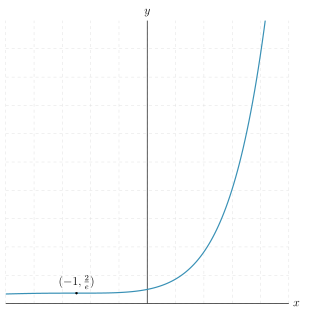
- Considering the function \(g(x) = (e^x-1)-k\tan^{-1} x \) then \(g'(x) = e^x - \frac{k}{1+x^2}\) therefore \(g'(x)\) has exactly one turning point when \(k > 0\) and \(0\) otherwise at the root of \(f(x) = k\) Notice also that \(g(0) = 0\) so we already have one solution, and \(g'(0) = 1 - k > 0\). Notice from our sketch that if \(0 < k < 1\) the root for \(f(x) = k\) has \(x \leq 0\), so our turning point is to the left of the origin and we are interested in the behaviour of \(g(x)\) as \(x \to -\infty\). (ie do we cross the axis again). \(\lim_{x \to -\infty} \left [ e^x - 1 - k \tan^{-1} x \right] = 0 - 1 +k \frac{\pi}{2} = k \frac{\pi}{2} - 1\). if this is positive, ie if \(k > \frac{2}{\pi}\) there are two solutions, otherwise there is only one real root.
1999 Paper 3 Q3
Justify, by means of a sketch, the formula $$ \lim_{n\rightarrow\infty}\left\{{1\over n}\sum_{m=1}^n \f(1+m/n)\right\} = \int_1^2 \f(x)\,\d x \,. $$ Show that $$ \lim_{n\rightarrow\infty}\left\{{1\over n+1} + {1\over n+2} + \cdots + {1\over n+n}\right\} = \ln 2 \,. $$ Evaluate $$ \lim_{n\rightarrow\infty}\left\{{n\over n^2+1} + {n\over n^2+4} + \cdots + {n\over n^2+n^2}\right\}\,. $$
Solution:

1999 Paper 3 Q6
A closed curve is given by the equation $$ x^{2/n} + y^{2/n} = a^{2/n} \eqno(*) $$ where \(n\) is an odd integer and \(a\) is a positive constant. Find a parametrization \(x=x(t)\), \(y=y(t)\) which describes the curve anticlockwise as \(t\) ranges from \(0\) to \(2\pi\). Sketch the curve in the case \(n=3\), justifying the main features of your sketch. The area \(A\) enclosed by such a curve is given by the formula $$ A= {1\over 2} \int_0^{2\pi} \left[ x(t) {\d y(t)\over \d t} - y(t) {\d x(t)\over \d t} \right] \,\d t \,. $$ Use this result to find the area enclosed by (\(*\)) for \(n=3\).
1998 Paper 2 Q6
Two curves are given parametrically by \[ x_{1}=(\theta+\sin\theta),\qquad y_{1}=(1+\cos\theta),\tag{1} \]and \[ x_{2}=(\theta-\sin\theta),\qquad y_{1}=-(1+\cos\theta),\tag{2} \] Find the gradients of the tangents to the curves at the points where \(\theta= \pi/2\) and \(\theta=3\pi/2\). Sketch, using the same axes, the curves for \(0\le\theta \le 2\pi\). Find the equation of the normal to the curve (1) at the point with parameter \(\theta\). Show that this normal is a tangent to the curve (2).
1998 Paper 3 Q1
Let $$ {\rm f}(x)=\sin^2x + 2 \cos x + 1 $$ for \(0 \le x \le 2\pi\). Sketch the curve \(y={\rm f}(x)\), giving the coordinates of the stationary points. Now let $$ \hspace{0.6in}{\rm g}(x)={a{\rm f}(x)+b \over c{\rm f}(x)+d} \hspace{0.8in} ad\neq bc\,,\; d\neq -3c\,,\; d\neq c\;. $$ Show that the stationary points of \(y={\rm g}(x)\) occur at the same values of \(x\) as those of \(y={\rm f}(x)\), and find the corresponding values of \({\rm g}(x)\). Explain why, if \(d/c <-3\) or \(d/c>1\), \(|{\rm g}(x)|\) cannot be arbitrarily large.
1998 Paper 3 Q4
Show that the equation (in plane polar coordinates) \(r=\cos\theta\), for $-\frac{1}{2}\pi \le \theta \le \frac{1}{2}\pi$, represents a circle. Sketch the curve \(r=\cos2\theta\) for \(0\le\theta\le 2\pi\), and describe the curves \(r=\cos2n\theta\), where \(n\) is an integer. Show that the area enclosed by such a curve is independent of \(n\). Sketch also the curve \(r=\cos3\theta\) for \(0\le\theta\le 2\pi\).
1998 Paper 3 Q7
Sketch the graph of \({\rm f}(s)={ \e}^s(s-3)+3\) for \(0\le s < \infty\). Taking \({\e\approx 2.7}\), find the smallest positive integer, \(m\), such that \({\rm f}(m) > 0\). Now let $$ {\rm b}(x) = {x^3 \over \e^{x/T} -1} \, $$ where \(T\) is a positive constant. Show that \({\rm b}(x)\) has a single turning point in \(0 < x < \infty\). By considering the behaviour for small \(x\) and for large \(x\), sketch \({\rm b}(x)\) for \(0\le x < \infty\). Let $$ \int_0^\infty {\rm b}(x)\,\d x =B, $$ which may be assumed to be finite. Show that \(B = K T^n\) where \(K\) is a constant, and \(n\) is an integer which you should determine. Given that \(\displaystyle{B \approx 2 \int_0^{Tm} {\rm b}(x) {\,\rm d }x}\), use your graph of \({\rm b}(x)\) to find a rough estimate for \(K\).
1997 Paper 1 Q8
By considering the maximum of \(\ln x-x\ln a\), or otherwise, show that the equation \(x=a^{x}\) has no real roots if \(a > e^{1/e}\). How many real roots does the equation have if \(0 < a < 1\)? Justify your answer.
Solution: \begin{align*} && y &= \ln x - x \ln a \\ \Rightarrow && y' &= \frac1x - \ln a \\ && y'' &= -\frac{1}{x^2} \end{align*} Therefore the maximum is when \(x = \frac{1}{\ln a}\) and \(y_{max} = -\ln \ln a - 1\). If \(y_{max} < 0\) then \(y \neq 0\). But that's equivalent to \(a > e^{1/e}\). \begin{align*} && 0 &> -\ln \ln a - 1 \\ \Leftrightarrow && 1 &> - \ln \ln a \\ \Leftrightarrow && \ln \ln a &>-1 \\ \Leftrightarrow && \ln a &> e^{-1} \\ \Leftrightarrow && a & > e^{1/e} \end{align*} If \(0 < a < 1\) then, when \(x\) is small, \(\ln x - x \ln a\) is large and negative. When \(x\) is large and positive \(\ln x\) is positive and \(-x \ln a\) is positive. We also notice there is no turning point. Hence exactly one solution