Problems
Filters
219 problems found
1998 Paper 3 Q7
Sketch the graph of \({\rm f}(s)={ \e}^s(s-3)+3\) for \(0\le s < \infty\). Taking \({\e\approx 2.7}\), find the smallest positive integer, \(m\), such that \({\rm f}(m) > 0\). Now let $$ {\rm b}(x) = {x^3 \over \e^{x/T} -1} \, $$ where \(T\) is a positive constant. Show that \({\rm b}(x)\) has a single turning point in \(0 < x < \infty\). By considering the behaviour for small \(x\) and for large \(x\), sketch \({\rm b}(x)\) for \(0\le x < \infty\). Let $$ \int_0^\infty {\rm b}(x)\,\d x =B, $$ which may be assumed to be finite. Show that \(B = K T^n\) where \(K\) is a constant, and \(n\) is an integer which you should determine. Given that \(\displaystyle{B \approx 2 \int_0^{Tm} {\rm b}(x) {\,\rm d }x}\), use your graph of \({\rm b}(x)\) to find a rough estimate for \(K\).
1998 Paper 3 Q13
Write down the probability of obtaining \(k\) heads in \(n\) tosses of a fair coin. Now suppose that \(k\) is known but \(n\) is unknown. A maximum likelihood estimator (MLE) of \(n\) is defined to be a value (which must be an integer) of \(n\) which maximizes the probability of \(k\) heads. A friend has thrown a fair coin a number of times. She tells you that she has observed one head. Show that in this case there are two MLEs of the number of tosses she has made. She now tells you that in a repeat of the exercise she has observed \(k\) heads. Find the two MLEs of the number of tosses she has made. She next uses a coin biased with probability \(p\) (known) of showing a head, and again tells you that she has observed \(k\) heads. Find the MLEs of the number of tosses made. What is the condition for the MLE to be unique?
Solution: \begin{align*} && \mathbb{P}(k \text{ heads} | n\text{ tosses}) &= \binom{n}k 2^{-n} \\ && \mathbb{P}(1 \text{ head} | n\text{ tosses}) &= n2^{-n} \\ \Rightarrow && \frac{ \mathbb{P}(1 \text{ head} | n+1\text{ tosses}) }{ \mathbb{P}(1 \text{ head} | n\text{ tosses}) } &= \frac{n+1}{2n} \end{align*} Which is less than \(1\) unless \(n \geq 1\). Therefore the MLE is \(n = 1\) or \(n= 2\). \begin{align*} \frac{ \mathbb{P}(k \text{ head} | n+1\text{ tosses}) }{ \mathbb{P}(k \text{ head} | n\text{ tosses}) } &= \frac{\binom{n+1}{k}}{2 \binom{n}{k}} \\ &= \frac{(n+1)!(n-k)!}{2n!(n+1-k)!} \\ &= \frac{n+1}{2(n+1-k)} \end{align*} This is less than or equal to \(1\) if \(n+1 = 2(n+1-k) \Leftrightarrow n= 2k-1\), therefore the MLEs are \(2k-1\) and \(2k\). If the coin is biased, we have \begin{align*} && \frac{ \mathbb{P}(k \text{ head} | n+1\text{ tosses}) }{ \mathbb{P}(k \text{ head} | n\text{ tosses}) } &= \frac{\binom{n+1}{k}p^kq^{n+1-k}}{\binom{n}{k}p^kq^{n-k}} \\ &&&= \frac{n+1}{(n+1-k)}q \\ \\ && 1 & \geq \frac{n+1}{(n+1-k)}q \\ \Leftrightarrow && (n+1)(1-q) &\geq k \\ \Leftrightarrow && n+1 & \geq \frac{k}{p} \end{align*} Therefore the probability is increasing until \(n+1 \geq \frac{k}{p}\). If \(\frac{k}p\) is an integer the MLEs are \(\frac{k}{p}-1\) and \(\frac{k}p\), otherwise it is \(\lfloor \frac{k}{p} \rfloor\) and the MLE is unique.
1997 Paper 1 Q8
By considering the maximum of \(\ln x-x\ln a\), or otherwise, show that the equation \(x=a^{x}\) has no real roots if \(a > e^{1/e}\). How many real roots does the equation have if \(0 < a < 1\)? Justify your answer.
Solution: \begin{align*} && y &= \ln x - x \ln a \\ \Rightarrow && y' &= \frac1x - \ln a \\ && y'' &= -\frac{1}{x^2} \end{align*} Therefore the maximum is when \(x = \frac{1}{\ln a}\) and \(y_{max} = -\ln \ln a - 1\). If \(y_{max} < 0\) then \(y \neq 0\). But that's equivalent to \(a > e^{1/e}\). \begin{align*} && 0 &> -\ln \ln a - 1 \\ \Leftrightarrow && 1 &> - \ln \ln a \\ \Leftrightarrow && \ln \ln a &>-1 \\ \Leftrightarrow && \ln a &> e^{-1} \\ \Leftrightarrow && a & > e^{1/e} \end{align*} If \(0 < a < 1\) then, when \(x\) is small, \(\ln x - x \ln a\) is large and negative. When \(x\) is large and positive \(\ln x\) is positive and \(-x \ln a\) is positive. We also notice there is no turning point. Hence exactly one solution
1997 Paper 1 Q9
A single stream of cars, each of width \(a\) and exactly in line, is passing along a straight road of breadth \(b\) with speed \(V\). The distance between the successive cars is \(c\).
1997 Paper 1 Q13
Mr Blond returns to his flat to find it in complete darkness. He knows that this means that one of four assassins Mr 1, Mr 2, Mr 3 or Mr 4 has set a trap for him. His trained instinct tells him that the probability that Mr \(i\) has set the trap is \(i/10\). His knowledge of their habits tells him that Mr \(i\) uses a deadly trained silent anaconda with probability \((i+1)/10\), a bomb with probability \(i/10\) and a vicious attack canary with probability \((9-2i)/10\) \([i=1,2,3,4]\). He now listens carefully and, hearing no singing, concludes correctly that no canary is involved. If he switches on the light and the trap is a bomb he has probability \(1/2\) of being killed but if the trap is an anaconda he has probability \(2/3\) of survival. If he does not switch on the light and the trap is a bomb he is certain to survive but, if the trap is an anaconda, he has a probability \(1/2\) of being killed. His professional pride means that he must enter the flat. Advise Mr Blond, giving reasons for your advice.
Solution: \begin{array}{c|c|c|c} & A & B & C \\ \hline 1 & \frac{1}{10} \cdot \frac{2}{10} & \frac{1}{10} \cdot \frac{1}{10} & \frac{1}{10} \cdot \frac{7}{10} \\ 2 & \frac{2}{10} \cdot \frac{3}{10} &\frac{2}{10} \cdot \frac{2}{10} &\frac{2}{10} \cdot \frac{5}{10} \\ 3 & \frac{3}{10} \cdot \frac{4}{10} &\frac{3}{10} \cdot \frac{3}{10} &\frac{3}{10} \cdot \frac{3}{10} \\ 4 & \frac{4}{10} \cdot \frac{5}{10} &\frac{4}{10} \cdot \frac{4}{10} &\frac{4}{10} \cdot \frac{1}{10} \\ \hline & \frac{2+6+12+20}{100} & \frac{1 + 4 + 9 + 16}{100} & \frac{7 + 10 + 9 + 4}{100} \end{array} Therefore \(\mathbb{P}(A) = \frac{4}{10}, \mathbb{P}(B) = \frac{3}{10}, \mathbb{P}(C) = \frac{3}{10}\), in particular, \begin{align*} \mathbb{P}(A | \text{not }C) &= \frac{4}{7} \\ \mathbb{P}(B | \text{not }C) &= \frac{3}{7} \\ \end{align*} If he switches the light on, his probability of survival is \(\frac47 \cdot \frac23 + \frac37 \cdot \frac12 = \frac{25}{42}\), if he doesn't his probability is \(\frac12 \cdot \frac47 +\frac37= \frac{5}{7} = \frac{30}{42}\) therefore he shouldn't switch the light on.
1997 Paper 1 Q14
The maximum height \(X\) of flood water each year on a certain river is a random variable with density function \begin{equation*} {\mathrm f}(x)= \begin{cases} \exp(-x)&\text{if \(x\geqslant 0\),}\\ 0&\text{otherwise}. \end{cases} \end{equation*} It costs \(y\) megadollars each year to prepare for flood water of height \(y\) or less. If \(X\leqslant y\) no further costs are incurred but if \(X\geqslant y\) the cost of flood damage is \(r+s(X-y)\) megadollars where \(r,s>0\). The total cost \(T\) megadollars is thus given by \begin{equation*} T= \begin{cases} y&\text{if \(X\leqslant y\)},\\ y+r+s(X-y)&\text{if \(X>y\)}. \end{cases} \end{equation*} Show that we can minimise the expected total cost by taking \[y=\ln(r+s).\]
1997 Paper 2 Q7
Let $$y^2=x^2(a^2-x^2),$$ where \(a\) is a real constant. Find, in terms of \(a\), the maximum and minimum values of \(y\). Sketch carefully on the same axes the graphs of \(y\) in the cases \(a=1\) and \(a=2\).
Solution: \begin{align*} && y^2 &= x^2a^2-x^2 \\ &&&= \frac{a^4}{4} -\left ( x^2 -\frac{a^2}{2} \right)^2 \end{align*} Therefore the maximum and minimum values of \(y\) are \(\pm \frac{a^2}2\)

1997 Paper 2 Q9
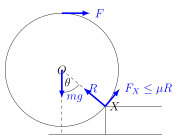
A uniform solid sphere of diameter \(d\) and mass \(m\) is drawn very slowly and without slipping from horizontal ground onto a step of height \(d/4\) by a horizontal force which is always applied to the highest point of the sphere and is always perpendicular to the vertical plane which forms the face of the step. Find the maximum horizontal force throughout the movement, and prove that the coefficient of friction between the sphere and the edge of the step must exceed \(1/\sqrt{3}\).
Solution:
1997 Paper 2 Q11
A tennis player serves from height \(H\) above horizontal ground, hitting the ball downwards with speed \(v\) at an angle \(\alpha\) below the horizontal. The ball just clears the net of height \(h\) at horizontal distance \(a\) from the server and hits the ground a further horizontal distance \(b\) beyond the net. Show that $$v^2 = \frac{ g(a+b)^2(1+\tan^2\alpha)}{ 2[H-(a+b)\tan\alpha]}$$ and $$\tan\alpha = \frac{2a+b }{ a(a+b)}H - \frac{a+b }{ ab}h \,.$$ By considering the signs of \(v^2\) and \(\tan\alpha\), find upper and lower bounds on \(H\) for such a serve to be possible.
Solution: We have \begin{align*} \rightarrow: && a &= v\cos \alpha t_{net} \\ \Rightarrow && t_{net} &= \frac{a}{v \cos \alpha} \\ \downarrow: && H-h &= v\sin \alpha t_{net} + \frac12 g t_{net}^2 \\ &&&= a \tan \alpha + \frac12 g \frac{a^2}{v^2} \sec^2 \alpha \\ &&&= a \tan \alpha + \frac{a^2g}{2v^2}(1 + \tan^2 \alpha) \tag{*}\\ \\ \rightarrow: && a+b &= v \cos \alpha t_{ground} \\ && t_{ground} &= \frac{a+b}{v \cos \alpha}\\ \downarrow: && H &= v\sin \alpha t_{ground} + \frac12 g t_{ground}^2 \\ &&&= (a+b)\tan \alpha + \frac{(a+b)^2g}{2v^2}(1+\tan^2\alpha) \tag{**} \\ \\ (**): && v^2 &= \frac{g(a+b)^2(1+\tan^2\alpha)}{2[H-(a+b)\tan \alpha]} \\ (a+b)^2(*) - a^2(**): && (a+b)^2(H-h) -a^2H &= [(a+b)^2a - a^2(a+b)]\tan \alpha \\ \Rightarrow && (2ab+b^2)H - (a+b)^2h &= ab(a+b) \tan \alpha \\ \Rightarrow && \tan \alpha &= \frac{2a+b}{a(a+b)}H - \frac{a+b}{ab} h \end{align*} Noting that \(v^2 \geq 0\) and the numerator is positive, we must have \begin{align*} && H &> (a+b)\tan \alpha \\ &&&= \frac{2a+b}{a}H - \frac{(a+b)^2}{ab} h \\ \Rightarrow && \frac{a+b}{a}H &< \frac{(a+b)^2}{ab} h \\ \Rightarrow && H &< \frac{a+b}{b} h \end{align*} Noting that \(\tan \alpha > 0\) we must have \begin{align*} && \frac{2a+b}{a(a+b)} H & > \frac{a+b}{ab} h \\ \Rightarrow && H &> \frac{(a+b)^2}{b(2a+b)}h \end{align*}
1997 Paper 3 Q8
Let \(R_{\alpha}\) be the \(2\times2\) matrix that represents a rotation through the angle \(\alpha\) and let $$A=\begin{pmatrix}a&b\\b&c\end{pmatrix}.$$
- Find in terms of \(a\), \(b\) and \(c\) an angle \(\alpha\) such that \(R_{-\alpha}AR_{\alpha}\) is a diagonal matrix (i.e. has the value zero in top-right and bottom-left positions).
- Find values of \(a\), \(b\) and \(c\) such that the equation of the ellipse \[x^2+(y+2x\cot2\theta)^2=1\qquad(0 < \theta < \tfrac{1}{4}\pi)\] can be expressed in the form \[\begin{pmatrix}x&y\end{pmatrix}A\begin{pmatrix}x\\y\end{pmatrix}=1.\] Show that, for this \(A\), \(R_{-\alpha}AR_{\alpha}\) is diagonal if \(\alpha=\theta\). Express the non--zero elements of this matrix in terms of \(\theta\).
- Deduce, or show otherwise, that the minimum and maximum distances from the centre to the circumference of this ellipse are \(\tan\theta\) and \(\cot\theta\).
Solution: \begin{questionparts} \item \begin{align*} R_{-\alpha}AR_{\alpha} &= \begin{pmatrix} \cos \alpha & \sin\alpha \\ -\sin \alpha & \cos \alpha \end{pmatrix}\begin{pmatrix} a & b \\ b & c \end{pmatrix} \begin{pmatrix} \cos \alpha & -\sin\alpha \\ \sin \alpha & \cos \alpha \end{pmatrix} \\ &= \begin{pmatrix} \cos \alpha & \sin\alpha \\ -\sin \alpha & \cos \alpha \end{pmatrix} \begin{pmatrix} a\cos \alpha + b \sin \alpha & -a\sin\alpha + b \cos\alpha \\ b\cos\alpha + c \sin\alpha & c\cos\alpha-b\sin\alpha \end{pmatrix} \\ &= \begin{pmatrix} a\cos^2\alpha+2b\sin\alpha\cos\alpha+c\sin^2\alpha & -a\sin\alpha\cos \alpha+b\cos^2\alpha +c\sin\alpha\cos\alpha-b\sin^2 \alpha\\ (c-a)\sin\alpha\cos \alpha +b(\cos^2\alpha-\sin^2 \alpha) & a\sin^2 \alpha -2b\sin\alpha\cos\alpha+c\cos^2\alpha \end{pmatrix} \\ &= \begin{pmatrix} * & \frac{c-a}{2}\sin2\alpha+b \cos 2\alpha\\\frac{c-a}{2}\sin2\alpha+b \cos 2\alpha & * \end{pmatrix} \end{align*} Therefore this will be diagonal if \(\tan 2\alpha = \frac{2b}{a-c} \Rightarrow \alpha = \frac12 \tan^{-1} \l \frac{2b}{a-c} \r\) \item \begin{align*} x^2+(y+2x\cot2\theta)^2 &= x^2(1 + 4\cot^22\theta) + 4\cot2\theta xy + y^2 \\ &= \begin{pmatrix}x&y\end{pmatrix}\begin{pmatrix} 1 + 4\cot^22\theta & 2\cot 2\theta \\ 2\cot 2\theta & 1 \end{pmatrix}\begin{pmatrix}x\\y\end{pmatrix} \end{align*} Plugging this \(\mathbf{A}\) in our result from before we discover \begin{align*} \frac12 \tan^{-1} \l \frac{2b}{a-c} \r &= \frac12 \tan^{-1} \l \frac{4\cot 2\theta}{1 + 4\cot^22\theta-1} \r \\ &= \frac12 \tan^{-1} \l \tan 2 \theta \r \\ &= \theta \end{align*} Therefore, the matrix will be: \begin{align*} & \textrm{diag}\begin{pmatrix} (1+4\cot^2 2\theta)\cos^2 \theta + 4\cot2\theta \sin\theta\cos\theta + \sin^2 \theta \\ (1+4\cot^2 2\theta)\sin^2 \theta - 4\cot2\theta \sin\theta\cos\theta + \cos^2 \theta \end{pmatrix} \\ =& \textrm{diag}\begin{pmatrix} \cos^2\theta + \frac{\cos^2 2\theta}{\sin^2 \theta} + 2\cos 2\theta + \sin^2 \theta \\ \sin^2\theta + \frac{\cos^2 2\theta}{\cos^2 \theta} - 2\cos 2\theta + \cos^2 \theta \end{pmatrix} \\ =& \textrm{diag}\begin{pmatrix} 1 + \cos 2\theta \l \frac{\cos2\theta}{\sin^2 \theta} + 2\r \\ 1 + \cos 2\theta \l \frac{\cos2\theta}{\cos^2 \theta} - 2\r \\ \end{pmatrix} \\ =& \textrm{diag}\begin{pmatrix} 1 + \cos 2\theta \l \frac{\cos^2 \theta + \sin^2 \theta}{\sin^2 \theta}\r \\ 1 -\cos 2\theta \l \frac{-\cos^2 \theta - \sin^2 \theta}{\cos^2 \theta}\r \\ \end{pmatrix} \\ =& \textrm{diag}\begin{pmatrix} 1 + (\cos^2\theta - \sin^2 \theta) \cosec^2 \theta \\ 1 - (\cos^2\theta - \sin^2 \theta) \sec^2 \theta \\ \end{pmatrix} \\ =& \textrm{diag}\begin{pmatrix} \cot^2 \theta \\ \tan^2 \theta \\ \end{pmatrix} \\ \end{align*} Therefore this is a rotation of an ellipse with equation: \((\cot \theta x)^2 + (\tan \theta y)^2 = 1\), ie the shortest side and longest side are \(\cot \theta\) and \(\tan \theta\) respectively, but we know since \(0 < \theta < \tfrac{1}{4}\pi\) the shortest will be \(\tan \theta\) and the longest \(\cot \theta\).
1996 Paper 1 Q1
A cylindrical biscuit tin has volume \(V\) and surface area \(S\) (including the ends). Show that the minimum possible surface area for a given value of \(V\) is \(S=3(2\pi V^{2})^{1/3}.\) For this value of \(S\) show that the volume of the largest sphere which can fit inside the tin is \(\frac{2}{3}V\), and find the volume of the smallest sphere into which the tin fits.
Solution: Suppose we have height \(h\) and radius \(r\), then: \(V = \pi r^2 h\) and \(S = 2\pi r^2 + 2\pi r h\). \(h = \frac{V}{\pi r^2}\), so \begin{align*} S &= 2 \pi r^2 + 2 \pi r\frac{V}{\pi r^2} \\ &= 2\pi r^2 +V \frac1{r}+V \frac1{r} \\ &\underbrace{ \geq }_{\text{AM-GM}} 3 \sqrt[3]{2\pi r^2 \frac{V^2}{r^2} } = 3 (2 \pi V^2)^{1/3} \end{align*} Equality holds when \(r = \sqrt[3]{\frac{V}{2 \pi}}, h = \frac{V}{\pi (V/2\pi)^{2/3}} = \sqrt[3]{\frac{4V}{\pi}}\) Since \(h > r\) the sphere has a maximum radius of \(r\) and so it's largest volume is \(\frac43 \pi r^3 = \frac43 \pi \frac{V}{2 \pi} = \frac23 V\).

1996 Paper 1 Q9
A bungee-jumper of mass \(m\) is attached by means of a light rope of natural length \(l\) and modulus of elasticity \(mg/k,\) where \(k\) is a constant, to a bridge over a ravine. She jumps from the bridge and falls vertically towards the ground. If she only just avoids hitting the ground, show that the height \(h\) of the bridge above the floor of the ravine satisfies \[ h^{2}-2hl(k+1)+l^{2}=0, \] and hence find \(h.\) Show that the maximum speed \(v\) which she attains during her fall satisfies \[ v^{2}=(k+2)gl. \]
Solution: \begin{align*} && \text{Energy at the top} &= mgh \\ && \text{Energy at the bottom} &= \frac12\frac{\lambda (h-l)^2}{l} \\ \Rightarrow && mgh & = \frac{\frac{mg}{k}(h-l)^2}{2l} \\ \Rightarrow && 2hkl &= (h-l)^2 \\ \Rightarrow && 0 &= h^2-2lh-2hlk+l^2 \\ &&0&= h^2-2hl(k+1)+l^2 \\ \Rightarrow && \frac{h}{l} &= \frac{2(k+1)\pm \sqrt{4(k+1)^2-4}}{2} \\ &&&= (k+1) \pm \sqrt{k^2+2k} \\ \Rightarrow && h &= l \left ( (k+1) \pm \sqrt{k^2+2k} \right) \end{align*} Since the negative root is less than \(1\), she would have not fully extended the cord. Therefore \(h = l \left ( (k+1) + \sqrt{k^2+2k} \right)\) Her maximum speed will be when her acceleration is \(0\), ie \(g = \text{force from cord}\) ie \(mg = \frac{\lambda x}{l}\) or \(x = \frac{mgl}{\lambda} = \frac{mglk}{mg} = kl\). At this point by conservation of energy we will have \begin{align*} && mgh &= mg(h-l-x) + \frac12 m v^2+\frac{1}{2} \frac{mgx^2}{kl} \\ \Rightarrow && mg\left ( l + kl \right) &= \frac12 m v^2 + \frac12 \frac{mgl^2k^2}{kl} \\ \Rightarrow && 2g\left ( l + kl \right) &= v^2 + glk \\ \Rightarrow && v^2 &= gl(2+k) \end{align*}
1996 Paper 1 Q10
A spaceship of mass \(M\) is at rest. It separates into two parts in an explosion in which the total kinetic energy released is \(E\). Immediately after the explosion the two parts have masses \(m_{1}\) and \(m_{2}\) and speeds \(v_{1}\) and \(v_{2}\) respectively. Show that the minimum possible relative speed \(v_{1}+v_{2}\) of the two parts of the spaceship after the explosion is \((8E/M)^{1/2}.\)
1996 Paper 2 Q6
A proper factor of a positive integer \(N\) is an integer \(M\), with \(M\ne 1\) and \(M\ne N\), which divides \(N\) without remainder. Show that \(12\) has \(4\) proper factors and \(16\) has \(3\). Suppose that \(N\) has the prime factorisation \[N=p_{1}^{m_{1}}p_{2}^{m_{2}}\dots p_{r}^{m_{r}},\] where \(p_{1}, p_{2}, \dots, p_{r}\) are distinct primes and \(m_{1}, m_{2}, \dots, m_{r}\) are positive integers. How many proper factors does \(N\) have and why? Find:
- the smallest positive integer which has precisely 12 proper factors;
- the smallest positive integer which has at least 12 proper factors.
Solution: \(12\) has factors \(1,2,3,4,6,12\) of which \(4\) are neither \(1\) nor \(12\). \(16\) has factors \(1,2,4,8,16\) of which \(3\) are neither \(1\) nor \(16\). If \(N = p_1^{m_1} \cdots p_r^{m_r}\) then \(N\) has \((m_1+1)\cdots(m_r+1)\) factors since we can have between \(0 \leq k \leq m_i\) of the \(i\)th prime factor, whcih is \(m_i+1\) possibilities. We then need to subtract two for the proper factors, ie \((m_1+1)\cdots(m_r+1) - 2\).
- We need \((m_1 + 1) \cdots (m_r + 1) - 2 = 12\) ie \((m_1+1) \cdots (m_r +1) = 14\). Since \(14 = 2 \times 7\) we should have two prime factors, ie of the form \(p_1^6p_2^1\). The smallest number of this form is \(2^6 \cdot 3 = 192\)
- We wish to make \((m_1+1)\cdots(m_r+1) \geq 14\) with \(2^{m_1} \cdot 3^{m_2} \cdots p_r^{m_r}\) as small as possible and \(m_1 \geq m_2 \geq \cdots \geq m_r\). With \(1\) prime, the best we can do is \(2^{13}\). With \(2\) primes the best we can do is \(2^p \cdot 3^q\) with \((p+1)(q+1) \geq 14\). \begin{array}{c|c} q & p & N \\ \hline 0 & 13 & 2^{13} \\ 1 & 6 & 2^6 \cdot 3^1 \\ 2 & 5 & 2^5 \cdot 3^2 \\ 3 & 3.& 2^3 \cdot 3^3 \end{array} So the best here is \(2^6 \cdot 3\) With \(3\) primes, the best we can do is \(2^p 3^q 5^r\) with \(p \geq q \geq r\) and \((p+1)(q+1)(r+1) \geq 14\) \begin{array}{c|c|c|c} r & q & p & N \\ \hline 1 & 1 & 3 & 2^3 \cdot 3 \cdot 5 \\ 1 & 2 & 2& 2^2 \cdot 3^2 \cdot 5 \\ 2 & 2& 2 & 2^2 \cdot 3^2 \cdot 5^2 \end{array} With four primes we can achieve it immediately with \(2\cdot3\cdot5\cdot 7\) and more primes clearly wont help, so our best options is \(120\)
1996 Paper 2 Q9
A child's toy consists of a solid cone of height \(\lambda a\) and a solid hemisphere of radius \(a\), made out of the same uniform material and fastened together so that their plane faces coincide. (Thus the diameter of the hemisphere is equal to that of the base of the cone.) Show that if \(\lambda < \sqrt{3}\) the toy will always move to an upright position if placed with the surface of the hemisphere on a horizontal table, but that if \(\lambda > \sqrt{3}\) the toy may overbalance. Show, however, that if the toy is placed with the surface of the cone touching the table it will remain there whatever the value of \(\lambda\). [The centre of gravity of a uniform solid cone of height \(h\) is a height \(h/4\) above its base. The centre of gravity of a uniform solid hemisphere of radius \(a\) is at distance \(3a/8\) from the centre of its base.]
Solution:

