Problems
Filters
298 problems found
2008 Paper 1 Q5
The polynomial \(\p(x)\) is given by \[ \ds \p(x)= x^n +\sum\limits_{r=0}^{n-1}a_rx^r\,, \] where \(a_0\), \(a_1\), \(\ldots\) , \(a_{n-1}\) are fixed real numbers and \(n\ge1\). Let \(M\) be the greatest value of \(\big\vert \p(x) \big\vert\) for $\vert x \vert\le 1\(. Then Chebyshev's theorem states that \)M\ge 2^{1-n}$.
- Prove Chebyshev's theorem in the case \(n=1\) and verify that Chebyshev's theorem holds in the following cases:
- \( \p(x) = x^2 - \frac12\,\);
- \(\p(x) = x^3 - x \,\).
- Use Chebyshev's theorem to show that the curve $ \ y= 64x^5+25x^4-66x^3-24x^2+3x+1 \ $ has at least one turning point in the interval \(-1\le x \le 1\).
Solution:
- If \(n = 1\) the theorem is \(\max_{x \in [-1,1]} \left ( |x + a_0 |\right) \geq 1\), but clearly \(\max(1+a_0, |a_0 - 1|) \geq 1\) (taking according to the sign of \(a_0\))
- \( \p(x) = x^2 - \frac12\,\) - take \(x = 0\) then \(|p(0)| = \frac12 \geq 2^{1-2} = \frac12\)
- \(\p(x) = x^3 - x \,\). take \(x = \frac1{\sqrt{2}}\), then \(|p\left ( \frac1{\sqrt{2}}\right)| = |\frac12 \frac{1}{\sqrt{2}}-\frac{1}{\sqrt{2}}| = \frac{1}{2\sqrt{2}} > \frac14 = 2^{1-3} \)
- Consider \(p(x) = \frac{1}{64} \left ( 64x^5+25x^4-66x^3-24x^2+3x+1\right)\), then \(p\) satisfies the conditions of the theorem, therefore \(\max |p(x)| \geq 2^{1-5} = \frac1{16} = \frac{4}{64}\). However, \(p(-1) = \frac{1}{64}\) and \(p(1) = \frac{3}{64}\), so it cannot be strictly increasing or decreasing and there must be at turning point to achieve \(\frac{4}{64}\)
2008 Paper 2 Q3
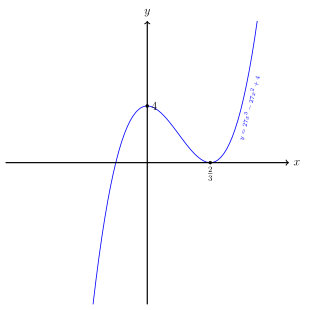
- Find the coordinates of the turning points of the curve \(y=27x^3-27x^2+4\). Sketch the curve and deduce that \(x^2(1-x)\le 4/27\) for all \(x\ge0\,\). Given that each of the numbers \(a\), \(b\) and \(c\) lies between \(0\) and \(1\), prove by contradiction that at least one of the numbers \(bc(1-a)\), \(ca(1-b)\) and \(ab(1-c)\) is less than or equal to \(4/27\).
- Given that each of the numbers \(p\) and \(q\) lies between \(0\) and \(1\), prove that at least one of the numbers \(p(1-q)\) and \(q(1-p)\) is less than or equal to \(1/4\).
Solution:
- \(\,\)
\begin{align*}
&& y & = 27x^3 - 27x^2 + 4 \\
\Rightarrow && \frac{\d y}{\d x} &= 81x^2 - 54x \\
\Rightarrow && x &= 0, \frac23 \\
\Rightarrow && (x,y) &= (0, 4), \left (\frac23, 0 \right)
\end{align*}
Since \(f(x) \geq 0\) for \(x \geq 0\) we must have \(27x^2(1-x) \leq 4 \Rightarrow x^2(1-x) \leq \frac{4}{27}\) Suppose for contradiction that \(bc(1-a) > \frac{4}{27}, ca(1-b) > \frac{4}{27}, ab(1-c) > \frac{4}{27}\) then taking the product we see \begin{align*} && \left ( \frac{4}{27} \right)^3 &< bc(1-a) \cdot ca(1-b) \cdot ab(1-c) \\ &&&= a^2(1-c) \cdot b^2(1-b) \cdot c^2(1-c) \leq \left ( \frac{4}{27}\right)^3 \end{align*} which is a contradiction.
- Notice that \(f(x) = x(1-x)\) has a turning point at \((\frac12, \frac14)\), and so \(f(x) \leq \frac14\). Suppose for contradiction that both \(p(1-q)\) and \(q(1-p)\) are larger than \(1/4\) \begin{align*} && \left ( \frac14 \right)^2 &< p(1-q) \cdot q(1-p) \\ &&&= p(1-p) \cdot q(1-q) \\ &&&\leq \left ( \frac14 \right)^2 \end{align*} which is a contradiction.
2008 Paper 2 Q5
Evaluate the integrals \[\int_0^{\frac{1}{2}\pi} \frac{\sin 2x}{1+\sin^2x} \d x \text{ and } \int_0^{\frac{1}{2}\pi} \frac{\sin x}{1+\sin^2x} \d x\] Show, using the binomial expansion, that \((1+\sqrt2\,)^5<99\). Show also that \(\sqrt 2 > 1.4\). Deduce that \(2^{\sqrt2} > 1+ \sqrt2\,\). Use this result to determine which of the above integrals is greater.
Solution: \begin{align*} && I &= \int_0^{\frac{1}{2}\pi} \frac{\sin 2x}{1+\sin^2x} \d x \\ &&&= \int_0^{\frac{1}{2}\pi} \frac{2 \sin x \cos x}{1+\sin^2x} \d x \\ &&&= \left [\ln (1 + \sin^2 x) \right]_0^{\pi/2} \\ &&&= \ln 2 \\ \\ && J &= \int_0^{\frac{1}{2}\pi} \frac{\sin x}{1+\sin^2x} \d x \\ &&&= \int_0^{\frac{1}{2}\pi} \frac{\sin x}{2-\cos^2x} \d x \\ &&&= \frac{1}{2\sqrt{2}}\int_0^{\frac{1}{2}\pi} \left ( \frac{\sin x}{\sqrt{2}-\cos x}+ \frac{\sin x}{\sqrt{2}+\cos x} \right) \d x \\ &&&= \frac{1}{2\sqrt{2}} \left [\ln (\sqrt{2}-\cos x) - \ln (\sqrt{2}+\cos x) \right]_0^{\pi/2} \\ &&&= \frac{1}{2\sqrt{2}} \left (-\ln(\sqrt{2}-1)+\ln(\sqrt{2}+1) \right) \\ &&&= \frac1{2\sqrt{2}} \ln \left (\frac{\sqrt{2}+1}{\sqrt{2}-1} \right)\\ &&&= \frac1{\sqrt{2}} \ln (\sqrt{2}+1) \end{align*} \begin{align*} && (1+\sqrt{2})^5 + (1-\sqrt{2})^5 &= 2(1+10\cdot2+5\cdot2^2) \\ &&&= 82 \\ && |(1-\sqrt{2})^5| & < 1 \\ && (1+\sqrt{2})^5 &< 83 < 99 \\ \\ && 1.4^2 &= 1.96 \\ &&&< 2 \\ \Rightarrow && 1.4 &<\sqrt{2} \\ \\ \Rightarrow && 2^{\sqrt{2}} &> 2^{1.4} \\ &&&=2^{7/5} \\ &&&= {128}^{1/5} \\ &&&>99^{1/5} \\ &&&>1+\sqrt{2} \end{align*} \begin{align*} && \ln 2 & > \frac{1}{\sqrt{2}} \ln(\sqrt{2}+1) \\ \Leftrightarrow && \sqrt{2} \ln 2 &> \ln(\sqrt{2}+1) \\ \Leftrightarrow && 2^{\sqrt{2}} &> 1+\sqrt{2} \end{align*} which we have already shown, so the first integral is larger.
2008 Paper 3 Q4
- Show, with the aid of a sketch, that \(y> \tanh (y/2)\) for \(y>0\) and deduce that \begin{equation} \textrm{arcosh} x > \dfrac{x-1}{\sqrt{x^2-1}} \text{ for } x>1. \tag{\(*\)} \end{equation}
- By integrating \((*)\), show that $\textrm{arcosh} x > 2 \dfrac{{x-1}}{\sqrt{x^2-1}} \( for \)x>1$.
- Show that $\textrm{arcosh} x >3 \dfrac{\sqrt{x^2-1}}{{x+2}} \( for \)x>1$.
Solution:
- If \(y = \textrm{arcosh} x \), then \(\tanh\textrm{arcosh} x/2 = \sqrt{\frac{\cosh \textrm{arcosh} x-1}{\cosh \textrm{arcosh} x+1}} = \sqrt{\frac{x-1}{x+1}} = \frac{x-1}{\sqrt{x^2-1}}\)
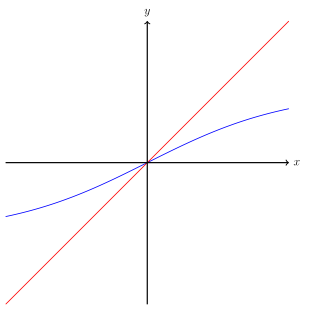
- \begin{align*} \int \textrm{arcosh} x \d x &= \left [x \textrm{arcosh} x \right] - \int \frac{x}{\sqrt{x^2-1}} \d x \\ &= x \textrm{arcosh} x - \sqrt{x^2-1}+C \\ \int \frac{x-1}{\sqrt{x^2-1}} &= \sqrt{x^2-1} - \textrm{arcosh} x +C \end{align*} Therefore \begin{align*} && \int_1^x \textrm{arcosh} t \d t &> \int_1^x \frac{t-1}{\sqrt{t^2-1}} \d t \\ \Rightarrow && x \textrm{arcosh} x - \sqrt{x^2-1} - 0 &> \sqrt{x^2-1} - \textrm{arcosh} x - 0 \\ \Rightarrow && (x+1) \textrm{arcosh} x &> 2\sqrt{x^2-1} \\ \Rightarrow && \textrm{arcosh} x & > 2\frac{\sqrt{x^2-1}}{x+1} \\ &&&= 2 \frac{\sqrt{x-1}}{\sqrt{x+1}} \\ &&&= 2 \frac{x-1}{\sqrt{x^2-1}} \end{align*}
- Integrating both sides again, \begin{align*} && \int_1^x \textrm{arcosh} t \d t &> 2 \int_1^x \frac{t-1}{\sqrt{t^2-1}} \d t \\ \Rightarrow && x \textrm{arcosh} x - \sqrt{x^2-1} &> 2\left (\sqrt{x^2-1} - \textrm{arcosh}x \right) \\ \Rightarrow && (x+2)\textrm{arcosh} x &> 3 \sqrt{x^2-1} \\ \Rightarrow && \textrm{arcosh} x &> 3 \frac{\sqrt{x^2-1}}{x+2} \end{align*}
2007 Paper 1 Q9
A particle of weight \(W\) is placed on a rough plane inclined at an angle of \(\theta\) to the horizontal. The coefficient of friction between the particle and the plane is \(\mu\). A horizontal force \(X\) acting on the particle is just sufficient to prevent the particle from sliding down the plane; when a horizontal force \(kX\) acts on the particle, the particle is about to slide up the plane. Both horizontal forces act in the vertical plane containing the line of greatest slope. Prove that \[ \left( k-1 \right) \left( 1 + \mu^2 \right) \sin \theta \cos \theta = \mu \left( k + 1 \right) \] and hence that $\displaystyle k \ge \frac{ \left( 1+ \mu \right)^2} { \left( 1 - \mu \right)^2}$ .
2007 Paper 1 Q10
The Norman army is advancing with constant speed \(u\) towards the Saxon army, which is at rest. When the armies are \(d\) apart, a Saxon horseman rides from the Saxon army directly towards the Norman army at constant speed \(x\). Simultaneously a Norman horseman rides from the Norman army directly towards the Saxon army at constant speed \(y\), where $y > u$. The horsemen ride their horses so that \(y - 2x < u < 2y - x\). When each horseman reaches the opposing army, he immediately rides straight back to his own army without changing his speed. Represent this information on a displacement-time graph, and show that the two horsemen pass each other at distances \[ \frac{xd }{ x + y} \;\; \mbox{and} \;\; \frac{xd(2y -x-u)} {(u+x ) ( x + y )} \] from the Saxon army. Explain briefly what will happen in the cases (i) \(u > 2y - x\) and (ii) \(u < y - 2x\).
2007 Paper 2 Q7
A function \(\f(x)\) is said to be concave on some interval if \(\f''(x)<0\) in that interval. Show that \(\sin x\) is concave for \(0< x < \pi\) and that \(\ln x\) is concave for \(x > 0\). Let \(\f(x)\) be concave on a given interval and let \(x_1\), \(x_2\), \(\ldots\), \(x_n\) lie in the interval. Jensen's inequality states that \[ \frac1 n \sum_{k=1}^n\f(x_k) \le \f \bigg (\frac1 n \sum_{k=1}^n x_k\bigg) \] and that equality holds if and only if \(x_1=x_2= \cdots =x_n\). You may use this result without proving it.
- Given that \(A\), \(B\) and \(C\) are angles of a triangle, show that \[ \sin A + \sin B + \sin C \le \frac{3\sqrt3}2 \,. \]
- By choosing a suitable function \(\f\), prove that
\[
\sqrt[n]{t_1t_2\cdots t_n}\; \le \; \frac{t_1+t_2+\cdots+t_n}n
\]
for any positive integer \(n\) and for any positive numbers \(t_1\), \(t_2\), \(\ldots\), \(t_n\).
Hence:
- show that \(x^4+y^4+z^4 +16 \ge 8xyz\), where \(x\), \(y\) and \(z\) are any positive numbers;
- find the minimum value of \(x^5+y^5+z^5 -5xyz\), where \(x\), \(y\) and \(z\) are any positive numbers.
Solution: \begin{align*} && f(x) &= \sin x \\ \Rightarrow && f''(x) &= -\sin x \end{align*} which is clearly negative on \((0,\pi)\) since \(\sin\) is positive on this interval. \begin{align*} && f(x) &= \ln x \\ \Rightarrow && f''(x) &= -1/x^2 \end{align*} which is clearly negative for \(x > 0\)
- Since \(A,B,C\) are angles in a triangle, we must have \(0 < A,B,C< \pi\) and so we can apply Jensen with \(f = \sin\) to obtain: \begin{align*} &&\frac13( \sin A + \sin B + \sin C) &\leq \sin \left ( \frac{A+B+C}{3}\right) \\ &&&= \sin \frac{\pi}{3} = \frac{\sqrt{3}}2 \\ \Rightarrow && \sin A + \sin B + \sin C &\leq\frac{3\sqrt{3}}2 \end{align*}
- Suppose \(f(x) = \ln x\), then applying Jensen on the positive numbers \(t_1, \ldots, t_n\) we obtain
\begin{align*}
&& \frac1n \left ( \sum_{i=1}^n \ln t_n \right) &\leq \ln \left ( \frac1n\sum_{i=1}^n t_n \right) \\
\Rightarrow && \frac1n \ln\left (\prod_{i=1} t_n\right)&\leq \ln \left ( \frac1n\sum_{i=1}^n t_n \right) \\
\Rightarrow && \ln\left (\left (\prod_{i=1} t_n\right)^{1/n}\right)&\leq \ln \left ( \frac1n\sum_{i=1}^n t_n \right) \\
\Rightarrow && \left (\prod_{i=1} t_n\right)^{1/n}&\leq\frac1n\sum_{i=1}^n t_n \\
\Rightarrow && \sqrt[n]{t_1t_2 \cdots t_n}&\leq\frac1n(t_1 + t_2 + \cdots + t_n) \tag{AM-GM}\\
\end{align*}
- Applying AM-GM with \(t_1 = x^4, t_2 = y^4, t_3 = z^4, t_4 = 2^4\) we have \begin{align*} && \frac{x^4+y^4+z^4+16}{4} & \geq \sqrt[4]{x^4y^4z^42^4} \\ \Rightarrow && x^4+y^4+z^4+16 &\geq 8xyz \end{align*}
- Applying AM-GM with \(t_1 = x^5, t_2 = y^5, t_3 = z^5, t_4 = 1^5, t_5 = 1^5\) we have \begin{align*} && \frac{x^5+y^5+z^5+1+1}{5} & \geq \sqrt[5]{x^5y^5z^5} \\ \Rightarrow && x^5+y^5+z^5+2 &\geq 5xyz \\ \Rightarrow && x^5+y^5+z^5 - 5xyz &\geq -2 \end{align*} Therefore the minimum is \(-2\)
2007 Paper 2 Q10
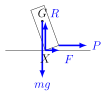
A solid figure is composed of a uniform solid cylinder of density \(\rho\) and a uniform solid hemisphere of density \(3\rho\). The cylinder has circular cross-section, with radius \(r\), and height \(3r\), and the hemisphere has radius \(r\). The flat face of the hemisphere is joined to one end of the cylinder, so that their centres coincide. The figure is held in equilibrium by a force \(P\) so that one point of its flat base is in contact with a rough horizontal plane and its base is inclined at an angle \(\alpha\) to the horizontal. The force \(P\) is horizontal and acts through the highest point of the base. The coefficient of friction between the solid and the plane is \(\mu\). Show that \[\mu \ge \left\vert \tfrac98 -\tfrac12 \cot\alpha\right\vert\,. \]
Solution: The centre of mass of the sphere will be at \((0, \frac{3}{2}r)\) and the centre of mass of the hemisphere will be at \((0, 3r + \frac38r)\), their masses will be \(3\pi r^3 \cdot \rho \) and \(\frac23 \pi r^3 \cdot 3\rho \), meaning the center of mass will be \(\frac{\frac92r + \frac{27}{8} \cdot 2r}{3 + 2} = \frac{45/4}{5}r = \frac{9}{4}r\) above the center of the base.
2007 Paper 2 Q13
Given that \(0 < r < n\) and \(r\) is much smaller than \(n\), show that \(\dfrac {n-r}n \approx \e^{-r/n}\). There are \(k\) guests at a party. Assuming that there are exactly 365 days in the year, and that the birthday of any guest is equally likely to fall on any of these days, show that the probability that there are at least two guests with the same birthday is approximately \(1-\e^{-k(k-1)/730}\). Using the approximation \( \frac{253}{365} \approx \ln 2\), find the smallest value of \(k\) such that the probability that at least two guests share the same birthday is at least \(\frac12\). How many guests must there be at the party for the probability that at least one guest has the same birthday as the host to be at least \(\frac12\)?
Solution: Given \(0 < r \ll n\), then \(\frac{r}{n}\) is small and so, \(e^x \approx 1+x\), therefore: \(\displaystyle e^{-r/n} \approx 1 - \frac{r}{n} = \frac{n-r}{n}\). Line everyone in the room up in some order. The first person is always going to have a birthday we haven't seen before. The probability the second person has a new birthday is \(\displaystyle 1 - \frac{1}{365}\) since they can't be born on the same day as the first person. The third person has a \(\displaystyle 1 - \frac{2}{365}\) probability of having a birthday we've not seen before, since they can't share a birthday with either of the first two people. Similarly the \(k\)th person has a \(\displaystyle 1 - \frac{k-1}{365}\) chance of having a unique birthday. \begin{align*} \prod_{i=1}^k \mathbb{P}(\text{the } i \text{th person has a new birthday}) &= \prod_{i=1}^k \l 1 - \frac{i-1}{365}\r \\ &\approx \prod_{i=1}^k \exp \l -\frac{i-1}{365}\r \\ &= \exp\l - \sum_{i=1}^k\frac{i-1}{365}\r \\ &= \exp\l - \frac{k(k-1)}{2\cdot365}\r \\ &= e^{-k(k-1)/730} \end{align*} But this the probability no-one shares a birthday, so the answer we are looking for is \(1-\) this, ie \(1 - e^{-k(k-1)/730}\) Suppose \(1 - e^{-k(k-1)/730} = \frac12\), then \begin{align*} && 1 - e^{-k(k-1)/730} &= \frac12 \\ \Rightarrow && e^{-k(k-1)/730} &= \frac12 \\ \Rightarrow && -k(k-1)/730 &= -\ln 2 \\ \Rightarrow && k(k-1)/730 &\approx \frac{253}{365} \\ \Rightarrow && k(k-1) &\approx 506 \end{align*} Therefore since \(22 \cdot 23 = 506\), we should expect the number to be approximately \(23\). Since \(e^{-r/n} > \frac{n-r}{n}\) we should expect this to be an overestimate, therefore \(23\) should suffice.
2006 Paper 1 Q2
A small goat is tethered by a rope to a point at ground level on a side of a square barn which stands in a large horizontal field of grass. The sides of the barn are of length \(2a\) and the rope is of length \(4a\). Let \(A\) be the area of the grass that the goat can graze. Prove that \(A\le14\pi a^2\) and determine the minimum value of \(A\).
Solution:

2006 Paper 1 Q3
In this question \(b\), \(c\), \(p\) and \(q\) are real numbers.
- By considering the graph \(y=x^2 + bx + c\) show that \(c < 0\) is a sufficient condition for the equation \(\displaystyle x^2 + bx + c = 0\) to have distinct real roots. Determine whether \(c < 0\) is a necessary condition for the equation to have distinct real roots.
- Determine necessary and sufficient conditions for the equation \(\displaystyle x^2 + bx + c = 0\) to have distinct positive real roots.
- What can be deduced about the number and the nature of the roots of the equation \(x^3 + px + q = 0\) if \(p>0\) and \(q<0\)? What can be deduced if \(p<0\,\) and \(q<0\)? You should consider the different cases that arise according to the value of \(4p^3+ 27q^2\,\).
Solution:
- Since \(y(0) < 0\) and \(y(\pm \infty) > 0\) we must cross the axis twice. Therefore there are two distinct real roots. It is not necessary, for example \((x-2)(x-3)\) has distinct real roots by the constant term is \(6 > 0\)

- For \(x^2+bx+c=0\) to have distinct, positive real roots we need \(\Delta > 0\) and \(\frac{-b -\sqrt{\Delta}}{2a} > 0\) where \(\Delta = b^2-4ac\), ie \(b < 0\) and \(b^2 > \Delta = b^2-4ac\) or \(4ac > 0\). Therefore we need \(b^2-4ac > 0, b < 0, 4ac > 0\)
- Since \(q < 0\) at least one of the roots is positive. The gradient is \(3x^2+p > 0\) therefore there is exactly one positive root. If \(p < 0\) then there are turning points when \(3x^2+p = 0\) ie \(x = \pm \sqrt{\frac{-p}{3}}\). If the first turning point is above the \(x\)-axis then there will be 3 roots. If it is on the \(x\)-axis then 2, otherwise only 1. \begin{align*} y &= \left (-\sqrt{\frac{-p}{3}}\right)^3 + p\left (-\sqrt{\frac{-p}{3}}\right)+q \\ &= \sqrt{\frac{-p}{3}} \left (p - \frac{p}{3} \right) + q \\ &= \frac{2}{3} \sqrt{\frac{-p}{3}}p +q \\ \end{align*} Therefore it is positive if \(-\frac{4}{27}p^3 >q^2\) ie if \(4p^3+27q^2 < 0\)
2006 Paper 1 Q4
By sketching on the same axes the graphs of \(y=\sin x\) and \(y=x\), show that, for \(x>0\):
- \(x>\sin x\,\);
- \(\dfrac {\sin x} {x} \approx 1\) for small \(x\).
2006 Paper 2 Q1
The sequence of real numbers \(u_1\), \(u_2\), \(u_3\), \(\ldots\) is defined by \begin{equation*} u_1=2 \,, \qquad\text{and} \qquad u_{n+1} = k - \frac{36}{u_n} \quad \text{for } n\ge1, \tag{\(*\)} \end{equation*} where \(k\) is a constant.
- Determine the values of \(k\) for which the sequence \((*)\) is: (a) constant; (b) periodic with period 2; (c) periodic with period 4.
- In the case \(k=37\), show that \(u_n\ge 2\) for all \(n\). Given that in this case the sequence \((*)\) converges to a limit \(\ell\), find the value of \(\ell\).
2006 Paper 2 Q2
Using the series \[ \e^x = 1 + x +\frac{x^2}{2!} + \frac{x^3}{3!} + \frac{x^4}{4!}+\cdots\,, \] show that \(\e>\frac83\). Show that \(n!>2^n\) for \(n\ge4\) and hence show that \(\e<\frac {67}{24}\). Show that the curve with equation \[ y= 3\e^{2x} +14 \ln (\tfrac43-x)\,, \qquad {x<\tfrac43} \] has a minimum turning point between \(x=\frac12\) and \(x=1\) and give a sketch to show the shape of the curve.
Solution: \begin{align*} && e &= 1 + 1 + \frac{1}{2!} + \frac{1}{3!} + \cdots \\ &&&> 1 + 1+ \frac12 + \frac16 \\ &&&= \frac{12+3+1}{6} = \frac83 \end{align*} \(4! = 24 > 16 = 2^4\), notice that \(n! = \underbrace{n \cdot (n-1) \cdots 5}_{>2^{n-4}} \cdot \underbrace{4!}_{>2^4} >2^n\). \begin{align*} && e &= 1 + 1 + \frac{1}{2!} + \frac{1}{3!} + \cdots \\ &&&< \frac83 + \frac{1}{2^4} + \frac{1}{2^5} + \cdots \\ &&&= \frac83 + \frac{1}{2^4} \frac{1}{1-\tfrac12} \\ &&&= \frac83 + \frac1{8} \\ &&&= \frac{67}{24} \end{align*} \begin{align*} && y &= 3e^{2x} +14 \ln(\tfrac43-x) \\ && y' &= 6e^{2x} - \frac{14}{\tfrac43-x} \\ && y'(\tfrac12) &= 6e - \frac{14}{\tfrac43-\tfrac12} \\ &&&= 6e -\tfrac{84}{5} = 6(e-\tfrac{14}5) < 0 \\ && y'(1) &= 6e^2 - \frac{14}{\tfrac43-1} \\ &&&= 6e^2 - 42 = 6(e^2-7) \\ &&&> 6(\tfrac{64}{9} - 7) > 0 \end{align*} Therefore \(y'\) changes from negative (decreasing) to positive (increasing) in our range, and therefore there is a minima in this range.

2006 Paper 2 Q3
- Show that $\displaystyle \big( 5 + \sqrt {24}\;\big)^4 + \frac{1 }{\big(5 + \sqrt {24}\;\big)^4} \ $ is an integer. Show also that \[\displaystyle 0.1 < \frac{1}{ 5 + \sqrt {24}} <\frac 2 {19}< 0.11\,.\] Hence determine, with clear reasoning, the value of \(\l 5 + \sqrt {24}\r^4\) correct to four decimal places.
- If \(N\) is an integer greater than 1, show that \(( N + \sqrt {N^2 - 1} \,) ^k\), where \(k\) is a positive integer, differs from the integer nearest to it by less than \(\big( 2N - \frac12 \big)^{-k}\).
Solution:
- First notice that \(\frac{1}{5+\sqrt{24}} = \frac{5-\sqrt{24}}{25-24} = 5 - \sqrt{24}\), hence \begin{align*} && ( 5 + \sqrt {24})^4 + \frac{1 }{(5 + \sqrt {24})^4} &= ( 5 + \sqrt {24})^4 + ( 5 - \sqrt {24})^4 \\ \end{align*} where clearly all terms including \(\sqrt{24}\) will cancel out, therefore it is an integer. \begin{align*} && 5 + \sqrt{24} &< 5 + 5 = 10 \\ \Rightarrow && \frac{1}{5+\sqrt{24}}& > \frac{1}{10} = 0.1 \\ && 2(5 + \sqrt{24}) &=10 + \sqrt{96} > 19 \\ \Rightarrow && \frac{1}{5+\sqrt{24}} & < \frac{2}{19} < \frac{2}{18} = \frac19 = 0.11111\ldots < 0.11 \end{align*} Therefore, \(10^{-4} < (5+\sqrt{24})^4 < 0.11^{-4} = 0.00014641\) \begin{align*} && (5+\sqrt{24})^4 + (5-\sqrt{24})^4 &= 2(5^4+6\cdot5^2\cdot24+24^2) \\ &&&= 2\cdot (625 + 3600+576) \\ &&&= 9602 \\ \Rightarrow && (5+\sqrt{24})^4 &= 9602 - \epsilon, \epsilon \in (0.0001, 0.00014641) \\ \Rightarrow && (5+\sqrt{24})^4 &\in (9601.999854, ,9601.9999) \\ \Rightarrow && (5+\sqrt{24})^4 &= 9601.9998 \, (4 \text{ d.p.}) \end{align*}
- Notice that \((N+\sqrt{N^2-1})^{k}+(N-\sqrt{N^2-1})^{k}\) is an integer for the same reason as before (sum of conjugates). Notice also that \(\frac{1}{N+\sqrt{N^2-1}} = N - \sqrt{N^2-1}\) and that so it sufficies to show that \begin{align*} && N + \sqrt{N^2-1} &> 2N-\tfrac12 \\ \Leftrightarrow && \sqrt{N^2-1} &> N - \tfrac12 \\ \Leftrightarrow && N^2-1 &> N^2-N+1\\ \Leftrightarrow && N &> \tfrac32\\ \end{align*} Which is true since \(N > 1\) and \(N\) is an integer.