Problems
Filters
24 problems found
2021 Paper 2 Q1
Prove, from the identities for \(\cos(A \pm B)\), that \[ \cos a \cos 3a \equiv \tfrac{1}{2}(\cos 4a + \cos 2a). \] Find a similar identity for \(\sin a \cos 3a\).
- Solve the equation \[ 4\cos x \cos 2x \cos 3x = 1 \] for \(0 \leqslant x \leqslant \pi\).
- Prove that if \[ \tan x = \tan 2x \tan 3x \tan 4x \qquad (\dagger) \] then \(\cos 6x = \tfrac{1}{2}\) or \(\sin 4x = 0\). Hence determine the solutions of equation \((\dagger)\) with \(0 \leqslant x \leqslant \pi\).
Solution: \begin{align*} && \cos(A \pm B) &= \cos A \cos B \mp \sin A \sin B \\ A = a, B = 3a&& \cos 4a + \cos 2a &= 2\cos 3a \cos a \\ \Rightarrow && \cos a \cos 3a &= \tfrac12(\cos 4a + \cos 2a) \\ \\ && \sin(A \pm B) &= \sin A \cos B \pm \cos A \sin B \\ && \sin 4a + \sin(- 2a) &= 2 \sin a \cos 3a \\ \Rightarrow && \sin a \cos 3a &= \tfrac12 (\sin 4a - \sin 2a) \end{align*}
- \(\,\) \begin{align*} && 1 &= 4 \cos x \cos 2x \cos 3x \\ &&&= 2(\cos 4x +\cos 2x)\cos 2x \\ c = \cos 2x:&&&= 2(2c^2-1+c)c \\ \Rightarrow && 0 &= 4c^3+2c^2-2c-1 \\ &&&= (2c+1)(2c^2-1) \\ \Rightarrow && \cos 2x &= -\frac12 \\ \Rightarrow && x &= \frac{\pi}{3}, \frac{2\pi}{3} \\ && \cos 2x &= \pm \frac1{\sqrt2} \\ \Rightarrow && x&= \frac{\pi}{8}, \frac{3\pi}{8}, \frac{5\pi}{8}, \frac{7\pi}{8} \end{align*}
- \(\,\) \begin{align*} && \tan x &= \tan 2x \tan 3x \tan 4x \\ \Rightarrow &&1 &= \frac{\cos x\sin 2x \sin 3x \sin 4x}{\sin x \cos 2x \cos 3x \cos 4x} \\ &&&= \frac{\sin 2x \sin 4x (\sin4 x + \sin 2x)}{\cos 2x \cos 4x (\sin 4x - \sin 2x)} \\ &&&= \frac{(\cos 2x - \cos 6x) (\sin4 x + \sin 2x)}{(\cos 6x + \cos 2x) (\sin 4x - \sin 2x)} \\ \Rightarrow && 0 &= 2\cos 6x \sin 4x - 2\cos 2x \sin 2 x\\ &&&= \sin 4 x (2 \cos 6x - 1) \\ \Rightarrow && \sin 4x &= 0 \\ \text{ or }&& \cos 6x &= \frac12 \end{align*} \(\sin 4x = 0 \Rightarrow x = 0, \frac{\pi}{4}, \frac{\pi}{2}, \frac{3\pi}{4}, \pi\) \(\cos 6x = \frac12 \Rightarrow x = \frac{\pi}{18}, \frac{5\pi}{18},\frac{7\pi}{18}, \frac{11\pi}{18}, \frac{13\pi}{18}, \frac{17\pi}{18}\). We should verify these work, since not all of them will, especially where \(\sin 4x = 0\), so our final answer is \(x = 0, \pi, \frac{\pi}{18}, \frac{5\pi}{18},\frac{7\pi}{18}, \frac{11\pi}{18}, \frac{13\pi}{18}, \frac{17\pi}{18}\)
2021 Paper 2 Q2
In this question, the numbers \(a\), \(b\) and \(c\) may be complex.
- Let \(p\), \(q\) and \(r\) be real numbers. Given that there are numbers \(a\) and \(b\) such that \[ a + b = p, \quad a^2 + b^2 = q \quad \text{and} \quad a^3 + b^3 = r, \qquad (*) \] show that \(3pq - p^3 = 2r\).
- Conversely, you are given that the real numbers \(p\), \(q\) and \(r\) satisfy \(3pq - p^3 = 2r\). By considering the equation \(2x^2 - 2px + (p^2 - q) = 0\), show that there exist numbers \(a\) and \(b\) such that the three equations \((*)\) hold.
- Let \(s\), \(t\), \(u\) and \(v\) be real numbers. Given that there are distinct numbers \(a\), \(b\) and \(c\) such that \[ a + b + c = s, \quad a^2 + b^2 + c^2 = t, \quad a^3 + b^3 + c^3 = u \quad \text{and} \quad abc = v, \] show, using part~(i), that \(c\) is a root of the equation \[ 6x^3 - 6sx^2 + 3(s^2 - t)x + 3st - s^3 - 2u = 0 \] and write down the other two roots. Deduce that \(s^3 - 3st + 2u = 6v\).
- Find numbers \(a\), \(b\) and \(c\) such that \[ a + b + c = 3, \quad a^2 + b^2 + c^2 = 1, \quad a^3 + b^3 + c^3 = -3 \quad \text{and} \quad abc = 2, \qquad (**) \] and verify that your solution satisfies the four equations \((**)\).
2021 Paper 2 Q3
In this question, \(x\), \(y\) and \(z\) are real numbers. Let \(\lfloor x \rfloor\) denote the largest integer that satisfies \(\lfloor x \rfloor \leqslant x\) and let \(\{x\}\) denote the fractional part of~\(x\), so that \(x = \lfloor x \rfloor + \{x\}\) and \(0 \leqslant \{x\} < 1\). For example, if \(x = 4.2\), then \(\lfloor x \rfloor = 4\) and \(\{x\} = 0.2\) and if \(x = -4.2\), then \(\lfloor x \rfloor = -5\) and \(\{x\} = 0.8\).
- Solve the simultaneous equations \begin{align*} \lfloor x \rfloor + \{y\} &= 4.9, \\ \{x\} + \lfloor y \rfloor &= -1.4. \end{align*}
- Given that \(x\), \(y\) and \(z\) satisfy the simultaneous equations \begin{align*} \lfloor x \rfloor + y + \{z\} &= 3.9, \\ \{x\} + \lfloor y \rfloor + z &= 5.3, \\ x + \{y\} + \lfloor z \rfloor &= 5, \end{align*} show that \(\{y\} + z = 3.2\) and solve the equations.
- Solve the simultaneous equations \begin{align*} \lfloor x \rfloor + 2y + \{z\} &= 3.9, \\ \{x\} + 2\lfloor y \rfloor + z &= 5.3, \\ x + 2\{y\} + \lfloor z \rfloor &= 5. \end{align*}
2021 Paper 2 Q4
- Sketch the curve \(y = xe^x\), giving the coordinates of any stationary points.
- The function \(f\) is defined by \(f(x) = xe^x\) for \(x \geqslant a\), where \(a\) is the minimum possible value such that \(f\) has an inverse function. What is the value of~\(a\)? Let \(g\) be the inverse of \(f\). Sketch the curve \(y = g(x)\).
- For each of the following equations, find a real root in terms of a value of the function~\(g\), or demonstrate that the equation has no real root. If the equation has two real roots, determine whether the root you have found is greater than or less than the other root.
- \(e^{-x} = 5x\)
- \(2x \ln x + 1 = 0\)
- \(3x \ln x + 1 = 0\)
- \(x = 3\ln x\)
- Given that the equation \(x^x = 10\) has a unique positive root, find this root in terms of a value of the function~\(g\).
2021 Paper 2 Q5
- Use the substitution \(y = (x - a)u\), where \(u\) is a function of \(x\), to solve the differential equation \[ (x - a)\frac{dy}{dx} = y - x, \] where \(a\) is a constant.
- The curve \(C\) with equation \(y = f(x)\) has the property that, for all values of \(t\) except \(t = 1\), the tangent at the point \(\bigl(t,\, f(t)\bigr)\) passes through the point \((1, t)\).
- Given that \(f(0) = 0\), find \(f(x)\) for \(x < 1\). Sketch \(C\) for \(x < 1\). You should find the coordinates of any stationary points and consider the gradient of \(C\) as \(x \to 1\). You may assume that \(z\ln|z| \to 0\) as \(z \to 0\).
- Given that \(f(2) = 2\), sketch \(C\) for \(x > 1\), giving the coordinates of any stationary points.
2021 Paper 2 Q6
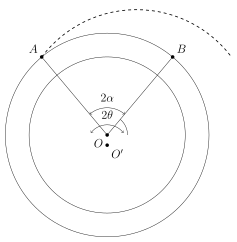
A plane circular road is bounded by two concentric circles with centres at point~\(O\). The inner circle has radius \(R\) and the outer circle has radius \(R + w\). The points \(A\) and \(B\) lie on the outer circle, as shown in the diagram, with \(\angle AOB = 2\alpha\), \(\tfrac{1}{3}\pi \leqslant \alpha \leqslant \tfrac{1}{2}\pi\) and \(0 < w < R\).
- Show that I cannot cycle from \(A\) to \(B\) in a straight line, while remaining on the road.
- I take a path from \(A\) to \(B\) that is an arc of a circle. This circle is tangent to the inner edge of the road, and has radius \(R + d\) (where \(d > w\)) and centre~\(O'\).
My path is represented by the dashed arc in the above diagram.
Let \(\angle AO'B = 2\theta\).
- Use the cosine rule to find \(d\) in terms of \(w\), \(R\) and \(\cos\alpha\).
- Find also an expression for \(\sin(\alpha - \theta)\) in terms of \(R\), \(d\) and \(\sin\alpha\).
- Show that \(\dfrac{d}{R}\) and \(\alpha - \theta\) are also both much less than \(1\).
- My friend cycles from \(A\) to \(B\) along the outer edge of the road. Let my path be shorter than my friend's path by distance~\(S\). Show that \[ S = 2(R+d)(\alpha - \theta) + 2\alpha(w - d). \] Hence show that \(S\) is approximately a fraction \[ \frac{\sin\alpha - \alpha\cos\alpha}{\alpha(1 - \cos\alpha)} \cdot \frac{w}{R} \] of the length of my friend's path.
2021 Paper 2 Q7
- The matrix \(\mathbf{R}\) represents an anticlockwise rotation through angle \(\varphi\) (\(0^\circ \leqslant \varphi < 360^\circ\)) in two dimensions, and the matrix \(\mathbf{R} + \mathbf{I}\) also represents a rotation in two dimensions. Determine the possible values of \(\varphi\) and deduce that \(\mathbf{R}^3 = \mathbf{I}\).
- Let \(\mathbf{S}\) be a real matrix with \(\mathbf{S}^3 = \mathbf{I}\), but \(\mathbf{S} \neq \mathbf{I}\). Show that \(\det(\mathbf{S}) = 1\). Given that \[ \mathbf{S} = \begin{pmatrix} a & b \\ c & d \end{pmatrix} \] show that \(\mathbf{S}^2 = (a+d)\mathbf{S} - \mathbf{I}\). Hence prove that \(a + d = -1\).
- Let \(\mathbf{S}\) be a real \(2 \times 2\) matrix. Show that if \(\mathbf{S}^3 = \mathbf{I}\) and \(\mathbf{S} + \mathbf{I}\) represents a rotation, then \(\mathbf{S}\) also represents a rotation. What are the possible angles of the rotation represented by \(\mathbf{S}\)?
2021 Paper 2 Q8
- Show that, for \(n = 2, 3, 4, \ldots\), \[ \frac{d^2}{dt^2}\bigl[t^n(1-t)^n\bigr] = n\,t^{n-2}(1-t)^{n-2}\bigl[(n-1) - 2(2n-1)t(1-t)\bigr]. \]
- The sequence \(T_0, T_1, \ldots\) is defined by \[ T_n = \int_0^1 \frac{t^n(1-t)^n}{n!}\,e^t\,dt. \] Show that, for \(n \geqslant 2\), \[ T_n = T_{n-2} - 2(2n-1)T_{n-1}. \]
- Evaluate \(T_0\) and \(T_1\) and deduce that, for \(n \geqslant 0\), \(T_n\) can be written in the form \[ T_n = a_n + b_n e, \] where \(a_n\) and \(b_n\) are integers (which you should not attempt to evaluate).
- Show that \(0 < T_n < \dfrac{e}{n!}\) for \(n \geqslant 0\). Given that \(b_n\) is non-zero for all~\(n\), deduce that \(\dfrac{-a_n}{b_n}\) tends to \(e\) as \(n\) tends to infinity.
2021 Paper 2 Q9
Two particles, of masses \(m_1\) and \(m_2\) where \(m_1 > m_2\), are attached to the ends of a light, inextensible string. A particle of mass \(M\) is fixed to a point \(P\) on the string. The string passes over two small, smooth pulleys at \(Q\) and \(R\), where \(QR\) is horizontal, so that the particle of mass \(m_1\) hangs vertically below \(Q\) and the particle of mass \(m_2\) hangs vertically below~\(R\). The particle of mass \(M\) hangs between the two pulleys with the section of the string \(PQ\) making an acute angle of \(\theta_1\) with the upward vertical and the section of the string \(PR\) making an acute angle of \(\theta_2\) with the upward vertical. \(S\) is the point on \(QR\) vertically above~\(P\). The system is in equilibrium.
- Using a triangle of forces, or otherwise, show that:
- \(\sqrt{m_1^2 - m_2^2} < M < m_1 + m_2\)\,;
- \(S\) divides \(QR\) in the ratio \(r : 1\), where \[ r = \frac{M^2 - m_1^2 + m_2^2}{M^2 - m_2^2 + m_1^2}. \]
- You are now given that \(M^2 = m_1^2 + m_2^2\). Show that \(\theta_1 + \theta_2 = 90^\circ\) and determine the ratio of \(QR\) to \(SP\) in terms of the masses only.
2021 Paper 2 Q10
A train moves westwards on a straight horizontal track with constant acceleration \(a\), where \(a > 0\). Axes are chosen as follows: the origin is fixed in the train; the \(x\)-axis is in the direction of the track with the positive \(x\)-axis pointing to the East; and the positive \(y\)-axis points vertically upwards. A smooth wire is fixed in the train. It lies in the \(x\)--\(y\) plane and is bent in the shape given by \(ky = x^2\), where \(k\) is a positive constant. A small bead is threaded onto the wire. Initially, the bead is held at the origin. It is then released.
- Explain why the bead cannot remain stationary relative to the train at the origin.
- Show that, in the subsequent motion, the coordinates \((x, y)\) of the bead satisfy \[ \dot{x}(\ddot{x} - a) + \dot{y}(\ddot{y} + g) = 0 \] and deduce that \(\tfrac{1}{2}(\dot{x}^2 + \dot{y}^2) - ax + gy\) is constant during the motion.
- Find an expression for the maximum vertical displacement, \(b\), of the bead from its initial position in terms of \(a\), \(k\) and \(g\).
- Find the value of \(x\) for which the speed of the bead relative to the train is greatest and give this maximum speed in terms of \(a\), \(k\) and \(g\).
2021 Paper 2 Q11
A train has \(n\) seats, where \(n \geqslant 2\). For a particular journey, all \(n\) seats have been sold, and each of the \(n\) passengers has been allocated a seat. The passengers arrive one at a time and are labelled \(T_1, \ldots, T_n\) according to the order in which they arrive: \(T_1\) arrives first and \(T_n\) arrives last. The seat allocated to \(T_r\) (\(r = 1, \ldots, n\)) is labelled \(S_r\). Passenger \(T_1\) ignores their allocation and decides to choose a seat at random (each of the \(n\) seats being equally likely). However, for each \(r \geqslant 2\), passenger \(T_r\) sits in \(S_r\) if it is available or, if \(S_r\) is not available, chooses from the available seats at random.
- Let \(P_n\) be the probability that, in a train with \(n\) seats, \(T_n\) sits in \(S_n\). Write down the value of \(P_2\) and find the value of \(P_3\).
- Explain why, for \(k = 2, 3, \ldots, n-1\), \[ \mathrm{P}\bigl(T_n \text{ sits in } S_n \mid T_1 \text{ sits in } S_k\bigr) = P_{n-k+1}, \] and deduce that, for \(n \geqslant 3\), \[ P_n = \frac{1}{n}\Biggl(1 + \sum_{r=2}^{n-1} P_r\Biggr). \]
- Give the value of \(P_n\) in its simplest form and prove your result by induction.
- Let \(Q_n\) be the probability that, in a train with \(n\) seats, \(T_{n-1}\) sits in \(S_{n-1}\). Determine \(Q_n\) for \(n \geqslant 2\).
2021 Paper 2 Q12
- A game for two players, \(A\) and \(B\), can be won by player \(A\), with probability \(p_A\), won by player \(B\), with probability \(p_B\), where \(0 < p_A + p_B < 1\), or drawn. A match consists of a series of games and is won by the first player to win a game. Show that the probability that \(A\) wins the match is \[ \frac{p_A}{p_A + p_B}. \]
- A second game for two players, \(A\) and \(B\), can be won by player \(A\), with probability~\(p\), or won by player \(B\), with probability \(q = 1 - p\). A match consists of a series of games and is won by the first player to have won two more games than the other. Show that the match is won after an even number of games, and that the probability that \(A\) wins the match is \[ \frac{p^2}{p^2 + q^2}. \]
- A third game, for only one player, consists of a series of rounds. The player starts the game with one token, wins the game if they have four tokens at the end of a round and loses the game if they have no tokens at the end of a round. There are two versions of the game. In the cautious version, in each round where the player has any tokens, the player wins one token with probability \(p\) and loses one token with probability \(q = 1 - p\). In the bold version, in each round where the player has any tokens, the player's tokens are doubled in number with probability \(p\) and all lost with probability \(q = 1 - p\). In each of the two versions of the game, find the probability that the player wins. Hence show that the player is more likely to win in the cautious version if \(1 > p > \tfrac{1}{2}\) and more likely to win in the bold version if \(0 < p < \tfrac{1}{2}\).
2021 Paper 3 Q1
- A curve has parametric equations \[ x = -4\cos^3 t, \qquad y = 12\sin t - 4\sin^3 t. \] Find the equation of the normal to this curve at the point \[ \bigl(-4\cos^3\phi,\; 12\sin\phi - 4\sin^3\phi\bigr), \] where \(0 < \phi < \tfrac{1}{2}\pi\). Verify that this normal is a tangent to the curve \[ x^{2/3} + y^{2/3} = 4 \] at the point \((8\cos^3\phi,\; 8\sin^3\phi)\).
- A curve has parametric equations \[ x = \cos t + t\sin t, \qquad y = \sin t - t\cos t. \] Find the equation of the normal to this curve at the point \[ \bigl(\cos\phi + \phi\sin\phi,\; \sin\phi - \phi\cos\phi\bigr), \] where \(0 < \phi < \tfrac{1}{2}\pi\). Determine the perpendicular distance from the origin to this normal, and hence find the equation of a curve, independent of \(\phi\), to which this normal is a tangent.
Solution:
- \(\,\) \begin{align*}
&& \dot{x} &=12 \cos^2 t \sin t \\
&& \dot{y} &= 12 \cos t - 12 \sin^2 t \cos t \\
&& \frac{\d y}{\d x} &= \frac{12 \cos t - 12 \sin^2 t \cos t}{12 \cos^2 t \sin t} \\
&&&= \frac{1 - \sin^2 t}{\cos t \sin t} \\
&&&= \cot t \\
\\
&& \frac{y - (12\sin\phi - 4\sin^3\phi)}{x - (-4 \cos^3 \phi)} &= - \tan \phi \\
&& y &= -\tan \phi x -4 \cos^3 \phi \tan \phi + 12 \sin \phi -4\sin^3 \phi \\
&&&= -\tan \phi x -4 \cos^2 \phi \sin \phi + 12 \sin \phi -4\sin^3 \phi \\
&&&= -\tan \phi x - 4\sin \phi+12 \sin \phi \\
&&y&= -\tan \phi x + 8 \sin \phi
\end{align*}
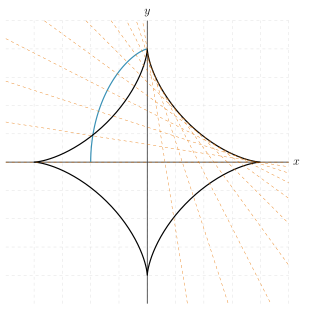
Note that when \(x = 8\cos^3 \phi\) we have \(y =-8 \cos^2 \phi \sin \phi + 8 \sin \phi = 8 \sin^3 \phi\). So the point lies on the curve. Notice also that \((8\cos^3 \phi, 8 \sin^ 3\phi)\) is a parametrisation of \(x^{2/3} + y^{2/3} = 4\) and so we can use parametric differentiation to see the gradient is \(\frac{24\sin^2 \phi \cos \phi}{-24\cos^2 \phi\sin\phi} = - \tan \phi\) so it also has the same gradient as required.
- \(\,\) \begin{align*}
&& \dot{x} &= -\sin t + \sin t + t \cos t \\
&&&= t \cos t \\
&& \dot{y} &= \cos t - \cos t + t \sin t \\
&&&= t \sin t \\
&& \frac{\d y}{\d x} &= \frac{t \sin t}{t \cos t} = \tan t \\
\\
&& \frac{y - (\sin \phi - \phi \cos \phi)}{x - (\cos \phi + \phi \sin \phi)} &= -\cot \phi \\
\Rightarrow && y &= -\cot \phi x + (\cos \phi + \phi \sin \phi) \cot \phi + \sin \phi - \phi \cos \phi \\
&&&= -\cot \phi x + \cos \phi \cot \phi + \phi \cos \phi + \sin \phi - \phi \cos \phi \\
&&&= -\cot \phi x + \frac{\cos^2 \phi + \sin^2 \phi}{\sin \phi} \\
&&&= -\cot \phi x + \cosec \phi
\end{align*}
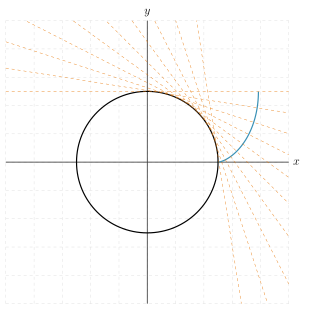
The distance to the origin is \(\displaystyle \frac{|\cosec \phi|}{\sqrt{1 + \cot^2 \phi}} = 1\) so this normal is a tangent to \(x^2 + y^2 = 1\)
2021 Paper 3 Q2
- Let \[ x = \frac{a}{b - c}, \qquad y = \frac{b}{c - a} \qquad \text{and} \qquad z = \frac{c}{a - b}, \] where \(a\), \(b\) and \(c\) are distinct real numbers. Show that \[ \begin{pmatrix} 1 & -x & x \\ y & 1 & -y \\ -z & z & 1 \end{pmatrix} \begin{pmatrix} a \\ b \\ c \end{pmatrix} = \begin{pmatrix} 0 \\ 0 \\ 0 \end{pmatrix} \] and use this result to deduce that \(yz + zx + xy = -1\). Hence show that \[ \frac{a^2}{(b-c)^2} + \frac{b^2}{(c-a)^2} + \frac{c^2}{(a-b)^2} \geqslant 2. \]
- Let \[ x = \frac{2a}{b+c}, \qquad y = \frac{2b}{c+a} \qquad \text{and} \qquad z = \frac{2c}{a+b}, \] where \(a\), \(b\) and \(c\) are positive real numbers. Using a suitable matrix, show that \(xyz + yz + zx + xy = 4\). Hence show that \[ (2a + b + c)(a + 2b + c)(a + b + 2c) > 5(b+c)(c+a)(a+b). \] Show further that \[ (2a + b + c)(a + 2b + c)(a + b + 2c) > 7(b+c)(c+a)(a+b). \]
Solution:
- \(\,\) \begin{align*} && \begin{pmatrix} 1 & -x & x \\ y & 1 & -y \\ -z & z & 1 \end{pmatrix} \begin{pmatrix} a \\ b \\ c \end{pmatrix} &= \begin{pmatrix} a-xb+xc \\ ay+b-yc \\ -za+zb+c \end{pmatrix} \\ &&&= \begin{pmatrix} a-x(b-c) \\ b-y(c-a) \\ c-z(a-b) \end{pmatrix} \\ &&&= \begin{pmatrix} 0 \\ 0 \\ 0 \end{pmatrix} \end{align*} Notice since \(a,b\) and \(c\) are distinct real numbers the vector \(\langle a,b,c \rangle\) cannot be the zero vector, so the determinant of the matrix is zero, ie \(0= 1(1+yz)+x(y-yz)+x(yz+z) = 1 +yz+yx+zx\). Notice also then that \begin{align*} && \frac{a^2}{(b-c)^2} + \frac{b^2}{(c-a)^2} + \frac{c^2}{(a-b)^2} &= x^2+y^2+z^2 \\ &&&= (x+y+z)^2 - 2(xy+yz+zx) \\ &&&= 2 + (x+y+z)^2 \geq 2 \end{align*}
- \(\,\) \begin{align*} && \begin{pmatrix} 2 & -x & -x \\ -y & 2 & -y \\ -z & -z & 2 \end{pmatrix} \begin{pmatrix} a \\ b \\ c \end{pmatrix} &= \begin{pmatrix} 2a-xb-xc \\ -ay+2b-yc \\ -za-zb+2c \end{pmatrix} \\ &&&= \begin{pmatrix} 2a-x(b+c) \\ 2b-y(c+a) \\ 2c-z(a+b) \end{pmatrix} \\ &&&= \begin{pmatrix} 0 \\ 0 \\ 0 \end{pmatrix} \\ \Rightarrow && 0 &= \det \begin{pmatrix} 2 & -x & -x \\ -y & 2 & -y \\ -z & -z & 2 \end{pmatrix} \\ &&&= 2(4 -yz)+x(-2y-yz)-x(yz+2z) \\ &&&= 8 - 2yz-2yx-2xyz-2zx\\ \Rightarrow && 4 &= xyz+xy+yz+zx \end{align*} \begin{align*} && (2a + b + c)(a + 2b + c)(a + b + 2c) &> 5(b+c)(c+a)(a+b) \\ \Leftrightarrow && \left ( \frac{2a}{b+c}+1 \right)\left ( \frac{2b}{c+a}+1 \right)\left ( \frac{2c}{a+b}+1 \right) &> 5 \\ \Leftrightarrow && \left ( x+1 \right)\left ( y+1 \right)\left ( x+1 \right) &> 5 \\ \Leftrightarrow && xyz+xy+yz+zx+x+y+z+1 &> 5 \\ \Leftrightarrow && 5+x+y+z&> 5 \\ \end{align*} Which is clearly true since if \(a,b,c\) are positve real numbers so are \(x,y,z\). This final inequality is equivalent to showing \(x+y+z > 2\) ie \begin{align*} && x+y+z &> 2 \\ \Leftrightarrow && \frac{a}{b+c} + \frac{b}{c+a} + \frac{c}{a+b} &> 1 \\ \\ && \frac{a}{b+c} + \frac{b}{c+a} + \frac{c}{a+b} & > \frac{a}{a+b+c} + \frac{b}{a+b+c} + \frac{c}{a+b+c} = 1 \end{align*} So we're done.
2021 Paper 3 Q3
- Let \(\displaystyle I_n = \int_0^{\beta} (\sec x + \tan x)^n \, dx\), where \(n\) is a non-negative integer and \(0 < \beta < \dfrac{\pi}{2}\). For \(n \geqslant 1\), show that \[ \tfrac{1}{2}(I_{n+1} + I_{n-1}) = \frac{1}{n}\bigl[(\sec\beta + \tan\beta)^n - 1\bigr]. \] Show also that \[ I_n < \frac{1}{n}\bigl[(\sec\beta + \tan\beta)^n - 1\bigr]. \]
- Let \(\displaystyle J_n = \int_0^{\beta} (\sec x \cos\beta + \tan x)^n \, dx\), where \(n\) is a non-negative integer and \(0 < \beta < \dfrac{\pi}{2}\). For \(n \geqslant 1\), show that \[ J_n < \frac{1}{n}\bigl[(1 + \tan\beta)^n - \cos^n\beta\bigr]. \]
Solution: \begin{questionparts} \item \(\,\) \begin{align*} && I_n &= \int_0^{\beta} (\sec x + \tan x)^n \, \d x \\ && \tfrac12(I_{n+1}+I_{n-1}) &= \tfrac12\int_0^{\beta} \left ( (\sec x + \tan x)^{n+1}+(\sec x + \tan x)^{n-1}\right) \, \d x \\ && \tfrac12(I_{n+1}+I_{n-1}) &= \tfrac12\int_0^{\beta} (\sec x + \tan x)^{n-1}\left ( (\sec x + \tan x)^{2}+1\right) \, \d x \\ && \tfrac12(I_{n+1}+I_{n-1}) &= \tfrac12\int_0^{\beta} (\sec x + \tan x)^{n-1}\left ( \sec^2 x + \tan^2 x + 2\sec x \tan x + 1\right) \, \d x \\ && \tfrac12(I_{n+1}+I_{n-1}) &= \tfrac12\int_0^{\beta} (\sec x + \tan x)^{n-1}\left ( 2\sec x \tan x +2\sec^2 x \right) \, \d x \\ &&& = \left [\frac1n(\sec x + \tan x)^{n} \right]_0^{\beta} \\ &&&= \frac1n[(\sec \beta + \tan \beta)^n - 1] \end{align*} Notice that by AM-GM \(\tfrac12( ( (\sec x + \tan x)^{n+1}+(\sec x + \tan x)^{n-1}) \geq (\sec x + \tan x)^{n}\) with equality not holding most of the time. Integrating we obtain our result. \item \(\,\) \begin{align*} && J_n &= \int_0^{\beta} (\sec x \cos \beta + \tan x )^n \d x \\ && \tfrac12( J_{n+1} + J_{n-1}) &= \tfrac12 \int_0^{\beta} \left ( (\sec x \cos \beta + \tan x )^{n+1} +(\sec x \cos \beta + \tan x )^{n-1}\right ) \d x \\ && &= \tfrac12 \int_0^{\beta}(\sec x \cos \beta + \tan x )^{n-1} \left ( (\sec x \cos \beta + \tan x )^{2} + \right ) \d x \\ && &= \tfrac12 \int_0^{\beta}(\sec x \cos \beta + \tan x )^{n-1} \left ( \sec^2 x \cos^2 \beta + \tan^2 x+ 2\sec x \tan x \cos \beta +1 \right ) \d x \\ && &= \int_0^{\beta}(\sec x \cos \beta + \tan x )^{n-1} \left ( \sec x \tan x \cos \beta +\tfrac12(\cos^2 \beta +1)\sec^2 x \right ) \d x \\ && &< \int_0^{\beta}(\sec x \cos \beta + \tan x )^{n-1} \left ( \sec x \tan x \cos \beta +\sec^2 x \right ) \d x \\ &&&= \left [\frac1n (\sec x \cos \beta + \tan x)^{n} \right]_0^{\beta} \\ &&&= \frac1n[ (1 + \tan \beta)^n - \cos^n \beta] \end{align*} But notice we can use the same AM-GM argument from before to show that \(J_n < \tfrac12( J_{n+1} + J_{n-1}) < \frac1n[ (1 + \tan \beta)^n - \cos^n \beta]\)