Problems
Filters
42 problems found
2007 Paper 1 Q1
A positive integer with \(2n\) digits (the first of which must not be \(0\)) is called a balanced number if the sum of the first \(n\) digits equals the sum of the last \(n\) digits. For example, \(1634\) is a \(4\)-digit balanced number, but \(123401\) is not a balanced number.
- Show that seventy \(4\)-digit balanced numbers can be made using the digits \(0, 1, 2, 3\) and \(4\).
- Show that \(\frac16 {k \left( k+1 \right) \left( 4k+5 \right) }\) \(4\)-digit balanced numbers can be made using the digits \(0\) to \(k\). You may use the identity $\displaystyle \sum _{r=0}^{n} r^2 \equiv \tfrac{1}{6} {n \left( n+1 \right) \left( 2n+1 \right) } \;$.
Solution:
- For each number from \(1\) to \(8\) (4+4), we can count the number of ways it can be achieved in any way, or without including a leading \(0\). \begin{array}{c|c|c|c} \text{total} & \text{ways with }0 & \text{ways without } 0 & \text{comb}\\ \hline 8 & 1 & 1 & 1\\ 7 & 2 & 2 & 4 \\ 6 & 3 & 3 & 9 \\ 5 & 4 & 4 & 16 \\ 4 & 5 & 4 & 20 \\ 3 & 4 & 3 & 12 \\ 2 & 3 & 2 & 6 \\ 1 & 2 & 1 & 2 \\ \hline &&& 70 \end{array}
- For \(2k\) to \(k+1\) there are \(1 \times 1 + 2 \times 2 + \cdots i\times i+\cdots + k\times k\) ways to achieve this, (we can choose anything from \(k\) to \(k-i+1\) for the first digit, and we can never have a \(0\). For \(1\) to \(k\) we can have \(1 \times 2 + 2 \times 3 + \cdots + k \times (k+1)\) since we cannot start with a \(0\), but can have anything less than or equal to \(i\) for the first digit, and then with the \(0\) we can have the same thing starting with \(0\). Hence the answer is: \begin{align*} && S &= \sum_{i=1}^k i^2 + \sum_{i=1}^k i (i+1) \\ &&&= 2\sum_{i=1}^k i^2 + \sum_{i=1}^k i \\ &&&= \frac{1}{3} k(k+1)(2k+1) + \frac12k(k+1) \\ &&&= k(k+1) \left (\frac{2k+1}{3} + \frac{1}{2} \right) \\ &&&= \frac16 k(k+1)(4k+2+3) \\ &&&= \frac16 k(k+1)(4k+5) \end{align*}
2007 Paper 1 Q2
- Given that \(A = \arctan \frac12\) and that \(B = \arctan\frac13\,\) (where \(A\) and \(B\) are acute) show, by considering \(\tan \left( A + B \right)\), that \(A + B = {\frac{1}{4}\pi }\). The non-zero integers \(p\) and \(q\) satisfy \[ \displaystyle \arctan {\frac1 p} + \arctan {\frac1 q} = {\frac\pi 4}\,. \] Show that \( \left ( p-1 \right) \left(q-1 \right) = 2\) and hence determine \(p\) and \(q\).
- Let \(r\), \(s\) and \(t\) be positive integers such that the highest common factor of \(s\) and \(t\) is \(1\). Show that, if \[ \arctan {\frac1 r} + \arctan \frac s {s+t} = {\frac\pi 4}\,, \] then there are only two possible values for \(t\), and give \(r\) in terms of \(s\) in each case.
Solution:
- \begin{align*} && \tan (A+B) &= \frac{\tan A + \tan B}{1-\tan A \tan B}\\ &&&= \frac{\tan \arctan \frac12 + \tan \arctan \frac13}{1-\tan \arctan \frac12 \tan \arctan \frac13}\\ &&&= \frac{\frac12+\frac13}{1-\frac16} \\ &&&= \frac{3+2}{5} \\ &&&= 1 \\ \Rightarrow && A+B &= \frac{\pi}{4} + n \pi \end{align*} but since \(A,B\) are acute \(0 < A+B < \pi\), so \(A+B = \frac{\pi}{4}\) \begin{align*} && 1 &= \tan \frac{\pi}{4} \\ &&&= \tan \left ( \arctan {\frac1 p} + \arctan {\frac1 q}\right) \\ &&&= \frac{\frac1p + \frac1q}{1-\frac1{pq}} \\ &&&= \frac{q+p}{pq-1} \\ \Rightarrow && pq-1 &= q+p \\ \Rightarrow && 0 &= pq-q-p-q \\ &&&= (p-1)(q-1)-2 \\ \Rightarrow && 2 &= (p-1)(q-1) \end{align*} But \(p\),\(q\) are integers, so \(p-1 \in \{-2,-1,1,1\} \Rightarrow p \in \{-1,0,2,3\}\) but we cannot have \(p= 0\), so we must have \((p,q) = (2,3), (3,2)\)
- \begin{align*} && 1 &= \tan \frac{\pi}{4} \\ &&&= \tan \left ( \arctan {\frac1 r} + \arctan \frac s {s+t} \right) \\ &&&= \frac{\frac1r + \frac{s}{s+t}}{1-\frac{s}{r(s+t)}} \\ &&&= \frac{s+t+sr}{r(s+t)-s} \\ \Rightarrow && rs+rt-s &= s+t + sr \\ \Rightarrow && 0 &= rt-2s-t \\ &&2s&= t(r-1) \end{align*} Since \((s,t) =1\), we must have \(t \mid 2\), so \( t = 1,2\) and \(r = 2s+1\) or \(r=s+1\) respectively.
2007 Paper 1 Q3
Prove the identities \(\cos^4\theta -\sin^4\theta \equiv \cos 2\theta\) and $\cos^4 \theta + \sin^4 \theta \equiv 1 - {\frac12} \sin^2 2 \theta$. Hence or otherwise evaluate \[ \int_0^{\frac{1}{2}\pi} \cos^4 \theta \; \d \theta \;\;\;\; \mbox{and}\;\;\;\; \int_0^{\frac{1}{2}\pi} \sin^4 \theta \; \d \theta \,. \] Evaluate also \[ \int_0^{\frac{1}{2}\pi} \cos^6 \theta \; \d \theta \;\;\;\; \mbox{and}\;\;\;\; \int_0^{\frac{1}{2}\pi} \sin^6 \theta \; \d \theta \,. \]
Solution: \begin{align*} && \cos^4 \theta - \sin^4 \theta &= (\cos^2 \theta - \sin^2 \theta)(\cos^2 \theta + \sin^2 \theta) \\ &&&= \cos^2 \theta - \sin^2 \theta \\ &&&= \cos 2 \theta \\ \\ && 1&= (\cos^2 \theta + \sin^2 \theta)^2 \\ &&&= \cos^4 \theta + \sin^4 \theta + 2 \sin^2 \theta \cos^2 \theta \\ &&&= \cos^4 \theta + \sin^4 \theta + \frac12 ( \sin^2 2 \theta) \\ \Rightarrow && \cos^4 \theta + \sin^4 \theta &= 1 - \tfrac12 \sin^2 2 \theta \end{align*} \begin{align*} && I &= \int_{0}^{\pi/2} \cos^4 \theta \d \theta \\ && J &= \int_0^{\pi/2} \sin^4 \theta \d \theta \\ && I-J &= \int_0^{\pi/2} \cos 2 \theta \d \theta = 0 \\ && I+J &= \int_0^{\pi/2} (1- \frac12 \sin^2 2 \theta) \d \theta \\ &&&= \frac{\pi}{2} - \frac14 \int_0^{\pi} \sin^2 \theta \d \theta \\ &&&= \frac{\pi}{2} - \frac{\pi}{8} \\ &&&= \frac{3\pi}{8} \\ \Rightarrow && I=J &= \frac{3\pi}{16} \end{align*} \begin{align*} && \cos^6 \theta + \sin^6 \theta &= (\cos^2 \theta + \sin^2 \theta)(\cos^4 \theta - \cos^2 \theta \sin^2 \theta + \sin^4 \theta) \\ &&&= 1-\tfrac12 \sin^2 2\theta - \tfrac14 \sin^2 2 \theta \\ &&&= 1 - \tfrac34 \sin^2 2 \theta \\ %&& \cos^6 \theta - \sin^6 \theta &= (\cos^2 \theta - \sin^2 \theta)(\cos^4 \theta + \cos^2 \theta \sin^2 \theta + \sin^4 \theta) \\ %&&&= \cos 2 \theta (1 - \tfrac12 \sin^2 2 \theta + \tfrac14 \sin^2 2 \theta) \\ %&&&= \cos 2 \theta (1 - \tfrac14 \sin^2 2 \theta) \\ \end{align*} \begin{align*} && I &= \int_{0}^{\pi/2} \cos^6 \theta \d \theta \\ && J &= \int_0^{\pi/2} \sin^6 \theta \d \theta \\ && I-J &= 0 \\ && I+J &= \int_0^{\pi/2} (1 - \tfrac34 \sin^2 2 \theta) \d \theta \\ &&&= \frac{\pi}{2} - \frac{3\pi}{16} = \frac{5\pi}{16} \\ \Rightarrow && I = J &= \frac{5\pi}{32} \end{align*}
2007 Paper 1 Q4
Show that \(x^3-3xbc + b^3 + c^3\) can be written in the form \(\left( x+ b+ c \right) {\rm Q}( x)\), where \({\rm Q}( x )\) is a quadratic expression. Show that \(2{\rm Q }( x )\) can be written as the sum of three expressions, each of which is a perfect square. It is given that the equations \(ay^2 + by + c =0\) and \(by^2 + cy + a = 0\) have a common root \(k\). The coefficients \(a\), \(b\) and \(c\) are real, \(a\) and \(b\) are both non-zero, and \(ac \neq b^2\). Show that \[ \left( ac - b^2 \right) k = bc - a^2 \] and determine a similar expression involving \(k^2\). Hence show that \[ \left( ac - b^2 \right) \left(ab-c^2 \right) = \left( bc - a^2 \right)^2 \] and that \( a^3 -3abc + b^3 +c^3 = 0\,\). Deduce that either \(k=1\) or the two equations are identical.
Solution: \begin{align*} && x^3 - 3xbc+b^3 + c^3 &= (x+b+c)(x^2-x(b+c)+b^2+c^2-bc) \\ &&&= \tfrac12(x+b+c)((x-b)^2+(x-c)^2+(b-c)^2) \\ \end{align*} We must have: \begin{align*} && 0 &= ak^2 + bk+c \tag{1}\\ &&0 &= bk^2+ck+a \tag{2}\\ b*(1)&& 0 &= abk^2 + b^2k+cb \\ a*(2)&& 0 &= abk^2 + ack + a^2 \\ \Rightarrow && 0 &= k(ac-b^2)+a^2-bc \\ \Rightarrow && (ac-b^2)k &= bc-a^2 \\ \\ c*(1) && 0 &= ack^2+bck+c^2 \\ b*(2) && 0 &= b^2k^2+bck+ab \\ \Rightarrow && 0 &= (ac-b^2)k^2 +c^2-ab \\ \Rightarrow && (ac-b^2)k^2 &= ab-c^2 \\ \\ \Rightarrow && \frac{ab-c^2}{ac-b^2} &= k^2 = \left (\frac{bc-a^2}{ac-b^2} \right)^2 \\ \Rightarrow && (ab-c^2)(ac-b^2) &= (bc-a^2)^2 \\ \Rightarrow && a^2bc - ab^3-ac^3+b^2c^2 &= b^2c^2-2a^2bc+a^4 \\ \Rightarrow && 0 &= a^4+ab^3+ac^3-3a^2bc \\ &&&= a(a^3+b^3+c^3-3abc) \\ \underbrace{\Rightarrow}_{a \neq 0} && 0 &= a^3+b^3+c^3-3abc \\ &&&= (a+b+c)((a-b)^2+(b-c)^2+(c-a)^2) \end{align*} Therefore \(a+b+c = 0\). (Since otherwise \(a=b=c\) but \(ac \neq b^2\)). This means \(1\) is a root of our equations. Therefore, either \(k = 1\) or they have both roots in common, ie they are the same equation up to a scalar factor. ie \(b = la, c = lb, a= lc \Rightarrow l^3 = 1 \Rightarrow l = 1\). Therefore, they are the same equation.
2007 Paper 1 Q5
Note: a regular octahedron is a polyhedron with eight faces each of which is an equilateral triangle.
- Show that the angle between any two faces of a regular octahedron is \(\arccos \left( -{\frac1 3} \right)\).
- Find the ratio of the volume of a regular octahedron to the volume of the cube whose vertices are the centres of the faces of the octahedron.
Solution:
- Suppose the vertices are \((\pm1, 0,0), (0,\pm1,0), (0,0,\pm1)\), then clearly this is an octahedron. We can measure the angle between the faces, by looking at vectors in the same plane and also in two of the faces: \(\langle \frac12, \frac12, - 1\rangle\) and \(\langle \frac12, \frac12, 1\rangle\), then by considering the dot product: \begin{align*} && \cos \theta &= \frac{\frac14+\frac14-1}{\frac14+\frac14+1} \\ &&&= \frac{-2}{6} = -\frac13 \end{align*}
- The volume of our octahedron is \(2 \cdot \frac13 \cdot \underbrace{\sqrt{2}^2}_{\text{base}} \cdot \underbrace{1}_{\text{height}} = \frac43\). The centre of two touching faces are \(\langle \frac13, \frac13, \frac13 \rangle\) and \(\langle \frac13, \frac13, -\frac13 \rangle\) and so the length of the side of the cube is \(\frac23\) and so the volume of the cube is \(\frac8{27}\). Therefore the ratio is \(\frac{2}{9}\)
2007 Paper 1 Q6
- Given that \(x^2 - y^2 = \left( x - y \right)^3\) and that \(x-y = d\) (where \(d \neq 0\)), express each of \(x\) and \(y\) in terms of \(d\). Hence find a pair of integers \(m\) and \(n\) satisfying \(m-n = \left( \sqrt {m} - \sqrt{n} \right)^3\) where \(m > n > 100\).
- Given that \(x^3 - y^3 = \left( x - y \right)^4\) and that \(x-y = d\) (where \(d \neq 0\)), show that \(3xy = d^3 - d^2\). Hence show that \[ 2x = d \pm d \sqrt {\frac{4d-1 }{3}} \] and determine a pair of distinct positive integers \(m\) and \(n\) such that \(m^3 - n^3 = \left( m - n \right)^4\).
Solution:
- \(\,\) \begin{align*} && x^2-y^2 &=(x-y)^3 \\ \Rightarrow && x+y &=d^2 \\ && x-y &= d \\ \Rightarrow && x &= \tfrac12(d^2+d) \\ && y &= \tfrac12(d^2-d) \end{align*} Therefore consider \(x^2 = m, y^2 = n\), so \(m = \tfrac14(d^2+d)^2, n = \tfrac14(d^2-d)^2\) so we want \(d^2-d > 20\), so \(d = 6, n = 225, m = 441\).
- \(\,\) \begin{align*} && x^3-y^3 &= (x-y)^4 \\ \Rightarrow && x^2+xy+y^2 &= (x-y)^3 \\ && d^3 &= (x-y)^2+3xy \\ && d^3 &= d^2 + 3xy \\ \Rightarrow && 3xy &= d^3 - d^2 \\ \Rightarrow && 3x(x-d) &= d^3-d^2 \\ \Rightarrow && 0 &= 3x^2-3dx-(d^3-d^2) \\ \Rightarrow && 2x &=d \pm \sqrt{d^2+4\frac{(d^3-d^2)}{3}} \\ &&&= d \pm d \sqrt{\frac{3+4d-4}{3}} \\ &&&= d \pm d \sqrt{\frac{4d-1}{3}} \end{align*} Therefore we need \(\frac{4d-1}{3}\) to be an odd square. \(y = x-d = -\frac{d}{2} \pm \frac{d}{2} \sqrt{\frac{4d-1}{3}}\). Since we want positive values, we should take the positive square roots. \(d = \frac{3 \cdot 3^2 + 1}{4} = 7\) we have \(2x = 7 +7 \cdot 3 = 28 \Rightarrow x = 14, y = 7\)
2007 Paper 1 Q7
- The line \(L_1\) has vector equation $\displaystyle {\bf r} = \begin{pmatrix} 1 \\ 0 \\ 2 \end{pmatrix} + \lambda \begin{pmatrix} \hphantom{-} 2 \\ \hphantom{-} 2 \\ -3 \end{pmatrix} $. The line \(L_2\) has vector equation $\displaystyle {\bf r} = \begin{pmatrix} \hphantom{-} 4 \\ -2 \\ \hphantom{-} 9 \end{pmatrix} + \mu \begin{pmatrix} \hphantom{-} 1 \\ \hphantom{-} 2 \\ -2 \end{pmatrix} . $ Show that the distance \(D\) between a point on \(L_1\) and a point on \(L_2\) can be expressed in the form \[ D^2 = \left(3\mu -4 \lambda-5 \right)^2 + \left( \lambda -1 \right)^2 + 36\,. \] Hence determine the minimum distance between these two lines and find the coordinates of the points on the two lines that are the minimum distance apart.
- The line \(L_3\) has vector equation ${\bf r} = \begin{pmatrix} 2 \\ 3 \\ 5 \end{pmatrix} + \alpha \begin{pmatrix} 0 \\ 1 \\ 0 \end{pmatrix} . $ The line \(L_4\) has vector equation $ {\bf r} = \begin{pmatrix} \hphantom{-} 3 \\ \hphantom{-} 3 \\ -2 \end{pmatrix} + \beta \begin{pmatrix} \, 4k\\ 1-k \\ \!\!\! -3k \end{pmatrix} . $ Determine the minimum distance between these two lines, explaining geometrically the two different cases that arise according to the value of \(k\).
2007 Paper 1 Q8
A curve is given by the equation \[ y = ax^3 - 6ax^2+ \left( 12a + 12 \right)x - \left( 8a + 16 \right)\,, \tag{\(*\)} \] where \(a\) is a real number. Show that this curve touches the curve with equation \[ y=x^3 \tag{\(**\)} \] at \(\left( 2 \, , \, 8 \right)\). Determine the coordinates of any other point of intersection of the two curves.
- Sketch on the same axes the curves \((*)\) and \((**)\) when \(a = 2\).
- Sketch on the same axes the curves \((*)\) and \((**)\) when \(a = 1\).
- Sketch on the same axes the curves \((*)\) and \((**)\) when \(a = -2\).
Solution: \begin{align*} && y &= ax^3 - 6ax^2+ \left( 12a + 12 \right)x - \left( 8a + 16 \right) \\ && y(2) &= 8a-24a+24a+24-8a-16 \\ &&&= 8 \\ && y'(x) &= 3ax^2-12ax+(12a+12) \\ && y'(0) &= 12a-24a+12a+12 \\ &&&= 12 \end{align*} Therefore since our curve has the same value and gradient at \((2,8)\) as \(y = x^3\) they must touch at this point. Therefore \begin{align*} && ax^3 - 6ax^2+ \left( 12a + 12 \right)x - \left( 8a + 16 \right) - x^3 &= (x-2)^2((a-1)x-(2a+4)) \end{align*} Therefore if \(a \neq 1\), they touch again when \(x = \frac{2a+4}{a-1}\).


2007 Paper 1 Q9
A particle of weight \(W\) is placed on a rough plane inclined at an angle of \(\theta\) to the horizontal. The coefficient of friction between the particle and the plane is \(\mu\). A horizontal force \(X\) acting on the particle is just sufficient to prevent the particle from sliding down the plane; when a horizontal force \(kX\) acts on the particle, the particle is about to slide up the plane. Both horizontal forces act in the vertical plane containing the line of greatest slope. Prove that \[ \left( k-1 \right) \left( 1 + \mu^2 \right) \sin \theta \cos \theta = \mu \left( k + 1 \right) \] and hence that $\displaystyle k \ge \frac{ \left( 1+ \mu \right)^2} { \left( 1 - \mu \right)^2}$ .
2007 Paper 1 Q10
The Norman army is advancing with constant speed \(u\) towards the Saxon army, which is at rest. When the armies are \(d\) apart, a Saxon horseman rides from the Saxon army directly towards the Norman army at constant speed \(x\). Simultaneously a Norman horseman rides from the Norman army directly towards the Saxon army at constant speed \(y\), where $y > u$. The horsemen ride their horses so that \(y - 2x < u < 2y - x\). When each horseman reaches the opposing army, he immediately rides straight back to his own army without changing his speed. Represent this information on a displacement-time graph, and show that the two horsemen pass each other at distances \[ \frac{xd }{ x + y} \;\; \mbox{and} \;\; \frac{xd(2y -x-u)} {(u+x ) ( x + y )} \] from the Saxon army. Explain briefly what will happen in the cases (i) \(u > 2y - x\) and (ii) \(u < y - 2x\).
2007 Paper 1 Q11
A smooth, straight, narrow tube of length \(L\) is fixed at an angle of \(30^\circ\) to the horizontal. A~particle is fired up the tube, from the lower end, with initial velocity \(u\). When the particle reaches the upper end of the tube, it continues its motion until it returns to the same level as the lower end of the tube, having travelled a horizontal distance \(D\) after leaving the tube. Show that \(D\) satisfies the equation \[ 4gD^2 - 2 \sqrt{3} \left( u^2 - Lg \right)D - 3L \left( u^2 - gL \right) = 0 \] and hence that \[ \frac{{\rm d}D}{ {\rm d}L} = - \frac{ 2\sqrt{3}gD - 3(u^2-2gL)} { 8gD - 2 \sqrt{3} \left(u^2 - gL \right)}. \] The final horizontal displacement of the particle from the lower end of the tube is \(R\). Show that \(\dfrac{\d R}{\d L} = 0\) when \(2D = L \sqrt 3\), and determine, in terms of \(u\) and \(g\), the corresponding value of \(R\).
2007 Paper 1 Q12
- A bag contains \(N\) sweets (where \(N \ge 2\)), of which \(a\) are red. Two sweets are drawn from the bag without replacement. Show that the probability that the first sweet is red is equal to the probability that the second sweet is red.
- There are two bags, each containing \(N\) sweets (where \(N \ge 2\)). The first bag contains \(a\) red sweets, and the second bag contains \(b\) red sweets. There is also a biased coin, showing Heads with probability \(p\) and Tails with probability \(q\), where \(p+q = 1\). The coin is tossed. If it shows Heads then a sweet is chosen from the first bag and transferred to the second bag; if it shows Tails then a sweet is chosen from the second bag and transferred to the first bag. The coin is then tossed a second time: if it shows Heads then a sweet is chosen from the first bag, and if it shows Tails then a sweet is chosen from the second bag. Show that the probability that the first sweet is red is equal to the probability that the second sweet is red.
2007 Paper 1 Q13
A bag contains eleven small discs, which are identical except that six of the discs are blank and five of the discs are numbered, using the numbers 1, 2, 3, 4 and 5. The bag is shaken, and four discs are taken one at a time without replacement. Calculate the probability that:
- all four discs taken are numbered;
- all four discs taken are numbered, given that the disc numbered ``3'' is taken first;
- exactly two numbered discs are taken, given that the disc numbered ``3'' is taken first;
- exactly two numbered discs are taken, given that the disc numbered ``3'' is taken;
- exactly two numbered discs are taken, given that a numbered disc is taken first;
- exactly two numbered discs are taken, given that a numbered disc is taken.
Solution: There are many ways to do the counting in each question, possibly the clearest way is to always consider the order in which discs are taken, although all methods should work equally well. For some examples Bayes rule also offers a fast solution.
- There are we are choose \(4\) objects in order from \(5\) (ie \({^5\P_4}\)) to obtain valid draws, this is out of a total of picking \(4\) objects from \(11\) (\({^{11}\P_4}\)). Ie the probability is: \(\displaystyle \frac{{^5\P_4}}{{^{11}\P_4}} = \frac{5! \cdot 7!}{11!} = \frac{1}{66}\) Alternatively, there are \(\binom{5}{4}\) ways to choose four numbered discs, out of \(\binom{11}{4}\) ways to choose four discs. ie \(\displaystyle \binom{5}{4} \Big / \binom{11}{4} = \frac{5 \cdot 4! \cdot 7!}{11!} = \frac{5 \cdot 4 \cdot 3 \cdot 2}{11 \cdot 10 \cdot 9 \cdot 8} = \frac1{66}\)
- \begin{align*} \mathbb{P}(\text{all four discs are numbered} | \text{first disc is 3}) &= \frac{\mathbb{P}(\text{all four discs are numbered and first disc is 3})}{\mathbb{P}( \text{first disc is 3})} \\ &= \frac{^4\P_3 \big / {^{11}\P_4}}{1/11} \\ &= 11\cdot \frac{4!}{1!} \Bigg / \frac{11!}{7!} \\ &= \frac{4! \cdot 7! \cdot 11}{11!} \\ &= \frac{4\cdot 3 \cdot 2}{10 \cdot 9 \cdot 8} \\ &= \frac{1}{30} \end{align*} Alternatively, \begin{align*} \mathbb{P}(\text{all four discs are numbered} | \text{first disc is 3}) &= \frac{\mathbb{P}(\text{all four discs are numbered and first disc is 3})}{\mathbb{P}( \text{first disc is 3})} \\ &= \frac{\binom{4}{3} \Bigg / 11 \cdot \binom{10}{3}}{1/11} \\ &= \frac{1}{30} \end{align*} Where we are calculating this as "choose one number", then "choose 3 more", which can happen ending up with 3, number, number, number in \(\binom{4}{3}\) ways, and there are \(11 \cdot \binom{10}{3}\) was overall. Another alternative using Bayes rule: \begin{align*} \mathbb{P}(\text{all four discs are numbered} | \text{first disc is 3}) &= \mathbb{P}( \text{first disc is 3} | \text{all four discs are numbered}) \frac{ \mathbb{P}( \text{all four discs are numbered} }{ \mathbb{P}( \text{first disc is 3} )} \\ &= \frac{\frac{1}{5} \cdot \frac{1}{66}}{\frac{1}{11}} \\ &= \frac1{30} \end{align*}
- \begin{align*} \mathbb{P}(\text{exactly two discs are numbered} | \text{first disc is 3}) &=\frac{\mathbb{P}(\text{exactly two discs are numbered and first disc is 3})}{\mathbb{P}( \text{first disc is 3})} \\ &= \frac{3 \cdot {^4\P_1} \cdot {^{6}\P_2} \big / {^{11}\P_4}}{\frac1{11} } \\ &= \frac12 \end{align*} Alternatively, \begin{align*} \mathbb{P}(\text{exactly two discs are numbered} | \text{first disc is 3}) &=\frac{\mathbb{P}(\text{exactly two discs are numbered and first disc is 3})}{\mathbb{P}( \text{first disc is 3})} \\ &= \frac{\binom{4}{1}\binom{6}{2} \Big / 11 \cdot \binom{10}{3}}{1/11} \\ &= \frac12 \end{align*}
- \begin{align*} \mathbb{P}(\text{exactly two discs are numbered} | \text{3 taken}) &= \frac{\mathbb{P}(\text{exactly two discs are numbered and 3 taken})}{\mathbb{P}( \text{3 taken})} \\ &= \frac{\binom{4}{1}\binom{6}{2} \Big / \binom{11}{4}}{\frac{4}{11}} \\ &= \frac{\frac{2}{11}}{\frac4{11}} \\ &= \frac12 \end{align*} Using Bayes rule: \(\mathbb{P}( \text{3 taken}) = \frac{1}{11} + \frac{10}{11}\frac{1}{10} + \frac{10}{11}\frac{9}{10}\frac{1}{9} + \frac{10}{11}\frac{9}{10}\frac89\frac18 = \frac{4}{11}\) \begin{align*} \mathbb{P}(\text{exactly two discs are numbered} | \text{3 taken}) &= \frac{\mathbb{P}(\text{3 taken | exactly two discs are numbered})\mathbb{P}(\text{exactly two discs are numbered})}{\mathbb{P}( \text{3 taken})} \\ &= \frac{\frac{4}{10} \cdot \binom{5}{2} \binom{6}{2} \Big / \binom{11}{4}}{4/11} \\ &= \frac{\frac4{10}{5 / 11}}{4/11} \\ &= \frac{1}{2} \end{align*}
- \begin{align*} \mathbb{P}(\text{exactly two discs are numbered} | \text{numbered disc first}) &= \frac{\mathbb{P}(\text{exactly two discs are numbered and numbered disc first})}{\mathbb{P}( \text{numbered disc first})} \\ &= \frac{3 \cdot {^5\P_1}\cdot{^4\P_1}\cdot{^6\P_2} \Big / {^{11}\P_4}}{\frac{5}{11}} \\ &= \frac{1}{2} \end{align*}
- \begin{align*} \mathbb{P}(\text{exactly two discs are numbered} | \text{numbered disc taken}) &= \frac{\mathbb{P}(\text{exactly two discs are numbered and numbered disc taken})}{\mathbb{P}(\text{numbered disc taken})} \\ &= \frac{\mathbb{P}(\text{exactly two discs are numbered})}{1 - \mathbb{P}(\text{not numbered discs taken})} \\ &= \frac{\binom{5}{2}\binom{6}{2} \Big / \binom{11}{4}}{1 - \binom{6}{4} \Big / \binom{11}{4}} \\ &= \frac{\frac{5}{11}}{\frac{21}{22}} \\ &= \frac{10}{21} \neq \frac12 \end{align*}
2007 Paper 1 Q14
The discrete random variable \(X\) has a Poisson distribution with mean \(\lambda\).
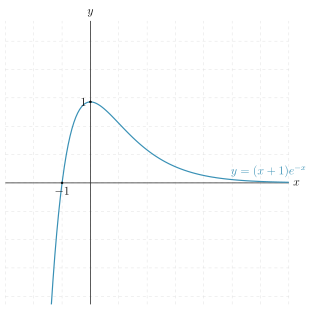
- Sketch the graph \(y=\l x+1 \r \e^{-x}\), stating the coordinates of the turning point and the points of intersection with the axes. It is known that \(\P(X \ge 2) = 1-p\), where \(p\) is a given number in the range \(0 < p <1\). Show that this information determines a unique value (which you should not attempt to find) of \(\lambda\).
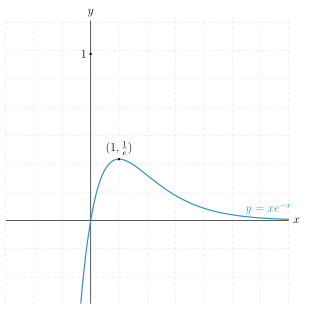
- It is known (instead) that \(\P \l X = 1 \r = q\), where \(q\) is a given number in the range \(0 < q <1\). Show that this information determines a unique value of \(\lambda\) (which you should find) for exactly one value of \(q\) (which you should also find).
- It is known (instead) that \(\P \l X = 1 \, \vert \, X \le 2 \r = r\), where \(r\) is a given number in the range \(0 < r < 1\). Show that this information determines a unique value of \(\lambda\) (which you should find) for exactly one value of \(r\) (which you should also find).
Solution: Let \(X \sim Po(\lambda)\), then
- \(\,\)
Suppose \(\mathbb{P}(X \geq 2) = 1-p\) then \(\mathbb{P}(X=0) + \mathbb{P}(X=1) = p\), ie \(e^{-\lambda} +\lambda e^{-\lambda} = p\) If \(f(x) = (1+x)e^{-x}\) we have see it is strictly decreasing on \(x \geq 0\) and takes all values from \(1\) to \(0\), therefore we can find a unique value such that \(f(\lambda) = p\) which is our desired \(\lambda\).
- Note that \(\mathbb{P}(X = 1) = \lambda e^{-\lambda}\)
Sketching \(y = xe^{-x}\) and finding it's turning point we can see that there is a unique value of \(\lambda = 1\) when \(q = \frac{1}{e}\), otherwise there is either no solution (\(p > \frac1{e}\)) or two solutions (\(0 < q > \frac1{e}\)).
- Suppose \(\mathbb{P}(X = 1 | X \leq 2) = r\), ie \begin{align*} && r &= \frac{\lambda e^{-\lambda}}{e^{-\lambda} + \lambda e^{-\lambda} + \frac12 \lambda^2 e^{-\lambda}} \\ &&&= \frac{2\lambda}{2+2\lambda+\lambda^2} \\ \Rightarrow && 0 &= r\lambda^2 + 2(r-1) \lambda + 2r\\ \Rightarrow && \Delta &= 4(r-1)^2 - 4\cdot r \cdot 2 r \\ &&&= 4((r-1)^2-2r^2) \\ &&&= 4(r-1-\sqrt{2}r)(r-1+\sqrt{2}r) \\ &&&= -4((\sqrt{2}-1)r + 1)((1+\sqrt{2})r-1) \end{align*} Therefore our quadratic in \(r\) has a unique solution if \(r = \frac{1}{1+\sqrt{2}}\). If it has a positive solution then note since \(2r > 0\) both solutions are positive, so \(\lambda\) is not unique by excluding other solutions.
2007 Paper 2 Q1
In this question, you are not required to justify the accuracy of the approximations.
- Write down the binomial expansion of \(\displaystyle \left( 1+\frac k {100} \right)^{\!\frac12}\)in ascending powers of \(k\), up to and including the \(k^3\) term.
- Use the value \(k=8\) to find an approximation to five decimal places for \(\sqrt{3}\,\).
- By choosing a suitable integer value of \(k\), find an approximation to five decimal places for \(\sqrt6\,\).
- By considering the first two terms of the binomial expansion of \(\displaystyle \left( 1+\frac k {1000} \right)^{\!\frac13}\), show that \(\dfrac{3029}{2100}\) is an approximation to \(\sqrt[3]{3}\).
Solution:
- Using the generalise binomial theorem
\begin{align*}
\left( 1+\frac k {100} \right)^{\frac12} &= 1 + \frac12 \frac{k}{100} + \frac{\tfrac12 \cdot \left ( -\tfrac12\right)}{2!} \left (\frac{k}{100} \right)^2 + \frac{\tfrac12 \cdot \left ( -\tfrac12\right)\cdot \left ( -\tfrac32\right)}{3!} \left (\frac{k}{100} \right)^3 + \cdots \\
&= 1 + \frac{1}{200}k - \frac{1}{80\,000}k^2 + \frac{1}{16\,000\,000}k^3 + \cdots
\end{align*}
- If \(k = 8\), \begin{align*} && \left( 1+\frac 8 {100} \right)^{\frac12} &= 1 + \frac{1}{200}8 - \frac{1}{80\,000}8^2 + \frac{1}{16\,000\,000}8^3 + \cdots \\ \Rightarrow && \frac{6\sqrt{3}}{10} &\approx 1 + 0.04 - 0.0008 + 0.000032 \\ &&&= 1.039232\\ \Rightarrow && \sqrt{3} &\approx 1.73205 \, (5\, \text{d.p.}) \end{align*}
- If \(k = -4\), \begin{align*} && \left( 1-\frac 4 {100} \right)^{\frac12} &= 1 - \frac{1}{200}4 - \frac{1}{80\,000}4^2 - \frac{1}{16\,000\,000}4^3 + \cdots \\ \Rightarrow && \frac{4\sqrt{6}}{10} &\approx 1 -0.02-0.0002 -0.000004 \\ &&&= 0.979796\\ \Rightarrow && \sqrt{6} &\approx 2.44949\, (5\, \text{d.p.}) \end{align*}
- \(\,\) \begin{align*} && \left( 1+\frac k {1000} \right)^{\!\frac13} &= 1 + \frac13 \frac{k}{1000} + \cdots \\ &&&= 1 + \frac{k}{3\,000} + \cdots \\ && 3 \times 7^3 &= 1029 \\ \Rightarrow && \left( 1+\frac {29} {1000} \right)^{\!\frac13} &\approx 1 + \frac{29}{3\,000} \\ \Rightarrow && \frac{7\sqrt[3]{3}}{10} &\approx \frac{3\,029}{3000} \\ \Rightarrow && \sqrt[3]{3} &= \frac{3\,029}{2\,100} \end{align*}