Problems
Filters
42 problems found
2000 Paper 1 Q1
To nine decimal places, \(\log_{10}2=0.301029996\) and \(\log_{10}3=0.477121255\).
- Calculate \(\log_{10}5\) and \(\log_{10}6\) to three decimal places. By taking logs, or otherwise, show that \[ 5\times 10^{47} < 3^{100} < 6\times 10^{47}. \] Hence write down the first digit of \(3^{100}\).
- Find the first digit of each of the following numbers: \(2^{1000}\); \ \(2^{10\,000}\); \ and \(2^{100\, 000}\).
Solution:
- \begin{align*} \log_{10}5 &= \log_{10} 10 - \log_{10}2 \\ &= 1- \log_{10} 2 \\ &= 0.699\\ \\ \log_{10} 6 &= \log_{10} 2 + \log_{10} 3 \\ &= 0.301029996+0.477121255 \\ &= 0.778 \end{align*} \begin{align*} && 5 \times 10^{47} < 3^{100} < 6 \times 10^{47} \\ \Leftrightarrow && 47 + \log_{10} 5 < 100 \log_{10} 3 < \log_{10} 6 + 47 \\ \Leftrightarrow &&47.699< 47.71 < 47.778 \\ \end{align*} Which is true. Therefore the first digit of \(3^{100}\) is 5.
- \(\log_{10} 2^{1000} = 1000 \log_{10} 2 = 301.02\cdots\). Therefore it starts with a \(1\). \(\log_{10}2^{10\, 000} = 10\,000 \log_{10} 2 = 3010.2\) therefore this also starts with a \(1\). \(\log_{10} 2^{100\, 000} = 100\,000 \log_{10} 2 = 30102.9996\) therefore it starts with a \(9\)
2000 Paper 1 Q2
Show that the coefficient of \(x^{-12}\) in the expansion of \[ \left(x^{4}-\frac{1}{x^{2}}\right)^{5} \left(x-\frac{1}{x}\right)^{6} \] is \(-15\), and calculate the coefficient of \(x^2\). Hence, or otherwise, calculate the coefficients of \(x^4\) and \(x^{38}\) in the expansion of \[ (x^2-1)^{11}(x^4+x^2+1)^5. \]
Solution: The powers of \(x\) in the first bracket will be \(x^{20}, x^{14}, \cdots, x^{-10}\). The powers of \(x\) in the second bracket will be \(x^6, x^4, \cdots, x^{-6}\). Therefore we can achieve \(x^{-12}\) in only one way: \begin{array}{c|c|c|c|c} 1\text{st bracket} & 2\text{nd bracket} & 1\text{st coef} & 2\text{nd coef} & \text{prod} \\ \hline x^{-10} & x^{-2} & \binom{5}{5}(-1)^5 = -1 & \binom{6}{4}(-1)^4 = 15& -15 \\ \end{array} We can achieve \(x^2\) as follows: \begin{array}{c|c|c|c|c} 1\text{st bracket} & 2\text{nd bracket} & 1\text{st coef} & 2\text{nd coef} & \text{prod} \\ \hline x^{-4} & x^{6} & \binom{5}{4}(-1)^4 = 5 & \binom{6}{0}(-1)^0 = 1& 5 \\ x^{2} & x^{0} & \binom{5}{3}(-1)^3 = -10 & \binom{6}{3}(-1)^3 = -20 & 200 \\ x^{8} & x^{-6} & \binom{5}{2}(-1)^2 = 10 & \binom{6}{6}(-1)^6 = 1 & 10 \end{array} Therefore the coefficient is \(215\) \((x^2-1)(x^4+x^2+1) = x^6-1\), therefore \begin{align*} (x^2-1)^{11}(x^4+x^2+1)^5 &= (x^2-1)^6(x^6-1)^5 \\ &= x^6\left(x-\frac1x\right)^6(x^6-1)^6 \\ &= x^6\left(x-\frac1x\right)^6\left(x^2\left(x^4-\frac{1}{x^2}\right)\right)^5 \\ &= x^6\left(x-\frac1x\right)^6x^{10}\left(x^4-\frac{1}{x^2}\right)^5 \\ &= x^{16}\left(x-\frac1x\right)^6\left(x^4-\frac{1}{x^2}\right)^6 \\ \end{align*} Therefore the coefficient of \(x^4\) is the coefficient of \(x^{4-16} = x^{-12}\) in our original expression, ie \(-15\). Similarly, the coefficient of \(x^{38}\) is the coefficient of \(x^{38-16} = x^{22}\), which can only be achieved in one way: \begin{array}{c|c|c|c|c} 1\text{st bracket} & 2\text{nd bracket} & 1\text{st coef} & 2\text{nd coef} & \text{prod} \\ \hline x^{20} & x^{2} & \binom{5}{0}(-1)^0 = 1 & \binom{6}{2}(-1)^2 = 15& 15 \\ \end{array} Therefore the coefficient is \(15\)
2000 Paper 1 Q3
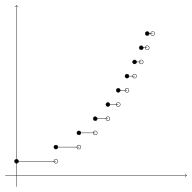
For any number \(x\), the largest integer less than or equal to \(x\) is denoted by \([x]\). For example, \([3.7]=3\) and \([4]=4\). Sketch the graph of \(y=[x]\) for \(0\le x<5\) and evaluate \[ \int_0^5 [x]\;\d x. \] Sketch the graph of \(y=[\e^{x}]\) for \(0\le x< \ln n\), where \(n\) is an integer, and show that \[ \int_{0}^{\ln n}[\e^{x}]\, \d x =n\ln n - \ln (n!). \]
Solution:

2000 Paper 1 Q4
- Show that, for \(0\le x\le 1\), the largest value of \(\displaystyle \frac{x^6}{(x^2+1)^4}\) is \(\frac1{16}\).
- Find constants \(A\), \(B\), \(C\) and \(D\) such that, for all \(x\), \[ \frac{1}{(x^2+1)^4}= \frac{\d \ }{\d x} \left( \frac{Ax^5+Bx^3+Cx}{(x^2+1)^3}\right) +\frac{Dx^6}{(x^2+1)^4}. \]
- Hence, or otherwise, prove that \[ \frac{11}{24} \le \int_{0}^{1}\frac{1}{(x^{2}+1)^{4}}\, \d x \le \frac{11}{24} + \frac 1{16} \; . \]
Solution:
- \(x^2 + 1 \geq 2x \Rightarrow \frac{1}{x^2+1} \leq \frac1{2x} \Rightarrow \frac{x^6}{(x^2+1)^4}\leq \frac{x^6}{16x^2} = \frac1{16}x^2 \leq \frac1{16}\) with equality when \(x = 1\)
- \(\,\) \begin{align*} && RHS &= \frac{\d \ }{\d x} \left( \frac{Ax^5+Bx^3+Cx}{(x^2+1)^3}\right) +\frac{Dx^6}{(x^2+1)^4} \\ &&&= \frac{(5Ax^4+3Bx^2+C)(x^2+1)^3-6x(x^2+1)^2(Ax^5+Bx^3+Cx)}{(x^2+1)^6}+\frac{Dx^6}{(x^2+1)^4} \\ &&&= \frac{(5Ax^4+3Bx^2+C)(x^2+1)-6x(Ax^5+Bx^3+Cx)+Dx^6}{(x^2+1)^4} \\ &&&= \frac{(D-A) x^6 + (5A-3B) x^4 + (3B-5C)x^2 + C}{(x^2+1)^4} \\ \Rightarrow && C &= 1 \\ && 3B &= 5 \quad\quad\quad\Rightarrow B = \frac53 \\ && 5A &= 3B = 5\Rightarrow A = 1 \\ && D &= A \quad\quad \Rightarrow D = 1 \end{align*}
- So \begin{align*} && I &= \int_{0}^{1}\frac{1}{(x^{2}+1)^{4}}\, \d x \\ &&&= \int_{0}^{1}\frac{\d \ }{\d x} \left( \frac{Ax^5+Bx^3+Cx}{(x^2+1)^3}\right) +\frac{Dx^6}{(x^2+1)^4} \, \d x \\ &&&= \left [ \frac{Ax^5+Bx^3+Cx}{(x^2+1)^3} \right]_0^1 + \int_{0}^{1}\frac{Dx^6}{(x^2+1)^4} \, \d x \\ &&& \leq \frac{A+B+C}{8} + \frac1{16} \\ &&&= \frac{2+\frac53}{8} + \frac1{16} = \frac{11}{24} + \frac{1}{16} \\ && I &\geq \left [ \frac{Ax^5+Bx^3+Cx}{(x^2+1)^3} \right]_0^1 = \frac{11}{24} \end{align*}
2000 Paper 1 Q5
Arthur and Bertha stand at a point \(O\) on an inclined plane. The steepest line in the plane through \(O\) makes an angle \(\theta\) with the horizontal. Arthur walks uphill at a steady pace in a straight line which makes an angle \(\alpha\) with the steepest line. Bertha walks uphill at the same speed in a straight line which makes an angle \(\beta\) with the steepest line (and is on the same side of the steepest line as Arthur). Show that, when Arthur has walked a distance \(d\), the distance between Arthur and Bertha is \(2d \vert\sin\frac12(\alpha-\beta)\vert\). Show also that, if \(\alpha\ne\beta\), the line joining Arthur and Bertha makes an angle \(\phi\) with the vertical, where \[ \cos\phi = \sin\theta \sin \frac12(\alpha+\beta). \]
2000 Paper 1 Q6
Show that \[ x^2-y^2 +x+3y-2 = (x-y+2)(x+y-1) \] and hence, or otherwise, indicate by means of a sketch the region of the \(x\)-\(y\) plane for which $$ x^2-y^2 +x+3y>2. $$ Sketch also the region of the \(x\)-\(y\) plane for which $$ x^2-4y^2 +3x-2y<-2. $$ Give the coordinates of a point for which both inequalities are satisfied or explain why no such point exists.
Solution: \begin{align*} && (x-y+2)(x+y-1) &= (x-y)(x+y)-(x-y)+2(x+y)-2 \\ &&&= x^2-y^2+x+3y-2 \end{align*}


2000 Paper 1 Q7
Let \[ {\f}(x)=a x-\frac{x^{3}}{1+x^{2}}, \] where \(a\) is a constant. Show that, if \(a\ge 9/8\), then \(\mathrm{f}' (x) \ge0\) for all \(x\).
Solution: \begin{align*} && f(x) &= a x-\frac{x^{3}}{1+x^{2}} \\ \Rightarrow && f'(x) &= a - \frac{3x^2(1+x^2)-x^3 \cdot 2 x}{(1+x^2)^2} \\ &&&= a - \frac{-x^4+3x^2}{(1+x^2)^2} \\ &&&= a - \frac{-t^2+3t}{(1+t)^2} \\ &&&= \frac{a+2at+at^2-t^2-3t}{(1+t)^2} \\ &&&= \frac{(a-1)t^2+(2a-3)t+a}{(1+t)^2} \\ \\ && 0 \leq \Delta &= (2a-3)^2 - 4 \cdot (a-1) \cdot a \\ &&&= 4a^2-12a+9 - 4a^2+4a \\ &&&= -8a + 9 \\ \Leftrightarrow && a &\geq 9/8 \end{align*} Therefore if \(a \geq 9/8\) the numerator is always non-negative and \(f'(x) \geq 0\)
2000 Paper 1 Q8
Show that \[ \int_{-1}^1 \vert \, x\e^x \,\vert \d x =- \int_{-1}^0 x\e^x \d x + \int_0^1 x\e^x \d x \] and hence evaluate the integral. Evaluate the following integrals:
- \(\displaystyle \int_0^4 \vert\, x^3-2x^2-x+2 \,\vert \, \d x\,;\)
- \(\displaystyle \int_{-\pi}^\pi \vert\, \sin x +\cos x \,\vert \; \d x\,.\)
Solution: \begin{align*} && \int_{-1}^1 |x e^x |\d x &= \int_{-1}^0 |xe^x| \d x + \int_0^1 |xe^x| \d x \\ &&&= \int_{-1}^0 -xe^x \d x + \int_0^1 x \e^x \d x \\ &&&= -\int_{-1}^0 xe^x \d x + \int_0^1 x \e^x \d x \\ \\ && \int xe^x \d x &= xe^x - \int e^x \d x \\ &&&= xe^x - e^x \\ \\ \Rightarrow && \int_{-1}^1 |x e^x |\d x &= \left [ xe^x - e^x \right]_0^{-1}+ \left [ xe^x - e^x \right]_0^{1} \\ &&&= -e^{-1}-e^{-1} +e^{0} + e^1 - e^1 +e^0 \\ &&&= 2-2e^{-1} \end{align*}
- \(\,\) \begin{align*} && I &= \int_0^4 | x^3-2x^2-x+2| \d x \\ &&&= \int_0^4 |(x-2)(x-1)(x+1)| \d x\\ &&&= \int_0^1( x^3-2x^2-x+2) \d x- \int_1^2 ( x^3-2x^2-x+2) \d x + \int_2^4 ( x^3-2x^2-x+2) \d x \\ &&&= \left [\frac14 x^4-\frac23 x^3- \frac12 x^2 +2x \right]_0^1 - \left [\frac14 x^4-\frac23 x^3- \frac12 x^2 +2x \right]_1^2 + \left [\frac14 x^4-\frac23 x^3- \frac12 x^2 +2x \right]_2^4 \\ &&&= 2 \left ( \frac14 - \frac23 -\frac12 + 2\right) - 2 \left ( \frac14 2^4 - \frac23 2^3 -\frac12 2^2 + 2 \cdot 2\right)+ \left ( \frac14 4^4 - \frac23 4^3 -\frac12 4^2 + 2 \cdot 4\right) \\ &&&= \frac{133}{6} \end{align*}
- \(\,\) \begin{align*} && J &= \int_{-\pi}^\pi | \sin x + \cos x | \d x \\ &&&= \int_{-\pi}^{\pi} | \sqrt{2} \sin(x + \tfrac{\pi}{4})| \d x \\ &&&= 2\sqrt{2}\int_0^\pi \sin x \d x \\ &&&= 4\sqrt{2} \end{align*}
2000 Paper 1 Q9
A child is playing with a toy cannon on the floor of a long railway carriage. The carriage is moving horizontally in a northerly direction with acceleration \(a\). The child points the cannon southward at an angle \(\theta\) to the horizontal and fires a toy shell which leaves the cannon at speed \(V\). Find, in terms of \(a\) and \(g\), the value of \(\tan 2\theta\) for which the cannon has maximum range (in the carriage). If \(a\) is small compared with \(g\), show that the value of \(\theta\) which gives the maximum range is approximately \[ \frac \pi 4 + \frac a {2g}, \] and show that the maximum range is approximately \(\displaystyle \frac {V^2} g + \frac {V^2a}{g^2}. \)
Solution: \begin{align*} && s_x &= V \cos \theta t + \frac12at^2 \\ && s_y &= V \sin \theta t - \frac12 gt^2 \\ \Rightarrow && T &= \frac{2V \sin \theta}g \\ \Rightarrow && s_{max} &= \frac{2V^2 \sin \theta \cos \theta}{g} + \frac12a \frac{4V^2 \sin^2 \theta}{g^2} \\ &&&= (g \sin 2 \theta+2a\sin^2 \theta)\frac{V^2}{g^2} \\ && \frac{\d s_{max}}{\d \theta} &= (2g \cos 2 \theta +4 a \cos \theta \sin \theta)\frac{V^2}{g^2} \\ &&&= (2g \cos 2\theta + 2a \sin2 \theta) \frac{V^2}{g^2} \\ \Rightarrow && \tan 2\theta &= -\frac{a}{g} \\ \Rightarrow && 2 \theta &\in (\frac{\pi}2, \pi) \\ \Rightarrow && \tan \left (\frac{\pi}{2} - 2 \theta\right) &=-\frac{a}{g} \\ \Rightarrow && \frac{\pi}{2} - 2 \theta&\approx -\frac{a}{g} \\ \Rightarrow && \theta &\approx \frac{\pi}{4} + \frac{a}{2g} \\ \\ && s_{max} & \approx \left (g \sin \left (\frac{\pi}{2} + \frac{a}{g} \right)+2a\sin^2 \left ( \frac{\pi}{4} + \frac{a}{2g}\right)\right)\frac{V^2}{g^2} \\ &&&\approx \left (g \cdot 1+2a\left( \frac{1}{\sqrt{2}}(\frac{a}{2g}+1)\right)^2\right)\frac{V^2}{g^2} \\ &&&\approx \left (g+a\left(1+\frac{a}{g}\right)^2\right)\frac{V^2}{g^2} \\ &&&\approx \left (g+a\right)\frac{V^2}{g^2} \\ &&&= \frac{V^2}{g} + \frac{V^2a}{g} \end{align*}
2000 Paper 1 Q10
Three particles \(P_1\), \(P_2\) and \(P_3\) of masses \(m_{1}\), \(m_{2}\) and \(m_{3}\) respectively lie at rest in a straight line on a smooth horizontal table. \(P_1\) is projected with speed \(v\) towards \(P_2\) and brought to rest by the collision. After \(P_2\) collides with \(P_3\), the latter moves forward with speed \(v\). The coefficients of restitution in the first and second collisions are \(e\) and \(e'\), respectively. Show that \[ e'= \frac{m_{2}+m_{3}-m_{1}}{m_{1}}. \] Show that \(2m_1\ge m_2 +m_3\ge m_1\) for such collisions to be possible. If \(m_1\), \(m_3\) and \(v\) are fixed, find, in terms of \(m_1\), \(m_3\) and \(v\), the largest and smallest possible values for the final energy of the system.
2000 Paper 1 Q11
A rod \(AB\) of length 0.81 m and mass 5 kg is in equilibrium with the end \(A\) on a rough floor and the end \(B\) against a very rough vertical wall. The rod is in a vertical plane perpendicular to the wall and is inclined at \(45^{\circ}\) to the horizontal. The centre of gravity of the rod is at \(G\), where \(AG = 0.21\) m. The coefficient of friction between the rod and the floor is 0.2, and the coefficient of friction between the rod and the wall is 1.0. Show that the friction cannot be limiting at both \(A\) and \(B\). A mass of 5 kg is attached to the rod at the point \(P\) such that now the friction is limiting at both \(A\) and \(B\). Determine the length of \(AP\).
2000 Paper 1 Q12
I have \(k\) different keys on my key ring. When I come home at night I try one key after another until I find the key that fits my front door. What is the probability that I find the correct key in exactly \(n\) attempts in each of the following three cases?
- At each attempt, I choose a key that I have not tried before but otherwise each choice is equally likely.
- At each attempt, I choose a key from all my keys and each of the \(k\) choices is equally likely.
- At the first attempt, I choose from all my keys and each of the \(k\) choices is equally likely. Thereafter, I choose from the keys that I did not try the previous time but otherwise each choice is equally likely.
2000 Paper 1 Q13
Every person carries two genes which can each be either of type \(A\) or of type \(B\). It is known that \(81\%\) of the population are \(AA\) (i.e. both genes are of type \(A\)), \(18\%\) are \(AB\) (i.e. there is one gene of type \(A\) and one of type \(B\)) and \(1\%\) are \(BB\). A child inherits one gene from each of its parents. If one parent is \(AA\), the child inherits a gene of type \(A\) from that parent; if the parent is \(BB\), the child inherits a gene of type \(B\) from that parent; if the parent is \(AB\), the inherited gene is equally likely to be \(A\) or \(B\).
- Given that two \(AB\) parents have four children, show that the probability that two of them are \(AA\) and two of them are \(BB\) is \(3/128\).
- My mother is \(AB\) and I am \(AA\). Find the probability that my father is \(AB\).
2000 Paper 1 Q14
The random variable \(X\) is uniformly distributed on the interval \([-1,1]\). Find \(\E(X^2)\) and \(\var (X^2)\). A second random variable \(Y\), independent of \(X\), is also uniformly distributed on \([-1,1]\), and \(Z=Y-X\). Find \(\E(Z^2)\) and show that \(\var (Z^2) = 7 \var (X^2)\).
Solution: \(X \sim U(-1,1)\) \begin{align*} \E[X^2] &= \int_{-1}^1 \frac12 x^2 \, dx \\ &= \frac{1}{6} \left [ x^3 \right]_{-1}^1 \\ &= \frac{1}{3} \end{align*} \begin{align*} \E[X^4] &= \int_{-1}^1 \frac12 x^4 \, dx \\ &= \frac{1}{10} \left [ x^5 \right]_{-1}^1 \\ &= \frac{1}{5} \end{align*} \begin{align*} \var[X^2] &=\E[X^4] - \E[X^2]^2 \\ &= \frac{1}{5} - \frac{1}{9} \\ &= \frac{4}{45} \end{align*} \begin{align*} \E(Z^2) &= \E(Y^2 - 2XY+Z^2) \\ &= \E(Y^2) - 2\E(X)\E(Y)+\E(Z^2) \\ &= \frac{1}{3} - 0 + \frac{1}{3} \\ &= \frac{2}{3} \end{align*} \begin{align*} \E[Z^4] &= \E[Y^4 -4Y^3X+6Y^2X^2-4YX^3+X^4] \\ &= \E[Y^4]-4\E[Y^3]\E[X]+6\E[Y^2]\E[X^2]-4\E[Y]\E[X^3]+\E[X^4] \\ &= \frac{1}{5}+6 \frac{1}{3} \frac13 + \frac{1}{5} \\ &= \frac{2}{5} + \frac{2}{3} \\ &= \frac{16}{15} \end{align*} \begin{align*} \var(Z^2) &= \E(Z^4) - \E(Z^2) \\ &= \frac{16}{15} - \frac{4}{9} \\ &= \frac{28}{45} \\ &= 7 \var(X^2) \end{align*}
2000 Paper 2 Q1
A number of the form \(1/N\), where \(N\) is an integer greater than 1, is called a unit fraction. Noting that \[ \frac1 2 =\frac13 + \frac16\\\ \mbox{ and } \frac13 = \frac14 + \frac1{12}, \] guess a general result of the form $$ \frac1N =\frac1a +\frac1b \tag{*} $$ and hence prove that any unit fraction can be expressed as the sum of two distinct unit fractions. By writing \((*)\) in the form \[ (a-N)(b-N)=N^2 \] and by considering the factors of \(N^2\), show that if \(N\) is prime, then there is only one way of expressing \(1/N\) as the sum of two distinct unit fractions. Prove similarly that any fraction of the form \(2/N\), where \(N\) is prime number greater than 2, can be expressed uniquely as the sum of two distinct unit fractions.
Solution: Notice that \(\frac{1}{N} = \frac{1}{N+1} + \frac{1}{N(N+1)}\), so any unit fraction can be expressed as the sum of two distinct unit fractions. \begin{align*} && \frac{1}N &= \frac1a + \frac1b \\ \Leftrightarrow && ab&= Nb+Na \\ \Leftrightarrow && 0 &= (a-N)(b-N)-N^2 \\ \Leftrightarrow && N^2 &= (a-N)(b-N) \end{align*} If \(N\) is prime then the only factors of \(N^2\) are \(1,N\) and \(N^2\). if \(a-N = b-N = N\) then \(a=b\) and we don't have distinct fractions. Therefore \(a-N = 1\) and \(b-N = N^2\) and we obtain the decomposition earlier (and it must be the only solution). \begin{align*} && \frac2N &= \frac1a+\frac1b \\ \Leftrightarrow && 2ab &= Nb+Na \\ \Leftrightarrow && 4ab &= 2Na+2Nb \\ \Leftrightarrow && N^2 &= (2a-N)(2b-N) \end{align*} Therefore for \(a,b\) to be distinct we must have \(2a = N+1\) and \(2b = N+N^2\) as the only possible factorisation. Both of the right hand sides are even so we can write \[ \frac{1}{N} = \frac{1}{\frac{N+1}{2}} + \frac{1}{\frac{N(N+1)}{2}} \] and this is unique