Problems
Filters
42 problems found
1999 Paper 1 Q1
How many integers greater than or equal to zero and less than a million are not divisible by 2 or 5? What is the average value of these integers? How many integers greater than or equal to zero and less than 4179 are not divisible by 3 or 7? What is the average value of these integers?
Solution: There are \(1\,000\,000\) numbers between 1 and a million (inclusive). \(500\,000\) are divisible by \(2\), \(200\,000\) are divisible by \(5\) and \(100\,000\) are divisible by both. Therefore there are: \(1\,000\,000 - 500\,000-200\,000+100\,000 = 400\,000\). (Alternatively, the only numbers are those which are \(1,3,7,9 \pmod{10}\) so there are \(4\) every \(10\), or \(4 \cdot 100\,000\)). We can sum all these values similarly, \begin{align*} S &= \underbrace{\sum_{i=1}^{10^6} i}_{\text{all numbers}}-\underbrace{\sum_{i=1}^{5 \cdot 10^5} 2i}_{\text{all multiples of } 2}-\underbrace{\sum_{i=1}^{2 \cdot 10^5} 5i}_{\text{all multiples of } 5}+\underbrace{\sum_{i=1}^{10^5} 10i}_{\text{all multiples of } 5} \\ &= \frac{10^6 \cdot (10^6 + 1)}{2} - \frac{10^6 \cdot (5\cdot 10^5+1)}{2} - \frac{10^6 \cdot (2\cdot 10^5+1)}{2} + \frac{10^6 \cdot (10^5+1)}{2} \\ &= \frac{10^6 (10^5 \cdot (10-5-2+1))))}{2} \\ &= \frac{10^6 \cdot 10^5 \cdot 4}{2} \\ &= 2\cdot 10^{11} \end{align*} So the average value is \(\frac{2 \cdot 10^{11}}{4 \cdot 10^5} = \frac{10^6}{2} = 500\,000\). (Alternatively, each value can be paired off eg \(999\,999\) with \(1\) and so on, leaving averages of \(500\,000\)). Note that \(4197\) is divisible by \(3\) and \(7\). Using the same long we have: \(4179 - \frac{4179}{3} - \frac{4179}{7} + \frac{4179}{21} = 4179 - 1393 - 597 + 199 = 2388\). The sum will be: \begin{align*} S &= \underbrace{\sum_{i=1}^{4179}i }_{\text{all numbers}}- \underbrace{\sum_{i=1}^{1393}3i }_{\text{multiples of }3}- \underbrace{\sum_{i=1}^{597}7i }_{\text{multiples of }7}+ \underbrace{\sum_{i=1}^{199}21i }_{\text{mulitples of }21} \\ &= \frac{4179 \cdot 4180}{2} - \frac{4179 \cdot 1394}{2} - \frac{4179 \cdot 598}{2} +\frac{4179 \cdot 200}{2} \\ &= \frac{4179 \cdot 2388}{2} \end{align*} So the average value is \(\frac{4179}{2}\).
1999 Paper 1 Q2
A point moves in the \(x\)-\(y\) plane so that the sum of the squares of its distances from the three fixed points \((x_{1},y_{1})\), \((x_{2},y_{2})\), and \((x_{3},y_{3})\) is always \(a^{2}\). Find the equation of the locus of the point and interpret it geometrically. Explain why \(a^2\) cannot be less than the sum of the squares of the distances of the three points from their centroid. [The centroid has coordinates \((\bar x, \bar y)\) where \(3\bar x = x_1+x_2+x_3,\) $3\bar y =y_1+y_2+y_3. $]
Solution: \begin{align*} && a^2 &= d_1^2 + d_2^2 + d_3^2 \\ &&&= (x-x_1)^2+(y-y_1)^2 + (x-x_2)^2+(y-y_2)^2 + (x-x_3)^2+(y-y_3)^2 \\ &&&= \sum (x-\bar{x}+\bar{x}-x_i)^2 + \sum (y-\bar{y}+\bar{y}-y_i)^2 \\ &&&= \sum \left ( (x-\bar{x})^2+(\bar{x}-x_i)^2 + 2(x-\bar{x})(\bar{x}-x_i) \right)+ \sum \left ( (y-\bar{y})^2+(\bar{y}-y_i)^2 + 2(y-\bar{y})(\bar{y}-y_i) \right)\\ &&&= 3(x-\bar{x})^2 + \sum (\bar{x}-x_i)^2 + 6x\bar{x} -6\bar{x}^2-2x\sum x_i+2\bar{x}\sum x_i + \\ &&&\quad\quad\quad 3(y-\bar{y})^2 + \sum (\bar{y}-y_i)^2 + 6y\bar{y} -6\bar{y}^2-2y\sum y_i+2\bar{y}\sum y_i \\ &&&= 3(x-\bar{x})^2 + \sum (\bar{x}-x_i)^2+3(y-\bar{y})^2 + \sum (\bar{y}-y_i)^2 \\ \\ \Rightarrow && (x-\bar{x})^2+(y-\bar{y})^2 &= \frac13\left ( a^2- \sum \left((\bar{x}-x_i)^2+(\bar{y}-y_i)^2 \right) \right) \end{align*} Therefore the locus is a circle, centre \((\bar{x}, \bar{y})\). radius \(\sqrt{\frac13(a^2 - \text{sum of squares distances of centroid to vertices}})\). \(a^2\) cannot be less than this distance, because clearly the right hand side is always bigger than it!
1999 Paper 1 Q3
The \(n\) positive numbers \(x_{1},x_{2},\dots,x_{n}\), where \(n\ge3\), satisfy $$ x_{1}=1+\frac{1}{x_{2}}\, ,\ \ \ x_{2}=1+\frac{1}{x_{3}}\, , \ \ \ \dots\; , \ \ \ x_{n-1}=1+\frac{1}{x_{n}}\, , $$ and also $$ \ x_{n}=1+\frac{1}{x_{1}}\, . $$ Show that
- \(x_{1},x_{2},\dots,x_{n}>1\),
- \({\displaystyle x_{1}-x_{2}=-\frac{x_{2}-x_{3}}{x_{2}x_{3}}}\),
- \(x_{1}=x_{2}=\cdots=x_{n}\).
1999 Paper 1 Q4
Sketch the following subsets of the \(x\)-\(y\) plane:
- \(|x|+|y|\le 1\) ;
- \(|x-1|+|y-1|\le 1 \) ;
- \(|x-1|-|y+1|\le 1 \) ;
- \(|x|\, |y-2|\le 1\) .
Solution:


1999 Paper 1 Q5
For this question, you may use the following approximations, valid if \(\theta \) is small: \ \(\sin\theta \approx \theta\) and \(\cos\theta \approx 1-\theta^2/2\,\). A satellite \(X\) is directly above the point \(Y\) on the Earth's surface and can just be seen (on the horizon) from another point \(Z\) on the Earth's surface. The radius of the Earth is \(R\) and the height of the satellite above the Earth is \(h\).
- Find the distance \(d\) of \(Z\) from \(Y\) along the Earth's surface.
- If the satellite is in low orbit (so that \(h\) is small compared with \(R\)), show that $$d \approx k(Rh)^{1/2},$$ where \(k\) is to be found.
- If the satellite is very distant from the Earth (so that \(R\) is small compared with \(h\)), show that $$d\approx aR+b(R^2/h),$$ where \(a\) and \(b\) are to be found.
1999 Paper 1 Q6
- Find the greatest and least values of \(bx+a\) for \(-10\leqslant x \leqslant 10\), distinguishing carefully between the cases \(b>0\), \(b=0\) and \(b<0\).
- Find the greatest and least values of \(cx^{2}+bx+a\), where \(c\ge0\), for \(-10\leqslant x \leqslant 10\), distinguishing carefully between the cases that can arise for different values of \(b\) and \(c\).
Solution:
- Case \(b > 0\). Then \(bx+a\) is increasing and the greatest value is \(10b+a\), and the least value \(a-10b\) Case \(b=0\), then \(a\) is constant and the greatest and least value is \(a\) Case \(b < 0\), then \(bx+a\) is decreasing and the greatest value is \(-10b+a\) and the least value is \(10b+a\)
- If \(c = 0\) we have the same cases as above. If \( c > 0\) the consider \(2cx+b\). if \(b-20c > 0\) then our function is increasing on our interval and the greatest value is \(100c+10b+a\) and the least value is \(100c-10b+a\) If \(20c+b < 0\) then our function is decreasing and that calculation is reversed. If neither of these are true, then the minimum will be when \(x = - \frac{b}{2c}\) and the max at one end point.
1999 Paper 1 Q7
Show that \(\sin(k\sin^{-1} x)\), where \(k\) is a constant, satisfies the differential equation $$(1-x^{2})\frac {\d^2 y}{\d x^2} -x\frac{\d y}{\d x} +k^{2}y=0. \tag{*}$$ In the particular case when \(k=3\), find the solution of equation \((*)\) of the form \[ y=Ax^{3}+Bx^{2}+Cx+D, \] that satisfies \(y=0\) and \(\displaystyle \frac{\d y}{\d x}=3\) at \(x=0\). Use this result to express \(\sin 3\theta\) in terms of powers of \(\sin\theta\).
Solution: \begin{align*} && y &= \sin(k \sin^{-1} x ) \\ &&y' &= \cos (k \sin^{-1} x) \cdot k \frac{1}{\sqrt{1-x^2}} \\ && y'' &= -\sin (k \sin^{-1} x) \cdot k^2 \frac{1}{(1-x^2)} - \cos(k \sin^{-1} x) \cdot k \frac{x}{(1-x^2)\sqrt{1-x^2}} \\ && (1-x^2)y'' &= -k^2y -xy' \\ \Rightarrow && 0 &= (1-x^2)y''+xy' + k^2y \end{align*} \begin{align*} && y &= Ax^3 + Bx^2 + Cx + D \\ && y' &= 3Ax^2 + 2Bx + C \\ && y'' &= 6Ax+2B \\ && 0 &= (1-x^2)(6Ax+2B) - x( 3Ax^2 + 2Bx + C) + 9(Ax^3 + Bx^2 + Cx + D ) \\ &&&= x^3(-6A-3A+9A) + x^2(-2B-2B+9B) + x(6A-C+9C) + (2B +9D) \\ \Rightarrow && B &= 0 \\ \Rightarrow && D &= 0 \\ \Rightarrow && C &= -\frac34 A \\ \\ x = 0, y = 0, y' = 0: && y &= 3x-4x^3 \\ \end{align*} And so \(\sin 3 x = 3 \sin x - 4\sin^3 x\)
1999 Paper 1 Q8
The function \(\f\) satisfies \(0\leqslant\f(t)\leqslant K\) when \(0\leqslant t\leqslant x\). Explain by means of a sketch, or otherwise, why \[0\leqslant\int_{0}^{x} \f (t)\,{\mathrm d}t \leqslant Kx.\] By considering \(\displaystyle \int_{0}^{1}\frac{t}{n(n-t)}\,{\mathrm d}t\), or otherwise, show that, if \(n>1\), \[ 0\le \ln \left( \frac n{n-1}\right) -\frac 1n \le \frac 1 {n-1} - \frac 1n \] and deduce that \[ 0\le \ln N -\sum_{n=2}^N \frac1n \le 1. \] Deduce that as \(N\to \infty\) \[ \sum_{n=1}^N \frac1n \to\infty. \] Noting that \(2^{10}=1024\), show also that if \(N<10^{30}\) then \[ \sum_{n=1}^N \frac1n <101. \]
1999 Paper 1 Q9
A tortoise and a hare have a race to the vegetable patch, a distance \(X\) kilometres from the starting post, and back. The tortoise sets off immediately, at a steady \(v\) kilometers per hour. The hare goes to sleep for half an hour and then sets off at a steady speed \(V\) kilometres per hour. The hare overtakes the tortoise half a kilometre from the starting post, and continues on to the vegetable patch, where she has another half an hour's sleep before setting off for the return journey at her previous pace. One and quarter kilometres from the vegetable patch, she passes the tortoise, still plodding gallantly and steadily towards the vegetable patch. Show that \[ V= \frac{10}{4X-9} \] and find \(v\) in terms of \(X\). Find \(X\) if the hare arrives back at the starting post one and a half hours after the start of the race.
Solution: If \(T_1\) is the time they meet after \(\frac12\)km from the starting points and \(T_2\) is the time they meet a second time, then \begin{align*} && \frac12 &= vT_1 \\ &&&= V(T_1-\tfrac12) \\ && X - \frac54 &= vT_2 \\ && X + \frac54 &= V(T_2 - 1) \\ && \frac{T_2}{T_1} &= \frac{4X-5}{2} \\ && X + \frac54 + V &= VT_2 \\ && \frac12 + \frac12 V &= VT_1 \\ \Rightarrow && \frac{T_2}{T_1} &= \frac{4X + 5 + 4V}{2(1+V)} \\ \Rightarrow && \frac{4X-5}{2}&=\frac{4X + 5 + 4V}{2(1+V)} \\ \Rightarrow && V(4X-9) &= 10 \\ \Rightarrow && V &= \frac{10}{4X-9} \\ \\ && T_1 &= \frac{1}{2V} + \frac12 \\ &&&= \frac{4X+1}{20} \\ && v &= \frac{1}{2T_1} \\ &&&= \frac{10}{4X+1} \end{align*} \begin{align*} && 2X &= \frac12 V \\ \Rightarrow && 2X(4X-9) &= 5 \\ \Rightarrow && 0 &= 8X^2-18X-5 \\ &&&= (4X+1)(2X-5) \\ \Rightarrow && X &= -\frac14, \frac52 \end{align*} Since \(X\) is positive, we must have \(X = \frac52\)km
1999 Paper 1 Q10
A particle is attached to a point \(P\) of an unstretched light uniform spring \(AB\) of modulus of elasticity \(\lambda\) in such a way that \(AP\) has length \(a\) and \(PB\) has length \(b\). The ends \(A\) and \(B\) of the spring are now fixed to points in a vertical line a distance \(l\) apart, The particle oscillates along this line. Show that the motion is simple harmonic. Show also that the period is the same whatever the value of \(l\) and whichever end of the string is uppermost.
1999 Paper 1 Q11
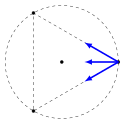
The force of attraction between two stars of masses \(m_{1}\) and \(m_{2}\) a distance \(r\) apart is \(\gamma m_{1}m_{2}/r^{2}\). The Starmakers of Kryton place three stars of equal mass \(m\) at the corners of an equilateral triangle of side \(a\). Show that it is possible for each star to revolve round the centre of mass of the system with angular velocity \((3\gamma m/a^{3})^{1/2}\). Find a corresponding result if the Starmakers place a fourth star, of mass \(\lambda m\), at the centre of mass of the system.
Solution: The net force on the planets will always be towards the centre of mass (by symmetry or similar arguments). Therefore it suffices to check whether we can find a speed where the planets follow uniform circular motion, ie \(F = mr \omega^2\). (But clearly this is possible, we just need to find the speed)

1999 Paper 1 Q12
- Prove that if \(x>0\) then \(x+x^{-1}\ge2.\;\) I have a pair of six-faced dice, each with faces numbered from 1 to 6. The probability of throwing \(i\) with the first die is \(q_{i}\) and the probability of throwing \(j\) with the second die is \(r_{j}\) (\(1\le i,j \le 6\)). The two dice are thrown independently and the sum noted. By considering the probabilities of throwing 2, 12 and 7, show the sums \(2, 3, \dots, 12\) are not equally likely.
- The first die described above is thrown twice and the two numbers on the die noted. Is it possible to find values of \(q_{j}\) so that the probability that the numbers are the same is less than \(1/36\)?
Solution:
- Notice that if \(x > 0\) we must have \begin{align*} && \left ( \sqrt{x} - \frac{1}{\sqrt{x}} \right)^2 &\geq 0 \\ \Leftrightarrow && x - 2 + x^{-1} & \geq 0 \\ \Leftrightarrow && x + x^{-1} & \geq 2 \end{align*} Let \(S\) be the sum, and assume all probabilities are equal \begin{align*} && \mathbb{P}(S = 2) &= q_1 r_1 \\ && \mathbb{P}(S = 12) &= q_6 r_6 \\ && \mathbb{P}(S = 7) &= \sum_{i=1}^6 q_i r_{7-i} \\ \Rightarrow && q_1r_1 &= q_6r_6 \\ \Rightarrow && q_1r_6+q_6r_1 &\leq q_1r_1 \\ \Rightarrow && \frac{r_6}{r_1} + \frac{q_6}{q_1} &\leq 1 \\ \Rightarrow && q_1r_6+q_6r_1 &\leq q_6r_6 \\ \Rightarrow && \frac{q_1}{q_6} + \frac{r_1}{r_6} &\leq 1 \\ \Rightarrow && \frac{r_6}{r_1} + \frac{q_6}{q_1}+\frac{q_1}{q_6} + \frac{r_1}{r_6} &\leq 2\\ \text{but} && \frac{r_6}{r_1} + \frac{q_6}{q_1}+\frac{q_1}{q_6} + \frac{r_1}{r_6} &\geq 4 \end{align*} Since we have a contradiction they cannot all be equal.
- We would like \(\displaystyle \sum q_i^2 \leq 1/36\) (subject to \(\displaystyle \sum q_i = 1\), clearly this cannot be true since: \begin{align*} && 1 &= \left ( \sum_{i=1}^6 q_i \right)^2 \\ &&&= \sum_{i=1}^6 q_i^2 + \sum_{i \neq j} 2q_i q_j \\ &&&\leq \sum_{i=1}^6 q_i^2 + 5\sum_{i=1}^6 q_i^2 \\ &&&=6 \sum_{i=1}^6 q_i^2 \\ \Rightarrow && \sum_{i=1}^6 q_i^2 &\geq 1/6 > 1/36 \end{align*} [For a weaker solution to the last part, notice that the largest value of \(q_i\) is \(\geq 1/6\) and therefore \(q_{max}^2 \geq 1/36\), but if equality holds then the other values must also be non-zero, and therefore the inequality cannot hold]
1999 Paper 1 Q13
Bar magnets are placed randomly end-to-end in a straight line. If adjacent magnets have ends of opposite polarities facing each other, they join together to form a single unit. If they have ends of the same polarity facing each other, they stand apart. Find the expectation and variance of the number of separate units in terms of the total number \(N\) of magnets.
Solution: There are \(N-1\) gaps between the magnets which are independently gaps or not gaps. Therefore the total number of gaps is \(X \sim Binomial(N-1, \frac12)\) and \begin{align*} \mathbb{E}(X) &= \frac{N-1}{2} \\ \textrm{Var}(X) &= \frac{N-1}{4} \end{align*}
1999 Paper 1 Q14
When I throw a dart at a target, the probability that it lands a distance \(X\) from the centre is a random variable with density function \[ \mathrm{f}(x)=\begin{cases} 2x & \text{ if }0\leqslant x\leqslant1;\\ 0 & \text{ otherwise.} \end{cases} \] I score points according to the position of the dart as follows: %
- Show that my expected score from one dart is 15/8.
- I play a game with the following rules. I start off with a total score 0, and each time~I throw a dart my score on that throw is added to my total. Then: \newline \hspace*{10mm} if my new total is greater than 3, I have lost and the game ends; \newline \hspace*{10mm} if my new total is 3, I have won and the game ends; \newline \hspace*{10mm} if my new total is less than 3, I throw again. Show that, if I have won such a game, the probability that I threw the dart three times is 343/2231.
1999 Paper 2 Q1
Let \(x=10^{100}\), \(y=10^{x}\), \(z=10^{y}\), and let $$ a_1=x!, \quad a_2=x^y,\quad a_3=y^x,\quad a_4=z^x,\quad a_5=\e^{xyz},\quad a_6=z^{1/y},\quad a_7 = y^{z/x}. $$
- Use Stirling's approximation \(n! \approx \sqrt{2 \pi}\, {n^{n+{1\over2}}\e^{-n}}\), which is valid for large \(n\), to show that \(\log_{10}\left(\log_{10} a_1 \right) \approx 102\).
- Arrange the seven numbers \(a_1\), \(\ldots\) , \(a_7\) in ascending order of magnitude, justifying your result.
Solution:
- \begin{align*} \log_{10}(\log_{10} a_1) &= \log_{10} (\log_{10} (x!) \\ &\approx \log_{10} (\log_{10} \sqrt{2 \pi} x^{x+\frac12} e^{-x}) \\ &= \log_{10} \l \log_{10} \sqrt{2 \pi} + (x+\frac12) \log_{10} x-x \r \\ &= \log_{10} \l \log_{10} \sqrt{2 \pi} + (100x+50)-x \r \\ &= \log_{10} \l 99x + \epsilon \r \\ &\approx \log_{10} 99 + \log_{10} x \\ &\approx 2 + 100 = 102 \end{align*}
- \begin{align*} \log_{10}(\log_{10} a_2) &= \log_{10}(\log_{10} x^y) \\ &= \log_{10} y + \log_{10} \log_{10} x \\ &= x + 2 \end{align*} \begin{align*} \log_{10}(\log_{10} a_3) &= \log_{10}(\log_{10} y^x) \\ &= \log_{10} x + \log_{10} \log_{10} y \\ &= 100 + \log_{10} x \\ &= 200 \end{align*} \begin{align*} \log_{10}(\log_{10} a_4) &= \log_{10}(\log_{10} z^x) \\ &= \log_{10} x + \log_{10} \log_{10} z \\ &= 100 + \log_{10} y \\ &= 100+x \end{align*} \begin{align*} \log_{10}(\log_{10} a_5) &= \log_{10}(\log_{10} e^{xyz}) \\ &= \log_{10} x + \log_{10}y+\log_{10} z+ \log_{10} \log_{10} e \\ &\approx 100 + x + y \end{align*} \begin{align*} \log_{10}(\log_{10} a_6) &= \log_{10}(\log_{10} z^{1/y}) \\ &= \log_{10}(\log_{10} 10) \\ &= 0 \end{align*} \begin{align*} \log_{10}(\log_{10} a_7) &= \log_{10}(\log_{10} y^{z/x}) \\ &= \log_{10}z-\log_{10} x + \log_{10} \log_{10} y \\ &= y \end{align*} Since \(0 < 102 < 200 < x+2 < x+100 < y < y+x+100\) we must have \(a_6 < a_1 < a_3 < a_2 < a_4 < a_7 < a_5\)