Problems
Filters
9 problems found
2009 Paper 1 Q5
A right circular cone has base radius \(r\), height \(h\) and slant length \(\ell\). Its volume \(V\), and the area \(A\) of its curved surface, are given by \[ V= \tfrac13 \pi r^2 h \,, \ \ \ \ \ \ \ A = \pi r\ell\,. \]
- Given that \(A\) is fixed and \(r\) is chosen so that \(V\) is at its stationary value, show that \(A^2 = 3\pi^2r^4\) and that \(\ell =\sqrt3\,r\).
- Given, instead, that \(V\) is fixed and \(r\) is chosen so that \(A\) is at its stationary value, find \(h\) in terms of \(r\).
Solution:
- Given \(A\) is fixed, and \(h^2 + r^2 = \ell^2\), we can look at \begin{align*} && V^2 &= \frac19 \pi^2 r^4 h^2 \\ &&&= \frac19\pi^2r^4(\ell^2 - r^2) \\ &&&= \frac19\pi^2 r^4\left (\frac{A^2}{\pi^2r^2} - r^2 \right) \\ &&&= \frac{A^2r^2 - \pi^2r^6}{9} \end{align*} Differentiating wrt to \(r\) we find that \(2rA^2-6\pi^2 r^5 = 0\) or hence \(A^2 = 3\pi^2 r^4 \Rightarrow A = \sqrt{3}\pi r^2\). Therefore \(\sqrt{3}\pi r^2 = \pi r \ell \Rightarrow \ell = \sqrt{3}r\).
- Supposing \(V\) is fixed, then \begin{align*} && A^2 &= \pi^2 r^2\ell^2 \\ &&&= \pi^2 r^2 (h^2+r^2) \\ &&&= \pi^2 r^2 \left ( \frac{9V^2}{\pi^2r^4} + r^2 \right) \\ &&&= 9V^2r^{-2} + \pi^2r^4 \\ \end{align*} Differentiating wrt to \(r\) we find \(-18V^2r^{-3} + 4\pi^2 r^3 = 0\) so \(V^2 = \frac{2\pi^2}{9}r^6\) or \(V = \frac{\sqrt{2}\pi}{3}r^3\), from which it follows: \(\frac{\sqrt{2}\pi}{3}r^3 = \frac13\pi r^2 h \Rightarrow h = \sqrt{2}r\)
2006 Paper 1 Q8
{\it Note that the volume of a tetrahedron is equal to \(\frac1 3\) \(\times\) the area of the base \(\times\) the height.} The points \(O\), \(A\), \(B\) and \(C\) have coordinates \((0,0,0)\), \((a,0,0)\), \((0,b,0)\) and \((0,0,c)\), respectively, where \(a\), \(b\) and \(c\) are positive.
- Find, in terms of \(a\), \(b\) and \(c\), the volume of the tetrahedron \(OABC\).
- Let angle \(ACB = \theta\). Show that \[ \cos\theta = \frac {c^2} { { \sqrt{\vphantom{ \dot b} (a^2+c^2)(b^2+c^2)} } ^{\vphantom A} \ } \] and find, in terms of \(a\), \(b\) and \(c\), the area of triangle \(ABC\). % is %\(\displaystyle \tfrac12 \sqrt{ \vphantom{\dot A } a^2b^2 +b^2c^2 + c^2 a^2 \;} \;\).
2002 Paper 1 Q6
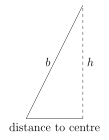
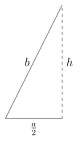
A pyramid stands on horizontal ground. Its base is an equilateral triangle with sides of length~\(a\), the other three sides of the pyramid are of length \(b\) and its volume is \(V\). Given that the formula for the volume of any pyramid is $ \textstyle \frac13 \times \mbox{area of base} \times \mbox {height} \,, $ show that \[ V= \frac1{12} {a^2(3b^2-a^2)}^{\frac12}\;. \] The pyramid is then placed so that a non-equilateral face lies on the ground. Show that the new height, \(h\), of the pyramid is given by \[ h^2 = \frac{a^2(3b^2-a^2)}{4b^2-a^2}\;. \] Find, in terms of \(a\) and \(b\,\), the angle between the equilateral triangle and the horizontal.
Solution: First let's consider the area of the base. It is an equilateral triangle with side length \(a\), so \(\frac12 a^2 \sin 60^\circ = \frac{\sqrt{3}}4a^2\).
2001 Paper 2 Q3
The cuboid \(ABCDEFGH\) is such \(AE\), \(BF\), \(CG\), \(DH\) are perpendicular to the opposite faces \(ABCD\) and \(EFGH\), and \(AB =2, BC=1, AE={\lambda}\). Show that if \(\alpha\) is the acute angle between the diagonals \(AG\) and \(BH\) then $$\cos {\alpha} = |\frac {3-{\lambda}^2} {5+{\lambda}^2} |$$ Let \(R\) be the ratio of the volume of the cuboid to its surface area. Show that \(R<\frac{1}{3}\) for all possible values of \(\lambda\). Prove that, if \(R\ge \frac{1}{4}\), then \(\alpha \le \arccos \frac{1}{9}\).
Solution:

1998 Paper 3 Q6
- Show that four vertices of a cube, no two of which are adjacent, form the vertices of a regular tetrahedron. Hence, or otherwise, find the volume of a regular tetrahedron whose edges are of unit length.
- Find the volume of a regular octahedron whose edges are of unit length.
- Show that the centres of the faces of a cube form the vertices of a regular octahedron. Show that its volume is half that of the tetrahedron whose vertices are the vertices of the cube.
1996 Paper 1 Q1
A cylindrical biscuit tin has volume \(V\) and surface area \(S\) (including the ends). Show that the minimum possible surface area for a given value of \(V\) is \(S=3(2\pi V^{2})^{1/3}.\) For this value of \(S\) show that the volume of the largest sphere which can fit inside the tin is \(\frac{2}{3}V\), and find the volume of the smallest sphere into which the tin fits.
Solution: Suppose we have height \(h\) and radius \(r\), then: \(V = \pi r^2 h\) and \(S = 2\pi r^2 + 2\pi r h\). \(h = \frac{V}{\pi r^2}\), so \begin{align*} S &= 2 \pi r^2 + 2 \pi r\frac{V}{\pi r^2} \\ &= 2\pi r^2 +V \frac1{r}+V \frac1{r} \\ &\underbrace{ \geq }_{\text{AM-GM}} 3 \sqrt[3]{2\pi r^2 \frac{V^2}{r^2} } = 3 (2 \pi V^2)^{1/3} \end{align*} Equality holds when \(r = \sqrt[3]{\frac{V}{2 \pi}}, h = \frac{V}{\pi (V/2\pi)^{2/3}} = \sqrt[3]{\frac{4V}{\pi}}\) Since \(h > r\) the sphere has a maximum radius of \(r\) and so it's largest volume is \(\frac43 \pi r^3 = \frac43 \pi \frac{V}{2 \pi} = \frac23 V\).

1994 Paper 1 Q1
My house has an attic consisting of a horizontal rectangular base of length \(2q\) and breadth \(2p\) (where \(p < q\)) and four plane roof sections each at angle \(\theta\) to the horizontal. Show that the length of the roof ridge is independent of \(\theta\) and find the volume of the attic and the surface area of the roof.
Solution:

1992 Paper 1 Q9
The diagram shows a coffee filter consisting of an inverted hollow right circular cone of height \(H\) cm and base radius \(a\) cm. \noindent
1991 Paper 1 Q2
Frosty the snowman is made from two uniform spherical snowballs, of initial radii \(2R\) and \(3R.\) The smaller (which is his head) stands on top of the larger. As each snowball melts, its volume decreases at a rate which is directly proportional to its surface area, the constant of proportionality being the same for both snowballs. During melting each snowball remains spherical and uniform. When Frosty is half his initial height, find the ratio of his volume to his initial volume. If \(V\) and \(S\) denote his total volume and surface area respectively, find the maximum value of \(\dfrac{\mathrm{d}V}{\mathrm{d}S}\) up to the moment when his head disappears.
Solution: \(V_h = \frac43 \pi r_h^3, S_h = 4 \pi r_h^2\) \(\frac{\d V_h}{\d t} = -k4\pi r_h^2 \Rightarrow 4\pi r_h^2 \frac{\d r_h}{\d t} = -k 4\pi r_h^2 \Rightarrow \frac{\d r_h}{\d t} = -k\) Therefore \(r_h = 2R - kt, r_b = 3R - kt\). The height will halve when \(2kt = \frac{5}{2}R \Rightarrow kt = \frac{5}{4}R\) and the two sections will have radii \(\frac{3}{4}R\) and \(\frac{7}{4}R\) and the ratio of the volumes will be: \begin{align*} \frac{\frac{3^3}{4^3}+\frac{7^3}{4^3}}{2^3+3^3} = \frac{37}{224} \end{align*} \begin{align*} && \frac{\d V}{\d t} &= -4\pi k(r_h^2+r_b^2) \\ && \frac{\d S}{\d t} &= -8\pi k (r_h+r_b) \\ \Rightarrow && \frac{\d V}{\d S} &= \frac{r_h^2 + r_b^2}{2(r_h+r_b)} \\ &&&= \frac{(2R-kt)^2+(3R-kt)^2}{2(5R-2kt)} \\ &&&= \frac{13R^2-10Rkt+2k^2t^2}{2(5R-2kt)} \\ &&&= \frac{13R^2-10Rs + 2s^2}{2(5R-2s)} \end{align*} Where \(s = kt\) and \(0 \leq s \leq 2R\). We can maximise this but differentiating wrt to \(s\). \begin{align*} \Rightarrow && &= \frac{(-10R+4s)(10R-4s)+4(13R^2-10Rs+2s^2)}{4(5R-2s)^2} \\ &&&= \frac{-48R^2+40Rs-8s^2}{4(5R-2s)^2} \\ &&&= \frac{-8(s-2R)(s-3R)}{4(5R-2s)^2} \\ &&&<0 \end{align*} Therefore it is largest when \(s = 0\), ie \(\frac{13R^2}{10R} = \frac{13}{10}R\)