Problems

Filters
Clear Filters

4 problems found

2018 Paper 3 Q11
D: 1700.0 B: 1487.9

A particle is attached to one end of a light inextensible string of length \(b\). The other end of the string is attached to a fixed point \(O\). Initially the particle hangs vertically below \(O\). The particle then receives a horizontal impulse. The particle moves in a circular arc with the string taut until the acute angle between the string and the upward vertical is \(\alpha\), at which time it becomes slack. Express \(V\), the speed of the particle when the string becomes slack, in terms of \( b\), \(g\) and \(\alpha\). Show that the string becomes taut again a time \(T\) later, where \[ gT = 4V \sin\alpha \,,\] and that just before this time the trajectory of the particle makes an angle \(\beta \) with the horizontal where \(\tan\beta = 3\tan \alpha \,\). When the string becomes taut, the momentum of the particle in the direction of the string is destroyed. Show that the particle comes instantaneously to rest at this time if and only if \[ \sin^2\alpha = \dfrac {1+\sqrt3}4 \,. \]


Solution:

TikZ diagram
\begin{align*} \text{N2}(\swarrow): &&T +mg \cos \alpha &= m \frac{V^2}{b} \\ \end{align*} So the string goes slack when \(bg\cos \alpha = V^2 \Rightarrow V = \sqrt{bg \cos \alpha}\). Once the string goes slack, the particle moves as a projectile. It's initial speed is \(V\binom{-\cos \alpha}{\sin \alpha}\) and it's position is \(\binom{b\sin \alpha}{b\cos \alpha}\): \begin{align*} && \mathbf{s} &= \binom{b\sin \alpha}{b\cos \alpha}+Vt \binom{-\cos \alpha}{\sin \alpha} + \frac12 gt^2 \binom{0}{-1} \\ &&&= \binom{b\sin \alpha - Vt \cos \alpha}{b\cos \alpha + Vt \sin \alpha - \frac12 gt^2} \\ |\mathbf{s}|^2 = b^2 \Rightarrow && b^2 &= \left ( \binom{b\sin \alpha}{b\cos \alpha}+Vt \binom{-\cos \alpha}{\sin \alpha} + \frac12 gt^2 \binom{0}{-1} \right)^2 \\ &&&= b^2 + V^2t^2+\frac14 g^2 t^4 -gb\cos \alpha t^2-V\sin \alpha gt^3 \\ \Rightarrow && 0 &= V^2t^2 + \frac14 g^2 t^4 - V^2 t^2- V \sin \alpha g t^3 \\ &&&= \frac14 g^2 t^4 - V \sin \alpha gt^3 \\ \Rightarrow && gT &= 4V \sin \alpha \end{align*} The particle will have velocity \(\displaystyle \binom{-V \cos \alpha}{V \sin \alpha - 4V \sin \alpha} = \binom{-V \cos \alpha}{-3V \sin \alpha}\) so the angle \(\beta\) will satisfy \(\tan \beta = 3 \tan \alpha\). The particle will come to an instantaneous rest if all the momentum is destroyed, ie if the particle is travelling parallel to the string. \begin{align*} && 3 \tan \alpha &= \frac{b\cos \alpha + Vt \sin \alpha - \frac12 gt^2}{b\sin \alpha - Vt \cos \alpha} \\ &&&= \frac{\frac{V^2}{g}+\frac{4V^2\sin^2\alpha}{g} - \frac{8V^2\sin^2 \alpha}{g}}{\frac{V^2\sin \alpha}{g \cos \alpha} - \frac{4V^2 \sin \alpha \cos \alpha}{g}} \\ &&&= \frac{1 -4\sin^2 \alpha}{\tan \alpha(1 - 4\cos^2 \alpha)} \\ \Leftrightarrow&& 3 \frac{\sin^2 \alpha}{1-\sin^2 \alpha} &= \frac{1- 4 \sin^2 \alpha}{-3+4\sin^2 \alpha} \\ \Leftrightarrow && -9 \sin^2 \alpha + 12 \sin^4 \alpha &= 1 - 5 \sin^2 \alpha + 4 \sin^4 \alpha \\ \Leftrightarrow && 0 &= 1+4 \sin^2 \alpha - 8\sin^4 \alpha \\ \Leftrightarrow && \sin^2 \alpha &= \frac{1 + \sqrt{3}}4 \end{align*} (taking the only positive root)

2010 Paper 3 Q9
D: 1700.0 B: 1468.9

\(\,\)

\newrgbcolor{wwwwww}{0.4 0.4 0.4} \psset{xunit=1.0cm,yunit=1.0cm,algebraic=true,dotstyle=o,dotsize=3pt 0,linewidth=0.3pt,arrowsize=3pt 2,arrowinset=0.25} \begin{pspicture*}(1.92,2.15)(7.25,6.21) \pspolygon[linecolor=wwwwww,fillcolor=wwwwww,fillstyle=solid,opacity=0.75](2.27,2.85)(2.27,2.52)(6.48,2.52)(6.48,2.85) \psline[linecolor=wwwwww](2.27,2.85)(2.27,2.52) \psline[linecolor=wwwwww](2.27,2.52)(6.48,2.52) \psline[linecolor=wwwwww](6.48,2.52)(6.48,2.85) \psline[linewidth=1.2pt,linecolor=wwwwww](6.48,2.85)(2.27,2.85) \psline(6.48,2.85)(6.48,5.88) \pscustom[linewidth=0.5pt]{\parametricplot{1.5707963267948966}{3.141592653589793}{1*3.02*cos(t)+0*3.02*sin(t)+6.48|0*3.02*cos(t)+1*3.02*sin(t)+2.85}\lineto(6.48,2.85)\closepath} \parametricplot{1.5450288353258959}{2.629484171074415}{1*3.1*cos(t)+0*3.1*sin(t)+6.48|0*3.1*cos(t)+1*3.1*sin(t)+2.85} \psline(6.56,3.94)(6.56,5.96) \psline[linestyle=dashed,dash=1pt 1pt](3.78,4.37)(6.48,2.85) \rput[tl](5.07,4.02){\(a\)} \rput[tl](5.76,3.17){\(\theta \)} \parametricplot{2.629484171074415}{3.141592653589793}{1*0.87*cos(t)+0*0.87*sin(t)+6.48|0*0.87*cos(t)+1*0.87*sin(t)+2.85} \rput[tl](6.61,3.14){\(O\)} \rput[tl](3.31,4.89){\(P\)} \rput[tl](6.85,4.39){\(Q\)} \begin{scriptsize} \psdots[dotsize=6pt 0,dotstyle=*](3.78,4.37) \psdots[dotsize=6pt 0,dotstyle=*](6.56,3.94) \end{scriptsize} \end{pspicture*}
The diagram shows two particles, \(P\) and \(Q\), connected by a light inextensible string which passes over a smooth block fixed to a horizontal table. The cross-section of the block is a quarter circle with centre \(O\), which is at the edge of the table, and radius \(a\). The angle between \(OP\) and the table is \(\theta\). The masses of \(P\) and \(Q\) are \(m\) and \(M \), respectively, where \(m < M\). Initially, \(P\) is held at rest on the table and in contact with the block, \(Q\) is vertically above \(O\), and the string is taut. Then \(P\) is released. Given that, in the subsequent motion, \(P\) remains in contact with the block as \(\theta\) increases from \(0\) to \(\frac12\pi\), find an expression, in terms of \(m\), \(M\), \(\theta\) and \(g\), for the normal reaction of the block on \(P\) and show that \[ \frac{m}{M} \ge \frac{\pi-1}3\,. \]

1997 Paper 1 Q10
D: 1516.0 B: 1484.0

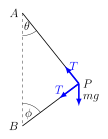
The point \(A\) is vertically above the point \(B\). A light inextensible string, with a smooth ring \(P\) of mass \(m\) threaded onto it, has its ends attached at \(A\) and \(B\). The plane \(APB\) rotates about \(AB\) with constant angular velocity \(\omega\) so that \(P\) describes a horizontal circle of radius \(r\) and the string is taut. The angle \(BAP\) has value \(\theta\) and the angle \(ABP\) has value \(\phi\). Show that \[\tan\frac{\phi-\theta}{2}=\frac{g}{r\omega^{2}}.\] Find the tension in the string in terms of \(m\), \(g\), \(r\), \(\omega\) and \(\sin\frac{1}{2}(\theta+\phi)\). Deduce from your results that if \(r\omega^2\) is small compared with \(g\), then the tension is approximately \(\frac{mg}{2}\)


Solution: None \begin{multicols}{2}
TikZ diagram
\columnbreak \begin{align*} N2(\uparrow): && T \cos \theta - T \cos \phi - mg &= 0 \\ N2(\rightarrow): && T \sin \theta + T \sin \phi &= m r \omega^2 \\ \\ && T \cos \theta - T \cos \phi &= mg \tag{\(*\)}\\ && T \sin \theta + T \sin \phi &= m r \omega^2 \tag{{\(**\)}} \end{align*} \end{multicols} Dividing \((*)\) by \((**)\) we obtain: \begin{align*} \frac{g}{r\omega^2} &= \frac{\cos \theta - \cos \phi}{\sin \theta + \sin \phi} \\ &= \frac{2 \sin \left ( \frac{\theta + \phi}2 \right )\sin \left (\frac{\phi - \theta}2 \right )}{2 \sin \left ( \frac{\theta + \phi}2 \right )\cos \left (\frac{\phi - \theta}2 \right )} \\ &= \tan \left ( \frac{\phi - \theta}2 \right ) \end{align*} as required. Squaring and adding \((*)\) and \((**)\) we obtain: \begin{align*} && m^2(g^2 + r^2 \omega^4) &= T^2(2 + \sin \theta \sin \phi - \cos \theta \cos \phi) \\ && &= T^2(2 - 2\cos (\theta + \phi)) \\ && &= T^2(2 - 2(1 - 2 \sin^2 \left ( \frac{\theta + \phi}2 \right ) )) \\ && &= T^2(4 \sin^2 \left ( \frac{\theta + \phi}2 \right )) \\ \Rightarrow && T &= \frac{m\sqrt{g^2 + r^2 \omega^4}}{2 \sin \left ( \frac{\theta + \phi}2 \right )} \\ \Rightarrow && T &= \frac{mg\sqrt{1 + \frac{r^2 \omega^4}{g^2}}}{2 \sin \left ( \frac{\theta + \phi}2 \right )} \end{align*} If \(r \omega^2 \ll g\) then \(\tan \l \frac{\phi - \theta}2 \r\) is very large, so \(\phi - \theta \approx \pi\) and so \(\phi + \theta \approx \pi\). We can then say that \[ T \approx \frac{mg}{2}\]

1992 Paper 1 Q11
D: 1500.0 B: 1470.8

Three light elastic strings \(AB,BC\) and \(CD\), each of natural length \(a\) and modulus of elasticity \(\lambda,\) are joined together as shown in the diagram. \noindent

\psset{xunit=1.0cm,yunit=1.0cm,algebraic=true,dimen=middle,dotstyle=o,dotsize=3pt 0,linewidth=0.5pt,arrowsize=3pt 2,arrowinset=0.25} \begin{pspicture*}(-2.46,-1.7)(5.55,2.55) \psline(-2,2)(-2,-1) \psline(-2,-1)(4,-1) \psline(4,-1)(4,2) \psline(4,2)(-2,2) \psline[linestyle=dashed,dash=2pt 2pt](1,2)(1,-1) \psline{<->}(5,2)(5,-1) \rput[tl](5.15,0.77){\(3d\)} \rput[tl](1.08,2.35){\(A\)} \rput[tl](1.14,0.63){\(B\)} \rput[tl](1.17,-0.32){\(C\)} \rput[tl](1.14,-1.1){\(D\)} \begin{scriptsize} \psdots[dotstyle=*](1,2) \psdots[dotstyle=*](1,-1) \psdots[dotstyle=*](1,0.5) \psdots[dotstyle=*](1,-0.37) \end{scriptsize} \end{pspicture*} \par
\(A\) is attached to the ceiling and \(D\) to the floor of a room of height \(3d\) in such a way that \(A,B,C\) and \(D\) are in a vertical line. Particles of mass \(m\) are attached at \(B\) and \(C\). Find the heights of \(B\) and \(C\) above the floor. Find the set of values of \(d\) for which it is possible, by choosing \(m\) suitably, to have \(CD=a\)?