Problems
Filters
7 problems found
2024 Paper 2 Q3
The unit circle is the circle with radius 1 and centre the origin, \(O\). \(N\) and \(P\) are distinct points on the unit circle. \(N\) has coordinates \((-1, 0)\), and \(P\) has coordinates \((\cos\theta, \sin\theta)\), where \(-\pi < \theta < \pi\). The line \(NP\) intersects the \(y\)-axis at \(Q\), which has coordinates \((0, q)\).
- Show that \(q = \tan\frac{1}{2}\theta\).
- In this part, \(q \neq 1\).
- Let \(\mathrm{f}_1(q) = \dfrac{1+q}{1-q}\). Show that \(\mathrm{f}_1(q) = \tan\frac{1}{2}\!\left(\theta + \frac{1}{2}\pi\right)\).
- Let \(Q_1\) be the point with coordinates \((0, \mathrm{f}_1(q))\) and \(P_1\) be the point of intersection (other than \(N\)) of the line \(NQ_1\) and the unit circle. Describe geometrically the relationship between \(P\) and \(P_1\).
- \(P_2\) is the image of \(P\) under an anti-clockwise rotation about \(O\) through angle \(\frac{1}{3}\pi\). The line \(NP_2\) intersects the \(y\)-axis at the point \(Q_2\) with co-ordinates \((0, \mathrm{f}_2(q))\). Find \(\mathrm{f}_2(q)\) in terms of \(q\), for \(q \neq \sqrt{3}\).
- In this part, \(q \neq -1\). Let \(\mathrm{f}_3(q) = \dfrac{1-q}{1+q}\), let \(Q_3\) be the point with coordinates \((0, \mathrm{f}_3(q))\) and let \(P_3\) be the point of intersection (other than \(N\)) of the line \(NQ_3\) and the unit circle. Describe geometrically the relationship between \(P\) and \(P_3\).
- In this part, \(0 < q < 1\). Let \(\mathrm{f}_4(q) = \mathrm{f}_2^{-1}\!\Big(\mathrm{f}_3\!\big(\mathrm{f}_2(q)\big)\Big)\), let \(Q_4\) be the point with coordinates \((0, \mathrm{f}_4(q))\) and let \(P_4\) be the point of intersection (other than \(N\)) of the line \(NQ_4\) and the unit circle. Describe geometrically the relationship between \(P\) and \(P_4\).
Solution:
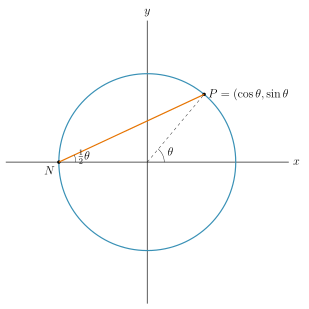
- \(\,\) \begin{align*} && \frac{y-0}{x-(-1)} &= \frac{\sin \theta }{\cos \theta + 1} \\ \Rightarrow && y_0 &= \frac{\sin \theta}{\cos \theta + 1} \\ &&&= \frac{\frac{2t}{1+t^2}}{\frac{1-t^2}{1+t^2}+1} \\ &&&= t = \tan \tfrac{\theta}{2} \end{align*} Alternatively, it is straightforward to see from the angles.
- \(f_1(q) = \frac{1+q}{1-q}\) so \begin{align*} && f_1(\tan\tfrac12\theta) &= \frac{1+\tan\tfrac12\theta}{1-\tan\tfrac12\theta} \\ &&&= \frac{\cos \tfrac12 \theta + \sin \tfrac12 \theta}{\cos \tfrac12 \theta - \sin \tfrac12 \theta} \\ &&&= \frac{\sin(\tfrac14 \pi + \tfrac12 \theta)}{\cos(\tfrac14 \pi + \tfrac12 \theta)} \\ &&&= \tan \tfrac12(\theta + \tfrac{\pi}{2}) \end{align*}
- \(Q_1\) is the point \((0, f_1(q))\) so \(P_1\) will be the point \((\cos (\theta + \tfrac{\pi}{2}), \sin (\theta + \tfrac{\pi}{2}))\) which is a rotation anticlockwise by \(\frac{\pi}{2}\)
- \(P_2 = (\cos(\theta + \tfrac{\pi}{3}), \sin( \theta + \tfrac{\pi}{3})\) and so \(f_2(q) = \tan (\tfrac12(\theta + \tfrac{\pi}{3}))\) so \begin{align*} && f_2(q) &= \tan (\tfrac12(\theta + \tfrac{\pi}{3})) \\ &&&= \frac{q + \tan \frac{\pi}{3}}{1 - \tan \frac{\pi}{3} \cdot q} \\ &&&= \frac{q + \frac{1}{\sqrt3}}{1 - \frac{q}{\sqrt{3}}} \\ &&&= \frac{\sqrt3 q + 1}{\sqrt3-q} \end{align*}
- Since \(q \to -q\) reflects \((0,q)\) in the \(x\)-axis, \(f_3(q) = f_1(-q)\) so \(P_3\) is the reflection of \(P_1\) so it's rotation by \(\frac{\pi}{2}\) followed by reflection in the \(x\)-axis, which is reflection in \(y=x\). [ie \(\theta \to -\theta + \frac{\pi}{2} \to \frac{\pi}{2}-\theta\)]
- We are rotating by \(\frac{\pi}{3}\) then reflecting in \(y=x\) and then rotating by \(-\frac{\pi}{3}\), ie \(\theta \to \theta + \frac{\pi}{3} \to \frac{\pi}{6}-\theta \to -\theta -\frac{\pi}{6} \)
2021 Paper 3 Q7
- Let \[ z = \frac{e^{i\theta} + e^{i\phi}}{e^{i\theta} - e^{i\phi}}, \] where \(\theta\) and \(\phi\) are real, and \(\theta - \phi \neq 2n\pi\) for any integer \(n\). Show that \[ z = i\cot\!\bigl(\tfrac{1}{2}(\phi - \theta)\bigr) \] and give expressions for the modulus and argument of \(z\).
- The distinct points \(A\) and \(B\) lie on a circle with radius \(1\) and centre \(O\). In the complex plane, \(A\) and \(B\) are represented by the complex numbers \(a\) and \(b\), and \(O\) is at the origin. The point \(X\) is represented by the complex number \(x\), where \(x = a + b\) and \(a + b \neq 0\). Show that \(OX\) is perpendicular to \(AB\). If the distinct points \(A\), \(B\) and \(C\) in the complex plane, which are represented by the complex numbers \(a\), \(b\) and \(c\), lie on a circle with radius \(1\) and centre \(O\), and \(h = a + b + c\) represents the point \(H\), then \(H\) is said to be the orthocentre of the triangle \(ABC\).
- The distinct points \(A\), \(B\) and \(C\) lie on a circle with radius \(1\) and centre \(O\). In the complex plane, \(A\), \(B\) and \(C\) are represented by the complex numbers \(a\), \(b\) and \(c\), and \(O\) is at the origin. Show that, if the point \(H\), represented by the complex number \(h\), is the orthocentre of the triangle \(ABC\), then either \(h = a\) or \(AH\) is perpendicular to \(BC\).
- The distinct points \(A\), \(B\), \(C\) and \(D\) (in that order, anticlockwise) all lie on a circle with radius \(1\) and centre \(O\). The points \(P\), \(Q\), \(R\) and \(S\) are the orthocentres of the triangles \(ABC\), \(BCD\), \(CDA\) and \(DAB\), respectively. By considering the midpoint of \(AQ\), show that there is a single transformation which maps the quadrilateral \(ABCD\) onto the quadrilateral \(QRSP\) and describe this transformation fully.
Solution:
- \(\,\) \begin{align*} && z &= \frac{e^{i \theta} + e^{i \phi}}{e^{i \theta} - e^{i \phi}} \\ &&&= \frac{e^{i\frac12(\theta +\phi)}(e^{i \frac12(\theta-\phi)} + e^{-i\frac12(\theta- \phi)})}{e^{i\frac12(\theta +\phi)}(e^{i \frac12(\theta-\phi)} - e^{-i\frac12(\theta- \phi)})} \\ &&&= \frac{(e^{i \frac12(\theta-\phi)} + e^{-i\frac12(\theta- \phi)})/2}{i(e^{i \frac12(\theta-\phi)} - e^{-i\frac12(\theta- \phi)})/2i} \\ &&&= \frac{\cos \frac12(\theta-\phi)}{i \sin \frac12(\theta-\phi)} \\ &&&= -i \cot \tfrac12(\theta-\phi) \end{align*} Therefore \(|z| = \cot \tfrac12(\theta-\phi)\) and \(\arg z = \frac{\pi}{2}\)
- Since \(a,b\) lie on the unit circle, wlog \(a = e^{i \theta}, b = e^{i\phi}\). Not that the line \(OX\) has vector \(a+b\) and \(AB\) has vector \(b-a\) and not their ratio has argument \(\frac{\pi}{2}\) and hence they are perpendicular.
- \(AH\) has vector \(h - a = (a+b+c) - a = b+c\) which we've already established is perpendicular to \(c-b\) which is the vector for \(BC\) (unless \(b+c = 0\) in which case \(h = a\)).
- \(p = a +b+c, q = b+c+d\) etc. The midpoint of \(AQ = \frac12(a+b+c+d)\) which is the same as the midpoint of \(BR\), \(CS\) and \(DP\). Therefore we could say the transformation is reflection in the point \(\frac12(a+b+c+d)\)
2018 Paper 3 Q6
- The distinct points \(A\), \(Q\) and \(C\) lie on a straight line in the Argand diagram, and represent the distinct complex numbers \(a\), \(q\) and \(c\), respectively. Show that \(\dfrac {q-a}{c-a}\) is real and hence that \((c-a)(q^*-a^*) = (c^*-a^*)(q-a)\,\). Given that \(aa^* = cc^* = 1\), show further that \[ q+ ac q^* = a+c \,. \]
- The distinct points \(A\), \(B\), \(C\) and \(D\) lie, in anticlockwise order, on the circle of unit radius with centre at the origin (so that, for example, \(aa^* =1\)). The lines \(AC\) and \(BD\) meet at \(Q\). Show that \[ (ac-bd)q^* = (a+c)-(b+d) \,, \] where \(b\) and \(d\) are complex numbers represented by the points \(B\) and \(D\) respectively, and show further that \[ (ac-bd) (q+q^*) = (a-b)(1+cd) +(c-d)(1+ab) \,. \]
- The lines \(AB\) and \(CD\) meet at \(P\), which represents the complex number \(p\). Given that \(p\) is real, show that \(p(1+ab)=a+b\,\). Given further that \(ac-bd \ne 0\,\), show that \[ p(q+q^*) = 2 \,. \]
Solution:
- \(A\), \(Q\), \(C\) lie on a straight line if \(q = \lambda a + (1-\lambda)c\) for some \(\lambda \in \mathbb{R}\), \begin{align*} && q &= \lambda a + (1-\lambda)c \\ \Leftrightarrow && q - a &= (\lambda - 1)a + (1-\lambda)c \\ \Leftrightarrow && q - a &= (\lambda - 1)(a-c) \\ \Leftrightarrow && \frac{q - a}{c-a} &= 1-\lambda \\ \end{align*} therefore \(\frac{q-a}{c-a} \in \mathbb{R}\) \begin{align*} && \frac{q-a}{c-a} & \in \mathbb{R} \\ \Leftrightarrow && \left (\frac{q-a}{c-a} \right)^* &= \frac{q-a}{c-a} \\ \Leftrightarrow && (q^*-a^*)(c-a) &= (q-a)(c^*-a^*) \\ \end{align*} Given \(aa^* = cc^* = 1\), \begin{align*} && (q^*-a^*)(c-a) &= (q-a)(c^*-a^*) \\ \Leftrightarrow && q^*(c-a) - \frac{c}{a}+1 &= q \frac{a-c}{ca} - \frac{a}{c}+1 \\ \Leftrightarrow && (c-a)\l q^* +\frac{q}{ca}\r &= \frac{c}{a} - \frac{a}{c} \\ &&&= \frac{c^2-a^2}{ac} \\ \Leftrightarrow && q^* +\frac{q}{ca} &= \frac{c+a}{ac} \\ \Leftrightarrow && q^*ac +q &= a+c \end{align*}
- Since \(Q\) lies on \(AC\) and \(BD\) we must have \begin{align*} &&& \begin{cases} q^*ac +q &= a+c \\ q^*bd +q &= b+d \\ \end{cases} \\ \Rightarrow && q^*(ac-bd) &= (a+c)-(b+d) \\ \Rightarrow && q(ac-bd) &= (b+d)ac-(a+c)bd \\ \Rightarrow && (q+q^*)(ac-bd) &= (a+c)(1-bd)+(b+d)(ac-1) \\ &&&=a-abd+c-bcd+abc-b+acd-d \\ &&&= a(1+cd)-b(1+cd)+c(1+ab)-d(1+ab) \\ &&&= (a-b)(1+cd)+(c-d)(1+ab) \end{align*}
- If \(AB\) and \(CD\) meet at \(p\) we must have \(p^*ab + p = a+b\), ie \(p(1+ab) = a+b\) amd \(p(1+cd) = c+d\), so \begin{align*} && (q+q^*)(ac-bd) &= (a-b) \frac{c+d}{p} + (c-d) \frac{a+b}{p} \\ \Leftrightarrow && p(q+q^*)(ac-bd) &= (a-b)(c+d)+(c-d)(a+b) \\ &&&= ac+ad-bc-bd+ac+bc-ad-bd \\ &&&= 2(ac-bd) \\ \Leftrightarrow && p(q+q^*) &= 2 \end{align*}
2012 Paper 2 Q7
Three distinct points, \(X_1\), \(X_2\) and \(X_3\), with position vectors \({\bf x}_1\), \({\bf x}_2\) and \({\bf x}_3\) respectively, lie on a circle of radius 1 with its centre at the origin \(O\). The point \(G\) has position vector \(\frac13({\bf x}_1+{\bf x}_2+{\bf x}_3)\). The line through \(X_1\) and \(G\) meets the circle again at the point \(Y_1\) and the points \(Y_2\) and \(Y_3\) are defined correspondingly. Given that \(\overrightarrow{GY_1} =-\lambda_1\overrightarrow{GX_1}\), where \(\lambda_1\) is a positive scalar, show that \[ \overrightarrow{OY_1}= \tfrac13 \big( (1-2\lambda_1){\bf x}_1 +(1+\lambda_1)({\bf x}_2+{\bf x}_3)\big) \] and hence that \[ \lambda_1 = \frac {3-\alpha-\beta-\gamma} {3+\alpha -2\beta-2\gamma} \,,\] where \(\alpha = {\bf x}_2 \,.\, {\bf x}_3\), \(\beta = {\bf x}_3\,.\, {\bf x}_1\) and \(\gamma = {\bf x}_1\,.\, {\bf x}_2\). Deduce that $\dfrac {GX_1}{GY_1} + \dfrac {GX_2}{GY_2} + \dfrac {GX_3}{GY_3} =3 \,$.
Solution:

2009 Paper 3 Q6
Show that $\big\vert \e^{\i\beta} -\e^{\i\alpha}\big\vert = 2\sin\frac12 (\beta-\alpha)\,\( for \)0<\alpha<\beta<2\pi\,$. Hence show that \[ \big\vert \e^{\i\alpha} -\e^{\i\beta}\big\vert \; \big\vert \e^{\i\gamma} -\e^{\i\delta}\big\vert + \big\vert \e^{\i\beta} -\e^{\i\gamma}\big\vert \; \big\vert \e^{\i\alpha} -\e^{\i\delta}\big\vert = \big\vert \e^{\i\alpha} -\e^{\i\gamma}\big\vert \; \big\vert \e^{\i\beta} -\e^{\i\delta}\big\vert \,, \] where \(0<\alpha<\beta<\gamma<\delta<2\pi\). Interpret this result as a theorem about cyclic quadrilaterals.
2002 Paper 3 Q8
Four complex numbers \(u_1\), \(u_2\), \(u_3\) and \(u_4\) have unit modulus, and arguments \(\theta_1\), \(\theta_2\), \(\theta_3\) and \(\theta_4\), respectively, with \(-\pi < \theta_1 < \theta_2 < \theta_3 < \theta_4 < \pi\). Show that \[ \arg \l u_1 - u_2 \r = \tfrac{1}{2} \l \theta_1 + \theta_2 -\pi \r + 2n\pi \] where \(n = 0 \hspace{4 pt} \mbox{or} \hspace{4 pt} 1\,\). Deduce that \[ \arg \l \l u_1 - u_2 \r \l u_4 - u_3 \r \r = \arg \l \l u_1 - u_4 \r \l u_3 - u_2 \r \r + 2n\pi \] for some integer \(n\). Prove that \[ | \l u_1 - u_2 \r \l u_4 - u_3 \r | + | \l u_1 - u_4 \r \l u_3 - u_2 \r | = | \l u_1 - u_3 \r \l u_4 - u_2 \r |\;. \]
1994 Paper 3 Q6
The four points \(A,B,C,D\) in the Argand diagram (complex plane) correspond to the complex numbers \(a,b,c,d\) respectively. The point \(P_{1}\) is mapped to \(P_{2}\) by rotating about \(A\) through \(\pi/2\) radians. Then \(P_{2}\) is mapped to \(P_{3}\) by rotating about \(B\) through \(\pi/2\) radians, \(P_{3}\) is mapped to \(P_{4}\) by rotating about \(C\) through \(\pi/2\) radians and \(P_{4}\) is mapped to \(P_{5}\) by rotating about \(D\) through \(\pi/2\) radians, each rotation being in the positive sense. If \(z_{i}\) is the complex number corresponding to \(P_{i},\) find \(z_{5}\) in terms of \(a,b,c,d\) and \(z_{1}.\) Show that \(P_{5}\) will coincide with \(P_{1},\) irrespective of the choice of the latter if, and only if \[a-c=\mathrm{i}(b-d)\] and interpret this condition geometrically. The points \(A,B\) and \(C\) are now chosen to be distinct points on the unit circle and the angle of rotation is changed to \(\theta,\) where \(\theta\neq0,\) on each occasion. Find the necessary and sufficient condition on \(\theta\) and the points \(A,B\) and \(C\) for \(P_{4}\) always to coincide with \(P_{1}.\)